INTRODUCTION
Several limitations, including the complex coastline, lack of local students and funding, and past political instability in the country, have restricted past attempts to study cetaceans in Guinea-Bissau (Van Waerebeek et al., Reference Van Waerebeek, Ndiaye, Djiba, Diallo, Murphy, Jallow, Camara, Ndiaye and Tous2000). Consequently, the cetacean fauna of Guinea-Bissau remains poorly known and is primarily documented from occasional strandings and bycatch, and opportunistic sightings recorded by casual observers or during bird surveys.
Two small cetaceans, the Atlantic humpback dolphin (Sousa teuszii) and the common bottlenose dolphin (Tursiops truncatus), have been most frequently reported to date. The first record of the Atlantic humpback dolphin in Guinea-Bissau was a male found entangled in a fishing trap at Canhabaque Island in the Arquipélago dos Bijagós during March 1989 (Sequeira & Reiner, Reference Sequeira and Reiner1992). A number of bottlenose dolphin sightings reported by Spaans (Reference Spaans1990) appear to represent the first records of that species for the country. Conservation concerns have been raised about both species in the region. The Atlantic humpback dolphin has been listed as Vulnerable by the IUCN and is considered at risk from low population size, habitat fragmentation and potentially high mortality levels throughout its range (Weir et al., Reference Weir, Van Waerebeek, Jefferson and Collins2011). The bottlenose dolphin, while comparatively widespread and abundant on a global scale, is a species for which data on West African population size and structure are lacking and it is considered potentially vulnerable to live-capture schemes for the aquarium industry (Van Waerebeek et al., Reference Van Waerebeek, Bamy, Jiddou, Sequeira, Diop, Ofori-Danson, Tchibozo and Campredon2008).
This paper reviews existing available data in Guinea-Bissau on Atlantic humpback and bottlenose dolphins, and presents novel unpublished data consolidated from a number of sources from 2008 onwards. Using this combined information, we evaluate the distribution, seasonality and group size of the two species in Guinea-Bissau waters, and also produce a checklist of other cetacean species recorded in the country to date.
METHODS
Study area
Guinea-Bissau is located on the west coast of Africa bordering the north Atlantic Ocean, with a 350 km coastline extending between latitudes of 10.85°N and 12.34°N (Figure 1). It shares coastal borders to the north with Senegal and to the south with Guinea. The exclusive economic zone (EEZ) is 106,117 km2 in size (Sea Around Us Project, 2014). The coastline is varied, consisting of complex systems of estuaries, islands and mangroves. The Arquipélago dos Bijagós, comprising around 88 islands and islets located over an area of 2624 km2, is located approximately 48 km off the mainland and was formed from the ancient delta of the Rio Gêba and the Rio Grande. The area was designated as the Boloma Bijagós Biosphere Reserve in 1996 in recognition of its marine fauna and habitats.
Location of the Guinea-Bissau study area, showing the location of boat survey effort in 2008 and 2012.

There are six main rivers flowing from Guinea-Bissau into the Atlantic Ocean, comprising the Cacheu, Mansôa, Gêba, Corubal, Cacine and the Rio Grande. The largest of these, the Rio Gêba, originates in Senegal and bisects Guinea-Bissau, entering the Atlantic Ocean via the Gêba Canal. Outflow from the numerous river mouths produce plumes of warm water and result in strong SST gradients between the coastal areas and the offshore islands (Hardman-Mountford & McGlade, Reference Hardman-Mountford and McGlade2003).
Guinea-Bissau is located close to the border between two marine ecoregions: the Sahelian Upwelling (SU) and the Gulf of Guinea West (Spalding et al., Reference Spalding, Fox, Allen, Davidson, Fernaña, Finlayson, Halperin, Jorge, Lombana, Lourie, Martin, McManus, Molnar, Recchia and Robertson2007). Consequently, its waters are affected seasonally by a cold water (<19°C) SU influence originating from the Senegalese and Mauritanian coastal upwellings (Hardman-Mountford & McGlade, Reference Hardman-Mountford and McGlade2003). The SU impacts Guinea-Bissau between December and May, reaching its greatest southwards extent in March and April. Between February and May the SU encircles the Arquipélago dos Bijagós, resulting in a frontal system between the islands and the warmer coastal waters along the Guinea-Bissau mainland. From July to November the SU influence recedes to produce warmer sea surface temperatures (≥24°C) (Hardman-Mountford & McGlade, Reference Hardman-Mountford and McGlade2003).
Literature review
A literature review was carried out to locate previously published records (i.e. sightings, strandings, skeletal remains, bycatch and captures) of cetaceans in Guinea-Bissau. Information was sourced from both peer-reviewed scientific papers and grey literature. Species identification for sightings was carried out by the authors of the studies in question, and in most cases it was not possible to independently verify them for this paper, since photographs were not usually presented. Whaling, stranding and capture records were accepted as published (with acknowledgement that whaling data are not always accurate with respect to species identification; Weir, Reference Weir2010). The Townsend (Reference Townsend1935) whaling records were analysed using a digitized version of the charts available from the Wildlife Conservation Society (http://www.wcscanada.org/WildPlaces/GlobalConservation/TownsendWhalingCharts.aspx).
Novel data sources
Cetacean records were compiled from a number of sources. A short dedicated dolphin sighting survey was carried out between 18 February and 29 April 2008 in three areas located in shallow coastal waters (Figure 1; Fulling et al., Reference Fulling, Foster, Fertl and Fagin2008). The first area was in the outer Canal do Géba, the second was the inner Canal do Géba, Canal de Boloma, Canal de Bolola and the Rio Grande de Buba, while the third area comprised the waters around the offshore islands of Rubane and Bubaque in the Arquipélago dos Bijagós. Surveys were carried out by a team of two observers using a small (<8 m) boat travelling at 16–32 km h−1 along predetermined routes and searching an area within 300 m of the transect line. For each dolphin sighting the species identification, number of individuals (including calves), behaviour, GPS position and time were recorded. While this survey work was carried out in a manner designed to collect effort-related data suitable for calculating dolphin abundance (and was initially calculated as such in an unpublished report: Fulling et al., Reference Fulling, Foster, Fertl and Fagin2008), the effort data were not available for this study and consequently only the sightings data are presented here. Bottlenose dolphin sightings recorded during a follow-up survey in 2009, conducted by the same team and using the same methods described above, have also been included.
Cetacean survey work was carried out in Guinea-Bissau during 2012, comprising one effort-related boat survey (a dedicated search for cetaceans), some opportunistic sightings made at sea and from land, and interview data with fishers. The effort-related survey was carried out on 3 November 2012 around the island of Formosa (Figure 1) using a 4 m fibreglass boat. The survey team consisted of two observers and survey methods were similar to those described earlier. The survey route was selected based on the availability of a suitable survey vessel on the island of Bubaque, and previous reports of humpback dolphins around the islands of the Arquipélago dos Bijagós. Opportunistic sightings were recorded while RHL was travelling amongst the various islands of the Arquipélago dos Bijagós and at Cacine while carrying out interviews for a study on sawfishes (Pristidae) and cetacean bycatch. Records of cetaceans were compiled during interviews with fishermen and from correspondence with two recreational fishing charter operators.
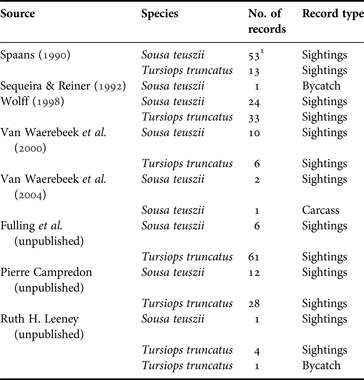
Opportunistic sightings of cetaceans in the Arquipélago dos Bijagós were recorded by PC from several sail boats of various sizes, between April 2007 and April 2014. GPS data were not available for these data and written descriptions of localities were logged instead. All of the data sources that were analysed for this paper are listed in Table 1.
Sources (first published account) of bottlenose dolphin (Tursiops truncatus) and Atlantic humpback dolphin (Sousa teuszii) records in Guinea-Bissau that were analysed for this paper.
1 Spaans (Reference Spaans1990) reported 56 sightings of Sousa teuszii but only 53 locations (and associated group size ranges) were evident in his Figure 2 and therefore available for inclusion in this paper.
Data analysis
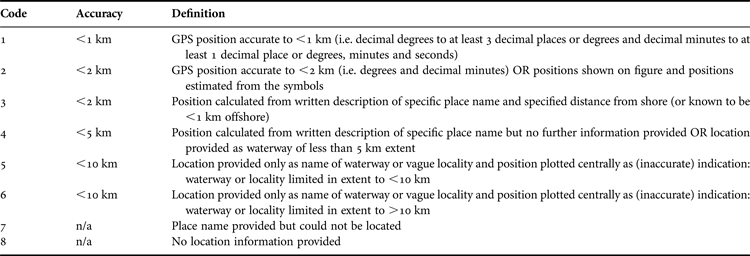
Sightings were compiled into a master database. Many sightings, both in the published and novel datasets, had only a written description of a place name or waterway (e.g. ‘Canal de Jeta’) and such positions were estimated using GoogleEarth. Each sighting was allocated an accuracy code, based on the quality of the positional data provided (Table 2). Although published in a map, the raw positional (GPS) data for one dataset (Figure 2; Spaans, Reference Spaans1990) are no longer available (Bernard Spaans, personal communication) and the positions for those sightings were also estimated using GoogleEarth. All records were subsequently mapped in Arcview 3.2 Geographic Information System (GIS). Evident errors in published localities (i.e. records that plotted on land) were checked and corrected. The occurrence of all records inside the Guinea-Bissau Exclusive Economic Zone (EEZ) was verified using an EEZ shapefile (v7; 20 November 2012; available from www.marineregions.org).
Location of bottlenose dolphin (Tursiops truncatus) records in Guinea-Bissau.
Accuracy codes allocated to all sightings data.
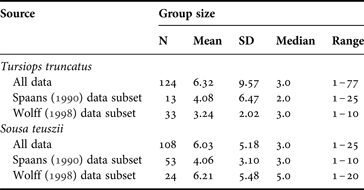
It was not usually possible to verify species identifications, and these have largely been accepted as published. Where species identification was clearly questionable (i.e. where the species name was followed by a question mark indicating uncertainty), the sighting was downgraded. In all cases this involved downgrades to ‘unidentified dolphin species’. Group size was reported differently in most datasets, varying from a specific value, to ranges (minimum and maximum) to not being available at all (N = 21 bottlenose dolphin sightings). A single value for each reported group size was determined, using either the best estimate, the minimum estimate (e.g. where groups were reported as 10+ they were coded as 10) or the conservative midpoint of a provided group range (e.g. groups reported as 2–5 animals were coded as 3).
The distance of each sighting from shore was calculated using a custom-design script in GIS. Only at-sea sightings where the positional data were deemed to be sufficiently accurate (<2 km) were included in this analysis (N = 214), namely those with an accuracy code of 1 or 2. Variation in distance from shore and group size were analysed and compared between species using Minitab statistical software (Minitab Ltd).
RESULTS
Bottlenose and Atlantic humpback dolphins
A total of 256 records of the bottlenose dolphin (N = 146) and the Atlantic humpback dolphin (N = 110) were obtained from the published and novel datasets (Table 1). There were two bycatch records (one of each species) and one carcass (Atlantic humpback dolphin) with the remaining records comprising sightings.
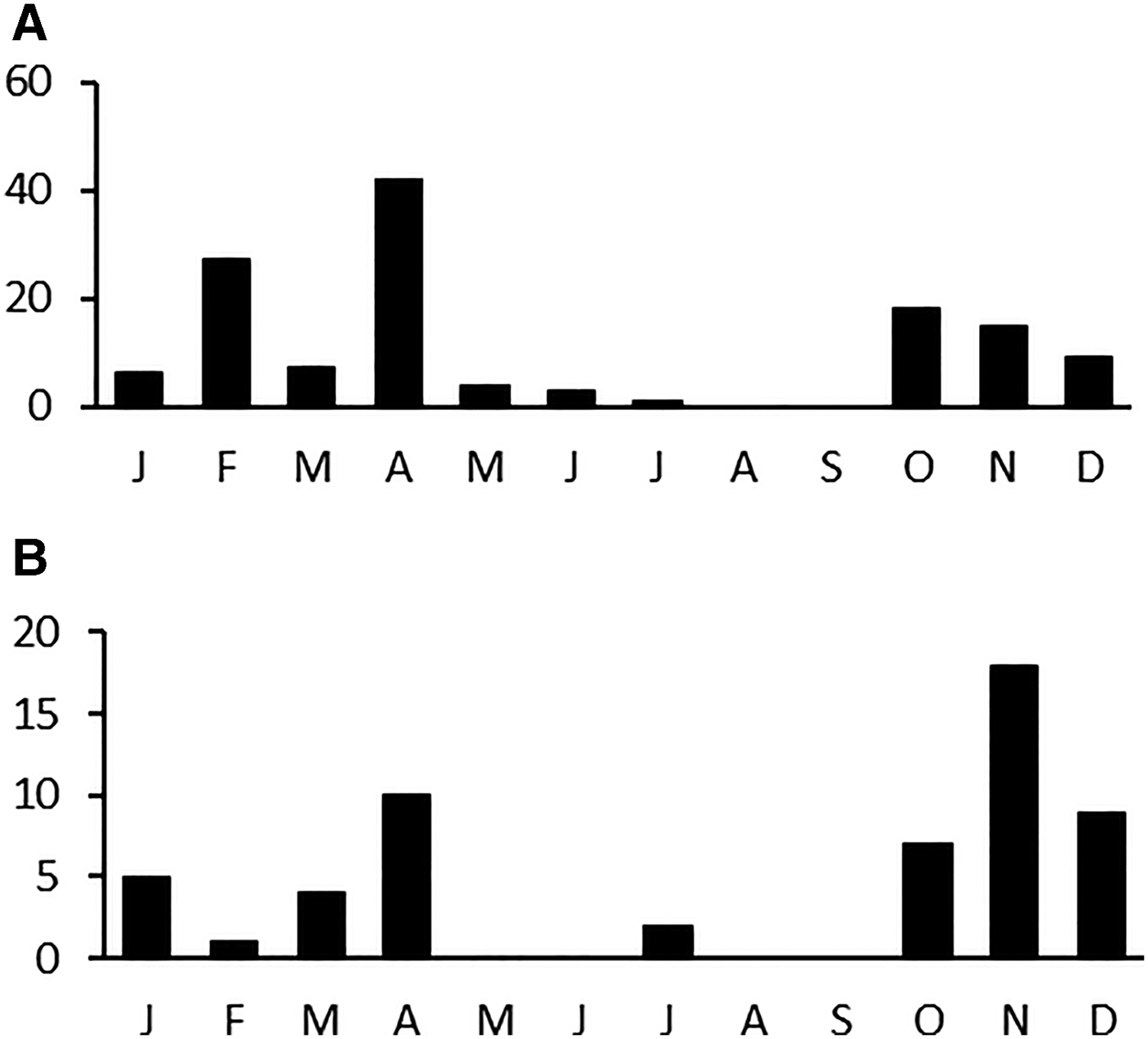
The majority of bottlenose dolphin records were widely distributed in coastal waters, although there was one record located in waters further offshore (>32 km) in association with pilot whales (Globicephala sp.) (Van Waerebeek et al., Reference Van Waerebeek, Ndiaye, Djiba, Diallo, Murphy, Jallow, Camara, Ndiaye and Tous2000). Sightings were particularly numerous in the outer Rio Gêba and in the Canal do Gêba (Figure 2). The species was also sighted around the Arquipélago dos Bijagós, in the Rio Cacine and in the outer Rio Grande de Buba. Although not represented here, anecdotal reports indicate that bottlenose dolphins are also seen regularly in the inner Rio Grande de Buba (Figure 3; Antonio Torres, personal communication). There were several sightings of this species in the upper reaches of the Rio Mansôa and in the river south of Quinhámel, indicating that bottlenose dolphins may enter quite enclosed waterways in Guinea-Bissau. An estimate of group size was available for 124 at-sea sightings, producing a mean of 6.3 animals (Table 3). Records were available for every month except for August and September (Figure 5), indicating that the species was likely present in Guinea-Bissau coastal waters throughout the year. A single bottlenose dolphin bycatch record was verified; during an interview with a fisherman in Cacine in 2012 the interviewee provided a photograph of an animal he had caught accidentally in his nets, some days earlier.
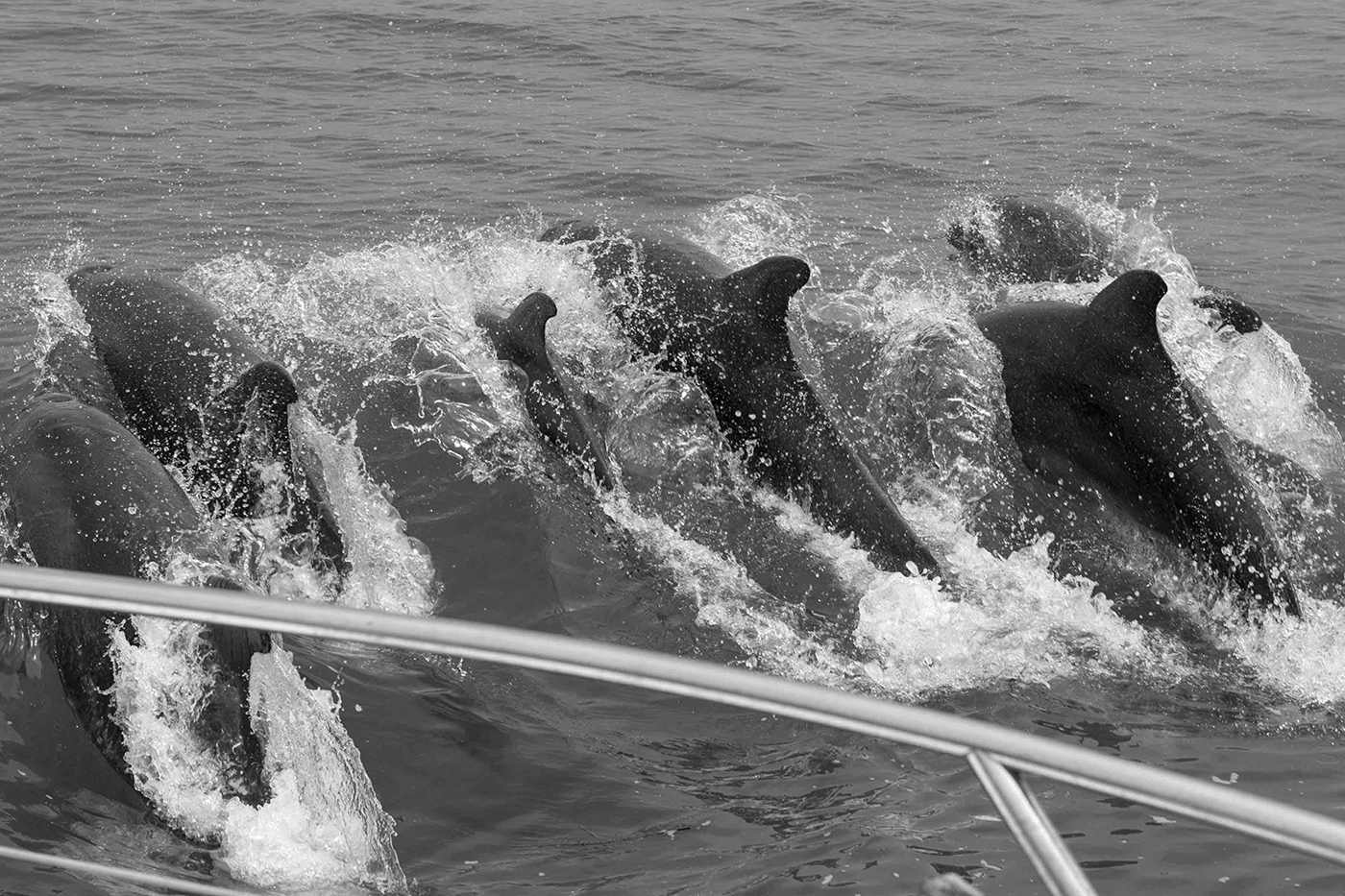
Bottlenose dolphins (Tursiops truncatus) bow-riding a boat in the Rio Buba during 2011 (Photo: Antonio Torres).
Group sizes of bottlenose dolphin (Tursiops truncatus) and Atlantic humpback dolphin (Sousa teuszii) in Guinea-Bissau that were analysed for this paper. See Methods for how single group size values were calculated for use in this analysis.
The Atlantic humpback dolphin was recorded from the Canal de Jeta and the Canal de Pecixe in the north of Guinea-Bissau to the Rio Cacine in the south (Figure 4). Sightings were particularly numerous along the north coast of the outer Rio Gêba, around the small island of Areias (located just south of the Rio Gêba mouth), around the western tip of the island of Bolama and throughout the Rio Grande de Buba. The species was also associated with islands in the Arquipélago dos Bijagós, being reported around the islands of Orangozinho, Roxa, Bubaque, Soga, Rubane, Galhinas, Uracane and the Urok Islands – Formosa, Ponta (also known as Nago) and Maio (also known as Chedia). Sightings were particularly frequent off the east coast of Ilha de Maio in association with small rocky islands close to the coast (Figure 4). Month was only available for a small number (N = 56) of humpback dolphin records, and sightings were most frequent between October and April (Figure 5). A mean group size of 6.0 animals was recorded (Table 3), but the median was lower (n = 3.0) suggesting that most groups are relatively small in size. Only one bycatch was documented; a male humpback dolphin found entangled in a fishing trap at Ilha Roxa in the Bijagós Archipelago during March 1989, which had been feeding on three species of fish, Gorean snapper (Lutjanus goreensis), Atlantic Emperor (Lethrinus atlanticus) and West African spadefish (Chaetodipterus lippie) (Sequeira & Reiner, Reference Sequeira and Reiner1992).
Location of Atlantic humpback dolphin (Sousa teuszii) records in Guinea-Bissau.
Monthly distribution in Guinea-Bissau of: (A) bottlenose dolphin (Tursiops truncatus) records (N = 132); and (B) Atlantic humpback dolphin (Sousa teuszii) records (N = 56).
Bottlenose and Atlantic humpback dolphins were sympatric in distribution, both being found throughout coastal waters from the northern regions of Canal de Jeta and Rio Mansôa south to the Rio Cacine and around the Arquipélago dos Bijagós. However, in general the bottlenose dolphin sightings were concentrated in the Canal do Gêba while Atlantic humpback dolphin sightings were found particularly along the north coast of the Rio Gêba, around the islands of Areias and Urok, and in the Rio Grande de Buba. A Mann–Whitney U-test revealed a highly significant (P < 0.001) difference between the distance from shore of sightings of bottlenose dolphins (N = 119; median = 4.57 km; mean = 4.74; SD = 3.58; range = 0.2–32.4) and Atlantic humpback dolphins (N = 91; median = 1.34 km; mean = 1.75; SD = 1.52; range = 0.2–9.2) providing evidence for a subtle difference in their use of the region. This distance remained highly significant (P < 0.001) even when an ‘offshore’ (32.4 km) bottlenose dolphin sighting was excluded. There was no significant difference in group size between the two species (P = 0.1533, Mann–Whitney U-test).
Other cetacean species
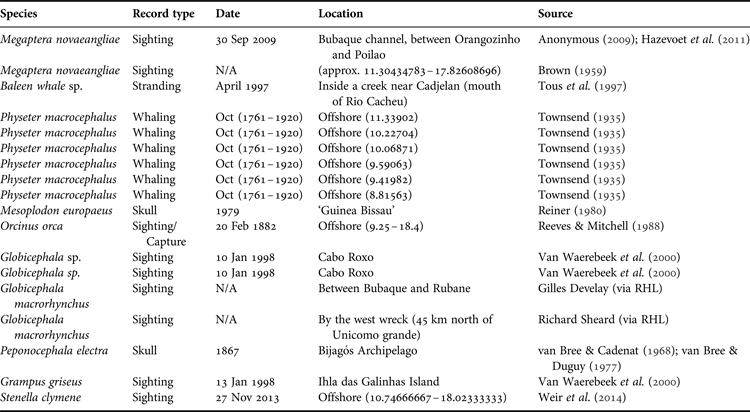
Records pertaining to the occurrence of at least eight other cetacean species within the Guinea-Bissau EEZ were revealed during the literature review (Table 4; Figure 6). This included two sightings of humpback whales (Megaptera novaeangliae; including a cow-calf pair in 2009), six whaling capture records of sperm whales (Physeter macrocephalus) and one of killer whales (Orcinus orca) in deep waters offshore, and sightings of pilot whales (Globicephala sp.), Risso's dolphin (Grampus griseus) and Clymene dolphin (Stenella clymene). In addition, two species are documented from skeletal remains found onshore in Guinea-Bissau; a Gervais’ beaked whale (Mesoplodon europaeus; skull No. M-167-79 at the Museu do Mar, Cascais, Portugal; Reiner, Reference Reiner1980) and a melon-headed whale (Peponocephala electra; skull No. 1174 at the Muséum de Bordeaux; van Bree & Cadenat, Reference van Bree and Cadenat1968; van Bree & Duguy, Reference van Bree and Duguy1977).
The location (when available) of records of other cetacean species within the Guinea-Bissau Exclusive Economic Zone.
Summary of records of other cetacean species in Guinea-Bissau.
There were also 15 sightings of unidentified dolphins, ranging in group size from one to 20 animals. All of these sightings were located coastally (Figure 6) and most likely comprised either bottlenose or humpback dolphins.
DISCUSSION
We located evidence for the occurrence of 10 cetacean species in the waters of Guinea-Bissau. The clear majority of records related to the Atlantic humpback dolphin and the bottlenose dolphin, with remaining species documented from only one or two records each. This likely reflects a strong bias in observer effort, with almost all cetacean records occurring as strandings, animals observed from shore, or animals seen from boats operating in coastal waters.
The data indicated that both the bottlenose and the Atlantic humpback dolphins were, and probably still are, reasonably widespread in Guinea-Bissau waters. The relative scarcity of records in the southern region of Guinea-Bissau and the eastern part of the Arquipélago dos Bijagós likely reflects a paucity of observer effort. In the absence of dedicated year-round survey effort, little can be concluded regarding the seasonal distribution of the two species in Guinea-Bissau. Sightings of both species occurred in the majority of calendar months and indicated a likely year-round occurrence. The fact that sightings of both species were lowest (or absent) during May to September suggests that observer effort over that period may be lacking, possibly because this period overlaps with Guinea-Bissau's rainy season, when travel throughout the country becomes difficult. Whilst the distance to shore analysis had limited (~2 km) accuracy, the margin of error should be similar for both species and the recorded difference in distance to shore of sightings is likely to be genuine. Atlantic humpback dolphins are considered to be a nearshore species throughout their range (Van Waerebeek et al., Reference Van Waerebeek, Barnett, Camara, Cham, Diallo, Djiba, Jallow, Ndiaye, Samba Ould Bilal and Bamy2004) while the bottlenose dolphin is known to inhabit a wide range of habitats worldwide (Wells & Scott, Reference Wells, Scott, Ridgway and Harrison1999).
It is likely that a number of additional cetacean species would be recorded if deep, offshore waters received dedicated survey focus. For example, several species relatively common elsewhere along the west coast of Africa have not yet been recorded for Guinea-Bissau such as common dolphins (Delphinus sp.), Atlantic spotted dolphins (Stenella frontalis) and Bryde's whale (Balaenoptera brydei) (Weir, Reference Weir2011). Most records of other cetacean species originated from the last century (whaling records) or were old sightings or skeletal records (<1990s) and almost no information is available about the current status and distribution of species offshore in the Guinea-Bissau EEZ.
Little specific information was revealed regarding the impacts from human activities on cetaceans in the waters of Guinea-Bissau. While there was only one documented instance of bycatch of an Atlantic humpback dolphin in a fish trap (Sequeira & Reiner, Reference Sequeira and Reiner1992) and of a bottlenose dolphin in artisanal fishing gear off Cacine (this paper), it is likely that the true scale of fisheries bycatch is far higher. Maigret (Reference Maigret1994) noted the presence of a significant (400–750) artisanal fishery taking shrimps and pilchards in the coastal mangrove channels of Guinea-Bissau. Leeney et al. (Reference Leeney, Dia and Dia2015) reported that 42% of fishermen interviewed in Guinea-Bissau stated that they had accidentally caught a dolphin at least once before, and 37% of interviewees had eaten dolphin meat. Given the high level of artisanal fishing by both Bissau-Guineans and other West Africans throughout Guinea-Bissau's waters, it is possible that levels of bycatch are significant (Binet et al., Reference Binet, Failler and Thorpe2012). Whilst many Bissau-Guineans only practice fishing seasonally, overfishing in other regions has driven many fishers from neighbouring West African countries to Guinea-Bissau, where they base their fishing activities from camps and permanent settlements (Campredon & Cuq, Reference Campredon and Cuq2001). Many of these fisheries target sharks, but catch marine mammals as bycatch (Almeida e Silva et al., Reference Almeida e Silva, Araujo, Djedjo, Gomes and Monteiro1999). Intensified fishing activities in Bissau-Guinean waters pose both the threat of greater levels of bycatch of humpback dolphins in fishing nets, and that of prey depletion (Weir et al., Reference Weir, Van Waerebeek, Jefferson and Collins2011).
In 2007 the Guinea-Bissau government received two applications from companies wishing to live-capture a quota of 30–40 bottlenose dolphins annually (for up to 15 years) for export to the aquarium trade (Van Waerebeek et al., Reference Van Waerebeek, Bamy, Jiddou, Sequeira, Diop, Ofori-Danson, Tchibozo and Campredon2008). One Guinea-Bissau based wildlife trade company states on their website (http://www.riverzoofarm.com/dolphins.htm) that ‘Guinea-Bissau has an annual export quota of 20 Tursiops truncatus’ and offers a live-capture and export service. In a small-scale live-capture operation in Senegal in 2003, all five captured bottlenose dolphins died (Van Waerebeek et al., Reference Van Waerebeek, Bamy, Jiddou, Sequeira, Diop, Ofori-Danson, Tchibozo and Campredon2008), and particularly in Guinea-Bissau, where the appropriate facilities and infrastructure for such operations are unavailable, live-capture is unlikely to be successful. Given the current absence of data on the abundance and population structure of bottlenose dolphins in the region, live-captures cannot be considered a sustainable management option in Guinea-Bissau.
Some national legislation is in place for the protection of marine mammals in Guinea-Bissau, namely the Bissau-Guinean Regulations for Artisanal Fisheries, June 2011 (Section II, Article 19) which states that the hunting, capture, landing and sale of marine mammals is prohibited unless authorized by the government responsible for fisheries, agriculture and environment sectors, and for the purposes of scientific or technical research. Guinea-Bissau also signed a Memorandum of Understanding (MoU) Concerning the Conservation of the Manatee and Small Cetaceans of Western Africa and Macaronesia in October 2008 under the auspices of the Convention on Migratory Species of Wild Animals (CMS). The MoU aims to protect small cetaceans at a national, regional and global level to achieve and maintain a favourable conservation status for the species and their habitats, and includes a requirement for the implementation of appropriate protective legislation. Some areas of importance for cetaceans are designated conservation areas, for example the Boloma Bijagós Biosphere Reserve. However, resources with which to manage such conservation areas are limited or non-existent, and local fishers from Orango often observe foreign fishing vessels operating within the limits of the park (R.H. Leeney, personal observation). Cross (Reference Cross2014) likewise documented the use of local and State Protected areas, including the waters of the Orango National Park, by in-migrant fishers.
Given the Vulnerable conservation status of the Atlantic humpback dolphin (Weir et al., Reference Weir, Van Waerebeek, Jefferson and Collins2011) and its apparent regularity in particular parts of Guinea-Bissau, this species warrants particular attention. However, the current instability and lack of resources in Guinea-Bissau make research and conservation efforts challenging (Leeney & Poncelet, Reference Leeney and Poncelet2013). External investment in and support of Guinea-Bissau's infrastructure and resources for management and conservation are urgently needed, if the unique marine biodiversity of this region is to be protected from overexploitation.
ACKNOWLEDGEMENTS
Our thanks to Dagmar Fertl and Mike Partida for providing databases and responding to queries related to the 2008 and 2009 work. Thanks to Nathalie Cadot (FIBA), Gilles Develay, Antonio Torres and Richard Shearer for local information and to Simon Wearne for assistance in the field. The authors are grateful to Peter Evans and three anonymous reviewers for comments on an earlier draft of this paper.
FINANCIAL SUPPORT
Ruth Leeney was funded by the Mohammed Bin Zayed Species Conservation Fund. Jeff Foster's 2008 and 2009 survey work was funded by an anonymous donor.