Studies examining genetic influences on behavior have become a significant part of scholarship represented in reputable and high impact journals across disciplines, including Science, Nature, the Proceedings of the National Academy of Sciences, the Journal of Economic Literature, Psychological Bulletin, and many others. Many of these studies focus on health issues and socially damaging behaviors such as personality disorders, alcoholism, and depression,Footnote 1 but others focus on the role of genes in social and political attitudes and behaviors.Footnote 2 While consideration of the role of genes in models of attitudes and behaviors was introduced to other fields in the 1970s, it is a relatively new addition to political science.Footnote 3 In particular, Alford, Funk and Hibbing's (Reference Alford, Funk and Hibbing2005) APSR article “Are Political Orientations Genetically Transmitted?” has drawn attention to the issue of the role of genes in political attitudes both from within academia and the popular press. In his essay, “Genes and Ideologies,” Evan Charney takes up the question of the role of genes via a critique of Alford, Funk, and Hibbing. Although a critical evaluation was long overdue, his essay falls short of what is required of a scientific critique on both empirical and theoretical grounds.
Methodological Considerations
Science is a way to ensure accountability for claims because the veracity of results can be questioned, studies replicated, and hypotheses retested using different methods. Rather than replicating the Alford, Funk, and Hibbing (hereafter AFH) findings using a new data set, or testing the hypotheses employing different methods, Charney questions the legitimacy of the AFH results through a multi-faceted essay. Certainly, questioning the results of an empirical study is the way in which scientific inquiry proceeds. An adequate critique of an empirical study, however, must entail a coherent explanation of the inadequacies of the methods employed and demonstrate or suggest what methods should be used in order to better test the hypotheses. If this is not done the evaluation is not a scientific critique.
The methods currently employed in the fields of genetics, psychiatry, and other disciplines used to explore attitudes and behaviors suggest a methodological critique of AFH is warranted. Twin studies are only a first step in genetic epidemiological research, albeit an important one (less frequently family or adoption studies are also used). Classical twin studies estimate heritability (h2) based on twin correlations: h2 is 2(rMZ − rDZ), where r is the correlation coefficient. The relative contributions of the shared and non-shared environmental effects are: c2 = 2rDZ − rMZ and e2 = 1 − h2 + c2, respectively. According to this formula, heritability is an estimate for the relative contribution of genetic effects to total phenotypic variance. Following designs from earlier twin studies, AFH applied polychoric correlations to the Holzinger formula above.Footnote 4 However, the method used by AFH is seldom employed for raw data analyses in current scholarship.
Polychoric correlation transformations are limited in that the formula does not (1) allow for model fitting (testing whether genetic or familial influences can be removed from the model without reducing model fit); (2) provide confidence intervals; (3) include opposite-sex (OS) twin pairs (thereby excluding roughly 1/3 of the sample in the VA30K data set used by AFH); (4) test for male-female differences in the magnitude of variance components estimates; (5) test for the potential for difference in males or females genes which influence the trait; (6) test or model differences in either means for continuous data and/or thresholds for ordinal data between the different zygosity groups; and (7) allow for the modeling of age, or other covariates. For these reasons, polychoric correlation transformations have been replaced by more advanced methods.Footnote 5
Structural equation modeling (SEM) under a maximum likelihood (ML) framework is the most common method used to infer the relative importance of the correlations between observed traits of monozygotic and dizygotic twins in terms of their underlying genetic and environmental components, less frequently, Bayesian methods are also used (see Fowler, Baker, and Dawes Reference Fowler, Baker and Dawes2006). SEM/ML addresses the aforementioned shortcomings by: (1) testing for differences in the zygosity groups; (2) modeling those difference if they exist; (3) including OS twins; (4) including other siblings, parents, and any number of different relative types; and (5) model fitting to determine if removing the genetic or social component of a specific trait provides a statistically better model. This last feature addresses Charney's argument that his explanation for attitudes is more parsimonious than what AFH present. What Charney seems to be arguing is that exclusively environmental explanations are “more parsimonious” simply because we are more used to them—an outrageous assertion on the face of it. Parsimony is only a virtue if it is also consistent with the data, not if it is only consistent with our preconceptions. If model parsimony is paramount, as Charney suggests, methodological improvements to AFH will resolve this concern. Rather than to assume that environment-only models are both more parsimonious and better fitting, model fitting techniques are available to determine whether a common and unique environmental model is superior to a model including genetic influences.
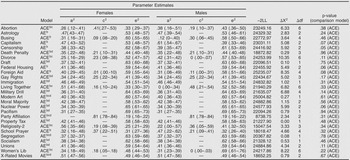
In short, the results presented by AFH can be strengthened and potential problems with the findings can be addressed with more sophisticated methods currently used in behavior genetics. An important consideration regarding the use of polychoric Holzinger transformations, is that if no sex differences exist, and the zygosity groups present no differences in means or thresholds, then Holzinger transformations provide remarkably similar results to an ML analysis.Footnote 6 This happens to be the case with the AFH results. The conservatism items in the AFH study were tested within an ML framework using the full sample of twins.Footnote 7 A subset of the results of those analyses are shown in table 1.
(US) Standardized Variance Components (95% CI) Sex Limitation Model Fitting for Political Attitudes; Thresholds Corrected for Agea

Note: This table was originally published in Hatemi 2007 as table 4.3; (a) Only best fitting models shown (b) Equated Thresholds for MZ and DZ pairs (MZ/DZ groups have no difference).(c) Equated Thresholds for Males and Females (d) Equated Variance components for Males and Females.
While there are some sex differences in the magnitude of the variance components, the additive genetic component could only be dropped for one trait (political affiliation), while the common environment component could be removed for more than half the attitude items. The more sophisticated methodology and more parsimonious explanation suggest that genes play an even stronger role in political attitudes. In other words, AFH provided a more conservative estimation using the simpler method.
An important methodological consideration raised by Charney concerns the construction of the conservatism scale used by AFH. He asserts that not all political items in the scale can be given equal weight and therefore the analyses are flawed. This point would be better addressed empirically by simply weighting the items based on national polling data in the year of the study (or the appropriate NES data) and rerunning the analyses based on an appropriate weighting scheme. However, a review of the AFH findings illustrate that many items that are stronger correlates to conservatism (e.g., immigration vs. divorce) have a more pronounced genetic influence. It is likely, therefore, that the results from such an analysis would show an increase in the additive genetic influence of conservatism (e.g., Hatemi et al. Reference Hatemi, Alford, Hibbing, Keller, Martin, Medland and Eaves2007). This stands opposed to what Charney seems to intend. Also, there is ample evidence for the construct validity and heritability of the Wilson-Patterson conservatism scale and there are two very important considerations not raised by Charney that a brief review of the current literature employing the Wilson-Patterson index provides.Footnote 8 Several studies factored the scale into separate latent constructs and then ACE modeled each factor score separately.Footnote 9 In each of the factors there is a significant genetic influence, though they differ depending on the factor (labeled Sex, Militarism, Religion, Politics, and Economics). Further, while the scale may be limited in many respects, it is remarkably normally distributed.
While it is no simple task to gain a broad understanding of a field, or a deep understanding of a subfield, a critique of empirical work should attempt to be thorough in the literature it presents. A particular transgression by Charney in this regard is his presentation of the equal environments assumption (EEA) literature in an attempt to augment his argument that the findings from twin studies are confounded. The literature presented was highly selective and ignored the corrections and tests employed by geneticists and social scientists to test the validity of the assumption on a trait-specific basis.Footnote 10
Early tests for EEA violations correlated perceived twin similarity with the trait under consideration while controlling for actual zygosity. Numerous studies of personality, intelligence, and psychiatric behaviors have found that twin trait resemblance was not influenced by perceived similarity.Footnote 11 Later tests focused on correlating the similarity of the twins' environments with the trait under consideration while controlling for actual zygosity, but also found no violation of the EEA.Footnote 12 A more recent test modeled the discrepancy between perceived and actual zygosity by extending the ACE model to partition the common environment into two parts; usual common environment (which is correlated at 1.0 for all twin pairs) and specific common environment (which is determined by perceived zygosity—correlated at 1 if both twins perceive themselves to be MZ, 0 if both twins see themselves as DZ, and .5 if the twins disagree about their zygosity). Utilizing this method, studies find no evidence that perceived zygosity (whether from the twins, parents, or others) influenced resemblance for personality traits or social attitudes.
The most common and least prohibitive test currently used for ordinal data is a simple statistical comparison which tests if equating the prevalence of the trait or attitude under examination (modeled as thresholds within a multi-factorial threshold model) between MZ and DZ twins provides a better fit to the data than separate thresholds. Thresholds for MZ and DZ twin pairs that can be equated without worsening model fit implies no difference in variances between MZ and DZ twin pairs.Footnote 13 Differences have been found for traits such as perceived closeness to siblings but not for intelligence, personality, or social and political attitudes.
Potential violations of the EEA are important to recognize when critiquing a twin study, but it should be noted that the EEA must be tested for each specific trait under consideration. For example, if a violation is found for dressing alike it does not follow that the violation applies to height, weight, or political attitudes. While a violation of the EEA invalidates the use of the classical twin model for the specific trait in question, it does not invalidate it for every trait. Social science challenges to the EEA tend to either misrepresent the assumption or generalize violations—suggesting that a violation means the overall twin design is empirically unsound and its results cannot be trusted for any trait. Again, a systematic review of the literature reveals these important considerations.
The EEA does not mean that geneticists assume there are no differences in MZ and DZ rearing. Rather, they assume that these differences do not affect the trait under examination because they test for it and if a violation is found they model the violation to correct for it. In the rare instances that a violation may be present, a statistical technique is used to model the increased similarity rather than assuming that similarity in dress, classrooms, and room sharing make any difference in twins' similarity in political attitudes.
The data and methods employed by AFH in their 2005 American Political Science Review article were presented for critique by their peers in the scientific tradition. If we collectively aim at becoming a science of human behavior, we have an obligation to hold each other accountable within scientific standards. Although critiquing AFH is entirely appropriate, the critique offered by Charney provides no opportunity to hold AFH accountable for their findings. The argument can be made that AFH's results should be carefully scrutinized because of the method used to test their hypotheses—similar to what we suggest above—but while AFH used simpler methods than those employed in current research, it should be noted that most studies attempting to analyze the heritability of any phenotype start with simple correlation differences between MZ and DZ twins. Normal science proceeds incrementally and complex studies such as those undertaken by behavioral geneticists are typically executed in stages.
Theoretical Considerations
It is widely acknowledged that attitudes are learned, that is, that they develop through experience.Footnote 14 It is often argued, in light of this understanding, that attitudes are environmentally caused. Studies since the 1970s have reported modest to strong genetic influences on social and political attitudes, thereby providing empirical evidence that attitudes and behaviors are a result of both genes and environment.Footnote 15 Such findings do not negate the impact of the environment, but explain the extent to which environment matters. Regarding the possibility of genetic influence on political attitudes, Charney says that “such a hypothesis is, in and of itself, extremely implausible (if not incoherent).” Addressing this admittedly widespread belief among social scientists appears to be the goal of the AFH study. However, it is not the case that environmental and biological hypotheses are implausible, incoherent, or incompatible—in fact, they are inseparable. Genetic factors exert their influence on an organism in a particular environment such that any trait must be a combination of the two factors. Any explanation that denies this interaction is incoherent.
Regarding the role of genes, Charney states that
if true, it would require nothing less than a revision of our understanding of all of human history, much, if not most of political science, sociology, anthropology, and psychology, as well as, perhaps, our understanding of what it means to be human.Footnote 16
This “revision of our understanding” happened a very long time ago. There is no nature-nurture debate. One can review the classical literature from Darwin (1872) and his contemporaries, or more recent literature from genetics to neuroscience and even philosophy to discern that the scientific community recognizes that genes are very much a part of what it means to be human. Genes are not mysterious, elusive or fleeting, and any assertion to the contrary is comparable to suggesting that bacteria we cannot see are not really there and that evil spirits in the body cause illness. Genes are physical and quantifiable. With empirical study, increasingly sophisticated methodology, technology, and time, scientists will continue to understand how genes do what they do.
Charney's critique seems largely a philosophical struggle with empirical science and the “threat” of genes merely provides the impetus. The argument he attempts to put forth is that variance component estimates do not measure what AFH say they measure. Charney does not convincingly show this to be the case. He may not believe such methods measure what they purport to measure, but science does not proceed in this way. If the problem is ultimately a disbelief in the ability to measure human attitudes and behavior, we relegate our discipline to philosophy and history. Charney's use of the Horwitz et al. (Reference Horwitz, Videon, Schmitz and Davis2003) critique of the EEA illustrates this danger. Horwitz et al.'s (Reference Horwitz, Videon, Schmitz and Davis2003, 125) assertion that “theoretical assumptions not empirical findings determine where to end the chain of causation between social and genetic factors” is an attempt to critique empirical findings on moralistic grounds.Footnote 17 A more scientifically-oriented critique would offer a means for further clarifying the estimates produced through twin studies rather than dismissing them simply because they only provide estimates. Estimates from any empirical study, whether regression analysis, Bayesian models, or others, are all just estimates based on the model employed.
Conclusion
It is unlikely that “the” gene for conservatism, financial success, a great golf stroke, or any other complex trait will be identified. It is more likely that complex networks of genes, for which causal variation might be specified, are the appropriate targets for future research. Genes likely establish general inclinations or predispositions that shape our interpretation and reaction to experiences. Those experiences increase the likelihood of developing a specific trait or attitude.Footnote 18 It may be the case that the more we learn about genes the more we discover the importance of relevant environmental influences on behavior. Without consideration of one we would not gain full understanding of the other.
If what political scientists are truly after is an answer to the question, “Why do people do what they do?” a focus on cultural or social influences alone will leave us with an incomplete understanding of our subject. Social determinism does not make any more sense than biological or genetic determinism and to proceed on the assumption that a barrier exists between the biological and social sciences, such that the biological sciences have nothing to offer the social sciences is naïve.
This comment is not intended to be simply an examination of one author's misrepresentative attack on a particular study, but a response to the idea that is it acceptable to critique empirical work based on the philosophical rejection of the scientific method. Epidemiologists and psychologists are currently undertaking the study of political attitudes and behaviors. We may prefer to wrangle about the utility and philosophical implications of incorporating genes into our models, but the evidence suggests that we must take on new theoretical approaches and developments in methodology and consider them as candidate improvements upon our existing paradigm. The alternative is to yield significant parts of our discipline to scientists in other disciplines. To concur with Charney, the AFH study could doubtless be improved upon—but what scientific study cannot? The greater issue emerging from this critique is that if we are to proceed as a social science there is something to learn from AFH. If we look beyond our discipline's current theoretical models we may find a more thorough, and not just competing, explanation of political behavior.