Introduction
Pigeons have been kept by man for almost 10,000 years. They were the first avian species to be domesticated and were originally kept to supply food to humans. Over this period the Rock Dove Columbia livia, which is believed to be the progenitor of all modern domestic pigeons (Wendell, Reference WENDELL1977), has been used for a variety of purposes, including notably for carrying messages (both the Ancient Egyptians and the Romans employed pigeons to this end) and then as a sport and hobby bird. There are now several hundred pigeon breeds worldwide and, to facilitate their classification and description, they have been assigned to major groupings. Several grouping systems exist (Wendell, Reference WENDELL1965; Shannon and Esposito, Reference SHANNON and ESPOSITO2000; Seymour, Reference SEYMOUR2006) but a commonly used one is that adopted in North America which has Flying/Sporting, Fancy and Utility Groups. Pigeons in all these categories are found throughout Turkey (Gokturk et al., 2008; Yel et al., Reference YEL, SAPBAYIR and YILDIZ2010; Sozen, Reference SOZEN2011).
The pigeon is just one species of bird in the assemblage of poultry that is reared in Turkey. Poultry themselves are a component of the wider array of domestic animal species that contribute to the Turkish economy as food, work and to provide pleasure as a diversion to everyday life for the Turkish people. This paper collates most of the information on pigeons in Turkey (which is generally produced only in the Turkish language and therefore not available to a wider audience) to provide a brief history of culture and use, assembles a comprehensive inventory of recognised genetic resources by groups and types as a basis for further development, identification and characterisation and finally discusses support organisations and conservation needs.
Pigeons and pigeon production in Turkey
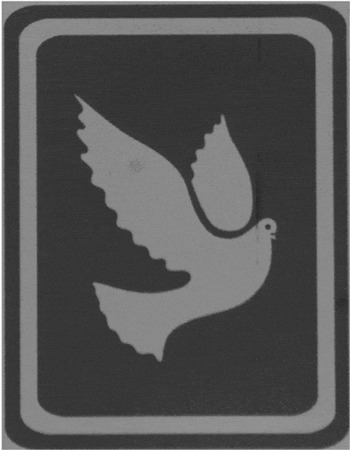
The Turkish passion for pigeons dates to pre-Islamic times when Shamanic cults believed pigeons guided the souls of the dead to heaven (Bekki, Reference BEKKI2004; Artun, Reference ARTUN2009). The former Prime Minister, Bulent Ecevit, who was revered for his honesty and humility, was leader of the Democratic Left Party (Demoratik Sol Parti, DSP) whose emblem is a white pigeon on a blue background (Figure 1) and was known as the White Pigeon because of his habit of carrying one around with him.
The white pigeon emblem of the Turkish Democratic Left Party.

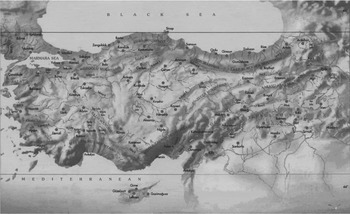
Pigeons are now kept by many hundreds of thousands of Turkish ‘fanciers’ yet very little in formal terms is known about them. Enthusiasts are found in every corner of the country (Figure 2), each rearing a few (3-5) to a great many (more than 100) birds. This informal dispersion does not lend itself to any form of census, except perhaps at a very local level and indeed the state statistical service makes no attempt to enumerate them. What is not in doubt is that there are many millions of pigeons in Turkey, but the somewhat negative attitude of the authorities to them is exemplified by the mass slaughter of the species during an outbreak of Highly Pathogenic Avian Influenza in Turkey in 2006, even though there is no evidence that pigeons transmit the disease to people (Turker Savas, personal observation).
Map of Turkey showing provinces (provinces are usually named after the administrative city).

It is not only in Turkey, however, that Turks maintain, or have maintained, their passion for pigeons. In the middle of the nineteenth century the Ottomans took pigeons to the Balkans. The ‘donek’ breed (see 1.8 in the tables below) was a favourite and from this has developed the ‘Prishtin Roller’ which takes its name from Pristina, the capital of Kosovo, where it has a breed standard and is registered as a breed there with the Federal Commission (Mirre se vini: www.ilmi-vushtri.tk). Turkish birds are commonly kept by the Diaspora all over the world where local breeders and fanciers clubs also provide a means of social cohesion (Jerolmack, Reference JEROLMACK2007).
According to Petis de Crois, a member of the French mission to Istanbul, pigeons fried in butter and onion, then baked with kaymak, sugar and rosewater were greatly enjoyed at the table of Sultan Mehmet IV in 1674 (TCF, Reference TCF2012). In the year 1723, the Ottoman Imperial kitchen had 1,370 kitchen staff and consumed 30,000 head of cattle, 160,000 sheep and 100,000 pigeons in the preparation of meals for palace personnel and visitors. Whole roasted pigeon covered in spices and salt was a favourite dish in the Seljuk period, and was served at royal banquets during much of the Ottoman period, and pigeons were used to make kebabs in Istanbul (TCF, Reference TCF2012). There are numerous other references to pigeons as food animals in the literature (TCF, Reference TCF2012) but there is very little consumption of pigeons in modern Turkey (Orhan Yilmaz, personal observation).
There are no formal studies of pigeon reproduction in Turkey. Fanciers state, however, that pigeons breed throughout the year except in the very coldest parts of the country, and usually rear four or five broods annually. The usual clutch size is two eggs. Males usually brood the eggs during the day with females incubating at night. Eggs hatch on average 17 days after laying, with a range of 16 to 19 days. The squabs (hatchlings) are fed crop milk for about two weeks, during which time growth is very rapid but then slows down as they are ‘weaned’ on to grain and receive less attention from their parents. Fledging (leaving the nest) takes place at about 25 days (Turker Savas, personal observation).
Classification
Pigeons can be grouped according to their body size, shape, colour and number of tail and wing feathers, but in Turkey they are more generally grouped by use. The groupings adopted are diver, tumbler, roller, spinner, fleet flier, high flier, racing homer, show and singer but these are not necessarily exclusive. Some birds can be considered as members of more than one group, but are listed only once in the inventory.
A total of 72 breeds have been identified in this inventory. Some of these are of international status, others are found throughout Turkey and yet others have only a regional or even provincial distribution. Many breeds have synonyms that are applied to them in local areas (in this paper synonyms in Turkish are indicated by the word being placed in single quotation marks and this notation is also used for colour varieties that are listed in Turkish).
For the purposes of inventory this paper adopts a binomial system of identification in the Tables whereby the first numeral indicates the group and the second (after the point/full stop) indicates the breed.
diver group
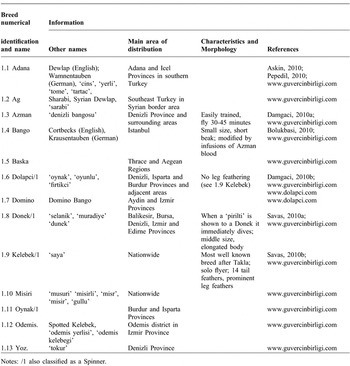
The Diver group is known as ‘dalici’ in Turkish. The pigeon flies aloft and then dives when shown a lure (a white pigeon ‘pirilti’) by the handler on the ground. The Diver group comprises 13 breeds (Table 1). The Azman (1.3 in Table 1) is essentially confined to Denizli as indicated by its alternative name of ‘Denizli bangosu’ and is considered to be rare, a situation believed to have been partly caused by excessive use in the modification of the Bango (1.4) by Istanbul fanciers who wanted to make use of the Azman short and broad beak (Bolukbasi, Reference BOLUKBASI2010; Damgaci Reference DAMGACI2010a). Five breeds are well known internationally and one – the Donek (1.8) – has a population in Kosovo where it is known as the Prishtin donek (Savas, Reference SAVAS2010a).
1 An internet search with the term ‘Turkish Pigeon’ will produce several to many ‘hits’ for Turkish nationals overseas who laud the value of their pigeons and of pigeon keeping but as many of these are likely to be ephemeral they are not listed here.
tumbler group
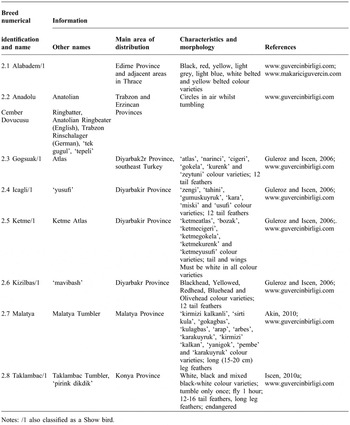
As the name implies the Tumbler (Turkish = ‘taklaci’) tumbles (rolls) forward or backward in flight. The Tumbler group has eight breeds (Table 2). Four of these breeds are well known outside Turkey although they all have very restricted distribution in the country. The other four breeds also have restricted distribution, with one in Thrace and three concentrated in Diyarbakir Province in southeast Turkey.
Breeds and characteristics of Diver group pigeons.

Notes: /1 also classified as a Spinner.
Breeds and characteristics of Tumbler group pigeons.

Notes: /1 also classified as a Show bird.
roller group
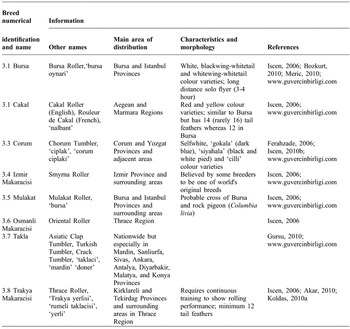
A spiral descent (Turkish = ‘dolap’) is the major characteristic of the Roller group. Within Turkey seven of the eight breeds in this group (Table 3) have limited or very limited spatial distribution, with only one type being widespread. Outside Turkey all the breeds are well known internationally, are especially popular in the USA and also have good support in Croatia, where they are registered with the Croatian Association of Small Animal Breeders (Iscen, Reference ISCEN2006).
Breeds and characteristics of Roller group pigeons.

spinner group
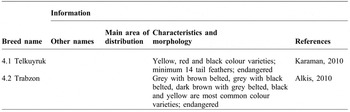
The Spinner group (Turkish = ‘donucu’) is known for the horizontal circles it flies in the air without descending or ascending flight. The group is next to the least diverse of Turkish groups as it comprises only two breeds (Table 4), both of which are endangered, although there are some Trabzon birds in the USA (Alkis, Reference ALKIS2010).
Breeds and characteristics of Spinner group pigeons.

fleet flyer group
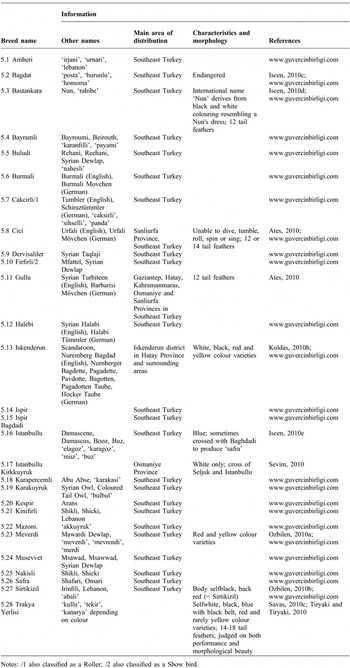
Pigeons that fly as a flock and show their grouping ability comprise the Fleet Flyer (‘filo ucucusu’) or Collective group. The Fleet Flyer group is by far the largest of the Turkish groups with a total of 28 breeds (Table 5) about half of which are known internationally. The group is characterised by birds of slim build that carry themselves with an upright stance. Almost all the breeds are found mainly in a large area of southeast Turkey along the Syrian border but the Iskenderun (5.13) is limited in distribution to the city of that name and its surrounds in Hatay Province on the Mediterranean coast (Koldas, Reference KOLDAS2010b). The Bagdat breed (5.2) is considered endangered (Iscen, Reference ISCEN2010c).
Breeds and characteristics of Fleet Flyer group pigeons.

Notes: /1 also classified as a Roller; /2 also classified as a Show bird.
high flyer group
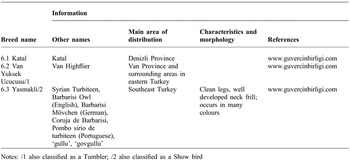
The High Flyer (‘yuksek ucucu’) group flies at higher altitudes than other pigeons and is considered to be unafraid of being taken by birds of prey. This small group comprises three breeds (Table 6), two of which have restricted distribution within Turkey with the third being more widespread. The group has similarities with the Egyptian Swift type of pigeon. The Katal breed (6.1) takes its name from the structures provided under the eaves of houses for it to build its nests. The Yasmakli (6.3) is well known abroad and has a following in the UK, Germany and Portugal.
Breeds and characteristics of High Flyer group pigeons.

Notes: /1 also classified as a Tumbler; /2 also classified as a Show bird
racing homer group
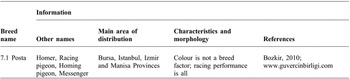
Racing Homer (‘postaci’) pigeons are of the traditional worldwide group of birds renowned for their ability to return from long distances to their home station. In Turkey, the Racing Homer group has only one breed (Table 7). Many specialist clubs are found in its main area of distribution around the Sea of Marmara in north-western Turkey and in the environs of Izmir on the Mediterranean (western) coast.
Breeds and characteristics of Racing Homer group pigeons.

show group
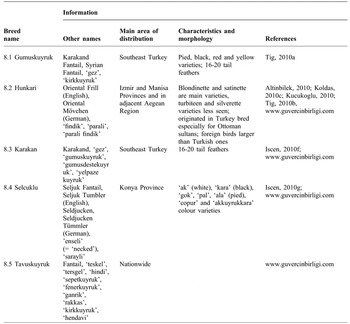
Known as ‘form’ or ‘sus’ in Turkish, Show group pigeons are bred only for their morphological beauty. This classic fantail group covers five breeds in Turkey of which four are known throughout much of the world (Table 8). Hunkari (8.2) translates as ‘the Sultan's Pigeon’ as the bird was originally bred for the royal palace (Seymour, Reference SEYMOUR2006). The Selcuclu or Seljuck Fantail (8.4) was bred by the Seljucks in Konya as early as the 13th century and was for long limited in distribution to their stronghold in Konya in south central Turkey: the breed is rare in Turkey, but has populations overseas (Iscen, Reference ISCEN2010g).
Breeds and characteristics of Show group pigeons.

singer group
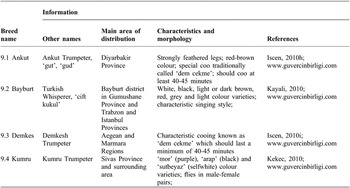
The Singer (Turkish = ‘otucu’) group is bred for its voice. These birds are generally known as Trumpeters in English. There are four Turkish breeds in this group (Table 9). They are found in discrete and somewhat restricted areas, except for the Bayburt (9.2) which has an outlying population in Istanbul Province and the Demkesh (9.3) which is widespread in the Aegean and Marmara Regions in western Turkey (Kayali, Reference KAYALI2010; Iscen, Reference ISCEN2010i). All four breeds are well known outside the country and are especially appreciated in Russia.
Breeds and characteristics of Singer group pigeons.

Breed support and breed organizations
There is very little interest or support for pigeon breeding and production in the public sector, neither from national and local governments nor from academic institutions. Two breeds have, however, been registered via the Animal Breed Registration Committee of the Ministry of Food, Agriculture and Livestock (Anon, Reference ANON2011). These breeds are the Bursa Tumbler (Bursa oynari) – listed as 3.1 in the foregoing inventory (Table 3) – registered by the Registration Committee as Notification Number 2010/27 in the Government Gazette Number 27643 of 16 July 2010 and the Thrace Roller (Trakya Makaracisi) – 3.8 in the inventory – registered as Notification Number 2011/38 in the Government Gazette Number 28036 of 25 August 2011.
The private sector is represented by the Turkey Pigeon Breeders Association (TPBA, Türkiye Güvercin Yetiştiricileri Birligi™) and the Turkish Pigeon Federation (TPF, Türkiye Güvercin Federasyonu) which act as the umbrella organisations for breeders and local clubs (Figure 3). The TPBA has almost 1100 individual members of whom 958 reside in 60 of Turkey's provinces and 110 in 19 other countries. The website www.guvercinbirligi.com cited so frequently in the inventory (and on which there are many photographs of the various breeds) is the home site of the TPBA and is well furnished with illustrations of most of the breeds. The TPF, whose website is http://www.gufed.com/, has 10 founding member clubs and 37 other affiliated clubs located mostly in the Istanbul Region. Some clubs are very active and organise many races – of up to 800 km – during the summer months for various classes of bird. There is a plethora of other individual clubs at the provincial or municipal level whose generic title can be said to be ‘The [name of breed] Pigeon Fancier's Club of [name of province or municipality]’ but many of these act more as social clubs than as protectors and promoters of the breed. Many clubs organise sales at which entries vary from a few to very many, with prices per bird also varying from a few to several thousand Turkish lira. Many breeds are being diluted by indiscriminate cross breeding and the maintenance of breed purity is not helped by the proliferation of local names. Breeders and fanciers admit that breeds are disappearing or being absorbed into other breeds.
The logos of the Turkish Pigeon Breeders Association (Figure 3a) and the Tukish Pigeon Federation (Figure 3b).

Conclusions
There is a very great amount of diversity in Turkish pigeons but it is clear that this is being eroded at a fairly rapid and probably increasing rate. In view of the fact that pigeons are mainly a hobby species rather than an economic one, they are unlikely to excite much interest from government and academia (although there is some limited interest from the latter). Biodiversity is clearly worthy of being conserved and enhanced but these objectives will have to be pursued and achieved largely by the private sector comprising the breeders and their clubs. This does not preclude initial assistance being provided by the public and voluntary sectors to the often poorly educated and resource-limited breeders in organisational and conservation aspects of their fancy.
Acknowledgments
We are most grateful to an anonymous referee for very constructive comments on an earlier version of this paper.