Introduction
Because of the considerable use of antimicrobial agents in human and veterinary medicine and animal husbandry, antimicrobial resistance (AMR) has developed into a prime illustration of how bacterial populations can readily adapt and react to selective pressure. We have witnessed, during the past decades, not only the emergence of a multitude of new resistance mechanisms, but also their spread across entire bacterial populations and ecological niches. This article will review some recent insights into the mechanisms used by bacteria to develop resistance to antimicrobials, and how AMR can spread or emerge repeatedly in entire populations.
The molecular mechanisms of emergence and transmission
Resistance to antimicrobials can be acquired in two ways: (i) mutations in pre-existing or previously acquired genes, and (ii) horizontal gene transfer (HGT), the acquisition of new genes from other bacteria. Depending on the antimicrobial, both mechanisms can play important roles in the development of the dramatic AMR situation that we face today.
Emergence of AMR through mutations
It is the interplay between the occurrence of random mutations and selective antimicrobial pressure that drives specific resistant mutants through evolutionary bottlenecks and ultimately to multiply and emerge out of the overall anonymity. Excellent reviews have been dedicated to the resistance mechanisms for specific antimicrobials (see for instance Schwarz et al., Reference Schwarz, Cloeckaert, Roberts and Aarestrup2006), and these topics will not be reviewed here. Instead, the following section of this article will focus on two important notions that have emerged recently in the context of AMR development and spread. The first is the ‘mutator state’ and the second is the concept of ‘selection windows’ and ‘mutant preventing concentration’.
Mutators
Mutations occur on a regular basis in every living organism as a consequence of either alterations in existing DNA or errors during DNA replication. Since mutations are more likely to have deleterious than advantageous effects on the survival of an individual cell, bacteria have evolved a range of proofreading and DNA repair mechanisms (for a review, see for instance Chopra et al., Reference Chopra, O'Neill and Miller2003 or Horst et al., Reference Horst, Wu and Marinus1999). However, the genes encoding these control mechanisms may themselves undergo mutations, thus resulting in bacteria with increased mutation rates – the so-called ‘mutators’ (Chopra et al., Reference Chopra, O'Neill and Miller2003). Recent studies have demonstrated surprisingly high frequencies of mutators in natural populations (LeClerc et al., Reference LeClerc, Li, Payne and Cebula1996; Matic et al., Reference Matic, Radman, Taddei, Picard, Doit, Bingen, Denamur and Elion1997), suggesting that they may play an important role in the evolution and adaptation of bacteria to changing environments (Travis and Travis, Reference Travis and Travis2002; Tanaka et al., Reference Tanaka, Bergstrom and Levin2003). Bacterial populations may undergo bursts of mutations when encountering new selection pressures (Giraud et al., Reference Giraud, Radman, Matic and Taddei2001). Such bursts are caused by the selection of bacteria with new advantageous characteristics that, like deleterious mutations, are more prone to emerge in mutator than in non-mutator strains. There is therefore a co-selection of bacteria in the mutator state together with the selection of advantageous mutations. This is of particular advantage to a population in a highly variable environment or when multiple successive mutations are needed to attain an optimally adapted phenotype (Tenaillon et al., Reference Tenaillon, Toupance, Le Nagard, Taddei and Godelle1999; Denamur and Matic, Reference Denamur and Matic2006). This mechanism is thought to play a role in the emergence of resistance to antimicrobial agents arising through mutations (Blazquez, Reference Blazquez2003; Macia et al., Reference Macia, Blanquer, Togores, Sauleda, Perez and Oliver2005), such as for fluoroquinolones (Komp Lindgren et al., Reference Komp Lindgren, Karlsson and Hughes2003; Levy et al., Reference Levy, Sharma and Cebula2004; Trong et al., Reference Trong, Prunier and Leclercq2005). It may also play a role in the acquisition of resistance genes through HGT, because the most frequent mutations leading to the mutator state (i.e. mutations in methyl-directed mismatch repair genes such as mutS and mutL in Enterobacteriaceae) also significantly increase the efficiency of HGT and of homologous recombination (Rayssiguier et al., Reference Rayssiguier, Thaler and Radman1989; Townsend et al., Reference Townsend, Nielsen, Fisher and Hartl2003). Furthermore, the mere stress and DNA alteration provided by some antimicrobials may induce the SOS system of bacteria and, consequently, the activity of error-prone DNA polymerases, which results in a transient mutator state (Foster, Reference Foster2007). Thus, exposure to fluoroquinolones increases the frequency of mutants resistant to this class of antimicrobials in an exposed bacterial population (Cirz et al., Reference Cirz, Chin, Andes, de Crecy-Lagard, Craig and Romesberg2005).
The mutator state may also be involved in the generation and spread of β-lactamase variants, particularly of extended-spectrum β-lactamases (ESBLs) (Woodford and Ellington, Reference Woodford and Ellington2007). Two different studies have made use of in vitro models to mimic the evolution of bla TEM in mutator strains and have shown that variants of TEM-1 similar to those observed in Nature can be obtained under such circumstances (Stepanova et al., Reference Stepanova, Pimkin, Nikulin, Kozyreva, Agapova and Edelstein2008), including the otherwise unlikely accumulation of multiple mutations leading to the bla TEM-52 variant (Orencia et al., Reference Orencia, Yoon, Ness, Stemmer and Stevens2001). Although there is no formal proof that this phenomenon is occurring in Nature, the higher prevalence of mutators among clinical Escherichia coli isolates that produce ESBL than among non-ESBL producers (Baquero et al., Reference Baquero, Galan, del Carmen Turrientes, Canton, Coque, Martinez and Baquero2005) strongly supports the hypothesis. Thus, ways to avoid mutators and their effects on the emergence of resistant isolates may become part of the strategies that we will have to envision in our fight against resistance.
The mutant selection window (MSW)
Common knowledge suggests that minimal inhibitory concentrations (MICs) should drive treatment dosage for bacterial infections (Drlica, Reference Drlica2003). However, there is a range of antimicrobial concentrations just above the MIC which would kill or inhibit susceptible bacteria, but at which the few spontaneous mutants in the infecting bacterial population would be able to survive or multiply. This range of concentrations is called MSW (Zhao and Drlica, Reference Zhao and Drlica2001). The lower limit of the MSW is usually considered to be between the MIC and MIC99 of the organism under scrutiny (Zhao and Drlica, Reference Zhao and Drlica2001; Drlica and Zhao, Reference Drlica and Zhao2007). The upper MSW limit, or mutant prevention concentration (MPC), has been defined as the concentration at which no resistant mutant can grow when testing 1010 cells in vitro (Drlica, Reference Drlica2003). The width of the MSW is a function of the microorganism, the antimicrobial agent, and the spectrum and type of MIC changes provided by mutations. In some cases, the MPC may be so high that it cannot be reached realistically in clinical settings and the principles of mutant selection prevention discussed here may not apply. This is, for instance, the case for many AMR genes, whose acquisition results in a major MIC shift to levels not achievable by any treatment. Also, under in vivo conditions, and depending on the mode of activity of the antimicrobial (i.e. bacteriostatic or bactericidal) and the organisms, the MPC may need to be adjusted further (Drlica and Zhao, Reference Drlica and Zhao2007).
The concept of MSW may have many practical implications in the case of stepwise mutations or of the acquisition of resistance genes that provide only small changes in MIC, and when multiple mutations are needed to reach clinically significant resistance levels. Prime examples of such situations are found in human medicine in relation to treatment of mycobacterial diseases (Almeida et al., Reference Almeida, Nuermberger, Tyagi, Bishai and Grosset2007). Fluoroquinolones, which are more relevant to veterinary medicine, represent another example of the potential implications of the MSW concept. In most bacteria, high-level fluoroquinolone resistance is essentially the result of multiple cumulative mutations (Hopkins et al., Reference Hopkins, Davies and Threlfall2005). In vitro as well as in vivo experiments show, for instance, that Staphylococcus aureus mutants with elevated fluoroquinolone MICs can be selected by levofloxacin concentrations within the MSW, but neither below nor above it (Firsov et al., Reference Firsov, Vostrov, Lubenko, Drlica, Portnoy and Zinner2003; Cui et al., Reference Cui, Liu, Wang, Tong, Drlica and Zhao2006). The phenomenon is bound to be the same and of general relevance for many other combinations of organism and fluoroquinolone (see for instance Croisier et al., Reference Croisier, Etienne, Bergoin, Charles, Lequeu, Piroth, Portier and Chavanet2004; Ferran et al., Reference Ferran, Dupouy, Toutain and Bousquet-Melou2007; Olofsson et al., Reference Olofsson, Marcusson, Stromback, Hughes and Cars2007), as well as for other antimicrobial agents (Goessens et al., Reference Goessens, Mouton, ten Kate, Bijl, Ott and Bakker-Woudenberg2007; Zinner et al., Reference Zinner, Gilbert, Lubenko, Greer and Firsov2008). When using antimicrobials for which the concept of MSW is applicable, special care may have to be applied, including, if possible, the determination of MPCs. In particular, some treatment modalities, which leave local in vivo antimicrobial concentrations too close to the MICs of the organism (i.e. within the MSW) for extended periods of time may be prone to select resistant mutants. Long acting formulations can potentially lead to such unwanted situations (Drlica and Zhao, Reference Drlica and Zhao2007). It is also possible that this approach should be applied to the use of new generation β-lactams in the treatment of infections by organisms that already possess a resistance mechanism to β-lactams of earlier generations. Such organisms may present a slightly elevated MIC and a higher MPC for new generation β-lactams when compared with fully susceptible isolates. This may facilitate the selection of ESBL mutants through the resulting elevated MSW.
HGT and AMR
For the majority of antimicrobials, resistance is mainly caused by the acquisition of new resistance genes rather than by spontaneous mutations. The exact origin of these genes is frequently unknown, but most of them apparently originate from environmental organisms. Some AMR genes seem to originate from natural antibiotic producers, where they protect the bacterium against its own weapons (Webb and Davies, Reference Webb and Davies1993; Davies, Reference Davies1994; Lu et al., Reference Lu, Asano and Davies2004). Others have been suggested to play different roles in their original host, including detoxification of components other than antimicrobials, and a variety of other metabolic (Martinez, Reference Martinez2008) and signaling functions (Davies et al., Reference Davies, Spiegelman and Yim2006; Linares et al., Reference Linares, Gustafsson, Baquero and Martinez2006; Fajardo and Martinez, Reference Fajardo and Martinez2008). A vast but broadly unknown reservoir of such genes is still lurking in natural environments (D'Costa et al., Reference D'Costa, Griffiths and Wright2007), thus providing transferrable resources for other bacteria for many years to come.
The genetic elements involved in the spread of resistance genes
The movement of AMR genes can take place at two distinct levels (Fig. 1), and different elements are involved at each level. At the intracellular level, AMR genes can move within the genome, including between chromosome and replicons such as plasmids and phages. Transposons and integrons are the major elements involved in these movements; they rely on both homologous and non-homologous recombination. In the case of inter-cellular movement (horizontal spread) of AMR genes, three major mechanisms are potentially involved: transformation (uptake of naked DNA), transduction (transfer by bacteriophages) and conjugation (transfer by plasmids and other conjugative elements). Numerous reviews have been written on these mechanisms and their role in the transfer of AMR (see for instance Aarestrup, Reference Aarestrup and Aarestrup2006; Schwarz et al., Reference Schwarz, Cloeckaert, Roberts and Aarestrup2006). Therefore, this article will focus essentially on recent developments in that field.
Molecular mechanisms and elements involved in the spread of AMR. For details of the involvement of each mechanism and element in the spread of AMR, please refer to the respective sections in the text. Overlapping mechanisms/elements indicate functional or physical linkage. Specific elements may be involved to variable degrees in both intra- and inter-cellular mobility and the width of each element is only an approximation of its respective involvement in these two levels of mobility. Because of the multidimensional nature of interactions, the relationships between elements may in fact be more direct than possibly represented in this figure. ISCR: the atypical class of insertion sequences with common regions.

Evolving integrons
Resistance integrons of classes 1 and 2 (Fluit and Schmitz, Reference Fluit and Schmitz2004) are widespread and well established among pathogens and commensal bacteria, resulting in a plethora of publications on their diversity and distribution in bacteria from animals and humans. Through their gene capture ability and association with widespread transposons such as Tn21 (Liebert et al., Reference Liebert, Hall and Summers1999) and Tn7 (Hansson et al., Reference Hansson, Sundstrom, Pelletier and Roy2002), they play a major role in the development and spread of multiresistance. New AMR genes keep showing up in classical and modified integrons. This is, for instance, the case with the newly identified qnr genes for quinolone resistance (Wang et al., Reference Wang, Tran, Jacoby, Zhang, Wang and Hooper2003), as well as with more classical genes such as the sulfonamide resistance gene sul3 (Bischoff et al., Reference Bischoff, White, Hume, Poole and Nisbet2005; Antunes et al., Reference Antunes, Machado and Peixe2007). Thus, known integrons are continuously evolving in order to provide bacteria with the tools to resist newer antimicrobials. In addition, recent findings on integron diversity and evolution suggest that they are much more diverse than originally thought (Boucher and Corey, Reference Boucher and Corey2008). They probably originated and evolved in environmental bacteria (Gillings et al., Reference Gillings, Boucher, Labbate, Holmes, Krishnan, Holley and Stokes2008) and spread across a very broad range of microorganisms, by both vertical and horizontal transfer (Nemergut et al., Reference Nemergut, Robeson, Kysela, Martin, Schmidt and Knight2008). Some integrons, such as those of class 1, have evolved from their original host to become vectors of resistance, and to spread in commensal and pathogenic bacteria from animals and humans through their associations with transposons (see for instance the model of evolution for class 1 integrons proposed by Gillings and collaborators in Gillings et al., Reference Gillings, Boucher, Labbate, Holmes, Krishnan, Holley and Stokes2008). However, a wealth of other integrons exists that may surface as additional AMR gene carriers in the future (Gillings et al., Reference Gillings, Boucher, Labbate, Holmes, Krishnan, Holley and Stokes2008).
Transposons, insertion sequences and ISCR elements
Insertion sequences (ISs) and composite or complex transposons have long been known to play a major role in the mobilization of AMR genes (for an introductory review, see for instance Bennett, Reference Bennett2008). Recently, a new class of mobile genetic elements with characteristics similar to IS91 has emerged. These are designated as ISCRs to stress their relationships with insertion sequence elements and the presence of conserved recombinase sequences (refered to as common regions) that facilitated their identification (Toleman et al., Reference Toleman, Bennett and Walsh2006b; Toleman and Walsh, Reference Toleman and Walsh2008). ISCRs are characterized by a transposase-like gene but lack the typical repeats found at the ends of classical ISs. They are flanked and delimited by sequences called oriIS and terIS (for origin and termination of replication), and they typically transpose using a rolling circle replication mechanism, which makes them very different from classical ISs (Mendiola et al., Reference Mendiola, Bernales and de la Cruz1994; Toleman et al., Reference Toleman, Bennett and Walsh2006b). They seem to insert relatively randomly in any DNA molecule and, very importantly, the termination mechanism for the replication of ISCRs is not very accurate (Tavakoli et al., Reference Tavakoli, Comanducci, Dodd, Lett, Albiger and Bennett2000; Toleman et al., Reference Toleman, Bennett and Walsh2006a). Termination frequently occurs beyond the limit marked by the terIS site, thus allowing for the mobilization of sequences adjacent to the ISCR elements, including AMR genes. ISCRs appear to have played a major role in the emergence and spread of a variety of recently identified AMR genes, including a number of ESBLs, and in the evolution of complex integrons. These complex integrons have resulted in combinations and clusters of AMR genes that would not have been possible through classical integrons alone (see for instance Toleman et al., Reference Toleman, Bennett and Walsh2006a, Reference Toleman, Bennett and Walsh2006b). The qnr genes for quinolone resistance are typical examples of such complex integrons in which ISCRs have played a major role in bringing together AMR gene combinations, including fluoroquinolone and extended-spectrum β-lactam resistance genes, on single conjugative plasmids (Wang et al., Reference Wang, Tran, Jacoby, Zhang, Wang and Hooper2003; Nordmann and Poirel, Reference Nordmann and Poirel2005; Garnier et al., Reference Garnier, Raked, Gassama, Denis and Ploy2006; Quiroga et al., Reference Quiroga, Andres, Petroni, Soler Bistue, Guerriero, Vargas, Zorreguieta, Tokumoto, Quiroga, Tolmasky, Galas and Centron2007).
AMR plasmids
Conjugative or mobilizable plasmids are the most common transmission vectors for AMR genes. Many of them carry multiple resistance genes leading to what can be termed ‘infectious multiresistance’. This topic will not be developed further here (for more information, see for instance Bennett, Reference Bennett2008). Despite the major relevance of plasmids in AMR, it is surprising how little has been attempted in the study of their diversity and epidemiology in relation to AMR in a broad and systematic way. The exponential growth of DNA sequencing capabilities and of informatics for sequence analysis and annotation have opened new avenues for a more comprehensive understanding of the molecular epidemiology of AMR plasmids. The bla CMY-2 plasmids, encoding resistance to extended-spectrum cephalosporins, provide a good illustration of this evolution. Restriction analysis of plasmids has been the workhorse of microbiologists in assessing global relationships between plasmids; four to five groups of bla CMY-2 plasmids were originally identified using this approach (Carattoli et al., Reference Carattoli, Tosini, Giles, Rupp, Hinrichs, Angulo, Barrett and Fey2002; Giles et al., Reference Giles, Benson, Olson, Hutkins, Whichard, Winokur and Fey2004). Recently, Carattoli and collaborators have developed new tools for plasmid characterization and molecular epidemiological analysis. They first developed an accessible PCR-based replicon-typing system that classifies plasmids by incompatibility group (Novick, Reference Novick1987; Carattoli et al., Reference Carattoli, Bertini, Villa, Falbo, Hopkins and Threlfall2005). This system is significantly less tedious than the classical incompatibility grouping technique (Couturier et al., Reference Couturier, Bex, Bergquist and Maas1988). Although some plasmids remained untypable by this method, these researchers showed that bla CMY-2 plasmids belong mainly to the I1 and A/C incompatibility groups, which have spread between continents (Carattoli et al., Reference Carattoli, Miriagou, Bertini, Loli, Colinon, Villa, Whichard and Rossolini2006; Hopkins et al., Reference Hopkins, Liebana, Villa, Batchelor, Threlfall and Carattoli2006). AMR plasmids within specific incompatibility groups present a relatively conserved backbone structure on top of which variable accessory regions, such as AMR genes, insert (Schluter et al., Reference Schluter, Szczepanowski, Puhler and Top2007). This conserved backbone can be used to compare the evolutionary relationships among plasmids in order to track plasmid movement across bacterial populations, and can consequently help us to better understand how mobile accessory elements move in and out of plasmids. Plasmid multilocus sequence typing (pMLST) (Garcia-Fernandez et al., Reference Garcia-Fernandez, Chiaretto, Bertini, Villa, Fortini, Ricci and Carattoli2008) is one approach that makes use of the conserved backbone mentioned above to classify plasmids. This method may replace restriction analysis of plasmids by providing similar but more reproducible results (Garcia-Fernandez et al., Reference Garcia-Fernandez, Chiaretto, Bertini, Villa, Fortini, Ricci and Carattoli2008). However, it may be less discriminatory than restriction analysis, and will not replace entirely the notoriously tedious and difficult sequencing of entire AMR plasmids.
Bacteriophages and AMR
Although they represent important mechanisms in the long-term evolution of pathogens, transformation and transduction have been considered to be not very significant in HGT of AMR genes. Recent reports on the transduction of multiple AMR genes from the Salmonella genomic island 1 (SGI1) of Salmonella Typhimurium DT104 (Schmieger and Schicklmaier, Reference Schmieger and Schicklmaier1999) and of the extended-spectrum cephalosporin resistance gene bla CMY-2 of Salmonella Heidelberg (Zhang and LeJeune, Reference Zhang and LeJeune2008) suggest that bacteriophages may play a more important role than originally thought in the transfer of AMR genes. Further studies are certainly warranted on this subject.
Integrative conjugative elements (ICEs) and genomic islands
Besides plasmids and bacteriophages, a number of other mobile elements involved in transfer of AMR have emerged in recent years, tentatively grouped under the concept of ICE (Burrus et al., Reference Burrus, Pavlovic, Decaris and Guedon2002). Such elements, in contrast with plasmids, are not self-replicating but integrate into the chromosome (with a variable site-specificity, dependent on the element and the host bacterium) to be stably passed from one generation to the next. They encode both excision and integration mechanisms, as well as transfer between bacteria by modes of conjugation (Burrus and Waldor, Reference Burrus and Waldor2004). Conjugative transposons, such as the archetypal tetracycline-resistance transposon Tn916, are the best known examples of ICEs of importance for AMR in human and veterinary medicine (Franke and Clewell, Reference Franke and Clewell1981; Rice, Reference Rice1998). They are widespread among Gram-positive organisms such as streptococci and enterococci but are also frequently found in Bacteroides spp. and other anaerobes. Since their discovery (Franke and Clewell, Reference Franke and Clewell1981), the list of host species for these elements has broadened continuously, and we now know that they can even be found among Enterobacteriaceae (Murphy and Pembroke, Reference Murphy and Pembroke1995; Hochhut et al., Reference Hochhut, Jahreis, Lengeler and Schmid1997).
Although genomic islands were first identified in relation to virulence (for a review, see for instance Schmidt and Hensel, Reference Schmidt and Hensel2004), they are also important in the spread of AMR genes. Their mode of transmission is not entirely clear but genomic islands are thought to be transferred by bacteriophages, and in ways similar to ICEs (Burrus et al., Reference Burrus and Waldor2004). Two genomic islands have become famous for their role in the spread of AMR in the past decades – the SGI1 and the chromosomal elements responsible for methicillin resistance in coagulase-positive staphylococci.
SGI1 was first discovered in relation to the intercontinental spread of the pentaresistant (ampicillin, chloramphenicol, streptomycin, sulfonamide, tetracycline or ACSSuT) Salmonella Typhimurium phage type DT104 (Poppe et al., Reference Poppe, Smart, Khakhria, Johnson, Spika and Prescott1998; Threlfall, Reference Threlfall2000). Molecular investigations later showed that the AMR genes responsible for this resistance profile are all clustered together (Briggs and Fratamico, Reference Briggs and Fratamico1999), and are part of a larger genomic island of approximately 43 kilobase pairs (Boyd et al., Reference Boyd, Peters, Cloeckaert, Boumedine, Chaslus-Dancla, Imberechts and Mulvey2001). Several of these AMR genes (bla PSE-1 for ampicillin, floR for chloramphenicol, aadA2 for streptomycin and tetG for tetracycline) were not the most common ones usually encoding resistance to these antimicrobials in Enterobacteriaceae and their origin still remains uncertain. The AMR genes of SGI1 are part of a complex integron in which two type 1 integrons have come together with tetracycline and florfenicol–chloramphenicol resistance genes of plasmid origin (Boyd et al., Reference Boyd, Peters, Cloeckaert, Boumedine, Chaslus-Dancla, Imberechts and Mulvey2001). SGI1 shares many features with ICEs, including the presence of recombinase genes for excision and integration, but seem to lack the self-transfer components of these elements. Nevertheless, in vitro experiments have demonstrated that helper plasmids can provide the necessary apparatus for an effective transfer of SGI1 between bacteria (Doublet et al., Reference Doublet, Boyd, Mulvey and Cloeckaert2005). As a proof that this potential mobility is not just a laboratory curiosity, numerous reports show that SGI1 has now spread to many Salmonella serovars other than Typhimurium, integrating relatively consistently at identical sites in the chromosome of these bacteria (Doublet et al., Reference Doublet, Boyd, Mulvey and Cloeckaert2005; Mulvey et al., Reference Mulvey, Boyd, Olson, Doublet and Cloeckaert2006). In addition, numerous variants of SGI1 have emerged through homologous recombination and transposition events (Mulvey et al., Reference Mulvey, Boyd, Olson, Doublet and Cloeckaert2006).
The first methicillin-resistant Staphylococcus aureus (MRSA) emerged very shortly after the introduction of this antimicrobial in clinical practice (Jevons et al., Reference Jevons, Coe and Parker1963). Methicilllin resistance in MRSA is caused by the presence of an alternative β-lactam-insensitive penicillin-binding protein (PBP2a) encoded by the mecA gene (Matsuhashi et al., Reference Matsuhashi, Song, Ishino, Wachi, Doi, Inoue, Ubukata, Yamashita and Konno1986). This gene is located within staphylococcal cassette chromosome (SCCmec) elements, which also encode recombinases allowing for the excision and integration of the cassettes downstream of a specific locus called orfX (Katayama et al., Reference Katayama, Ito and Hiramatsu2000). At least seven major types of SCC cassettes have been identified to date in MRSAs (Deurenberg and Stobberingh, Reference Deurenberg and Stobberingh2008). Molecular investigations on methicillin-resistant and -susceptible strains have demonstrated that these cassettes have been acquired repeatedly by a variety of S. aureus strains as well as by the same clonal lineages (Enright et al., Reference Enright, Robinson, Randle, Feil, Grundmann and Spratt2002). After this acquisition, the resulting MRSA clones spread internationally. The exact origin of the mec genes found in MRSA is not entirely clear, but the high homology between a PBP of Staphylococcus sciuri and PBP2a suggests that they may have originated in this organism (Wu et al., Reference Wu, de Lencastre and Tomasz2001). Other studies suggest that the assembling of the SCC, including the amalgamation of the mec genes with the crr recombinase genes, may have taken place in coagulase-negative staphylococci (Hanssen and Ericson Sollid, Reference Hanssen and Ericson Sollid2006). SCCmec similar to those of MRSA have also been demonstrated in coagulase-negative staphylococci such as Staphylococcus epidermidis, and these organisms are considered by some as a reservoir of SCCs (Wisplinghoff et al., Reference Wisplinghoff, Rosato, Enright, Noto, Craig and Archer2003; Hanssen and Ericson Sollid, Reference Hanssen and Ericson Sollid2006). After the first emergence of hospital-associated MRSA, community-acquired MRSA emerged (for a review, see for instance Boucher et al., Reference Boucher and Corey2008), and we now face the emergence of MRSA in animals. They were first detected in horses (Weese, Reference Weese2004) and companion animals (Weese, Reference Weese2005), but recent findings suggest that they may be even more widespread in swine (de Neeling et al., Reference de Neeling, van den Broek, Spalburg, van Santen-Verheuvel, Dam-Deisz, Boshuizen, van de Giessen, van Duijkeren and Huijsdens2007). Interestingly, whereas MRSA strains found in pets are similar to strains prevalent in humans, those from horses seem to be less frequent in humans. The emerging strains from swine seem to belong to a new clone previously absent in humans, although it is now found in populations at risk such as veterinarians and pig farmers (Huijsdens et al., Reference Huijsdens, van Dijke, Spalburg, van Santen-Verheuvel, Heck, Pluister, Voss, Wannet and de Neeling2006; van Loo et al., Reference van Loo, Huijsdens, Tiemersma, de Neeling, van de Sande-Bruinsma, Beaujean, Voss and Kluytmans2007; Khanna et al., Reference White, Zhao, Sudler, Ayers, Friedman, Chen, McDermott, McDermott, Wagner and Meng2008). SCCmec have spread to coagulase-positive staphylococci other than S. aureus, and can now also be found in the mainly animal-associated Staphylococcus pseudintermedius (formerly called Staphylococcus intermedius) (Bannoehr et al., Reference Bannoehr, Ben Zakour, Waller, Guardabassi, Thoday, van den Broek and Fitzgerald2007; Loeffler et al., Reference Loeffler, Linek, Moodley, Guardabassi, Sung, Winkler, Weiss and Lloyd2007; Zubeir et al., Reference Zubeir, Kanbar, Alber, Lammler, Akineden, Weiss and Zschock2007; Griffeth et al., Reference Griffeth, Morris, Abraham, Shofer and Rankin2008).
The global picture
The interplay of mutations and HGT
Whether originally by mutation or HGT, the impact of resistance on human and animal health is, at least in part, a function of the spread of that resistance across bacterial populations. If selection pressure is sustained and a mutation event is simple, de novo mutation in pathogens can occur many times over, as is the case in the response of Campylobacter to fluoroquinolone selection pressure (Zhang et al., Reference Zhang, Lin and Pereira2003). If selection pressure is sustained, and the mutation or assembly of resistance elements complex, the key to the human or animal health impact may lie mainly in clonal spread, as was the case for the global dissemination of the ACSSuT penta-resistance cassette, originally associated primarily with Salmonella Typhimurium DT104 (Threlfall, Reference Threlfall2000). In other scenarios, the key to global dissemination may be the ease of HGT between bacterial strains or species, e.g. the spread of bla CMY-2 in Salmonella and other Enterobacteriacea. The recent example of the withdrawal of ceftiofur use in broiler hatching eggs in Québec Canada and subsequent changes in the prevalence of extended-spectrum cephalosporin resistance in human and chicken Salmonella, and chicken E. coli (Government of Canada, 2007; Irwin et al., Reference Irwin, Dutil, Doré, Finley, Ng and Avery2008) provides population evidence of both clonal and horizontal spread, i.e. the gene is present in different species of Enterobacteriacea (likely horizontal spread) but also widespread in Salmonella Heidelberg recovered from chickens and humans (likely clonal spread). The bla CMY-2 gene was first identified in Klebsiella in Greece before spreading to other pathogens and commensals (Bauernfeind et al., Reference Baurenfeind, Stemplinger, Jungwirth and Giamarellou1996). There is similar evidence of both clonal and horizontal dissemination in the spread of the bla CTX-M gene around the world (Cantón and Coque, Reference Cantón and Coque2006; Liu et al., Reference Liu, Wei, Ma, Zeng, Lü, Yang and Chen2007; Machado et al., Reference Machado, Coque, Cantón, Sousa and Peixe2008).
The relevance of the distinction between clonal spread and HGT
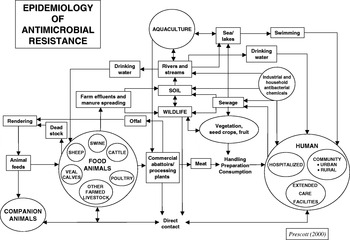
From a public/animal health perspective, and since both mechanisms are ultimately involved in the spread of AMR, it is unclear if there is relevance to the distinction between clonal spread and HGT in the spread of AMR. Although this distinction helps to refine our understanding of the epidemiology or resistance in specific situations, for many purposes, AMR epidemiology could be regarded on a global scale without any regard to its mode of transfer and with more attention to the potential routes of spread (Fig. 2). Clonal spread may be more rapid and driven by specific selection pressures, many unclear and not always related to antimicrobial use only. Clonal extinctions and replacements may also take place. These could possibly be driven by interventions directed at specific serotypes, including, in the case of resistant clones, modification to antimicrobial selection pressure, or the vagaries of clonal biology (e.g. the subsidence of Salmonella Typhimurium DTs 29 and 204, the apparent current subsidence of DT104, the reasons for which remain unclear (Threlfall, Reference Threlfall2000, Reference Threlfall2008)). HGT is potentially more sustained and overall less erratic, as genes or genetic elements shift on an apparent regular basis between bacteria occupying overlapping but different ecological niches. The transfer of individual genes and genetic elements becomes particularly important if the traffic between non-pathogen resistance gene reservoir (e.g. commensal E. coli) and pathogens (e.g. Salmonella, Shigella and Klebsiella) is happening on anything more than an occasional basis.
The pathways of resistance transmission. This diagram (the ‘Confusogram’) has been used in various incarnations to depict the epidemiology of antimicrobial resistance and plausible pathways of spread between various environments. This version was adapted from Prescott (2000). The circles represent potential anthropogenic antimicrobial selection pressure. Some pathways are well described, while others are plausible but lack substantive evidence. Not all plausible pathways are depicted. Please see the text for example references. Reproduced with permission of John Wiley and Sons, Inc.; Antimicrobial Therapy in Veterinary Medicine, by J. F. Prescott et al., pp. 39, © 1988.

Commensals as a reservoir
The reservoirs of AMR genes may be thought of in two categories – one being commensal microflora, primarily of the gastrointestinal tract of humans and animals (Salyers et al., Reference Salyers, Gupta and Wang2004), but including other non-sterile body systems. There are well-documented examples of in vitro and in vivo transfer between commensals and pathogens in gastrointestinal tracts and food matrices (Zhao et al., Reference Zhao, White, McDermott, Friedman, English, Ayers, Meng, Maurer, Holland and Walker2001; Poppe et al., Reference Poppe, Martin, Gyles, Reid-Smith, Boerlin, McEwen, Prescott and Forward2005; Walsh et al., Reference Walsh, Duffy, Nally, O'Mahoney, McDowell and Fanning2008). This reservoir, the development and maintenance of resistance in it, and subsequent transfer to pathogens are thought by many to be a more global threat to health than direct selection pressure on the pathogens themselves, i.e. the occasional de novo development of resistance in a pathogen may be less frequent and less impactful than the constant traffic from the vast commensal reservoir into the relatively small pathogen pool. Understanding the human and animal health impact of gene traffic between this reservoir and pathogens is, however, blurred and complicated by the fact that the distinction between commensal and pathogen is artificial in several regards: what is a commensal to one host species can be a pathogen to another (e.g. Campylobacter in pigs and humans); what is commensal to an individual host can be an opportunistic pathogen to another (e.g. S. aureus, Enterococcus; Top et al., Reference Top, Willems and Bonten2008); and what is commensal in one body system may be pathogenic in another (e.g. extraintestinal pathogenic E. coli (ExPEC) are commensal in the gastrointestinal tract and pathogenic in the urinary tract or bloodstream; they may also be an example of the spread among food animals, companion animals, and humans (see Smith et al., Reference Smith, Fratamico and Gunther2007, for a review of ExPEC).
Environmental reservoir
The other major reservoir of AMR determinants is the environmental and soil microbiota; most, if not all, transferrable AMR genes in pathogens and commensals arose in, and were transferred from, environmental bacteria (D'Costa et al., Reference D'Costa, Griffiths and Wright2007). The extent to which these transfers happen on a regular basis, as opposed to being isolated events in microbial evolution, is unclear. However, in the modern era of antimicrobial use, there may be an artificial selection pressure for this transfer, not to mention disruption of natural microbial ecosystems, under the influence of environmental antimicrobial residues in the breeding grounds represented by sewage, and farm and aquacultural effluent (Kostich and Lazorchak, Reference Kostich and Lazorchak2008).
The pathways of resistance transmission (‘The Confusogram’)
The traffic of genes and genetic elements, and of resistant commensal and pathogenic bacteria between different hosts and ecological niches is complex (Fig. 2). Evidence for these potential pathways is global, and evidentiary examples for most pathways can be found in data from many countries. However, the evidence for each pathway is often incomplete, demonstrating plausibility for a portion of the pathway rather than fully illuminating the entire ‘farm to fork’ pathway for example. The primary focus in the study of the movement, or potential for movement, of bacteria and resistance genes between different ecological niches has been on the direct routes of transmission of human health concern: between human populations directly in the community or in health care settings, and indirectly through food, the environment, particularly in health care settings, and shared fomites; and from food animals to humans, directly or through the food chain via meat, milk and dairy products, eggs, and sea food (see, for example, Smith et al., Reference Smith, Besser, Hedberg, Leano, Bender, Wicklund, Johnson, Moore and Osterholm1999; White et al., Reference White, Zhao, Sudler, Ayers, Friedman, Chen, McDermott, McDermott, Wagner and Meng2001; Huijsdens et al., Reference Huijsdens, van Dijke, Spalburg, van Santen-Verheuvel, Heck, Pluister, Voss, Wannet and de Neeling2006; Adesiyun et al., Reference Adesiyun, Offiah, Seepersadsingh, Rodrigo, Lashley and Musai2007; Klevens et al., Reference Klevens, Morrison, Nadle, Petit, Gershman, Ray, Harrison, Lynfield, Dumyati, Townes, Craig, Zell, Fosheim, McDougal, Carey and Fridkin2007; Khanna et al., Reference Khanna, Friendship, Dewey and Weese2008; Machado et al., Reference Machado, Coque, Cantón, Sousa and Peixe2008). The global nature of the evidence for these pathways is particularly important in the context of international travel, animal movement and food trade. There is also evidence for the potential spread through other routes: between food animals directly or via human intermediaries such as veterinarians and farmers; between companion animals and people; between horses and humans; from food animals to companion animals directly or via the food chain; via wildlife, zoo animals, insects, pet rodents and aquarium fish; from food animals to water and soil; from humans to water and soil; from aquaculture to water; via contaminated fruits and vegetables; and via animal feed (see, for example, Österblad et al., Reference Österblad, Norrdahl, Korpmäki and Huovinen2001;Petersen et al., Reference Petersen, Andersen, Kaewmak, Somsiri and Dalsgaard2002; Sengeløv et al., Reference Sengeløv, Agersø, Halling-Sørensen, Baloda, Andersen and Jensen2003; Weese, Reference Weese2004; Dargatz et al., Reference Dargatz, Strohmeyer, Morley, Hyatt and Salman2005; Anderson et al., Reference Anderson, Parrish, Akhtar, Zurek and Hirt2008; Lefebvre et al., Reference Lefebvre, Reid-Smith and Weese2008; Macovei et al., Reference Macovei, Miles and Zurek2008; Yoke-Kqueen et al., Reference Yoke-Kqueen, Learn-Han, Noorzaleha, Son, Sabrina, Jiun-Horng and Chia-Hoon2008). Because the epidemiology of AMR is so complex, it is unlikely that a comprehensive integrative understanding is possible, i.e. our understanding may always be limited to specific segments of the epidemiology of AMR – the role of a certain genetic element, the effect of particular risk factors, the likelihood of infection with resistant organism given exposure to a given food, etc. The issue at the global level has been likened by some to climate change because of this complexity, the cumulative and synergistic effects of various causative elements, the separation of cause and effect by intervening variables, and the interplay between effects of natural and human origin. As with climate change, interventions (e.g. antimicrobial use bans, restricted labeling, voluntary cessation of specific antimicrobial uses, clinical practice guidelines, infection control and biosecurity practices, development of vaccines and alternatives to antimicrobials, education and behavior modification programs, etc.) targeted at identifiable issues or through specific mechanisms may have an important and, in some cases, measurable impact (e.g. the withdrawal of fluoroquinolones from use in poultry in the US (Nelson et al., Reference Nelson, Chiller, Powers and Angulo2007), the growth promoter ban in Sweden, Denmark and then the European Union (Aaerstrup et al., Reference Aarestrup, Seyfarth, Emborg, Pederson, Hendriksen and Bager2001), the voluntary cessation of ceftiofur use in broiler hatching eggs in Québec Canada (Irwin et al., Reference Irwin, Dutil, Doré, Finley, Ng and Avery2008)), but, ultimately, the greater value of such interventions may be in effecting an incremental long-term shift in the attitude of physicians, veterinarians and other health care providers, food animal producers and the general public toward the prudent use and conservation of antimicrobials.
Conclusion
Refinements in our understanding of AMR emergence and transfer may help develop strategies to better control AMR. Simultaneously, new molecular tools for tracing genes and their carriers will also support both control strategies and monitoring. However, given the complexity of the transmission routes, the unexploited reservoirs of new AMR genes and of mobile elements present in the environment, it is unlikely that a magic bullet will ever solve our fight against AMR. Prudent use of antimicrobials can be refined continuously using the new information and tools, and will always remain the cornerstone of our strategy to protect the efficacy of both old and new antimicrobials.