Introduction
Studies of language acquisition have demonstrated a clear relationship between the amount of time a child spends hearing and speaking a particular language and their success with certain linguistic forms in that language. This has been highlighted for monolinguals (Gathercole, Reference Gathercole1986; Gathercole, Sebastián & Soto, 1999; Hart & Risely, Reference Hart and Risley1995; Maratsos, Reference Maratsos2000) as well as for bilinguals (Gathercole, Reference Gathercole2002a, Reference Gathercoleb, Reference Gathercolec; Oller & Eilers, Reference Oller and Eilers2002; Thordardottir, Rothenberg, Rivard & Naves, Reference Thordardottir, Rothenberg, Rivard and Naves2006). Studies have also demonstrated how certain properties of the input (e.g., the reliability of form–function mappings) influence the pattern and rate of children's acquisition of certain morphosyntactic structures (Lieven & Tomasello, Reference Lieven, Tomasello, Robinson and Ellis2008; Nicoladis, Crago & Genesee, Reference Nicoladis, Crago and Genesee2010; Thomas & Gathercole, Reference Thomas and Gathercole2007; Tomasello, Reference Tomasello2003). These findings have been used to support input-driven accounts of language acquisition, as in, for example, those proposed under an Usage-Based or Constructivist account of language acquisition, whereby frequency of exposure to certain morphosyntactic structures (up to a critical mass), as well as the consistency of their distributional properties, are believed to influence the rate and pattern of acquisition (see e.g., Bialystok, Reference Bialystok2001; Bybee, Reference Bybee2001; Elman, Reference Elman, Tomasello and Bates2001; Elman, Bates, Johnson, Karmiloff-Smith, Parisi & Plunkett, Reference Elman, Bates, Johnson, Karmiloff-Smith, Parisi and Plunkett1996; Gathercole, Reference Gathercole2007a; Gathercole & Hoff, Reference Gathercole, Hoff, Hoff and Shatz2007). This paper aims to explore further the role of input quantity (in terms of home language exposure to language) and input quality (in the form of target-like marking across speakers) in bilingual children's acquisition of complex Welsh plural morphology, under various conditions of minority language exposure.
The role of input frequency has long been the focus of many studies comparing different types of bilingual speakers with monolingual controls. For example, the studies reported in Oller and Eilers (Reference Oller and Eilers2002) included a variety of measures of children's abilities in English and in Spanish, including standardized measures of oral language skills, receptive vocabulary, and morphosyntactic structures, and compared bilingual children from Spanish-speaking homes or Spanish- and English-speaking homes attending either English immersion or bilingual Spanish–English schools with English monolingual controls. Across all tasks and all studies, the general pattern to emerge was that the more input the child received in a particular language, the better they performed in that language. Within the bilingual groups, children who received English alongside Spanish in the home tended to outperform those from Spanish-only homes on tasks of English, especially at the younger ages. A similar trend was found with regard to school language. Children who attended English immersion schools tended to outperform those attending bilingual schools on tasks of English, especially at the younger ages. At the older ages, however, children's performance seemed to “level out”.
A similar pattern was found for tasks in Spanish. The more Spanish the children received at home and at school, the better their performance on tasks of Spanish proficiency. At the older ages, any differences that were found at the earlier ages seemed to become neutralized. The authors argued that bilingual children take longer to acquire the “critical mass” of exposure (see e.g., Maratsos, Reference Maratsos2000; Marchman & Bates, Reference Marchman and Bates1994) to certain linguistic structures that is necessary in order for them to acquire a productive grasp of their stored knowledge. Others, such as Lanza (Reference Lanza1997), have found similar results, while others caution against evaluating the role of increased input without also taking into consideration factors such as socio-economic status, fluency of the input provider, and community context (Goldberg, Paradis & Crago, Reference Goldberg, Paradis and Crago2008). These studies are therefore in support of the notion that the greater the amount or frequency of exposure, the quicker and “fuller” the acquisition, indicating a specific and important role for input.
The influence of input is especially pertinent, therefore, in bilingual communities where the opportunity to receive, hear, and use any one language may be reduced in comparison to a monolingual speaker exposed to the same language, and is particularly noticeable for those languages that operate under minority conditions in those communities (Gathercole, Reference Gathercole2007a, Reference Gathercoleb; Gathercole & Thomas, Reference Gathercole and Thomas2009; Montrul, Reference Montrul2008; Oller & Eilers, Reference Oller and Eilers2002; Thomas & Mayr, Reference Thomas and Mayr2010; see also Paradis, Nicoladis & Crago, Reference Paradis, Nicoladis, Crago, Caunt-Nulton, Kulatilake and Woo2007; Pérez-Leroux, Pirvulescu & Roberge, Reference Pérez-Leroux, Pirvulescu and Roberge2009). These studies also demonstrate how such speakers are able to achieve native-like competence with particular structures, albeit at a later stage, once they receive the appropriate “critical mass of exposure” that may be necessary in order to gain native-like command of those structures (Gathercole, Reference Gathercole2007a; Oller & Eilers, Reference Oller and Eilers2002; Paradis, Reference Paradis2010). This has been demonstrated widely for vocabulary (e.g., Cobo-Lewis, Pearson, Eilers & Umbel, Reference Cobo-Lewis, Pearson, Eilers and Umbel2002a, Reference Cobo-Lewis, Pearson, Eilers and Umbelb; Pearson, Fernández & Oller, Reference Pearson, Fernández and Oller1993; Pearson, Fernández, Lewedeg & Oller, Reference Pearson, Fernández, Lewedeg and Oller1997; Umbel, Pearson, Fernández & Oller, Reference Umbel, Pearson, Fernández and Oller1992; however, see Bialystok & Luk, Reference Bialystok and Luk2012, and Rhys & Thomas, Reference Rhys and Thomas2013) and certain aspects of morphosyntactic and early grammatical development (e.g., Blom, Reference Blom2010; Gathercole, Reference Gathercole2002c; Hoff & Elledge, Reference Hoff and Elledge2005; Thordardottir et al., Reference Thordardottir, Rothenberg, Rivard and Naves2006). However, such gains in native-like competence have not been demonstrated clearly for structures that are complex, even for L1 speakers, in so far as they demonstrate opaque form–function mappings (Gathercole, Reference Gathercole2007a; Gathercole & Thomas, Reference Gathercole and Thomas2005, Reference Gathercole and Thomas2009; Gathercole, Thomas & Laporte Reference Gathercole, Thomas and Laporte2001; Thomas, Reference Thomas2001; Thomas & Gathercole, Reference Thomas and Gathercole2005, Reference Thomas and Roberts2007; Polinsky, Reference Polinsky and Browne1997, Reference Polinsky2008). For example, in Welsh, there is no clear form–function mapping between the form of a noun and the gender it encodes. This, in combination with a number of other factors that render the system complex (see e.g., Ball & Müller, Reference Ball and Müller1992; Gathercole et al., Reference Gathercole, Thomas and Laporte2001; Thomas, Reference Thomas2001; Thomas & Gathercole, Reference Thomas and Gathercole2007) means that acquiring the Welsh gender system is particularly difficult in comparison to other Indo-European languages, particularly for bilinguals with less optimal exposure, and may even be “timed ‘off the map’ for acquisition” (Gathercole & Thomas, Reference Gathercole and Thomas2005, p. 871). This notion of falling short of the necessary time-frame within which speakers need to gain sufficient exposure to certain linguistic forms if they are to be learned at all, is consistent with Montrul's (Reference Montrul2008) notion of “incomplete acquisition”, and that “when language exposure and use is reduced in childhood, the grammatical system of bilingual children in either language, and in some cases of their family language, can be dramatically compromised, especially at the level of morphosyntax” (Montrul, Reference Montrul2008, p. 93). Gains in linguistic knowledge, particularly in contexts of limited exposure, are therefore not necessarily guaranteed for all bilinguals.
While exposure to a language is clearly necessary for language acquisition in monolinguals and bilinguals alike (regardless of one's theoretical persuasion), increasing the amount of exposure by itself is not necessarily sufficient to ensure optimal acquisition of any given structure or language. The quality of the input experienced is also important (Chondrogianni & Marinis, Reference Chondrioganni and Marinis2011; Döpke, Reference Döpke1988; Hulk & Cornips, Reference Hulk, Cornips, Unsworth, Parodi, Sorace and Young-Scholten2006). Numerous studies have focused on quantity issues of input (in terms of amount and length of exposure), yet fewer studies have focused on or involved a measure of the impact of quality issues in relation to bilingual acquisition in particular. Of those that have looked at the role of quality in acquisition, the measure of quality varies across studies, including native vs. non-native input (Hulk & Cornips, Reference Hulk, Cornips, Unsworth, Parodi, Sorace and Young-Scholten2006; Unsworth, Reference Unsworth2013), maternal self-rated proficiency (Chondrogianni & Marinis, Reference Chondrioganni and Marinis2011), sophistication of lexical items and their density in meaningful, instructive interactions (Weizman & Snow, Reference Weizman and Snow2001), socio-economic status (Hoff, Reference Hoff2003), number of individuals providing input (Place & Hoff, Reference Place and Hoff2011), nature of communicative strategies received by the interlocutor (Döpke, Reference Döpke1992), and domain of language exposure (Oller & Eilers, Reference Oller and Eilers2002). An additional marker of “quality” would be uniformity of marking across speakers, particularly in cases where children are acquiring complex morphological structures, with limited form–function mappings. The plural morphology of Welsh is a case in point (see below). Exploring children's rate and pattern of development of various components of the plural system, across speakers receiving various levels of exposure to the language, would help illustrate further the role of quality (uniformity of use) and quantity (amount of exposure to the language and to the forms) of input in influencing children's ability to acquire complex systems in minority language settings.
The Welsh plural system
The Welsh plural system involves a complex mechanism for modifying noun number. The system is loosely based around two basic principles: (i) element addition or deletion (addition of a plural or singular suffix, deletion of singular suffix to denote the plural), and (ii) element substitution (alternating plural and singular suffixes, and/or alternating sound elements within the root) ([P. W.] Thomas, Reference Thomas1996). Each of these principles is discussed in more detail below.
Element addition or deletion
Adding a plural suffix to a singular root is the most frequent way of marking the plural in Welsh. Each suffix carries an additional syllable, resulting in further alterations to the final plural form in some instances. These additional alterations take the form of mutationFootnote 1 and other sound alterations (Thomas, Reference Thomas1996).
The most common plural suffixes are -aid, -au, -i, -od, -oedd, -on and -ydd, often used in combination with additional changes in sound quality and/or vowel alternations (e.g., -(i)au: pen (sg) /pɛn/ “head” – pennau (pl) /pɛnːaɨ/ “heads”; -i: pêl (sg) /peːl/ “ball” – peli (pl) /pɛli/ “balls”; -oedd: môr (sg) /moːr/ “sea” – moroedd (pl) /mɔrɔɨð/ “seas”; -od: cath (sg) /kɑːθ/ “cat” – cathod (pl) /kaθɔd/ “cats”). The plural suffixes that are attachable to the least number of nouns are -aint, -ed, -edd, -en, -(i)ach and -yr, affecting only a small, closed set of (mostly) infrequent nouns (e.g., câr (sg) /kɑːr/ “friend, loved one” vs. ceraint (pl) /kɛraint/ “friends/loved ones”; ych (sg) /ɨːχ/ “ox” vs. ychen (pl) /əχɛn/ “oxen”), although some are highly frequent forms among the set (e.g., brawd (sg) /braʊd/ “brother” vs. brodyr (pl) /brɔdɨr/ “brothers”; merch (sg) /mɛrχ/ “girl” vs. merched (pl) /mɛrχed/ “girls”; gwraig (sg) /ɡuraiɡ/ “wife, woman” vs. gwragedd (pl) /ɡuraɡɛð/ “wives, women”).
In relation to the collective-unit system (Roberts & Gathercole, Reference Roberts and Gathercole2006), Welsh also has a reverse process of forming the plural through suffix deletion (e.g., mochyn (sg) /mɔχɨn/ “pig” – moch (collective, pl) /mɔːχ/ “pigs”) (see also King, Reference King1993; Thomas, Reference Thomas1996; Thorne, Reference Thorne1993).
Element substitution
While, in many cases, the plural suffix is attached to a singular root (e.g., cath “cat”, cathod “cats”), there are cases where the plural suffix alternates with a singular suffix (e.g., -en (sg) and -od (pl): cwningen /kunɪŋɛn/ “rabbit” – cwningod /kunɪŋɔd/ “rabbits”). The most typical substitution, however, involves various combinations of internal vowel changes that often occur in combination with sound alterations on penultimate vowels (e.g., /a/–/ε/, /a/–/ai/: dafad (sg) /davad/ – defaid (pl) /dɛvaid/ “sheep”; /a/–/ε/, /ɨ/, a larch (sg) /alarχ/ “swan” – e lyrch (pl) /ɛlɨrχ/ “swans”). While there are some sound changes that are partially predictable based on the vowel sound present in the word stem (e.g., stems including /a/ or /ɛ/ often alternate with /ɨ/ – e.g., alarch /alarχ/ – elyrch /ɛlɨrχ/ “swans”; castell /kastɛɬ/ – cestyll /kɛstɨɬ/ “castles”) these patterns are not applied across-the-board (e.g., dafad /davad/ – defaid /dɛvaid/ “sheep”, not *defyd /dɛvɨd/; pibell /pibɛɬ/ – pibellau/pibɛɬaɨ/ or pibelli /pibɛɬi/ “pipes”, not *pibyll /pibɨɬ/) (see Thomas, Reference Thomas1996). While such phonological cues may help the child build their knowledge of a small, closed set of items where such patterns exist, learning of these items is more likely to be item-by-item than systematic.
In addition to suffix additions, deletions and alternations, with or without vowel change, the system is complicated further by the multifunctionality of particular endings, and by the fact that, in many cases, there is nothing in common between the singular roots that help dictate which plural form they take. For example, many singular nouns indicating person or object have the -ydd suffix (e.g., melinydd “miller”, gobennydd “pillow”); some abstract nouns have -i or -ydd (diogi “laziness”, caledi “hardship”, llawenydd “joy”); and some verb-noun forms (forms that can function both verbally (as infinitive) and nominally) have -(h)áu (e.g., agosáu “to approach”, casáu “to hate”). Moreover, a number of verb-nouns and nouns have the same phonological endings as some of these plural suffixes, including -i (drewi “to stink”, gweiddi “to shout”), and a number of multi-syllabic singular nouns end in -od (e.g., tafod “tongue”, cawod “shower”).
Only two suffixes, -au and -oedd, function solely as plural markers. However, while -au affects a number of words, -oedd affects fewer, and neither pattern is predictable since there are no common features across the root forms that take either -au or -oedd as their plural. (See Tables 3 and 4 for further indication of the frequency of certain plural forms in Welsh.)
The plural system in Welsh is thus complex, and largely involves opaque form–function mappings. Given the nature of the system, one could predict that the acquisition of Welsh plural morphology will be protracted. However, in the process of acquisition, forms that follow typical rules of plural formation in Welsh, such as suffix addition, are likely to be most productive, and the easiest to learn. If children are learning the suffix addition rule systematically, the -au form is most likely to be the least problematic to acquire, due to its frequency in the language and its unitary function as a plural marker (Thomas, Reference Thomas1996), and is most likely to be overgeneralized during acquisition. Should frequency of exposure to examplars in the language for the purpose of rule abstraction not matter, then we would expect similar rates of acquisition among different types of bilinguals on these forms. The aspects of the system that will be most problematic to acquire are likely to be those involving the subtle sound changes that affect the root, with or without the addition, alternation or deletion of a plural suffix due to their limited predictability (Thomas, Reference Thomas1996), and are likely to be highly contingent on frequency of exposure. Those who receive the greatest amounts of exposure to the language (and thus to these forms) are likely to demonstrate faster acquisition of these forms. Finally, suppletives and nouns denoting the mass–count distinction may be learned on an individual basis, due to their limited type frequency in the language (see e.g., Bybee, Reference Bybee2001).
Despite its complexity, however, fluent adult speakers seldom produce the incorrect plural form if pluralizing in Welsh, particularly for concrete nouns that feature greatly in child input. Speakers will sometimes use the English -(i)(e)s ending (henceforth represented as -s), sometimes by choice (to mark an emphatic statement or to be humorous), sometimes because they may not know or are unable to recall the correct plural form in Welsh at that precise moment in time (e.g., pwrsus /pursɨs/ “purses” for pyrsiau /pərʃaɨ/ as a plural of pwrs /purs/ “purse”), and sometimes because the -s form has been accepted into the language (e.g., ffarmwrs /farmurs/ “farmers” is a frequent colloquial form which is an acceptable alternative to ffermwyr /fɛrmuɨr/ – Griffiths & Jones, Reference Griffiths and Jones1995). (However, note that this is not very frequent, as shown in Study 1 below.) But outside these uses, children are very likely to be experiencing input that is relatively uniform in its marking. Consequently, one could hypothesize that if uniformity of input is important, children will learn the Welsh plural system quickly, and with relative ease (see Lieven & Tomasello, Reference Lieven, Tomasello, Robinson and Ellis2008; Tomasello, Reference Tomasello2003). However, if children who are receiving the least amount of exposure to Welsh (i.e., children from English-speaking homes attending Welsh-medium schools) are unable to catch up with peers who are receiving ample exposure to Welsh at home and at school in relation to the Welsh plural system, particularly in relation to those forms that are predicted to be acquired systematically, then we can conclude that the uniformity of the input is not enough by itself to counteract the effects of limited amounts of exposure or to “speed up” the accumulation of a critical mass of exemplars needed to sort out complex structures in a minority language.
Predictions
This study involved two components: first, we analysed naturalistic adult–adult speech corpora for instances of plural usage in order to determine the uniformity of marking of the structure among adults, and second, we elicited children's productions of the plural forms of a wide selection of nouns in Welsh.
In relation to the adult speech corpora, we predict that adults’ use of the plural system in Welsh would be uniform across speakers, demonstrating few errors in naturalistic speech. Our analysis would also identify the prominent patters of forms in the input in order to help identify the forms that are most frequent in the input.
In relation to children's productive command of the plural system in Welsh, comparing performance of L1 Welsh bilinguals (children from Welsh-speaking homes), L2 Welsh bilinguals (children from English-speaking homes), and 2L1 bilinguals (children from mixed Welsh- and English-speaking families), across two age groups (with adults from similar language backgrounds for comparison), we explored the role of home language exposure on bilingual children's acquisition pattern. We made the following predictions:
-
(i) Due to the higher amount of Welsh input, L1 Welsh bilinguals would approach adult-like knowledge of plural morphology faster than other bilinguals.
-
(ii) L2 Welsh bilinguals’ command of the system would approach that of L1 Welsh bilinguals as they became older, with the 2L1 bilinguals performing somewhere in between.
-
(iii) All bilinguals would demonstrate quicker progression with the less opaque aspects of the system (those requiring suffix addition (+suff)/alternation (~suff)/deletion (–suff) and the suppletives) than with the more opaque structures (those requiring sound alteration to the root, with or without suffix addition (+suff +V)/alternation (~suff +V)/deletion (–suff +V)), with type frequency in the language influencing the pattern of acquisition within these forms. Among these forms, we predicted that the +suff forms would be the most productive, with items involving sound alternations more susceptible to item-by-item learning.
Study 1: Adult use of the system
The dataset
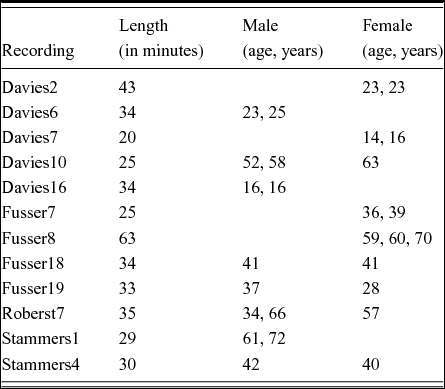
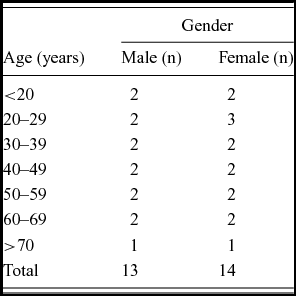
In order to analyse adults’ naturalistic use of the plural system in Welsh, we selected 12 sets of recordings from the Siarad corpus (Deuchar & Davies, Reference Deuchar and Davies2009) which are already transcribed and available on Childes (MacWhinney, Reference MacWhinney2000) via Talkbank. This selection from the corpus totalled 405 minutes (6 hours 45 minutes) overall. Each recording included naturalistic conversations between two or three acquaintances, which lasted between 25 and 63 minutes. The 12 recordings were selected carefully in order to ensure a wide sample of participants covering different age groups and representing both male and female speech. Across the 12 recordings, there were 27 different speakers, 13 male and 14 female, with ages ranging between 14 and 72 years (see Tables 1 and 2). All speakers were native Welsh speakers (all bilingual, with English as their second language; see Deuchar & Davies, Reference Deuchar and Davies2009, for more information).
Length of recordings and participant information.

Balancing of the sample across age and gender.

Procedures
Each transcript was analysed for all instances of plural forms – in Welsh and in English – that appeared within the text. Each instance was coded as being correct or incorrect in form, according to prescriptive norms, and any additional information (e.g., an English plural form used in a film title) was also noted.
Results
Frequency of forms in the input
A total of 1078 plural forms was produced during the 405 minutes of recordings. Two forms were eliminated from analysis – (g)weithiau “sometimes” (31 tokens) and arddegau “teen years” (1 token) – since they have no clearly defined forms in the singular. A further 16 tokens were eliminated since the classification of the plural “type” could be one of two, depending on the singular form that the speaker would use – e.g., athrawon “teachers” could be classified either as +suffix with a vowel alteration (+suff +V) if the singular form was athro “teacher (masculine)”, or singular–plural suffix alternation (~suff) if athrawes “teacher (feminine)”. Analysis was therefore conducted on the remaining 1030 forms, as detailed below.
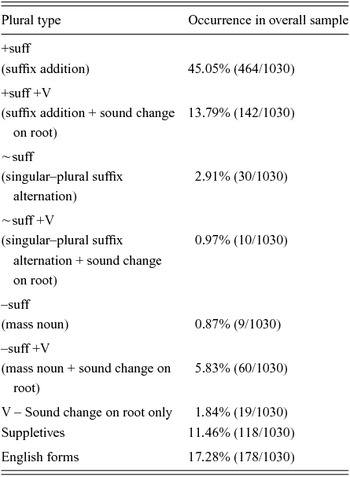
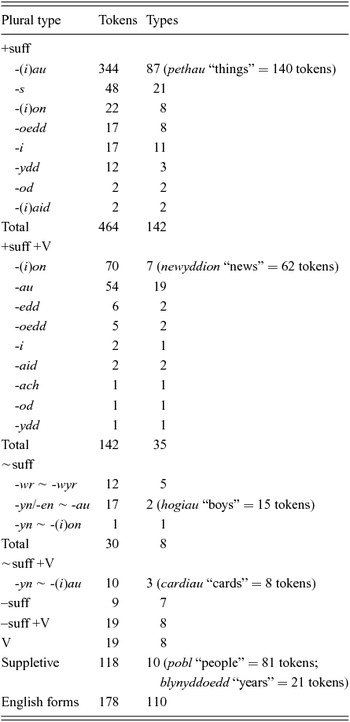
A variety of plural types was produced among the 1030 forms identified, inclusive mostly of suffix additions such as -(i)au, -i, -(i)on, -oedd, -od, -(i)aid and -ydd (with or without sound alteration) and mass noun forms, and fewer instances of less common suffixes such as -edd, -(i)ach and -(w)yr, singular–plural suffix alternation, vowel alternations, and suppletive forms. Proportions of the plural form productions per “type” are presented in Table 3, followed by type–token ratios in Table 4, where distinct classification was possible.
Proportion of plural types.

Type–token ratio.

As can be seen from Table 3, suffix addition (+suff) was by far the most prominent plural type among the sample, followed by the use of English cognates (with an English -s ending), suffix addition with sound changes, and suppletives. Suffix alternations (with or without sound changes) and pure vowel changes were the least common.
Among the most prominent plural types (+suff and +suff +V), some forms were more frequent than others (see Table 4). In particular, forms involving an addition of the -au suffix were by far the most prominent form within +suff (344 tokens, 87 types) and +suff +V forms (54 tokens, 19 types). These patterns reflect the prominence of these forms as plural markers in the language.
Together, these results suggest that (i) plural morphology is marked uniformly across adult speakers in adult–adult interactions, and should remain so in child-directed speech; and (ii) +suff and +suff +V are the most prominent forms in the input.
Error analysis: Adult forms
Of the 1030 plural forms analysed, only 5 (0.49% of the whole sample) could be classified as “pure” errors. These errors included *taids for teidiau “grandfathers” from the singular taid “grandfather”, *stondins for stondinau “stalls” from the singular stondin “stall”, and *haearns for heyrn “irons” from the singular haearn “iron”, all of which involved an overgeneralization of the English plural pattern of adding an -s to an unaltered root. Another error – *archfarchnadau for archfarchadoedd “supermarkets” – involved the speaker using the incorrect plural suffix, and in a further error – *diwrnodiau for diwrnodau “days” – the speaker used the appropriate suffix -(i)au, but selected the wrong form (i.e., with the -i-). Such “errors” are extremely subtle and may even be dialectal, or could simply have reflected a performance error.
An additional 226 forms (21.92% of the whole sample) were English borrowings. Of these borrowings, 22 had plausible Welsh plural forms; however, the speakers opted to use the English forms instead (e.g., cameras was used instead of camer âu , tablets instead of tabledi , artists intead of artistiaid ). Again, these forms cannot be coded as “errors” since it is not clear whether the speaker was using the English as a borrowing or simply “Anglicizing” the Welsh form.
Overall, this analysis suggests that adults’ productive command of the plural system in Welsh is extremely uniform across speakers, rendering the quality of the input to children consistent and reliable. The next section explores children's productive command of the system via an elicitation task.
Study 2: Children's productive command of the system
Method
Participants
Children
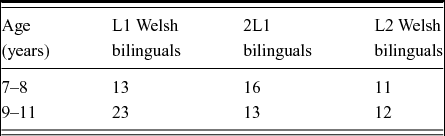
Eighty-eight children took part in the study, 40 boys and 48 girls. For the purpose of measuring age progression, the children were divided into two age categories: 7–8 years (N = 40, age range 7;4–8;11, M = 8;0) and 9–11 years (N = 48, age range 9;0–11;2, M = 10;0). Within each age category, the children were subdivided into one of three bilingual groups (as measured by the language(s) spoken by the parent(s) to the child, see Gathercole & Thomas, Reference Gathercole and Thomas2009, and Gathercole, Thomas & Hughes, Reference Gathercole, Thomas and Hughes2008, for similar coding). L1 Welsh bilinguals were those who were raised in Welsh-speaking households, where both parents spoke Welsh to the child from birth. For these children, the acquisition of English developed after the acquisition of Welsh (around age 3). 2L1 bilinguals were those who were raised in mixed Welsh- and English-speaking households, where one parent spoke Welsh to the child from birth and one parent spoke English to the child from birth. Thus, for these children, both languages were acquired simultaneously. L2 Welsh bilinguals were those who were raised in English-speaking households, where both parents spoke English to the child from birth, but the children were exposed to Welsh upon starting school at age 4. Table 5 outlines the number of children per age, and per language exposure classification.
Numbers of children who participated, by language group and by age.

The children were recruited from primary schools in Gwynedd, a county situated in north-west Wales where there is a long-established bilingual education policy and where we find the highest proportion of Welsh speakers in the whole of Wales (Morris, Reference Morris2010). The schools included in this study spanned various sub-regions, from regions where the majority of the population (and hence the majority of children at school) speak Welsh as a home language, to those where the majority of the population (and hence the majority of children at school) speak English as a home language. In all cases, children whose parents spoke Welsh to them were themselves bilingual in Welsh and English, while parents who addressed their children in English were typically only English speakers. While is was impossible to quantify the exact amount of exposure each child received in each language for this present study, the major difference between the groups related to the age at which they were exposed to the second language, and whether that language was English or Welsh.
Adult controls
Ten Welsh–English adult bilinguals were recruited for each of three language group types (10 L1 Welsh bilinguals, mean age = 46; 10 2L1 bilinguals, mean age = 28; and 10 L2 Welsh bilinguals, mean age = 36). (All adults recruited for Study 2 were different from those who took part in Study 1.) Although none of these adults had any relation to the children involved in the study, they nevertheless provided a good comparison measure of the ultimate achievement one could expect for children receiving different levels of exposure to Welsh. As was the case with the children, the L1 Welsh adults grew up in families where both of their parents spoke Welsh to them at all times, but learned English gradually from exposure in the community and to some extent at school. The 2L1 bilingual adults grew up in families where one parent spoke Welsh and the other spoke English to them. While it is impossible to quantify how often these speakers were exposed to either language in the home, they were all exposed to both languages at home from birth. The L2 Welsh bilingual adults grew up in families where both parents spoke English to them at all times, with their exposure to Welsh happening only when they started school. All adult participants lived in one of two dominant Welsh-speaking regions of Wales – Gwynedd (where 69% of the county spoke Welsh) and Ceredigion (where 52.01% of the county had some knowledge of Welsh) (Census, 2001). Apart from two L2 Welsh participants, all adults attended primary schools where the predominant language of instruction was Welsh, and secondary schools where the linguistic provision was either bilingual, or predominantly Welsh. In the case of the other two L2 Welsh adults, their primary school experience was through the medium of Welsh, but they attended English-medium secondary schools (where Welsh was taught as a subject). However, both adults spoke Welsh on a daily basis as adults, due to the nature of their professions.
Design and procedures
Linguistic stimuli
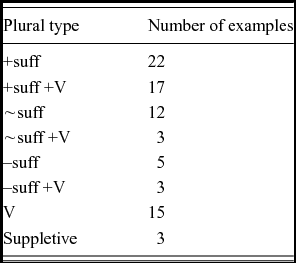
In order to gain a comprehensive knowledge of children's productions of plural forms, we designed an elicitation task that elicited oral production of these forms. For this task, we selected a series of 80 target words covering eight of the possible plural “types” in Welsh: (i) +suff (addition of plural suffix – e.g., coes /kɔɨs/ “leg”, coesau /kɔɨsaɨ/ “legs”); (ii) +suff +V (addition of plural suffix + internal vowel change – e.g., cwch /kuχ/ “boat”, cychod /kəχɔd/ “boats”); (iii) ~suff (singular to plural suffix change – e.g., hoelen /hɔɨlɛn/ “nail”, hoelion /hɔɨliɔn/ “nails”); (iv) ~suff +V (singular to plural suffix + vowel change – e.g., deigryn /dɛiɡrɨn/ “tear”, dagrau /daɡraɨ/ “tears”); (v) –suff (mass noun forms – e.g., mochyn /mɔχɨn/ “pig”, moch /moːχ/ “pigs”); (vi) –suff +V (mass noun from + internal vowel change – e.g., aderyn /adɛrɨn/ “bird”, adar /adar/ “birds”); (vii) V (internal vowel/diphthong change only – e.g., troed /trɔɨd/ “foot”, traed /traɨd/ “feet”); and (viii) suppletive (plural forms not easily derived from the root – e.g., llaw /ɬɑːu/ “hand”, dwylo /duɨlɔ/ “hands”). All possible examples that were deemed appropriate for primary school-aged children were given to each child (see Table 6). All words selected had picturable referents and covered a range of different frequency counts (as measured by the Cronfa Electroneg o'r Gymraeg – a one-million word corpus of written Welsh, Ellis, O'Dochartaigh, Hicks, Morgan & Laporte, Reference Ellis, O'Dochartaigh, Hicks, Morgan and Laporte2001).
Number of items per plural type.

Scoring of the children's responses involved 1 for a correct form (involving all the alternations, additions, and subtractions required), and 0 for anything else. Since the plural suffix -(i)au is often reduced to -(i)a or -(i)e in the spoken dialects of the children involved in this study, forms with these suffixes were accepted as correct (provided that the accompanying sound alteration was also performed where appropriate). For this purpose, two native Welsh-speaking researchers, both from North Wales and aware of the various varieties of the North Wales dialect, collected the data.
Non-linguistic stimuli
Children (and adult controls) were shown a series of 11 coloured picture scenes (in the park, animals at the zoo, the human body, in the kitchen, at school, in the countryside, in the living room, at the farm, on the street, around the house, in the garden) and a slide with additional items that we were unable to link thematically. Each page involved a number of picture items arranged around a central picture scene. Each individual picture scene was placed in the centre of an A4 size page. Target items were copied from within the scene and framed around the picture on the same page. The child's task was to simply provide the form used to refer to more than one of each of the target items selected from within the picture. The researcher asked the child to simply tell her what we call more than one X: Be’ ’dan ni'n galw mwy nag un X? “What do we call more than one X?”, and she wrote down their responses on a recording sheet. In order that we received the children's responses to all target items, the researcher provided the singular form each time.
Raven's Progressive Matrices (RPM)
Each child was given a purposefully selected subset of 12 slides from the Raven's Progressive Matrices (RPM, Raven, Raven & Court, Reference Raven, Raven and Court1998), covering a range of difficulties, as a control measure of non-verbal intelligence. Instructions on how to complete the task were provided in the children's preferred language. (The whole test was not administered due to time restrictions, therefore analysis was performed on the raw scores.) A univariate ANOVA revealed a main effect of Age (F(1,87) = 9.02, p = .004) indicating better performance among the older children (42.6%) than the younger children (60.62%), as expected, but no main effect of Bilingual Group (F(2,87) = .969, p = .384) indicating comparable general abilities across the children in each bilingual group within a given age group.
Results
Children's plural oral production task
An 8 × 3 × 2 repeated measures ANOVA was conducted on the data, with performance on each of the eight plural form types (“Plural Type”) (+suff, +suff +V, ~suff, ~suff +V, –suff, –suff +V, V and suppletive) entered as the dependent variable and Bilingual Group (L1 Welsh, 2L1, and L2 Welsh) and Age (7–8 and 9–11 years) entered as independent variables.
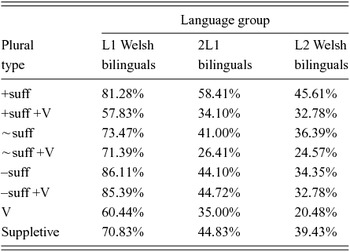
The results revealed a main effect of Bilingual Group (F(2,82) = 22.408, p = .000), Age (F(1,82) = 7.281, p = .008), and Plural Type (F(7,574) = 16.834, p = .000). Mean percent responses are presented in Table 7. The Age effect was due to the older children (55.96%) outperforming the younger children (42.14%), and the Bilingual Group effect was due to more advanced performance among the L1 Welsh bilinguals (72.04%) as compared to the 2L1 bilinguals (42.09%) or the L2 Welsh bilinguals (33.03%). There were no significant differences between the 2L1 and the L2 Welsh bilinguals’ performance. The fact that the 2L1 bilinguals’ performance remained so much lower than that of the L1 Welsh bilinguals at this age is interesting. We return to this point in the “Discussion” section below. In contrast, the adult data revealed higher performance across the board, although the L1 Welsh adults were the only ones to display ceiling effects for all items with the L2 Welsh adults averaging around 65%–80% on most items (see Figures 1–3). In terms of Plural Type, performance on items involving no alteration to the root form (+suff: 61.5%, ~suff: 50.36%, –suff: 55.31%, suppletives: 51.27%), was better, typically, than on those involving suffix addition, alternation or deletion in addition to sound alteration to the root form (suff +V: 41.41% and ~suff +V: 40.1%, V: 37.98%) (although performance on those items requiring suffix alternation plus sound alteration (~suff +V: 54.48%) was typically high).
Mean scores on plural oral production task per plural type and language group.

L1 Welsh children (7–8- and 9–11-year-olds combined) vs. L1 Welsh adults’ performance across all plural types.

2L1 children (7–8- and 9–11-year-olds combined) vs. 2L1 adults’ performance across all plural types.

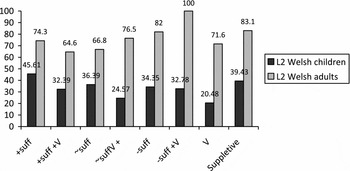
L2 Welsh children (7–8- and 9–11-year-olds combined) vs. L2 Welsh adults’ performance across all plural types.

Finally, while L2 Welsh children's performance was low across all plural types, the best performance was again on +suff (45.61%), and worst on ~suff +V (24.57%) and V (20.48%), with all other types somewhere in-between these two extremes. Figure 3 plots their performance against L2 Welsh adult controls.
The effect of Plural Type was modified further by Bilingual Group (F(7,574) = 2.945, p = .000), demonstrating that while L1 Welsh bilinguals were approaching adult norms on each structure, those from mixed or English-speaking homes (2L1 bilinguals and L2 Welsh bilinguals) were progressing at a slower pace (all SEs ≤ 10.6; all ps < .05; mean scores ranging from 57.83% (+suff +V) to 86.11% (–suff) for the L1 Welsh children, from 26.41% (~suff +V) to 58.41% (+suff) for the 2L1 children, and from 20.48% (V) to 45.61% (+suff) for the L2 Welsh children). Within each bilingual language group, the degree of difference across the various plural types varied, as detailed below.
First, it is noteworthy that the L1 Welsh children performed well on most forms, particularly those requiring suffix addition, alternation or reduction without additional vowel change to the root (+suff: 81.28%, ~suff: 73.47%, and –suff: 86.11%). The poorest performance was on those items requiring sound alteration to the root form with or without suffix addition (+suff +V: 57.83% and V: 60.44%) with performance on ~suff +V and suppletives somewhere in between (~suff +V: 71.39% and suppletion: 70.83%). Figure 1 plots their performance against L1 Welsh adult controls.
Interestingly, 2L1 children produced fewer target forms than L1 Welsh bilinguals in each plural category. For these children, performance was best on category +suff (58.41%), and worst on ~suff +V (26.41%). Figure 2 plots their performance against 2L1 adult controls.
Together, these results demonstrate the role of transparency in aiding children's acquisition of structures with those items involving sound alteration to the root being the most difficult to acquire for all children.
These results clearly demonstrate the influence of home language exposure on children's progression with a complex structure. L1 Welsh-speaking children from exclusively Welsh-speaking homes are closely approaching the adult norm on some forms by age 11. However, although 2L1 and L2 Welsh bilinguals failed to approach their L1 peers by age 11 (and fell far behind their respective adult control norms), there was progression with age, for all plural types.
Regardless of these lower scores among the 2L1 and L2 Welsh children, all children were capable of producing some correct forms, thus demonstrating that there was learning in progress. Since scoring on the test was strict in that the children were given a score of 1 if the whole word form was correct and a 0 if any or all of it was incorrect, such a scoring procedure may have concealed additional information regarding children's knowledge of the system. For this reason, children's errors were inspected further for the purpose of identifying any salient patterns among the children's attempts at forming the plural.
Error analysis
Given the relative transparency of the plural system in English as compared to Welsh, one might expect that a number of the errors produced by the children, especially the L2 Welsh bilinguals, would involve the overgeneralization of the English -s suffix. However, this was not the case for this dataset. While some such forms were present, they were nevertheless rare, with most of the forms being attempts at formulating the plural using a variety of plausible Welsh forms.
In what follows, we discuss (i) zero plural marking (reiterations of the singular form or forms with non-plural suffixes); (ii) use of the English -s; (iii) patterns of overgeneralizations; (iv) attempts at altering the root, in combination (or not) with the insertion of plural suffixes; and (v) alternation of a singular suffix for a plural suffix when no suffix was required.
Zero plural marking
Productions of forms that did not carry plural morphological features, or did not involve an (incorrect) attempt at sound alteration, were low for all groups (15.26% of all attempts for L1 Welsh children, 25.48% for 2L1 children, and 12.54% for L2 Welsh children). While such attempts were found in all bilingual groups and for all plural types (apart from the older L1 Welsh children who produced no such errors for +suff – the most prominent type), albeit at a slightly higher proportion among the 2L1 bilinguals, they were, nevertheless, infrequent errors. (While it is impossible to know for sure why the 2L1 bilinguals produced more of these forms than the other bilinguals, one might speculate that since the 2L1 bilinguals were exposed to both Welsh and English from birth, this may have resulted in heightened knowledge, and possible use, of the English forms, particularly in code-switching, leading to weaker knowledge and production of these forms in Welsh.) This suggests that children's errors consisted mostly of attempts at generating the plural form.
English -s
Contrary to expectation, L2 Welsh children did not rely on the (plausible) use of -s as a default strategy. (Recall that adults produced only 48 tokens (4.66%) involving -s among their 1030 plural utterances in Study 1.) In fact, the use of -s was minimal across the eight plural types examined, for all three bilingual groups, and for all ages, and particularly so among L2 Welsh children (used in an average 1.49% of errors as compared to 2.58% of errors produced by 2L1 children and 6.34% of errors produced by L1 Welsh children).
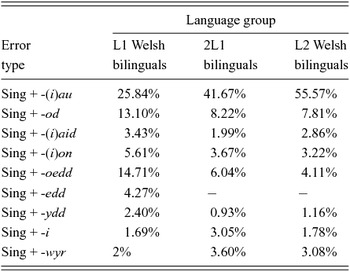
Overgeneralizations: -(i)au and -od
The overgeneralization of the -au suffix (followed by -od) to a singular, unaltered root was by far the most common type of error (from 11.11% to 51.35% across the plural types for L1 Welsh children; 7–8-year-olds’ average: 27.69%, 9–11-year-olds’ average: 31.39%). (See Table 8.) Such an overgeneralization pattern was particularly salient among the 2L1 (6.25%– 59.48% across plural types; 7–8-year-olds’ average: 44.07%, 9–11-year-olds’ average: 29.95%) and L2 Welsh children (from 26.67% to 80% across plural types; 7–8-year-olds’ average: 56.58%, 9–11-year-olds’ average: 54.31%). These overgeneralization errors are not surprising as they reflect the input patterns discussed under Study 1 (refer to Table 5 above). However, while -au was clearly used as a default strategy, its use was not exclusive. (Only four children used the -(i)au suffix in over 80% of their responses, three 2L1 children (two in the 7–8-years age group and one in the 9–11-years age group) and one L2 Welsh child in the 9–11-years group.) Children from all language backgrounds produced errors involving -(i)aid, -(i)on, -oedd and -i, in addition to a few examples of -ydd, while L1 Welsh children and 2L1 children produced, in addition, a few examples of -wyr, with one L1 Welsh child producing a single example involving -edd. These suffixes are also present, to various extents, in the input. Such patterns of responding demonstrate a developing knowledge of the processes by which plurals are formed in Welsh, yet children remain unsure as to the exact process in relation to a given word at age 11.
Number of overgeneralizations per home language group.

Alterations to the root
As shown in the analyses above (see Figures 1–3), items requiring root alterations, with or without plural suffix (+suff +V, ~suff +V, V), were the most problematic for the children. However, there were errors that involved an element of root form change, only not in the appropriate manner. For example, *geirdd /ɡeirð/ was used instead of gerddi /ɡɛrði/ as the plural for gardd /ɡarð/ “garden”, and *neint /neint/ was used instead of nentydd /nɛntɨð/ for nant /nant/ “stream”. However, it is noteworthy that most attempts at changing the root form of the word were found in relation to +suff +V. These patterns suggest that children are aware of the sound-change pattern as a way of marking the plural of some specific types of roots, and that children are attending to and extracting out the rules from the input they are receiving. However, they are yet to fully acquire the subtleties of these patterns, presumably due to the limitations in the amount of input they receive.
Singular–plural suffix alternation
Children's attempts at forming the appropriate plural via the deletion of a singular suffix (types –suff and –suff +V) involved a tendency to alternate the singular suffix with a plural suffix (usually -au) rather than eliminate a suffix altogether. For example, mochyn “pig” was often produced as *mochod instead of moch (with a possible overgeneralization of the -od because of its propensity in relation to the plural forms of nouns for animals).
Together, these patterns of errors do demonstrate a developing knowledge of the underlying properties of the system. The implications of our results from Studies 1 and 2 for theories of language acquisition are discussed below.
Discussion
The studies reported in this paper aimed to explore the role of input quality (in terms of uniformity of use) and quantity (in terms of amount of exposure) on children's productive command of complex plural morphology in Welsh. The results revealed a number of interesting patterns that warrant further investigations. These patterns are discussed, first, in relation to adult use of the system (uniformity of marking in the input), both in naturalistic speech and in the experimental task; second, in relation to children's developing knowledge of the system, given their patterns of exposure at home (quantity of exposure); and, third, in relation to performance on the more opaque vs. the less opaque structures within the system (transparency of structure). This is then followed by a discussion of error patterns, before a more general discussion of the implications of the findings to theory and practice.
Uniformity of marking in the input
As predicted, analysis of adults’ spontaneous speech data revealed target-like marking of plural forms. Target forms were observed across a variety of possible plural structures, with a number of those forms found in the speech of all speakers analysed. On the plural production task, adult performance was generally good, with L1 Welsh adults performing at ceiling (averaging 97.63%), with the 2L1 adults averaging 88.17% and the L2 Welsh adults averaging 77.36%. These provide further evidence to support the notion that adult input to children – in relation to plural forms – is relatively uniform, particularly among L1 speakers. This uniformity of marking within the input may well facilitate children's acquisition of the system, provided that the appropriate amount of exposure is received and from those who use the language on a daily basis.
Quantity of exposure
As highlighted previously in the literature, our results demonstrated quite clearly a relationship between home-language exposure and performance on the plural task (as shown by e.g., Gathercole & Thomas, Reference Gathercole and Thomas2009, for gender). However, given the uniformity of plural marking in L1 Welsh adult input, we predicted further that L1 Welsh children would demonstrate the fullest acquisition of plural morphology. This prediction was partially upheld. Performance of the L1 Welsh children (those from Welsh-speaking homes) approached ceiling on many of the plural types (+suff: 81.28%, –suff: 86.11%, –suff +V: 85.39%), with good performance (increasing with age) on other forms (+suff +V: 57.83%, ~suff: 73.83%, V: 60.44%, suppletives: 70.83%). Such results suggest that L1 Welsh-speaking children are approaching L1 Welsh adult norms on the more transparent aspects of the plural system by age 11, while continuing to acquire the more opaque structures. Contrary to prediction, however, L2 Welsh children's command of the system did not appear to approach that of their L1 peers (averaging between 20.48% and 39.43% across the plural types), neither did its command by simultaneous, 2L1 children (averaging between 26.41% and 44.83% across the plural types). This pattern is supported further by the adult data, whereby those from 2L1 and L2 Welsh backgrounds failed to perform on par with those from L1 Welsh backgrounds, indicating that the target norm for each type of bilingual is not the same. This latter effect is interesting as it demonstrates how receiving Welsh from birth at home (i.e., having an early Age of Onset) is not sufficient enough by itself to allow for the acquisition of the plural system by the end of primary school age, or indeed by later adulthood. In fact, the results of 2L1 children patterned more like L2 Welsh children, a finding that has been previously reported for aspects of children's acquisition of gender and word order in Welsh (Gathercole, Laporte & Thomas, Reference Gathercole, Laporte and Thomas2005; Gathercole & Thomas, Reference Gathercole and Thomas2005; see also Kupisch, Reference Kupisch2012, for similar results for the acquisition of determiners by simultaneous German–Italian bilinguals in their weaker language). There are two main reasons why this may be, including language-internal and language-external factors. In terms of language-internal factors, given that even the L1 Welsh children were still in the process of acquiring the system while approaching adult norms at age 11, the Welsh plural system may simply be subject to late acquisition due to its complexity, leading to delayed pattern of performance, particularly among those with less exposure to the language. Further studies need to look beyond age 11 in order to gain a more complete pattern of development of this structure. In terms of language-external factors, recent studies have identified patterns of “incomplete acquisition” or “incomplete competence” among heritage language speakers who reside in the US, particularly in their knowledge of complex structures, such as Russian gender marking, in their L1 (Polinsky, Reference Polinsky and Browne1997, Reference Polinsky2008). Here, heritage language speakers are defined as those who were first exposed to their L1 (Russian) at home, usually without any further support at school, but whose L1 has subsequently been replaced by another language (English) as their primary, most dominant language. Under these conditions, speakers demonstrate huge variation in performance, and, as a group, their productions of gender-marked forms and judgements of grammaticality differ from those of controls. Similar findings among L1 heritage speakers have been discussed by Montrul, who describes cases where “the amount of input received was not optimal to fully develop and sustain the linguistic system . . . even when the exposure occurred early in childhood” (Montrul, Reference Montrul2008, p. 6). While there are many socio-political factors that may influence incomplete knowledge of the heritage language in contexts such as the US, the fact that children who are exposed to native Welsh input from birth and later at school, and who maintain exposure to Welsh alongside English, show marked delays in acquisition – unlike other 2L1 bilinguals, such as German–Italian speakers in Germany, who are capable of reaching native-like standards with gender marking in Italian (Bianchi, Reference Bianchi2013) – suggests there are other language-external factors at play. First, in mixed language families where one parent speaks Language A (an official minority community language) and the other parent speaks Language B (an official dominant community language) to their child(ren), the common language among the parents is often Language B (the dominant community language). Consequently, when all members of the family are involved in a conversation, the default language choice is often Language B, which can also develop to be the language of choice between siblings. Under such circumstances, Language B can easily become the default language of the home, and, in combination with more prominent use of Language B in the wider community, Language B can become the language that is heard and used most frequently. Language A is thus limited to a few interactions at home and to the school domain. At the same time, mixed families who reside in areas where Language A is used more widely may be more inclined to use and support the use of Language A in the home. However, since Welsh is only spoken by 19% of the population of Wales (Welsh Government, 2012), maintaining the use of Welsh as the default language in the face of English dominance is difficult. Second, dual-language families may socialize with more Language B speakers than Language A speakers, and may feel more culturally affiliated with speakers of Language B. Such practices may influence the language of choice, particularly in peer–peer interactions (Thomas, Lewis & Apolloni, Reference Thomas, Lewis and Apolloni2012; Thomas & Roberts, Reference Thomas and Roberts2011), and reduce the scope for minority language exposure that is needed for successful maintenance and acquisition of structures in the minority language (Bianchi, Reference Bianchi2013). Further studies are now needed to explore in more depth the nature and characteristics of the input afforded to 2L1 speakers, including the amount and quality of interactions with parents, teachers, siblings, and with friends, and the influence of active (vs. passive) engagement with Welsh on patterns of linguistic development.
Transparency of structure
As predicted, all children struggled more with items requiring subtle, word-internal sound changes to the root form that are not predictable than with items that required a more overt structural change. That is, everyone produced more target forms of less opaque items (those requiring suffix addition, alternation or deletion, and suppletives) than of more opaque structures (those requiring vowel or sound alterations, with or without suffix addition, alternation or deletion). Nevertheless, children's performance, even on the more predictable +suff forms, differed according to input quantity, whereby the L1 Welsh bilinguals far outperformed the 2L1 and L2 Welsh bilinguals. Likewise, performance on the more opaque items improved with increasing exposure patterns to the language at home (although improvement remained slow for 2L1 children and L2 Welsh children, as discussed above). Such results are in line with those of previous studies looking at the influence of quality of exposure in relation to opacity of the structures (Paradis, Reference Paradis2010; Unsworth, Reference Unsworth2013), and provide further support for the Constructivist notion that the greater the opacity of a structure, the greater the amount of exposure necessary to ensure optimal acquisition (Gathercole, Reference Gathercole2007a).
In terms of developmental progression, the 9–11-year-olds outperformed the 7–8-year-olds in each language group and on all plural types (bar “type” ~suff +V among children from English-speaking homes, where both age groups averaged around 24% correct, and –suff among children from Welsh-speaking homes, where both age groups averaged around 86%). These data demonstrate slow but continual progression, especially among 2L1 and L2 Welsh children.
Considered together, the data revealed in this paper suggest that children are still in the process of developing a full morphological paradigm at age 11, but the building of the full plural paradigm is gradual, starting with the easiest rules (i.e., the addition of the suffix), which may become adopted as a default strategy. Forms requiring alterations to the root are the most difficult to acquire, and are likely only to be mapped onto the system once the child requires the necessary exposure to the language. L1 Welsh children have a well-developed paradigm in place, but are still making errors, albeit predictable ones. The 2L1 and L2 Welsh children, on the other hand, are still in the process of building their system, with the best distinctions acquired being the +suff and +suff +V forms. These issues are discussed in more detail below.
Differences across plural types
L2 Welsh and 2L1 children performed consistently better on items requiring suffix addition without any sound alteration (+suff), which affects the greatest amount of nouns in the language, and was identified as the most frequent type produced by the adults in their peer–peer interactions (Study 1). Such findings support previous studies which have also identified the role of frequency of patterns in the input on children's acquisition (e.g., Paradis & Navarro, Reference Paradis and Navarro2003). However, both groups also tended to perform well on types ~suff, ~suff +V and suppletives (and on ~suff +V for the older children), which are not highly frequent in the input. Children also demonstrated quicker progression with age on +suff, –suff, –suff +V and suppletives (and on ~suff +V for 2L1 children). L1 Welsh children also performed well on +suff items, although performance was best on –suff and –suff +V, from age 7–8 years. While +suff may be acquired more quickly due to its higher frequency within the system, types –suff, –suff +V and suppletives may be items that speakers learn individually due to their uniqueness within the system. Our data suggest that –suff and –suff +V are susceptible to accelerated learning, presumably due to the relative low frequency of such forms in the language and to the uniqueness of the process of forming their plural, leading to individual item learning.
Error patterns
Analysis of children's errors revealed a number of interesting trends. First, all groups, regardless of home language background, tended to overextend the -(i)au suffix as a default strategy, but not exclusively. Other suffixes were also produced as errors, but to a lesser extent. These overextension patterns mirror the relative frequencies of these structures in the input. Second, the overextension of the English suffix -s was minimal, even for L2 Welsh children. In fact, and contrary to our expectation, L2 Welsh children produced the least number of -s attempts. Unlike the L1 Welsh and 2L1 bilinguals, who are most likely to be exposed to codeswitching from English into Welsh on a regular basis, L2 Welsh children may be less exposed to such practices, leading to a heightened awareness of the differences between the two languages as they are developing their competence in the language. These results provide further evidence to suggest that bilinguals differentiate their two languages (Nicoladis, Reference Nicoladis2006), and that this level of syntactic awareness is present for both simultaneous and successive bilinguals. Third, most children produced a variety of plausible plural forms, and displayed differential knowledge of the necessary type of pluralization process to apply to a given word. Only a handful of children chose one specific default form and applied it across the board. These patterns suggest that children are developing the rules of the system, but are yet to acquire the full paradigm.
Further studies are now needed to identify the exact nature of children's underlying knowledge of the system, including their knowledge of typical forms relating to specific semantic classes (e.g., the recognition of the tendency to pluralize singular nouns for animals with -od or the tendency for plurals denoting collections of people to be pluralized with -iaid), and phonological form of the root (e.g., the tendency for words ending in -iadur to pluralize with -on). Explorations of children's performance in relation to these partial regularities would help elucidate the relative role of language-internal cues, and would help identify the extent to which children receiving the greatest amount of exposure to Welsh demonstrate knowledge of these regularities earlier than other children.
Implications: Theory and practice
The findings reported in the paper have implications for theories of bilingual acquisition and have practical implications for education. First, the data clearly show that children who receive the greatest amount of exposure to Welsh, in terms of home language use, outperform others on the production of target plural forms. These findings support previous findings in the literature relating to bilingual children's acquisition of vocabulary and aspects of morphosyntax (e.g., Gathercole, Reference Gathercole2002a, Reference Gathercoleb, Reference Gathercolec). However, contrary to previous findings, these data revealed that children from English-speaking homes fail to “catch-up” by age 11. More surprising is the fact that 2L1 children also failed to progress as fast as their L1 Welsh peers. These findings have clear implications in the educational setting, and have ramifications for language policy planning in the education context. Second, the data reveal that acquisition of the plural is protracted (see Gathercole et al., Reference Gathercole, Thomas and Laporte2001; Thomas, Reference Thomas2001; Thomas & Gathercole, Reference Thomas and Gathercole2007), with accelerated learning of the paradigm evident only in the context of increased input and in relation to items that are frequent in the language, with infrequent forms (such as the –suff, –suff +V and the suppletives) learned on an individual basis. Given that many of our children are exposed to Welsh at school only, schools have an important role to play in guiding children's linguistic experience and knowledge. It is clear, from the error analyses performed above, that children are acquiring knowledge of the plural system, but they are yet to master the subtleties of plural marking involving sound alterations to the root. In the absence of a critical mass of exposure, increasing children's attention and exposure to plural forms, and their underlying patterns, may be one way of addressing this issue, and of reversing the potential for incomplete acquisition (Montrul, Reference Montrul2008) among some speakers.
Conclusion
The data presented in this paper suggest that success at acquiring Welsh plural morphology under various conditions of minority language exposure is contingent upon external (amount of exposure) and internal (frequency, transparency, uniformity, and rule predictability) factors. Children receiving the greatest amount of exposure to Welsh in the home were approaching adult norms on some aspects of the task, while those receiving less or no Welsh input at home continued to lag behind their peers, and their adult comparisons, at age 11. Given the opacity of plural morphology in Welsh, it may take a long while for 2L1 and L2 Welsh children to achieve the critical mass of exposure that may be necessary in order to acquire the appropriate forms. Analysis of children's errors revealed knowledge of the various processes of forming the plural in Welsh among all bilingual groups, and performance on the task seemed to follow predictable patterns, relative to the frequency of forms in the input. These results are consistent with input-driven accounts of bilingual acquisition as discussed in this paper.
Further research is now required in order to measure the nature of children's knowledge of the system, to identify more specifically the amount of direct exposure various types of Welsh–English bilinguals have to each language, the extent to which reduced input leads to native-like competence or incomplete acquisition in a minority language context, and in developing teaching and learning tools that can help aid children's knowledge of the appropriate plural form in Welsh.