Introduction
India is heavily dependent on irrigation for agricultural food production. Surface water is used extensively for irrigation, but groundwater is also used, sometimes exceeding the recharge capacity. The increase in population, which is expected to have reached 1.6 billion in 2050, continued urbanization, climate change and changing consumer food habits will have a significant impact on the use of available water resources in the coming years. On average, India has only 4.2 m3 of water per person per day, but there are large differences between the dry northwest and the wetter east of India (FAO, 2012). It is expected that the total water demand will increase by 13–19% by 2025 compared with 2010 (CWC, 2013). An article in the Indian Economist stated that India will become a water-scarce country within 10 years (The Economic Times, 2015). In this case, water scarcity means <2.7 m3 of water per person per day (White, Reference White2012). Unless action is taken, the projected decrease in water availability and increasing demands from other sectors will severely impact irrigated agriculture and food production in the country. There is, therefore, an urgent need to manage water resources sustainably. This is also reflected in the Indian National Mission for Sustainable Agriculture (NMSA) and the National Water Mission (NWM) initiatives. The NMSA aims to devise strategies making agriculture more resilient to climate change, to be made possible through, for example, developing new crop varieties, alternative cropping systems, integrating traditional knowledge and capacity building. An improvement of water productivity (WP) in agriculture is necessary to compensate the need for additional water withdrawals over the next 25 years (Singh et al., Reference Singh, Kundu and Bandyopadhyay2010). While water use efficiency is the percentage of water (%) supplied to and used by the plants and as such not lost through deep percolation or artificial drainage systems, WP is the amount of crop produced per unit of water, supplied to the crop through irrigation, precipitation or a combination of both, expressed as kg/m3 or g/l (Molden et al., Reference Molden, Oweis, Steduto, Bindraban, Hanjra and Kijne2010; Ragab, Reference Ragab2014). The major portion of water available in Indian river basins is used for irrigation of rice, making it the largest consumer of water.
The ClimaAdapt project, funded by the Ministry of Foreign Affairs, Norway, was initiated in 2012 to address the issues of climate change and WP in the Krishna River Basin (https://www.nibio.no/en/projects/climaadapt?locationfilter=true). The main objective was to enhance the adaptive capacity of the agricultural and water sectors for future rainfall and temperature under climate change conditions in the states of Andhra Pradesh and Telangana. Climate change projections for India indicate that the mean temperature will increase by 1.7–4.8 °C by 2030–80 (Chaturvedi et al., Reference Chaturvedi, Joshi, Jayaraman, Bala and Ravindranath2012). In Andhra Pradesh and Telangana states, rainfall is expected to increase from May to December by 10–23% by mid-century and 9–33% by the end of the century (Geethalakshmi et al., Reference Geethalakshmi, Lakshmanan, Bhuvaneswari, Jella, Narasimhan, Kakumanu, Palanisami and Nagothu2013), while the frequency of extreme events such as droughts and floods are expected to increase due to erratic distribution of rainfall as well as unseasonal rains. Compared with other grain crops, water losses under traditional irrigated rice can be considerable and as a consequence, its WP varies from 0.30 to 0.54 kg/m3, being the lowest among the major food grain crops grown in India (Singh et al., Reference Singh, Kundu and Bandyopadhyay2010). New rice growing techniques such as the System of Rice Intensification (SRI, Stoop et al., Reference Stoop, Uphoff and Kassam2002) and alternating wetting and drying (AWD, Bouman et al., Reference Bouman, Lampayan and Tuong2007; Lampayan et al., Reference Lampayan, Rejesus, Singleton and Bouman2015) use less water compared with conventional paddy rice and have a higher WP. One of the objectives of the ClimaAdapt project was to obtain information about WP under different rice growing practices, being conventional paddy rice (NI) and alternative practices such as direct seeded rice (DSR), a modified system of rice intensification (MSRI) and AWD. The current paper presents the results of WP measurements carried out under farmer field conditions.
Materials and methods
Project area
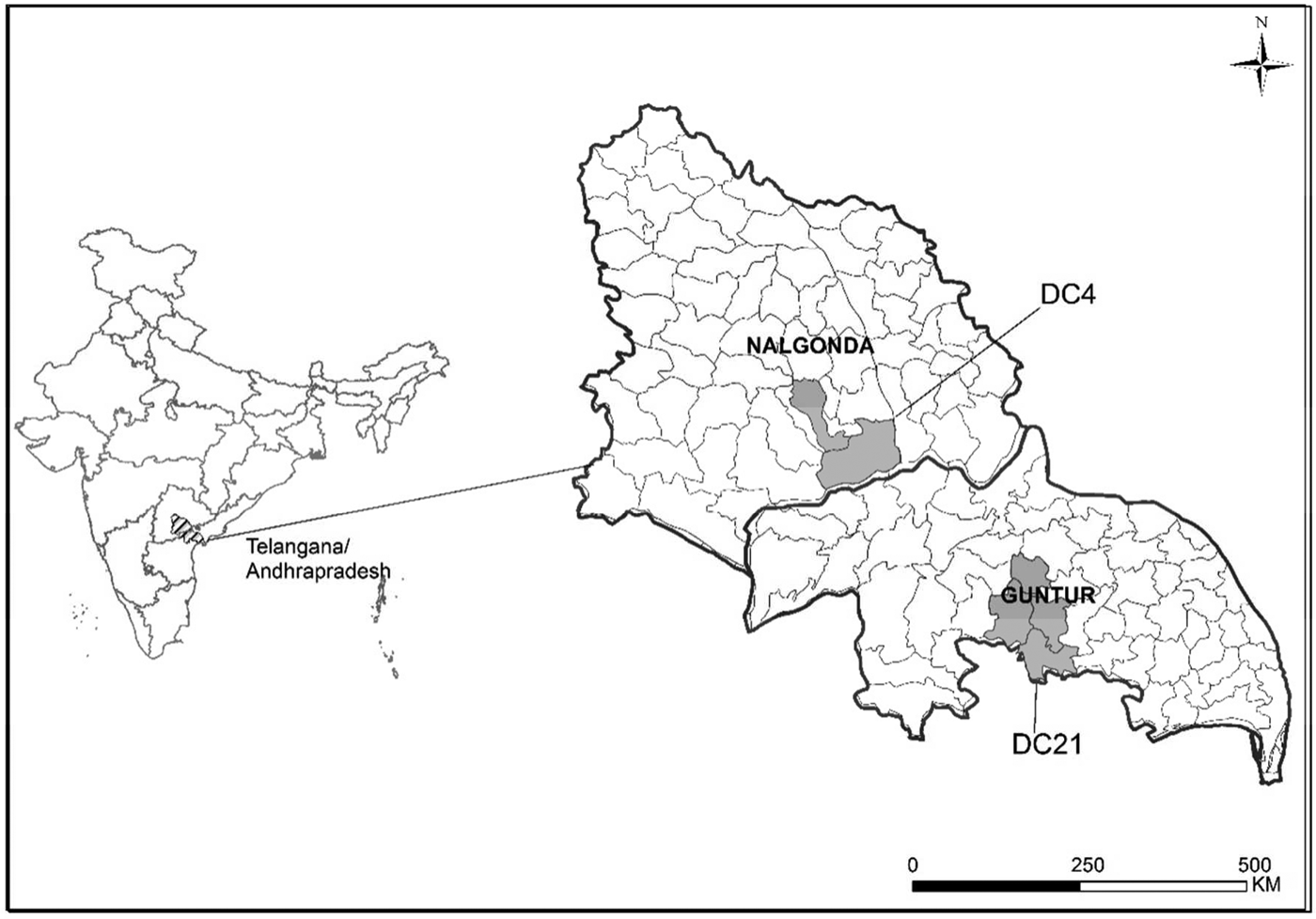
The measurements were carried out at different sites in the states of Andhra Pradesh (AP) and Telangana located under the command area of the Nagarjuna Sagar Project (NSP), within the lower Krishna River Basin, being one of the largest multipurpose irrigation projects in the country (Fig. 1). Irrigation water is distributed through the Nagarjuna Sagar Project Left Canal (NSLC) and the Nagarjuna Sagar Project Right Canal (NSRC) covering a total area of 890 000 ha. Measurements were carried out in selected clusters on two distribution canals (DC): DC 4 in the Nalgonda district (NSLC) and DC 21 in the Guntur district (NSRC), approximately 140 km downstream from the main reservoir. The measurements started during the Rabi (winter) season of 2012/13 until the Kharif (rainy) season of 2014. Kharif and Rabi are the cropping seasons: Kharif lasts from June/July until October/November while Rabi starts during December and lasts until March/April. The normal annual precipitation for the Nalgonda and Guntur districts is 753 and 815 mm respectively, with 0.70 of the precipitation occurring from June to September during the southwest monsoon and the remaining 0.30 from October to December from the northeast monsoon. There is significant variation in annual precipitation in both districts. Maximum temperatures can be as high as 43 °C, occurring during the months of April and May, while the minimum temperature can be as low as 15 °C, mostly occurring during August–October.
Location of districts in Andhra Pradesh and Telangana states.

Soil types
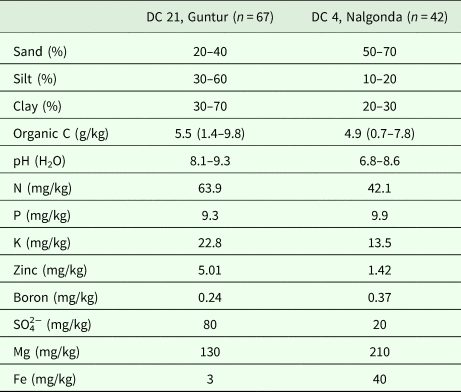
Information about soil texture and chemistry was obtained based on a sampling of the topsoil over a depth of 0–0.30 m. A total of 67 and 42 samples were collected in the Guntur and Nalgonda districts, respectively. The soils of Guntur areas were dominated by black cotton soils, classified as a silty clay loam according to the USDA textural classification system (Soil Survey Staff, 1999). The organic carbon (C) content varied from 1.4 to 9.8 g/kg with an average of 5.5 g/kg, while the pH varied from 8.1 to 9.3. Red soils with a sandy loam texture dominated the Nalgonda area. The organic C content varied from 0.7 to 7.8 g/kg with an average of 4.9 g/kg, while the pH was in the range of 6.8–8.6 (Table 1). There was a difference in soil fertility levels between the two areas, with soils in DC 21 being more fertile than those in DC 4, exemplified by the higher organic matter and nitrogen (N) content.
Soil texture and chemistry of the soils in Guntur and Nalgonda districts

DC, distribution canal; n, number of samples; C, carbon; N, plant available nitrogen; P, plant available phosphorus; K, plant available potassium; SO42−, sulphate ions; Mg, magnesium; Fe, iron.
Rice growing practices
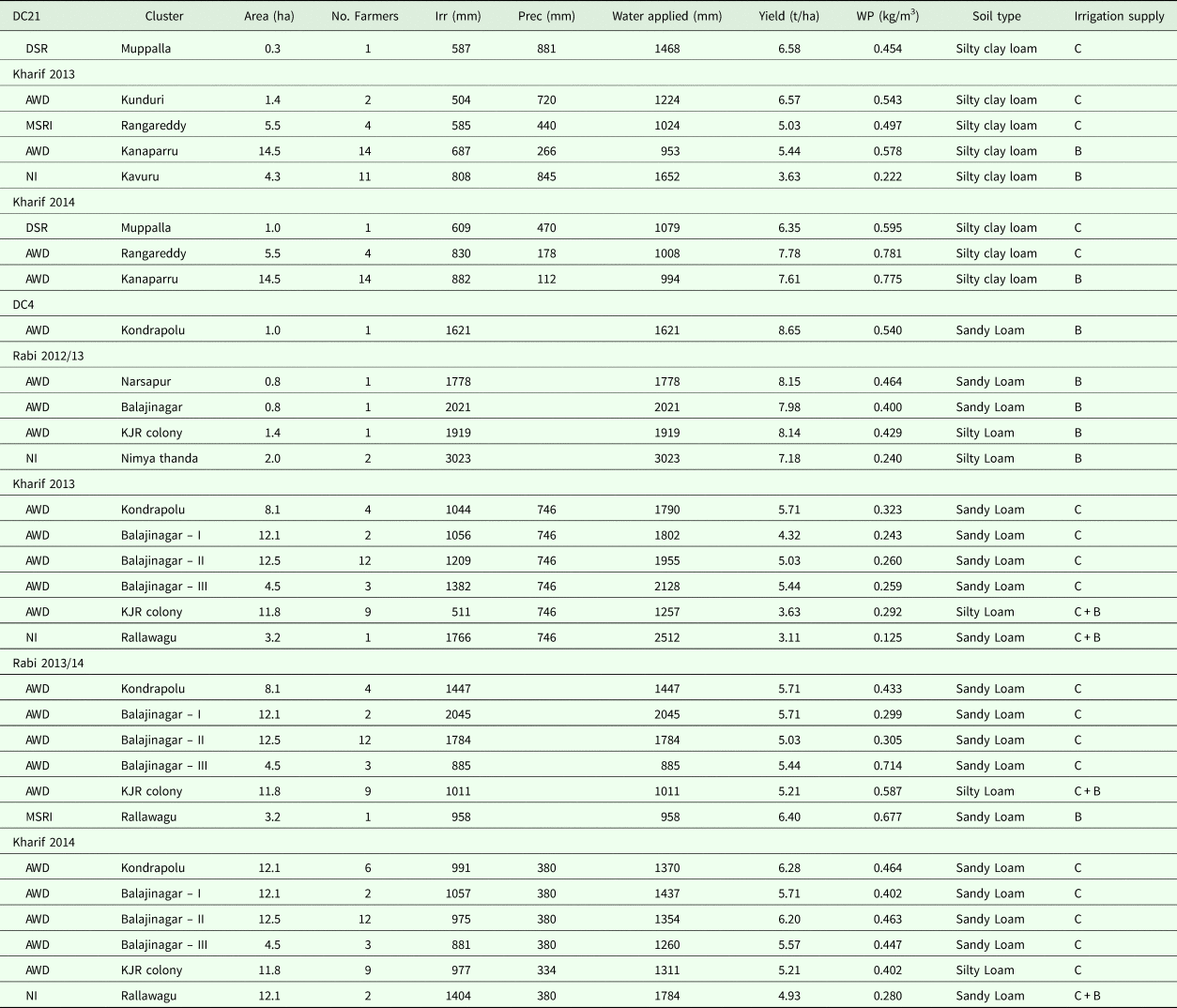
Under NI, the rice field is permanently flooded with a depth of water varying from 5 to 10 cm during the period after transplanting until 2 weeks before harvest. Before transplanting, the rice fields are puddled, the main objective being to reduce percolation losses and control weed growth. With DSR, no nursery and subsequent transplanting are practised. The land is prepared under dry conditions, no puddling is practised and rice is sown directly, manually or by machine, before or immediately after the pre-monsoon rain showers. Irrigation is provided from 40 to 50 days after sowing, subject to water availability. Irrigation during the grain filling stage is required. Compared with NI, weed growth is higher in DSR (Chauhan and Opeña, Reference Chauhan and Opeña2012). In AWD, transplanting of rice seedlings is similar to NI. During the first 30 days, water is provided continuously to overcome the weed problem. From then onwards, water is applied intermittently every 10–15 days depending on the water level observed in a perforated plastic tube located in the rice field (Bouman et al., Reference Bouman, Lampayan and Tuong2007; Rejesus et al., Reference Rejesus, Palis, Rodriguez, Lampayan and Bouman2011). Normal practice is to apply irrigation water when the water level has dropped 5–15 cm below the soil surface. In MSRI, the seedlings are grown separately on a mat nursery and transplanted using a Kubota Rice transplanter, 6-row model (Chennai, India, Kubota Agricultural Machinery India Pvt. Ltd.). Irrigation water is applied as practised under AWD. During every season four or five alternative rice growing practises were initiated compared with NI (Table 2). In this way, farmers were trained in different aspects related to alternative rice growing practices compared with the NI, with respect to the use of perforated tubes in scheduling irrigation, fertilizer applications, weed control and other related farming practices.
Results of water application under different rice growing practices
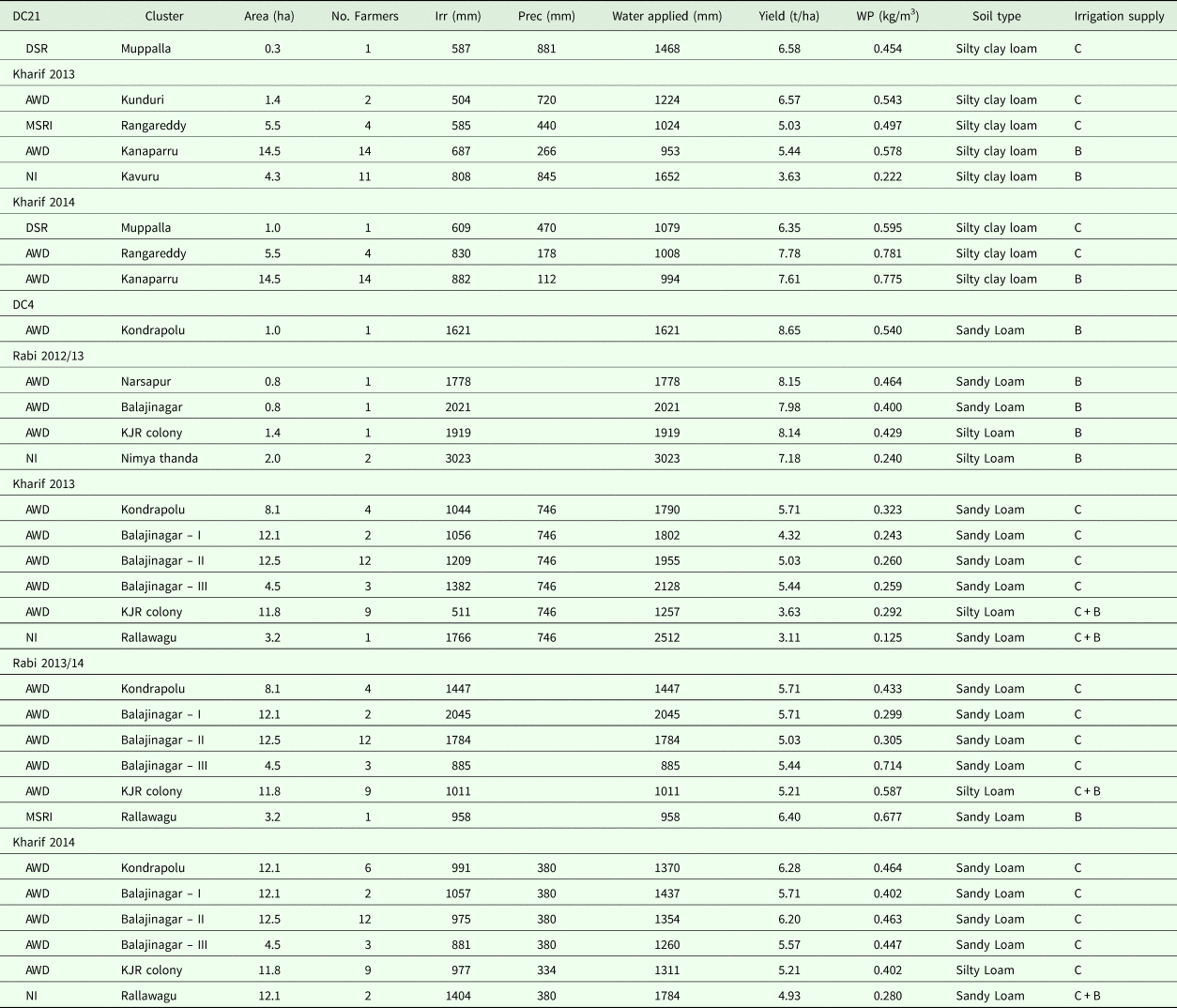
Irr, irrigation; Prec, precipitation; WP, water productivity; DC21, Distribution Canal 21; DSR, direct seeded rice; AWD, alternating wetting and drying; MSRI, modified systems of rice intensification; NI, conventional paddy rice; C, irrigation canal; B, bore well; DC4, Distribution Canal 4.
Water delivery
The source of irrigation water to the clusters was either from irrigation canals, groundwater through bore wells or from both in some cases. Where irrigation water was obtained via the irrigation canal, the irrigation department announced the start and end dates for release of water into the canal system and the farmers had to finish water application to the rice fields within the stipulated time window. Where farmers used bore wells in addition to the irrigation canal, they often started water application using the bore well and continued with canal irrigation when that water became available. Clusters varied in size from 0.3 to 14.5 ha, while the number of farmers varied from 1 to 14 (Table 2). Where water was supplied through the irrigation canal system, a Replogle, Bos and Clemmens (RBC) flume (Bos et al., Reference Bos, Repogle and Clemmens1984) was used to measure water delivery into the cluster. The discharge was recorded once a day at the inlet to the clusters; in addition, the length of time that water was applied was recorded, both records allowing calculation of water delivery to the cluster. Outflow from the cluster was also measured using an RBC flume. The readings were carried out by local personnel appointed by the project field officer in charge. To obtain information about the uncertainty, a sensor was used in the Kondrapolu cluster. Measurements showed a good similarity between manual and sensor readings of the water level. However, some differences were observed concerning the duration of water application, which affects the accuracy. In case of water delivery from bore-wells, flowmeters were used, having a high degree of accuracy, with readings recorded weekly. The project measured water delivery to clusters, which in almost all cases consisted of a number of farmers under the command area of a field irrigation canal. Also, in cases when water was obtained through bore-wells, with the exception of the Rabi 2012 under DC 4, more than one farmer used the same bore-well. As such, water delivery to a single farm or field could not be recorded.
Crop yield
At the end of the growing season, information about crop yield was collected from individual farmers within the different clusters. Yields might be influenced by many factors including soil conditions and fertilizer application to the rice crops. There were slight variations in yield within clusters and the average yield for the cluster was used in calculations of WP, more so as water application to the cluster was also measured. Fertilizer application was based on recommendations provided by extension services and ranged from 124 to 148 kg N/ha, 49 kg phosphorus (P)/ha and 49 kg potassium (K)/ha per cropping season. Fertilizer was applied in split doses: during land preparation time, at maximum tillering stage (20–25 days after transplanting) and during the panicle initiation stage (45–60 days after transplanting).
Results
A total of 31 measurements were carried out covering AWD (23), NI (4), DSR (2) and MSRI (2). The measurements showed large variations in both yield and water application (Table 2). Under alternative rice growing alternatives, the yield of AWD varied from 3.63 to 8.65 t/ha, with an average of 6.11 t/ha, yields under DSR were 6.35 and 6.58 t/ha and those under MSRI were 5.03 and 6.40 t/ha. Under NI, yield varied from 3.11 to 7.18 t/ha with an average of 4.71 t/ha. Yields under alternative rice growing practices were, in general, higher than under conventional paddy rice; however, the difference was not significant (two sample t test, t = 1.97, 29 d.f., P = 0.058).
Water application, being the sum of irrigation and precipitation, varied under AWD from 885 to 2128 mm with an average of 1494 mm (Table 2). The applications to DSR were 1079 and 1468 mm and MSRI 958 and 1024 mm. Under NI, water application varied from 1652 to 3023 mm with an average of 2243 mm. As with yield, there was an overlap in water application between the different alternatives. However, water application under alternative rice growing practices was significantly less compared with conventional paddy rice cultivation (two sample t test, t = −3.53, 29 d.f., P = 0.001).
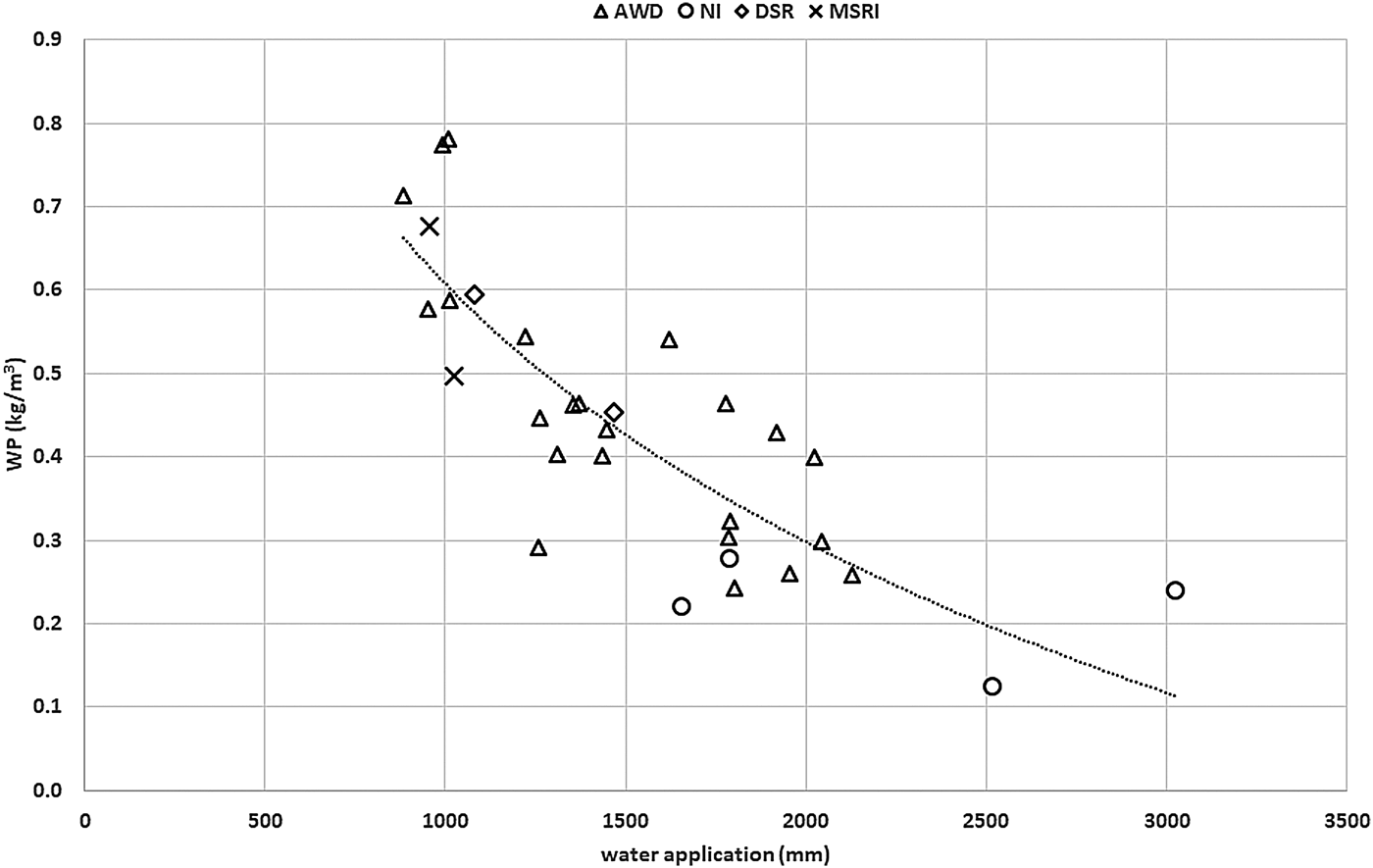
Water productivity under AWD varied from 0.24 to 0.78 with an average of 0.45 kg/m3 (Table 2). Under DSR the WP was 0.54 and 0.60 kg/m3 while under MSRI this was 0.50 and 0.68 kg/m3, respectively. For NI it varied from 0.13 to 0.28 with an average of 0.22 kg/m3. The overall result showed that WP increased under alternative rice growing practices (Fig. 2), while being significantly different compared with conventional paddy rice cultivation (two sample t test, t = 3.19, 29 d.f., P = 0.003).
Water productivity and water application for different rice growing practices.

Discussion
The main objective of the introduction of alternative rice growing practices is to use less water to grow rice, or to produce more ‘crop per drop’, i.e., an improvement in the WP. In the current study, the measurements were carried out in clusters often containing more than one farmer and as such, no information was collected concerning WP for single farmers’ fields. Water delivery was measured using different methods, i.e., RBC weirs and flow meters. When using the RBC, a lower accuracy in water delivery was obtained compared with flow meters and as such might have influenced the results. A total of nine water delivery measurements were carried out using only bore-wells. Two of the nine measurements were under normal NI while the remainder were under AWD and MSRI. The results showed that water application to NI was significantly higher compared with the alternative practices and lower yields were obtained, which resulted in WP under NI being less than half of the WP under AWD and MSRI. These results confirmed the overall measurements showing a significant increase in WP under alternative rice growing practices compared with conventional paddy rice cultivation. Practices such as SRI and AWD are introduced with the objective of saving water while increasing the yield or at least keeping it at the same level. Similar results were obtained by Radha et al. (Reference Radha, Reddy, Rao, Chandra and Babu2009) and Zhao et al. (Reference Zhao, Wu, Li, Animesh, Zhu and Uphoff2010). Significant amounts of water can be lost as percolation through the soil profile (Tuong et al., Reference Tuong, Wopereis, Marquez and Kropff1994) under NI. Losses of up to 350 cm (mainly due to seepage/percolation) during one crop cycle in a well-puddled rice field have been reported (Wopereis et al., Reference Wopereis, Bouman, Kropff, Ten Berge and Maligaya1994). Percolation losses depend to a large extent on the soil physical and hydrological characteristics, which can be reduced through puddling. However, on coarse soils the effects of puddling are limited. A change to alternative rice growing techniques will reduce these losses due to the absence of permanent standing water on the field (Belder et al., Reference Belder, Bouman, Cabangon, Guoan, Quilang, Yuanhua, Spiertz and Tuong2004; Singh et al., Reference Singh, Kundu and Bandyopadhyay2010) and thereby can increase WP. Water savings of up to 70% were reported through the introduction of intermittent irrigation by Belder et al. (Reference Belder, Bouman and Spiertz2007) and Feng et al. (Reference Feng, Bouman, Tuong, Cabangon, Li, Lu and Feng2007). Practices such as AWD also reduce the length of time when the field is flooded and therefore decreases the amount of evaporation. Alberto et al. (Reference Alberto, Wassmann, Hirano, Miyata, Hatano, Kumar, Padre and Amante2011), when comparing aerobic and flooded rice, showed a reduction in annual evapotranspiration in the order of 100 mm.
Although there was an overlap in yield between the different rice growing practices, the results showed that yields under alternative rice growing practices were, in general, higher than under NI. This is in agreement with results obtained by Sinha and Talati (Reference Sinha and Talati2007), Radha et al. (Reference Radha, Reddy, Rao, Chandra and Babu2009) and Zhao et al. (Reference Zhao, Wu, Li, Animesh, Zhu and Uphoff2010) who also documented an increase in the yield of rice under alternative practices such as AWD and SRI. On the other hand, results also have shown that alternative rice growing practices can result in a decrease in yield per unit area (Bouman and Tuong, Reference Bouman and Tuong2001; Tuong and Bouman, Reference Tuong, Bouman, Kijne, Barker and Molden2003; Swarup et al., Reference Swarup, Panda, Mishra, Kundu, Singh, Dani, Rao, Nayak, Panda, Dash, Mishra and Ghosh2008). Although Bouman and Tuong (Reference Bouman and Tuong2001) obtained a decrease in yield per unit area, at the same time the WP, varying from 0.2 to 0.4 kg/m3 under traditional practices, increased to 1.9 kg/m3 under water-saving irrigation practices. Similar results were reported by Tuong and Bouman (Reference Tuong, Bouman, Kijne, Barker and Molden2003) and Swarup et al. (Reference Swarup, Panda, Mishra, Kundu, Singh, Dani, Rao, Nayak, Panda, Dash, Mishra and Ghosh2008). Although AWD can be practiced in different ways, Carrijo et al. (Reference Carrijo, Lundy and Linquist2017) showed that crop yields under AWD, as practised in the ClimaAdapt project, were similar to yields under NI, leading to an increase in WP. Radha et al. (Reference Radha, Reddy, Rao, Chandra and Babu2009), when studying the effects of alternative rice growing practices on WP in Andhra Pradesh, observed that water savings were largest under SRI, obtaining WP of 0.9 kg/m3, while farmers practising traditional paddy rice obtained WP of 0.6 kg/m3. In addition, the yield per unit area increased under SRI. Results by Zhao et al. (Reference Zhao, Wu, Li, Animesh, Zhu and Uphoff2010) also showed a yield increase per unit area with a reduction in water use, resulting in a considerable increase in WP. There is ongoing uncertainty concerning the effects of alternative rice growing practices on yield and WP. Monaco and Sali (Reference Monaco and Sali2018) carried out an analysis of 51 studies related to rice growing practices, such as continuous flooding, different AWD practices and aerobic rice, and their effects on water use and yield: their study showed that similar yields were observed under different irrigation practices. Irrespective of the rice-growing practice, the current results showed a significant non-linear decrease in WP with increasing water application, similar to the results obtained in the current project. The lowest WP was observed in those cases with the highest water application, as under continuous flooding.
Saved water under alternative rice growing practices could be made available at other locations or used for different purposes than agriculture. However, a reduction in percolation losses could affect farmers at present using bore-wells. The reduction also might affect backflow losses into the river or canal system, often used to maintain a so-called minimum flow in rivers to sustain the ecosystem and provide a livelihood for, among others, fishermen (Ward and Pulido-Velazquez, Reference Ward and Pulido-Velazquez2008; Perry et al., Reference Perry, Steduto, Allen and Burt2009). A clear understanding of the real potential for reducing water losses is needed to avoid designing costly and ineffective demand management strategies (FAO, 2012).
The introduction of new practices will have an influence on the way water is provided to farms, which at present is a supply-based system, while AWD requires a demand-based system determined by the water level in the field. Farmers, agricultural engineers and irrigation engineers have to be trained in this and adaptation strategies should provide resources and training to farmers to improve their adaptive capacity.
Conclusion
The overall results of the measurements showed that under alternative rice growing practices, an increase in yield per unit area was obtained with a considerable reduction in water delivery, resulting in increased WP. The results are important for water-scarce areas, providing information useful to policymakers, farmers, agricultural departments and water management boards in devising future climate-smart adaptation and mitigation strategies. Simultaneously, capacity building of institutions responsible for water management is essential to scale up alternative rice growing practices.
Financial support
This paper presents results of the ClimaAdapt project, financed by the Norwegian Ministry of Foreign Affairs.
Conflict of interest
The authors do not have any conflict of interest.
Ethical standards
Not applicable.