1. Introduction
Examples (1)–(2) feature different types of clausal ellipsis in English in an exchange between a speaker A and a speaker B:

The stranded wh-phrases in (1B) represent a construction called sluicing in the ellipsis literature, and the stranded XPs in (2Aii) give fragment answers, a subtype of Bare Argument Ellipsis (BAE). Sluicing refers to stranded items that contain a wh-phrase and BAE to those containing a non-wh-phrase. In both cases, there is an explicit PP in the antecedent (to a wedding in (1A) and to who(m) in (2B)) that licenses optional P(reposition)-drop, that is, the possibility of realizing the stranded phrase as either PP or NP in (1B) and (2Aii). If there is only an implicit PP in the antecedent, as in give it back (to someone) in (2Ai), then the stranded wh-phrase to who(m) in (2B) must occur together with the preposition that is part of the implicit PP. This stranded wh-phrase in (2B) is an instance of sprouting (a subcase of sluicing referring to ellipses whose correspondents are implicit rather than explicit).
We explore the patterns of usage for stranded XPs and wh-phrases in present-day English with respect to P-drop. Drawing on corpus data, we demonstrate that English exhibits high frequencies of P-drop, which, we propose, is due to its extensive word-external dependencies among lexical categories, typically between verbs and prepositions. This, we argue, explains why English differs from other languages where P-drop appears to be more limited.
Before we proceed, a note on terminology is in order. Stranded wh-phrases and non-wh-phrases will both be called ‘fragments’ here, i.e., (1B), (2B), (2Aii) are all fragments. Following the ellipsis literature, we use sprouting fragments and merger fragments to distinguish between sprouted fragments and non-sprouted ones (i.e., with implicit versus explicit correspondents, respectively). We refer to these correspondents for the fragments as correlates (other terms that have been used are: Salient Utterance in Ginzburg & Sag, Reference Ginzburg and Sag2000, target in Culicover & Jackendoff, Reference Culicover and Jackendoff2005, and inner antecedent in Chung, Ladusaw, & McCloskey, Reference Chung, Ladusaw and McCloskey1995).
English is considered a language in which P-drop is fully grammatical under clausal ellipsis. Merchant (Reference Merchant2001) argued for an apparent correspondence between the behavior of fragments and their counterparts in overt questions and declarative clauses. For instance, (3) permits the fragment to surface as an NP or a PP, because prepositional objects may either strand prepositions (4a) or pied-pipe them (4b) in overt questions.

This is captured in the Preposition-Stranding Generalization (PSG) originally formulated for sluicing:

Merchant (Reference Merchant2004) connected the possibility of P-drop from fragments to the syntax of sentential structures more generally: not just to wh-movement in questions in the case of sluicing but also to left-peripheral movement in declarative clauses in the case of fragment answers. These correspondences are admittedly strong in English, but they are not perfect.
Levin (Reference Levin and Bresnan1982, pp. 606–608) presented evidence that the behavior of fragments does not in fact align with the behavior of their counterparts in overt questions (see also Chung et al., Reference Chung, Ladusaw and McCloskey1995; Fortin, Reference Fortin2007). For instance, both PPs and NPs may serve as fragments in (6), even though preposition pied-piping is degraded in the corresponding embedded overt question (7).Footnote 1

And both NPs and PPs may serve as fragments in (8) when the corresponding overt questions do not permit preposition stranding at all; see (9).

If the syntax of questions were a determinant of how fragments can surface, then the PP fragment in (6) should be degraded and the NP fragment in (8) downright unacceptable. Instead, it appears that fragments may surface as NPs or PPs regardless of what is allowed by the syntax of overt clauses. These examples may seem like limited exceptions to an otherwise robust generalization, but cross-linguistic data also provide a challenge to this interpretation of the English facts.
The PSG has been tested extensively across a range of languages. The findings are that NP fragments are attested in a greater range of languages than just those languages that allow preposition stranding, suggesting that P-drop is more general than, and independent of, the availability of preposition stranding (see Abels, Reference Abels, Mueller-Reichau and Guhl2017, for Bulgarian; Caha, Reference Caha2011, for Czech; Fortin, Reference Fortin2007, for Bahasa Indonesia; Leung, Reference Leung2014, for Emirati Arabic; Molimpakis, Reference Molimpakis2018, for Greek; Philippova, Reference Philippova, Kohlberger, Bellamy and Dutton2014, for Russian; Rodrigues et al., Reference Rodrigues, Nevins, Vicente, Torck and Wetzels2009, for Spanish and Brazilian Portuguese; Stjepanovic, Reference Stjepanovic2008, Reference Stjepanovic, Merchant and Simpson2012, for Serbo-Croatian; Szczegielniak, Reference Szczegielniak, Abner and Bishop2008; Sag & Nykiel, Reference Sag and Nykiel2011; Nykiel, Reference Nykiel2013, for Polish). Acceptability judgment and corpus studies demonstrate further that PP fragments are better overall than NP fragments (see Molimpakis, Reference Molimpakis2018, for Greek; Nykiel, Reference Nykiel2013, for Polish; Nykiel, Reference Nykiel2015, for Early and Late Modern English).
This research raises questions about the general status of P-drop. It appears to be a fairly limited phenomenon in each language that exhibits it while at the same time being widespread in present-day English (Nykiel, Reference Nykiel2015, Reference Nykiel2017), making English stand out as exceptional. We will see that corpus data from spoken English corroborate the familiar English pattern: the frequency of NP fragments is higher than that of PP fragments. We will also see evidence for a key factor that boosts the frequency of NP fragments in English when other factors are controlled for, namely word-external dependencies between prepositions and other lexical categories. To anticipate our analysis, we will argue that two very general processing principles, Minimize Domains (MiD) and Minimize Forms (MiF) (Hawkins, Reference Hawkins2004, Reference Hawkins2014a) can account for most of the data, in conjunction with some more specific principles applying to particular constructions that have been independently supported in the processing and linguistic research literature. We conceive of MiD and MiF as real-time constraints on language processing that result in the preferred selection of some fragment forms rather than others, when grammars (in this case English) permit a choice between alternatives, and that result in conventionalization in historical time when the preferred fragment (e.g., PP in sprouting environments) is the only option that is grammatically well formed. Both MiD and MiF are cross-linguistically general mechanisms that govern the operation of P-drop in this context, but MiD makes different predictions for the PP and VP processing domains, the latter having special relevance for English, a language in which there are extensive word-external dependencies between a preposition in the fragment and other lexical categories in the VP of the antecedent.
The MiD and MiF principles were originally proposed in Hawkins (Reference Hawkins2004), building on psycholinguistic experimental and corpus usage data that were available at the time and that motivated them. Conventionalized data from grammatical rules across languages were also shown to correlate with the observed patterns of variation within languages, offering further support for MiD and MiF and leading to a Performance-Grammar Correspondence Hypothesis. The MiD and MiF principles have since been tested on usage data and grammars from many different languages and have been incorporated within the emerging general theory of communicative efficiency in psycholinguistics. This approach, termed the Efficiency Hypothesis in Futrell (Reference Futrellin press), sees languages as shaped by a trade-off between information transfer, ease of production, and ease of comprehension under information processing constraints that are inherent to the human brain. A summary of its basic tenets with extensive supporting references can be found in Gibson et al. (Reference Gibson, Futrell, Piantadosi, Dautriche, Mahowald, Bergen and Levy2019), see also, e.g., Futrell, Mahowald, and Gibson (Reference Futrell, Mahowald and Gibson2015), Jaeger and Tily (Reference Jaeger and Tily2011), Norcliffe, Harris, and Jaeger (Reference Norcliffe, Harris and Jaeger2015), Gibson (Reference Gibson1998, Reference Gibson, Miyashita, Marantz and O’Neil2000), Haspelmath (Reference Haspelmathforthcoming), and Levshina (Reference Levshinaforthcoming). This approach provides solutions to many traditional problems in psycholinguistics, including the relationship between integration and prediction in processing, between the speaker’s needs and the hearer’s needs, between ease and complexity of processing and efficient information transfer, and between performance and the grammaticalized conventions of the world’s languages. The interested reader is referred to the research literature summarized in these publications for the larger context within which MiD and MiF have been incorporated, and in order to see how they have been made relevant to current issues in psycholinguistics from this communicative efficiency perspective (see also Hawkins, Reference Hawkins2014a, for an updating of Hawkins, Reference Hawkins2004).
In sum, our focus in this paper is on how the syntactic and semantic content of fragments can be adjusted to ease the processing demands on speaker and hearer and to make the information transfer intended by sentence fragments more efficient. The ellipsis literature considers these matters to be part of the recoverability question and is primarily concerned with the syntactic and/or semantic environment that allows for successful retrieval of the antecedent for an ellipsis. This question typically reduces to the type of identity (syntactic or non-syntactic) that must hold between an antecedent and an ellipsis. On construction-based analyses, it is just the fragment (analyzed as a stand-alone phrase with no unpronounced structure) that is subject to identity conditions (Culicover & Jackendoff, Reference Culicover and Jackendoff2005, Reference Culicover and Jackendoff2012; Ginzburg, Reference Ginzburg2012; Ginzburg, & Sag, Reference Ginzburg and Sag2000). On PF-deletion analyses, the further assumption is made that a fragment contains unpronounced sentential structure that is subject to identity conditions along with the fragment (Chung, Reference Chung2013; Merchant, Reference Merchant2001, Reference Merchant2004,).Footnote 2 We are concerned with the linguistic content of fragments (not the content of unpronounced elements, if one assumes their existence), treating them as stand-alone phrases that the parser must interpret as such, which aligns us with the construction-based strand of research. We propose our processing-based efficiency account of P-drop as a reflection of construction-specific constraints on fragments.
The rest of the paper proceeds as follows. Section 2 spells out our proposal that the availability of P-drop is mediated by processing-based factors. We introduce MiD and MiF as general principles that support numerous limitations on P-drop, including in English. Section 3 focuses on the partially competing effects of MiD in the VP domain which predict higher frequencies for P-drop and for NP fragments in English than the considerations of Section 2 would lead us to expect. Section 4 presents supporting evidence for certain key predictions made by our general proposal in a corpus analysis of English fragments. In Section 5, we discuss the implications of these corpus results for the role that processing principles play in clausal ellipsis and for theories of clausal ellipsis. Section 6 concludes.
2. P-drop is costly
In this section we flesh out the idea that P-drop is a costly operation in processing terms, which results in higher frequencies of PP fragments than of NP fragments across languages. We account for this general cross-linguistic preference, and then show how certain properties of Modern English lead to the contrary preference for more NP fragments in this language, as evidenced by the results of our statistical analysis (Section 4.2).
The process of assigning an interpretation to a fragment is guided by our general cognitive abilities and can be thought of as locating or inferring a salient antecedent and integrating the fragment into a proposition supplied by that antecedent (Culicover, Reference Culicover2016; Culicover & Jackendoff Reference Culicover and Jackendoff2005, Reference Culicover and Jackendoff2012; Harris & Carlson, Reference Harris and Carlson2019). There is evidence that these tasks are completed by a direct-access mechanism whereby the processor finds an appropriate mental representation among those it has stored so far, using the linguistic information that the fragment encodes (Martin & McElree, Reference Martin and McElree2011). The direct-access mechanism in turn follows from cue-based parsing models of sentence processing (Caplan & Waters, Reference Caplan and Waters2013; Lewis & Vasishth, Reference Lewis and Vasishth2005; Lewis, Vasishth, & Van Dyke, Reference Lewis, Vasishth and Van Dyke2006; McElree, Reference McElree2000; McElree, Foraker, & Dyer, Reference McElree, Foraker and Dyer2003; Van Dyke, Reference Van Dyke2011; Van Dyke & Johns, Reference Van Dyke and Johns2012), which rely on the quality of retrieval cues to guide the processor’s search for the target representation among other candidates, all of these representations being evaluated simultaneously. If the fragment is aligned with its explicit or implicit correlate via such a cue-based search, and assigned an interpretation based on the proposition into which it becomes integrated as a result,Footnote 3 then the ease of interpreting the fragment must depend on the diagnosticity of the retrieval clues encoded in the fragment and on features of the antecedent. Let us start with clues that can be encoded by the fragment, and address features of the antecedent in Section 2.2.
Following Barton (Reference Barton, Leffel and Bouchard1991, Reference Barton, Progovac, Paesani, Casielles-Suárez and Barton2006), we assume that a fragment may, at a minimum, be realized as any subsentential maximal category, such as NP, VP, AdjP, AdvP, or PP. The realization of fragments is often fully consistent with the argument structure of their linguistic antecedents (e.g., Abels, Reference Abels2019; Bechhofer, Reference Bechhofer, Hankamer and Aissen1976; Beecher, Reference Beecher2008; Chung, Reference Chung2013; Culicover & Jackendoff, Reference Culicover and Jackendoff2005; Merchant, Reference Merchant2001, Reference Merchant2013; Ross, Reference Ross, Binnick, Davison, Green and Morgan1969), as evidenced, for example, by repetition of parts of the antecedent in a fragment, as in (10–11).Footnote 4 Given the types of fragments that are our primary concern, the smallest available maximal category is an NP and the next largest a PP. Fragments are typically minimally short phrases that elaborate on their antecedents, but the fragments in (10–11) also contain material whose status is given in information-structural terms.Footnote 5 In (10) the antecedent would license a simple NP (what) as a fragment, but the B-response also pied-pipes additional material repeated from their antecedent. In (11) a PP would be licensed as the B-fragment (due to sprouting) and an NP as the Aii-fragment, but both repeat the adjective afraid.

This possibility can be explained as a means to supply more clues to how a fragment fits into the antecedent proposition, since repeating apparently redundant material can often have beneficial effects on language comprehension (Arts, Reference Arts2004; Arts, Maes, Noordman, & Jansen, Reference Arts, Maes, Noordman and Jansen2011; Davies & Katsos, Reference Davies and Katsos2009; Levelt, Reference Levelt1989; Maes, Arts, & Noordman, Reference Maes, Arts and Noordman2004) and lead to a processing advantage both for less reduced ellipses over more reduced ones (Harris, Reference Harris2015) and for unreduced counterparts of ellipsis over ellipsis (Dickey & Bunger, Reference Dickey and Bunger2011; Kertz, Reference Kertz2013b). Specifically, Dickey and Bunger (Reference Dickey and Bunger2011) reported on one effect of ellipsis in their study of sluicing in which sluices were consistently read slower than their unreduced counterparts. Harris (Reference Harris2015) found a contrast between fully specified sluicing fragments (with explicit lexical NPs, e.g., Some tourists sampled the wines but I’ve forgotten which tourists) and partially specified fragments (with the pronoun one, e.g., Some tourists sampled the wines but I’ve forgotten which ones): the former were read faster on several eye-tracking measures and helped reduce the risk of non-target representations interfering with the retrieval of the correlate. These findings suggest that ellipsis, although commonly used, induces greater processing costs than partially or fully explicit material. We argue here that including prepositions in fragments is part of the general mechanism that determines ease of processing and efficiency by permitting fragments of varying size that repeat thematic information from the antecedent. In our specific case, this mechanism permits fragments to be realized as either minimal phrases (NPs) or larger phrases (PPs). The latter are easier to process due to the repeated preposition. Recall from the previous section that, consistent with our argument, there is a cross-linguistically robust preference for PPs over NPs as fragments.
There are further reasons for why P-drop leads to greater processing cost. Numerous syntactic, morphosyntactic, and semantic relations hold between P and NP that are much easier to process when both are explicitly present and also immediately adjacent within the PP. These include the syntactic relations of sisterhood and subcategorization. In many Indo-European languages P assigns surface case to its sister NP, or else in head-marking languages like Abkhaz, P agrees with this NP (Nichols, Reference Nichols1986). Semantic relations holding within PP include the semantic dependency of P on NP (e.g., the meaning of English in regularly depends on its sister NP, compare locative in Oslo with temporal in the morning). All of these grammatical and semantic relations are easier to process if they can take place locally within the PP itself, i.e., within a small processing domain in the sense of Hawkins (Reference Hawkins2004, Reference Hawkins2014a).
2.1. Minimize Domains
More generally, Hawkins (Reference Hawkins2004, Reference Hawkins2014a) proposes a principle of Minimize Domains, formulated in (12).

We are concerned with how independently processable the fragment is, and whether its syntax and semantics can be assigned within the domain of the fragment itself, or whether the processor relies on external material in the antecedent in order to assign syntactic and semantic properties to the fragment within a larger and less minimal processing domain. The task of interpreting the fragment can be considered the first task the processor faces upon encountering it (see also Harris & Carlson, Reference Harris and Carlson2019).
The processing of lexically specified relations between V (or some other head category such as Adj or N) and P takes place within a lexical domain in the terminology of Hawkins (Reference Hawkins2004, p. 117), defined in (13):

If P does not contract grammatical and semantic relations outside of its PP, then processing the various relations it does contract with its sister NP can take place within a minimal PP-internal domain, as long as both are explicit and adjacent in the fragment. For instance, the processor can assign all relevant properties to the PP fragment in (14Aii) based on the literal benefactive meaning of the preposition for which is independently processable within the PP, and given the syntactic co-occurrence of P and NP.

When P and NP are not adjacent, the syntactic and semantic bonds between them are disrupted in processing, and since there are many such bonds, languages favor PP fragments overall, all else being equal. The fact that it is difficult to sever the ties between P and NP within the PP domain by any syntactic operations finds further support in the rarity of preposition stranding in filler–gap constructions (e.g., the train we are waiting for vs. the train for which we are waiting) in the world’s languages. Because preposition stranding displaces the complement NP alone, this negatively affects the processing of its properties relative to the prepositional head and expands the lexical domain to include a possibly distant filler and its gap. However, not all prepositions, especially in English, are fully processable within the PP domain, as we will see, and this leads to MiD making different predictions for fragments whose processing requires access to larger lexical domains beyond PP, and favors P-drop in such cases (see Sections 3 and 4.1.1). In addition, cross-linguistic work has uncovered some further factors and environments that facilitate P-drop. We turn to these first.
2.2. MiF and environments facilitating P-drop
This section spells out some predictions based on the principle of Minimize Forms (Hawkins, Reference Hawkins2004) which, as we argue, supports P-drop in easy-to-process environments. MiF is a processing principle that underlies several kinds of reduction in language, including ellipsis, and is defined in (15).

MiF leads us to expect that, since ellipsis is costly, it will generally be found only rarely, or not at all, in environments where it is difficult to assign the required properties to an elliptical form. The ellipsis literature has identified at least two kinds of such environments. One is the non-linguistic antecedent type shown in (16), and the other involves structurally mismatched linguistic antecedents, exemplified in (17).

Several authors have argued that fragments tolerate non-linguistic antecedents like (16) only under limited circumstances (Culicover & Jackendoff, Reference Culicover and Jackendoff2005; Ginzburg & Miller, Reference Ginzburg, Miller, van Creanenbroeck and Temmerman2018; Ginzburg & Sag, Reference Ginzburg and Sag2000; Merchant, Reference Merchant2004). The fragment in (17), mismatching its active antecedent in voice, has been claimed to be ungrammatical (Merchant, Reference Merchant2001).Footnote 8 These facts show that ellipsis is generally favored in easy-to-process environments, and that certain features of an antecedent can mediate the ease of processing ellipsis. Let us now consider in more detail how different antecedents can help reduce the difficulty of assigning an interpretation to a fragment, and hence support P-drop by MiF.
We address the semantic and syntactic content of the fragment’s correlate (see further Section 4.1.3) first. A basic distinction has been drawn in the ellipsis literature between sprouting fragments, which have implicit correlates (18), and merger fragments, which have explicit correlates (19) (Chung, Reference Chung, Cover and Kim2006, Reference Chung2013; Chung et al., Reference Chung, Ladusaw and McCloskey1995) (see also (Reference Abels, Mueller-Reichau and Guhl2)).

Sprouting fragments cannot be realized as minimal phrases (NPs), i.e., as *What? in (18B), if their correlates are prepositional objects. But they can be realized as larger phrases than the required PPs, as in (18B). This pattern suggests that assigning an interpretation to an NP fragment requires richer and explicit contextual conditions, while assigning an interpretation to a PP fragment is successful with both implicit and explicit correlates.
Another relevant distinction is made between correlates that host indefinite pronouns (20A) and those that host lexical NPs (21A), which has consequences for how fragments are realized. The fragment Who? in (20B) and (21B) is not equally probable in these two contexts.

When the fragment’s correlate hosts a lexical NP, and not a pronoun, that fragment is more likely to surface as an NP than a PP (Nykiel, Reference Nykiel2015, Reference Nykiel2017), hence (21B) is more probable than To who(m). This preference for lexical NP antecedents over indefinite pronouns with NP fragments has been reported in several cross-linguistic studies of clausal ellipsis (see Caha, Reference Caha2011, for Czech; Rodrigues et al., Reference Rodrigues, Nevins, Vicente, Torck and Wetzels2009, for Brazilian Portuguese, Spanish, and French; Stjepanovic, Reference Stjepanovic2008, for Serbo-Croatian; Szczegielniak, Reference Szczegielniak, Abner and Bishop2008; Sag & Nykiel, Reference Sag and Nykiel2011; Nykiel, Reference Nykiel2013, for Polish). The difference between pronouns and lexical NPs is rooted in the strength of the mental representations that they each receive on being processed. Research on memory retrieval has shown that semantically and syntactically contentful expressions like lexical NPs receive stronger mental representations than expressions that are less contentful, which boosts their accessibility for future retrieval from memory (Craik & Lockhart, Reference Craik and Lockhart1972; Gallo, Meadow, Johnson, & Foster, Reference Gallo, Meadow, Johnson and Foster2008; Hofmeister, Reference Hofmeister2007, Reference Hofmeister2008, Reference Hofmeister2011; Hofmeister, Jaeger, Sag, Arnon, & Snider Reference Hofmeister2007; Hofmeister, Jaeger, Arnon, Sag, & Snider, Reference Hofmeister, Jaeger, Arnon, Sag and Snider2013). Given this, the process of retrieving an antecedent for a fragment is easier when the antecedent hosts a contentful correlate (i.e., one containing a lexical NP).Footnote 9
To explain these patterns we invoke MiF. If fragments are direct pointers to antecedents that are more or less accessible for future retrieval, then MiF leads us to expect that (a) less explicit pointers (i.e., smaller-sized fragments) are sufficient for accessing more accessible antecedents, and (b) more explicit pointers (i.e., larger-sized fragments) are necessary for accessing less accessible antecedents. A correlate hosting a lexical NP is associated with the highest level of accessibility, promoting minimally sized fragments (NPs). It is not surprising, therefore, that NP fragments appear in as wide a range of languages as they do, in addition to PPs, if their use is tied to complementary processing considerations of this sort. By contrast, an implicit correlate lacks form and content, hence it is less accessible than any explicit correlate, and this promotes the use of larger-sized fragments. It is plausible that the grammatical ban on reducing fragments from PPs to NPs here is a conventionalized performance preference and hence has a clear processing motivation and explanation.Footnote 10
The final feature of an antecedent that impacts P-drop is the form of the antecedent itself (see also Section 4.1.2 below). A portion of our data involves elliptical antecedents as in (22).

Elliptical antecedents appear most often as PP fragments (77.2%), as in (22B), and are followed by fragments that may be either PPs (as in (22Aii) or simple NPs (Carla Albright). As we report in Section 4, PPs are more frequent fragments in this context than they are with non-elliptical antecedents. A possible explanation is that the difficulty of retrieving an antecedent is greater here because the retrieval process must continue past the nearest elliptical antecedent (22B) until the processor has also re-accessed the prior non-elliptical clause (22Ai) and assigned all the relevant features to the fragment. That is, speaker B’s sprouting fragment introduces the new proposition Who was X asked to be in the room by? into the discourse (cf. the propositions raised by (22Ai) Was X asked to be in the room? Was X in the room?), to which speaker A is responding and which they can only access by reference to both (22B) and (22Ai). The need to access both a nearer and a more distant antecedent creates a more difficult-to-process environment and leads to a greater than usual dispreference for NP fragments, following MiF. It is plausible that the effects of MiF are also strengthened here by priming effects induced by PP fragments serving as antecedents (see Section 4.1.4 for more detail).
In sum, we predict a general preference for PP fragments over NP fragments based on the processing difficulty that ellipsis induces compared to overt material, and on the processing pressures within the PP domain, as per MiD. NP fragments will be favored, however, in a limited number of environments where antecedents are easily accessible, following MiF, and in proportion to the syntactic and semantic relations that P contracts with a V or other head external to PP, following MiD. We turn now again to MiD and formulate more precise predictions which will help us explain the English bias toward NP fragments.
3. Predictions of MiD for English P-drop
In this section we focus on the VP processing domain rather the PP domain discussed in Section 2.1. Recall that MiD is concerned with the sizes of the various domains within which syntactically and/or semantically dependent elements are processed, and it predicts a tension between the PP and VP domains, especially in languages with high frequencies of semantically dependent elements.
If the fragment in (23B) were a PP (On people going into the booth and changing their minds?), the preposition on could not receive its subcategorized and semantically dependent interpretation without the parser accessing the verb depend.

This P is not independently processable within the PP fragment itself, and a long-distance processing domain is required linking it to a higher V in order for a basic sense and interpretation to be assigned to the fragment. When P contracts syntactic and semantic relations like this with a head category outside of PP, the processing of these PP-external properties must extend to a more complex domain in which P seeks its grammatical role and semantic interpretation at some distance from PP. Such an extended lexical domain is dispreferred, per MiD. Hence, we predict that any V-P dependencies external to the PP should have severe consequences for processing and should lead to a strong preference for NP fragments over PPs in proportion to their number and nature. The NP fragment in (23B) can be processed syntactically and semantically as a referentially complete expression independently of the P that governs what in the antecedent (23A), and it can be readily slotted into the NP position adjacent to P within the PP of the antecedent, thereby receiving its full interpretation. This processing advantage of using an NP fragment will now be in competition with PP-internal syntactic and semantic processing, since the fragment must be linked to a non-adjacent P within the antecedent, thus extending its processing domain.
The VP processing domain can be stronger than the PP domain when they compete in cases such as this. Any subcategorization and semantic dependencies between V and P make processing difficult in the event that P cannot receive an interpretation within the PP fragment itself. An NP fragment, by contrast, is generally independently processable on its own, and any dependencies of P on this NP will already have been assigned in the antecedent. These considerations make the integration of the NP fragment into the antecedent more straightforward, and shift the balance of overall processing difficulty in favor of the VP domain, as a consequence of the dependent or independent processability of the preposition within the PP fragment. The precise push and pull of these different domains of processing associated with PP vs. NP fragments is quite complex, and there will be numerous lexical idiosyncrasies within and across languages that impact the precise predictions we can make. Our MiD principle does lead to one very clear and very general prediction, however: the more prepositions there are in a language that contract syntactic and semantic relations outside of their PP and with a higher head category within VP, and the more such PP-external relations there are syntactically and semantically, the more NP fragments we expect to find over PP fragments. This gradient prediction will be tested on corpus data in Section 4.1.1 and discussed again in Section 5. The number of these V-P dependencies will be critical for our predictions about the preference for NP fragments over PP fragments in English.
It is important to note before we proceed that however strong the effects of MiD are in a given language, there is an interdependence between MiD and MiF with respect to fragments in the sense that MiD can increase the frequency of P-drop in environments where MiF already supports it to various degrees, but it cannot override grammatical constraints that block P-drop altogether (i.e., in the case of sprouting fragments).
English speakers are sensitive, it seems, to the intra- or inter-phrase interpretability of PPs. Independent evidence for this comes from linear ordering data involving two post-verbal PPs, which reveals a preference for adjacency to verbs for those PPs that are semantically dependent on them. This preference was reported in Hawkins’ (Reference Hawkins2000) critique of traditional ordering generalizations such as Manner before Place before Time and Complement before Adjunct using a corpus study, and then confirmed in a larger corpus by Wiechmann and Lohmann (Reference Wiechmann and Lohmann2013). Example (Reference Biber, Johannsson, Leech, Conrad and Finegan24) illustrates.

The difference between PP1 and PP2 is that the parser must look to the verb waited when processing the preposition for in PP1, before it can assign an interpretation to it (the relevant subcategorization frame for wait in this example includes a PP headed by for). If and when PP1 is separated from waited, the distance over which it is interpreted must stretch back across the intervening material to the verb, resulting in a non-optimal size for the lexical domain in which PP1 can be processed. The processing of PP2 is not affected by distance from the verb, because the temporal property of in can be fully assigned within the domain of the PP itself (see the tests in (Reference Brinton and Closs Traugott25) and (Reference Cable, Harris, Grant and Harris26)).
To identify semantic dependencies between verbs and prepositions, Hawkins (Reference Hawkins2000, pp. 242–243) introduced two entailment tests, given in (Reference Brinton and Closs Traugott25) and (Reference Cable, Harris, Grant and Harris26). The verb entailment test identifies verbs whose interpretation depends on prepositions, and the pro-verb entailment test identifies prepositions dependent on their verbs. The subscripts i and d stand for the features independent and dependent, respectively.

These tests yielded 211 semantically dependent V-P combinations out of the total of 394 V-PP-PP sequences in Hawkins’ data, such that either verbs required access to prepositions, or prepositions required access to verbs, or both. 73% of these combinations had the dependent verbs and prepositions adjacent to each other. This pattern demonstrates that English speakers are sensitive to semantic dependencies between V and P and to the size of lexical domains within which these dependencies are processed.Footnote 11 This sensitivity can be seen as a function of English-specific changes over time.
Hawkins (Reference Hawkins2019) argues that English underwent a series of diachronic developments that can be subsumed under a drift toward more ‘word-external properties’. Individual lexical and grammatical items have over time lost some of the morphosyntactic and semantic information once contained within them, and as a result the relevant properties must now be assigned word-externally, i.e., on the basis of the surrounding syntactic and semantic context. The grammatical and lexical areas affected by this drift include NPs dependent on a verb for their theta-role assignment, lexical items whose syntactic category is underspecified and dependent on neighboring words, syntactic environments involving long distance dependencies, a wider than usual range of selectional restrictions that verbs are compatible with, and multiword verbs. One type of multiword verb is of particular relevance here, prepositional verbs like wait for and depend on.
Prepositional verbs are combinations of verbs and prepositions that generally have non-compositional semantics (i.e., V or P or both are assigned dependent status by the entailment tests above) or else a highly frequent pattern of syntactic co-occurrence. Their development has been described as a separation of earlier verbal prefixes from verbs dating back to the Early Middle English period, followed by a steady increase in the number of such prepositional verbs from that period onwards (Brinton & Closs Traugott, Reference Brinton and Closs Traugott2005; Claridge, Reference Claridge2000; Denison Reference Denison1981, Reference Denison1985). An interesting further aspect of this development is that the frequency of prepositional verbs more than doubles after Early Modern English (Biber, Johannsson, Leech, Conrad, & Finegan, Reference Biber, Johannsson, Leech, Conrad and Finegan1999). It is also after this period that the proportion of NP fragments to PP fragments under ellipsis rises (Nykiel, Reference Nykiel, Adams, Brinton and Fulk2014, Reference Nykiel2015), setting Modern English apart from earlier English and from so many other languages as well.Footnote 12 The explanatory question this raises is: Can it be shown that the much larger number of semantic dependencies now holding between verbs and prepositions is actually responsible for more NP fragments in present-day English? In order to show this, we would need to test for a split in the data: MiD favors more NP fragments for semantically dependent V-P pairs than for semantically independent ones.
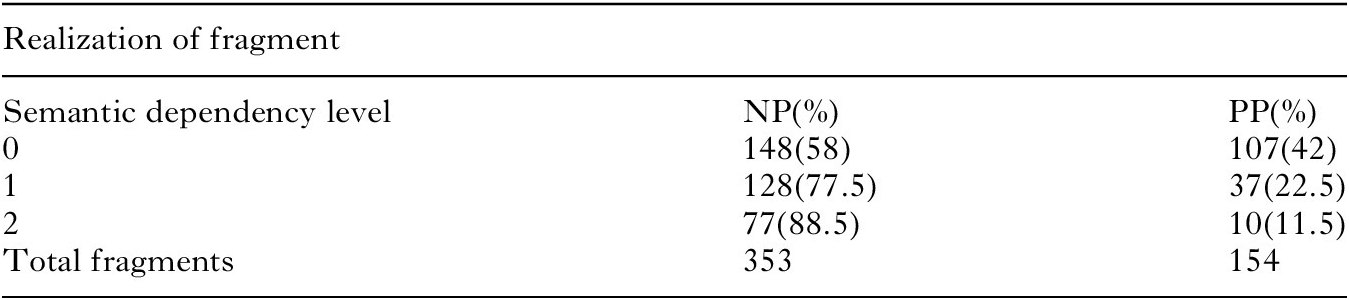
As we show in the next section, this prediction is supported: the distribution of NP fragments to PP fragments is at chance for V-P combinations when there is no semantic dependency between them, but NP fragments are highly preferred when there is one (see Table 1). However, in order to obtain reliable evidence for the effects of MiD we need to tease them apart from the effects of MiF, which also pull in the direction of NP fragments in easy-to-process environments. Our full data and analysis are set out in the next section.
Realization of fragments by semantic dependency level

4. Data and method
We harvested data from three corpora of spoken US English: the Switchboard corpus (henceforth S), the Santa Barbara corpus (henceforth SB), and the Corpus of Contemporary American English (henceforth COCA). Relevant contexts were extracted via two searches. The first was a search for wh-phrases embedded in interrogative clauses as prepositional objects, followed by responses to them (e.g., A: What are you majoring in? B: Communications.). Relevant fragments were then extracted manually from among the responses. We included examples where a wh-interrogative antecedent was followed by two fragments, such that the first fragment served as an antecedent for the second (e.g., Ai: What did you think about all this? B: About what? Aii: Lisa, me, married life.). The second search was for wh-phrases serving as fragments (e.g., A: Can I talk about that for a second? B: About what?). From among these, we manually extracted those fragments whose correlates were either PPs or objects of prepositions. These procedures yielded a total of 507 fragments, of which 353 (69.6%) were NPs.
The statistical analysis of the data was a mixed-effects regression model predicting the realization of fragments as NPs vs. PPs. This procedure involved selection of the best-fitting model that could accurately predict this binary outcome based on a number of factors. We turn next to the fixed factors included in the model.
4.1. Fixed factors
We found five factors overall that make a statistically significant contribution to when fragments will be realized as NPs. We discuss the coding scheme for each in the following subsections. Three of these factors have been discussed above: semantic dependencies in the VP domain (§4.1.1); antecedent form (§4.1.2); and correlate content (§4.1.3); the first in connection with MiD, the second and third in connection with MiF. Two further factors have emerged from previous research on P-drop that also need controlling for, a correspondence effect (§4.1.4), and certain distinctions in construction type within the fragment (4.1.5).
4.1.1. Semantic dependencies in the VP domain
We introduced three distinct levels of semantic dependency between P and a PP-external category X: level 0, level 1, and level 2. These are understood as follows:Footnote 13
1. Level 0: no semantic dependency
2. Level 1: one-way semantic dependency, where P depends on XFootnote 14
3. Level 2: two-way semantic dependency, where X and P depend on each other
The different levels were identified on the basis of Hawkins’ (Reference Hawkins2000) entailment tests (see (25–26)). The dependency of X on P was tested by removing the entire PP from the antecedent clause, and the dependency of P on X by replacing the actual X with an appropriate pro-form. Illustrative tests appear in (27–29):

In (27), neither the PP in Dallas nor the verb grew up are semantically dependent on each other ((1) and (2) are both entailed), and so the dependency would be coded as level 0. In (28) the verb waited is not dependent on the PP headed by for (the entailment in (1) goes through), but for is dependent on waited ((2) is not entailed), so this dependency is level 1. And in (29) counted is dependent on the PP headed by on and also vice versa (neither entailment goes through), so this is a level 2 dependency.
Table 1 shows that semantically independent verbs and prepositions with Level 0 had a chance-level distribution between NP and PP fragments. When there was a semantic dependency of at least Level 1, there were significantly more NP fragments (77.5%), and the proportion of NP fragments increased from dependency Level 1 to 2 (77.5% for Level 1, and 88.5% for Level 2). This is all very much in accordance with MiD.
4.1.2. Antecedent form
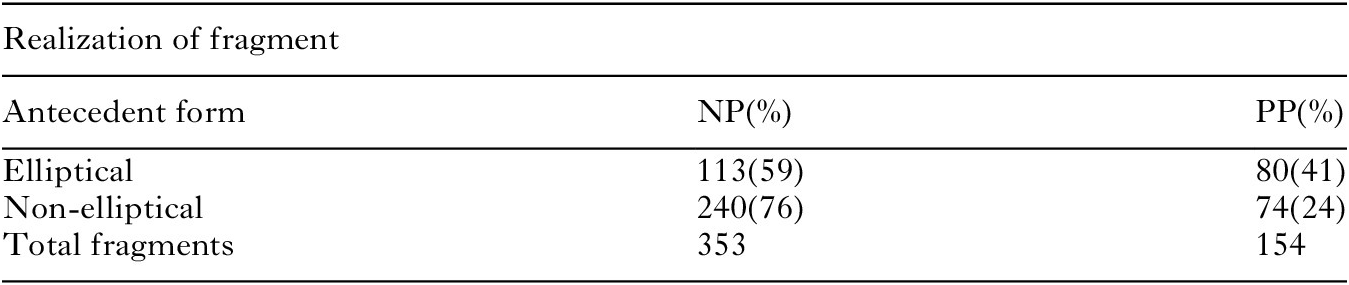
PP fragments were almost twice as frequent with elliptical antecedents (see (22) and (2) above) as with non-elliptical antecedents (see (1)), as predicted by MiF (see Table 2). We coded our data for antecedent form (elliptical vs. non-elliptical) to capture this distinction.
Realization of fragments by antecedent form

4.1.3. Correlate content
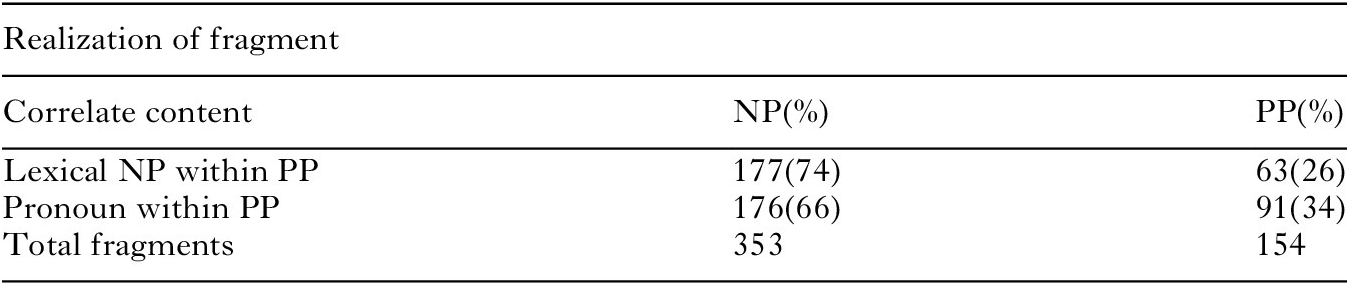
We also coded our data using a binary split between lexical NPs and pronouns. For every NP fragment, its NP correlate was coded as either containing a lexical NP or a pronoun, and for every PP fragment, the object of the preposition within its PP correlate was coded in the same way (see examples (20–21)). There was a higher number of PP fragments when the correlate hosted a pronoun than when the correlate hosted a lexical NP (see Table 3). This is again in the direction predicted by MiF.
Realization of fragments by correlate content

Realization of fragments by correlate form

4.1.4. Correspondence effect
How fragments will be realized has also been shown in the research literature to be tied to whether the form of the fragment matches that of the correlate in the antecedent. This effect was first reported in Levelt and Kelter (Reference Levelt and Kelter1982) for Dutch fragments and termed a correspondence effect. Consider the NP fragments in (30–32).

Preposition stranding in (30A) separates the prepositional object from the head, raising the probability that a subsequent fragment will surface as an NP, not as a PP. Similarly, when an NP fragment serves as an antecedent for another fragment, as in (31B), this raises the probability that the second fragment will also be an NP. Conversely, if a PP fragment acts as an antecedent for another fragment, the second fragment has a higher chance of being a PP. When a prepositional object follows the head, as in (32A), the probability that a subsequent fragment will surface as an NP is lower. These correspondence patterns have been observed in the English corpus data reported in Nykiel (Reference Nykiel2015, Reference Nykiel2017). We can think of them as reflecting a reuse of whatever structure was employed in the fragment’s correlate, part of the general mechanism known as priming or structural persistence (see Nykiel, Reference Nykiel2017, for discussion).
There is an additional explanation for the correspondence effect that is part of the general principle of MiF and its predictions. Recall from Section 2.2 that MiF predicts the appearance of minimal forms to be constrained by the ease with which they can be processed efficiently. One of the factors that promotes minimal forms by improving their ease of processing is structural parallelism between (the structure that contains) the minimal form and its target (i.e., the form or structure that supplies linguistic content for the minimal form) (Hawkins, Reference Hawkins2004). We see structural parallelism effects at work in phenomena such as Right Node Raising (RNR) (2004, pp. 94–95) and filler–gap dependencies (2004, pp. 93–97, 197–201), in addition to fragments.
Our data were coded for whether correlates were continuous PPs (32A) or discontinuous PPs (30A). Antecedents realized as NP fragments (31B) were added to the discontinuous category, while antecedents realized as PP fragments (see (22B) above) to the continuous category. The frequency of PP fragments was almost four times lower with discontinuous correlates than with continuous ones, a skew in the data that we predict whichever explanation we adopt for the correspondence effect (see Table 4). There were more NPs than PPs in both categories, which is consistent with the greater frequency of NP fragments overall in these corpus data for all the reasons exemplified in this section.
4.1.5. Construction type
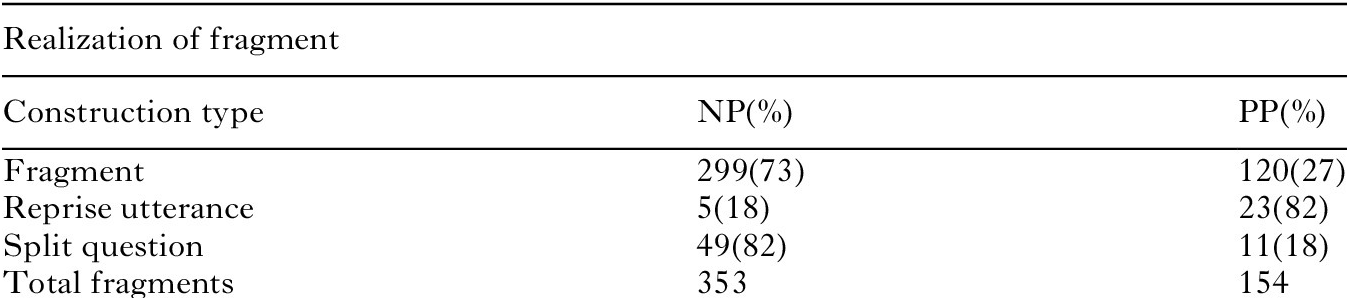
As part of our coding scheme, we have split the general category of fragments into three types: fragments, reprise utterances, and split questions. The fragments type comprises all instances of regular sluicing and BAE (recall Section 1). Fragments behave as expected with respect to the English preference for NPs over PPs (see Table 5). However, reprise utterances and split questions do not (see Nykiel, Reference Nykiel2015, Reference Nykiel2017).
Realization of fragments by construction type

Reprise utterances are clarificational in nature.Footnote 15 Consider (33). Speaker B has not understood the NP Aguilar correctly and is asking for clarification. Because B’s question includes a wh-phrase, it also instantiates sluicing.

But reprise utterances need not instantiate sluicing. In (Reference Culicover34), the reference of the prepositional object that is unclear to speaker B, but their question is not an instance of sluicing.

Reprise utterances exhibit much less P-drop than do fragments.
Split questions are questions followed by tentative answers uttered by a single speaker, as in (35).Footnote 16

Although they appear to be similar to fragments, their striking characteristic is that PPs make up only approximately 18% of the total for this construction type, while they make up close to 30% of the total for fragments.
We included construction type as a fixed factor to keep it from confounding the results of our statistical analysis. However, it is also possible to view some of the above patterns as conforming to MiF. The clarificational nature of the reprise utterance fragments in (33B) and (34B) indicates that they appear in an environment that is difficult to process: speaker B failed to assign the correct properties to the NPs being clarified upon hearing them. MiF predicts that these fragments should contain more explicit material than they would under neutral conditions, resulting in PPs rather than NPs, which they do in 82% of cases (see Table 5). Similarly, the greater frequency of NP fragments in split questions may reflect their greater proximity to a PP correlate within the speech of a single speaker (especially if the antecedent is an in-situ wh-interrogative clause, as in (35)), instead of having to link it with an antecedent across the utterances of different speakers, which plausibly makes processing easier for the single speaker, resulting in a more minimal fragment. Once again, MiF can be invoked.
4.2. Statistical analysis and results
To reiterate, the model presented in this section predicts when English fragments are realized as NPs vs PPs. Our main purpose is to test the predictions that the processing principles MiD and MiF make for English P-drop (as formulated in Sections 2 and 3). We are therefore primarily interested in the effects of semantic dependencies on the one hand, motivated by MiD, and antecedent form and correlate content on the other, which are clearly motivated by MiF, while MiF may also be contributing to the correspondence effect and to construction type. The mixed-effects model we fitted to the data and validated with the bootMer function in the lme4 package (Bates, Maechler, Bolker, & Walker, Reference Bates, Maechler, Bolker and Walker2015) included all five fixed factors listed above and one random factor, items, which was justified by multiple occurrences of several X-P combinations. The random effects structure was selected by means of likelihood ratio tests. In addition to items, we considered the effects of corpus and speaker, but the maximal model that was justified and that converged included only by-items random intercepts.
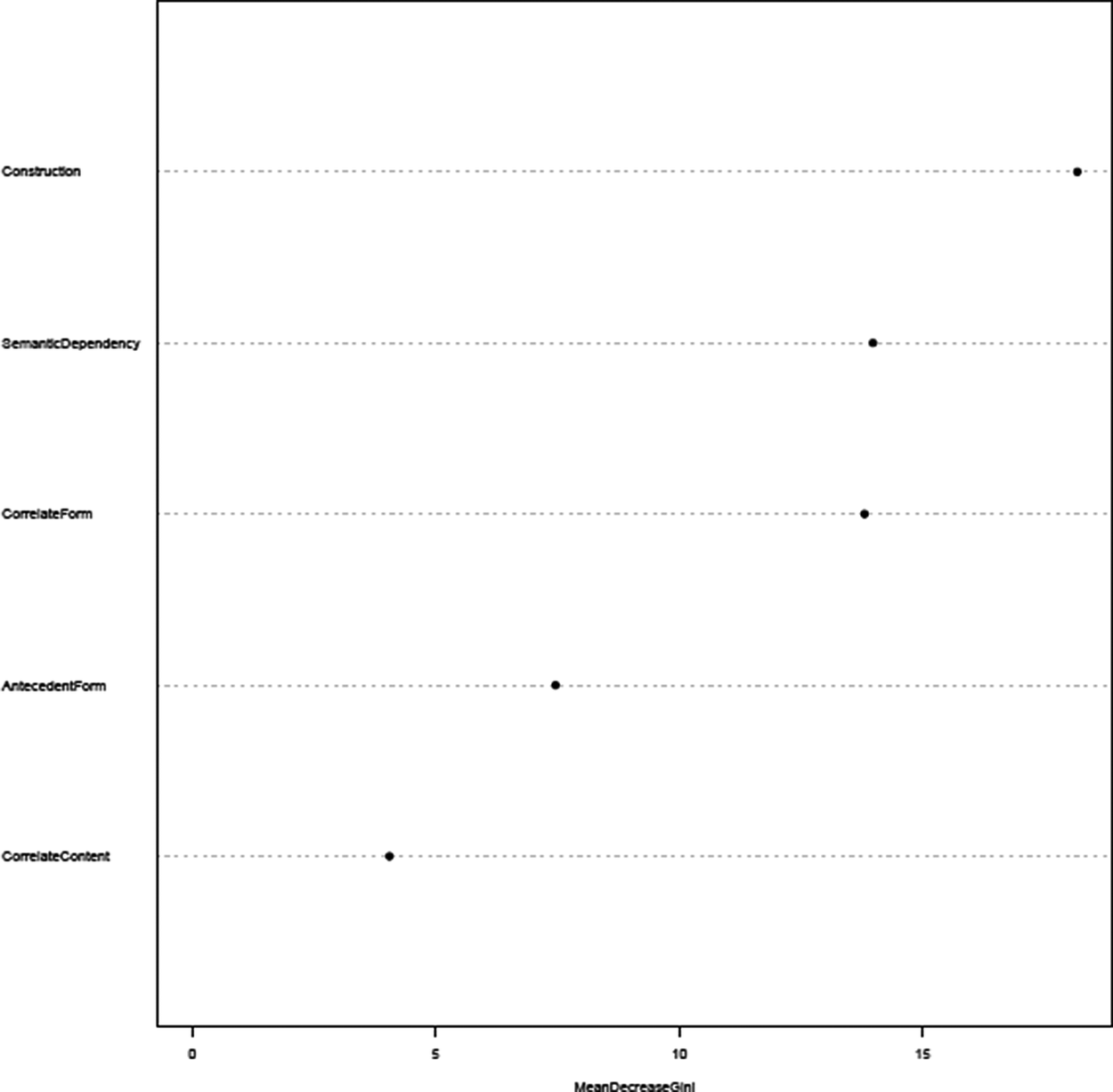
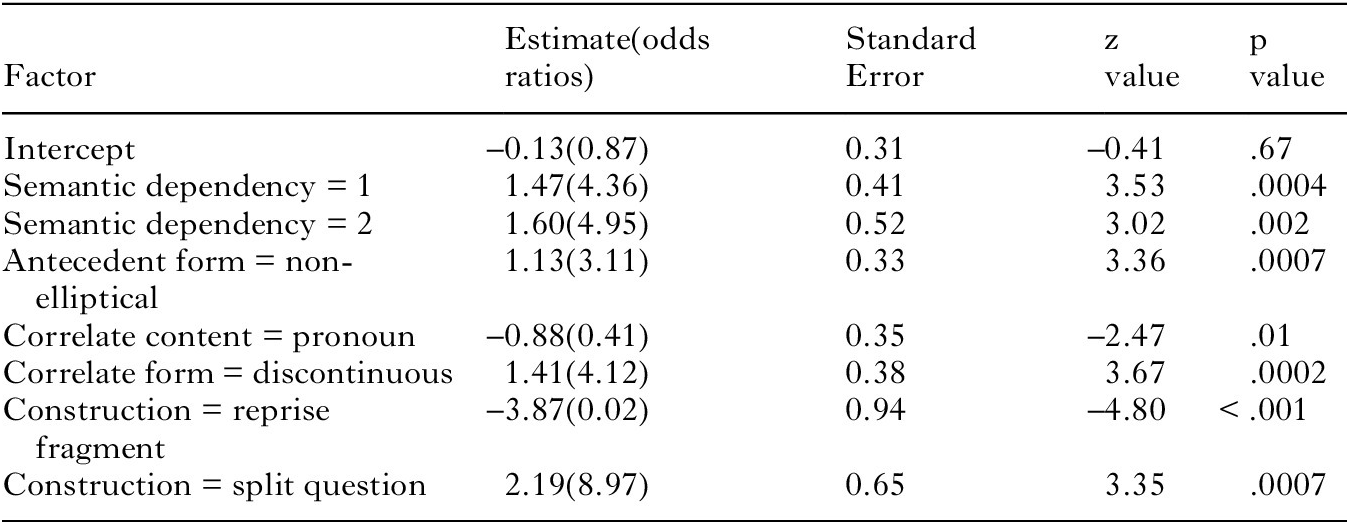
The effect of semantic dependencies is a stronger predictor of P-drop in English than either antecedent form or correlate content. The odds of NPs increase 4.4 times if the level of semantic dependency is 1 rather than its default 0, and 4.9 times if the level of semantic dependency is 2. Antecedent form has smaller effects: the odds of NPs increase 3.1 times if the antecedent is non-elliptical rather than elliptical. As for the effects of correlate content, NPs are 0.4 times less likely if a correlate hosts a pronoun, as opposed to the default lexical NP. In the ‘Appendix’ we provide the model’s outcome and a follow-up random forest analysis, which identifies semantic dependencies as the strongest predictor of the three and the second strongest overall (after construction type).
These results can be extended to formulate the cross-linguistic generalization that the predicted proportion of NP fragments can be computed from the proportion of semantic dependencies in a language. We propose specifically that the probability that fragments will be realized as NPs as a consequence of the operation of MiD in the VP domain can be calculated as a function of the number of semantically dependent combinations from the formula in (36) using the Naive Bayesian classifier. Based on the data in Table 1, this probability is as high as .81 for English, but we predict it to vary from language to language as an estimate of how common P-drop is in each language.

5. Discussion
Our model has confirmed the patterns we gleaned from Section 4.1. The three primary factors we have used to explore how MiD and MiF influence P-drop in English – semantic dependencies in the VP domain, antecedent form, and correlate content – differ in magnitude. All three factors are significant predictors of P-drop, but semantic dependencies have been identified as the strongest of them. We view this result as an explanation for the cross-linguistically unusual bias toward NP fragments in English.
It is important that we understand why English should show more sensitivity to the effects of MiD operating between P and a PP-external head, most commonly V within the VP domain, than to the effects of both MiF and MiD in the PP domain. Semantic dependencies in the VP domain do not enter into statistically significant interactions with any other factors, and this means that MiD wins most of the competitions in the dataset of Table 1 against other factors that favor PP fragments. Hawkins (Reference Hawkins2014a, pp. 210–218) and Hawkins (Reference Hawkins, MacWhinney, Malchukov and Moravcsik2014b) offer an overview of the ways that processing principles may interact with each other, including the scenarios where two principles cooperate or pull in opposite directions, resulting in competition between them. There is independent evidence that if the preference for efficient processing of semantic dependencies competes with other preferences (e.g., information-structural preferences affecting word order), it generally wins the competition (Wiechmann & Lohmann, Reference Wiechmann and Lohmann2013). Hawkins (Reference Hawkins2014a) argues that some efficiency factors can be expected to be strong and to win their competitions against others due to the overall processing advantages of the structures that result from the relevant principles winning the competition. Those that relate to the processing of semantic dependencies are strong because assigning meanings to forms is one of the most fundamental prerequisites for communication and understanding, and the more meanings that can be assigned correctly and without delay, the more efficient is the overall communication of a sentence’s meaning.Footnote 17 This consideration applies particularly strongly to fragments and results in a preference for prepositions that are interpretable within the fragment itself rather than outside it.
Given this, the strength of MiD in the VP domain in the current data is a consequence of, first, the general processing significance of assigning meanings to forms as easily and as rapidly as possible, and specifically the preference for fragment phrases to be independently interpretable, and second it is a consequence of the large number of semantic dependencies between P and X in English. A full 54% of the corpus data of V-PP-PP sequences in Hawkins (Reference Hawkins2000) had at least one P interdependent with V by the entailment tests of (25–26). Nearly 50% of all Ps in the data shown in Table 1 are classified as semantically dependent on X by the same tests. Meanwhile MiF accounts for the gradient effects in antecedent form and correlate content, and it contributes to the parallelism preferences of the correspondence effect and arguably also to the preference for PP fragments in reprise utterances and for NP fragments in split questions. MiD within VP therefore competes with MiD within PP when there are strong PP-external dependencies, resulting in more NP fragments, while MiF may cooperate or compete with MiD in both domains in favor of either NP or PP fragments depending on the syntactic and semantic content and richness of the antecedent and of the fragment and the resulting ease or difficulty of integrating the latter into the former.Footnote 18
One clear prediction made from these English data, beyond the predictions that MiF makes regarding the availability of NP fragments, is that PP-external dependencies should lead to NP fragments occurring in languages that mainly have PP fragments. German, for example, has a strong preference for PP fragments, yet the antecedent in (37A) permits both fragments shown in (37B) as answers, just as in English, with auf being a subcategorized preposition like English on in the gloss.Footnote 19

More generally, the PP pied-piping structures in most languages provide evidence for the strength of the various PP-internal processing domains linking P and NP syntactically, morphosyntactically, and semantically, leading to their preferred adjacency, but PP-external processing domains can be expected to override them in some cases at least, in the interests of the independent processability of the fragment, as in (37B). We would like to offer tests of this expectation operationalized as the formula in (36) in a research program for future cross-linguistic work.
On a theoretical level, our corpus results have implications for the way theories of clausal ellipsis treat P-drop. They bring into sharp relief Levin’s (Reference Levin and Bresnan1982) original insight that fragments fail to behave like constituents of full clauses with respect to P-drop. If the size of fragments is indeed determined by the processing principles MiD and MiF, then P-drop may well be found in any easy-to-process context and regardless of the syntax of full clauses. The advantage of analyzing P-drop as a processing phenomenon is that we not only account for P-drop both in English and cross-linguistically, but also offer a motivation for the general ban on P-drop for sprouting fragments. Current syntactic theories of clausal ellipsis, whether they assimilate fragments to constituents of full clauses (Abels, Reference Abels, Mueller-Reichau and Guhl2017; Chung, Reference Chung2013; Merchant, Reference Merchant2001, Reference Merchant2004; Rodrigues et al., Reference Rodrigues, Nevins, Vicente, Torck and Wetzels2009) or use a distinct mechanism to license fragments (Culicover & Jackendoff Reference Culicover and Jackendoff2005, Reference Culicover and Jackendoff2012; Ginzburg & Sag, Reference Ginzburg and Sag2000), have difficulty explaining the full range of contexts and languages that allow P-drop (as discussed in the ‘Introduction’) as successfully as we can on the basis of two processing principles. However, on the latter type of theory (the construction-based type) construction-specific constraints (e.g., processing-based ones) operating on fragments can be accommodated.
6. Conclusion
This paper spelled out and tested the proposal that P-drop is governed by language-processing principles and communicative efficiency. We have focused on two specific principles, MiD and MiF, and argued that MiD operating in the PP domain disfavors P-drop in general, including in English, while MiD operating in the VP domain has special relevance for English and accounts, in conjunction with the large number of semantic dependencies between V and P, for the typologically unusual preference for NP fragments in this language. MiF also supports P-drop in certain circumstances, both in English and elsewhere, and it calibrates the occurrence of the more minimal NP fragment and the less minimal PP to the ease or difficulty respectively of linking the fragment to its correlate in the antecedent. We have fitted a mixed-effects regression model to data from spoken US English, which yielded support for the predictions made by both MiD and MiF.
Appendix
Statistical analysis
Outcome of a follow-up random forest analysis: the mean decrease in Gini, which indicates improvement in correct classification of each new data item, for the three top factors was 18.16 for construction type, 13.97 for semantic dependencies, and 13.8 for correlate form.

Outcome of the mixed-effects regression model (94% of the fragments predicted correctly; Somer’s Dxy = 0.88); all fixed factors are statistically significant at .05

Random effects