


Introduction
Cognitive behaviour therapy (CBT) has a strong evidence base and there is an increasing demand for training in the UK. Guidelines for treatment of mental health problems in the UK, such as the NICE guidelines, have concluded that psychological therapy and CBT are recommended for several common mental disorders (NICE, 2010). In the UK a substantial body of research has been and is carried out focusing on the components of CBT, in its clinical application and wider social effects, and new models of service delivery have been developed [e.g. Improving Access to Psychological Therapies (IAPT)]. However, the application of CBT is also being explored across cultures, including developing countries (Naeem et al. Reference Naeem, Waheed, Gobbi, Ayub and Kingdon2011). While there does not seem to be an established convention for defining a developing country, the United Nations Development Programme (2010) measures the development of countries with statistical indexes; thus a developing country might have a low value among, for example, per capita income, life expectancy, or literacy rates.
In low- and middle-income countries studies have repeatedly demonstrated an association between poverty and associated factors (such as violence and social change), common mental disorders and state productivity (Patel & Kleinman, Reference Patel and Kleinman2003). The World Health Organization (WHO) recommends that mental health care is available in the community for anyone who needs it and launched the Mental Health Gap Programme to enhance community-level services for mental health disorders, among others (WHO, 2008a). This document highlighted how psychosocial interventions, in particular CBT, could be used in mental health services in low-income countries to address priority conditions, such as depression (WHO, 2008b).
Tanzania has a population of approximately 34 million, and it is estimated that at least 1% of the population suffers from severe mental disorders (Mental Health Policy Guidelines for Tanzania; MHPGT, 2006). Approximately 24% of those attending a primary healthcare clinic and 48% of those attending a traditional healing clinic in Dar es Salaam, the country's largest city, were experiencing symptoms of mental disorder (Ngoma et al. Reference Ngoma, Prince and Mann2003). Demand for mental health services in Tanzania may, therefore, be significant.
In line with WHO guidelines, the MHPGT (2006) also recommend further training of health workers in mental health assessment and treatment both in primary care and in-patient mental healthcare. Mental health services are developing, but at the district level it is acknowledged that there is a lack of skilled mental health workers to meet local mental health needs (MHPGT, 2006).
There have been only a small number of studies of the effectiveness of implementing psychological therapy in developing countries (Chisholm et al. Reference Chisholm, James, Sekar, Kumar, Murthy, Saeed and Mubbashar2000; Bass et al. Reference Bass, Neugebauer, Clougherty, Verdeli, Wickramaratne, Ndogoni, Speelman, Weissman and Bolton2006; Chatterjee et al. Reference Chatterjee, Chowdhary, Pednekar, Cohen, Andrew, Araya, Simon, King, Telles, Verdeli, Clougherty, Kirkwood and Patel2008) and no studies to date of implementing CBT in Tanzania. Similarly, compared to studies on the effectiveness of CBT, there is relatively less literature looking at the training of clinicians to use CBT. A clutch of studies find positive results on delivering brief training to health clinicians (e.g. Miles & Milne, Reference Myles and Milne2004; Mannix et al. Reference Mannix, Blackburn, Garland, Gracie, Moorey, Reid, Standard and Scott2006), while others advocate training models that focus on accessibility and different ways of delivering CBT other than at the expert level (Williams & Martinez, Reference Williams and Martinez2008). A programme was developed to provide training in CBT to psychiatric staff in Tanzania and evaluate its effectiveness. This paper describes the implementation and first phase results of the training intervention. Other qualitative data is being analysed and will contribute to the submission of further papers.
Method
Intervention and setting
A pilot project was developed to train staff at Mirembe hospital (Tanzania's only psychiatric referral hospital) in CBT. At Mirembe, there are approximately 100 clinical staff, of which about 20 are on duty for an inpatient population of up to 540 at any one time (other staff serve psychiatric outpatients, approximately 30 per day, and general outpatients). There is only one fully trained psychiatrist.
The Cognitive Behaviour Therapy in Tanzania (CBT-Tz) programme comprised twelve 3-hour workshops over a period of 4 months. The workshops involved didactic teaching, individual and group exercises, and homework tasks. The programme was developed by the author, who has 5 years’ post-qualification experience using CBT as her main approach in clinical interventions and receiving supervision from therapists recognized by the BABCP. The author was employed as a clinical psychologist and development worker by the Tanzanian Ministry of Health and Social Welfare and an international non-governmental organization. Consultation with authors of previous short-courses in CBT (P. J. Myles, L. Maunder, personal communications) was also carried out to maximize consistency with common approaches to training health professionals in CBT. The programme of sessions aimed to develop the skills of the trainees so that they could conduct sessions with patients using the cognitive-behavioural approach and apply core techniques to patients with Axis I disorders.
Consultation with senior mental health professionals in Tanzania was carried out prior to and during the course of the training, as well as during the preparation of this paper, to consider how the Western nature of CBT could fit within a non-Western environment. Two of the most striking adaptations involved first, the nature of the complaints patients presented with, and second, the educational level of patients.
In the UK, the most common mental health problems people present with are mixed anxiety and depression, generalized anxiety, depressive episodes, phobia, obsessive-compulsive disorder and panic disorder (McManus et al. Reference McManus, Meltzer, Brugha, Bebbington and Jenkins2009). A few studies of rates have been done in Tanzania (e.g. Ngoma et al. Reference Ngoma, Prince and Mann2003) but, for example, obsessive-compulsive disorder seemed relatively unknown in the clinical experience of the Tanzanian clinicians, as did panic disorder. Patients in the UK are more ‘primed’ to use psychological language to describe their symptoms, while Tanzanian patients were much more likely to present with medically unexplained physical symptoms. Therefore training involved building the confidence of clinicians to scrupulously assess more psychologically relevant factors, such as emotions, thoughts, behaviours, and also to investigate situational/environmental factors more thoroughly, e.g. through interview with family members as well as the patient. As one clinician put it, they had to be ‘keen’.
Further, the educational level of patients varied considerably, from those with basic primary school education (sometimes to the extent of only knowing their tribal language), to those with incomplete secondary education, through to those with higher university-level education. This meant there was much discussion of how CBT components such as psychoeducation and the use of homework could be made accessible for these diverse groups.
The training sessions were planned to run consecutively over 12 weeks, the first session taking place 4 weeks prior to the second session, and then sessions every 1 or 2 weeks, except for the final session, to take place another 4 weeks after the penultimate session.
Evaluation
Following Kirkpatrick (Reference Kirkpatrick1998), the study aimed to evaluate the training at three of the four levels: training acceptability, knowledge gain, and behaviour change in practice. Interviews were also held with clinicians after the training.
Procedure
Entry to the programme was open to all staff at Mirembe hospital, provided they had some degree of professional training and had direct clinical contact with patients. Given the immense staff shortage of mental health personnel at the hospital (a reflection of the general situation in Tanzania), only a small group could be relieved of duties to undertake this initial programme, and so a senior clinician screened for participants who already used a counselling approach in their clinical work and who had declared themselves particularly interested in psychological therapy.
Evaluation measures were collected at four time-points:
(1) 4 weeks prior to training (at an orientation to psychological therapy session).
(2) At the first CBT (‘proper’) training session.
(3) At the last CBT training session.
(4) 12 weeks after the last CBT training session.
This procedure with two initial time-points followed Myles & Milne (Reference Myles and Milne2004), who used two baselines to treat the group as their own controls (as in a ‘waiting-list’ condition).
Participants
An initial cohort of nine individuals participated. This was a diverse group, with one consultant psychiatrist, one registrar in psychiatry, one assistant medical officer (senior mental health clinician), one clinical officer (general health clinician), one social worker, one HIV counsellor, one psychiatric nurse, and two general nurses. There were five males and four females. Attendance averaged seven participants per session.
Evaluation tools
Previously used and validated instruments from studies on CBT training were adapted to the current study's circumstances in order to ensure they were culturally appropriate. For example, instrument items using clinical examples were changed (names, presentation, etc.) to make them Tanzanian, and instructions were clarified and/or elaborated. The instruments used were as follows:
Satisfaction/acceptability of the training
A simple measure was developed which used 10-point Likert scales to enquire about usefulness, information, enjoyability and comprehension; as well as two questions about negative and positive side-effects of the training (following Myles & Milne, Reference Myles and Milne2004).
Knowledge gained
(a) A multiple-choice questionnaire adapted from Myles & Milne (Reference Myles and Milne2004) and Maunder et al. (Reference Maunder, Milne and Cameron2008) – MCQ-Tz. The questionnaire was slightly shortened and two clinical vignettes were changed to reflect typical local Tanzanian cases. The scores were summed into five categories: General CBT issues; Theoretical underpinnings of behavioural approaches; Theoretical underpinnings of cognitive approaches; Practice of behavioural psychotherapy; Practice of cognitive therapy.
(b) A video assessment task adapted from Myles & Milne (Reference Myles and Milne2004) – VAT-Tz. In this task participants were shown a 3-minute video of an actor role-playing a patient describing panic disorder. The video was specially made for the programme in collaboration with local students. The actor/patient describes symptoms across affective, behavioural, cognitive and physical domains. Participants were asked to describe the problem, define it (give it a ‘CBT diagnosis’) and list appropriate CBT interventions. Raters (the author and another clinical psychologist trained in and practising CBT in the UK) of this evaluation measure followed a scoring system and inter-rater reliability was 0.82.
Implementation of learning in practice
(a) A ‘CBT in Practice’ questionnaire adapted from Maunder et al. (Reference Maunder, Milne and Cameron2008) – CBTP-Tz. This asks participants to estimate the number of patients with whom CBT approaches covered within training had been used over the last 2-week period.
(b) A ‘generalization’ questionnaire adapted from Myles & Milne (Reference Myles and Milne2004). The questionnaire focused on five main categories and participants were asked to score themselves on items across these on a 1–5 scale. The Experience category relates to participants’ practical use of concepts from CBT; the Generalization category to how much participants use CBT ideas in areas other than in clinical work and have developed new clinical methods based on CBT; the Areas of Functioning category to personal impact. The Support and Participation category lists seven activities and participants must rate the frequency of their involvement, e.g. supervision. Last, the Competence and Confidence category assessed precisely those concepts using three items.
Results
Statistical analysis was initially carried out, but given the small numbers, these were not thought to be meaningful (contact first author for more details). Therefore pre- and post-scores are presented here.
Satisfaction/acceptability of training
Mean scores of the four questions covering usefulness, information, enjoyability and comprehension revealed high ratings by trainees (8.43, 9.00, 9.43, and 7.57, respectively). Scores ranged between 6 and 10. Inspection of the qualitative information concerning negative and positive aspects of the training revealed that the most common problems were the timing of the sessions (participants requested an intensive week-long course rather than the sessions being divided into 12) and lack of opportunity for clinical application; and the most common issues that were appreciated and enjoyed were gaining completely new knowledge and the trainer's teaching style.
Knowledge gained
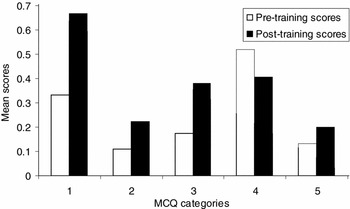
(a) Inspection of MCQ-Tz pre-training (time-point 1) and post-training (time point 3) scores revealed that mean scores across participants increased for four categories, particularly in category 1 (General CBT issues) (see Fig. 1).
Bar chart showing mean pre-training (time-point 1) and post-training (time-point 3) scores. MCQ, Multiple-choice questionnaire.

(b) The VAT-Tz was administered at the first orientation session (i.e. 4 weeks prior to the first proper CBT session), at the first CBT session, and at the last session. Participants’ scores for the three questions were summed such that overall score range was 0–24. The mean pre-training score was 1.78 (s.d. = 1.39), the mean first-session score was 1.67 (s.d = 1.86) and the mean post-training score was 10.29 (s.d = 4.39).
Implementation of learning in practice
Inspection of the data from the CBTP-Tz revealed great variation of scores across individuals and time-points, to the extent that it was clear this was not a valid measureFootnote †. Moreover, collection of data from this questionnaire was for some reason difficult (eight completed it pre-training, only two completed it at the first session and four post-training) which further invalidated use of the data.
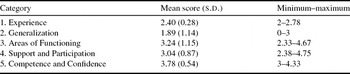
The Generalization Questionnaire was administered at the last CBT training session. Mean scores were calculated across the five main categories and are summarized in Table 1.
Mean scores and ranges of scores for the Generalization questionnaire

Qualitative information
In-depth interviews with clinicians were held some months after the training to ask clinicians how they now understood CBT and what their experience was of both the training and implementation of CBT. Full details and analysis are being prepared in a separate report (Stone & Arroll, unpublished data), but some relevant issues to this paper will be noted here. Five major themes (with sub-themes) were identified. One major theme was ‘Novelty’ with a sub-theme of ‘Training is needed’. The clinicians felt that their journey in CBT had only begun, and moreover, they identified its usefulness for other mental health professionals. Although they felt careful selection of the right trainees was essential, they also felt that all health professionals could benefit from knowing about talking therapies such as CBT. As one clinician put it:
If it is possible, all the training on medical field, especially in mental health . . . CBT should be one component to make, because mental health workers, expert and competent health professionals, especially in treatment without medication . . . yeah, need it.
And another said:
I know, even now, at the school level, health school or colleges, CBT is not there. It's not included in the curriculum. So if I can suggest or give advice that if possible maybe the Ministry of Health could add the CBT because it's very helpful.
Discussion
We will discuss the findings with respect to the acceptability of the training at Mirembe (including methodological issues), its applicability to clinical practice at the hospital, and its applicability to Tanzania, before making recommendations and conclusions.
Acceptability of the training in Mirembe
While there was a clear plan to deliver the training over 12 consecutive weekly/fortnightly sessions before a final session and a follow-up (as outlined in the Methods section), several obstacles typical of those encountered by organizations in developing countries prevented this. In reality, the 12 sessions actually occurred over the course of 3 months, and a follow-up was impossible. Planned sessions often had to be rearranged due to staff being on leave for training, sickness or personal issues, staff shortages in the hospital, and use of the training classroom for other meetings. Follow-up was not possible as three of the participants moved away from the hospital for various reasons and one changed his role to purely physical medicine. These human resource issues appear to be typical in Tanzania, where staff turnover and management seem unpredictable.
This was a pilot study, to gain an initial idea of how to conduct CBT training in the Mirembe setting. Training was based on materials and approaches commonly used in CBT courses, but adjusted to the Mirembe environment. For example, the trainer frequently asked participants for case examples to discuss the ‘fit’ of the approach to clinicians’ experiences; practicalities of the hospital environment were discussed; and each session began with a kamusi ya kisaikolojia (dictionary of psychology) to provide translation from English to Swahili of key terms to be used in the session.
From the results of the evaluation measure it is clear that participants rated the training with high acceptability: all ratings were >5, the mid-point. Such measures are often criticized for being biased as participants may feel socially driven to rate training highly and therefore reluctant to give low ratings. This may be true in our setting, particularly as the training was delivered by a White/European ‘specialist’. Many Tanzanians view the White/European ethnic group (Swahili: mzungu) with positive prejudice. However, it is noteworthy that ratings of comprehension were lower than the other ratings, and it is reflective of participants’ comments that they sometimes struggled to understand concepts in full because the training was in English. They were able to be honest about this question.
While previous studies (e.g. King et al. Reference King, Davidson, Taylor, Haines, Sharp and Turner2002; Myles & Milne, Reference Myles and Milne2004; Maunder et al. Reference Maunder, Milne and Cameron2008) used similar evaluation measures to ours and cited that they took just a few minutes to complete, this was not the case here. Completion of the evaluation measures took approximately 90 minutes, probably because the participants were not practised in completing such documents (as students in the West are from a young age) and also the documents were not in their native language. It is important for readers to understand that in Tanzania all learning consequent to primary education occurs in English, and so professionals are well used to the English language; however, the language of parlance is Swahili. The Video Assessment Task was in Swahili, but it was not possible to translate and validate the other measures into Swahili. Because the evaluation measures took longer to complete than expected, the trainer decided to reduce the number of measures given in the first training session, in the interest of engaging the participants. In order to prevent demoralization and focus on the most ecologically valid measure, only the VAT-Tz was administered at the first session time-point.
Results from the MCQ-Tz showed that participants’ knowledge of CBT, particularly about general concepts, had noticeably improved. Only one category (practice of behavioural approaches) had reduced, which may have been due to greater focus on other CBT issues, at the expense of the behavioural component.
Results from the VAT-Tz also showed an increased ability to apply the CBT model to formulation and recommend treatment strategies in response to a video of a clinical case. This is encouraging given that this is probably the most ‘clinically real’ and ecologically valid of all the evaluation measures.
Applicability of the training to clinical practice at the hospital
Unfortunately, the CBTP-Tz measure proved to be an invalid measure in this setting. The results of the Generalization questionnaire indicated that participants only used the concepts of CBT moderately frequently in their everyday experience at Mirembe, and generalization to novel situations was also moderate. However, it seemed they were slightly more able to use CBT in their personal lives, and to get involved in various activities related to CBT. Participants rated themselves as competent and confident to use CBT in their working lives. Of course, it could be seen as rather alarming that participants rate themselves highly competent and confident, when they actually use the model infrequently and do not know how to generalize concepts. This indicates the need for supervised practice of CBT but is encouraging in the personal use of CBT and the enthusiasm for CBT that the results suggest.
Both participants and the authors noted difficulties with generalizing knowledge gained from training due to lack of time and opportunity for clinical application because Mirembe is understaffed and clinical systems are often inconsistently managed. For example, there is no system for regular clinical or professional supervision and the only opportunity for case discussion is in meetings where more than 30 staff may be present. Together with low staffing resources, this results in problems arranging for supervised practice, joint work, or formal supervision time. These latter activities are core aspects of good psychotherapeutic practice, not least good CBT practice (Pretorius, Reference Pretorius2006) and are found to directly affect clinicians’ CBT skills and confidence (Mannix et al. Reference Mannix, Blackburn, Garland, Gracie, Moorey, Reid, Standard and Scott2006). Participants’ request for more intensive training where time for CBT was in a sense more obviously ‘protected’ is important to note. Direct observation, while optimal to assess changes in practice, was not practically possible given staff shortages and language barriers. Language also precluded the use of an instrument such as the revised Cognitive Therapy Scale (CTS-R; Vallis et al. Reference Vallis, Shaw and Dobson1986; Blackburn et al. Reference Blackburn, James, Milne, Baker, Standart, Garland and Reichert2001). Interestingly, there is some evidence that a measure of knowledge such as the MCQ may be more reliable than the CTS-R (P. J. Myles, personal communication) in measuring outcomes of CBT training.
Applicability of the training to clinicians and patients in Tanzania
Psychological interventions are not widely known about or used in clinical settings in Tanzania (or in fact in most countries in Africa, with the possible exception of South Africa). Thus CBT, a specialized form of psychological intervention, is novel and unusual for clinicians and patients in Tanzania. The evaluation of the training in CBT carried out in Mirembe shows that clinicians are certainly able to learn basic CBT concepts and are interested and keen. However, at that initial stage it was difficult for them to fully understand the details of behavioural and cognitive approaches and therapeutic interventions.
Throughout the trainer's time in Tanzania, the cost of implementing CBT compared to its potential benefits was frequently mentioned. Due to limited human resources, training clinicians in this approach could be inefficient given the time it takes to see a patient for CBT compared to providing medication or simple psychoeducation only (for example). If clinicians know only basic CBT and apply it without supervision, this too is certainly not beneficial. However, we would argue that long-term thinking is needed. For the patient, research to date indicates that CBT reduces relapse and provides better prognosis over time, and we are hopeful that with future development and research, this would become apparent in Tanzania also. For Tanzanian clinicians, CBT increased their confidence in dealing with patients and we believe helped them personally while working in this challenging field of healthcare.
Novelty of the approach could explain some of this, but other reasons emerged from the evaluation and were probably a combination of the following factors: difficulties with full comprehension of English, lack of continuous learning (i.e. spread across 12 weeks), and lack of opportunity for clinical application. This latter point was an issue due to the high demands on the clinicians’ time from other services in the hospital and lack of communication by management to all staff that the participants were undergoing this training. Several months after the training, this was already changing due to designation of a special CBT room with materials, posters being put up to remind all staff when clinicians would be in the ‘CBT clinic’ and regular discussion of CBT in morning handover meetings.
Cultural adaptation of both mental health measures and interventions is rightly much discussed and debated within both psychology and psychiatry (Bhui et al. Reference Bhui, Mohamud, Warfa, Craig and Stansfeld2003; Summerfield, Reference Summerfield2008) and CBT as a ‘Western’ therapy requiring major adaptation for effective use in the culture of Tanzania must be considered further in ongoing research. More insight into the strengths and difficulties that clinicians found in learning and using CBT in Tanzania is revealed in a qualitative study of their attitudes (Stone & Arroll, unpublished data). A qualitative study of patients’ experiences of CBT at Mirembe is also being prepared and offers a compelling view of CBT's potential from the stance of Tanzanian service-users. Given that this CBT programme was a pilot, we are only beginning to understand how it must be adapted for Tanzania, and more details will come with greater clinical application. In their exploration of culturally sensitive CBT in Pakistan, Naeem et al. (Reference Naeem, Waheed, Gobbi, Ayub and Kingdon2011) demonstrated how different pilot stages can clarify which specific elements of cognitions might need addressing in effective CBT.
Through the course of the training, some examples of potentially influential cultural differences came to light. For example, CBT focuses on the individuals’ ability to make change, while the notion of individual responsibility and individual-based locus of control is not culturally common in Tanzania (although with development and globalization things are changing). A person's sense of self appears less individualistic and more invested in the extended family. Thus CBT's application to Tanzanian patients must be changed to reflect this and make it more suitable to a population who identify themselves more in terms of social groups, particularly the family. This might mean modification of CBT to be used with families and groups is necessary to enable Tanzanian patients and clinicians to see its relevance, understand and apply it. This might also affect the content of cognitions at different levels and mean CBT models pertaining to typical psychological disorders require modification to suit Tanzanian psychological constructs. At least it might mean clinicians should be prepared to tackle unique cognitive distortions that are not as common in Western cultures, e.g. relating to responsibility. Other cultural issues which arose were the significance of social hierarchy and its effect on the therapeutic alliance; low levels of literacy of patients; patients’ expectations to receive advice from clinicians rather than collaborative work; and both clinicians and patients being unused to planned courses of talking therapy.
However, despite these differences between Tanzanian and ‘Western’ culture that might affect the course of training and practice of CBT, we believe there are similarities and other factors which point to its potential. For example, the notion of telling stories, and having different beliefs and viewpoints, seems key to Tanzania cultural life and many people will say that ‘storytelling’ (Swahili: kupiga stori) is a favourite past-time. This may make the analysis of situations and formulation in CBT attractive and meaningful to Tanzanian individuals. It may also mean the use of narrative therapy could inform how CBT develops here. Further, Tanzanians are well able to distinguish between physiological feelings, emotions, thoughts and actions. Although not practised in doing so, it was this revelation that thoughts (fikra) exist separately to feelings (hisia) that seemed to offer potential in producing changes.
Recommendations for future training
From the conclusions outlined above, as well as qualitative information obtained from the training participants, recommendations for future training are as follows:
(1) Facilitation should be conducted jointly by CBT specialists and local staff to assist with language and cultural application.
(2) The 12-session format should be trialled in a consecutive period, e.g. in the space of 1 week. Not only could this help strengthen participants’ ability to focus on and attend the training, it would also mean collection of evaluation measures could be done more systematically.
(3) Alternative evaluation measures should be found which would be less of a burden for participants, e.g. quicker and more ecologically friendly. More qualitative measures should be considered.
(4) Opportunities for clinical application of the CBT concepts and supervision should be an intrinsic part of the training and thus should be authorized by senior management, i.e. time off from normal duties should be clearly arranged such that participants can practice new skills with patients.
(5) While self-practice and self-reflection were encouraged throughout the training, neither were formally used within the training course. The value of self-practice has been found to enhance the learning of cognitive therapists (Bennet-Levy et al. Reference Bennet-Levy, Turner, Beaty, Smith, Paterson and Farmer2001) and so could be more explicitly included.
(6) Opportunities for ongoing professional development should be made available to clinicians following such initial training courses, and this should involve clinical supervision as a minimum. Even in remote areas, internet connectivity is growing and while limited, this could offer at least supervision via ‘chatting’ which does not require a large bandwidth. Online learning and talking via Skype would be possible with better internet connections.
(7) This pilot study should serve as a basis for future studies of CBT training and effectiveness in Tanzania. While large randomized, controlled trials may meet with considerable obstacles when implemented in typical working hospitals in Africa, much learning can still be gained from these efforts. Future research should include both quantitative and qualitative investigation to triangulate and add validity to these initial findings, and include both clinicians’ and patients’ views (as mentioned, qualitative data from both clinicians and patients is currently being analysed).
Summary
The results of this evaluation of a pilot CBT-training programme in Tanzania have been discussed with reference to the practical acceptability of the training in the Mirembe Hospital setting, its potential impact on clinical practice at the hospital, and then wider issues such as the applicability of such training to services across Tanzania. Having concluded with specific recommendations for future training of CBT in Tanzania, the authors hope that the potential of CBT is recognized in Tanzania so that training and supervision can be followed up with the aim of learning more about its effectiveness in cultures beyond that in which it originated.
Acknowledgements
We acknowledge and thank Mirembe Hospital and the Mental Health Section of the Tanzanian Ministry of Health for their support of this project, in particular Dr Joseph Mbatia and Dr Erasmus Mndeme. We are further indebted to all the clinicians who participated in the project and all those in Dodoma who gave support despite the heat and challenges along the way.
Declaration of Interest
None.
Learning objectives
(1) To consider the means of training health professionals in CBT (a Western psychological therapy) for use in non-Western countries.
(2) To understand the barriers to training and evaluation of training programmes in developing countries
(3) To appreciate how training of CBT may need to be adapted to ensure practical and cultural acceptability in a busy hospital in a developing country.



Comments
No Comments have been published for this article.