INTRODUCTIONFootnote 1
Since the classic works of Adam Smith (Reference Smith2008 (1776)) and David Hume (Reference Hume1983 (1688)) at the latest, state regulation and religious establishment have been considered central determinants in the organizational behavior of religious congregations with regard to religious, political, and social welfare. More recently, the question of state regulation and religious establishment has sparked new interest in both sociology and political science (Grim and Finke Reference Grim and Finke2006a; Gill Reference Gill2007; Liedhegener Reference Liedhegener, Liedhegener, Tunger-Zanetti and Wirz2011; Pickel Reference Pickel, Liedhegener, Tunger-Zanetti and Wirz2011; Finke Reference Finke2013; Sullivan and Beaman Reference Sullivan and Beaman2013; Fox Reference Fox2015). For example, scholars have looked at the consequences of religious regulation (in its various forms) on religiosity (Chaves and Cann Reference Chaves and Cann1992; Fox and Tabory Reference Fox and Tabory2008), on democracy (Driessen Reference Driessen2010), on political activities (Chaves et al. Reference Chaves, Stephens and Galaskiewicz2004), on social capital (Traunmüller and Freitag Reference Traunmüller and Freitag2011), and on persecution (Grim and Finke Reference Grim and Finke2006b).
One of the reasons for this interest in the effects of religious regulation and establishment on congregations is that Western societies are facing increasing religious diversity, which leads to the explicit or implicit question of the legitimacy of establishing some but not other religions (Robbers Reference Robbers2005; Giordan and Pace Reference Giordan and Pace2014). Another reason for the high level of interest in religious establishment and regulation is the claim made by the paradigm of religious economy that state regulation and establishment dampen religious vitality, and that this is the central reason for the lower aggregate level of religious vitality in European countries in comparison to other countries, especially the United States (Iannaccone Reference Iannaccone1992; Stark and Iannaccone Reference Stark and Iannaccone1994; Stark and Finke Reference Stark and Finke2000). Finally, an empirical understanding of the extent and the nature of the political activities of religious congregations—especially established congregations—seems to be important since the question of the desirability of religious establishment is so fiercely debated in Western countries (Baubérot Reference Baubérot2004; Koenig and Willaime Reference Koenig and Willaime2008). Individuals and groups that take a laïcist position often claim that religious groups should refrain from interfering in the political sphere so as to ensure the principle of laïcité. Other observers—often including religious groups themselves—think that religious groups are important actors in civil society and that they can and should make their political voices heard in society (Habermas Reference Habermas2008).
Despite the obvious importance of state–church relations and establishment regimes, there are very few studies for European countries that investigate the effects of religious establishment on a congregation's organizational behavior. What is the effect of different establishment regimes on the established congregations and the system as a whole? The truth is that we simply do not know, because most of these questions have not been studied at the congregational level.
One key reason for the fact that the connection between level of establishment and congregational characteristics has remained an unopened black box has been the absence of appropriate data. However, the Swiss National Congregations Study (NCS), conducted in the winter of 2008–2009, now allows us to assess key claims about the connection between different levels of establishment and the political activities of congregations for the first time.
This article engages with the literature mentioned by focusing on one specific relationship in one geographical context: namely, the influence of establishment on the political activities of congregations in Switzerland. The key questions that we address are:
(1) What are the main political activities of religious congregations in Switzerland?
(2) What is the overall relationship between the level of establishment (regulation) in the canton and the extent to which established and non-established congregations are politically active?
Before we proceed, it is important to clarify what we mean by the terms establishment, congregation, and political activities—and why the Swiss case is interesting.
Establishment of churches is a central feature of the church–state regime in most European countries (Robbers Reference Robbers2005). Generally speaking, establishment refers to preferential treatment for one or more religious groups, their members, or their institutions (Stolz and Chaves Reference Stolz and Chaves2017, 413). This may take many forms, including paying salaries to clergy, collecting church taxes, and giving preferential treatment to some people when it comes to filling positions in schools, hospitals, the media, and the military. For established groups, establishment normally entails both rights and obligations. The former may include the levying of a church tax, the opportunity to receive state subsidies, and the chance to offer religious services in public institutions such as prisons. Examples of obligations may include the requirement to be organized democratically and the duty of offering religious services to legitimize state proceedings. This kind of establishment is a form of what Grim and Finke (Reference Grim and Finke2006a) call government favoritism.Footnote 2
A congregation is for our purposes simply a “local religious group”—of whatever religious tradition. More specifically, we define congregation as “a social institution in which individuals who are not all religious specialists gather in physical proximity to one another, frequently and at regularly scheduled intervals, for activities and events with explicitly religious content and purpose, and in which there is continuity over time in the individuals who gather, the location of the gathering, and the nature of the activities and events at each gathering” (Chaves Reference Chaves2004, 1–2). This definition is applicable to both established and non-established, and both Christian and non-Christian, groups, and therefore allows us to capture organized religion across the whole range of religious traditions (Monnot and Stolz Reference Monnot, Stolz, Monnot and Stolz2018).
Religious congregations are by definition centrally concerned with religion—but they are also an important part of civil society, and, as such, they may engage in political actions (Beyerlein and Chaves Reference Beyerlein and Chaves2003; Chaves et al. Reference Chaves, Stephens and Galaskiewicz2004; Wald, Silverman, and Fridy Reference Wald, Silverman and Fridy2005). These political actions can take very different forms, from providing an organizational framework for political discussions, encouraging members to vote in a particular way, endorsing certain candidates, collecting signatures for initiatives or petitions, and organizing or participating in political activities such as demonstrations or marches.
Switzerland is an especially appropriate country in which to study these connections because its federalist history has produced substantial variation in church–state relationships across its 26 cantons, leading some cantons to very strong, others to intermediate, and still others to extremely weak state establishment of religion (Stolz and Chaves Reference Stolz and Chaves2017). In all cantons, the same two religious groups—Reformed and Roman Catholic—are advantaged. But in some cantons this takes very strong forms, whereas in others only very slight advantages for the two groups can be found. Cantons differ widely in their establishment regimes, with the most obvious and important differences involving the financial support given to religion. In cantons with strong establishments (Berne, Zurich, Vaud), churches in the established denominations are supported financially by the state. In Berne, the state pays the salaries of Reformed pastors, while in Vaud the Reformed and Catholic churches are financed through the state budget. In cantons with weak establishments, such as Geneva or Neuchâtel, the state still collects church contributions for the Reformed and Catholic churches, but these are not compulsory and most individuals ignore them (Streiff Reference Streiff2008). A compulsory church tax is levied on members of established churches in 21 cantons (SSK Reference SSK2009), and most of these cantons also collect a church tax from businesses.
Establishment rules differ not only in every one of the 26 cantons; they also differ for different churches, especially between the Reformed and the Roman Catholic church (Pahud de Mortanges Reference Pahud de Mortanges2007). While the establishment of the Reformed Church has sometimes been able to achieve very high levels of integration between church and state, the Catholic Church has historically seen state control as problematical. This is why the Roman Catholic Church in Switzerland has opted for a double organizational structure; it is simultaneously organized as a hierarchically organized episcopal church (led by the Bischofskonferenz) and as a democratically organized people's church (presided over by the Römisch-katholische Zentralkonferenz). Only the latter is officially recognized by the state and may levy church tax, which it is then supposed to channel to the episcopal church (Marti, Kraft, and Walter Reference Marti, Kraft and Walter2010b). Not surprisingly, both parts of the church (the episcopal and the people's) regularly come into conflict with each other. Since Reformed and Roman Catholic groups exist in all cantons, these differences do not interfere with our key interest, namely estimating effects of the level of establishment of the canton on the different religious groups.
We see the contribution of our article as twofold. First, we show descriptively how and to what extent congregations belonging to different religious traditions in Switzerland engage in political activities. Second, we investigate whether establishment suppresses the political involvement of established congregations or of the religious field as a whole.
THEORY
The literature that deals with political activity and mobilization on the part of religious groups is strongly influenced by social movement theory, which suggests the importance of both resources and opportunity structures to explaining political activity (Wald, Silverman, and Fridy Reference Wald, Silverman and Fridy2005). Resources can be defined as the material, institutional, and cultural means that religious congregations may use to further their political ends. This includes many things, including buildings, money, personnel, members, social connections, ideology, and motivation (for a list of resources see Fox Reference Fox2013, 85). Opportunity structures are the exogenous material, institutional, and cultural elements of the situation that restrain or empower a given religious congregation when it tries to take action. Such opportunity structures “provide both incentives and disincentives for political mobilization” (Wald, Silverman, and Fridy Reference Wald, Silverman and Fridy2005, 136). Examples are spatial arrangements in a given city, legal frameworks that allow or restrain political mobilization, connections to political parties, and the general values in a society with respect to a certain issue.
In what follows, we identify several mechanisms linking both resources and opportunity structures that show how establishment may either suppress or enhance the political activities of congregations.
How Establishment may Suppress the Political Activities of CongregationsFootnote 3
Resource Dependency
A first straightforward mechanism by which establishment may suppress the political activities of a congregation is resource dependency vis-à-vis the state. Since established congregations are to an important extent financed and otherwise supported by the state, they perhaps do not want to “bite the hand that feeds them” (Chaves et al. Reference Chaves, Stephens and Galaskiewicz2004, 295). In other words, officials of established congregations may be reluctant to engage in oppositional political activities if they know or suspect that they will be viewed critically by their state funders (Toft, Philpott, and Shah Reference Toft, Philpott and Shah2011, 48ff; Fox Reference Fox2013, 89). Such a mechanism seems to works in Switzerland and shows up in various sources. A document produced by the Reformed Church of Lucerne, for example, says that the church cannot emancipate itself from the state but has to use “critical solidarity” because of its establishment (Stolz and Ballif Reference Stolz and Ballif2010, 97). In one of the most telling descriptions by a church official of the Reformed Church in the canton of Vaud (EERV), a canton with very strong state–church relations, it is said that this church, because of its financial dependence, tries to please the state, and avoids offending, criticizing, and confronting it (Rossier Buri Reference Rossier Buri2002, 7).
Fear of Negative Reactions from Political Parties, The Wider Society, and Members
A second mechanism that may suppress the political activities of established congregations is the fear of being criticized not so much by the state, but by political parties or by their own church members (Fox Reference Fox2013, 89). When established churches take a political stance on a contentious issue, the political parties opposing this stance may react negatively. They may argue that an established and partly state-funded church should be neutral and should not use tax-payers’ money to make a political statement (compare to Chaves et al. Reference Chaves, Stephens and Galaskiewicz2004, 296). Also, churches that openly take a political stance may alienate that section of membership who hold a different political opinion.Footnote 4 There are many examples of the importance of this mechanism in Switzerland. Thus, the leading right-wing politician and ex-federal councilor in Switzerland, Christoph Blocher, often criticizes the Reformed and Catholic churches. According to Blocher, “[p]astors moralize, politicize, rebuke…—with much hypocrisy and according to their own convenience” (Ackeret Reference Ackeret2007, 193). Likewise, the Catholic politician Béatrice Acklin Zimmermann publicly criticized the social ethics commission of the Catholic Church, Justitia et Pax, for taking too specific a political position on various issues and for having a “know-it-all” and “paternalistic” attitude with “little expert knowledge of the actual issues”.Footnote 5 Criticism of the political activities and statements of established congregations stems not only from politicians, however; it also comes from a congregation's members. Ferkel and Stadler (Reference Ferkel and Stadler1996, 38) surveyed members of the Reformed Church in the canton of Basel-Country, and were able to show a striking correlation between their party preference and their attitude to the political statements of the church. While members of the church who identified themselves closely with left-wing parties believed overwhelmingly that their church should take political positions in public, members who identified with right-wing parties expressed the exact opposite opinion. No wonder: the statements of the Reformed Church on social and migration policy are in substance often close to left-wing positions—although the church justifies these positions in a religious manner. Every time the Reformed churches take a political stance, they therefore alienate an important section of their membership. We could easily multiply the examples, but the important point is that such negative reactions are frequent, and that congregations that engage in political activities can expect them.
How Establishment may Enhance the Political Activities of Congregations
However, the literature also mentions mechanisms that might lead us to expect a positive relationship between establishment and the political activities of congregations.
Advantage in Terms of Resources
The theoretical literature sees resources as one of the most powerful determinants of political mobilization (Johnston and Figa Reference Johnston and Figa1988, 34ff.; Wald, Silverman, and Fridy Reference Wald, Silverman and Fridy2005, 131). If established religious groups have greater resources, they may engage in more political action than non-established groups that might simply lack the necessary funds, personnel, political connections, and legitimacy for such activities. In fact, established religious groups in Switzerland do indeed have greater financial and organizational resources. Established congregations can count on church tax and state subsidies, and therefore have on average a much higher level of income (Marti, Kraft, and Walter Reference Marti, Kraft and Walter2010a). Because of this, they also have a significantly higher number of paid full-time and part-time staff (Monnot and Stolz Reference Monnot, Stolz, Giordan and Pace2014). An important element of organizational resources for established religious congregations in Switzerland are their denominations, federations, and special links to aid organizations. The initial impetus for the political activities of a congregation often comes not from the congregation itself, but from the higher level of denominations and aid organizations. The Reformed churches are linked to HEKS, Brot für alle, and Mission 21; the Roman Catholic churches are linked to CARITAS, Fastenopfer, and others. It is these denominations at the federal or cantonal levels and aid organizations that have the resources and expertise to react to the current social and political environment, and to see opportunities for political activity. They often then turn to the congregations, which encourage political involvement (such as petitions, marches, votes) on the ground. To take another example, Reformed congregations have a regulated way of collecting money after the religious service, with the donations going to specific Protestant aid organizations such as HEKS, Brot für alle, or Mission 21 four times a year.Footnote 6 On such Sundays, pastors very often use materials made available by the aid organizations—often linked to implicit or explicit appeals for congregation members to become not only financially, but also politically, active.
Self-interest
Established groups are privileged by the state and have an interest in maintaining and defending this situation. Just like government-funded non-profit organizations in general, they have an “objective incentive to increase their participation in the political process to protect or enhance their own funding streams or otherwise improve their working conditions” (Chaves et al. Reference Chaves, Stephens and Galaskiewicz2004, 298). We might especially expect an increased tendency to engage in political action if established groups see their privileges—or even institutional survival—as directly threatened (Fox Reference Fox2013, 85). Political action seems all the more likely if this threat stems from a political process that is easily influenced by mobilization, such as a vote. In Switzerland, we find evidence for such self-interested political action on the part of established churches. For example, established churches in the canton of Zurich fought the popular initiative to separate church and state in 2014. If this initiative had been implemented, the churches would have lost almost all of their income. Church officials took part in public discussions, lobbied politicians, organized publicity campaigns; congregations worked jointly in a common campaign called Sorge tragen. Nein zur Kirchensteuerinitiative (“Take care. No to the initiative on church tax”; our translation).Footnote 7 The Zurich population finally voted the initiative down, with 71.8% “no” votes, and 28.2% “yes” votes.Footnote 8 Another example is the fact that established churches mobilized politically to convince the state to give public recognition to the importance of voluntary work in society.Footnote 9 Established churches defend their establishment status by arguing, for example, that they contribute a lot of voluntary work to society. The public recognition of the importance of voluntary work is therefore an important issue that furthers their interests. A third example is the struggle waged by the churches against Sunday shopping. It seems clear here that they are fighting for their own interests, and against secular competition on Sundays and on important Christian holidays.Footnote 10
Aggregate Effects of Competing Mechanisms
We have described different mechanisms that have opposite effects—some suppressing and some enhancing the political activities of religious congregations. Drawing on the literature and our knowledge of the field, we think it reasonable to assume that these mechanisms do function in contemporary Switzerland. Since we do not have measures of relevant intervening variables representing each of these mechanisms, we cannot estimate their relative importance. What we can do, however, is to estimate the overall aggregate effect of the working of the different—suppressing and enhancing—mechanisms. In other words, we can show
• whether the relationship between level of establishment of the canton and political activities of established groups and the religious field as a whole is positive, negative, or null;
• whether established congregations are more, equally, or less politically active than non-established congregations.
An exception to this general point is the income mechanism. In this special case, we will be able to see how establishment—through income—may or may not influence political activities.
METHOD
The National Congregations Study Switzerland (NCSS) was conducted in 2008–2009. It was modeled on the National Congregations Studies conducted in the United States in 1997–98, 2006–2007, and 2012 (Chaves Reference Chaves2004).Footnote 11
Sampling and Data Collection
To create the sampling framework, we conducted a count of all local religious groups in Switzerland between September 2008 and September 2009.Footnote 12 This was done by combining all available sources of information, including existing lists of local religious groups produced by churches and religious federations; existing lists (published or not) drawn up by scholars; existing lists appearing on institutional websites or in directories or databases; and interviews with informed individuals within the religious milieus. All this information was collated and reviewed to identify local religious congregations. A congregation was retained in the final list only if it appeared in two independent sources of information. From the resulting list of 5,734 congregations of all religions in Switzerland, a sample of 1,040 religious congregations, stratified to over-represent religious minorities, was chosen. For every chosen congregation, one key informant (in most cases the spiritual leader) was interviewed by telephone in 2008–2009 in one of the three national languages.Footnote 13 The approximately 250 questions focused on concrete and verifiable congregational practices as well as on the tangible characteristics of the organization for which the respondent could provide reliable information. The response rate was 71.8%.Footnote 14
Dependent Variables
Our key dependent variables consist of a set of six dichotomous-dependent variables measuring political activities of the congregation. Key informants were asked whether the congregation had (1) encouraged its members to vote in a particular way in a federal, cantonal, or communal election in the last 4 years, (2) encouraged members during religious celebrations to become politically involved in the past year, (3) discussed politics in congregation groups or activities in the past few years, (4) endorsed a specific candidate in a federal, cantonal, or communal election in the past year, (5) collected signatures for a political initiative, a referendum, or a petition in the past year, (6) organized meetings to prepare for or participate in political activities in the past year. These six variables were combined into an additive scale. Cronbach's α is 0.638.
For descriptive purposes, we also use a variable measuring political issues that a group or different groups in the congregation had focused on in the past year. Respondents could name up to three political issues. The answers were analyzed as a multiple response variable. This variable helps us to judge the content of the political activities of established and non-established congregations. We do not use it in our regression analysis, however.
Independent Variables
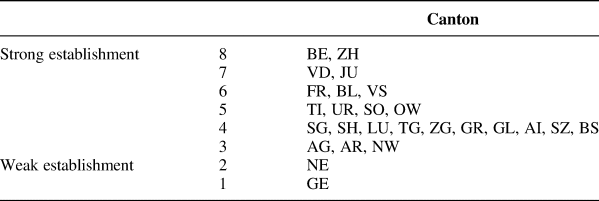
Our key independent variable is the strength of establishment (or: government favoritism) in the different cantons. This variable was measured with a version of the index described in Chaves and Cann (Reference Chaves and Cann1992), adapted to capture as much variation across cantons as possible.Footnote 15 The index ranged in principle from 0 to 10, although no canton received a score of 0, 9, or 10. Coders used information given in Frey (Reference Frey1999) and SSK (Reference SSK2009). Inter-coder reliability was 0.87, with discrepancies resolved by the first author. As shown in Table 1, the coding procedure yielded a distribution of cantons across the establishment scale that seems qualitatively correct.
Level of establishment in different cantons

AG, Aargau; AR, Appenzell Innerrhoden; AI, Appenzell Innerrhoden; BE, Bernee; BL, Basel Land; BS, Basel Stadt; FR, Fribourg; GE, Genève; GL, Glarus; GR, Graubünden; JU, Jura; LU, Luzern; NE, Neuchâtel; NW, Nidwalden; OW, Obwalden; SG, Sankt Gallen; SH, Schaffhausen; SO, Solothurn; SZ, Schwyz; TG, Thurgau; TI, Ticino; UR, Uri; VD, Vaud; VS, Valais; ZG, Zug; ZH, Zurich.
To measure religious tradition, we use a 10-step variable distinguishing “Roman Catholic”, “Reformed”, “Evangelical”, “Other Christian”, “Jewish”, “Muslim”, “Buddhist”, “Hindu”, and “Other”. For our multivariate analysis, we transformed this variable into a five-step variable, where all non-Christian groups are collapsed into a single category. Since Roman Catholics and Reformed congregations are (to a certain extent) established in all cantons, religious tradition and establishment as an attribute of the congregation are perfectly correlated. We therefore cannot disentangle the separate effect of these two variables. What does vary, however, is the strength of establishment in the canton. We can therefore assess the overall effect of strength of establishment in the canton on the religious field as a whole by inspecting the main effect of establishment and the specific effect of establishment on established congregations by calculating the interaction of the establishment and the (dummy) religious tradition variables for Reformed and Roman Catholic church. It is important to understand that the religious tradition variable also captures a distinct bundle of historically grown values, norms, and representations that may influence the propensity of political activity in their own right—independently of any establishment. One of the main results of our article will in fact be that religious tradition as such seems to be an important driver for congregations of engaging in politics.
One of our hypothesized mechanisms uses congregation income. This variable was measured as the total amount of income of the congregation in CHF from all sources in the last year. This variable was logged. In our theoretical account, we presented congregation as a possible intervening variable: establishment may lead to higher income and thereby to greater political involvement. In order to capture this idea in our statistical model, we include the interactions between income and different religious tradition dummies.
We also control for a number of variables that can be expected to co-vary with both establishment and political involvement.
One may consider an effect emanating from a congregation's theological and political self-positioning, although it is difficult to say a priori what effect one should expect. It probably depends on what side of the political and theological spectrum experiences most grievances and is therefore spurned into political action. We therefore include a three-step variable measuring theological orientation of the congregation: “Theologically speaking, would you consider your congregation to be more conservative, more liberal, or right in the middle?”. In the regressions, this variable is represented by two dummy variables. We also include political self-positioning with a three-step variable measuring political orientation of the congregation: “Politically speaking, would you consider your congregation to be more on the left, more on the right, or right in the middle?”. Again, this variable is represented by two dummy variables.
Congregations may simply engage more often in political activities since the individuals united in them are more likely to engage in such behavior. It is well-known, for example, that individuals with a higher level of education engage more and younger people less in political activities (Putnam Reference Putnam2000; Heidelberger Reference Heidelberger2018). We therefore control for the number of regular members who are older than 60 and younger than 35. With regard to income, we control for regular members with an income higher than 100,000 CHF per year and lower than 25,000 CHF per year.
It is also possible for congregations to engage more often in political activities because of organizational capacity. We therefore also controlled for variables measuring (1) whether the congregation was linked to a federation or denomination; (2) whether the head clergy has Swiss nationality; (3) when the congregation was founded; (4) the size of the congregation, that is, the total number of people logged with any link to the congregation; (5) whether the religious services of the congregation were conducted in one of the national languages; and (6) the size of the political community.
Data Analysis
We excluded from the analysis a small established Christian group, the Christ Catholics, and a few established Jewish groups, since including them would have greatly complicated matters when it came to presenting the results. The substantive results are similar with our without their exclusion. The resulting dataset has N = 1010. Data were used in non-weighted form. We employed standard multiple regression techniques, introducing consecutive blocks of variables and thus creating nested models. When there were values missing, we substituted the mean (in the case of continuous variables) and zeros (in the case of dummy variables). An analysis with listwise deletion gives a very similar result.
RESULTS
Extent and Orientation of the Political Involvement of Religious Congregations
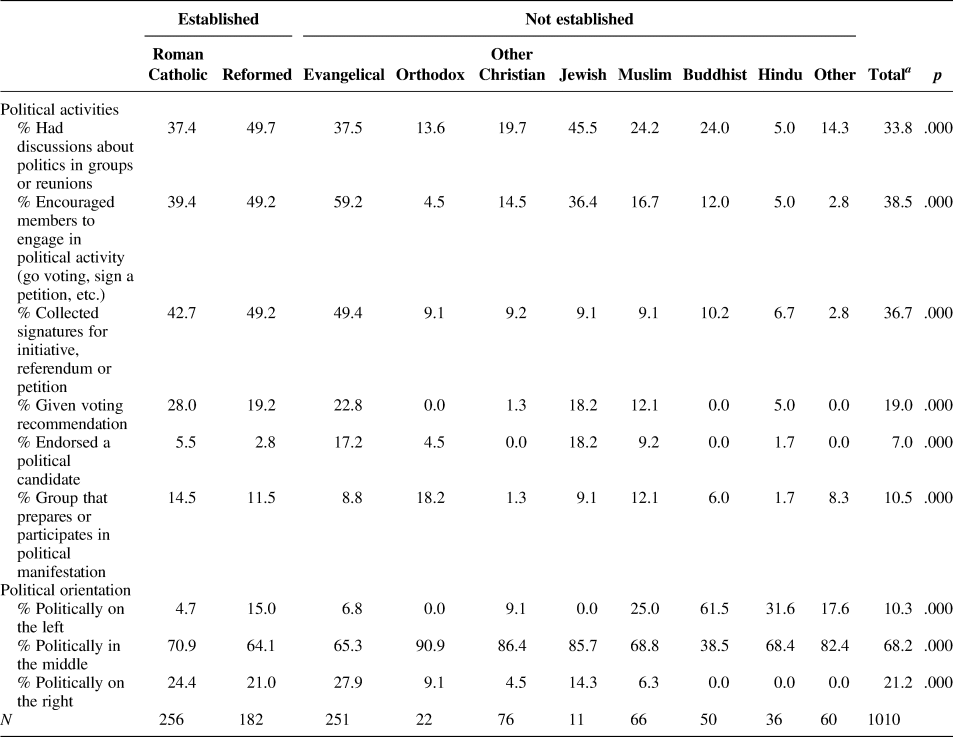
One contribution that our article makes is simply to describe the frequency with which the congregations of different religious traditions are politically active. It would be tedious to describe and comment on every detail given in Table 2; instead, we focus on three central patterns.
Political activities and political orientation of congregations of different religious tradition

aThe totals are weighted so as to account for the over-representing of small groups in the sampling.
First, the political activities of religious congregations in Switzerland can be described as being of “medium importance”: they are neither central to the activities of a congregation, and nor are they completely absent. As Table 2 shows, 38.5% of congregations have encouraged their members to engage in political activity (such as voting, signing a petition, etc.) at least once in the last year; 36.7% have collected signatures for an initiative, referendum, or petition; 33.8% have had discussions about politics in groups or reunions in the past year; 17.5% have encouraged members to vote in a particular way; 10.0% have a group that prepares for or participates in political activity; and 7.2% have endorsed a particular political candidate. As we could have expected, we find higher percentages for general activities where congregations do not have to take a clear position, and lower percentages for more specific political activities such as encouraging members to vote in a particular way and endorsing a specific candidate, where members with different political opinions could be antagonized. It may come as a surprise to non-Swiss readers that as many as 36.7% of congregations have engaged in collecting signatures for an initiative, referendum, or petition—but we have to bear in mind here that Switzerland is a “direct democracy” where people put their signature to popular initiatives and referendums, and vote directly on substantive issues throughout the year. The high percentage is therefore a sign not so much of the high level of political involvement on the part of congregations, but rather of the way that the Swiss political system works in general. In other words, the overall high propensity of Swiss people to collect signatures for popular initiatives and referendums can be expected to show up in the different groups of society (in this case, congregations), too.
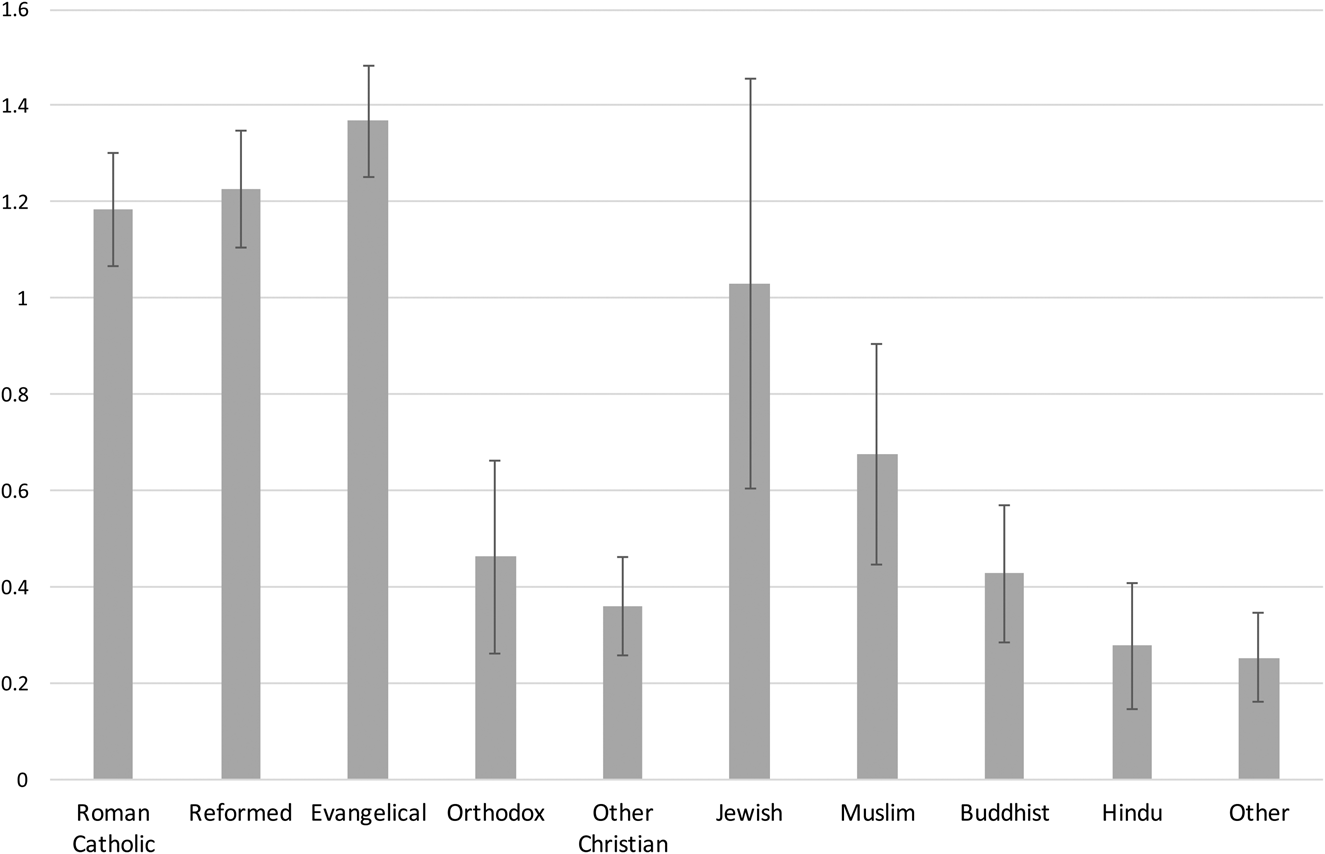
Second, we can clearly make out two groups, one with a relatively high and one with a relatively low level of political activity (Figure 1). The high-level group includes Roman Catholics, Reformed, and Evangelicals. The low-level group comprises all other groups: Orthodox, other Christians, Muslim, Buddhists, Hindu, and other. The Jewish groups are exceptional in that they are a non-Christian group with a relatively high level of political involvement—but the internal variation is high and the numbers are small, which is why the estimation becomes difficult.
Political activities of the congregation (scale mean). Note: we show the mean+1 of the standardized political involvement scale. The transformation+1 was made for better visibility

Third, Evangelicals are the most politically active group in our data. To interpret this, we can only suggest some points that certainly need further research. Compared to all other groups (at the level of aggregation used in this study), Evangelicals are by far the most religious and ideologically homogenous group, a characteristic that represents strong resources that may be used for political mobilization. Evangelicals also have important issues and grievances in current Swiss society, which seems to them to be heading in a direction (secularizing and sexually promiscuous) that they deem unacceptable. We may therefore wonder why it is that they do not in fact mobilize even more than they actually do. However, this group, like all others, also faces constraints that prevent them from mobilizing too much. Swiss Evangelicals are a very small minority (around 2% of the population), and they are for various reasons quickly seen as “sects” or “cults” by the societal mainstream (Stolz et al. Reference Stolz, Favre, Gachet and Buchard2012). They are therefore very careful when mobilizing so as not to encourage the idea that they might be religiously deviant. It is also noteworthy that Swiss Evangelicals are conservative in moral and sexual matters, but otherwise relatively in the center politically, and in any case much less politically conservative than their U.S. counterparts (Stolz et al. Reference Stolz, Favre, Gachet and Buchard2012).
Fourth, there are clearly different political styles among those who are politically active to a relatively strong extent. For example, Evangelicals tend to endorse political candidates more often than Roman Catholics and Reformed; but Roman Catholics and Reformed are more likely to have groups that prepare for or participate in political activities. Jewish groups are much more likely to endorse a political candidate than Roman Catholic or Reformed—but they are much less likely to collect signatures for initiatives, referendums, or petitions. This finding echoes results in the United States. Also using a national congregations study, Beyerlein and Chaves (Reference Beyerlein and Chaves2003, 241) found that “congregations tend to specialize in particular forms of political action, and that specialization is structured by religious traditions”.
Let us turn now to the political orientation of religious congregations in Switzerland (Table 2). Congregations across all religious traditions—except Buddhism—see themselves overwhelmingly as occupying the political center. Only 11.7% of congregations see themselves as being politically rather on the left, and only 20.1% lean to the right, leaving almost 70% in the political center. It is interesting that Buddhist, Hindu, and Other groups either see themselves as in the middle or to the left, and none actually see themselves as being politically on the right. Especially noteworthy is Buddhism, where a majority of groups actually say that they are rather on the political left. The main reason that Hindu, Other, and especially Buddhist congregations tend to lean politically to the left is that many of these groups actually belong to what has been called the “holistic milieu”. This milieu engages in alternative spirituality and, as various studies have shown, its practitioners and participants have an alternative, politically left-leaning lifestyle (Höllinger and Tripold Reference Höllinger and Tripold2012; Siegers Reference Siegers2012).
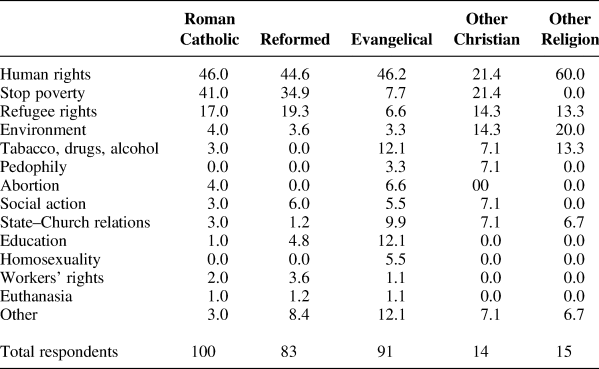
As we have seen above, only 10% of congregations have a group that regularly meets for political activities. These groups are mainly to be found in Roman Catholic, Reformed, or Evangelical congregations. But what political themes do these groups deal with? As Table 3 shows, there is one main theme that is central in all traditions: human rights. Two other themes, “Stop poverty” and “Refugee rights”, are also prominent, especially in Roman Catholic and Reformed congregations. All other themes mentioned are clearly dealt with by these groups less often. It is especially noteworthy that Evangelical groups do not mention more often themes that could have been expected as typical political points of the Evangelical movement, such as the fight against abortion, tobacco, drugs and alcohol, or questions concerning homosexuality. We see slightly higher percentages concerning these issues among Evangelicals than among all other Christian traditions—but the differences are much smaller than we might have expected.
Themes concerning which a group of the congregation has been politically active (e.g., petition, initiative, referendum), according to religious tradition (percent of respondents)

Note: This is a cross-tabulation of a multiple response variable; respondents could mention up to three themes. The basis of percentages is cases. This means that, for example, 46% of Roman Catholics mentioned “Human rights” as a theme.
Accounting for the Extent to Which Congregations are Politically Active
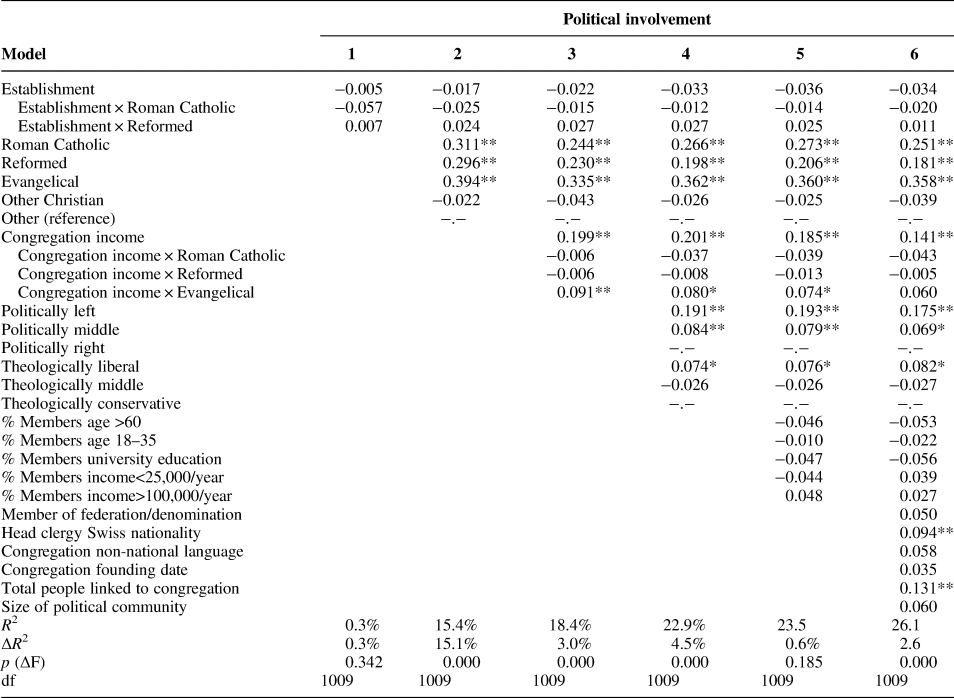
What factors determine the political activities of congregations? Table 4 presents six multiple regressions on our scale of political involvement, entering the dependent variables block-wise.
Multiple regression on political activities

Note: * = significant at the .05 level; ** = significant at the .01 level.
Model 1 begins with our central independent variable, strength of establishment in the canton, and its interactions with dummy variables for established congregations. If establishment in the canton had an effect on the political involvement of the religious field as a whole, it should show up in the main effect; if there was an effect on the established Roman Catholic or Reformed congregations, we would find it in the interaction terms. It turns out that there is no significant effect whatsoever either in the main or in the interaction effects. This is true in all the models, regardless of what variables are controlled for.
Model 2 adds religious tradition. We have collapsed the religious tradition variable into a five-step variable distinguishing Roman Catholic, Reformed, Evangelical, other Christian, and other religions. We find that Roman Catholics, Reformed, and Evangelicals are significantly more politically involved than other Christian or non-Christian congregations. In all models, Evangelicals show a higher score than Catholics, and Catholics a higher score than Reformed. These differences are not very large, but they are statistically significant. The important point here is that, while we saw above that the strength of establishment did not play a role in political involvement, here we see that the established traditions—Reformed and Catholic—are among the more politically active group of congregations, and yet not the most politically active.
Model 3 enters income and interactions of income with the three religious tradition variables, Roman Catholic, Reformed, and Evangelical. We find that income does indeed play a role: congregations with a higher level of income show significantly more political involvement. The interactions are important, too, since they permit us to test one of our theoretical ideas. We had hypothesized that the attribute of being established might lead congregations to having more income and therefore to being more politically involved. If this were true, it should show in the interactions of income with the established Roman Catholic and Reformed variables. But, again, the result is negative. Income does not drive political involvement among established religious traditions more than it does among non-established traditions. The only interaction that becomes significant is the one for Evangelicals (although this effect is not very strong and is no longer significant in model 6). This means that income may drive political involvement a little more strongly among Evangelicals.
Models 4, 5, and 6 enter various control variables and show relationships that are mostly unsurprising. As expected, congregations that tend to see themselves on the political left and describe themselves as religiously liberal are more likely to be politically active than congregations that are on the political right and are religiously conservative. Larger congregations have a higher likelihood of becoming politically involved than smaller congregations. If the head clergy is of Swiss nationality, political involvement is more likely.
CONCLUSION
In this paper, we have explored the political activities of religious congregations in Switzerland, and investigated whether the strength of establishment in the canton suppresses or enhances the political involvement of established groups or of the religious field as a whole.
Concerning the extent and orientation of political involvement, we found that the overall political involvement of religious congregations is at a “medium level”; it is neither central to, nor completely absent from, the activities of congregations. The religious field is very weakly politicized along ideological lines. Most key informants see their congregations as being neither to the right nor to the left, but “in the middle” of the political spectrum. An analysis of the issues that congregations became active in shows that established Christians deal almost exclusively with human rights, poverty, and help for refugees. They differ from Evangelicals in that the latter also deal with human rights, but they deal less often with poverty or help for refugees, and more often with issues such as abortion, religious regulation, education, and homosexuality.
Concerning the determinants of political involvement, our key finding is that establishment does not suppress the political activities of congregations. Although the strength of establishment varies considerably across cantons, we find no statistical effect whatsoever either on the political involvement of established congregations or on the system as a whole. Neither do we find an indirect causal path through income. While it is true that congregations with a higher average level of income are more likely to be politically involved, it is not the case that, by providing more income, establishment leads to more political activities.
Note that we do not wish to say that establishment cannot or does not suppress the political activity of religious congregations. The case studies that we have cited clearly show otherwise. But it seems that, while the suppressing mechanisms have a certain influence, they are balanced by other mechanisms that enhance political activity, with the effect of creating a null-result (compare to Chaves et al. Reference Chaves, Stephens and Galaskiewicz2004).
Instead of establishment, we found other factors that determine the political involvement of congregations, the first and most important being religious tradition. It turns out that Evangelicals, Catholics, and Reformed congregations are much more politically active than other Christian or non-Christian congregations. In all models, according to our scale, Evangelicals are more politically active than Catholics, who are in turn more politically active than the Reformed. Among the non-Christian congregations, it is especially Jews who are much more politically active than all other groups. The non-Christian groups belonging to the “holistic milieu” are among the least political groups. Furthermore, we find, in line with previous research, that different religious groups show distinct political styles; in other words, they prefer some types of political activity to others. It seems that—just as with worship and organizational styles—religious traditions develop through history specific ways of “doing (or not doing) politics” that show up in our data, but that are difficult to unpack further.Footnote 16
Second, congregations with a higher level of income show more political involvement. This finding reminds us of the simple—but not trivial—fact that political activities demand important, often financial, resources (Fox Reference Fox2013, 89). Congregations that simply do not have these resources, such as many small groups, cannot engage in many of these activities, even if they wanted to.
Third, congregations on the political left and with a more liberal theology are politically more active than congregations on the political right and with a more conservative theology. This may surprise readers from, for example, the United States, since they are accustomed to strong religious–political activism from the right. Why, then, do we find this correlation in Switzerland? In our view, part of the reason may be historical. The fact that Evangelicalism has remained small, and that politically conservative Catholicism has developed into a very centrist mainline party (CVP), has meant that no large conservative Christian political movement has emerged in Switzerland. On the other hand, there have always been Christian-social and Christian-socialist forces in Christian congregations. It is their activities that seem to be showing up in these correlations.Footnote 17 This is not to say that conservative politization of religious groups is completely absent. As we have seen, Evangelicals are theologically and politically conservative and also the most politically active group—however, they are so small that they cannot reverse the overall finding that leftist groups are politically more active.
The main—negative—finding of our paper is of practical importance because it means that further disestablishment in Switzerland would probably not make congregations that are no longer established more political; neither is it probable that extending establishment to new groups would reduce their political involvement. This echoes other findings that have shown that the level of establishment in Switzerland had no effect on the religious vitality of established congregations or on the system as a whole (Stolz and Chaves Reference Stolz and Chaves2017).
Our findings may come as a surprise to those who took for granted that establishment or government favoritism would certainly stifle the political activism of religious groups. It is, of course, an open question whether these findings are transferable to other countries and regions. What is certain, however, is that our findings are not just a Swiss specificity. In fact, the study by Chaves et al. (Reference Chaves, Stephens and Galaskiewicz2004) on the question of whether public funding for both religious congregations and secular non-profit organizations depresses political activity in the United States comes to the exactly same conclusion as we do for Switzerland.
We welcome studies that either conduct similar investigations in other countries to see whether our results are transferable, or investigate the empirical relation of religious organizations and political activities at the federal/denominational level.
Appendix
Adapted Chaves/Cann index for level of religious establishment of the canton
1. Recognition
0 = weak; public recognition of some and not other religious groups
1 = strong; ???public-corporate??? recognition of some and not other religious groups
2. Leader appointment by state
0 = no
1 = weak; state gives symbolic recognition to appointment
2 = strong; state is employer
3. Salaries of clergy
0 = no
1 = yes; the state pays some or all of the salaries of pastors
4. Church tax paid by individuals
0 = no/payment optional
1 = mandatory
5. Church tax paid by organizations
0 = no/payment optional
1 = mandatory
6. Church tax or donations collected by the state
0 = no
1 = yes
7. Direct subsidies
0 = no; there are no direct financial subsidies
1 = weak; the state helps churches financially, especially concerning buildings
2 = strong; the state pays flat rates and/or per capita money per church member and/or provides houses for pastors
3 = very strong; recognized churches are financed by the state (state budget)