The United States’ US system of supporting persons with brain injuries such as strokes and traumatic brain injuries (TBI) can be conceptualised as a dichotomous system of acute and long-term care. The US system provides state of the art acute care (Rontondi, Sinkule, & Spring, Reference Rontondi, Sinkule and Spring2005) while failing to provide comprehensive and effective long-term community-based services (Degeneffe et al., Reference Degeneffe, Boot, Kuehne, Kuraishi, Maristela, Noyes, Price, Slooten and Will2008). As a result of this shortcoming, many families assume long-term care responsibilities (Kolakowsky-Hayner, Miner, & Kreutzer, Reference Kolakowsky-Hayner, Miner and Kreutzer2001). Brain injury also presents substantial costs to the US economy. The Brain Injury Association of America [BIAA], 2011b) estimated that TBI costs the US approximately $60 billion per year in medical care and lost wages.
Despite these costs, the US system of long-term care for persons with brain injuries is distinguished by fragmentation, as states differ considerably with respect to the extent of professional attention and financial assistance available. For example, states vary in how brain injury service eligibility is determined, based on factors such as age and cause of injury (Degeneffe et al., Reference Degeneffe, Boot, Kuehne, Kuraishi, Maristela, Noyes, Price, Slooten and Will2008). Families struggle in coming to terms with the demands of caregiving in the face of limited support. Bishop, Degeneffe and Mast's (Reference Bishop, Degeneffe and Mast2006) review found that following brain injury, families consistently identify needs for medical information, financial advice and social support. Moreover, families often encounter elevated levels of anxiety, burden and depression (Degeneffe, Reference Degeneffe2001).
Not surprisingly, families of persons with brain injuries in the US express many anxieties and concerns about the future (e.g., Orsillo, McCaffrey, & Fisher, Reference Orsillo, McCaffrey and Fisher1993). In a sample of 280 adult siblings of persons with TBI in the US, Degeneffe and Olney (Reference Degeneffe and Olney2008) found that siblings were most often worried about the extent of recovery their family members would experience along with who would assume future caregiving responsibilities. Furthermore, siblings expressed fears about their family member's expected level of independence, quality of professional care and the quality of their relationships with family and friends.
The extant research on family future concerns is primarily available directly through the perspectives and opinions of family. To provide an alterative perspective on family future concerns following brain injury from the point of view of professionals, our study assessed family concerns from the perspective of staff and volunteers from the oldest brain injury advocacy organisation in the US, the BIAA (2011a). Our assumption was that participants would provide an informed perspective on family future concerns in the US given the BIAA's extensive involvement with families that stretches from acute-care to many years post-injury.
Method
Population and Procedure
At the time of the study there were 43 BIAA state affiliates in the US and the target population consisted of persons in leadership positions in the state affiliates. We secured the support of the national BIAA office prior to conducting the study. In addition to endorsing the study, the national BIAA office furnished us with contact information for each of the BIAA state affiliates. The national BIAA office identified one individual at each of the 43 state affiliates (typically the president of the board of directors or the executive director). We contacted prospective participants and asked them to complete an electronic survey or to designate another person with the state affiliate, who possessed a thorough understanding of the support provided to families by the affiliate. We limited survey participation to one response from each of the 43 state affiliates in order to obtain responses from the different states equally.
Individuals representing 28 of the 43 affiliates completed the survey (approximately 65% of all BIAA state affiliates). Two respondents were members of the board of directors and the other 26 respondents were paid staff members. Most (n = 17) respondents were executive directors, while others reported being directors of family services (n = 3), service coordinators (n = 3), resource directors (n = 1), secretaries of the board (n = 1), or regional managers (n = 1). Two individuals did not indicate their positions with the state affiliate. Respondents indicated that their organisations had been in existence an average of 24.1 years, and had been affiliated with the BIAA an average of 19.8 years. The state affiliates employed a mean of 6.9 full-time staff and 2.4 part-time staff. When asked to estimate the composition of state affiliate membership, respondents’ estimates indicated that approximately 38.5% of affiliate members were persons with brain injuries, 26.2% were family members of persons with brain injuries, 9.5% were friends of persons with brain injuries, and 28.9% were professionals.
Instrument Design
The data collection instrument consisted of an electronic survey, which was developed using a subscription-based survey application. The survey consisted of four sections: (a) a section addressing informed consent; (b) a section designed to collect demographic data on the respondents’ roles in their organisations, the history of their organisations, and the services offered by their organisations to the families of individuals with brain injury; (c) a section designed to assess family needs; and (d) a small number of open-ended questions designed to prompt respondents to describe the influence of brain injury upon individuals and their families. Previous survey results are presented in (Degeneffe & Tucker, Reference Degeneffe and Tucker2012). The analysis that follows is based upon responses to the question, ‘What common concerns regarding the future do your chapter families have about their family members with brain injuries?’
Survey Distribution Methodology
In an attempt to maximise the survey response rate, the authors employed approaches drawn from Dillman's (Reference Dillman2000) tailored design method, which included appealing for participation using a variety of different messages sent to BIAA state affiliates during a period of approximately 18 days. In order to be reasonably certain that only one respondent from each state affiliate would be represented in the final sample and to reduce the likelihood that respondents might be unintentionally identified, respondents were not asked to provide their name when completing the survey; instead, each state affiliate was provided with a unique code number that they used to access and complete the survey.
Data analysis
Qualitative data gathered though the open-ended questions at the conclusion of the survey instrument were organised with the assistance of HyperRESEARCH version 2.8 (Depuis, Reference Depuis2007), a software programme that facilitated coding and retrieval of narrative data. Working in tandem, we utilised open and axial coding strategies detailed by Strauss and Corbin (Reference Strauss and Corbin1990). Narrative data were categorised into fundamental elements of meaning and the elements were then compared in order to construct categories of conceptually related data. We used the categories and the narrative data associated with each category to identify, report and describe themes that represented concepts and ideas expressed with varying degrees of consensus among the survey respondents.
Results
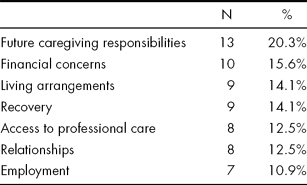
The next several paragraphs detail the results of the analysis of narrative data provided by BIA affiliates. Our analysis resulted in seven themes of commonly endorsed family future concerns, summarised in Table 1. The themes are presented in the order of the frequency they were identified by participants.
Frequency count and percentages of responses for most common future concerns themes

Future Caregiving Responsibilities
Family concerns about future caregiving responsibilities were described frequently by state affiliates in their responses to the question about future concerns. Most of the state affiliates’ statements related to concerns about who would care for the individuals once family members were no longer willing or able to do so (e.g., ‘What if something happens to me? Who will care for the injured individual?’, ‘Who will take care of them after their families are gone?’). Concerns about the quality of life of the individual with the brain injury were also apparent in the responses, as one individual indicated: ‘Who will take care of my loved one when I am gone and what kind of life will they have?’
Financial Concerns
Financial concerns that state affiliates described were related to three primary concepts: living with diminished income, access to financial help and being able to afford long-term care. Respondents indicated that families have concerns about getting by on less income and ‘managing impoverishment’. Future concerns also related to knowing where to turn for financial help and learning about financial resources that might be available. Concerns about long-term care and the financial resources to provide that type of care also were voiced by respondents. One state affiliate suggested that long-term financial security was connected, to some extent to ‘Whether the social security system will still be in place. . .’
Living Arrangements
Future concerns about living arrangements were described as being related to the individuals capacity for independent living (‘. . .when they will be able to live by themselves or become more independent’), assisted living (‘Long term planning and assisted living arrangements’), and finding housing when the present caregiver is no longer able to provide care (‘Where will the person live when the family member who is the caregiver is no longer available’).
Recovery
State affiliates indicated that families’ future concerns often centered on the recovery of the family member with the brain injury. Chief among the concepts embedded in the theme of recovery were concerns about the extent of recovery (‘Fear of the person getting worse’, ‘A lot of the concern is about the unknown. . .what will the survivor be like after rehabilitation’), and the duration of the recovery process (‘When he will be back to normal’, ‘When they will be able to live by themselves or become more independent’).
Access to Professional Care
Respondents suggested that some family concerns relate to the families’ ability to access care for their family member with brain injury. State affiliates indicated concerns about a lack of brain injury expertise amongst professional care providers (‘Lack of community providers who specialize in brain injury’, ‘. . .assistance in finding professionals that have experience working with brain injury’) and concerns about families’ abilities to afford necessary services.
Relationships
State affiliates affirmed that families have concerns about future relationships, both within the family and in other social settings. Among the relationship-focused concerns were loss of social relationships and the resulting isolation, as well as concerns about future opportunities for socialisation. Families also were described as being concerned about the impact upon family relationships as well as the impact upon relationships precipitated by changes in the personality of the individual who experienced the brain injury.
Employment
Future concerns about employment were described as relating to obtaining a job, determining when the individual with the brain injury could work, finding employment for the individual with the brain injury and maintaining a job after brain injury.
Discussion
We identified seven future concerns families commonly encounter as they cope with the stresses and strains of caregiving for a person with brain injury according to the perceptions of the professionals who participated in the study. Our findings underscore the overarching uncertainty families face regarding who will meet the future care, residential and support needs of their loved ones, as well as worries about their injured family members’ level of independence, quality of relationships, level of recovery and extent of access to professional services. Our findings parallel future concerns identified by Degeneffe and Olney (Reference Degeneffe and Olney2008), which helps to support the validity of our findings for understanding family perceptions in the US. Our findings also are consistent with previous studies that suggest brain injury professionals in the US often lack adequate training (e.g., Walker, Boling, & Cobb, Reference Walker, Boling and Cobb1999) and that families and injured persons lack access to professional care and funding (e.g., Spearman et al., Reference Spearman, Stamm, Rosen, Kayala, Zillinger, Breese and Wargo2001). Also like our findings, previous US-based studies indicate that injured persons can struggle with the process of maintaining relationships (Medlar, Reference Medlar1998) and engaging in productive employment (Wehman, Targett, West, & Kregel, Reference Wehman, Targett, West and Kregel2005).
As suggested in our literature review, our findings are not surprising and perhaps even expected given the deficient state of long-term community support provided to persons with brain injuries and their families in the US (Degeneffe et al., Reference Degeneffe, Boot, Kuehne, Kuraishi, Maristela, Noyes, Price, Slooten and Will2008). On the federal level, the US is working toward providing greater funding for research and training through passage of the TBI Act (BIAA, 2006) and the TBI Model Systems of Care Program, funded by the National Institute on Disability and Rehabilitation Research (BIAA, 2013). Also, with the high number of veterans with TBI returning from the military conflicts in Iraq and Afganistan, the US Department of Veterans Affairs (2011) has created specialised funding and programmes to support families. For example, families of injured veterans can receive financial assistance through the Caregivers and Veterans Omnibus Health Services Act of 2010 (Public Law: 111–163, as cited in Griffin et al., Reference Griffin, Friedemann-Sanchez, Jensen, Taylor, Gravely, Clothier, Simon, Bangerter, Pickett, Thors, Ceperich, Poole and van Ryn2011). Our findings, however, suggest that federal programmes are falling short of translating to practice and meeting local, community-based, long-term needs in the civilian population.
With regard to clinical practice, our findings should motivate rehabilitation counsellors and other helping professionals in the US to advocate for funding, policies, professional training, and programmes to better meet family needs following brain injury. Also, rehabilitation counselors need to enable families to make future plans for the care and support of their injured family members. Our findings suggest that a great deal of uncertainty exists about where injured family members will live in future years and who will meet their care needs. This finding is consistent with Degeneffe's (Reference Degeneffe2012) study of 30 adult sibling/parent dyads of persons with brain injuries in the Southern California region of the US. Degeneffe reported that only 56.7% of siblings planned on assuming future care responsibilities while 46% of parents expected adult siblings would be future caregivers to their injured brothers and sisters.
Our findings may be limited in relying on BIAA perspectives because they may have overstated the level of need given their advocacy role and interactions with families during times of distress. Our findings present the need for future research to determine how public policy, funding and professional training can better address the future concerns of families of persons with brain injury in the US. Consistent with this special issue, an important strategy for future studies should rely on cross-cultural and international comparisons of best practice approaches for supporting persons with brain injuries and their families.
Conclusion
This study analysed the perceptions of 28 persons in leadership positions with the BIAA regarding common family future concerns following brain injury. The findings indicate that many families are unprepared to meet the future care and support needs of their injured family members, due in large part to the poor state of long-term community support and professional assistance available in the US It is hoped that the results of this study will motivate researchers and rehabilitation counselors to place greater focus on how persons with brain injuries and their families are supported on a long-term basis in the US.