1. Introduction
Cheloniellida is a major clade of generally rare (nekto-)benthic vicissicaudate euarthropods ranging from the Early Ordovician (Van Roy, Reference Van Roy2006 b; Van Roy et al. Reference Van Roy, Orr, Botting, Muir, Vinther, Lefebvre, Hariri and Briggs2010, Reference Van Roy, Briggs and Gaines2015) to the Early Devonian (Broili, Reference Broili1932, Reference Broili1933; Stürmer & Bergström, Reference Stürmer and Bergström1978; Bartels & Brassel, Reference Bartels and Brassel1990; Bartels et al. Reference Bartels, Briggs and Brassel1998; Van Roy, Reference Van Roy2006 b; Kühl et al. Reference Kühl, Bartels, Briggs and Rust2011, Reference Kühl, Bartels, Briggs and Rust2012). They have a dorsoventrally flattened body and are characterized by the possession of a cephalic shield with sharply procurved posterior margins and a trunk with broad, radially arranged tergopleura, followed by a single posterior cylindrical sclerite bearing a pair of furcal appendages dorsolaterally and terminated by a small, cap-shaped telson. While their distinctive morphology makes them readily recognizable, they were only relatively recently formally recognized as a distinct clade by Dunlop and Selden (Reference Dunlop, Selden, Fortey and Thomas1997), who regarded them as a sister group to Chelicerata. Earlier authors had allied various cheloniellid taxa with trilobites (Barrande, Reference Barrande1872; Quenstedt, Reference Quenstedt1932; Broili, Reference Broili1933), aglaspidids (Caster & Macke, Reference Caster and Macke1952; Chlupáč, Reference Chlupáč1965), the chelicerate stem (Størmer, Reference Størmer1944, Reference Størmer and Moore1959; Stürmer & Bergström, Reference Stürmer and Bergström1978; Bergström, Reference Bergström and Kraus1980; Chlupáč, Reference Chlupáč1988, Reference Chlupáč1999 b; Hou & Bergström, Reference Hou and Bergström1997), xiphosurans (Neumayr, Reference Neumayr1887; Bergström, Reference Bergström1968), pancrustaceans (Broili, Reference Broili1932, Reference Broili1933; Boudreaux, Reference Boudreaux1979; Simonetta & Delle Cave, Reference Simonetta, Delle Cave, Simonetta and Conway Morris1991) or even polyplacophoran molluscs (Jahn, Reference Jahn1893).
Triopus draboviensis Barrande, 1872 was the first cheloniellid to be formally described, based on a single specimen from the Sandbian (Upper Ordovician) Letná Formation from the Děd Hill near Beroun, Bohemia. Barrande (Reference Barrande1872), with some reservations, considered Triopus to be a trilobite, but also commented that its unusual morphology might mean it actually belonged to another clade, closely related to Trilobita; in his closing remarks, he also mentions some possible limited similarities with the trunk of the Carboniferous xiphosurid Euproops rotundatus (Prestwich, Reference Prestwich1840). Novák (Reference Novák1885) realized the non-trilobite affinity of Triopus, and according to Chlupáč (Reference Chlupáč1965), he assigned the fossil to the Xiphosura in an unpublished manuscript. This view was followed by Neumayr (Reference Neumayr1887), and much later also by Bergström (Reference Bergström1968), while Jahn (Reference Jahn1893) mistook the fossil for a polyplacophoran. Based on Barrande’s (Reference Barrande1872) original description and illustration of the holotype, Chlupáč (Reference Chlupáč1965) considered Triopus to be an aglaspidid. Later, he compared it to Duslia Jahn, 1893, but concluded that the systematic position of Triopus was uncertain (Chlupáč, Reference Chlupáč1988), a view also shared by Selden and White (Reference Selden, White, Briggs and Lane1983). Incomplete knowledge of the head of Triopus led Chlupáč (Reference Chlupáč1965) to the suggestion that the isolated cephalic shields of Zonozoe drabowiensis Barrande, 1872 or Drabovaspis complexa (Barrande, Reference Barrande1872) may have belonged to this animal, and he subsequently hypothesized that the body may have terminated in a spinose telson (Chlupáč, Reference Chlupáč1988). Later, Chlupáč (Reference Chlupáč1999 a) further suggested Zonoscutum solum Chlupáč, 1999b as an additional candidate for the cephalic shield of Triopus draboviensis. Likewise, Bergström (Reference Bergström1968) combined Triopus with Drabovaspis, and even provided a speculative reconstruction of this composite with a long, styliform telson.
While over the past 150 years multiple authors have commented on the affinities and morphology of Triopus, the single available specimen has eluded detailed restudy ever since it was first described by Barrande (Reference Barrande1872). This is likely at least in part due to the fact that for a considerable time it was misplaced, being only rediscovered in the late 1980s (Chlupáč, Reference Chlupáč1965, Reference Chlupáč1988). As a consequence, until now the most comprehensive analysis of Triopus draboviensis was contained in Chlupáč’s (Reference Chlupáč1965, Reference Chlupáč1988, Reference Chlupáč1999 a) brief comments. Here, for the first time, we provide a detailed redescription and reconstruction of Triopus draboviensis, showing that, contrary to previous assertions, the anterior of the holotype, while relatively poorly preserved, is essentially complete. In addition to the holotype NM L 16736, a second recently discovered partial specimen NM L 60823 is also described. While this new specimen likely is conspecific with the holotype, out of caution due to its incomplete preservation it is left here under open nomenclature as Triopus sp. An emended diagnosis for Cheloniellida, which hitherto had not been revised since it was first established by Broili (Reference Broili1932), is also provided.
2. Geological setting and preservation
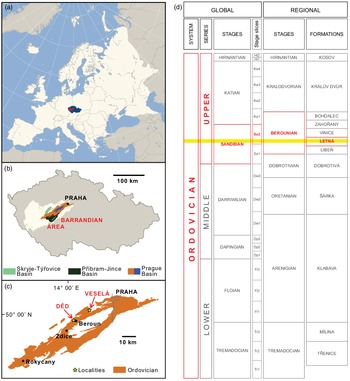
The holotype NM L 16736 of Triopus draboviensis comes from the Děd Hill, a classical outcrop near Beroun that was known since Barrande’s time and is also referred to as ‘Drabov’ or ‘Drabow’ (see Chlupáč, Reference Chlupáč1963, Reference Chlupáč1988; Rak et al. Reference Rak, Bergström, Fatka and Budil2009, Reference Rak, Ortega-Hernández and Legg2013; Fatka et al. Reference Fatka, Lerosey-Aubril, Budil and Rak2013; Drage et al. Reference Drage, Laibl and Budil2018). The new partial specimen NM L 60823 was collected from a float block near another historical outcrop at Veselá Gorge. Both localities belong to the middle third of the Letná Formation in its quartz sandstone facies development, with Veselá possibly being situated slightly below Děd stratigraphically (Fig. 1).
Overview maps and stratigraphical column showing the geographical and stratigraphical position of the localities where Triopus draboviensis Barrande, Reference Barrande1872 (Děd Hill) and Triopus sp. (Veselá Gorge) were collected. (a) Position of the Czech Republic (blue) and the Barrandian area (red) in Europe (from Van Roy et al. Reference Van Roy, Rak, Budil and Fatka2021; base map adapted from Ssolbergi, 2011). (b) Map of the Czech Republic showing the position of the Barrandian area, with Lower Palaeozoic basins indicated (from Van Roy et al. Reference Van Roy, Rak, Budil and Fatka2021). (c) Overview map of the Ordovician of the Prague basin. Localities of Triopus draboviensis (Děd Hill) and Triopus sp. (Veselá Gorge) indicated with a yellow star and red arrow (adapted from Van Roy et al. Reference Van Roy, Rak, Budil and Fatka2021). (d) Stratigraphical occurrence of Triopus draboviensis Barrande, Reference Barrande1872. Range of Triopus draboviensis is indicated by the yellow band across the columns.

The thick complex of vertically rapidly alternating quartzose sandstone, greywacke, siltstone and pelites that constitutes the Letná Formation was first distinguished as a separate unit by Kettner and Prantl (Reference Kettner and Prantl1948). Formalization of what is now considered the Letná Formation was published by Havlíček and Vaněk (Reference Havlíček and Vaněk1966) and Havlíček (Reference Havlíček, Chlupáč, Havlíček, Kříž, Kukal and Štorch1998). The thickness of the Letná Formation locally exceeds 600 m between Prague and Beroun and represents the thickest Ordovician unit in the Prague Basin. Its lower boundary is given by the onset of thick, rhythmically bedded quartzose sandstones, bioturbated quartzose sandstones, siltstones and greywackes (Kukal, Reference Kukal1958, Reference Kukal, Chlupáč, Havlíček, Kříž, Kukal and Štorch1998).
The Letná Formation is characterized by an alternation of coarser and finer sediments in beds several centimetres to decimetres thick (Havlíček, Reference Havlíček, Chlupáč, Havlíček, Kříž, Kukal and Štorch1998), all with strong bioturbation and diverse ichnofossils (Mikuláš, Reference Mikuláš1998 a, b). Fine-grained sandstones to greywackes, sandy siltstones, clayey siltstones and clayey sandstones dominate, with clayey shales being only rarely present. The trilobite fauna is highly diverse, and dominated by Dalmanitina socialis (Barrande, Reference Barrande1846) and Deanaspis goldfussi (Barrande, Reference Barrande1846); in fact, the holotype NM L 16736 is associated with a pygidium of D. socialis on the other side of the slab. Bivalves, gastropods, conulariids, brachiopods and echinoderms are also present in this unit (Kříž & Steinová, Reference Kříž and Steinová2009; Noailles et al. Reference Noailles, Lefebvre and Kašička2014; Polechová, Reference Polechová2022). In addition to these classical ‘shelly’ taxa, the Letná Formation has also yielded numerous exceptionally preserved non-biomineralized euarthropods and problematica, the most famous of which are the marrellid Furca bohemica Fritsch, 1908 and the cheloniellid Duslia insignis Jahn, 1893 (Chlupáč, Reference Chlupáč1963, Reference Chlupáč1965, Reference Chlupáč1970, Reference Chlupáč1988, Reference Chlupáč1999 a, b; Rak et al. Reference Rak, Bergström, Fatka and Budil2009, Reference Rak, Ortega-Hernández and Legg2013; Ortega-Hernández et al. Reference Ortega-Hernández, Braddy and Rak2010). Remains of the digestive tract in several trilobite taxa from the Letná Formation were described by Beyrich (Reference Beyrich1846), Barrande (Reference Barrande1852), Přibyl and Vaněk (Reference Přibyl and Vaněk1969), Šnajdr (Reference Šnajdr1990, Reference Šnajdr1991) and Fatka et al. (Reference Fatka, Lerosey-Aubril, Budil and Rak2013). While for the past two centuries the Letná Formation has been a prime target for fossil collection and study by both amateurs and researchers alike, new discoveries keep being made on a regular basis, as exemplified by the recent description of two new thylacocephalans (Van Roy et al. Reference Van Roy, Rak, Budil and Fatka2021). The above-mentioned faunas are in particular characteristic for the inshore quartzose sandstones, while a poor atheloptic trilobite association is typical for the offshore slope settings. Very rare graptolites, trilobites of the Cyclopygid Biofacies and brachiopods of the Paterula Community occur in poorly oxygenated black shales supposedly belonging to the Letná Formation in central parts of the basin only (for a summary see Fatka et al. Reference Fatka, Lerosey-Aubril, Budil and Rak2013).
In the holotype NM L 16736, the actual dorsal exoskeleton is preserved as a cast in the surrounding sediment, but has a slighly darker, brownish colour possibly due to the presence of iron oxides resulting from the weathering of original authigenic pyrite. The new specimen NM L 60823 is preserved as an external (negative) mould in the surrounding sandstone.
3. Materials and methods
Both specimens are housed in the collections of the Department of Palaeontology of the Natural Museum, National Museum in Prague, Czech Republic; detailed locality information is curated with the fossils.
For photography, both Triopus specimens were illuminated by a LED light source with a colour temperature of 4500 K, and with a linear polarizer mounted in front. A circular polarizer was mounted on the camera lens and crossed with the polarizer of the light source to enhance contrast between specimen and matrix and suppress unwanted reflections, following the techniques described by Bengtson (Reference Bengtson2000) and Crabb (Reference Crabb2001). Both specimens were photographed with lighting coming from the NW. In addition, the new specimen, which only consists of the negative relief counterpart, was also imaged with illumination from the SW and mirrored in Adobe Photoshop CC 2021 to create a false positive relief image to facilitate interpretation and direct comparison between the specimens. All specimens were photographed dry and whitened with ammonium chloride sublimate. All photographs were taken with a Canon EOS 6D digital SLR and Canon EF 100 mm f/2.8 Macro USM lens to acquire 20.2 MP digital negatives in CRW format. The Canon EF 100 mm f/2.8 Macro USM macro lens was stopped down to f/8.0. Stacks of between 20 and 25 CRW images were taken in aperture priority mode, with manual focusing through the focal plane. The CRW digital negatives were developed in Adobe Camera Raw plugin for Photoshop CC 2021, to correct lens distortion and balance highlights and shadows. The CRW files were subsequently converted to 32-bit TIFF images and stacked in Zerene Stacker Pro1.04 (64 bit) Build T2021-02-16-2045 using the PMax pyramid stack algorithm. The stacked images were saved as 16-bit extended dynamic range TIFF files and post-processed in Adobe Photoshop CC 2021. This involved enhancement and moderate sharpening in Camera RAW, followed by removal of the background and manual balancing of levels to prevent clipping of pixels in the specimen; the grey level was always retained at 50 %. Photographs of whitened specimens were converted to black-and-white images using the High Contrast Red filter, to minimize interference of any patchy reddish-brown colouration present in the specimens. The high-resolution images were down-sampled in Adobe Photoshop CC 2021 to lower-resolution TIFF files for use in the plates.
The material of Zonozoe, Zonoscutum and Drabovaspis was lit from the NW using unpolarized lighting, and photographed without lens polarizer. Two to four JPEG images were taken with a Sony α7R III 35 mm full-frame digital mirrorless interchangeable lens camera with a Canon EF 100 mm f/2.8L Macro IS USM macro lens stopped down to f/18.0. The JPEG images were then enhanced in Camera RAW, exported as TIFF and stacked in Zerene Stacker Pro1.04 (64 bit) Build T2021-08-28-1410 using the PMax pyramid stack algorithm. Post-processing in Adobe Photoshop CC 2021 was carried out as described above.
Interpretative drawings were prepared in Illustrator CC 2021 from the high-resolution photographs using a Huion HS 64 digital drawing pad. Measurements were taken from the digital images.
All dimensions provided in the text were measured from the photographs, and for the holotype were rounded to the next 0.5 mm; hence, the rounded error on each measurement is ±0.3 mm. The new specimen is too poorly preserved to allow measurements to this degree of precision, and for this reason all dimensions given are rough estimates only.
Institutional abbreviations are as follows: NM, National Museum, Natural Museum, Department of Palaeontology, Prague, Czech Republic; UWGM, University of Wisconsin Geological Museum, Madison, Wisconsin, United States of America.
4. Systematic palaeontology
Euarthropoda Lankester, Reference Lankester1904 sensu Ortega-Hernández, Reference Ortega-Hernández2016
Artiopoda (Hou & Bergström, Reference Hou and Bergström1997)
Vicissicaudata (Ortega-Hernández, Legg and Braddy, 2013)
Cheloniellida Broili, 1932
Emended diagnosis. Small to medium-sized, dorsoventrally flattened, non-biomineralized vicissicaudate euarthropods. Posterior margins of the cephalic shield almost straight and strongly procurved. Dorsal exoskeleton of trunk composed of tergites with broad, overlapping, widely radially splayed tergopleura, followed by one cylindrical sclerite lacking pleura and bearing a pair of modified, posteriorly directed elongate furcal appendages dorsolaterally, and terminating in a short, rounded, cap-shaped telson. At least five pairs of cephalic appendages present, the first pair of which is antenniform. Robust proximal part of antennae tapers abruptly into a slender, flagellate morphology distally. One pair of biramous trunk appendages composed of lamellate, spiniferous exopod and pediform endopod per trunk somite (emended from Broili, Reference Broili1932).
Included taxa. Cheloniellon calmani Broili, 1932, Drabovaspis complexa (Barrande, Reference Barrande1872), Duslia insignis Jahn, 1893, Duslia sp. from the Tafilalt Biota (Alessandrello & Bracchi, Reference Alessandrello and Bracchi2006; Van Roy, Reference Van Roy2006 b; Lefebvre et al. Reference Lefebvre, Van Roy, Zamora, Gutiérrez-Marco and Nohejlová2022), Neostrabops martini Caster and Macke, 1952, Paraduslia talimaae Dunlop, 2002, Pseudarthron whittingtoni Selden and White, 1983, Triopus draboviensis Barrande, 1872, Triopus sp. from the Tafilalt Biota (Van Roy, Reference Van Roy2006 b; Lefebvre et al. Reference Lefebvre, Van Roy, Zamora, Gutiérrez-Marco and Nohejlová2022), undescribed cheloniellid from the Fezouata Biota (Van Roy, Reference Van Roy2006 b; Van Roy et al. Reference Van Roy, Orr, Botting, Muir, Vinther, Lefebvre, Hariri and Briggs2010, Reference Van Roy, Briggs and Gaines2015), specimen UWGM 2345 from the Waukesha exceptionally preserved fauna (Wendruff et al. Reference Wendruff, Babcock, Mikulic and Kluessendorf2018, Reference Wendruff, Babcock, Mikulic and Kluessendorf2020 b; Anderson et al. Reference Anderson, Schiffbauer, Jacquet, Lamsdell, Kluessendorf and Mikulic2021).
Genus Triopus Barrande, 1872
Type species. Triopus draboviensis Barrande, 1872
Diagnosis. As for type species.
Triopus draboviensis Barrande, 1872
Holotype and only specimen. NM L 16736, consisting of only the part, no counterpart available.
Diagnosis. Cheloniellid euarthropod with comparatively strongly vaulted and relatively elongated dorsal exoskeleton, c. 1.5 times longer than wide and with an untapered ovoid outline in dorsal view. Axial region prominently raised, broad, of roughly constant width and with a rounded, somewhat box-shaped cross-section. First cephalic sclerite small, narrow, with rounded anterior margin and sharply procurved rear margins orientated at an angle of c. 65° to the horizontal in dorsal view. Small dorsal eyes possibly located posterolaterally on the anterior cephalic sclerite. Tergopleura of trunk tergites with articulating platform and ridge, and drawn out into sharp angle posterolaterally. Narrow marginal rim possibly associated with a ventral doublure present at least on lateral margins of tergopleura.
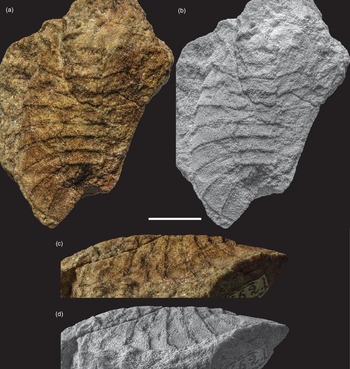
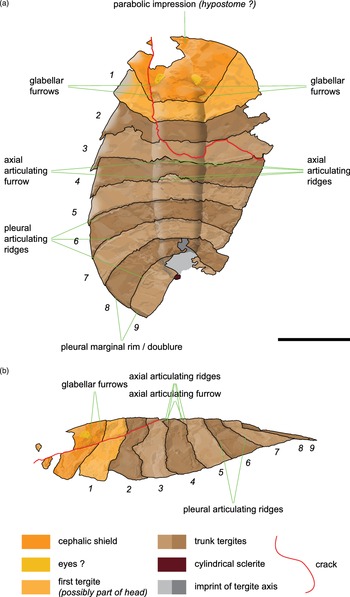
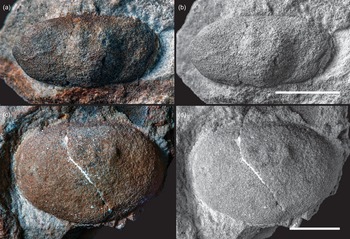
Description of holotype NM L 16736. The specimen consists of the part only, preserved in dorsal view and exhibiting very little deformation or compaction, limited to the left anterior (Figs 2, 3). The anterior and left side are essentially complete. A crack runs down the left side of the axis, traversing the cephalic shield and tergites 1 and 2; upon reaching tergite 3, the crack curves towards the right, transecting the axial region of tergite 3, and then follows the boundary between tergites 2 and 3. On the right side, breakage has removed the distal parts of the tergopleura starting from tergite 2, the very tip of tergopleura 9 on the left side, and the termination of the body; the top of the axis of tergite 8 is broken away, and almost the entire axial region of tergite 9 is gone, although its outline is still visible in dorsal view.
The holotype NM L 16736 (part only) of Triopus draboviensis Barrande, Reference Barrande1872 from the Upper Ordovician Letná Formation, Děd Hill near Beroun, Bohemia, Czech Republic. (a). Dorsal view. (b) Dorsal view, whitened with ammonium chloride. (c) Left lateral view. (d) Left lateral view, whitened with ammonium chloride. Scale bar equals 10 mm.

Interpretative drawings of the holotype NM L 16736 of Triopus draboviensis Barrande, Reference Barrande1872 from the Upper Ordovician Letná Formation, Děd Hill near Beroun, Bohemia, Czech Republic. (a) Dorsal view. (b) Left lateral view. Scale bar equals 10 mm.

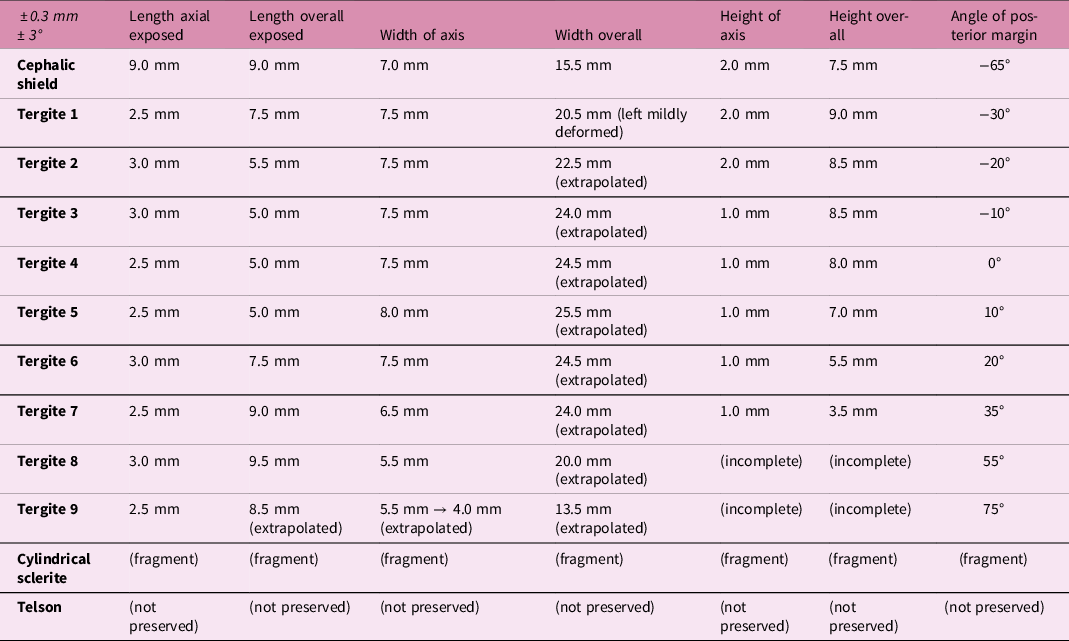
The total preserved axial length of the specimen is c. 33.5 mm, and the preserved length overall is c. 39.0 mm; the greatest preserved width is c. 24.5 mm. The extrapolated total complete length is c. 39.5 mm, while the extrapolated maximum width is c. 25.5 mm, indicating a length/width ratio of between 1.5 and 1.6. The specimen has a maximum height of c. 9.0 mm. An overview of measurements for each individual sclerite of NM L 16736 is provided in Table 1.
Measurements of individual sclerites of holotype NM L 16736 (part only) of Triopus draboviensis Barrande, Reference Barrande1872. All measurements are ±3 mm; the angles are ±3°

The anterior left margin is slightly crushed, and the distal parts of the tergopleura are somewhat folded in under themselves, foreshortening their width somewhat; the extent of the deformation reduces posteriorly, and from tergite 4–5 onwards the specimen is undeformed. This moderate deformation causes the specimen to exhibit an anterior taper in dorsal view on its left side (Figs 2a, b, 3a), while on the right side the exoskeleton has an untapered, symmetrically ovoid outline. The specimen reaches its greatest width around the middle, across tergite 5. In lateral view (Figs 2c, d, 3b), the specimen exhibits considerable vaulting, and is tallest in its anterior region, reaching its greatest height in tergite 1. The next two tergites are almost equally tall, after which the trunk gradually tapers, becoming less convex towards the posterior; the tergopleura of tergites 8 and 9 are almost flat. The exoskeleton appears to be smooth, lacking any obvious sculpture.
The narrow cephalic shield is partially covered by matrix on its left anterior side, but is completely preserved. In dorsal view, it has a rounded anterior margin, straight posterior axial margin, and straight, posterolateral margins sharply swept forward at a c. 65° angle to the horizontal. Genal corners are sharp. Because of the matrix adhering to the shield, and its somewhat indifferent preservation, the detailed morphology apart from its outline is somewhat obscure. The axis forms an anteriorly tapering glabella, which extends forward from the rear margin over c. 6 mm (i.e. two-thirds of the length of the shield). Its shape is somewhat obscured, but it appears to be roughly parabolic and exhibits at least two pairs of glabellar furrows in its posterior half. On the posterior right, directly in front of the most anterior glabellar furrow, the glabella is flanked by a small, roughly reniform raised structure, c. 1.5 mm long; on the left side, a similarly shaped and sized structure is present, but spots of matrix and some limited breakage obscure this area somewhat. Anteromedially, pointing backward from the anterior margin is a roughly triangular to parabolic-shaped shallow depression, c. 4.0 mm long by 3.5 mm wide at its base, which is accentuated further by some limited breakage of the cuticle.
The trunk preserves nine tergites with tergopleura. All tergites have a narrow, raised band c. 1.0 mm wide along the entire posterior margin; this band is slightly broader in the axial region than on the tergopleura. More anteriorly on the tergopleura, there is a narrow articulating ridge just behind and parallel to the posterior margin of the preceding tergite. Ahead of this articulating ridge extends a smooth articulating platform, which is exposed in particular in the middle of the left tergopleura of tergite 3, where part of the overlying tergite 2 has broken away. The lateral margin of tergites 7–9 shows evidence for the presence of a narrow doublure, c. 0.5 mm wide. As is characteristic of cheloniellids, the tergopleura are arranged radially, with the rear margins of the tergopleura of the first tergite having a forward sweep of c. 30°. The sweep increases by c. 10° for each successive tergopleura, up to about tergite 7, after which sweep increases in increments of c. 20° for the last two tergites, tergite 9 exhibiting a backward sweep of the tergopleura of c. 75°. Tergite 4 is almost straight, but the greatest width of the trunk is attained over tergite 5. The rear margins of the tergopleura are very weakly concave, being almost straight; concavity is greatest distally, near the tips. The tergopleura have acute posterolateral angles, but are not drawn out into spines: in tergites 2–4, the aforementioned mild deformation on the left side and some limited breakage near the tip of the tergopleura creates the false impression of the presence of a short posteriorly directed spine. Axially, all tergites have a similar length of c. 2.5–3 mm, and their rear margins run parallel to each other. The axis also maintains an almost constant width of c. 7.5 mm throughout the trunk; it starts tapering gradually from tergite 7 onwards, to reach a width of c. 4.0 mm posteriorly on tergite 9. The axis shows considerable relief and is tallest anteriorly, in the cephalic area and tergites 1 and 2, where it reaches c. 2.0 mm in height. From tergite 3 onwards, axial height starts gradually decreasing, and remains constant at c. 1 mm until at least tergite 7; because the axial region of tergite 8 is incomplete, and only the impression of the axis is left for tergite 9, the height for these segments could not be established. The axis is sharply delimited, and there may be some thickening of the cuticle marking the abrupt transition to the tergopleura. Furrows flanking the axis appear to be absent. In cross-section, the axis exhibits a rounded box shape, with a somewhat flattened top. The posterior part of the axial regions of tergites 3 and 4 is broken away, revealing the presence of two transverse articulating ridges separated by a furrow in the axial region of the underlying tergites 4 and 5.
Beyond tergite 9, the termination of the body is broken away, leaving behind only a tiny fragment likely belonging to the cylindrical sclerite.
Remarks. While the sharply procurved posterolateral margin of the cephalic shield and the radially arranged tergopleura unequivocally identify Triopus draboviensis Barrande, 1872 as belonging to Cheloniellida, it is set apart from other cheloniellids by its vaulted dorsal exoskeleton and well-delimited raised axis, with other genera in the clade, including Duslia insignis Jahn, 1893 from the same lithological unit (Chlupáč, Reference Chlupáč1988, Reference Chlupáč1999 b), all being extremely dorsoventrally flattened. Another character distinguishing the genus Triopus from other cheloniellids is the particularly small surface area of the narrow cephalic shield, which results from the extreme forward sweep of the shield’s posterolateral margins, which is remarkable even for a cheloniellid. There may be some similarity to Cheloniellon calmani Broili, 1932 which also has a small cephalic shield (Broili, Reference Broili1932, Reference Broili1933; Stürmer & Bergström, Reference Stürmer and Bergström1978; Bartels & Brassel, Reference Bartels and Brassel1990; Bartels et al. Reference Bartels, Briggs and Brassel1998; Van Roy, Reference Van Roy2006 a; Kühl et al. Reference Kühl, Bartels, Briggs and Rust2011, Reference Kühl, Bartels, Briggs and Rust2012), but in that case the small size is the result of the short length of the shield, not the extreme forward sweep of the posterolateral margins. Pseudarthron whittingtoni Selden and White, 1983 was described as having a cephalic shield somewhat comparable to the shield described here for Triopus; however, judging from the published photographs of the sole specimen of P. whittingtoni, it seems plausible that Selden and White (Reference Selden, White, Briggs and Lane1983) mistook a furrow in front of the inflated rear margin of the shield as an actual tergite boundary. If this is indeed the case, the supposed first tergite of P. whittingtoni is actually the posterior margin of the cephalic shield, which would make it rather similar in overall outline and relative size to e.g. Duslia and other cheloniellids. Triopus also has a more elongate shape than most other cheloniellid taxa, although in this respect it can be compared to Paraduslia talimaae Dunlop, 2002, which has a similar ovoid outline, and to a lesser extent to the undescribed cheloniellid from the Fezouata Biota, which is also quite elongate, but tapers posteriorly, giving it more of drop shape (Van Roy, Reference Van Roy2006 b; Van Roy et al. Reference Van Roy, Orr, Botting, Muir, Vinther, Lefebvre, Hariri and Briggs2010, Reference Van Roy, Briggs and Gaines2015).
Occurrence. Letná Formation, Sandbian (Upper Ordovician), collected from a quarry on Děd Hill (‘Drabow’) near Beroun town, Bohemia, Czech Republic.
Triopus sp.
Material. NM L 60823, consisting of only the partial counterpart (negative relief external mould), no part available.
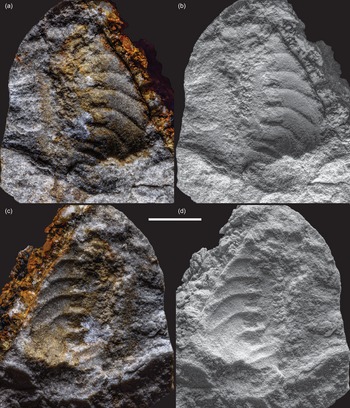
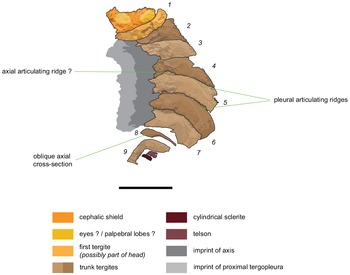
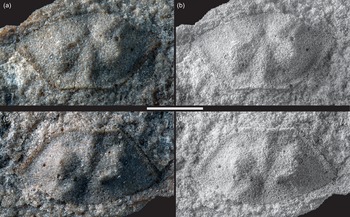
Description of specimen NM L 60823. This new specimen consists of a poorly preserved incomplete external mould of a partially disarticulated individual (Figs 4, 5). The cephalic shield is partially preserved, its anterior margin missing. It appears to have been rotated towards the right with respect to the trunk and has been pushed under the first tergite, of which only part of the axial region remains. The trunk curves towards the left. The specimen has split in such a way that behind the first tergite the entire left side of the animal and most of the axis have been removed, largely leaving only a vague imprint of the axial region. The right margin of the axis and the proximal parts of the tergopleura on the right side are preserved, but breakage has removed the median and distal parts; only the tergopleura of tergites 5, 6 and 7 are reasonably complete, but even these miss their tips. Tergite 8 is fully disarticulated (see Fig. 4 and especially the interpretative drawing in Fig. 5 for details), rotated forward and towards the right, exposing the cross-section of the axis, which is the only part of this tergite that is preserved. Tergite 9 is also fully disarticulated, rotated towards the left through almost 90° and displaced backwards and towards the left side; its right tergopleuron is relatively complete, missing the distal part, while the proximal part of the left is also preserved. Located slightly to the right of tergite 9, the terminal cylindrical sclerite and telson are preserved rotated through c. 180°; there is some slight dislocation visible between them, and the cylindrical sclerite is tilted slightly backward.
New specimen NM L 60823 (counterpart only) of Triopus sp. from the Upper Ordovician Letná Formation, Veselá Gorge, Beroun District, Bohemia, Czech Republic. (a) Dorsal view, lighting from the SSW and mirrored to create false positive relief image. (b) Dorsal view, whitened with ammonium chloride, lighting from the SSW and mirrored to create false positive relief image. (c) Dorsal view, regular lighting from the NNW. (d) Dorsal view, whitened with ammonium chloride, regular lighting from the NNW. Scale bar equals 10 mm.

Interpretative drawing of new specimen NM L 60823 (counterpart only) of Triopus sp. from the Upper Ordovician Letná Formation, Veselá Gorge, Beroun District, Bohemia, Czech Republic. Dorsal view, based on the mirrored false positive relief images. Scale bar equals 10 mm.

Including the disarticulated parts, the specimen is spread out over roughly 35 mm in the axial direction, and its greatest preserved width overall is some 20 mm. Because of the very incomplete and poorly preserved nature of the specimen, reliable measurements for most individual sclerites cannot be made.
The few details that can be gleaned from the extremely poorly preserved and incomplete cephalic shield show it had a straight posterior axial margin, and sharply procurved posterolateral margin, sweeping forward at an angle of roughly between 55° and 65°. A pair of large, rounded bulges is located subcentrally on the shield, close to the posterior margin.
The first two tergites are too incomplete to provide any meaningful information, with tergite 1 likely being rotated backward. The right tergopleuron of tergite 3 was probably straight, whereas the tergopleura of subsequent tergites become progressively more recurved towards the rear; the rear margin of the tergopleura of tergite 9 appears to be sharply recurved at an angle of c. 65°. Breakage of the posterior margin of tergite 4 possibly reveals the presence of an axial articulating ridge on tergite 5. Tergites 5 and 6 show a thin pleural articulating ridge, preceded by a flat articulating platform. Tergite 8 is rotated forward, and as a result reveals the rounded, flat-topped cross-section of the axial region, the right edge of which is missing; the tergopleura are not preserved. The impression of the axis that is left in most of the specimen indicates that it had a constant width throughout most of the trunk of c. 6 mm, while tergite 9 shows that on its posterior margin the axial width tapers to c. 3 mm. The axis is clearly delineated and had considerable relief, tergite 8 suggesting a height of c. 1.5 mm. Measurements of the axial length of tergites 4–7 show that it was constant throughout the trunk, being around 2.5–3 mm.
The terminal cylindrical sclerite has simple parallel, straight anterior and posterior margins. It is c. 2.5 mm wide. Its length is measured as slightly greater than 0.5 mm, but the limited backward tilt slightly foreshortens its true length; as a result, the real length of the cylindrical sclerite must have been more than 0.5 mm, but not greater than 1 mm. The telson has a straight anterior margin, and a broadly rounded posterior. Its edges are slightly damaged, and it has a preserved width of c. 2 mm, from which an actual width of c. 2.5 mm can be extrapolated. Length of the telson is c. 1 mm.
Remarks. The anteriorly curved posterolateral margins of the cephalic shield, the arrangement of the tergopleura, and the presence of a cylindrical sclerite preceding a small, rounded telson unequivocally identify NM L 60823 as a cheloniellid. The strong vaulting of the exoskeleton, the broad, untapered, sharply delimited raised axis and the extreme forward sweep of the posterolateral cephalic margins firmly place the new specimen in the genus Triopus. All measurements of NM L 60823 are in line with those of the holotype of T. draboviensis NM L 16736 and indicate that the new specimen is of almost the same size, being smaller by at most a few mm. Although incomplete and poorly preserved, the importance of NM L 60823 lies in the fact that it confirms the presence of a cylindrical sclerite and telson in this genus, and reveals their morphology, as the termination of the body is missing in NM L 16736.
Notwithstanding the many similarities to NM L 16736, there are also some small apparent discrepancies. First, the articulating ridges on the tergites do not seem to run parallel to the rear margins of the preceding tergites. Second, the angles of the tergopleura may not be identical, although this is difficult to tell due to the incompleteness of NM L 60823. Third, the tergites seem to be missing the narrow posterior band along the rear margins of the tergites present in NM L 16736. All these potential differences may be explained by the sideways curvature of the body of NM L 60823, loss of the rear margins of tergopleura due to breakage, and partial disarticulation; however, the very incomplete and poor preservation of the fossil make this proposition difficult to verify. As a consequence, while it is highly likely that NM L 60823 is conspecific with NM L16736 and hence represents a second specimen of the species T. draboviensis, the incomplete preservation of the new fossil makes it difficult to establish this with certainty. Therefore, out of caution, NM L 60823 is here left under open nomenclature as Triopus sp.
Interestingly, NM L 60823 likely represents the first example of disarticulation in a cheloniellid fossil: all cheloniellid specimens published hitherto, and the hundreds of fossils belonging to this group that have been assessed by the authors so far (predominantly new material of the Czech and Moroccan species of Duslia, but also including the much rarer Moroccan Triopus sp., Cheloniellon calmani and the undescribed Fezouata cheloniellid), all appear to represent fully articulated individuals.
Occurrence. Letná Formation, Sandbian (Upper Ordovician), collected from float near an outcrop in the classical Veselá Gorge locality, Beroun District, Bohemia, Czech Republic.
5. Discussion
5.a. Interpretation and reconstruction
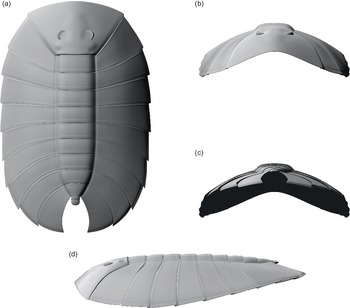
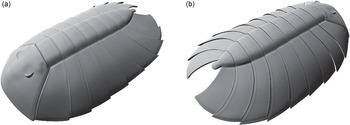
Chlupáč (Reference Chlupáč1988) stated that NM L 16736 was longitudinally compacted, but there is little evidence to support this: while there is some limited deformation on the anterior left, affecting the margins of the cephalic shield and tergites 1–3, resulting in the right side of the specimen being somewhat wider than the left and providing the false impression of an anterior taper on the left side, the difference is small, and there are no indications for any significant modifications to the original outline of the specimen. It is therefore considered that, apart from the mild deformation on its anterior left margin, NM L 16736 provides a faithful representation of the original shape and convexity of the dorsal exoskeleton of Triopus. This is further supported by the similarities shown by NM L 16736 to the new specimen NM L 60823, and to unpublished material from the Upper Ordovician Tafilalt Biota of Morocco attributed to Triopus by Van Roy (Reference Van Roy2006 b) and Lefebvre et al.(Reference Lefebvre, Van Roy, Zamora, Gutiérrez-Marco and Nohejlová2022). The dorsal exoskeleton of Triopus draboviensis overall had an elongated, symmetrically ovoid outline in dorsal aspect. Vaulting is strongest in the anterior half, after which, in lateral view, the body tapers gradually posteriorly, the tergopleura of tergites 8 and 9 being nearly flat; a reconstruction of the dorsal exoskeleton of Triopus draboviensis is presented in Figures 6 and 7.
Orthometric views of the reconstruction of the dorsal exoskeleton of Triopus draboviensis Barrande, Reference Barrande1872. (a) Dorsal view. (b) Frontal view. (c) Rear view. (d) Lateral view. Termination of the body based on the new specimen NM L 60823, and undescribed material attributed to Triopus sp. from the Upper Ordovician of Morocco (Van Roy, Reference Van Roy2006 b; Lefebvre et al. Reference Lefebvre, Van Roy, Zamora, Gutiérrez-Marco and Nohejlová2022). Reconstruction courtesy of Martin Lisec (mightyfossils.com/Red Crew Limited).

Perspective views of the reconstruction of the dorsal exoskeleton of Triopus draboviensis Barrande, 1872. (a) Upper frontal view. (b) Upper rear view. Termination of the body based on the new specimen NM L 60823, and undescribed material attributed to Triopus sp. from the Upper Ordovician of Morocco (Van Roy, Reference Van Roy2006 b; Lefebvre et al. Reference Lefebvre, Van Roy, Zamora, Gutiérrez-Marco and Nohejlová2022). Reconstruction courtesy of Martin Lisec (mightyfossils.com/Red Crew Limited).

While all previous authors who have commented on Triopus erroneously claimed that the head was either completely missing or only its posterior margin was preserved, we show here conclusively that the anterior of NM L 16736 is essentially complete. While the preservation of the cephalic shield is rather indifferent, and it is somewhat obscured in parts by matrix adhering to the specimen, it is nevertheless possible to quite clearly see its outline and the presence of major morphological features, like the roughly triangular glabella in its posterior two-thirds, and the two pairs of glabellar furrows. The rounded to reniform structures flanking the glabella posteriorly likely represent small eyes; at least Cheloniellon calmani (Stürmer & Bergström, Reference Stürmer and Bergström1978) and Duslia (personal observations by the authors) also have eyes in a comparable position. The bulges on the poorly preserved cephalic shield of NM L 60823 are in a comparable position to the supposed eyes of NM L 16736, and hence may also represent eyes. The difference in size and shape between the supposed eyes in NM L 16736 and NM L 60823 may be down to preservational factors, but the poor state of the latter makes this difficult to verify; the cephalic bulges of NM L 60823 may alternatively be interpreted as glabellar lobes. The anteromedian parabolic depression on the shield of NM L 16736 may possibly be caused by an underlying conterminant hypostome; however, it is not possible to confirm this with any degree of certainty.
Although NM L 16736 is missing the termination of the body, and NM L 60823 is partially disarticulated, there is no doubt that the trunk only contained nine tergites with tergopleura: the extreme posterior curvature of the tergopleura of tergite 9 simply does not leave any space for additional tergites with tergopleura. A similar number of tergites with tergopleura also appears to be present in the undescribed material from Morocco (Van Roy, Reference Van Roy2006 b; Lefebvre et al. Reference Lefebvre, Van Roy, Zamora, Gutiérrez-Marco and Nohejlová2022). The flat-topped, rounded box shape of the axial region in NM L 16736 was believed by Barrande (Reference Barrande1872) to be the result of compaction. However, the forward rotation of tergite 8 in NM L 60823 shows that this shape represents the genuine morphology of the axis of Triopus. The apparent thickening of the sharp transition between the axis and the tergopleura may be related to the presence of apodemes on the inside; large apodemes associated with extrinsic leg musculature and with the digestive tract are present in this position in many trilobites and xiphosurans, and dorsally these structures often manifest themselves as pits, nodes, furrows or cuticular thickenings flanking the axis. The pair of articulating ridges, separated by a furrow, as observed on the axis of tergite 5, may represent an articulating device: it seems likely that a single ridge on the underside of the preceding tergite locked into the furrow between both articulating ridges. The fulcrum of this articulation would have run along the flat top of the axis. Such an arrangement would allow a considerable degree of dorsoventral flexibility; at the same time, this construction, in conjunction with the close association of the pleural articulating ridges with the rear margins of the preceding tergites would have considerably limited lateral flexibility of the body. The lateral curvature of the body witnessed in NM L 60823 is hence likely the consequence of incipient disarticulation of the exoskeleton. The articulation device in Triopus is the first to be described for a cheloniellid, and may help explain the apparent strong connection between the elements of the dorsal exoskeleton as noted for other cheloniellid taxa (Chlupáč, Reference Chlupáč1988). Currently, this type of articulation has only been documented in Triopus, but if its presence also should be confirmed in other cheloniellids, it may represent an apomorphy for Cheloniellida.
Although rather poorly preserved, the termination of the body as shown by NM L 60823, consisting of a cylindrical sclerite and a small, rounded telson, is typical for cheloniellids and similar to that seen in other taxa, including Triopus sp. from Morocco (Van Roy, Reference Van Roy2006 b; Lefebvre et al. Reference Lefebvre, Van Roy, Zamora, Gutiérrez-Marco and Nohejlová2022). This finding closes any argument regarding the unlikely suggestion that Triopus might have had a long, styliform telson (Bergström, Reference Bergström1968; Chlupáč, Reference Chlupáč1988).
Triopus is distinguished from all other cheloniellids by its considerably more strongly vaulted convex dorsal morphology: all other known cheloniellids are extremely dorsoventrally flattened. This suggests that Triopus probably had a different lifestyle, and/or preferred different environments, possibly only rarely venturing into the Letná habitat. However, failing any knowledge of the appendages in this genus, no further comments on its mode of life are possible.
Even for a cheloniellid, the very sharp forward sweep of the posterolateral cephalic margins, and the resultant narrow width and small surface area of the cephalic shield are remarkable. Pseudarthron whittingtoni was likewise described as having a very small shield (Selden & White, Reference Selden, White, Briggs and Lane1983), but judging from the published images of the only described specimen, it seems likely that the authors mistook the posterior margin of the shield for a separate tergite; if this is indeed the case, Pseudarthron would have a cephalic shield that is comparable in size to that of most other cheloniellids. Another cheloniellid with a genuinely small cephalic shield is Cheloniellon calmani, but in this animal it was shown that the first tergite was associated with an appendage pair of similar morphology to that of the preceding post-antennal cephalic appendages (Stürmer & Bergström, Reference Stürmer and Bergström1978). This led Stürmer and Bergström (Reference Stürmer and Bergström1978) to suggest that this tergite and its appendage pair were actually part of the head of Cheloniellon. This view was rejected by Van Roy (Reference Van Roy2006 a), who argued that while functionally being part of the head, the first tergite and its appendage pair structurally belonged to the trunk. It is, however, interesting to note that in both Cheloniellon and Triopus, if the first tergite is considered part of the head, these taxa have cephalic shapes and areas comparable to other cheloniellids. In this context, it may be significant that the first tergite of Triopus differs somewhat in morphology from succeeding tergites: the tergopleura are considerably more expanded distally, their lateral margins being 1.5–2 times longer than those of other tergites. This opens up the possibility that some cheloniellid taxa indeed may have had bipartite heads, while others may have had a single shield; however, answering this question is currently not possible, considering that at the moment detailed information on the organization of the head and its appendages in cheloniellids is limited to Cheloniellon.
Another intriguing aspect of Triopus is its rarity: over more than 150 years of intensive collecting in Bohemia, only two specimens have been found, while two decades of even larger-scale collecting in Morocco have only turned up three or four examples. This cannot be explained by taphonomic factors, considering that the closely related genus Duslia is the most abundant non-trilobite arthropod in both the Czech and Moroccan biotas to which Triopus belongs. It is possible that Triopus as a living animal was a rare component of the biota, and that the fossil record in this case is an accurate reflection of its rarity in life. Another possible explanation could be that Triopus was not a particularly rare form, but only rarely entered the Letná and Tafilalt Biota environments, preferring other settings that were not conducive to its preservation. The considerably more vaulted dorsal exoskeleton of Triopus as compared to Duslia and other cheloniellids is also suggestive of a different lifestyle, which possibly negatively influenced its chances of preservation. Another factor to consider is the robustness of the exoskeleton and the connection between its constituent sclerites; indeed, the fact that none of the dozens of Duslia specimens from Bohemia shows any signs of disarticulation did not escape Chlupáč (Reference Chlupáč1988), who commented on the apparently tight connection between the sclerites of the dorsal exoskeleton. In this respect, it may be significant that the new specimen of Triopus sp. NM L 60823 represents the first disarticulated cheloniellid fossil. This may suggest that Triopus had a more fragile construction than other cheloniellids, which would also have limited its fossilization potential.
5.b. Fossils previously suggested as the cephalic shield of Triopus draboviensis
The recognition that the anterior of NM L 16736 is essentially complete finally allows previously suggested candidates (Chlupáč, Reference Chlupáč1965, Reference Chlupáč1999 a; Bergström, Reference Bergström1968) for the cephalic shield of Triopus draboviensis to be assessed. Therefore, a short discussion of Zonozoe drabowiensis, Zonoscutum solum and Drabovaspis complexa is provided.
5.b.1. Zonozoe drabowiensis Barrande, 1872 and Zonoscutum solum Chlupáč, 1999b
Zonozoe drabowiensis (Fig. 8a, b) was originally described by Barrande (Reference Barrande1872) as a large ostracod. Chlupáč (Reference Chlupáč1963, Reference Chlupáč1965) recognized it as a cephalic shield, which he considered to belong to an aglaspidid. Later (Chlupáč, Reference Chlupáč1999 a, b), he commented that the systematic position of Zonozoe was uncertain given the total lack of any information on its post-cephalic anatomy, but still considered it likely to be an aglaspidid or xiphosuran.
Cephalic shields previously (Chlupáč, Reference Chlupáč1965, Reference Chlupáč1988, Reference Chlupáč1999b) suggested to possibly belong to Triopus draboviensis Barrande, Reference Barrande1872. (a, b) Lectotype NM L 23586 of Zonozoe drabowiensis Barrande, Reference Barrande1872. (b) Whitened with ammonium chloride. (c, d) Holotype NM L 33021 of Zonoscutum solum Chlupáč, Reference Chlupáč1999 b. (d) Whitened with ammonium chloride. Scale bars equal 10 mm.

The cephalic shield of Zonozoe drabowiensis is moderately vaulted, about twice as wide as it is long and has a roughly lenticular outline in dorsal view, with somewhat pointed genae on the transverse midline projecting laterally. A well-defined, raised rhomboidal glabella extends longitudinally across the shield, and is associated with a small bulge in the outline posteriorly (Rak et al. Reference Rak, Bergström, Fatka and Budil2009). A pair of small eyes sits subcentrally, just forward of the transverse midline atop the glabella, near its lateral margins. Rak et al. (Reference Rak, Bergström, Fatka and Budil2009) reported the presence of three pairs of faint glabellar furrows posterior of the eyes in a specimen from the Libeň Formation.
As such, the morphology of Zonozoe drabowiensis is considerably different to that of the cephalic shield of Triopus draboviensis, and is incompatible with its trunk. Therefore, Zonozoe can unequivocally be rejected as belonging to Triopus. In the absence of any other information on the morphology of Zonozoe, its affinities must remain unresolved; it is safe to state that it likely belongs to Artiopoda, but any more detailed systematic attribution will require the discovery of more complete material.
Zonoscutum solum (Fig. 8c, d) was described by Chlupáč (Reference Chlupáč1999 b) on the basis of a single cephalic shield, and regarded as an arthropod of uncertain affinity, possibly belonging to either aglaspidids or aquatic chelicerates (Chlupáč, Reference Chlupáč1999 a, b).
Its shield has moderate relief, and in dorsal view shows bluntly rounded anterior and rounded, procurved posterior margins; the genae are also rounded. There is a very vaguely delimited glabellar area which extends over c. three-quarters the length of the shield, and is flanked by three pairs of vague muscle scars pointing obliquely forward. In a very anteromedian position, right in front of the tip of the glabella, a pair of small eyes is located.
As in the case of Zonozoe, Zonoscutum cannot be reconciled with the morphology displayed by Triopus, and as a consequence, any association with Triopus can be rejected out of hand. Likewise, the postion of Zonoscutum is uncertain beyond a placement in Artiopoda, due to the incompleteness of the available material.
5.b.2. Drabovaspis complexa (Barrande, Reference Barrande1872)
In contrast to Zonozoe and Zonoscutum, the shield of Drabovaspis complexa (Fig. 9) represents a more compelling case. It was first described by Barrande (Reference Barrande1872) as an ostracod. Chlupáč (Reference Chlupáč1963, Reference Chlupáč1965) believed Drabovaspis to be an aglaspidid, while Bergström (Reference Bergström1968) placed the fossil in Xiphosura, later attributing it more specifically to the Belinurina (Bergström, Reference Bergström and Martinsson1975). In his later work, Chlupáč (Reference Chlupáč1999 a) also accepted Drabovaspis as a xiphosuran. Ortega-Hernández et al. (Reference Ortega-Hernández, Braddy and Rak2010) also argued for xiphosuran affinities for Drabovaspis; however, they reinterpreted the shield, rotating it through 180° (Fig. 9a, b), an orientation which is here considered to be correct, and used in the following short description of this species. Lamsdell (Reference Lamsdell2020) formally removed Drabovaspis from Xiphosura, considering it to represent a bradoriid. Braddy and Dunlop (Reference Braddy and Dunlop2021) attributed the fossil to Cheloniellida, a view with which we agree.
Holotype NM L 23577 of Drabovaspis complexa (Barrande Reference Barrande1872), previously suggested as the possible cephalic shield of Triopus draboviensis (Chlupáč, Reference Chlupáč1965, Reference Chlupáč1988, Reference Chlupáč1999 b; Bergström, Reference Bergström1968). (a, b) Currently accepted orientation. (b) Whitened with ammonium chloride. (c, d) Orientation advocated by previous authors (Chlupáč, Reference Chlupáč1963, Reference Chlupáč1965; Bergström, Reference Bergström1968). (d) Whitened with ammonium chloride. Scale bar equals 10 mm.

The non-biomineralized shield of Drabovaspis complexa displays a strongly dorsoventrally flattened morphology. It has a horizontal posterior axial margin, straight posterolateral margins that sweep forward at an angle of c. 50°, and a round frontal margin. The genal angles are sharp. The posterior and posterolateral margins have a narrow thickened rim, which widens towards the genal angles. A narrow rhomboid glabella extends from the posterior axial margin halfway forward onto the shield. In the middle of the shield, the glabella is flanked by a pair of large, crescentic eyes. Anterolaterally, a pair of ridges extends from the anterior corners of the eyes; the ridges run parallel to the posterolateral cephalic margins. The area inside the ridges, in front of the glabella, is inflated, but anteromedially there is a triangular flattened area extending backward from the anterior margin. The flattened area is linked with a similarly depressed region directly in front of the glabella.
While they admitted that the morphology of Drabovaspis is highly unusual for a horseshoe crab, Ortega-Hernández et al. (Reference Ortega-Hernández, Braddy and Rak2010, p. 428) justified their attribution to Xiphosura by citing ‘the presence of a well-defined triangular cardiac lobe, developed ophthalmic ridges, centrally placed eyes and presence of an occipital band’. None of these cited characters, however, can be considered conclusive of a xiphosuran affinity. The xiphosuran cardiac lobe is simply a continuation of the axial region in the cephalic area, accommodating the circulatory and digestive systems and associated glands and musculature, and as such is a direct homologue of the glabella in other euarthropods. This is a very widespread plesiomorphic character among euarthropods, and highly prevalent among artiopods in particular. Ophthalmic ridges were also shown to be present in some chasmataspidids (Dunlop, Reference Dunlop2002; Marshall et al. Reference Marshall, Lamsdell, Shpinev and Braddy2014); in addition, the ophthalmic ridges in horseshoe crabs tend to loop back towards the cardiac lobe, whereas the supposed ophthalmic ridges of Drabovaspis continue straight outwards, until they meet the anterior margin of the cephalic shield. Centrally placed eyes and an occipital band are, of course, again characters that are widely shared among euarthropods and artiopods in particular, and have no value in identifying xiphosuran affinities. Therefore, there are no strong arguments to support this systematic placement.
Considering the weak support for a xiphosuran affinity for Drabovaspis complexa, Lamsdell (Reference Lamsdell2020) formally removed it from Xiphosura, suggesting it represented a bradoriid instead. It is not clear what led Lamsdell (Reference Lamsdell2020) to consider a bradoriid affinity for this fossil, but in any case, this attribution also appears difficult to support. Drabovaspis lacks any indication for the presence of a hinge, which would be expected if it were a bradoriid carapace valve. The angular, symmetrical morphology and topography of the shield also do not fit comfortably with a bradoriid interpretation, and the size of Drabovaspis pushes the upper boundary of the known size range of bradoriids. Therefore, a bradoriid affinity for Drabovaspis complexa can also be discounted.
The procurved posterior margins of the shield, following the orientation favoured by Ortega-Hernández et al. (Reference Ortega-Hernández, Braddy and Rak2010), may be compared to several other possible euarthropod clades. Burlingiids do have slightly procurved posterior cephalic margins. However, the anterior curvature of the rear cephalic margins in burlingiids is considerably less pronounced than what is seen in Drabovaspis complexa; moreover, burlingiids are significantly smaller and have a biomineralized exoskeleton (Whittington, Reference Whittington1994; Ebbestad & Budd, Reference Ebbestad and Budd2003). Therefore, a burlingiid affinity for Drabovaspis complexa appears unlikely.
Some sanctacaridids (Briggs & Collins, Reference Briggs and Collins1988; Legg & Pates, Reference Legg and Pates2017) also show procurved posterior cephalic margins, but these tend to be rounded, whereas in Drabovaspis complexa they are straight. In addition, sanctacaridids have a broad, strongly inflated glabellar area (Briggs & Collins, Reference Briggs and Collins1988; Jago et al. Reference Jago, García-Bellido and Gehling2016; Legg & Pates Reference Legg and Pates2017) entirely different from the narrow glabella and flattened morphology of Drabovaspis, and do not incorporate the eyes into the cephalic shield. Based on this, a sanctacaridid affinity for Drabovaspis complexa can also be rejected.
On the other hand, the general outline and size of Drabovaspis complexa are very similar to the shield of Triopus draboviensis, being only slightly larger. Differences include the smaller forward sweep of the posterolateral margins in Drabovaspis (c. 50° vs c. 65° in Triopus), a much narrower, differently shaped glabella, the absence of well-defined glabellar furrows, eyes that are considerably larger than the purported eyes of Triopus, and the presence of ridges emanating from the eyes. While some of these differences may be due to the poor preservation and matrix obscuring parts of the cephalic shield of NM L 16736, it seems unlikely that this can account for the differences in sweep of the posterolateral margins, size and shape of the glabella and eyes, and absence of clear glabellar furrows; moreover, these characters displayed by Drabovaspis are also different or absent in the Moroccan specimens attributed to Triopus sp. (Van Roy, Reference Van Roy2006 b; Lefebvre et al. Reference Lefebvre, Van Roy, Zamora, Gutiérrez-Marco and Nohejlová2022). Consequently, it is unlikely that Drabovaspis complexa represents a disarticulated cephalic shield of Triopus draboviensis.
At the same time, the morphology of Drabovaspis complexa does fit comfortably inside Cheloniellida, as also noted recently by Braddy and Dunlop (Reference Braddy and Dunlop2021). The only aberrant character for a cheloniellid is the pronounced ridges running from the eyes to the anterior margin of the cephalic shield. Therefore, we concur with Braddy and Dunlop (Reference Braddy and Dunlop2021) that it is highly likely that Drabovaspis complexa represents an isolated cephalic shield of a cheloniellid euarthropod, of which to date no parts of the trunk have been identified. If this is indeed correct, this would make the Letná Formation the world’s cheloniellid hotspot, in that case harbouring three different genera (Triopus, Duslia and Drabovaspis).
5.c. Cheloniellid systematic position and relationships: an overview
Since their recognition as a distinct clade, our understanding of the systematic position and relationships of cheloniellids has improved considerably. Hou and Bergström (Reference Hou and Bergström1997) included Cheloniellida within their newly-erected Artiopoda, a view which has gained widespread acceptance since. Although a potential close relationship between aglaspidids and cheloniellids had already been considered previously by multiple authors (Wills et al. Reference Wills, Briggs, Fortey and Wilkinson1995, Reference Wills, Briggs, Fortey, Wilkinson, Sneath and Edgecombe1998; Dunlop & Selden, Reference Dunlop, Selden, Fortey and Thomas1997; Hou & Bergström, Reference Hou and Bergström1997; Bergström & Hou, Reference Bergström and Hou2003), Cotton and Braddy (Reference Cotton and Braddy2004) were the first to identify a distinct clade composed of cheloniellids, aglaspidids, Emeraldella Walcott, 1912 and Sidneyia Walcott, 1912 in their phylogenetic analysis. These authors also suggested that the various modified posterior appendages in these animals might be homologous. Van Roy (Reference Van Roy2006 a, b) explored this idea further, and proposed that these taxa additionally might be united by the shared possession of a terminal cylindrical somite lacking tergopleura, and bearing the aforementioned pair of modified appendages (with the aglaspidid tailspine being the result of fusion of this somite and the telson). Subsequently, multiple phylogenetic analyses (e.g. Edgecombe et al. Reference Edgecombe, García-Bellido and Paterson2011, Reference Edgecombe, Paterson and García-Bellido2017; Legg et al. Reference Legg, Sutton and Edgecombe2013; Ortega-Hernández et al. Reference Ortega-Hernández, Legg and Braddy2013; Legg, Reference Legg2014; Lerosey-Aubril et al. Reference Lerosey-Aubril, Paterson, Gibb and Chatterton2017 a) have consistently recovered this clade, which was named Vicissicaudata by Ortega-Hernández et al. (Reference Ortega-Hernández, Legg and Braddy2013; see also Lerosey-Aubril et al. Reference Lerosey-Aubril, Paterson, Gibb and Chatterton2017 a for a formal diagnosis). While unequivocal identification of strong vicissicaudate apomorphies initially proved elusive, the recent confirmation (Lerosey-Aubril et al. Reference Lerosey-Aubril, Paterson, Gibb and Chatterton2017 a, b) of the derived homologies between the various representatives of this group proposed earlier by Cotton and Braddy (Reference Cotton and Braddy2004) and Van Roy (Reference Van Roy2006 a, b) has reaffirmed the validity of this clade. Nevertheless, both the intra- and interrelationships of Vicissicaudata remain unresolved; while they are consistently placed within Artiopoda, some phylogenetic analyses recover them as sister group to Trilobitomorpha (Ortega-Hernández et al. Reference Ortega-Hernández, Legg and Braddy2013; Edgecombe et al. Reference Edgecombe, Paterson and García-Bellido2017; Lerosey-Aubril et al. Reference Lerosey-Aubril, Zhu and Ortega-Hernández2017 b), whereas others resolve them as sister group to Chelicerata, and hence also include chelicerates within Artiopoda (Cotton & Braddy, Reference Cotton and Braddy2004; Edgecombe et al. Reference Edgecombe, García-Bellido and Paterson2011; Legg et al. Reference Legg, Sutton and Edgecombe2013; Legg, Reference Legg2014).
In phylogenetic analyses involving multiple cheloniellid taxa, the Mid Ordovician Neostrabops martini Caster & Macke, Reference Caster and Macke1952 generally emerges as the earliest offshoot of the clade on account of its undifferentiated axial morphology (Dunlop & Selden, Reference Dunlop, Selden, Fortey and Thomas1997; Edgecombe et al. Reference Edgecombe, García-Bellido and Paterson2011, Reference Edgecombe, Paterson and García-Bellido2017; Legg et al. Reference Legg, Sutton and Edgecombe2013; Ortega-Hernández et al. Reference Ortega-Hernández, Legg and Braddy2013; Lerosey-Aubril et al. Reference Lerosey-Aubril, Paterson, Gibb and Chatterton2017 a). While Dunlop and Selden (Reference Dunlop, Selden, Fortey and Thomas1997) had Triopus draboviensis Barrande, Reference Barrande1872 in a relatively basal position, in more recent works it usually resolves close (Legg et al. Reference Legg, Sutton and Edgecombe2013), or as sister group, to Duslia insignis Jahn, Reference Jahn1893 (Edgecombe et al. Reference Edgecombe, García-Bellido and Paterson2011, Reference Edgecombe, Paterson and García-Bellido2017; Ortega-Hernández et al. Reference Ortega-Hernández, Legg and Braddy2013; Lerosey-Aubril et al. Reference Lerosey-Aubril, Zhu and Ortega-Hernández2017 b), placing it among the more derived members of Cheloniellida. However, our understanding of cheloniellid intra-relationships is considerably hamstrung by incomplete knowledge of most representatives of the group; detailed information on the appendages and ventral morphology is currently only available for the Early Devonian Cheloniellon calmani Broili, Reference Broili1932, which, being the youngest member of the clade, may not be the best model for reconstructing cheloniellid anatomy in general.
5.d. Parioscorpio venator: not a cheloniellid
Parioscorpio venator Wendruff, Babcock, Wirkner, Kluessendorf and Mikulic, 2020a is a problematic euarthropod (Anderson et al. Reference Anderson, Schiffbauer, Jacquet, Lamsdell, Kluessendorf and Mikulic2021) from the Telychian (Llandovery, Silurian) Waukesha exceptionally preserved fauna, Brandon Bridge Formation of Wisconsin, which has been the subject of considerable recent debate, with some authors (Wendruff et al. Reference Wendruff, Babcock, Mikulic and Kluessendorf2018, Reference Wendruff, Babcock, Wirkner, Kluessendorf and Mikulic2020 a, b; Braddy & Dunlop, Reference Braddy and Dunlop2021) incorrectly asserting a cheloniellid affinity for some or all of the material assigned to this species. In view of the major confusion surrounding this fossil, including the conflation of a genuine cheloniellid specimen with entirely unrelated material, it seems prudent to review why Parioscorpio venator cannot possibly be accommodated among either Cheloniellida or any other vicissicaudate clade.
Specimens of Parioscorpio venator were first figured by Mikulic et al. (Reference Mikulic, Briggs and Kluessendorf1985 a), and subsequently interpreted as having a crustacean affinity (Mikulic et al. Reference Mikulic, Briggs and Kluessendorf1985 b). In an unpublished draft manuscript posted to the bioarXiv pre-print server, Wendruff et al. (Reference Wendruff, Babcock, Mikulic and Kluessendorf2018) amalgamated material of this fossil with specimens of an unrelated euarthropod, at least one of which (UWGM 2345) shows clear cheloniellid affinities, to erroneously describe this composite as a cheloniellid. This paper failed to get formally published, and subsequently the authors reinterpreted two specimens, UWGM 2162 (holotype) and UWGM 2163 (paratype), as an early scorpion (Wendruff et al. Reference Wendruff, Babcock, Wirkner, Kluessendorf and Mikulic2020 a) which they named Parioscorpio venator, while simultaneously (Wendruff et al. Reference Wendruff, Babcock, Mikulic and Kluessendorf2020 b) persevering in compositing their bona fide cheloniellid UWGM 2345 with the remaining unrelated specimens from the draft manuscript of Wendruff et al. (Reference Wendruff, Babcock, Mikulic and Kluessendorf2018). In a detailed restudy, Anderson et al. (Reference Anderson, Schiffbauer, Jacquet, Lamsdell, Kluessendorf and Mikulic2021) conclusively demonstrated that the reinterpretation of some of the material from Wendruff et al. (Reference Wendruff, Babcock, Mikulic and Kluessendorf2018) as belonging to a scorpion was as misguided as its original cheloniellid attribution, and further showed that most of the remaining specimens from Wendruff et al. (Reference Wendruff, Babcock, Mikulic and Kluessendorf2018) also belong to Parioscorpio. While Anderson et al. (Reference Anderson, Schiffbauer, Jacquet, Lamsdell, Kluessendorf and Mikulic2021) excluded UWGM 2439 and UWGM 2345 from their restudy, they considered that these two specimens were the only fossils among the material of Wendruff et al. (Reference Wendruff, Babcock, Mikulic and Kluessendorf2018, Reference Wendruff, Babcock, Wirkner, Kluessendorf and Mikulic2020 a, b) that exhibited possible cheloniellid affinities. Parioscorpio venator itself was revealed as a problematic euarthropod exhibiting a highly intriguing organization, which likely places it in a basal position within Deuteropoda (Anderson et al. Reference Anderson, Schiffbauer, Jacquet, Lamsdell, Kluessendorf and Mikulic2021). Braddy and Dunlop (Reference Braddy and Dunlop2021) then recycled part of the defunct draft manuscript posted to bioarXiv by Wendruff et al. (Reference Wendruff, Babcock, Mikulic and Kluessendorf2018) and resurrected some of its misinterpretations in a formal publication which appeared online just before the current paper was about to be submitted.
In a throwback to Wendruff et al. (Reference Wendruff, Babcock, Mikulic and Kluessendorf2018), Braddy and Dunlop (Reference Braddy and Dunlop2021) consider specimens UWGM 2439 and UWGM 2345 to be similar to the material attributed to Parioscopio venator by Anderson et al. (Reference Anderson, Schiffbauer, Jacquet, Lamsdell, Kluessendorf and Mikulic2021) and use this supposed similarity to reassign Parioscorpio to Cheloniellida. They base this attribution almost exclusively on purported similarities in the cephalic and posterior trunk areas of UWGM 2439 and material previously assigned to Parioscorpio venator by Wendruff et al. (Reference Wendruff, Babcock, Wirkner, Kluessendorf and Mikulic2020 a) and Anderson et al. (Reference Anderson, Schiffbauer, Jacquet, Lamsdell, Kluessendorf and Mikulic2021); the cheloniellid specimen UWGM 2345 is only mentioned briefly with respect to its poorly preserved anterior appendages, ignoring the fact that this fossil lacks the cephalic and posterior trunk characters used to align UWGM 2439 with Parioscorpio venator, and has a lower segment count.
Braddy and Dunlop (Reference Braddy and Dunlop2021) use the presence of a supposed procurved posterior margin of the cephalic shield as an argument for a cheloniellid affinity of Parioscorpio. While strongly procurved posterior cephalic margins are indeed characteristic of cheloniellids, this character is not exclusive to them and is to a lesser extent also shown by e.g. some sanctacaridids (Briggs & Collins, Reference Briggs and Collins1988; Legg & Pates Reference Legg and Pates2017), burlingiids (Whittington, Reference Whittington1994; Ebbestad & Budd, Reference Ebbestad and Budd2003), Strabops thacheri Beecher, Reference Beecher1901 and the problematic cephalic shields Zonozoe drabowiensis and Zonoscutum solum (Barrande, Reference Barrande1872; Chlupáč1999a, b; Fig. 8). More importantly, the only fossil from Wendruff et al. (Reference Wendruff, Babcock, Mikulic and Kluessendorf2018) to show sharply procurved posterior cephalic margins characteristic of Cheloniellida is UWGM 2345; specimen UWGM 2439 shows only a very mild anterior curvature of the rear cephalic margin, which is atypical for cheloniellids but comparable to that of other aforementioned non-cheloniellid taxa, while in none of the other specimens the dorsal exoskeleton is sufficiently well preserved to allow the exsagittal posterior cephalic margin to be discerned with any degree of certainty (Anderson et al. Reference Anderson, Schiffbauer, Jacquet, Lamsdell, Kluessendorf and Mikulic2021).
In Parioscorpio, the cephalic shield widely overlaps the trunk, covering the anterior first and possibly also second tergites (Anderson et al. Reference Anderson, Schiffbauer, Jacquet, Lamsdell, Kluessendorf and Mikulic2021; Braddy & Dunlop, Reference Braddy and Dunlop2021). Such a large overlap of the shield with the trunk is not encountered in any true cheloniellid, including specimen UWGM 2345, and is uncharacteristic for vicissicaudates in general.
While the radial arrangement of tergopleura is a pronounced character of Cheloniellida, this is also not exclusive to this clade either, as it is also to a somewhat lesser extent encountered in burlingiids (Whittington, Reference Whittington1994; Ebbestad & Budd, Reference Ebbestad and Budd2003) and the larvae of some psephenids (Lee et al. Reference Lee, Satô, Shepard and Jäch2007). Again, the typical cheloniellid widely splayed radial arrangement of the tergopleura is only evidenced by UWGM 2345. The degree of anterior curvature of the first two tergites in specimen UWGM 2439 is considerably less than in UWGM 2345, and much milder than what is typical for cheloniellids; in fact, the curvature of the tergites and posterior cephalic margin in UWGM 2439 may easily have been influenced by the flattening of an originally vaulted exoskeleton. No other published specimens preserve the tergites well enough to determine tergopleural arrangement with any degree of certainty.
All material attributed by either Wendruff et al. (Reference Wendruff, Babcock, Wirkner, Kluessendorf and Mikulic2020 a) or Anderson et al. (Reference Anderson, Schiffbauer, Jacquet, Lamsdell, Kluessendorf and Mikulic2021) to Parioscorpio venator shows a posterior constriction of the axial region, differentiating the trunk into a ten-segmented pre-abdomen and a four-segmented abdomen. Such a differentiation is never observed in vicissicaudates, where axial width only gradually tapers posteriorly, remaining largely constant throughout the length of the body. The vicisscaudate trunk is composed of a number of somites covered by tergites with tergopleura, followed by a single cylindrical sclerite lacking pleura, and terminated by a telson, which in most aglaspidid taxa is fused to the preceding cylindrical sclerite (Van Roy, Reference Van Roy2006 a, b; Lerosey-Aubril et al. Reference Lerosey-Aubril, Paterson, Gibb and Chatterton2017 a, b). The only exception to this is the genus Sidneyia Walcott, Reference Walcott1912, which has two cylindrical sclerites without pleura preceding the telson (Bruton, Reference Bruton1981); in this respect, it is interesting to note that Lerosey-Aubril et al. (Reference Lerosey-Aubril, Zhu and Ortega-Hernández2017 b) recovered Sidneyia as the earliest offshoot of Vicissicaudata. Conversely, none of the specimens attributed to Parioscorpio by Wendruff et al. (Reference Wendruff, Babcock, Wirkner, Kluessendorf and Mikulic2020 a) or Anderson et al. (Reference Anderson, Schiffbauer, Jacquet, Lamsdell, Kluessendorf and Mikulic2021) shows any evidence for the presence of a terminal cylindrical sclerite without pleura, which is a prime apomorphy uniting Vicissicaudata (Van Roy Reference Van Roy2006 a, b; Lerosey-Aubril et al. Reference Lerosey-Aubril, Paterson, Gibb and Chatterton2017 a, b). While a differentiation in pre-abdominal and abdominal regions may also be present in UWGM 2439, it is clearly absent in UWGM 2345, in common with other cheloniellids.
In all cheloniellids where the posterior is known in sufficient detail, the trunk terminates in a small, rounded, cap-shaped or conical telson. In Parioscorpio, and in specimen UWGM 2439, the body is terminated by a small styliform structure, which is totally unknown from any bona fide cheloniellid. Still, notwithstanding the fact that in all cheloniellids where the body termination is known it is a tiny blunt sclerite, Braddy and Dunlop (Reference Braddy and Dunlop2021) refer to it in their discussion of cheloniellid taxa as a ‘tailspine’, which is demonstrably incorrect.
Another important vicissicaudate apomorphy is the association of a pair of modified appendages with the posterior cylindrical sclerite. The morphology of these modified appendages differs strongly between vicissicaudate clades, and in cheloniellids they take the form of a pair of multisegmented, elongate appendages (furca) which insert dorsolaterally on the cylindrical somite. In Parioscorpio, the posterior shows a pair of rigid, unsegmented spines which appear to be fused into the same plate-like structure. Such a morphology precludes any interpretation of these structures as a cheloniellid furca, and Anderson et al. (Reference Anderson, Schiffbauer, Jacquet, Lamsdell, Kluessendorf and Mikulic2021) considered them to represent the tergopleura of the last tergite. Nevertheless, these critical differences did not prevent Braddy and Dunlop (Reference Braddy and Dunlop2021) from summarily accepting the posterior lateral spines of Parioscorpio as cheloniellid furcal appendages, while also noting the presence of a rounded, ventrally located valve similar to the anal plate of Sidneyia, which they argued to be homologous with the aglaspidid post-ventral plates – in that case leaving open the question of homology of Sidneyia’s uropods. Because this would mean that Parioscorpio (and, in effect, also Sidneyia) has two pairs of modified appendages associated with the termination of the body, whereas real vicissicaudates only have one pair, Braddy and Dunlop (Reference Braddy and Dunlop2021) tried to get around this problem by arguing that the cheloniellid furca was not homologous with the aglaspidid post-ventral plates, invoking a scenario where the former evolved from the exopods of the terminal somite, while the latter was derived from the endopods. While this may seem unlikely at first sight because it involves the breaking-up of a biramous appendage into its separate constituent rami, the example of Dibasterium durgae Briggs, Siveter, Siveter, Sutton, Garwood and Legg, Reference Briggs, Siveter, Sutton, Garwood and Legg2012 nevertheless shows this to be possible. However, the aglaspidid Glyparthrus trispinicaudatus Lerosey-Aubril, Zhu and Ortega-Hernández, Reference Lerosey-Aubril, Zhu and Ortega-Hernández2017 b demonstrates the presence of long furcal appendages on the terminal cylindrical somite, while the specimen preserving the posterior appears to lack post-ventral plates. While not conclusive, this nevertheless suggests that the aglaspidid post-ventral plates and cheloniellid furca are indeed likely to be homologous. This notion is further supported by recent discoveries in the Early Ordovician Fezouata biota, which strongly indicate an exopod origin for the aglaspidid post-ventral plates (Van Roy, personal observations). In any case, any argument about the exact origins and homology of the cheloniellid furca and aglaspidid post-ventral plates in respect to Parioscorpio is rendered moot by the mere fact that the rigid, fused, unsegmented, plate-like morphology of the posterior lateral spines in Parioscorpio is entirely incompatible with their interpretation as a cheloniellid furca.
While the huge raptorial appendages in the head of Parioscorpio appear atypical for a cheloniellid, this is not enough to exclude it from this clade: the cephalic appendages are only poorly known for a few cheloniellid taxa, so it cannot be discounted that some did indeed evolve large raptorial structures. However, even when taken in isolation, the extremely unusual morphology of the trunk appendages of Parioscorpio (Anderson et al. Reference Anderson, Schiffbauer, Jacquet, Lamsdell, Kluessendorf and Mikulic2021) is not only enough to unequivocally exclude it from Cheloniellida, but from Artiopoda as a whole.
In summary, it can be concluded that, of all the specimens in Wendruff et al. (Reference Wendruff, Babcock, Mikulic and Kluessendorf2018, Reference Wendruff, Babcock, Mikulic and Kluessendorf2020 b) and of all the material attributed to Parioscorpio by Wendruff et al. (Reference Wendruff, Babcock, Wirkner, Kluessendorf and Mikulic2020 a), Anderson et al. (Reference Anderson, Schiffbauer, Jacquet, Lamsdell, Kluessendorf and Mikulic2021) and Braddy and Dunlop (Reference Braddy and Dunlop2021), only UWGM 2345 can likely be retained as a true cheloniellid. In this respect, it may be of interest to note that this is the only specimen which comes from a fäule layer, while all the other material was collected from flinz levels. UWGM 2345 exhibits the typical highly pronounced cheloniellid radial arrangement of tergopleura and strongly dorsoventrally flattened morphology, lacks any constriction of the axis differentiating the trunk into a preabdomen and abdomen, and does not have a styliform telson. While damage to the posterior and the indifferent preservation of this fossil make it difficult to decide from photographs whether the posterior cylindrical somite typical of vicissicaudates is present, all aspects of its morphology that can be gleaned from photographs agree fully with a cheloniellid affinity. The supposedly heavy anterior appendages may not be that surprising either, considering that cheloniellid antennae have a relatively robust proximal part, abruptly narrowing to a thin, flagellate morphology distally (Stürmer & Bergström, Reference Stürmer and Bergström1978; Van Roy, Reference Van Roy2006 b; Van Roy, personal observations). In the case of UWGM 2345, it seems likely that only the more robust proximal part is preserved, its width possibly being further enhanced by preservational effects (e.g. the formation of a decay halo). UWGM 2345 is also differentiated from the other material by its shorter trunk, which contains only 10 or, at most, 11 tergites with tergopleura, compared to 14 in Parioscorpio.
While at this point, we do not wish to exclude a cheloniellid affinity for UWGM 2439, on balance we feel that this fossil likely belongs to another clade, and may possibly be attributed to Parioscorpio. However, in view of the relatively poor and incomplete preservation of this specimen, we believe it is best to leave its affinities unresolved pending further detailed examination.
And as for Parioscorpio venator: it is a most fascinating euarthropod, but a cheloniellid most definitely it is not.
6. Conclusions
The first restudy in 150 years of Triopus draboviensis Barrande, Reference Barrande1872 shows that, contrary to previous claims (Barrande, Reference Barrande1872; Chlupáč, Reference Chlupáč1965, Reference Chlupáč1988, Reference Chlupáč1999 b; Bergström, Reference Bergström1968), the cephalic shield is completely preserved in the holotype and hitherto only known specimen NM L 16736.
This finding dispels any earlier suggestions (Chlupáč, Reference Chlupáč1965, Reference Chlupáč1988, Reference Chlupáč1999 b; Bergström, Reference Bergström1968) that either Zonozoe, Zonoscutum or Drabovaspis represents the cephalic shield of Triopus.
For the first time in a cheloniellid, a likely articulating device is identified in the axial region. This articulation would have imparted considerable dorsoventral flexibility, while at the same time severely restricting lateral flexibility; it may also at least in part explain the strong connection between cheloniellid dorsal exoskeletal elements, as noted previously (Chlupáč, Reference Chlupáč1988). If the presence of this articulation type can also be demonstrated in other cheloniellids, it may represent an apomorphy for Cheloniellida.
A newly discovered partial specimen from Veselá Gorge, NM L 60823, here described as Triopus sp., confirms that the trunk of Triopus had a typical cheloniellid termination consisting of a short cylindrical sclerite and a small, cap-shaped telson.
This discovery unequivocally puts to rest any previous speculation (Bergström, Reference Bergström1968; Chlupáč, Reference Chlupáč1988) that Triopus may have had a long styliform telson, something which in any case was extremely unlikely considering its cheloniellid affinities.
The new specimen NM L 60823 represents the first example of a partially disarticulated cheloniellid, suggesting that the dorsal exoskeleton of Triopus might have been more fragile than that of other members of the group, which could be a factor in explaining its extreme rarity.
While Drabovaspis complexa probably is not a cephalic shield belonging to Triopus draboviensis, its morphology does indicate that it likely belongs to another cheloniellid, of which so far no other parts have been discovered. This makes the Letná Formation home to the greatest diversity of cheloniellids anywhere in the world, harbouring Triopus draboviensis, Duslia insignis and Drabovaspis complexa.
The recently described euarthropod Parioscorpio venator from the Silurian of Wisconsin has been suggested to belong to Cheloniellida, but it is shown here that the morphology of this problematic fossil cannot possibly be reconciled with a cheloniellid affinity; P. venator is therefore unequivocally rejected as a member of Cheloniellida.
Among all published material from the Waukesha exceptionally preserved fauna, specimen UWGM 2345 likely represents the only bona fide cheloniellid.
Acknowledgements
Martin Lisec (mightyfossils.com/Red Crew Limited) graciously offered to design the 3D model of Triopus draboviensis. P.V.R. is greatly indebted to the staff of the Natural Museum, National Museum in Prague, in particular Jana Bruthansová, Petr Daneš, Jiří Kvaček, Vojtech Turek, Martin Valent and Jan Wagner for their help, support and generous hospitality during his stays at the museum. Martin Valent was kind enough to provide the photographs of Zonozoe, Zonoscutum and Drabovaspis. Carolin Haug and an anonymous reviewer provided constructive reviews. This paper is a contribution to Czech Science Foundation (GAČR) project no.18-14575S ‘Fossil assemblages of the Libeň and Letná formations (Upper Ordovician) – keys to the understanding of the Fezouata and Tafilalt biotas of Morocco’ and to the program Cooperatio GEOL (to O.F.).
Conflict of interest
The authors declare that there is no conflict of interest.