



This article pertains to the duplication diacritic, or “doubler,” of Epigraphic Mayan (ISO 639-3 emy), first identified by Stuart (Reference Stuart2014) (originally circulated in 1990). Epigraphic Mayan—the written language of Lowland Mayan society of Mexico, Guatemala, Belize, Honduras, and El Salvador—was in use between circa 300 b.c. and the late seventeenth century. It represented varieties of the Ch'olan and Yucatecan subgroups of the Mayan language family, with Ch'olan serving as the basis of the script itself (e.g., Bricker Reference Bricker1986; Gronemeyer Reference Gronemeyer2014; Houston et al. Reference Houston, Robertson and Stuart2000; Justeson and Fox Reference Justeson and Fox1989; Justeson et al. Reference Justeson, Norman, Campbell and Kaufman1985; Josserand and Hopkins Reference Josserand and Hopkins2002; Lacadena and Wichmann Reference Lacadena, Wichmann, Blos, Cobos and Robertson2002; Mora-Marín Reference Mora-Marín2009). The script was characterized by three major types of distinctive signs or graphemes: logograms, which represent lexemes (e.g., Mora-Marín Reference Mora-Marín2005, Reference Mora-Marín2010); syllabograms, which represent CV or CVC sequences (C = consonant, V = vowel); and diacritics, a term first applied by Zender (Reference Zender1999) to the case of Mayan writing, referring to a grapheme that is juxtaposed or graphically affixed to another grapheme to indicate a deviation from its unmarked value or unmarked application.
The grapheme in question, cataloged as 22A (Looper et al. Reference Looper, Macri, Polyukhovych and Vail2022), was a diacritic in the sense just defined. Its most frequent function is to tell the reader to read a syllabogram twice (Stuart Reference Stuart2014) and therefore constitutes a deviation from its unmarked application (a single reading). Zender (Reference Zender1999) conducted a thorough review of the literature on 22A up until the late 1990s and systematically evaluated the relevant claims and hypotheses, especially those outlined by Stuart and Houston (Reference Stuart and Houston1994), which suggested that 22A could also be applied to logograms. Zender's (Reference Zender1999) conclusion was that 22A applied only to syllabograms, not to logograms, and that its function was to duplicate the reading of the syllabogram to which it was affixed. Nevertheless, recent work by Kettunen and Helmke (Reference Kettunen and Helmke2020:20) and Prager (Reference Prager2020:3) has called attention to instances in which 22A is affixed to logograms with a C1VC1 shape. Even earlier, Stuart and Houston (Reference Stuart and Houston1994) had made reference to a possible collocation-distinguishing function, in which 22A would be used to distinguish between similar collocations of signs spelling different terms (e.g., chik'in ‘west’ from k'ihnich ‘heated [Sun God]' both based on *k'in ‘sun', and both potentially employing the logogram K'IN and the syllabogram chi—albeit usually in different reading orders) or different values of a polyvalent logogram (e.g., the grapheme ZBB for B'UTS’ for b'utz’ ‘smoke’ and K'AK’ for k'ahk’ ‘fire', but see disclaimer below about the former value). And more recently, Mora-Marín (Reference Mora-Marín2022b) has argued that in a few instances, 22A functioned as a punctuation marker, indicating the abbreviation of a common collocation.
With this background in mind, one of the goals of this article is to utilize the Maya Hieroglyphic Database (MHD) by Looper and Macri (Reference Looper and Macri1991–2023), a comprehensive digital corpus of 85,565 records consisting of close to 5,000 individual texts and spanning the entire history of the script, which became accessible online in early 2022, to conduct a comprehensive examination of all the evidence for the proposed functions of the 22A diacritic. The second goal of this article, made possible by the MHD, is to conduct a quantitative study of 22A aimed at understanding its historical development and the factors—scriptal, linguistic, temporal, geographic—that may have influenced such development.
I begin with a review of the literature to evaluate the validity of the proposed functions of 22A and to elaborate a classification of such functions. Then, I introduce the methods applied in this study, including the definition of the relevant scriptal and linguistic categories, the definition of the relevant geographic and temporal categories, the procedures for preparing the data set, and the types of statistical tests used to analyze the data set. I continue with a presentation of the quantitative results in three parts: (1) the results relevant to time as an independent variable and its possible influence on the uses and functions of 22A; (2) the results relevant to the possible influence of scriptal, linguistic, and geographic factors on the use of 22A; and (3) an examination of the lexical distribution of 22A in the corpus. The quantitative study, serving the dual role of a hypothesis-forming and a hypothesis-testing tool, will allow for the formulation of a model outlining the key factors influencing the evolution of 22A during the Classic period. The article then summarizes the major findings and offers a set of conclusions and desiderata for further research.
More specifically, the article proposes that 22A started on portable media by the beginning of the Early Classic period and that its early evolution (i.e., its set of preferred graphemic and phonological targets) was strongly influenced by its use in the spellings of proto-Ch'olan *käkäw ‘cacao', which served as a scriptal and linguistic prototype for scribes. This does not mean that 22A was originally applied to the spellings of ‘cacao'. It only means that this root quickly became its primary lexical target and influenced the scribes’ application of 22A from then on. Once accepted on more formal monumental media, which became its preferred medium during the Late Classic period, 22A was frequently applied to the lexeme *k'ahk’ ‘fire', which accounts on its own for some of the associations that characterize 22A during that time. Interestingly, 22A is completely absent from the Postclassic codices. Two factors are posited to account for this: (1) perhaps the Postclassic codex tradition was a direct descendant of one of the geographic subtraditions (Northern, Southern, Pasion) where 22A was rarer than normal; and (2) perhaps the dramatic decline in text production at the end of the Classic period led to a kind of bottleneck effect, through which only common scribal practices survived, and rare practices such as the use of 22A simply did not.
Background and classification
Basic graphemes in Mayan writing
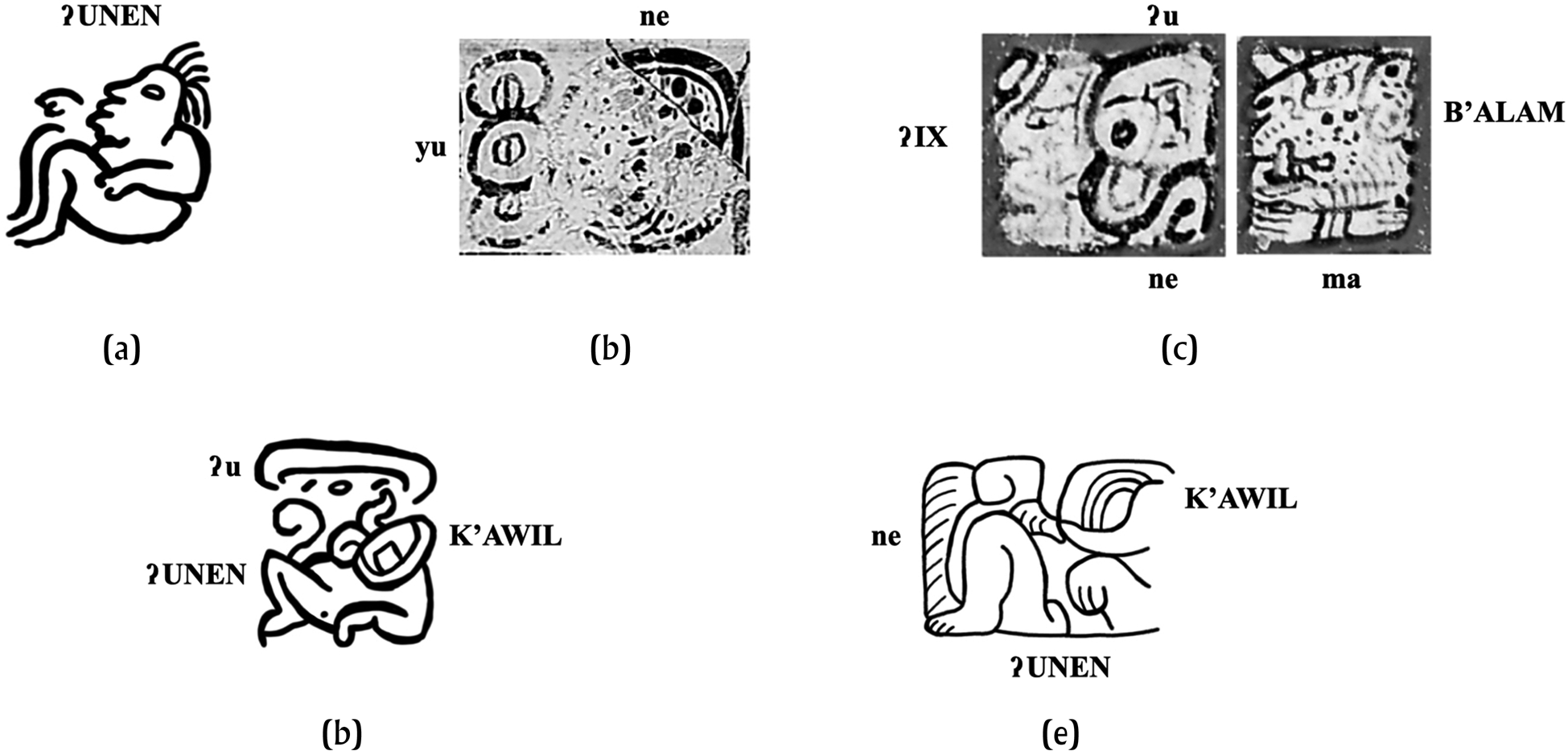
I am following the definition of grapheme as “the minimally contrastive unit in a writing system” (Henderson Reference Henderson1985:135), and I occasionally use it interchangeably with the term sign in the Peircean sense, although I use these terms to refer not just to a unit of form and meaning (e.g., a logogram) but more generally to a unit of form and value (e.g., logograms or syllabograms) or of form and function (e.g., diacritics). In this sense, Mayan writing employs three major types of graphemes: logograms, syllabograms, and diacritics. Following Fox and Justeson (Reference Fox, Justeson, Justeson and Campbell1984), I render logograms in uppercase bold letters, syllabograms in lowercase bold letters, and following more recent conventions, the duplication diacritic as a bold superscript <2>. The two most important types are logograms and syllabograms, which could be utilized in three major types of spellings. These can be illustrated with the term ʔunen ‘baby; child', or its possessed form y-unen ‘his/her/its baby’: (1) logographic, when only a logogram was used, as in ʔUNEN (Figure 1a); (2) syllabographic (or simply syllabic), when only syllabograms were used, as in yu-ne (Figure 1b) or ʔu-ne (Figure 1c); and (3) logosyllabic, when logograms and syllabograms were combined, as in ʔu-ʔUNEN-ne (Figure 1d) or ʔUNEN-ne (Figure 1e).
Types of spellings in Epigraphic Mayan. (a) Logographic spelling ʔUNEN for ʔunen ‘baby; child', collocation U01 on Uaxactun Structure B13 Mural (UAXB13Mu). Drawing by author (after drawing by Antonio Tejeda in Smith Reference Smith1950:Figure 47). (b) Syllabographic spelling yu-ne for y-unen ‘his child', collocation Q on Vase 1986.1080 at the Art Institute of Chicago (COLK0635). Photograph by Justin Kerr from Maya Vase Database at http://research.mayavase.com/kerrmaya.html. (c) Syllabographic spelling ʔIX-ʔu-ne B'ALAM for ʔix-ʔunen b'ahläm ‘Lady Baby Jaguar', collocation B’01 on Vase of the Eleven Gods at the Kimbell Art Museum (COLK7750). Photograph by Justin Kerr from Maya Vase Database at http://research.mayavase.com/kerrmaya.html. (d) Logosyllabic spelling ʔu-ʔUNEN:K'AWIL-ne for ʔunen k'awil ‘baby k'awil', collocation B05 on Comalcalco Urn 26 Pendant 08 (CMLU26Sp08). Drawing by author (after drawing by Marc Zender in Martin et al. Reference Martin, Zender and Grube2002:II-51). (e) Logosyllabic spelling ʔUNEN:K'AWIL-ne for ʔunen k'awil ‘baby k'awil', collocation C02c on Palenque House C Hieroglyphic Stairway (PALHCHS). Drawing by author (after drawing by Yuriy Polyukhovych in Sánchez Gamboa et al. Reference Sánchez Gamboa, Polyukhovych, García, de Lourdes Herbert Pesquera and Krempel2020:7–11, Figure 5).
I am following Zender (Reference Zender1999:101–102) in his extension of the term diacritic to apply to nonalphabetic scripts, and in the case of Mayan, to both “semantic determinatives” (referred to as lexical determinatives by Mora-Marín [2023]) and the “doubler.” Here, I refine Zender's definition, extending its usage from one in which a diacritic points to a departure of a grapheme's unmarked phonetic or lexical value (e.g., syllabographic, logographic) to one in which it may also point to a departure of its unmarked scope of application (e.g., a single reading versus two readings within a spelling). Determinatives do not point to general lexical or semantic domains, but instead, to specific lexemes (Mora-Marín Reference Mora-Marín2023). Some scripts (e.g., Sumerian, Egyptian, Chinese), in addition to lexical determinatives, also employ semantic classifiers, which point to general lexical or semantic domains. Mayan does not have a class of semantic classifiers proper. The closest to such a category are the classifiers identified by Hopkins (Reference Hopkins1994) and Hopkins and Josserand (Reference Hopkins and Josserand1999), also discussed by Mora-Marín (Reference Mora-Marín2008), but which the present author now considers to be iconographic classifiers that function within the artistic subsystem of the script rather than the graphematic subsystem that interfaces with the spoken language.
The third type, diacritics, were graphemes that were “affixed” to a logogram or syllabogram to indicate a deviation from its default or unmarked value, function, or scope of application within a spelling. One such sign has been known for quite some time: the so-called semantic determinative (Hopkins Reference Hopkins1994; Hopkins and Josserand Reference Hopkins and Josserand1999; Justeson Reference Justeson1986:447–449; Kelley Reference Kelley1976:206–211; Mora-Marín Reference Mora-Marín2008; Schele Reference Schele1983:19–21); more recently, Mora-Marín (Reference Mora-Marín2022a, Reference Mora-Marín2023) has redefined such signs as lexical determinatives, for they point to specific lexemes rather than more general semantic classes. These are equivalent to Gelb's (Reference Gelb1963:105) notion of “specific determinatives,” rather than his notion of “determinatives” or “semantic indicators” (1963:252) (also known as “classifiers”), which point to a general semantic class. Although some writing systems bear both types (e.g., Sumerian, Egyptian, Chinese), others exhibit only one type. Mayan may bear only the first type, lexical determinatives: what Hopkins (Reference Hopkins1994), Hopkins and Josserand (Reference Hopkins and Josserand1999), and Mora-Marín (Reference Mora-Marín2008) have called “semantic classifiers” in the past, Mora-Marín (Reference Mora-Marín2022a, Reference Mora-Marín2023) has more recently redefined as “iconographic classifiers” and suggested that they bear no relevance to the script/language interface.
Figure 2 illustrates examples of lexical determinatives. First, Figure 2a illustrates the use of T533 ʔAJAW for ʔajaw ‘lord, ruler’ used as a lexical determinative in conjunction with T670 to determine the value CH'AM for ch’äm ‘to hold/receive', whereas Figure 2b shows that when combined with the SPIRAL diacritic, T670 bore the value YAL (or ʔAL) for y-al ‘her child’ instead. Figures 2c–d illustrate a different example, T713, which, unmarked, conveys the value K'AB’ for k'ab’ ‘hand, arm’ (Figure 2c), but when combined with T617 as a lexical determinative, it bears the value K'AL for k'al ‘to wrap, close’ (Figure 2d). In these cases, the signs T533, SPIRAL (possibly same as ZRJ), and T617 function as diacritics called lexical determinatives because, when combined with another sign, they determine that other sign's value.
Examples of lexical determinatives. (a) Example of T670 with T533/ZA1a in the ʔu- T533CH'AM collocation for u-ch’äm(-aw)-Ø ‘s/he received/took it’ on incised conch shell trumpet. Drawing by author. (b) Example of T670 with SPIRAL in the ya-SPIRAL(Y)AL-la collocation for y-al ‘her child’ on jade belt plaque at Museo del Jade, San José, Costa Rica. Drawing by author. (c) Example of T713 as K'AB’ in K'AB’-TEʔ expression for (u-)k'ab’ teʔ ‘tree branch (hand/arm)’ on Vessel K7149 (COLK7149). Photograph by Justin Kerr from Maya Vase Database at http://research.mayavase.com/kerrmaya.html. (d) T617K'AL-ja collocation for k'a[h]l-aj-Ø-Ø ‘it was wrapped/closed’ on inscribed bone (COLDMA129). Drawing #7320 from the Linda Schele Drawings Collection at http://research.famsi.org/schele.html.

The other major type of a diacritic—and the focus of this article—is 22A, first identified by Stuart (Reference Stuart2014), who noted that the TWO.DOTS sign, typically used to represent the numeral ‘two', proto-Ch'olan *chaʔ=, appeared to function as a “doubler”: it allowed scribes to “indicate that a sign is to be read twice without having to render a doubled element” (Stuart Reference Stuart2014:1). In fact, a few of the Early Classic examples do not exhibit the common “affix” or “diacritic” look, but instead resemble a common spelling of the numeral ‘two' (e.g., MHD abbreviations: COLSGBc173:B, YAXLnt22:A06, COLPoPan:D04 and E02). One of Stuart's (Reference Stuart2014) examples was the spelling for the term k'uk’ for ‘quetzal', which could be spelled with two syllabograms: k'u-k'u, as in in Figure 3a, or as 2k'u, with 22A affixed to a single syllabogram k'u, as in Figure 3b, with the superscripted “2” indicating the presence of the duplication diacritic in epigraphic transcriptions. It can also be seen in Figure 3c with a spelling ʔu-ne2 for ʔunen ‘baby; child’. This proposal is universally accepted, and it has proven to be a crucial piece of evidence in the decipherment of various expressions (e.g., Stuart Reference Stuart2001).
Examples of use of 22A. (a) Syllabographic spelling k'u-k'u for k'uk’ ‘quetzal’ (NARSt32, Z04). Drawing by author after detail of drawing by Ian Graham (Reference Graham1978:86). (b) Syllabographic spelling 2k'u for k'uk’ ‘quetzal’ (COLK1874, A04). Drawing by the author (after photograph provided by Justin Kerr). (c) Syllabographic spelling ʔu-2ne for ʔunen ‘baby; child’ (CMLSpn02, A13). Drawing by author (after drawing by Zender Reference Zender2004:Figure 70).

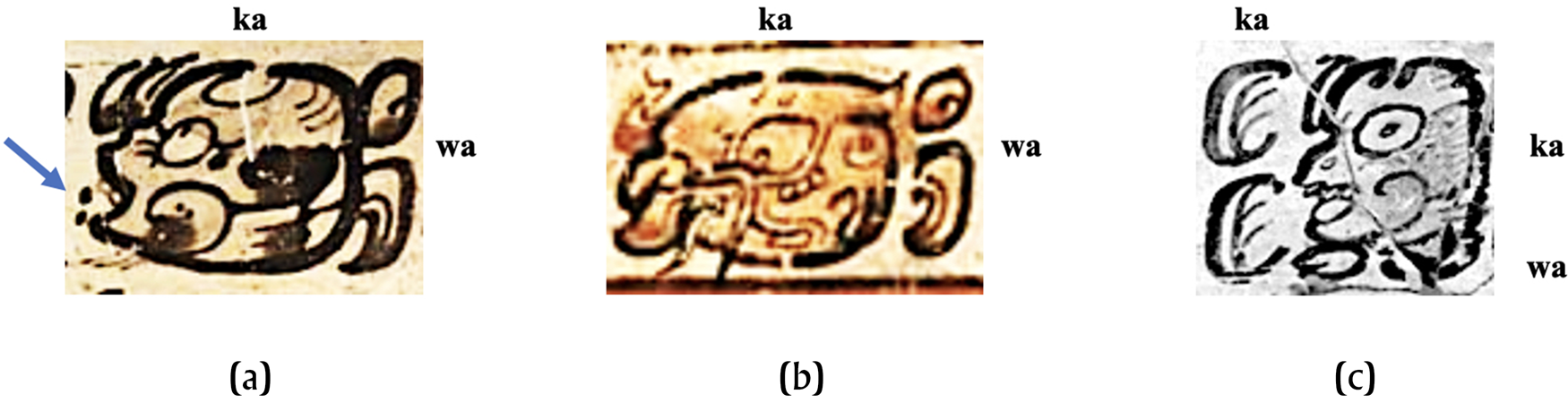
The use of the 22A diacritic, as observed by prior authors (e.g. Zender Reference Zender1999), was both rare and optional. Figure 4 provides three different types of spellings of *käkäw ‘cacao’: the first (Figure 4a) shows the use of 22A, rendering 2ka-wa; the second shows only ka-wa (Figure 4b), with no need for the diacritic; and the third shows a full syllabic spelling ka-ka-wa (Figure 4c). Using the MHD, it is possible to study the variety of contexts of use of 22A in a systematic and comprehensive fashion. The MHD (as of August 2022) contains 28 examples of 2ka-wa, approximately 233 examples of ka-wa, and 35 examples of ka-ka-wa. Consequently, out of 261 examples that were the ideal target for the duplication diacritic (i.e., those with only one instance of the syllabogram ka), only 10.7 percent employed it. Some of the potential targets of 22A (other morphemes or lexemes containing a C1VC1 sequence) employed 22A even less frequently than käkäw.
The duplication diacritic in spellings of *käkäw ‘cacao’. (a) Spelling 2ka-wa using 22A on K3230. (b) Spelling ka-wa without 22A on K554. (c) Spelling ka-ka-wa on K1837. All examples are details of photographs by Justin Kerr from the Maya Vase Database at http://research.mayavase.com/kerrmaya.html.
Prior literature on 22A
Following Stuart's (Reference Stuart2014) notes, distributed to other scholars after December 7 of 1990 and mentioned at the Texas Maya Meetings in March of 1991 by Schele (1991) (cf. Schele and Wanyerka Reference Schele and Wanyerka1991:97), the earliest didactic materials mentioning this convention consist of Harris (Reference Harris1993:ix) and Schele and Grube (Reference Schele and Grube1994:19). Harris (Reference Harris1993) was a supplement to Harris and Stearns (Reference Harris and Stearns1992). By the time Harris and Stearns (Reference Harris and Stearns1997) came out—a revised edition of Harris and Stearns (Reference Harris and Stearns1992)—its authors had already incorporated a basic description (1997:35) and a few examples (1997:Figures 3:13 and 3:16) of the duplication diacritic adopted mainly from Stuart (Reference Stuart2014) or Stuart and Houston (Reference Stuart and Houston1994).
Stuart's (Reference Stuart2014) seminal identification of 22A reviewed 12 sets of examples. One of his examples (2014:3) was pointed out to him by Stephen Houston: an instance in which 22A was applied to the syllabogram ʔu to indicate that it had to be read twice, once with each of the two nouns present in the glyph block, in order to mark them for possession with u- ‘third-person singular ergative/possessive'. Stuart took this example to be a case of 22A applying to a logogram, based on the common assumption at the time (e.g., Fox and Justeson Reference Fox, Justeson, Justeson and Campbell1984; Justeson Reference Justeson, Hanks and Rice1989)—one held by some to this day (e.g., Houston et al. Reference Houston, Robertson and Stuart2001)—that syllabograms used to spell grammatical morphemes behaved logographically. Indeed, Stuart (Reference Stuart2014:2) did not see this case as “indicating a doubling of a syllabic element,” but instead, as a case indicating that “each of the logographic mainsigns carry the prefix u”—that is, the third-person singular agreement marker. In other words, he considered the syllabogram ʔu (his u) to function logographically (U) in the spelling of u-. Here, as in previous work by Stuart (1987) and others (Mora-Marín Reference Mora-Marín2005, Reference Mora-Marín2010, Reference Mora-Marín2019, Reference Mora-Marín2021, Reference Mora-Marín2022c), I assume that grammatical morphemes are spelled phonographically by means of syllabograms.
Finally, Stuart innovated the already introduced convention of representing 22A by means of a superscript “2.” Henceforth, I apply the superscript to the left of the intended target at the beginning of a collocation, and to the right when it is at the end of the collocation.
Stuart and Houston (Reference Stuart and Houston1994:46, 49, Figures 56–57) soon followed with a single paragraph and a footnote describing what they knew or suspected about 22A at the time. Both the observations and illustrations were largely based on Stuart's (Reference Stuart2014) notes. They suggested that 22A was generally rare to begin with. They also proposed that it could be applied to both syllabograms and logograms to repeat their reading. With regard to the latter case (i.e., logograms), like Stuart (Reference Stuart2014:3), these authors were, for the most part, referring to cases of syllabograms used to spell grammatical morphemes. They also observed that 22A tended to be placed on the upper left or upper right of the intended target—what I will refer to in this article as the locus of 22A. Although they do not discuss its discovery and decipherment, they do comment on cases where its function is unclear (1994:46, n13): “We do not yet understand why some spellings use this convention. Perhaps they signal a particular spelling when two are possible: chi-K'IN in place of K'IN-chi, or k'a-k'a instead of BUTS’, respectively.”
Unfortunately, those authors do not provide relevant illustrations or otherwise reference specific inscriptions. The cases of chi-K'IN for Lowland Mayan chik'in ‘west’ and K'IN-chi for Yucatecan k'ihnich/k'iinich ‘Sun God’ would be cases of logosyllabic collocations that could be potentially ambiguous, especially given the nonsequential sign orders that were allowed in Mayan writing. Given these facts, chi-K'IN for chik'in could have been confused with K'IN-chi for k'ihnich. Stuart and Houston (Reference Stuart and Houston1994) did not, regrettably, illustrate which of the two spellings would take the diacritic to disambiguate the possible readings. (Below, I suggest the most likely example they were alluding to, and I offer an alternative explanation.) Similarly, regarding the possible ambiguity between T122/ZBBa K'AK’ for proto-Ch'olan *k'ahk’ ‘fire', on the one hand, and T122/ZBBa B'UTZ’ for proto-Ch'olan *b'utz’ ‘smoke', on the other, the authors did illustrate which spelling would take 22A for the purposes of disambiguation. More importantly, it is no longer generally accepted that T122/ZBBa could be read both as K'AK’ and as B'UTZ’; it is only read as K'AK’.
Zender (Reference Zender1999:102–130) provided a more detailed account of the various contexts and uses of 22A than had been attempted up until that time—or for that matter, since. He set out to test four hypotheses (or observations) derived primarily from (Stuart and Houston Reference Stuart and Houston1994): (1) that 22A indicates the necessary repetition of a syllabogram; (2) that a logogram can also be “doubled in this manner”; (3) that the loci for placement of 22A were on the upper left (most commonly) and upper right (less commonly); and (4) that 22A was in general “relatively rare.” Zender supported (1) and (4). He also rejected (2), concluding that its “canonical function is to double syllables” (1999:118). With regard to (3), Zender also noted cases where 22A is applied in front (i.e., to the left) or below the target grapheme, and more importantly, he showed that it need not be juxtaposed to the target sign. It could be “attached” to a logogram or to a syllabogram it was not meant to repeat, as long as it was within the same glyph block as the intended target.
Following in Stuart's (Reference Stuart2014:3) footsteps, Zender (Reference Zender1999:124–126) also discussed cases where the diacritic was used in the spelling of condensed couplets, expressions that require unfurling, and in such cases, the syllabogram marked with the diacritic would be read twice, in “non-serial” fashion, at the beginning of each paired phrase. Such cases constitute a different type of repetition than the more common cases, and they likely represent an extension of the original function of sequential repetition to a novel function of nonsequential repetition. Below, I distinguish these two functions in my proposed classification. Of the four examples of this function of 22A in my data set, three apply to word- or phrase-initial grammatical morphemes (e.g., ʔu for u- ‘s/he/it; his/her/its', or ʔa for a- ‘you (singular); your (singular)', ma for maʔ ‘no/not’), requiring the application of the same morpheme at the beginning of a noun phrase in sequences of two noun phrases functioning as a couplet. The case in Figure 5a shows 2ʔu-KAB’-CH'EN for u-kab’ u-ch'en ‘his/her/its land, his/her/its well/cave; his/her/its settlement/town'. An unfurled version of this couplet is seen in Figure 5b. As Zender (Reference Zender1999) had observed, the fact is that this “non-serial” duplication of syllabograms was also common practice even without 22A: there are cases of couplets where a single ʔu, without 22A, must be read twice within the collocation, such as the ʔu-to-k'a-pa-ka-la expression (Yaxchilan Lintel 46, F08), also represented ʔu-to-k'a=ʔu-pa-ka-la (Yaxchilan Lintel 45, C06), both of which spell u-tok’ u-pakal ‘his/her flint, his/her shield'. This same duplication without diacritic was expected in cases where the same syllabogram could be used at the end of two words that belonged to the same common sequence of nouns, as with CHAN-na-CH'EN-na (e.g., COLK1398:R4, Copan Stela 13 Altar:H01) versus CHAN-CH'EN-na (Tikal Stela 31:H23), both for chan ch'en ‘sky cave/well'. Typically, such instances of required duplication of the reading of a syllabogram without 22A involved visual overlap: the syllabogram to be repeated had to be visually adjacent to spellings of both words.
Examples of nonsequential duplication. (a) Glyph block C01 from Copan Stela 49 (CPNSt49). Drawing by author (after drawing by David Stuart in Schele Reference Schele1990:Figure 19a). (b) Glyph block G’01 from Quirigua Zoomorph G. From drawing by Matthew Looper (Reference Looper2007:96–97, Figure 3.38). (c) Glyph block E08 from Copan Stela 7. From Drawing #1031 from the Linda Schele Drawings Collection at http://research.famsi.org/schele.html. (d) Glyph blocks F25-E26 from Tikal Stela 31. Drawing by author (after drawing by William R. Coe [Jones and Satterthwaite Reference Jones and Satterthwaite1982:Figures 51 and 52]). (e) Excerpt from K1552. Photograph from Justin Kerr from Maya Vase Database at http://research.mayavase.com/kerrmaya.html.
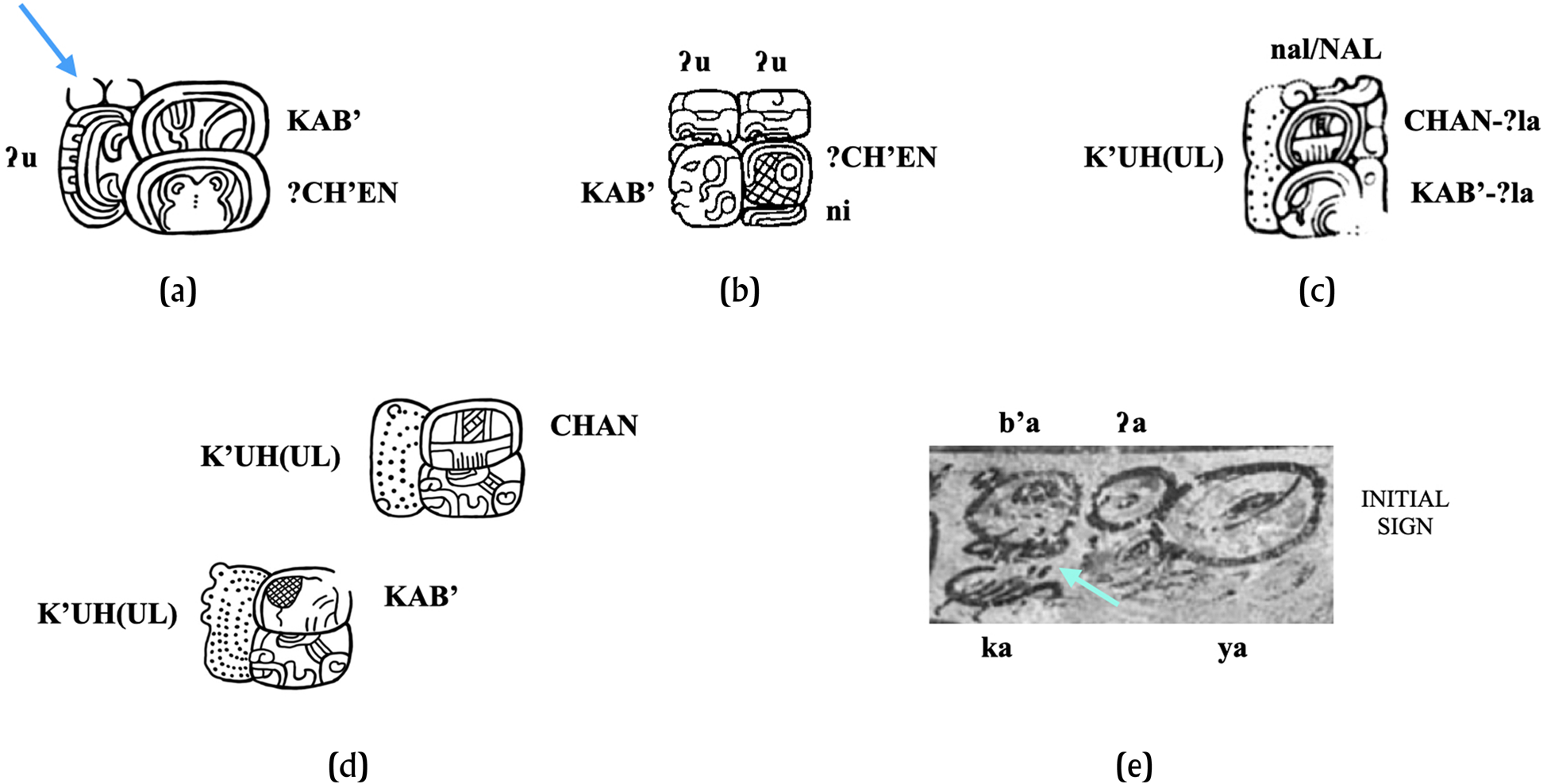
Interestingly, logograms could also experience “duplication” without 22A. The logogram K'UH(UL) ‘god(ly)’ could be similarly applied jointly to two separate nouns by means of the convention of visual overlap, as in Figure 5c, where the expression K'UH(UL)-CHAN-nal-?la-KAB’-?la, for chanal k'uh, kab'al k'uh ‘celestial god, earthly god’, is shown. Or it could be applied individually to each of the nominal expressions, as in Figure 5d, showing K'UH(UL)-CHAN K'UH(UL)-KAB’. Given this scribal practice of duplicating the reading of a logogram, without 22A, in contexts requiring “unfurling,” it is to be expected that at least one case of 22A applying to a logogram would require a duplication function. Although not one example of such a case has surfaced to date, I would not be surprised if at least one were to do so in the near future.
Zender (Reference Zender1999:128) proposed that in instances in which “doubled signs were not meant to be read serially,” the diacritic would be found, with “no exceptions,” in the top-left corner of the collocation. There are very few examples of 22A in this nonsequential duplication function: of the four examples of nonsequential duplication in my data set, three are, generally—although not always strictly—on the top-left corner of the collocation. Note that in Figure 5a, 22A is in the top locus, not the top left. Nevertheless, in the example in Figure 5e, the spelling 2b'a-ka for b'ah=kab’ ‘head/top of land’—a title—22A is found on the bottom of the target grapheme, placing the diacritic in the middle of the collocation.
Zender (Reference Zender1999:120–121) also offered some interesting remarks on the practical rationale for the innovation of 22A. He noted that because Mayan scribes often duplicated syllabograms for purely graphic purposes (e.g., to fill in more space within a glyph block), duplication of such signs (e.g., ka, la) would not have been an obvious way to call for their sequential reading. Although I find this idea very appealing, this must not have been a very important concern for the scribes, given the overall rarity of use of 22A. Also, although this explanation makes sense with the highly frequent use of 22A with T25 ka (30 cases)—a sign that was commonly doubled for graphic purposes (e.g., instances of ka in RAZV15)—it does not work as well for other signs mentioned by Zender, such as la: the MHD data set of 132 cases of 22A bears only one instance in which 22A may have applied to la.
In addition, Zender (Reference Zender1999) proposed a subscript convention (e.g., ka2-wa) for indicating the placement of 22A, but the subscript convention is already reserved for marking allograms (Fox and Justeson Reference Fox, Justeson, Justeson and Campbell1984), and therefore I will favor the superscript convention.
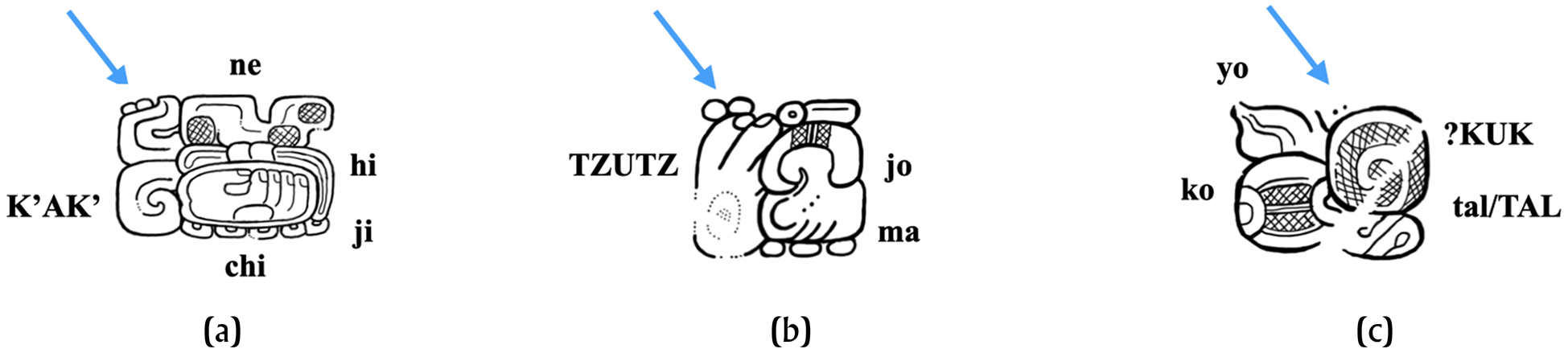
Recently, Kettunen and Helmke (Reference Kettunen and Helmke2020:20) and Prager (Reference Prager2020:3) have suggested that the diacritic was used “on some rare occasions” with logograms of the shape CVC, where both consonants were identical; henceforth, I refer to such shapes as C1VC1. Indeed, 22A can apply to two confirmed logograms: T122/ZBBa K'AK’ for k'ahk’ ‘fire’ (Figure 6a) and TZUTZ for tzutz ‘to finish’ (Figure 6b). There is another likely logogram, ZRJ, whose reading remains unconfirmed (Figure 6c). Kettunen and Helmke (Reference Kettunen and Helmke2020:20) highlight the case of K'AK’ for k'ahk’ ‘fire', and they refer to the case of ZRJ, the RUBBER.BALL sign (Helmke, personal communication, 2022), which bears 22A in the texts from Palenque's Temple XIX Platform and Stone Pier. ZRJ, a circular sign depicting some sort of material rolled up onto itself, possibly depicting a rubber ball, has been proposed to bear the value CH'ICH’/K'IK’ ‘blood’ (Helmke, personal communication, 2022). Around the same time, however, Prager (Reference Prager2020:3), who also remarked on the use of 22A with ZBBa K'AK’ and the AW3/AW8/MR6 TZUTZ logograms, presented plausible although not definitive evidence in favor of reading KUK ‘bundle, textile; roll up, wrap up’ for ZRJ (Prager Reference Prager2020:7). Pending confirmation for the reading of ZRJ, I will focus my remarks below on the two clear cases of 22A applied to C1VC1 shapes—namely, K'AK’ and TZUTZ.
Cases of 22A applied to logograms with C1VC1 shapes. (a) Glyph block B02 from Santa Rita Corozal stone bowl. Drawing by author (after drawing by Stuart Reference Stuart2005:131). (b) Glyph block O02 from Tortuguero Monument 6. From drawings #109039 and #109029 from the Linda Schele Drawings Collection at http://research.famsi.org/schele.html. (c) Glyph block Y01 from Palenque Temple 19 Platform. Drawing by author (after drawing by Stuart Reference Stuart2005:123, Figure 92).
Most recently, Mora-Marín (Reference Mora-Marín2022b) presented evidence for another function of 22A as an abbreviation marker in collocations. As such, it would be analogous to a punctuation marker, akin to the use of the period to mark abbreviations in Latin-derived scripts (e.g., Prof., Dr., etc.). One example is the case on K1670 of the spelling K'UHUL cha 2TAN (Figure 7a), which is present on a pottery vessel with a Primary Standard Sequence (PSS) text, immediately before the collocation that begins the inscription yu-k'i-b'i for y-uk’-ib’ ‘his/her cup'. This type of PSS text often begins with a possessed noun followed by the name of the intended owner, and the two (possessee and possessor) are often separated by an intervening prepositional phrase that modifies the possessee. In the case at hand, the K'UHUL cha 2TAN expression corresponds to a well-known title, corresponding to the intended owner of the vessel. Typically, the title begins with k'uhul ‘holy/divine', which is followed by cha… tahn (an expression that remains opaque) and ends in the logogram WINIK for winik ‘person'. Such a typical case is seen in Figure 7b. In the case in Figure 7a, then, 22A marks the last component of the formulaic collocation, the logogram TAN for tahn ‘chest', which typically precedes the last component, the logogram WINIK for winik ‘person’, which was omitted in this case, possibly because the scribe ran out of space before the text—painted around the rim of the vessel—returned to the beginning, the yu-k'i-b'i expression. Consequently, a logogram has been omitted from a formulaic collocation, and 22A points to the fact that this component is missing.
Cases of 22A in its abbreviation function applying to collocations. (a) Excerpt from K1670. Photograph courtesy of Donald Hales (All Rights Reserved). (b) Excerpt from K1810. (c) Excerpt from K2295. (d) Glyph from Simojovel Shell. Drawing by author (after drawing by Peter Mathews in Robertson et al. Reference Robertson, Rosenblum Scandizzo, Scandizzo and Robertson1976:Figure 9). (b)–(c) Excerpts from photographs by Justin Kerr from Maya Vase Database at http://research.mayavase.com/kerrmaya.html.
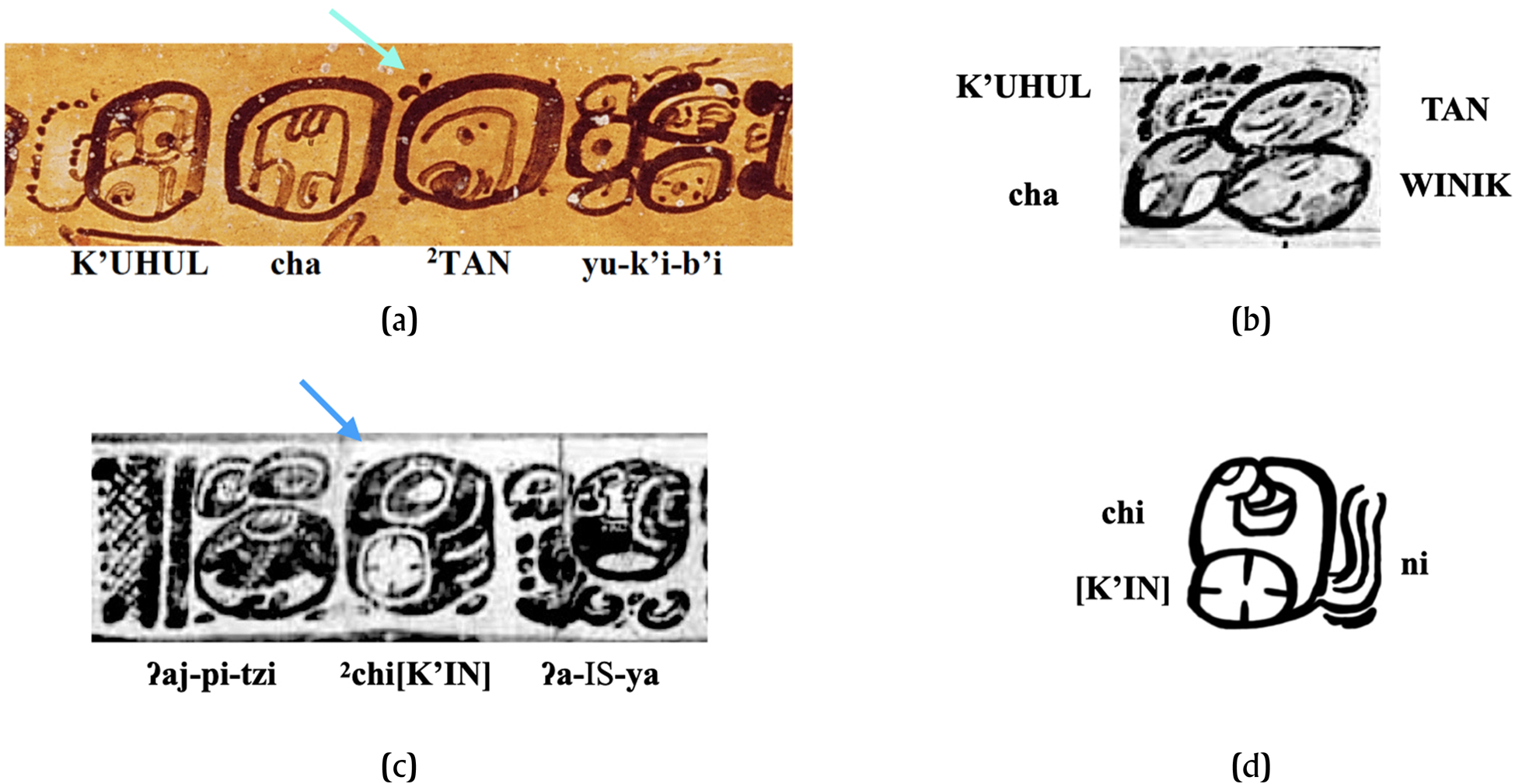
A second example, out of a total of five examples where 22A bears this function (Mora-Marín Reference Mora-Marín2022b), occurs in the last glyphic collocation of another PSS text painted on a different pottery vessel. In this instance (Figure 7c), the spelling 2[chi]K'IN appears as part of a title phrase for an individual, the intended owner of the vessel, and it likely represents the common appellative k'ihnich/k'iinich ‘radiant/Sun God’, referring to the Sun God. The collocation appears at the very end of the text, immediately before the so-called Initial Sign of the PSS, spelled ʔa-INITIAL.SIGN-ya. This Initial Sign appears in hundreds of PSS texts on pottery vessels, and it unambiguously marks the beginning of such texts. The scribe clearly reached the end of the text (also the beginning of the text) and ran out of room to complete the typical spelling of the ‘radiant/Sun God’ title, which, when spelled logosyllabically (as opposed to simply logographically), typically bears the ni syllabogram (Figure 7d), if the chi syllabogram is also present (120 cases in the MHD). Only rarely (17 cases in the MHD) does it show chi by itself, without a ni in such spellings. Consequently, in the case at hand, the scribe appears to have used 22A to indicate that something was missing—the typical ni syllabogram of logosyllabic spellings of k'ihnich/k'iinich.
Two more examples support this abbreviation function. They both involve the child-of-father expression. In both cases, 22A is placed between K'AK’ for k'ahk’ ‘fire’ and the T535 (Capped Ajaw) sign, as seen in Figures 8a–b. In this collocation, T535/ZA3 (Capped Ajaw) and T533/ZA1 (Regular Ajaw) may co-occur (Figure 8c). When this happens, T535 always precedes T533. The 22A diacritic only appears in two cases—the two examples already noted—and in both cases, it is T533 that is seemingly absent from the collocation. Also, 22A does not always appear in instances in which T533 is absent; as has already been explained, 22A is optional. But both cases where it does appear are instances in which T533 has been omitted. In principle, examples like those in Figures 8a–b (and similar examples lacking the optional 22A) could be argued to be instances in which T533, Regular Ajaw, has been infixed within T535, Capped Ajaw, resulting in the appearance of only the Capped Ajaw. Consequently, 22A could be functioning, in the rare occasion when it is present in the child-of-father collocation, to indicate that something is missing—specifically, T533—or at the very least, not obvious.
Cases of 22A in its abbreviation function applying to collocations. (a) Itzimte Bolonchen Stela 7 (ITBSt017). Drawing by the author (after drawing by von Euw Reference von Euw1977:19). (b) Excerpt from Tikal Stela 22 (TIKSt22). Drawing by the author (after drawing by William R. Coe in Jones and Satterthwaite Reference Jones and Satterthwaite1982:48–50, Figure 33). (c) Excerpt from (BPKSt02). Drawing by the author (after drawing by Peter Mathews Reference Mathews and Green Robertson1980:62, Figure 2).
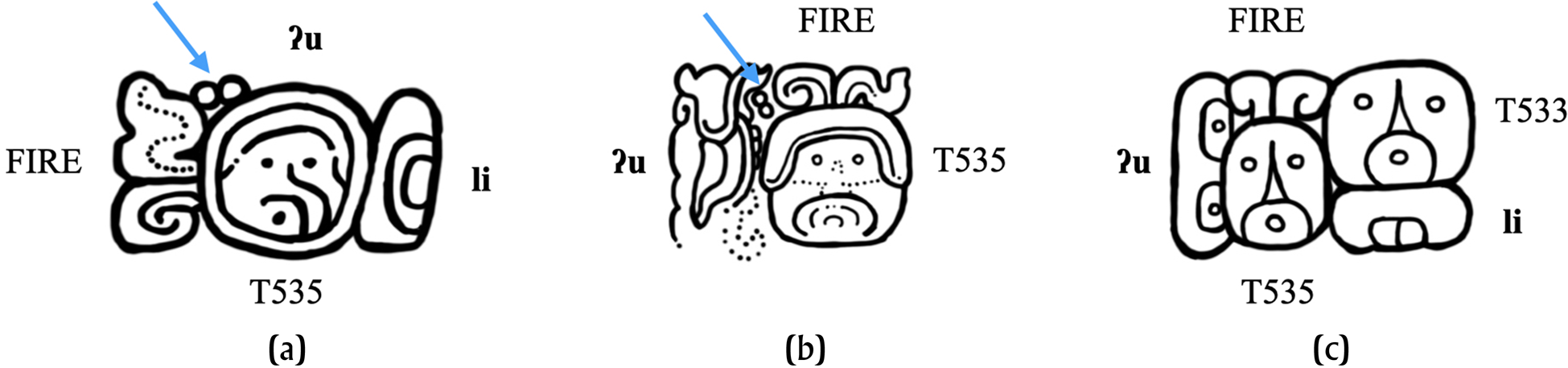
Four examples, then, apply to logograms, one to a syllabogram, and all fall within the Late Classic period. I propose that it was a late innovation—an analogical extension of the more common duplication function—and one that operates at the collocational level, and therefore, at the supragraphemic level. This means that at the graphemic level, either logograms or syllabograms may be the target. Both the examples in Figures 7a and 7c, consequently, constitute cases of the use of 22A in a glyph block at the end of a text. At least one other instance, shown in Figure 5e, also involves 22A in the last glyph block of a text, suggesting that perhaps position within a text could have an influence on its application.
Functional classification of 22A and hypotheses
Given what has been discussed so far, I propose a classification of four functions of the 22A diacritic:
(1) Sequential duplication of syllabograms (Stuart Reference Stuart2014; Zender Reference Zender1999);
(2) Nonsequential (“non-serial”) duplication of syllabograms (Stuart Reference Stuart2014; Zender Reference Zender1999);
(3) Marking of logograms representing lexemes based on C1VC1 roots/stems (Kettunen and Helmke Reference Kettunen and Helmke2020; Prager Reference Prager2020); and
(4) Abbreviation function, applied to graphemes (logograms, syllabograms) or supragraphemically (entire collocations), proposed here for the first time, which implies that 22A also functioned as a punctuation mark (Mora-Marín Reference Mora-Marín2022b).
I propose that functions (2)–(4) constitute analogical extensions of function (1), given that the use of 22A to indicate the need for sequential duplication of a sign within a glyph block would have allowed for scribes to generalize the pattern to the nonsequential duplication of the same sign within a glyph block. In addition, the sequential duplication of a syllabogram to render a C1VC1 lexical root could have also led to the reanalysis of 22A as a marker of logograms based on C1VC1 roots. And last, given that in the first two functions 22A essentially indicates that something is missing in the spelling, scribes could have extended 22A to function as an abbreviation marker, this time applying at the level of a whole spelling rather than at the level of an individual grapheme within a spelling.
Postclassic codices
A search of 22A in the MHD yielded no cases in the Postclassic codices. One may wonder whether the conditions for any of the functions of 22A just reviewed are present in the codices, and whether the more frequent and likely lexical and morphemic targets of 22A occur as well. I have not conducted a comprehensive search. Instead, I have restricted myself to investigating whether incomplete spellings of käkäw ‘cacao’, ʔunen ‘baby; child’, and -(V)l-el ‘abstractivizer of nouns’ are amenable to the sequential duplication function of 22A—its most frequent function. Figure 9 presents characteristic examples of each one.
Examples of common lexical and morphological targets of 22A in the Postclassic codices lacking 22A. (a) ka-ka-wa for käkäw ‘cacao’ on DRE25:A01. (b) ya-YAL-ne for y-aal y-unen ‘children’ on DRE02:D01. (c) ʔAJAW-le for ʔajaw-(a)l-el ‘kingship’ on DRE02:B01.

The first target (Figure 9a), käkäw, occurs 13 times, in all of them showing at least ka-ka, and 11 showing ka-ka-wa. Not one shows ka-wa, the context that would allow for the optional application of 22A. The second and third targets, though, do exhibit the right contexts: of the four instances of ʔunen, as part of a diphrastic kenning y-aal y-unen ‘her child, her baby’ for ‘her children’ (Figure 9b), all four show only ne, with not a single case of -ne-ne; and of the 72 instances of ʔajaw-(a)lel ‘kingship’ (Figure 9c), all cases show only -le, with not a single case of -le-le. Consequently, the conditions for the application of 22A are present in the Postclassic codices. The Postclassic scribes were just not keen on 22A, if they knew of it at all.
Objectives
Given the foregoing review and discussion, any data set for quantitative analysis of 22A should consider, at the very least, the following scriptal factors variables: the graphemic targets of 22A (syllabogram vs. logogram); its position within a text (dispersion); the function of 22A (duplication, nonsequential duplication, C1VC1 shape marking, and abbreviation); and the locus of 22A (where it is placed with respect to the target grapheme). Dispersion here refers to the distribution of 22A within a whole text, whether it occurs near the beginning, middle, or end. Intuitively, one could imagine that as scribes get closer to the end of a text, especially one painted in a rush, and perhaps with less planning time, more information is packed toward the end, and the limited space prompts scribes to abbreviate more. However, to test whether this is an important factor, it would be necessary to have dispersion values for all the spellings of a given lexeme (e.g., käkäw), both those that use 22A and those that do not. This is a task for a future study.
Following Kettunen and Helmke (Reference Kettunen and Helmke2020) and Prager (Reference Prager2020), who raised the possibility of a linguistic factor (C1VC1 shapes), I further propose the following linguistic variables for consideration: phonological classes (manner and place of articulation) and grammatical classes (nouns, verbs, grammatical morphemes) of the graphemic targets. In addition, given that the prior literature has not explicitly discussed nonscriptal and nonlinguistic factors in connection with 22A, I propose the following: media (portable vs. monumental), geography, and time. Studying these variables should allow one to investigate questions regarding the historical development of 22A: when it originated, where, what its most likely functions and targets were early on, and how it became extended to more functions and targets as time went on. More narrowly, it is possible that the data may point to specific lexemes that may have promoted the use of 22A as well as influenced the scribes’ preferences in its application.
Procedures and methods
I have employed the MHD (Looper and Macri Reference Looper and Macri1991–2023) to prepare a data set amenable to quantitative analysis. A total of 132 records with 22A were downloaded (in August 2022) as a CSV file and curated with Apple Numbers. This process involved several steps: (1) checking all examples visually for accuracy; (2) culling examples that could not be corroborated; (3) adding a few examples not included in the MHD at the time (of which a couple have since been added); and (4) preparing data categories, which are identified in the Objectives section, to study variables relevant to the current study.
A minor issue pertains to the dates provided by the MHD: (1) some dates are based on calendrical evidence internal to a text; (2) others are based on calendrical evidence and associations (e.g., names of individuals known from a specific period of time); (3) others are based on archaeological associations (e.g., interment in the burial of a historically known individual, ideally one mentioned in the text itself); and (4) others are estimates based on style (generally) and labeled “estimate.” This information is captured in the “objcal” field of each record, which needs to be selected prior to downloading data so that the records may be sorted appropriately. For the purposes of studying the chronological development of 22A, I have only included date categories (1)–(3) as part of the independent metric variable of time, which appears in Gregorian years rather than in Mayan Long Count dates in my results. The fourth category has been included in the more general category of all texts, whether dated or not, and coded for time period, as an ordinal variable, either as Early Classic (ca. a.d. 200–600) or Late Classic (ca. a.d. 600–909).
After processing the data, the final data set retained 125 records. Nonetheless, different analyses are based on different total numbers of cases, because it is not possible to classify all cases according to the all the variables of interest in this article. As a case in point, dated texts (N = 74) constitute only 59.2 percent of the data set. However, for some tests, time measured metrically (in years) is more useful and accurate than time measured ordinally (in time periods, such as Early Classic, Late Classic), which tends to make up for the lower frequency of dated texts. For a very few tests, texts dated by style may be considered among the dated texts, which raises the total of dated texts to 86 (68.8 percent). In such tests, the inclusion of texts dated only stylistically (12 in total) constitutes a small but nonetheless important source of potential error.
When adding cases of 22A not recorded in the MHD, I have erred on the side of including anything that shows 22A, but for which a canonical duplication function may or may not be ascribed. For example, despite the obvious presence of 22A in two examples from the famous lock-top cacao pot of Rio Azul (MHD code RAZV15), these spellings were not coded in the MHD as containing 22A. The two spellings are identical: they are both cases of ka-2ka-wa for käkäw ‘cacao'. Perhaps the authors of the MHD omitted 22A in these spellings because it seems superfluous: the spellings already contain two instances of the syllabogram ka, to which 22A was applied, and therefore there is nothing to duplicate. Nevertheless, I have included these two cases in my data set, because I believe they can teach us something about the way that scribes were thinking about 22A.
Table 1 provides the basic categories and variables of the data set.
Basic dataset categories and variables (125 records).
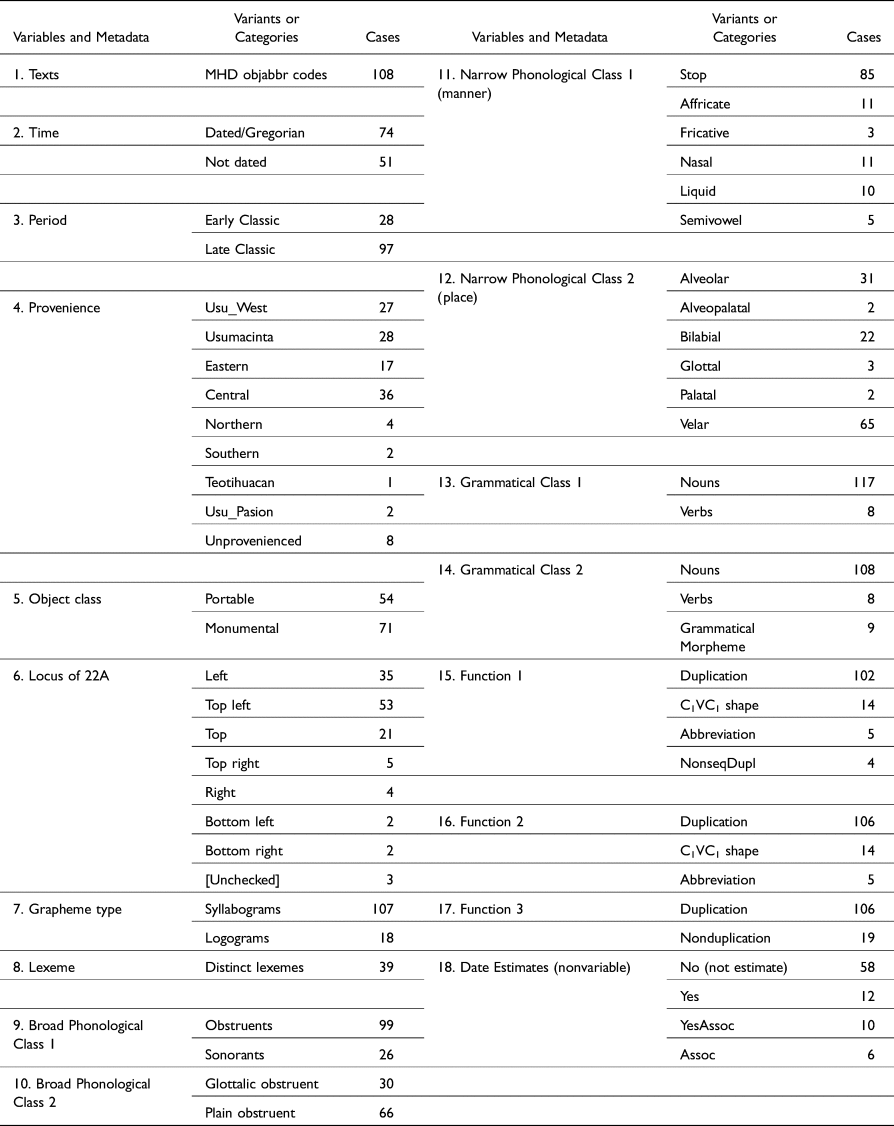
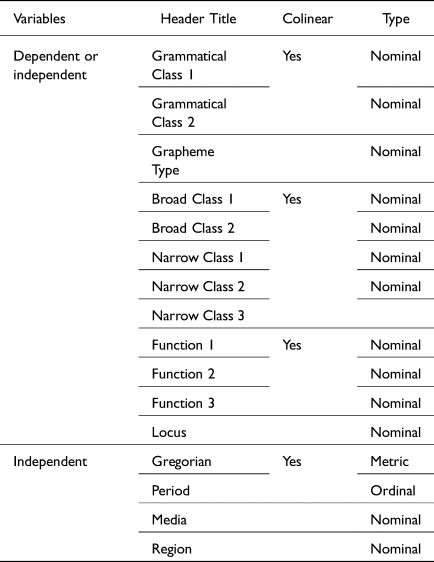
Table 2 shows the nature of the variables as metric, nominal, or ordinal. It also clarifies which sets of variables are mutually colinear, and therefore were not included in statistical tests at the same time.
Types of variables (metric, ordinal, nominal) and cases of colinearity.
I assessed the grapheme type that was the target of 22A—that is, whether 22A was applied to a syllabogram or logogram—not only by paying attention to the placement of code 22A relative to other graphemes in the column indicating the grapheme codes but also by checking the figures provided in the MHD for each glyph block, or by seeking out figures from other sources. The latter step was necessary whenever the MHD lacked relevant images, or whenever the image provided by the MHD appeared to lack information (some illustrations in the MHD have omitted the 22A diacritic). Cases for which no corroboration was possible were omitted from the data set or from a particular test. Grammatical Class, a category involving nouns and verbs, was ascertained by checking every example in the MHD directly, and in some cases, cross-checking with existing categories in the MHD (e.g., blsem for semantic class, blmaya1 for Mayan transliteration, etc.).
The main source of error in my data set is the locus variable, which provides location values for 22A relative to the target grapheme. It is likely that different scholars would make somewhat different decisions regarding some of these values (e.g., top left vs. top).
In a relatively few cases, 22A was applied to syllabograms used to spell grammatical morphemes (e.g., 2ʔa to spell /a-/ ‘second person singular ergative/possessive’ twice, 2le to spell /-Vl-el/ ‘abstractivizer of nouns and adjectives’). In such cases, I coded two sets of variables: Grammatical Class 1 with variants Noun and Verb, and Grammatical Class 2 with variants Noun, Verb, and Grammatical Morpheme. Of the total 125 cases, only eight unambiguous cases involve grammatical morphemes, only one of which dates to the Early Classic period (a.d. 514), and five cases make up the majority of instances in which 22A was applied to a syllabogram with a liquid consonant (i.e., 2li or 2le).
Next, I present the results of descriptive and inferential statistical tests and offer some discussion of their implications. I begin with the results pertaining to the independent variable of time, both for dated texts (in actual years) and then for all texts according to the ordinal distinction of Early Classic versus Late Classic. Then, I consider interactions between pairs and sets of nominal variables, some independent (region, media), and others dependent (grapheme type, grammatical class, phonological class, locus). I have employed DATAtab (DATAtab Team Reference Team2022) for the descriptive and inferential statistical procedures, as well as the graphs that make up most of the figures. Several nonparametric tests (Kruskal-Wallis Test, Mann-Whitney U Test) were used for assessing whether the variants or categories of a dependent variable (e.g., syllabogram vs. logogram as variants of the grapheme type variable) differ significantly from each other with respect to time (Gregorian years). Chi-square tests of independence were used for assessing whether two sets of categorical variables (each one nominal or ordinal) exhibit a statistically significant relationship. Last, Logistic Regression Tests were used to assess whether, and to what extent, multiple independent variables (e.g., region, media, Gregorian, period) may influence a nominal dependent variable (e.g., grammatical class), allowing for an assessment of which independent variables may exert a stronger influence than others. The details of the statistics and the data sets are provided as Appendixes 1–3 of the Online Supporting Materials (OSM).
Results
Relationship between 22A and time
Recall that no cases of 22A are attested in the Postclassic codices, according to the data from the MHD, so only Classic-period examples will be of relevance. A Late Preclassic example dating to the first century b.c., the so-called Uaxactun perforator (Kováč et al. Reference Kováč, Jobbová and Krempel2016), may exist, but its presence has yet to be proven to constitute a diacritic function—much less be correlated with a specific type of diacritic function—given that graphemes to which the TWO.DOTS grapheme was applied, not to mention the text as a whole, remain largely undeciphered and untranslated. It is possible that the two examples of this grapheme on the perforator could constitute cases of the numerical logogram CHAʔ for *chaʔ= ‘two’, or even the syllabogram ʔu without a “bracket” element, consisting of only the two dots.
Figure 10 presents a basic chronological breakdown of the data set, with Figure 10a showing the distribution of all texts in their respective Early Classic and Late Classic periods; Figure 10b showing the distribution of the reliably dated texts, with a mean corresponding roughly to the year a.d. 700; Figure 10c showing the geographic distribution by period; and Figure 10d showing the geographic distribution for dated texts.
Overall distribution of texts with 22A during Classic period. (a) All texts (N = 125), dated and undated, by period. (b) All reliably dated texts (N = 74), with mean (699.82) represented as a horizontal dashed line, and median (728) represented as a horizontal solid line. Dashed triangle represents standard deviation (95.37). (c) Distribution of all generally provenienced texts (N = 117) across regions by period. (d) Distribution of reliably dated texts (N = 74) across regions.

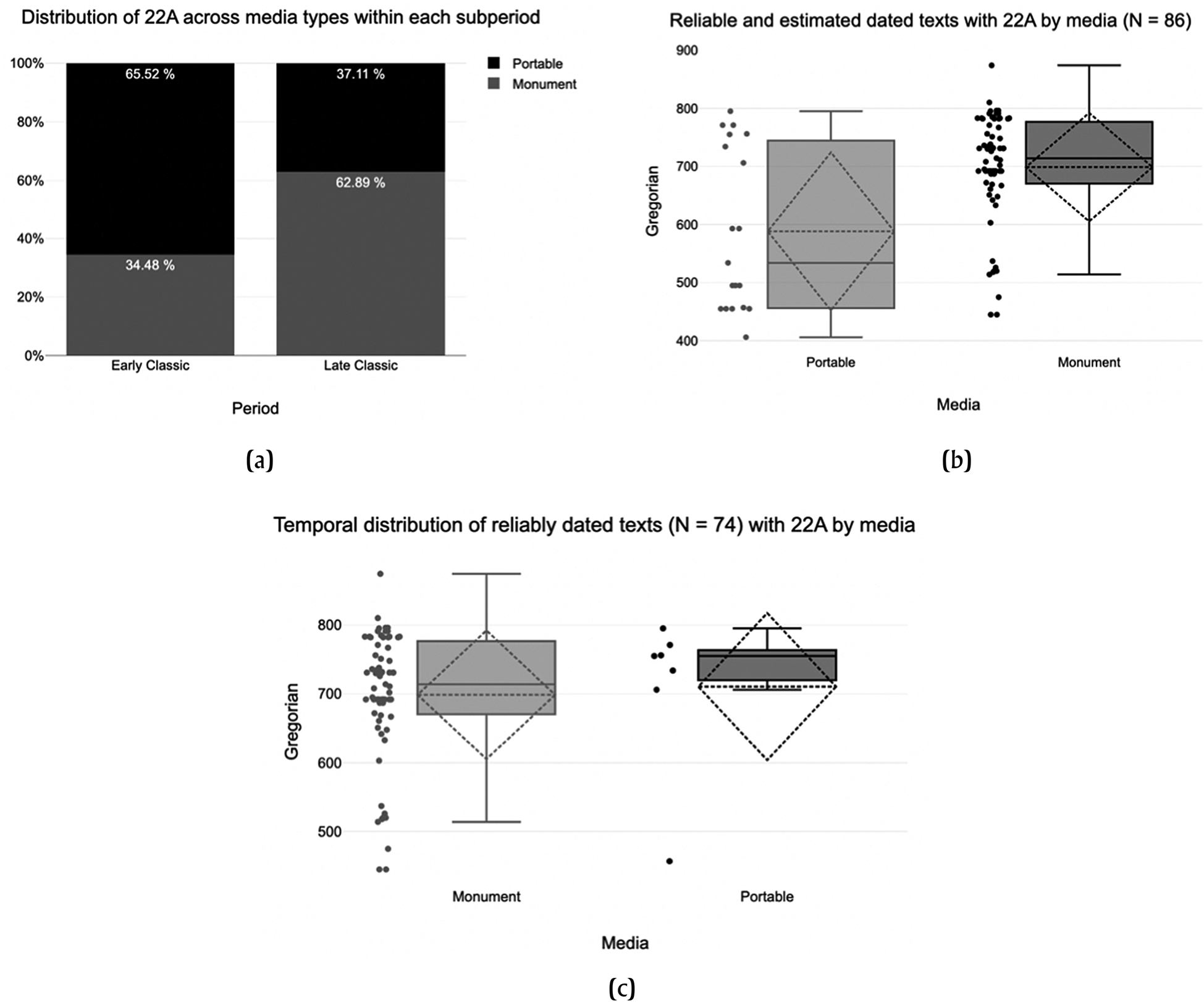
Figure 11 presents the temporal distribution of texts containing 22A broken down by media, whether portable or monumental. It is noteworthy that the proportions of texts with 22A shift according to media: portable texts make a larger proportion of the Early Classic data set relative to monumental texts, but the proportion is inverted during the Late Classic period. When all dated texts are considered, including the 12 texts dated stylistically, portable texts exhibit a lower mean value corresponding to the year a.d. 588; when those 12 texts are subtracted, then monumental texts exhibit a lower mean value of approximately a.d. 699. The question is whether these apparent differences are statistically significant.
Before addressing this question, a few words about the statistical tests are needed. Table 3 presents the statistically significant results of the variables of relevance with respect to time, considered both as a metric variable (Gregorian years) and as an ordinal variable (period). The final column refers to the tables within Appendix 1 of the OSM (OSM-1), where the detailed statistical results can be consulted. Every test was carried out with both the full data set of dated and undated texts, and the data set of only dated texts. Next, I will review the significant results in a bit of detail to draw out their implications.
Distribution of texts with 22A during Classic period by media. (a) All texts (N = 125), dated and undated, by period and media, showing total percentages within period by media. Portable texts make up greater proportion of Early Classic examples of 22A. The distribution is inverted during the Late Classic period. (b) All dated texts (N = 86). Portable texts exhibit a lower mean value (588.21) than monumental texts (698.7). (c) Only reliably dated texts (N = 74) by media. Monumental texts exhibit a slightly lower mean value (698.7) than portable ones (710.57).
Summaries of significant statistical tests, Part 1: Media and Region variables.
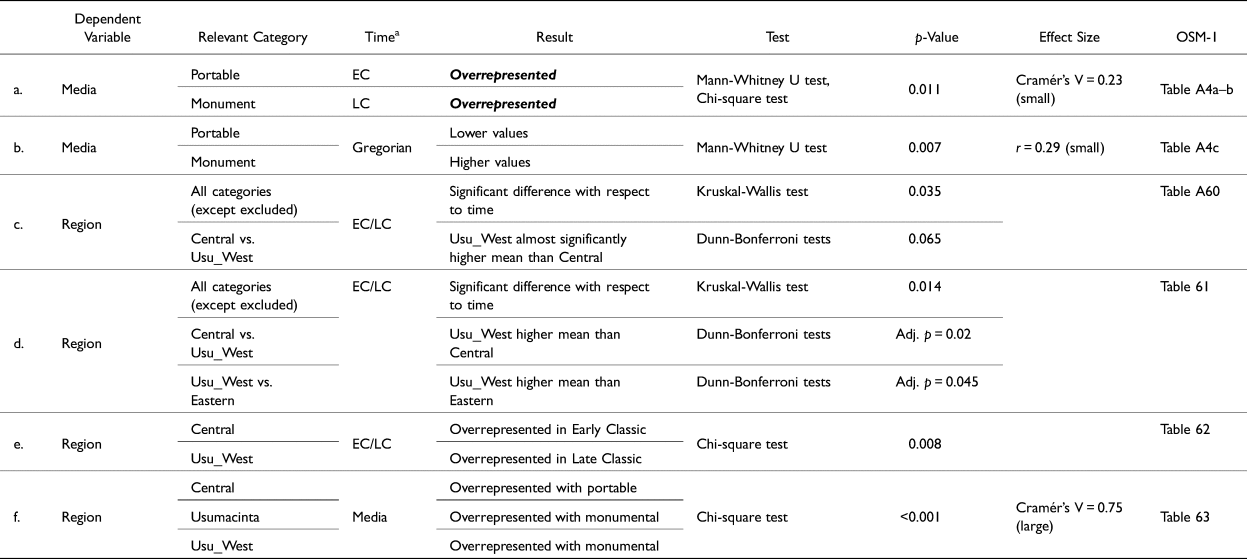
a EC = Early Classic, LC = Late Classic, Gregorian = Gregorian calendar years.
Returning to the question of the relative distribution of texts with 22A broken down by media (portable vs. monumental), the results summarized in Table 3a, considering all texts (N = 125), indicate that portable texts make up a significantly higher proportion of instances of 22A during the Early Classic period compared to the Late Classic period, as illustrated with Figure 11a. Similarly, the summary in Table 3b indicates that when all dated texts (N = 86) are considered, including the 12 dated stylistically, the difference is also significant, with portable texts with 22A being significantly earlier than monumental texts. When only reliably dated texts (N = 74) are considered (OSM, Appendix 1, Table A5), the difference between portable and monumental is no longer significant. On the weight of the first test (all texts), I propose the following hypothesis:
Hypothesis 1: 22A may have been innovated, but at the very least was initially popularized, on portable media. During the Late Classic period, 22A became more widely accepted, and in fact favored, on monumental media. This may reflect an important difference (e.g., in style or formality, or simply available space) between portable and monumental media, but one that became blurred over time.
There was a statistically significant result related to geography and time (Table 3c): when all regions are considered together (except for Unprovenienced and Teotihuacan, the latter with only one case), as in Figures 10c and 10d, they are, as a whole, significantly different with respect to time. However, the data are too limited for some regions to allow for more narrow results across the board. When additional regions were excluded due to their scarcity of cases (Southern, Northern), the results (Table 3d) point to significantly different pairwise comparisons (Usu_West vs. Central, Usu_West vs. Eastern), with the Central region (lower mean values) showing overrepresentation during the Early Classic, and the Usumacinta_West region (higher mean values) in the Late Classic (Table 3e). Given that the Central and Usumacinta regions have the earliest reliably dated examples, a.d. 445 and a.d. 475, respectively, and given that the Central region is at least significantly different (i.e., earlier) than the Usumacinta_West region, I put forth the following hypothesis:
Hypothesis 2: 22A may have been innovated, but at the very least was initially popularized, in the Central region during the Early Classic.
It is worth exploring whether Hypotheses 1 and 2 may be combined: is there a significant relationship between media and geography? Using only the four regions with ample representation of 22A cases (Central, Usumacinta, Usumacinta_West, and Eastern), a chi-square test of independence with respect to media (portable vs. monumental) was carried out. The results, summarized in Table 3f, show that there is: portable texts are overrepresented in the Central region with respect to monumental, and by comparison with the other regions. Consequently, the following hypothesis can be proposed:
Hypothesis 3: 22A may have been initially popularized on portable media in the Central region during the Early Classic.
Next, I examine scriptal and linguistic variables pertaining to 22A in relation to time. The significant statistical tests are summarized in Table 4.
Summaries of significant statistical tests, Part 2: Scriptal and linguistic variables.
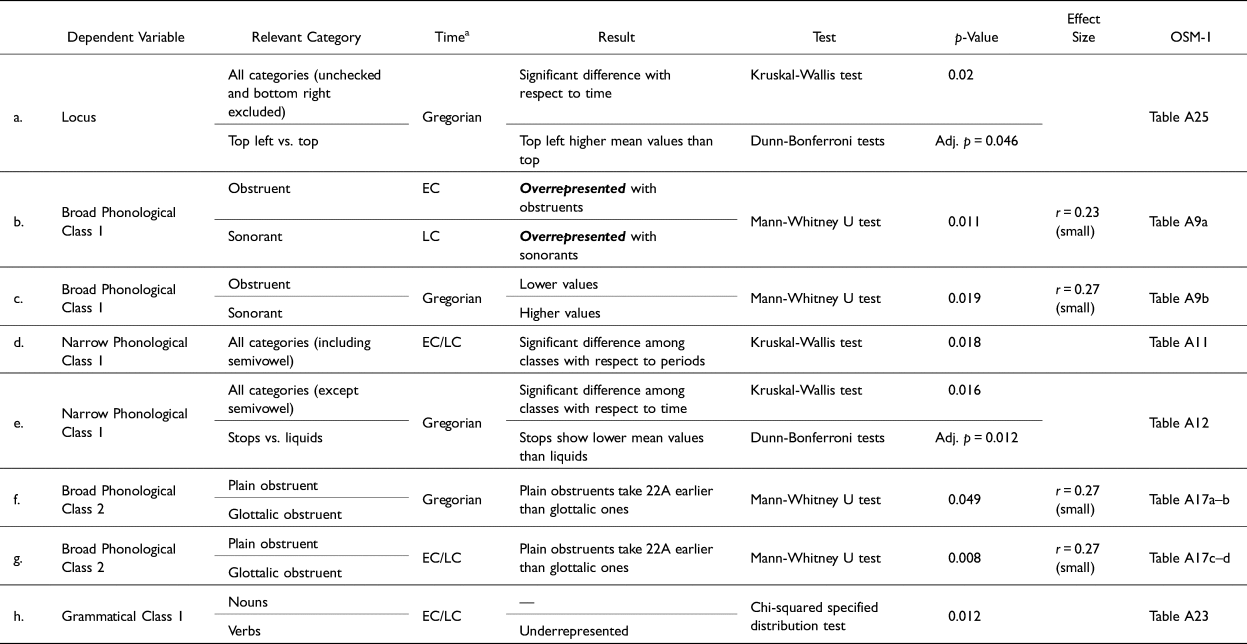
a EC = Early Classic, LC = Late Classic, Gregorian = Gregorian calendar years.
First, I will consider the scriptal variable of the graphemic target. Despite the difference in frequency between the two graphemic targets (108 syllabograms, 18 logograms), the statistical tests did not yield any statistical significance in their temporal distribution as targets of 22A. For all texts, considering time as an ordinal variable (Early Classic vs. Late Classic), the results of the Mann-Whitney U test (U = 773.5, p = 0.185, r = 0.17) support the null hypothesis (no significant difference). The same was the case when time was treated as a metric variable (Gregorian years) (1) with all dated texts (N = 86), with results (U = 388.5, p = 0.304, r = 0.11) showing no significance; and (2) with all reliably dated texts (N = 74), with results (U = 316, p = 0.417, r = 0.1) also showing no significance. This is despite the fact that, so far, only one Early Classic text bears a case of 22A applied to a logogram (2K'AK’ for k'ahk’ ‘fire’, present on a vessel from Santa Rita Corozal, dated stylistically and archaeologically to ca. 9.3.0.0.0 [ca. a.d. 495]). In contrast, the earliest reliably dated texts with 22A applying to syllabograms appear by ca. a.d. 445 (on Tikal Stela 31). These results could suggest that future findings may yet yield earlier cases of 22A applied to logograms.
Another scriptal variable, the functions of 22A (sequential duplication, nonsequential duplication, C1VC1 shape, abbreviation), was also considered. As with the case of the graphemic target variable, the statistical tests also failed to yield evidence of a significant difference among these various functions with respect to time, whether measured metrically (Gregorian years) or ordinally (Early Classic, Late Classic). Despite such results, it is worth observing that, thus far, all cases of the abbreviation function of 22A are found on Late Classic pottery vessels, and that only one case each of the nonsequential duplication and C1VC1 shape-marking functions is known from the Early Classic period.
The last scriptal variable is the locus of 22A—in other words, where it was placed in relation to its graphemic target. For these tests, the cases that could not be confirmed (“unchecked”) were eliminated, as was the single instance of the bottom-right locus among dated texts. The results of the statistical tests summarized in Table 4a show significance overall and, more specifically, point to a significant difference between the top-left and top loci, with the former having higher mean values than the latter, despite the earliest attestation for both loci being on the same text (Tikal Stela 31) in a.d. 445. These results suggest the following hypothesis:
Hypothesis 4: 22A was innovated, or at the very least was initially popularized, on the top or top-left locus of the target grapheme.
Next, I will consider linguistic variables, starting with phonological variables. The Broad Phonological Class 1 variable, referring to whether 22A was applied to graphemes that contained an obstruent consonant (stops, affricates, fricatives) or a sonorant consonant (nasals, liquids, semivowels) is first. The statistically significant results summarized in Table 4b (all texts) and 5c (reliably dated texts) suggest that the earlier targets of 22A, in general, were graphemes with an obstruent consonant (e.g., pa, ta, ka, etc.), and that sonorant consonants (e.g., ma, nu, ne, le, etc.) became targets later. In fact, with one exception—the spelling 2ma-si on Piedras Negras Panel 12—22A begins to target sonorants during the Late Classic period. Given that obstruents and sonorants are broad classes of consonants, I also devised a Narrow Phonological Class 1 variable that breaks up consonants according to manner of articulation (stops, affricates, fricatives, nasals, liquids, semivowels). Although the statistical test applied to all texts (dated and undated, summarized in Table 4d) yielded significant results overall, the simple ordinal distinction of time into two periods (Early Classic, Late Classic) was not sufficient to resolve significant differences among subclasses of consonants. In contrast, the test applied to all reliably dated texts (summarized in Table 4e) yielded significant results overall, as well as a significant difference specifically between stops (e.g. ka, ta) and liquids (e.g., le, li). Additionally, given that 10 obstruent consonants exist in the varieties represented in Epigraphic Mayan that can be distinguished by plain (pulmonic) or ejective (glottalic) articulation, I devised a Broad Phonological Class 2 variable that distinguishes between Plain and Glottalic obstruents. The relevant statistical tests (see summaries in Table 4f and 4g) suggest that 22A was applied to plain obstruents (e.g., ka) significantly earlier than to glottalic ones (e.g., k'a). I therefore propose the following hypothesis:
Hypothesis 5: 22A may have been innovated, but at the very least was initially popularized, with lexical targets that begin with plain (nonglottalic) obstruents, more generally, and with plain (nonglottalic) stops, more narrowly.
The last linguistic variable worth considering is grammatical class. This variable posed a more complex problem. First, two grammatical class variables were defined: Grammatical Class 1, consisting of a three-way distinction between nouns, verbs, and grammatical morphemes; and Grammatical Class 2, a two-way distinction between nouns and verbs. Neither version yielded significant results—that is, it would seem that there is no significant difference between nouns and verbs (and grammatical morphemes) with respect to time, whether the latter variable is measured ordinally or metrically. However, such results seem counterintuitive for two reasons: (1) it cannot be assumed that nouns and verbs occur in equal proportions in a language (they usually do not); and (2) it cannot be assumed that C1VC1 shapes, which constitute the majority of the targets of 22A (whether we are dealing with the sequential duplication or C1VC1 shape-marking function), occur with equal frequency in nouns and verbs in a language. Regarding the first point, the proto-Ch'olan vocabulary by Kaufman and Norman (Reference Kaufman, Norman, Justeson and Campbell1984) contains 361 (60.7 percent) nouns and 234 (39.3 percent) verbs. And regarding the second point, the proto-Ch'olan vocabulary yields 43 lexical roots or stems with a C1VC1 sequence (i.e., C1VC1, C1VC1VC, CVC1VC1, C1VC1CV), of which 37 are nouns and verbs, broken down into 31 (72.1 percent) nouns (7.2 percent of nouns overall) and 6 (14.0 percent) verbs (2.14 percent of verbs overall).
Taking into account the total numbers of nouns and verbs with and without C1VC1 sequences, a chi-square test was carried out, with results (χ2(1) = 8.98, p = 0.003) pointing to a significant difference between nouns and verbs, with C1VC1 shapes overrepresented among nouns with respect to verbs. Assuming these proto-Ch'olan proportions are representative of the varieties spoken by the Epigraphic Mayan scribes, and considering again the total number of distinct expressions to which 22A was applied in the Late Classic and Early Classic periods—34 (33 nouns, 1 verb) and 7 (7 nouns, no verbs), respectively—we would expect to see approximately 28.1 distinct nouns and 5.9 distinct verbs for the Late Classic, and 5.8 and 1.2 for the Early Classic, respectively. These then constitute the “specified expected frequencies.” If one now attempts another chi-square test of distribution to see how much the observed frequencies deviate from the specified expected frequencies, considering the numbers of distinct lexemes per period, the results summarized in Table 4h (χ2(1) = 6.37, p = 0.012) point to a statistically significant difference, essentially to a bias —an overrepresentation of nouns relative to verbs. Consequently, the following hypothesis can be proposed:
Hypothesis 6: 22A may have been innovated, but at the very least was initially popularized, with nouns (with C1VC1 sequences), and only later, and to a much lesser extent, extended to verbs (with C1VC1 sequences).
Relationships between nominal variables
In this section, I will report on the logistic regression tests that assess relationships between one dependent nominal variable and two or more independent nominal variables at once. Tables 5 and 6 present statistically significant results (p = ≤0.05), as well as one case that was close to the conventional alpha value (0.05). Table 5 presents the results relevant to media and region as independent variables, whereas Table 6 presents the results relevant to scriptal and linguistic variables as independent variables.
Important results of LR analysis of scriptal and linguistic variables in relation to media and region for all texts (N = 125)a.

a Statistical significance involves p-values <0.05.
Important results of LR analysis of scriptal and linguistic variables in relation to other scriptal and linguistic variables for all texts (N = 125).
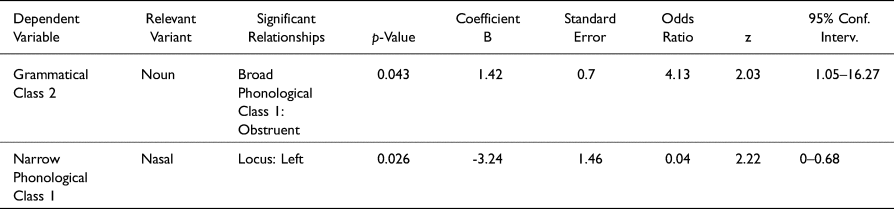
aFor these tests, when a scriptal variable was the dependent variable, only Broad Phonological Class 1 was used as a phonological variable. In cases where locus of 22A is the dependent variable, the unchecked instances were omitted (N = 122). Statistical significance involves p-values <0.05.
An important result of Table 5 is that when the media and region variables are both tested as independent variables for a relationship with a scriptal or linguistic variable as a dependent variable, it is only the former (media) that appears to be an important predictor. Starting with scriptal factors, it can be observed, regarding the Function variable (Table 5a), that the C1VC1 shape-marking function exhibits a significant positive correlation (with Odds Ratio of 7.03) with monumental texts, whereas the duplication function exhibits a significant negative correlation with monumental texts. In addition, regarding the grapheme type variable (Table 5b), the results indicate that logograms are positively correlated with monumental media (Odds Ratio of 4.47), whereas syllabograms are negatively correlated with monumental media. These results are likely related, given that the C1VC1 shape-marking function applied to logograms (e.g., 2K'AK’ and 2TZUTZ). Consequently, it is no surprise that both are positively correlated with monumental media. The following hypothesis can be proposed on the basis of these results:
Hypothesis 7: Scribes favored the application of 22A with C1VC1-shaped logograms on monumental media from the beginning, and consequently, such practice may have been perceived as formal and prestigious.
Finally, when tested for a relationship with the media and region variables, Grammatical Class 2 (nouns vs. verbs vs. grammatical morphemes)—specifically the noun category—shows a significant negative correlation with monumental media (Table 5c). This is probably due to the already mentioned overrepresentation of nouns with respect to verbs: because all the cases of verbs that take 22A occur on monumental media, and because nouns that take 22A occur on both monumental and portable media, the apparent negative correlation between nouns and monumental media probably has more to do with the absence of cases of 22A applying to verbs on portable media.
Table 6 summarizes fewer significant results. Table 6a suggests that the left locus of 22A is negatively correlated with nasals (Narrow Phonological Class 1). Regarding Grammatical Class 2, Table 6b points to a positive correlation between nouns and obstruents (Broad Phonological Class 1).
22A and the lexicon
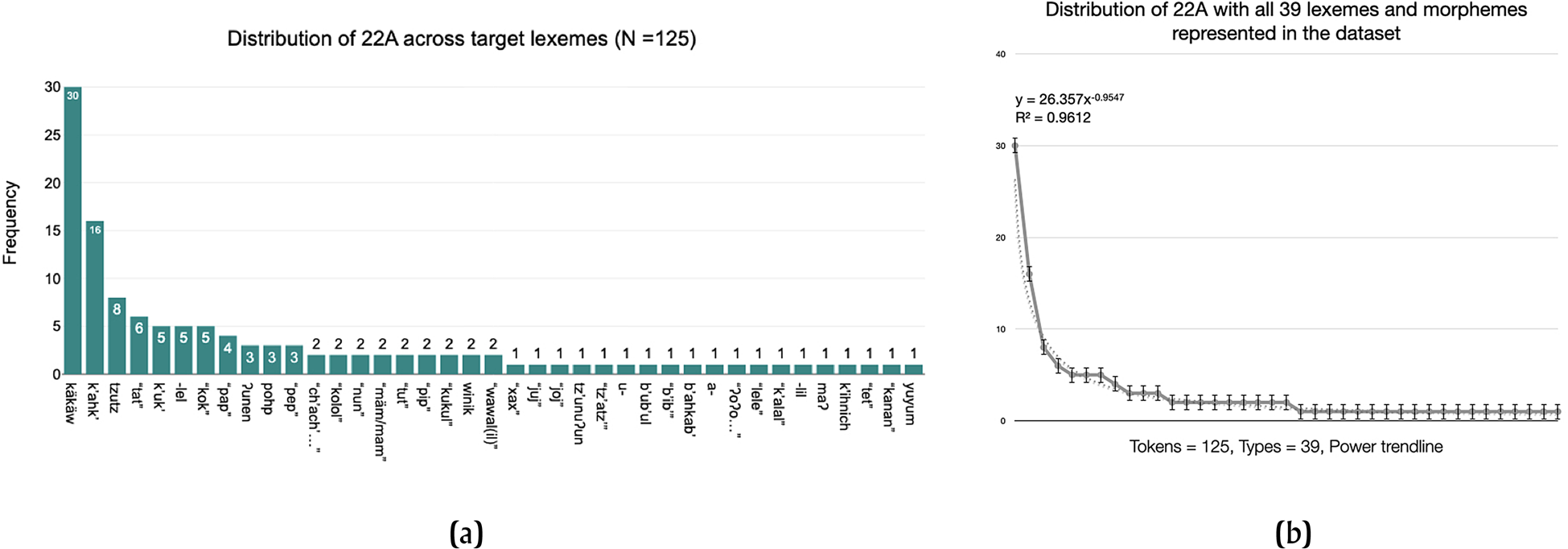
Another interesting question pertains to the distribution of 22A with respect to the lexicon. The data set of 125 examples (tokens) includes 39 distinct lexemes and grammatical morphemes (types). Figure 12a presents the frequencies of all 39. The frequencies can be best described in terms of a power trendline (R2 = 0.9612), as in Figure 12b: the most frequent target of 22A, käkäw, is roughly twice as frequent as the second most frequent, k'ahk’, which is roughly twice as frequent as the next most frequent, tzutz, and so on.
Lexical distribution of 22A. (a) Distribution of all 39 lexemes and grammatical morphemes. Prepared with DATAtab (DATAtab Team Reference Team2022). (b) Linear model (power trendline) of distribution of 22A among all 39 types.
Also interesting is whether one can predict how many spellings (tokens) of a lexeme or morpheme (type) will take 22A. Given that the majority of instances of 22A apply to syllabograms with the function of duplicating their reading, I have opted to focus on such instances only. Figure 13 provides a tentative answer: it shows a close agreement between the linear (Figure 13a) and polynomial solutions (Figure 13b). Because of this close agreement, the following linear equation should suffice: x = (y - 8.5675)/13.183. For example, the number of instances of käkäw in the MHD is 384; hence, x = (384 - 8.5675)/13.183 = 28.5. This is close to the actual number of cases of with käkäw attested with 22A (30). The much more complex and precise polynomial equation yields x = 29.98361, but this equation is less practical.
Linear relationships between overall attestations with syllabograms as targets and frequency of use of 22A. (a) Linear trendline. (b) Polynomial trendline. Prepared with Apple Numbers.

Revisiting käkäw ‘cacao’
It is worth repeating the observation (cf. Figure 12a) that the most frequent use of 22A involves the käkäw expression, with 30 out of 125 examples, or 24 percent. This observation calls for testing to what extent cases of käkäw dominate the use of 22A according to temporal distribution. A chi-square test was conducted to compare the observed and expected frequencies of käkäw spellings with 22A against those of all other lexemes in the data set with respect to period (Early Classic, Late Classic). The results (Table 7a) point to a statistically significant relationship, characterized by an overrepresentation of 22A applied to käkäw during the Early Classic period, with 15 observed attestations, but 6.72 expected attestations. At the same time, it is underrepresented in the Late Classic period, with 15 observed attestations, but 23.28 expected attestations. This is especially striking when one considers that, overall, the MHD contains about 300 spellings of käkäw during the Classic period, 49 of which date to the Early Classic, and 251 of which date to the Late Classic. In other words, 30.6 percent of käkäw spellings during the Early Classic bear 22A, whereas only 5.9 percent of käkäw spellings during the Late Classic period do. The results summarized in Table 7b support the proposition that such difference is significant.
Summaries of statistical tests relevant to use of 22A with käkäw, Part 1.
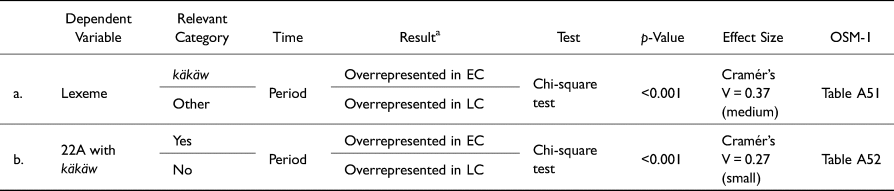
a EC = Early Classic, LC = Late Classic.
Consequently, it is worth repeating that käkäw is the most frequent target of 22A overall. This is remarkable for two reasons. First, the use of 22A with käkäw starts early, perhaps earlier than for any other proven example of 22A. In fact, based on ceramic styles, some of the inscribed pots with 2ka-wa may predate the earliest dated occurrence of 22A on Tikal Stela 31 (a.d. 445) by as much as two centuries, as in the case of a lidded tripod vessel, catalog #109 in (Fields and Reents-Budet Reference Fields and Reents-Budet2005:215), estimated to approximately a.d. 250–400. And second, given the likely motivation for the use of TWO as a duplication diacritic—based on proto-Mayan *kaʔ= ‘two’, which is also typically used to mean 'again' or 'twice' when incorporated as an adverbial modifier with a verb (e.g., Yucatec Maya kaʔa súunajen ‘I returned again’) or combined with a numerical classifier for ‘times’ (e.g., Yucatec Maya kaʔa=téen ‘two times’ and kaʔa=máal ‘twice’) (Bricker et al. Reference Bricker, Poʔot Yah and Dzul de Poʔot1998:120–121, 273)—it seems that käkäw would have been an ideal first target for 22A because of its /C1V1C1V1w/ structure. Unlike a large number of instances where 22A calls for duplication, in which the result is a /C1VC1/ sequence requiring that the vowel of the syllabogram not be read “aloud” the second time (e.g., tz'u-nu2 for tz'unun ‘hummingbird’), with käkäw, the duplication triggered by 22A requires that the vowel be read “aloud” the second time, allowing for a simpler, more straightforward application (with no special “fictitious vowel” rule needed). In other words, the coincidence of ideal structure for the application of 22A, the chronological priority in its demonstrated use of 22A, and the significant overrepresentation during the Early Classic of 22A with käkäw all support the possibility that käkäw may have been 22A's first target—the lexeme that motivated its innovative use as a duplication diacritic—or at the very least, that it may have been quickly regarded by scribes as the prototypical target of 22A.
What would happen if käkäw were removed from the data set? Would there be evidence for a possible influence of its phonological traits (obstruent, stop, nonglottalic), suggesting that the early, frequent use of 22A with käkäw could in fact have had an impact and served as a type of prototype for extension of 22A to spellings of other lexemes? Recall that the variable categories obstruents, stops, and plain stops appear to be significantly earlier than other consonant types (Tables 4b, 4c, 4e, 4f, 4g, 4h). To test this possibility, several tests were carried out, and they are summarized in Table 9. As far as Broad Phonological Class 1 is concerned, the data set with reliably dated texts (minus those with käkäw) shows a significant difference (Table 8a), supporting the earlier use of 22A with obstruents. Similarly, the data set with all reliably dated texts (minus those with käkäw) shows a statistically significant difference across Narrow Phonological Class 1 (manner) categories (Table 8b) and supports the earlier use of 22A with stops, and the distinction between stops and liquids, with stops exhibiting lower mean values. Finally, the data set with all reliably dated texts (minus those with käkäw) shows a statistically significant difference across Broad Phonological Class 2 (plain vs. glottalic obstruents) categories (Table 8c) and supports the earlier use of 22A with plain stops, which exhibit lower mean values.
Summaries of statistical tests relevant to use of 22A with käkäw, Part 2: Removal of käkäw from data set.
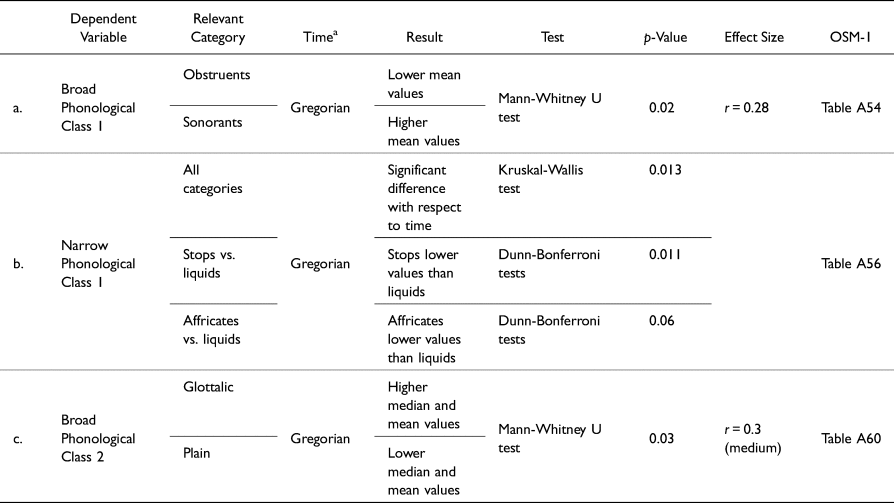
a Gregorian = Gregorian calendar years.
Given the results just presented, and recalling that käkäw is an obstruent/plain/stop-initial lexeme, and that it is overrepresented on portable media, the following hypothesis can be proposed:
Hypothesis 8: 22A may have been initially applied with significant frequency to käkäw, resulting in the use of 22A, with this target becoming a phonological prototype for scribes, which led to the preferential application of 22A to duplicate syllabograms with initial obstruent/plain/stops, especially on portable media, during the Early Classic.
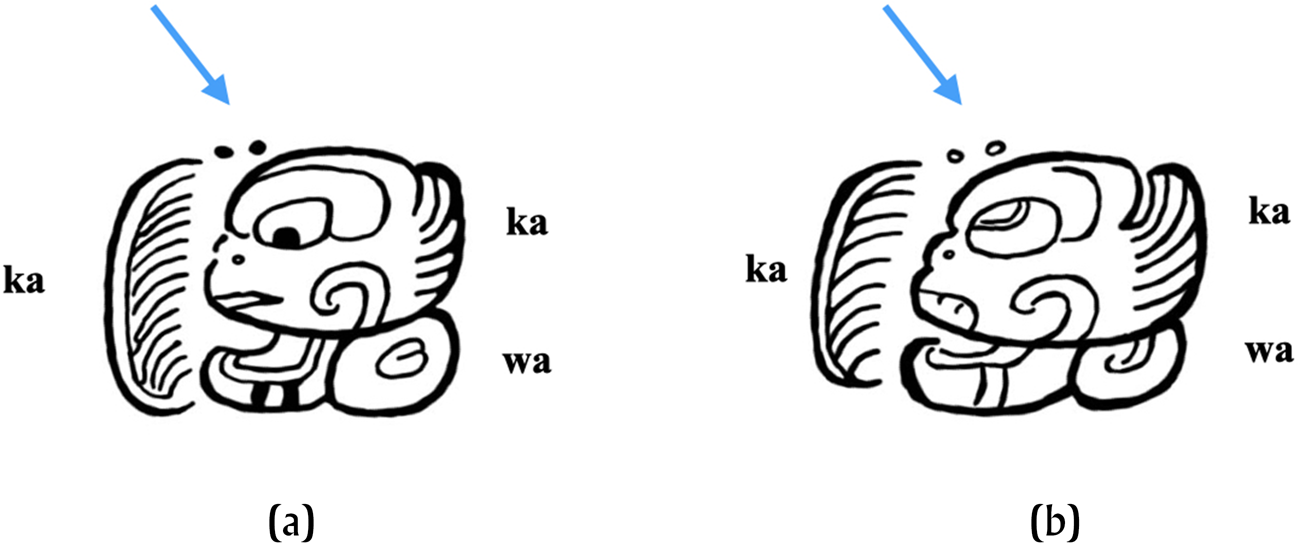
An interesting example of 22A applied to käkäw is seen in two Early Classic spellings of käkäw from Rio Azul (Figure 14)—more specifically, from the famous lock-top cacao pot (Stuart Reference Stuart1988). The spellings (Figures 14a–b) are rendered as ka-2ka-wa. This spelling obviously seems redundant, and as noted at the beginning of this article, the MHD does not even code the presence of 22A in these examples (or it did not when I prepared the data set). Nevertheless, it is worth not only commenting on but also speculating about. This spelling could suggest that the use of 22A was common enough by this time, at least in spellings of käkäw, that scribes were beginning to see it as a fixed component of the spelling—in fact, as a type of lexical determinative (recall examples in Figure 2) for the term käkäw (Justeson, personal communication, 2022)—perhaps to distinguish it from other possible terms that could be spelled with a sequence ka-wa or even ka-ka. If so, then the spelling ka-2ka-wa could be analyzed as (ka-)[KAKAWka-wa], with the initial ka- functioning as a phonetic complement (and 22A transliterated as superfixed KAKAW to indicate its lexical determinative function). If additional cases of 22A functioning in this manner were found, they could allow for the definition of yet another function, a fifth function (lexical determinative) of 22A.
Examples of seemingly superfluous 22A. (a) Glyph C on RAZV15. (b) Glyph F on RAZV15. Drawing by author (after drawings by Stuart Reference Stuart1988:153–157, Figure 30).
An alternative is that, by this point, the spelling 2ka-wa may have been so common that some scribes may have begun to think of it as a (pseudo-)logographic spelling—one that could take a phonetic complement—which would explain the seemingly unnecessary ka syllabogram preceding it. This would be consistent with Zender's (Reference Zender1999:122–123) suggestion that in the context of pottery vessels, at least, the ka syllabogram by itself (or in conjunction with 22A) may have been understood as a type of logogram for KAKAW. In this way, the spelling ka-2ka-wa could be analyzed as follows: (ka-)KAKAW. This is consistent with other instances in which syllabic or logosyllabic spellings have been observed to function as (pseudo-)logograms (cf. Bricker Reference Bricker1986; Mora-Marín Reference Mora-Marín2010; Tokovinine and Davletshin Reference Tokovinine and Davletshin2001; Zender Reference Zender1999) in a process that Matsumoto (Reference Matsumoto2017) has referred to as “orthographic semantization.”
The C1VC1 shape–marking function and k'ahk’ ‘fire’
It is a worthwhile exercise to review the question of the C1VC1 shape-marking function of 22A. As was mentioned before, lexical roots and stems with C1VC1 shapes are relatively rare: 5.3 percent of the approximately 813 etyma reconstructed to proto-Ch'olan and, more specifically, five adjective roots, six transitive verb roots, 31 noun roots, and one verbal noun root. Given that the duplication function of 22A is empirically the earliest attested function, even if the difference among the four proposed functions is not significant statistically; given that such function is also by far the most frequent function of 22A; and given that such function results in sequences of the shape /C1VC1(V)/, it is likely that one of the following two processes took place:
(1) Scribes began to spell k'ahk’ and tzutz with 22A applied to the relevant CV syllabogram (i.e., 2k'a for k'ahk’, 2tzu for tzutz), and soon after, they extended the use of 22A to the logographic spellings of such roots.
(2) Scribes began to apply 22A directly to logograms based on roots of the shape C1VC1 by analogy with the general duplication function of 22A, which results in phonological /C1VC1…/ shapes, without necessarily spelling such sequences phonographically with 22A first (i.e., 2C1V).
The question now is whether the temporal distribution of 22A with spellings for ‘to finish' and ‘fire' favors either scenario. As it turns out, cases of 22A applying to logographic allograms (MR6, AW3) with the value TZUTZ for ‘to finish', as well as the logogram ZBBa K'AK’ for ‘fire', precede instances in which 22A is applied to the syllabogram that would allow for the spelling of the root —ZT1s tzu or MZ2 k'a, respectively. In the former case, the difference is not great: the earliest spelling of tzutz as 2TZUTZ only precedes the earliest as 2tzu by 23 years. However, the earliest spelling of k'ahk’ as 2K'AK’—though not reliably dated and only assigned an estimated dating of approximately 9.3.0.0.0 (ca. a.d. 495)—does precede the earliest spelling as 2k'a by well over a century and perhaps close to two centuries.
Still, I decided to test these dated texts to see whether there is a statistically significant difference between them with respect to time, both with and without the estimated date of circa a.d. 495 for the earliest example of 2K'AK’. This involved testing only cases of 22A applying to k'ahk’ and tzutz to determine whether cases of 22A applied to syllabographic spellings are significantly earlier than those applied to logographic spellings. Although the syllabic targets do exhibit lower mean and median values (a.d. 716, a.d. 692) than the logographic targets (a.d. 719/737.67, a.d. 738/744.5), the results—summarized in Tables 9a and 9b—of two Mann-Whitney U tests applied to all dated texts (N = 86) and to all reliably dated texts (N = 74) suggest that the answer is negative.
Summaries of results of Mann-Whitney U tests applied to cases of 22A with k'ahk’ and tzutz spelled logographically or syllabographically.a

a Relationship of time (Gregorian, period) to dependent variables in texts with 22A: significant results.
b Gregorian = Gregorian calendar years.
This means that both scenarios remain viable, and of the two, I would favor the first scenario, which predicts that spellings such as 2k'a and 2tzu should precede spellings such as 2K'AK’ and 2TZUTZ. This leads to the following hypothesis:
Hypothesis 9: Scribes began to apply 22A to the relevant CV syllabogram (i.e., 2k'a for k'ahk’, 2tzu for tzutz) to spell k'ahk’ and tzutz before extending its use to the logographic spellings of such roots; findings of 2k'a and 2tzu temporally preceding cases of 2K'AK’ and 2TZUTZ should be expected in the future.
Finally, given that k'ahk’ is the second most frequent lexeme taking 22A, it would be interesting to know whether it may have exerted an influence similar to that of käkäw on scribal preferences. Given that it is an obstruent and a stop, like the initial consonant of käkäw, the only way to distinguish its possible influence from that of käkäw would be in terms of the glottal stricture feature: Broad Phonological Class 2 (glottalic vs. plain). First, all instances of k'ahk’ were removed from the data set, and then statistical tests were carried out on all reliably dated texts (minus those with k'ahk’), and to all dated texts (minus those with k'ahk’), including those dated stylistically. The results are summarized in Table 10.
Summaries of results of Mann-Whitney U tests applied to cases of 22A according to Glottalic/Plain consonantal target, excluding k’ahk’.a

a Relationship of time (Gregorian, period) to dependent variables in texts with 22A: significant results.
b Gregorian = Gregorian calendar years.
As far as Broad Phonological Class 2 is concerned, the data set with reliably dated texts (minus those with käkäw) does not show a significant difference between glottalic and plain obstruents (Table 10a). Nevertheless, the data set with all dated texts (minus those with käkäw), including a few dated stylistically, shows a statistically significant difference between Broad Phonological Class 2 categories (Table 10b) and supports the possibility that glottalic obstruents (stops, affricates) can be significantly distinguished from their plain obstruent counterparts (stops, affricates), with cases of 22A applied to glottalic targets being later than plain targets. Consequently, the following more tentative hypothesis can be proposed for future testing:
Hypothesis 10: k'ahk’ may have served as a second prototype, after käkäw, possibly influencing scribes in the application of 22A to lexemes with initial glottalic consonants over time.
Discussion: The evolution of 22A
It is now possible to review the results and hypotheses and to elaborate a model that explains the development of 22A.
(1) 22A originated in the logogram TWO (proto-Mayan *kaʔ=, proto-Ch'olan *chaʔ=), as originally proposed by Stuart (Reference Stuart2014), probably during the Late Preclassic (300 b.c.–a.d. 200) or early Early Classic (a.d. 200–600) period.
(2) Its initial function was likely the sequential duplication function, not only because it is the most frequent by far of all four functions but because the other three functions (nonsequential duplication, C1VC1 shape marking, abbreviation) can be explained as analogical extensions based on it. The overall chronological distribution also suggests this, even if the statistical tests with dated texts did not point to a significant difference. The origin of this diacritic in the logogram for TWO also supports this, as the term for ‘two' can also mean ‘twice' or ‘again' in the spoken Mayan languages.
(3) It is likely that käkäw became the most frequent early target of 22A and, as a result, became a functional (sequential duplication), contextual (portable media), grammatical (noun), phonological (obstruents, stops), orthographic (syllabogram), and positional (left locus) prototype for the use of the 22A in general.
(4) The lexeme k'ahk’ ‘fire', the second most frequent lexeme to take 22A, may have become a second prototype for the use of 22A, leading to the extension of the sequential duplication function of 22A to logograms with C1VC1 shapes (tzutz, k'ahk’, kuk), but it remains to be seen whether such application preceded explicit phonetic spellings of such roots.
The absence of 22A in the Postclassic codices suggests the possibility that 22A was employed too infrequently, overall, to survive what might have been a significant bottleneck effect at the end of the Classic period, when text production dropped drastically. It would be worth comparing this decline and cessation to other Classic-period traits that similarly did not survive into the Postclassic period. Perhaps, alternatively, as a result of a bottleneck effect at the end of the Classic period, only one regional scribal subtradition, or a few such subtraditions that already exhibited extremely limited use of 22A (e.g., Northern, Southern, Pasion), continued into the Postclassic period. The obvious choice would be the Northern subtradition, but I suspect that other factors are likely at play.
Conclusions
The most significant conclusion of this article is that the MHD (Looper and Macri Reference Looper and Macri1991–2023) offers many advantages for the study of Epigraphic Mayan, especially for scholars interested in studying broader patterns relevant to the script and its relationship to linguistic and nonlinguistic factors via quantitative methods. If a data set of a mere 125 records can offer insights into the history of Mayan writing, the 5,000 texts and 85,565 records contained within the MHD (which is continually updated) promise to open up new avenues for epigraphic, linguistic, art historical, and archaeological discoveries. This has already been demonstrated by Munson and Macri (Reference Munson and Martha2009), Looper et al. (Reference Looper, Jonathan, Jessica, Yuriy and Martha2015), and Munson et al. (Reference Munson, Scholnick, Looper, Polyukhovych and Macri2016) years prior to the inauguration of the MHD online.
Another important conclusion of this article is that the statistical methods applied to a relatively small data set were useful in discerning patterns of interest for assessing the evolution of an ancient scribal practice, in terms of not only scriptal and linguistic factors but also temporal, geographic, and contextual ones. The following conclusions can be offered:
(1) For the most part, 22A was applied to syllabograms to trigger sequential duplication, supporting the prior literature on the topic (Kettunen and Helmke Reference Kettunen and Helmke2020; Mora-Marín Reference Mora-Marín2022b; Prager Reference Prager2020; Stuart Reference Stuart2014; Stuart and Houston Reference Stuart and Houston1994; Zender Reference Zender1999). This function is more strongly correlated with portable media, both because of the high frequency of use of 22A to duplicate the initial syllabogram in the syllabographic spellings of käkäw on pottery vessels, and due to the fact that the majority of cases that applied to logograms (especially in the spelling of k'ahk’ ‘fire’) occur on monuments.
(2) Four functions of 22A can be supported, with functions (b)–(d) likely derived from (a):
(a) Sequential duplication
(b) Non-sequential duplication
(c) C1VC1 shape marking
(d) Abbreviation punctuation
(3) The most significant temporal, phonological, graphemic, grammatical, and media distribution patterns attributable to 22A can be explained on the basis of its use with käkäw and, to a lesser extent, with k'ahk’.
(4) It is possible to employ the overall incidence of a lexeme or morpheme with a C1VC1 shape in the corpus of texts to estimate the incidence of the application of 22A, characterized by the (practical) linear equation x = (y - 8.5675)/13.183, where y = overall frequency of expression in text corpus.
There are still many questions that can be addressed regarding 22A, including its discontinuation sometime after the end of the Classic period. More examples of 22A undoubtedly remain to be included in the MHD, or remain to be discovered, and a larger database will allow us to discern more patterns and, hopefully, carry out further tests of the hypotheses presented here. Perhaps the more obvious next step would be to prepare a database of the more common lexical targets of 22A (e.g., käkäw, k'ahk’, k'uk’, ʔajawlel), including cases both with and without 22A, to attempt to discern evidence of factors, such as dispersion (position within a text), that may have influenced variable scribal behavior 22A.
Acknowledgments
I am indebted to Matthew Looper for his answers to several crucial questions and comments regarding the MHD and specific examples. I am also grateful to Nick Hopkins, John Justeson, Barbara MacLeod, Gaby Vail, and the rest of the Q&G participants, for their comments and feedback during and following a presentation on this topic in September 2022. Special thanks to Søren Wichmann for extremely helpful observations and comments on a more recent version of my manuscript. Finally, I want to express my gratitude to the anonymous reviewers, whose feedback allowed me to fill in some important gaps, and to the editorial staff at Ancient Mesoamerica for their guidance and patience.
Data availability statement
All data are available as supplementary online materials.
Supplementary Material
To view supplementary material for this article, please visit https://doi.org/10.1017/S0956536123000317
Supporting information.
Appendix 1.
Appendix 2.
Appendix 3.



