Infants’ initial skills in producing and understanding language do not always reflect their eventual linguistic success. Before the age of 2, some toddlers may only know a dozen words, while others might already have a vocabulary of several hundred words, some of which they can combine into phrases (e.g., Fenson et al., Reference Fenson, Dale, Reznick, Bates, Thal and Pethick1994, Reference Fenson, Marchman, Thal, Dale, Reznick and Bates2006). Many late-talking toddlers catch up with their peers by the age of 3 to 4 years (Dale, Price, Bishop, & Plomin, Reference Dale, Price, Bishop and Plomin2003; Rescorla & Lee, Reference Rescorla, Lee, Layton and Watson2000), but some late talkers go on to experience continuing language delay (e.g., Rescorla, Reference Rescorla2009). It has been traditionally difficult to effectively identify these children early. Knowing more about early predictors of language development will inform theoretical models of language development (Newman, Bernstein Ratner, Jusczyk, Jusczyk, & Dow, Reference Newman, Bernstein Ratner, Jusczyk, Jusczyk and Dow2006; Reilly et al., Reference Reilly, Wake, Bavin, Prior, Williams and Bretherton2007) and enhance outcomes associated with early intervention (e.g., Bernhardt & Major, Reference Bernhardt and Major2005). Previous researchers have examined infants’ online performance on speech-based tasks, and also parental reports of their children's language development. The aim of the present study was to assess the extent to which infants’ performance on the switch task of word–object correspondence (Stager & Werker, Reference Stager and Werker1997) could predict, and/or help explain, progress in language development up to the age of 3 years. As such, we also considered how this predictive value could compare with, or add to, the value of parental reports of vocabulary on the MacArthur–Bates Communicative Development Inventory (CDI; Fenson et al., Reference Fenson, Dale, Reznick, Bates, Thal and Pethick1994).
A growing number of studies have shown that core indices of early language acquisition can predict later aspects of linguistic development. For example, later vocabulary size and/or language skills have been linked with early abilities in phonological memory (Hoff, Core, & Bridges, Reference Hoff, Core and Bridges2008; Parra, Hoff, & Core, Reference Parra, Hoff and Core2010) and phonetic perception, both retrospectively (Molfese & Molfese, Reference Molfese and Molfese1997) and prospectively (Molfese, Reference Molfese2000; Tsao, Liu, & Kuhl, Reference Tsao, Liu and Kuhl2004), and specifically for native contrasts (Kuhl, Conboy, Padden, Nelson, & Pruitt, Reference Kuhl, Conboy, Padden, Nelson and Pruitt2005). Infants who were better at segmenting words from the speech stream before the age of 12 months (Newman et al., Reference Newman, Bernstein Ratner, Jusczyk, Jusczyk and Dow2006), 10 months (Junge, Kooijman, Hagoort, & Cutler, Reference Junge, Kooijman, Hagoort and Cutler2012), and even 7.5 months (Singh, Reznick, & Xuehua, Reference Singh, Reznick and Xuehua2012) have shown larger vocabularies at age 2 years. Newman et al. noted further that a subset of their participants showed higher scores on a range of language skills even at the age of 4–6 years. It is presumed that all of these subskills (in phonological working memory, phonetic perception, and segmentation) contribute to the language-learning process.
However, successfully learning language eventually requires the higher level combining of subskills. One such subskill involves learning to associate an object with an auditory label. This is an important first step in acquiring words and their meanings, and is tested in the habituation-based switch task (Stager & Werker, Reference Stager and Werker1997; Werker, Cohen, Lloyd, Casasola, & Stager, Reference Werker, Cohen, Lloyd, Casasola and Stager1998; Werker, Fennell, Corcoran, & Stager, Reference Werker, Fennell, Corcoran and Stager2002). In this task, infants are habituated to two word-visual object pairings, and then shown a “switched” combination, in which one of the words is paired with the other object. Infants who look longer at this switch trial are presumed to have detected the change, and thus to have learned the original pairings. The standard switch task uses phonetically distinct labels (lif, neem) to assess infants’ ability to associate a word with an object. Such associations can be learned by infants of 14 months of age, as a group (Werker et al., Reference Werker, Cohen, Lloyd, Casasola and Stager1998) or, with other phonetically distinctive labels, even at 12 months of age (Mackenzie, Curtin, & Graham, Reference Mackenzie, Curtin and Graham2012; MacKenzie, Graham, & Curtin, Reference MacKenzie, Graham and Curtin2011).
A second important subskill involves being able to use the phonetic distinctions that have phonological significance in the native language to guide this associative word learning (Dietrich, Swingley, & Werker, Reference Dietrich, Swingley and Werker2007). Performance on the switch task varies in part by the salience and phonological relevance of the ways in which the two words differ. When extended to the learning of words that differ in stress (strong–weak bisyllabic words vs. weak–strong ones), infants succeed by 12 months of age (Curtin, Reference Curtin2009). However, when the switch task is extended to test infants’ attention to phonetic detail, by using labels that form a minimal pair, success is typically seen at a later age. For example, the nonwords bih and dih differ in only one phonetic feature: the place of articulation of the first sound. Although infants of 14 months can perceptually discriminate bih and dih, when given this minimal pair version of the switch task, they fail, as a group, to learn these word–object associations (Jusczyk & Aslin, Reference Jusczyk and Aslin1995; Stager & Werker, Reference Stager and Werker1997; Werker et al., Reference Werker, Fennell, Corcoran and Stager2002). Such difficulty, however, is short-lived. At 17 and at 20 months, arguably once a more stable phonological system is established (Werker & Curtin, Reference Werker and Curtin2005), infants can pass the minimal pair version of the switch paradigm (Werker et al., Reference Werker, Fennell, Corcoran and Stager2002), although with some longer nonwords, success with minimal pairs has been seen even in 14-month-olds (Archer, Ference, & Curtin, Reference Archer, Ference and Curtin2014).
Thus, it appears that by at least 17 months, and sometimes younger, infants can form associative links between words and their referents, while making use of fine phonetic detail. The extra cognitive demands of distinguishing this phonetic detail before a stable phonological system is in place, added to the work of associating the objects with their labels, seem to explain why the minimal pair switch task is more challenging than the standard (lif, neem) version. This suggestion is supported by the finding that reducing a task's processing demands (Fennell & Werker, Reference Fennell and Werker2003) or providing additional experience with spoken labels (Thiessen, Reference Thiessen2007) results in access to fine phonetic detail even by 14-month-olds, in habituation tasks and in preferential looking tasks with reduced memory demands at the recognition stage (Ballem & Plunkett, Reference Ballem and Plunkett2005; Yoshida, Fennell, Swingley, & Werker, Reference Yoshida, Fennell, Swingley and Werker2009).
Of interest, even in the standard minimal pair version of the switch task, those infants aged 14 months who have larger vocabularies are able to use phonetic detail to guide word learning (Werker et al., Reference Werker, Fennell, Corcoran and Stager2002). However, not all studies have shown a relationship between word recognition ability and word knowledge. Some studies of 14- to 24-month-old infants’ latency to look to a matching picture in response to a familiar label and a similar mispronounced distractor label (e.g., baby–vaby) have shown that although infants are sensitive to such mispronunciations (in terms of looking latency), this sensitivity is not related to the size of their production and/or comprehension vocabularies (e.g., Ballem & Plunkett, Reference Ballem and Plunkett2005; Swingley & Aslin, Reference Swingley and Aslin2000, Reference Swingley and Aslin2002). In contrast, preferential looking tasks of real-word recognition have revealed significant relationships with vocabulary size. Zangl, Klarman, Thal, Fernald, and Bates (Reference Zangl, Klarman, Thal, Fernald and Bates2005) showed a significant relationship with vocabulary for infants of 12 to 31 months, even when the familiar words were distorted through compression or filtering. Similarly, Fernald, Swingley, and Pinto (Reference Fernald, Swingley and Pinto2001) found that infants aged 18 and 21 months with larger vocabularies were more efficient at recognizing familiar whole words and parts of words in a “looking while listening” task, and that this word recognition efficiency predicted more accelerated growth in vocabulary up to 25 months (Fernald, Perfors, & Marchman, Reference Fernald, Perfors and Marchman2006). More recently, Fernald and Marchman (Reference Fernald and Marchman2012) reported that this relationship held also for late talkers, even when followed to age 30 months. Specifically, infants whose vocabulary size was below the 20th percentile at 18 months of age were more likely to show vocabulary size above the 20th percentile at 30 months if they had, at 18 months, been more efficient at recognizing familiar word stimuli in the looking while listening task.
The minimal pair switch task does not assess infants’ ability to recognize or discriminate words that they already know. Rather, it measures the ability to associate newly learned words with new objects at the time of testing. Thus, because the minimal pair switch task can index the ability to combine phonological knowledge with the ability to make arbitrary word–object associations, we expect to see early success on this task reflected in success on concurrent and later language-based tasks. Furthermore, there is some evidence for this. Ference and Curtin (Reference Ference and Curtin2015) used a version of the switch task in which the stimuli were bisyllabic words differing in syllable stress (strong–weak vs. weak–strong). They found that in this relatively easy version of the switch task, performance at 12 months predicted vocabulary size at 24 months in infants who had an older sibling diagnosed with autism. Further, Bernhardt, Kemp, and Werker (Reference Bernhardt, Kemp and Werker2007) showed that performance on the phonetic minimal pair version of the switch task (bih–dih) by infants of 17 or 20 months significantly correlated with their scores on standardized tests of language production and comprehension, up to 2.5 years later. The early ability to use phonological contrasts to guide word learning might in turn have facilitated the more rapid acquisition of later vocabulary.
A more common way to measure infants’ word-learning ability is to count the number of words that an infant understands or produces (i.e., to take an offline measure of words already acquired). A well-known measure of early vocabulary development is the CDI (Fenson et al., Reference Fenson, Dale, Reznick, Bates, Thal and Pethick1994), a parental-report measure of children's comprehension and production vocabulary size (and some aspects of verb use). Parents with fewer years of education and lower socioeconomic status tend to overestimate the number of words that their children can understand (Feldman et al., Reference Feldman, Dollaghan, Campbell, Kurs-Lasdy, Janosky and Paradise2000; Fenson et al., Reference Fenson, Dale, Reznick, Thal, Bates and Hartung1993; Thal, O'Hanlon, Clemmons, & Fralin, Reference Thal, O'Hanlon, Clemmons and Fralin1999; Tomasello & Mervis, Reference Tomasello and Mervis1994). However, parents of a variety of educational and income backgrounds (Feldman et al., Reference Feldman, Dollaghan, Campbell, Kurs-Lasdy, Janosky and Paradise2000) appear to be relatively accurate at documenting the words that their children say (Dale et al., Reference Dale, Price, Bishop and Plomin2003; Ring & Fenson, Reference Ring and Fenson2000), even those children with delayed language development (Thal et al., Reference Thal, O'Hanlon, Clemmons and Fralin1999). The CDI is thus a reliable measure of children's early productive vocabulary. Further, there is evidence of moderate continuity between early and later measures over small age ranges, with stable scores between 13 and 16 months (Tsao et al., Reference Tsao, Liu and Kuhl2004), and even 13 and 20 months (Fenson et al., Reference Fenson, Dale, Reznick, Bates, Thal and Pethick1994). The CDI appears to be a less reliable predictor of later language development over longer periods; for example, parents’ reporting of CDI scores does not always remain consistent up to 24 months (Tsao et al., Reference Tsao, Liu and Kuhl2004). Beyond age 2, in typically developing children, vocabulary size between 18 and 24 months is modestly or reasonably correlated with vocabulary and later language skills at ages 3 and 4 years (Dale et al., Reference Dale, Price, Bishop and Plomin2003; Feldman et al., Reference Feldman, Dale, Campbell, Colborn, Kurs-Lasky and Rockette2005), but the trajectory for late talkers is less stable (Fernald & Marchman, Reference Fernald and Marchman2012; Thal et al., 1997). Thus, on its own, parent-estimated vocabulary size is a reasonable but imperfect predictor of later language skills, especially for children whose language is developing slowly. However, it is not suitable for children above the age of 3 years. Further, with its primary focus on vocabulary, the CDI does not assess more general aspects of language development.
As children's language develops, two other major areas to consider are morphosyntax and phonology. Morphosyntax typically develops rapidly after age 2 and into the early school years. English-speaking children with specific language impairment (SLI) often have difficulty with acquisition of syntactic relations and grammatical morphemes (Bishop, Reference Bishop1997; Chiat, Reference Chiat2001), and late talkers may also show such delays. Much of the focus in morphosyntactical development is on the structural underpinnings such development provides, and yet even here, the infant must map word forms to meanings. Function words are an important component of morphosyntactical development, and across the first year of an infant's life, underlying phonological representations of function words become more precise, with precision emerging earliest for those function words that are the most frequent in the input (for a review, see Shi, Reference Shi2014).
In early phonological development, when the phonetic specification of both function and content words is increasing as indicated by tasks of speech perception, toddlers’ articulation skills are limited (e.g., Vihman, Reference Vihman1996). Yet in production as well, the pronunciation of both word structure and phonemes becomes more accurate with age (Schmitt, Howard, & Schmitt, Reference Schmitt, Howard and Schmitt1983). However, for children with language delay or SLI, phonological skills may be later developing: children with SLI may produce fewer phonemes and find it more difficult to articulate complex syllables than their typically developing peers (Paul & Jennings, Reference Paul and Jennings1992; Rescorla & Ratner, Reference Rescorla and Ratner1996). The switch task crucially associates phonological form with “word” meaning in a task that contrasts minimal phonetic distinctions: it tests both phonology and semantics and their association. The phonologically adept child will respond to those distinctions and notice switches. The phonologically less adept child may overlook, misperceive, or fail to notice such distinctions. Such inability to notice fine distinctions, especially as word forms become increasingly complex, may result in a lack of differentiation of phonetic form by word meaning, especially as the child attempts to produce more phonologically complex words (e.g., Ingram, Reference Ingram1981; Shiller, Rvachew, & Brosseau-Lapré, Reference Shiller, Rvachew and Brosseau-Lapré2010). Thus, the switch task has potential to identify children who are adept and less adept at the mapping of form to meaning. (For further discussion of the relationship between lexical and phonological development, see Stoel-Gammon, Reference Stoel-Gammon2011)
In sum, a range of early linguistic skills have been shown to be related to a variety of aspects of later language development. The early ability to acquire vocabulary seems to indicate a later ability to acquire further words, but this relationship requires further investigation. It is especially important to study the component skills needed in language acquisition, and to consider not only growth in vocabulary but also in phonology and morphosyntax. As discussed above (and as indicated in Bernhardt et al., Reference Bernhardt, Kemp and Werker2007), we suggest that the component skills required to succeed on the minimal pair switch task coincide with the skills required to acquire language efficiently.
THE PRESENT STUDY
In the current study, we investigated the predictive value of infants’ switch task performance, in addition to their parent-reported vocabulary, for their language development up to the age of 3 years. We invited a larger and more diverse range of participants than in previous studies (including Bernhardt et al., Reference Bernhardt, Kemp and Werker2007) and assessed a range of standardized and nonstandardized language measures. In order to begin with a relatively wide range of language ability, we included in our sample infants at higher risk for language impairment because of family history of language impairment, often an important risk factor (Beitchman, Hood, & Inglis, Reference Beitchman, Hood and Inglis1992; Felsenfeld & Plomin, Reference Felsenfeld and Plomin1997). We acknowledge that children diagnosed with language impairment likely fall on a continuum of normally distributed language skills, with some being closer to the lower end on multiple dimensions of language (e.g., Rescorla, Reference Rescorla2009), and that being at higher risk does not necessarily mean that language impairment will result. We also included children from a wider range of both urban and rural populations than the usual populations for university-based studies.
We first collected data from children who were mainly aged 18–20 months (with an overall range of 16–24 months). In Phase 1, we assessed performance on the minimal pair switch task, and their concurrent language performance (including vocabulary and morphosyntax) as measured on the CDI and the Preschool Language Scale—Fourth Edition (PLS-4; Zimmerman, Steiner, & Pond, Reference Zimmerman, Steiner and Pond2002). We followed up these infants when they turned 27 months old (Phase 2), by asking parents to again estimate their children's vocabulary on the CDI. In Phase 3, when children turned 3 years old, we assessed their general language skills on the PLS-4, and their more specific phonological skills on the Computerized Articulation and Phonology Evaluation System (CAPES; Masterson & Bernhardt, Reference Masterson and Bernhardt2001). We examined the concurrent and predictive links between Phase 1 minimal pair switch task performance and CDI productive vocabulary size, and the later tasks.
It was predicted that the extent of preference for switch over same test trials would be significantly and positively correlated with concurrent and later measures of productive vocabulary size (CDI), and of the broader language comprehension and production skills measured by the PLS-4 subscales, as well as later articulation skills. As a partial replication of Bernhardt et al. (Reference Bernhardt, Kemp and Werker2007), we planned to investigate whether children who preferred the switch trial most strongly would show a different pattern of results from the other participants. Because of the moderate stability seen in the relationship between earlier and later vocabulary size and other language skills, it was also predicted that the number of words that infants could produce at Phase 1 (as measured on the CDI) would also be significantly and positively correlated with scores on the later language tasks at Phases 2 and 3.
Conclusions drawn from infants’ performance on the switch task, as from any task of habituation, are vulnerable to variation in infants’ performance on the day of testing. However, as noted earlier, a parent's estimation of his or her child's productive vocabulary is generally quite reliable (Dale et al., Reference Dale, Price, Bishop and Plomin2003). Thus, in our more exploratory analyses, we also assessed whether the combined predictions of an offline estimate of accumulated knowledge (CDI) and an online, dynamic measure of children's component language acquisition skills (the switch task) would be related to later linguistic skills.
METHOD
Phase 1
Participants
The initial participants were 64 infants (28 boys, 36 girls), with a mean age of 19.25 months (SD = 1.67). The majority (75%) were aged 18–20 months, but the overall range was from 16 to 24 months. The infants, and their parents who volunteered to participate, were from urban and rural parts of British Columbia, Canada, and were recruited through visiting a range of community centers, health centers and library groups. Infants considered “higher risk” had a sibling or parent with a diagnosed or suspected speech/language impairment (n = 25, 11 boys), and infants considered “lower risk” had no such reported family history (n = 39, 17 boys). Even though not every child with a relative with speech/language impairment will turn out to experience later language impairment, this recruitment method was intended to increase the range of risk in participating children. The children came from dual-parent homes where parents reported having from 13 to 23.5 years of education (M = 17.00, SD = 2.31). Infant participants had from 0 to 4 siblings (M = 0.76, SD = 0.93). Only infants exposed to at least 80% English were included. Parents reported that their infants had been born at or within 4 weeks of full term and were currently in good health, and only 18 (28%) had reportedly ever experienced an ear infection. This is important because middle-ear infections can impair phonetic perception (Polka & Rvachew, Reference Polka and Rvachew2005).
An additional 27 infants were tested but excluded because of (a) a tympanometry result suggesting accumulated fluid in the middle ear on the day of testing (n = 6), (b) parent-reported gestation <36 weeks (n = 2), (c) parent-reported exposure to English <80% (n = 7), or (d) a failure to complete the switch task because of fussiness (n = 12). A series of t tests revealed no significant differences between infants who completed/failed to complete the switch task on the (other) Phase 1 tests. Infants received an “Infant Scientist” T-shirt and diploma for participating.
Minimal pair switch task
The switch task was conducted as described below.
STIMULI
The auditory stimuli for the habituation and test trials of the switch task were two low-frequency consonant–vowel–consonant nouns, bin and din, used in previous research (e.g., Pater, Stager, & Werker, Reference Pater, Stager and Werker2004). These words form a minimal pair, differing only in the place of articulation of the initial sound (labial /b/ vs. alveolar /d/). The phonetically distinct pseudoword pok was played during the pre- and posttest trials. The auditory pairs were recorded by an English-speaking female, with rise–fall intonation, in an infant-directed speech style. Seven exemplars of approximately 0.7 s each were chosen, with a 1.5-s silent interval in between. The first three exemplars of each series were attached to the end of the series of seven, resulting in a 20-s audio file for each word. Two objects, a “crown” and a “molecule,” which moved slowly back and forth across the screen, were used in the habituation and test trials. A colorful toy waterwheel, which rotated slowly, was used for the pre- and posttest. All objects appeared against a black background (see Werker et al., Reference Werker, Fennell, Corcoran and Stager2002). A contracting and expanding bull's-eye pattern was used between trials to reengage infants’ attention.
APPARATUS
Testing took place in a dimly lit, sound-attenuated booth or room of about 2.3 × 2.2 m in size, in one of three locations: (a) a mobile testing unit (in four rural locations), (b) a city health center, or (c) a university testing room. The infant sat on the parent's lap, approximately 1.2 m from a 23- or 27-in. display screen or monitor. The audio stimuli were played at 70 ± 2 dB through two speakers under the monitor, and participants were recorded with DV tape on a camcorder, located approximately 25 cm above or below the monitor. This recording allowed online monitoring of the infant's looking, and later offline coding. During testing, the parent listened to female vocal music through sound-attenuating headphones. The experiment was controlled by a version of the Habit program (Cohen, Atkinson, & Chaput, Reference Cohen, Atkinson and Chaput2000) run on a Macintosh Powerbook G4. The stimuli were sent to the testing monitor and speakers from a digitized computer file.
The experimenter was hidden from the child during testing, behind a cardboard screen and table draped in black cloth (remote locations) or in a separate room (university). In the remote locations, the experimenter wore sound-attenuated headphones to remain unaware of which audio stimuli were being played. The experimenter monitored infants’ looking time to the monitor via a closed-circuit television system and recorded “looks” by pressing a computer key. After each trial, the “attention-getter” was played until the infant looked back at the screen, when the experimenter initiated the next trial.
Procedure
The study had approval from the University of British Columbia's Behavioural Research Ethics Board. The minimal pair switch task was conducted according to a modified habituation paradigm, similar to that used by Werker et al. (Reference Werker, Cohen, Lloyd, Casasola and Stager1998). Each trial began with the attention-getter stimulus. The first trial was the pretest visual waterwheel plus audio pok. During habituation, the infant was presented with two semirandomly alternating word–object combinations (crown + bin, molecule + din) until the average looking time for a 4-trial block (calculated online) decreased to 50% of the looking time during the initial 4 trials. If a child was too upset or distracted to attend to the visual/auditory pairings by the end of the first block of 4 trials, the task was run in the second session instead. It was assumed that these infants had not had sufficient opportunity to attend to any of the pairings to have any advantage over their peers when it came to completing the task in Session 2. A minimum of 8 and a maximum of 24 trials were presented (infants who did not habituate, i.e., whose looking time did not decrease to 50%, saw the maximum 24 trials before the test trials). Two test trials followed this habituation phase: the same trial consisted of one of the same pairings presented in habituation (e.g., crown + bin), and the switch trial consisted of a novel pairing (e.g., crown + din). Presentation order (test trial order and switch type) was counterbalanced across infants. It was expected that if the infants had learned the initial word–object associations, then they would notice the switch and thus look longer during the switch than the same trial. Finally, the posttest stimulus was presented (waterwheel plus pok). It was expected that if infants were still engaged in the task, their looking time would recover to a level similar to that of the pretest trial.
The efficiency of early encoding/recollection of visual and auditory stimuli may contribute to later general intellectual ability (e.g., Rose, Feldman, Jakowski, & Van Rossem, Reference Rose, Feldman, Jankowski and Van Rossem2005), itself closely related to verbal ability (Bornstein & Sigman, Reference Bornstein and Sigman1986). Although this was not a major focus, we also examined the number of trials that infants took to reach criterion on the switch task, on the assumption that fewer trials indicated more efficient encoding.
Language measures
CDI
This parent-report questionnaire is designed to assess language and communication development in infants of 8 to 30 months. On the words and gestures (WG) form of the CDI (Fenson et al., Reference Fenson, Dale, Reznick, Bates, Thal and Pethick1994), parents indicate, from a list of 396 words, which words their infant understands, or both understands and says. This form is designed for use with infants of 8 to 16 months, but it is also appropriate for use with older, developmentally delayed children. We gave this WG form to all parents to complete because we wished to collect the same vocabulary estimate for each infant in our developmentally varied sample. However, in order to avoid ceiling effects, all parents were also offered the words and sentences form (WS), so that parents whose infants had more advanced spoken language had the chance to report accurately on their child's productive vocabulary. The WG comprehension vocabulary scores had not been normed for infants of the current study's age group, and are not reported here. All the production vocabulary items on the WG form occur on the WS form. Thus, for those infants older than 16 months whose relatively small productive vocabularies meant that their parents had completed the WG form, we calculated their percentile ranks from the WS norms.
PLS-4
This individually administered, norm-referenced measure (Zimmerman et al., Reference Zimmerman, Steiner and Pond2002) is designed to assess language development (including morphosyntax) from birth to 6 years. It was selected because it is a frequently used instrument for preschool language assessment and allowed us to follow children with the same tool from infancy to age 4. It comprises an auditory comprehension subscale (PLS-AC), which assesses the understanding of spoken language (e.g., by responding to simple commands or pointing to particular parts of a picture), and an expressive communication subscale (PLS-EC), which assesses ability to communicate with others (e.g., by producing a variety of speech sounds, answering what and where questions, and using correct past-tense forms). An age-based standard score was calculated for each child for both subscales. The administration of the PLS-4 took 15 to 40 min. Sessions were video- and audiorecorded. Wireless microphones worn by the parent and infant sent audio signals to a wireless tuner connected to a Tascam Digital Audio Tape recorder.
Hearing status
A middle-ear infection can impair phonetic perception on the day of testing (Polka & Rvachew, Reference Polka and Rvachew2005). Thus, middle-ear functioning was assessed with a tympanometry test that checks the functionality of the tympanic membrane and pressure in the middle ear. An impedance audiometer reading showing a large distinct peak, with middle-ear pressure between 0 and –150 daPa, <200 daPa tympanic width, and <1 ml ear canal volume was considered normal.
General procedure
Families visited the testing location for two testing sessions, about 1 week apart, with breaks provided as required. The language tests were conducted at a small table with chairs in a larger testing room, outside the soundproof booth. In Session 1, infants completed the minimal pair switch task, the tympanometry test, and several other tasks whose results are not reported here. Infants who failed to complete the switch task in Session 1 were given this task, and the tympanometry test, again in Session 2, when they also completed the two subtests of the PLS-4. Parents filled in the CDI and a questionnaire about their child's health history, at home. All Phase 1 testing was conducted by the first author.
Phase 2
Participants
Fifty-three children (22 boys) and their families from the original sample participated in Phase 2, when they were 27 months old. Twenty children (8 boys) were classified as higher risk and 33 (14 boys) as lower risk for developing a language delay. Fourteen families from the original sample did not participate at Phase 2 because they (a) moved and could not be located (n = 1), (b) did not return the questionnaire materials (n = 9), (c) were provided with the incorrect CDI form (n = 3), or (d) indicated they were not interested in participating further (n = 1).
Procedure
Just before these infants turned 27 months old, the WS version of the CDI was sent to all participating parents, to complete and return by mail.
Phase 3
Participants
Fifty-eight children (27 boys) who ranged in age from 35 to 42 months (M = 36.45 months, SD = 0.98) and their families participated at Phase 3 (all but 1 between ages 35 and 38 months). Twenty-one of the children (10 boys) were classified as higher risk and 37 (17 boys) were classified as lower risk for developing a language delay. Six families from the original sample did not participate because they (a) moved and could not be located (n = 4), or (b) indicated they were not interested in participating further (n = 2).
Procedure
Children were tested at their homes or at the university, in two sessions of 45 to 60 min. In Session 1, they completed the PLS-AC. They also completed 46 words of the basic phonemic profile of the CAPES (Masterson & Bernhardt, Reference Masterson and Bernhardt2001), which assesses children's pronunciations for a standard set of real words containing a variety of word lengths and structures (up to three syllables) and speech sounds of English across word positions. This instrument was selected because of its purposeful testing of a wide range of word structures in addition to the phonemes of English, except for /ʒ/ and word-final /ð/ (both low frequency in children's vocabulary). In Session 2, children were administered the PLS-EC and the CAPES Individualized Phonological Evaluation (Level 2 list of 40 additional words that mirror the phonology of the words in the phonemic profile list in one- and two-syllable words). Testing was conducted in a standardized fashion by the Phase 1 researcher and her successor, and two speech–language pathologists (SLPs), all of whom were trained to deliver the testing in the same way, with video samples used to ensure procedural fidelity.
We note that parents had volunteered to take part in the study because they were interested in helping with the research, rather than in the hope that they would gain intervention or assessment for their children. However, most of the participating children considered at higher risk had been recruited by SLPs who were seeing the children's older siblings, and thus if the participants did turn out to show language difficulties, the parents were reassured that the children were already under informal observation by SLPs.
RESULTS
Unless stated otherwise, the data met the assumptions for the given analyses, in terms of their measurement properties and normality of distribution.
Phase 1
Preliminary analyses: Switch task
Three measures were computed for each infant: (a) switch test trial looking time, (b) same test trial looking time, and (c) switch–same test trial looking time difference. The switch–same trial difference score was used to investigate individual differences in performance (as in Bernhardt et al., Reference Bernhardt, Kemp and Werker2007; Fennell, Byers-Heinlein, & Werker, Reference Fennell, Byers-Heinlein and Werker2007; Werker et al., Reference Werker, Fennell, Corcoran and Stager2002), because it allows within-subjects comparisons on this task and avoids the potential regression to the mean inherent in standard habituation designs.
We first wished to establish the validity of the minimal pair switch testing procedure with our relatively diverse sample. Two separate analyses of variance (ANOVAs) confirmed that switch scores did not differ significantly with test location (mobile testing unit, city or hospital booth, university testing room), F (3, 48) = 1.18, p = .33, nor according to whether infants completed this test in the first (n = 55) or the second (n = 9) testing session, F (1, 56) = 0.32, p = .58. Minimal pair switch–same looking time difference did not correlate significantly with parental education (r = .03, p = .85), nor number of infant ear infections (r = .09, p = .47). Because of the relatively wide infant age range in our sample, we also calculated bivariate correlations between infant age and each of the main dependent variables. However, none of these correlations were significant, in part because our standardized measures took age into account, but the nonsignificant relationship also held between age and switch–same test trial looking time difference (r = .10, p = .42).
To determine whether infants had remained interested for the duration of the experiment, a 2 (gender: female, male) × 2 (risk: lower risk, higher risk) mixed ANOVA was conducted for looking time (number of seconds) to pre- and posttest trials. Infants’ interest was apparently maintained: they spent about the same amount of time looking during pretest (M = 17.09, SD = 4.75) and posttest (M = 17.48; SD = 3.12), F (1, 50) = 0.31, p = .58, d = 0.10.
Main analyses: Switch task
The next analyses addressed whether, as a group, infants could learn the word–object associations presented during habituation and in the crucial switch test trial with the phonetically similar auditory stimuli bin and din. All infants who completed the minimal pair switch task were included in the analyses, including 12 who did not meet the habituation criterion. An analysis restricted only to the 49 infants who met the habituation criterion revealed results identical to those for the full sample, and thus all subsequent analyses included the full sample. This finding also confirms the conclusion of later switch studies (e.g., Fennell et al., Reference Fennell, Byers-Heinlein and Werker2007; Thiessen, Reference Thiessen2007; Werker et al., Reference Werker, Fennell, Corcoran and Stager2002) that both habituating and nonhabituating infants can form word–object associations.
A 2 (gender: male, female) × 2 (risk: lower risk, higher risk) ANOVA comparing looking time during the switch and same test trials was conducted. Unless otherwise specified, this switch–same looking time difference is used as the main switch task measure in later analyses. Overall, the mean number of seconds that infants spent looking during the switch (M = 8.00, SD = 4.77) compared to the same test trial (M = 7.37, SD = 5.27) did not differ significantly, F (1, 60) = 1.10, p = .30, η2 = 0.02. This overall failure to “pass” the minimal pair switch task as a group with a mean age of 19 months contrasts with the group performance in previous studies (e.g., Werker et al., Reference Werker, Fennell, Corcoran and Stager2002), and probably stems from the wider family/community base (and thus the more varied language skills) of the current sample. This idea was supported when we reran the analysis with only those infants whose productive vocabulary scores on the CDI were above the 50th percentile (n = 28), and found that this subgroup (i.e., those with larger vocabularies for their age) did look significantly longer at the switch (M = 9.36, SD = 5.30) than the same trial (M = 7.43, SD = 5.11), F (1, 24) = 4.57, p = .04, η2 = 0.16. No further main effects or interactions were significant, including risk status. This finding emphasizes that familial risk for language impairment does not always translate directly into language delay, at least at this early stage of development.
Links with other tasks
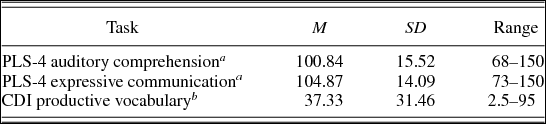
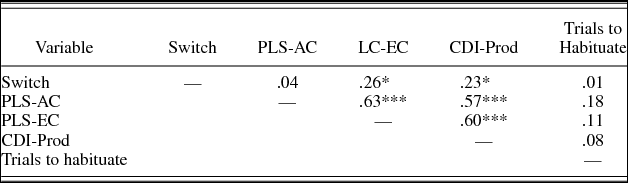
We then examined the relation between the full sample's performance on the minimal pair switch task and their concurrent language development. The descriptive statistics for infants’ scores on the PLS-AC and the PLS-EC and their productive vocabulary score (CDI-Prod; whose raw scores ranged from 0 to 568 words) are shown in Table 1. Mean scores were close to the population mean, with a relatively wide range. Correlations were calculated between minimal pair switch–same difference scores and the other measures, as shown in Table 2. Switch scores correlated significantly with performance on two of the three concurrent language measures: productive vocabulary (CDI-Prod) and language production (PLS-EC), although not language comprehension (PLS-AC). However, the significant correlations did not survive Bonferroni correction. Scores on the standardized language tasks all intercorrelated significantly (even after Bonferroni correction). The number of trials it took infants to habituate did not correlate significantly with switch performance or with any other measure.
Descriptive statistics for infants’ performance on the Phase 1 language measures

Note: PLS-4, Preschool Language Scale—Fourth Edition; CDI, MacArthur–Bates Communicative Development Inventory.
a Standard score (M = 100, SD = 15).
b Percentile rank.
Bivariate correlations for infants’ concurrent performance on the Phase 1 minimal pair switch and language measures

Note: PLS-AC, Preschool Language Scale auditory comprehension; PLS-EC, Preschool Language Scale expressive communication; CDI-Prod, MacArthur–Bates Communicative Development Inventory productive vocabulary.
*p < .05. ***p < .001.
Switch task groups
When Bernhardt et al. (Reference Bernhardt, Kemp and Werker2007) examined the later language performance of children who had completed the switch task at 17 or 20 months, they found that infants who had shown a strong looking preference for the switch trial differed significantly from the rest of the sample in terms of their later language scores. Specifically, those with a strong switch preference had a looking time that was above the mean switch–same looking time difference, in that study, about 2.5 s (a difference very similar to that observed in other switch studies, e.g., Werker et al., Reference Werker, Fennell, Corcoran and Stager2002). Thus, in the present study, we replicated this analysis. It was predicted that infants who showed a strong preference for the switch trial would show significantly better performance on our language measures than the rest of the sample.
Eighteen of the 64 infants (28%) showed a strong switch trial preference (cf. Bernhardt et al.’s 48%). To examine whether these children differed from the rest of the sample in their performance on the three measures of language development, three univariate ANOVAs with switch task group (strong switch preference vs. remainder) were conducted with scores on each of the PLS-AC, PLS-EC, and the CDI-Prod. These analyses revealed that, on average, infants with a strong switch preference outscored the rest of the group on both measures of language production: the PLS-EC (M = 110.21, SD = 11.49 vs. M = 102.64, SD = 13.11), F (1, 63) = 4.78, p = .033, d = 0.60; and the CDI-Prod (M = 54.34, SD = 35.81 vs. M = 31.19, SD = 28.20), F (1, 62) = 7.57, p = .008, d = 0.62, and also on the measure of language comprehension, the PLS-AC (M = 107.74, SD = 14.74 vs. M = 97.86, SD = 15.03), F (1, 62) = 5.79, p = .019, d = 0.66. (The first and third differences did not survive stringent Bonferroni corrections for multiple comparisons, but their medium to large effect sizes suggest that they are still important differences to consider.) We also noticed that a subgroup of infants (n = 15, 23% of sample) showed an unexpected preference for the same test trial, in terms of looking at this trial for >2.5 s more than the switch trial (M = 6.70, SD = 3.92). Exploratory analyses revealed that the performance differences seen between infants with a strong switch preference and those infants with a strong same preference were in the same direction as, and even larger than, the differences seen in the comparisons reported immediately above, ps < .01.
Phase 2
Links between tasks
At 27 months, infants were reported by their parents to have a range of 10 to 675 words, with a mean of 429.1 (SD = 190.4). The percentile ranks of these scores are displayed in Table 3, and show a wide range with a mean similar to the population mean. We first considered whether gender or language risk status made a difference to infants’ 27-month vocabulary. A between-subjects ANOVA with two factors: gender (male, female) and risk status (lower, higher) showed that boys and girls did not differ significantly on CDI percentile rank, F (1, 49) = 0.02, p = .90. (This was to be expected, because the CDI has separate norms for males and females.) However, unlike in Phase 1 of testing, infants at lower risk for language delay (M = 56.23, SD = 29.71) scored significantly higher on the CDI than higher risk children (M = 33.38, SD = 34.18), F (1, 52) = 6.58, p = .01, d = 0.77.
Phase 2 CDI productive vocabulary scores

Note: CDI, MacArthur–Bates Communicative Development Inventory.
a Percentile rank.
Phase 1 CDI-Prod scores were significantly correlated with Phase 2 CDI-Prod percentile ranks (r = .73, p < .001). In contrast, the correlation between Phase 1 switch task performance and Phase 2 CDI percentile rank was not significant, r = .15, p = .28.
Switch task groups
As in Phase 1, we considered just those participants who had looked to the switch trial for >2.5 s, compared with the rest of the sample. Infants who had shown a strong switch preference at Phase 1 scored higher on the CDI at 27 months (M = 59.25, SD = 32.98) than the rest of the group (M = 41.61, SD = 31.97). A univariate ANOVA revealed that this difference did not reach a conventional level of significance, F (1, 52) = 3.54, p = .066, d = 0.55. However, the medium effect size suggests that some relationship may still exist. When we made this comparison between the infants who strongly preferred the switch trial with those who had strongly preferred the same trial (M = 35.63, SD = 30.21), the difference was significant, and the effect size was even larger, F (1, 19) = 7.23, p = .01, d = 0.83.
Phase 3
PLS-4 and CAPES
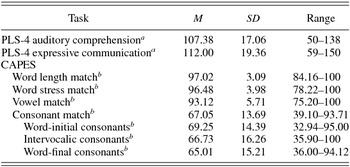
Table 4 shows the children's mean scores on the PLS-4 scales and the CAPES, at the age of 3 years. Overall, children scored around the population average on both the PLS-AC and the PLS-EC scales of the PLS-4, and near ceiling on the CAPES for word length, word stress, and word shape. Vowels also showed near mastery, but consonants were still developing (as would be expected at age 3 years). Children ranged in age from 35 to 42 months (all but one between 35 and 38 months) when completing the Phase 3 tasks, and thus, as would be expected in this narrow age range, none of the CAPES subscores correlated significantly with age.
Phase 3 language scores

Note: PLS-4, Preschool Language Scale—Fourth Edition; CAPES, Computerized Articulation and Phonology Evaluation System.
a Standard score (M = 100, SD = 15).
b Percentage match with the adult targets.
Links with Phase 1 scores
As in the previous phases, we assessed the effects of Phase 1 trial preference group (strong switch preference vs. remainder) on later language scores, in a series of univariate ANOVAs considering Phase 3 performance on the PLS-AC, PLS-EC, and CAPES scores for word structure, vowels, and consonants overall. However, no effects reached significance, which suggests that none of these switch grouping variables has predictive value for the tasks we chose for evaluating language performance, at least at 3 years of age.
We then examined the correlations between infants’ Phase 1 performance on our two key measures: the minimal pair switch task and CDI-Prod, with children's Phase 3 language skills, as shown in Table 5. Phase 1 CDI productive vocabulary score correlated significantly with Phase 3 language production and comprehension, as measured by the PLS-4, as well as scores on the CAPES (these correlations all remained significant after Bonferroni correction, apart from CAPES vowel scores, which were near ceiling). In contrast, Phase 1 switch task performance did not correlate significantly with any Phase 3 measures.
Correlations between Phase 1 switch and CDI scores and Phase 3 language scores

Note: CDI, MacArthur–Bates Communicative Development Inventory; PLS-AC, Preschool Language Scale auditory comprehension; PLS-EC, Preschool Language Scale expressive communication; CAPES, Computerized Articulation and Phonology Evaluation System; PCM, percentage consonant match with the adult target; PVM, percentage vowel match.
*p < .05. **p < .001.
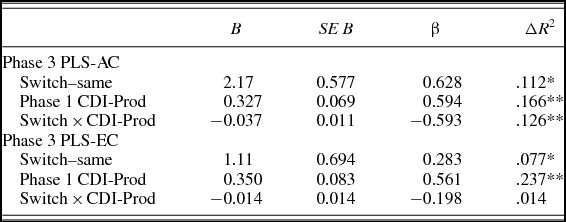
We now come to the more exploratory part of our analyses. The CDI-Prod at 16–24 months appears to be a better predictor of language skills at the age of 3 years than the switch task. However, as discussed earlier, the skills underlying performance on both tasks may play a role in contributing to later language development. To explore this possibility, we ran two regressions in which we predicted Phase 3 PLS-AC and PLS-EC scores from Phase 1 performance, entering our variable of main interest, switch performance (switch–same difference score), Phase 1 CDI-Prod score, and an interaction term (Switch × CDI-Prod) in that order. Before conducting the analyses, we calculated the Mahalanobis distance for each participant, and identified one outlier that exceeded the critical value of 16.2, at an α level of 0.001. (In Phase 1 of testing, this infant had looked longer at the same than the switch trial by 14.4 s, which was an unusual pattern. Removal of this infant from the Phase 1 and 2 analyses, however, did not alter the patterns of significance observed.) This infant was thus excluded from the regression analyses, which are shown in Table 6.
Multiple regressions predicting Phase 3 PLS-AC and PLS-EC, with Phase 1 CDI-Prod, switch performance, and CDI–switch interaction term as predictors

Note: PLS-AC, Preschool Language Scale auditory comprehension; PLS-EC, Preschool Language Scale expressive communication; CDI-Prod, MacArthur–Bates Communicative Development Inventory productive vocabulary.
*p < .05. **p < .01.
The first regression shows that both switch task performance and Phase 1 CDI-Prod accounted for a significant amount of variance in Phase 3 PLS-AC. However, the interaction term accounted for a significant 13% further variance. The second regression also revealed that both switch task performance and Phase 1 CDI-Prod accounted for a significant amount of variance in Phase 3 PLS-EC. However, the interaction term made no further significant contribution.
To interpret the contribution of the interaction term to auditory comprehension, we wanted to ascertain the Phase 1 productive vocabulary score below which switch task performance could predict later PLS-AC scores. The earlier correlations had suggested that the Phase 1 Switch/Phase 3 PLS-AC relationship was stronger for infants with smaller initial vocabularies for their age. We thus centered the CDI-Prod variable, and recalculated the corresponding interaction term, for a series of decreasing CDI-Prod percentile ranks, and tested whether the switch/PLS-AC relationship remained significant. We found that when infants had scored at or below the 40th percentile on the CDI-Prod at Phase 1, their Phase 1 switch task performance significantly predicted their Phase 3 PLS-AC standard score (ΔR 2 = .235, p = .041). Beyond the 40th percentile, this relationship was no longer significant.
Predictions for individuals
The results reported above are useful for describing the pattern of behaviors and characteristics of a group of children across time. However, it is possible to consider, at a preliminary level, whether the combination of individual infants’ switch score and productive vocabulary score might be useful in indicating later language performance. If we rank all participants in terms of their Phase 1 CDI production vocabulary score, as well as their Phase 1 switch task scores, we can then consider their Phase 3 PLS-AC scores. As part of this more exploratory part of our analyses, we also considered the possible role of being in the group that strongly (by >2.5 s) preferred looking at the same versus the switch test trial.
Of the 56 infants included in the Phase 3 analyses, only 4 had a PLS-AC standard score of <85 (i.e., more than 1 standard deviation below the mean) in Phase 3. In terms of predicting the Phase 3 PLS-AC standard score on an individual level, the most telling combination appears to be an initial CDI-Prod rank in the 5th percentile, coupled with having looked at the same trial for >2.5 s longer than the switch trial. All 4 of the infants with a Phase 3 PLS-AC score of <85 showed this combination, and only 1 false positive was predicted. If infants met only one of the two “risk” criteria, their later language comprehension scores were within normal limits. There were 9 additional infants who scored at the 5th percentile on CDI-Prod, but none of them strongly preferred the same trial, and all had PLS-AC scores of >85 in Phase 3. There were also 7 infants who strongly preferred the same trial, but all had CDI-Prod percentile ranks above the 5th percentile and again, all had PLS-AC scores of >85 (all were above 100). The remaining infants did not meet either of the risk criteria, and all had later PLS-AC scores of ≥85. There were no false negatives.
We can calculate the sensitivity and specificity of using this combination of Phase 1 CDI-Prod at the fifth percentile and switch task performance with a same trial preference of >2.5 s. Sensitivity is the number of true positives (4) divided by the number of true positives plus false negatives (4 + 0), and is thus 100%. Specificity is the number of true negatives (50) divided by the number of true negatives plus false positives (50 + 1), and is thus 98%. Of course, these conclusions, based on a small sample, must be seen as speculative. However, they provide some suggestion that combinations of online and offline language performance could help to offer some predictive value in terms of later language development.
DISCUSSION
In this study, we investigated how infants’ later language skills could be predicted by their earlier performance on an online task of word–object association, in addition to their parents’ estimates of their early vocabulary. We were interested in examining the predictive value of early performance on the minimal pair switch task because it taps into a set of skills that are critical for language development: associating a new word with a new object, attending to and representing the fine phonetic detail necessary to discriminate that new word from other possible new words in the language, and using this detail to guide word learning. It has previously been argued that this suite of skills may support the development of more abstract phonological categories (Curtin & Werker, Reference Curtin, Werker and Gaskell2007; Swingley, Reference Swingley2007; Werker & Curtin, Reference Werker and Curtin2005). In this way, the minimal pair switch task may be particularly sensitive for understanding the foundations of language development more generally. We have already seen evidence for links between early minimal pair switch task performance and some language skills up to 2.5 years later in more limited samples (e.g., Bernhardt et al., Reference Bernhardt, Kemp and Werker2007; Ference & Curtin, Reference Ference and Curtin2015). However, it was not clear whether these associations would hold in a larger sample of infants drawn from the broader community, rather than the more usual narrower, university-based samples.
As in previous studies (Bernhardt et al., Reference Bernhardt, Kemp and Werker2007; Werker et al., Reference Werker, Fennell, Corcoran and Stager2002), a measure of switch task performance was calculated by subtracting each infant's same trial looking time from his or her switch trial looking time. This switch task score did not correlate significantly with age or parental education level, and did not differ significantly with location of testing, reported history of ear infection, or with family history of language delay. This does not rule out the possibility that any of these factors had an effect on infants’ word–object association ability, but it suggests that they do not provide the main explanation for any differences observed. Switch task performance also did not correlate significantly with the number of trials that infants took to habituate, and so it seems that minimal pair switch task performance cannot be attributed simply to general habituation efficiency (e.g., Bornstein & Sigman, Reference Bornstein and Sigman1986).
The infants in this study represented a wider range of family backgrounds, location (urban/rural), and language risk than those in many similar university-based studies. Unlike in previous research with more homogeneous samples (e.g., Fennell et al., Reference Fennell, Byers-Heinlein and Werker2007; Thiessen, Reference Thiessen2007; Werker et al., Reference Werker, Fennell, Corcoran and Stager2002), these infants were unable, as a group, to learn the associations between two phonetically similar words and their referents. They did not look significantly longer when presented with a new word–object combination (switch trial) than when presented with a combination to which they had just become habituated (same trial). This finding may reflect the relative diversity of our sample. This possibility is supported by the finding that when we reran the switch task analysis with the subset of infants whose productive vocabulary scores were at or above the population mean, we did see a significant preference for the switch trial, as reported in previous university-based studies. Thus, the inclusion of a more varied sample means that the findings in this study are more likely to be representative of those in the general population than those observed in most university-based infant research.
At each of the three phases of the study, the infants showed language skills around the population mean, but with a wide range, as measured by parental estimates of productive vocabulary (CDI, Phases 1 and 2) and scores on standardized, researcher-administered tests of language production (PLS-EC) and comprehension (PLS-AC, Phases 1 and 3). Their phonological word structures were well developed, although generally later-developing consonants had not yet reached mastery (CAPES, Phase 3). As noted above, being at higher family risk for language delay was not associated with Phase 1 switch performance, or with any of the language tasks in Phase 1. In Phase 2, children at higher risk for language delay showed significantly smaller productive vocabularies for their age than their lower risk peers, but by Phase 3, we did not observe further significant language differences between the two risk status groups. A few individuals, however, did perform more than 1 SD below the mean on certain language tasks, suggesting that the group difference may have masked individual low performance, even with this liberal criterion (>1 SD from the mean). Overall, although a family history of language delay is a risk factor (e.g., Felsenfeld & Plomin, Reference Felsenfeld and Plomin1997), it is not on its own a reliable predictor of future delay for all children. Individual difference must be considered in clinical work, if not in group studies such as this.
Scores for productive vocabulary at age 16–24 months correlated significantly with productive vocabulary at 27 months. More important, initial productive vocabulary scores also correlated significantly with language comprehension and production, and phonological skill at 3 years of age. This strengthens previous findings showing the stability of parental estimates of spoken vocabulary across some months of childhood (e.g., Fenson et al., Reference Fenson, Dale, Reznick, Bates, Thal and Pethick1994; Tsao et al., Reference Tsao, Liu and Kuhl2004), as well as some of the links between early vocabulary and later broader language skills (e.g., Dale et al., Reference Dale, Price, Bishop and Plomin2003), even if these links have been generally found to be weaker for late talkers (e.g., Fernald & Marchman, Reference Fernald and Marchman2012). Having a large store of words for their age, from early on, provides a strong basis for children to acquire even more words. The range of phonemes and phonotactic rules exemplified in a large lexicon provides the building blocks for further lexical acquisition (Fasolo, Majorano, & D'Odorico, Reference Fasolo, Majorano and D'Odorico2008) and phonological development.
An important question in this study was whether early performance on the minimal pair switch task would also correlate with concurrent and later language skills, and/or yield further insight into why the correlations exist between more global measures. Previous studies have yielded mixed evidence about the existence of a link between early language processing and vocabulary size, depending on the nature of the task (e.g., Fernald & Marchman, Reference Fernald and Marchman2012; Singh et al., Reference Singh, Reznick and Xuehua2012; Swingley & Aslin, Reference Swingley and Aslin2002; Zangl et al., Reference Zangl, Klarman, Thal, Fernald and Bates2005) and the age of the infant participants (Fennell et al., Reference Fennell, Byers-Heinlein and Werker2007; Werker et al., Reference Werker, Fennell, Corcoran and Stager2002). The present study confirmed a correlation between minimal pair switch task performance and both concurrent productive vocabulary size and expressive communication skill. At first it might seem surprising that a positive correlation was seen between switch task performance and words produced, rather than words understood (assuming that phonological competence applies to both production and perception). However, it is not uncommon to obtain stronger correlations with productive/expressive than comprehension scales of the CDI, because inference about what children understand is less reliable than about what they produce (Fenson et al., Reference Fenson, Dale, Reznick, Bates, Thal and Pethick1994). Nevertheless, even these correlations should be interpreted with caution, because they did not survive a stringent correction factor. It is possible that the current sample's relatively heterogeneous nature made the children more comparable in general word-learning development to the younger infants tested in previous studies. In any case, the results suggest that the minimal pair switch task is tapping the component linguistic skills required for acquiring productive vocabulary and language competence, or that both switch performance and productive linguistic skills are based on the same general skill set. Minimal pair switch task performance did not correlate significantly with concurrent auditory comprehension scores on the PLS-4. Although the PLS-4 was the most appropriate test for the current study, its range of questions may tap aspects of comprehension that did not clearly differentiate between these participants. However, there were links between the PLS scores and other measures later in the study, as discussed below. By Phase 2 and Phase 3, switch task performance no longer correlated significantly with productive vocabulary score (CDI), or with auditory comprehension or expressive communication (PLS-4), or with phonological skills (CAPES).
We suggest that the ability to use phonological categories (here, place of articulation contrasts) to guide word learning, although not sufficient on its own, may be one of the developmental achievements that has to be in place for infants to be able to build up a vocabulary relatively efficiently, at least in the first 2 years of life. If infants’ cognitive resources are entirely consumed just by learning to link each new word with its object/event, they will be less able to attend to the phonetic information available in the stimulus, and will thus find it more difficult to learn and distinguish similar-sounding words. In contrast, infants who can use their attentional resources more efficiently will have the cognitive “space” to attend to fine phonetic detail, and thus to learn and discriminate new words (Fennell et al., Reference Fennell, Byers-Heinlein and Werker2007). Alternatively, greater ability to access phonological representations may allow word learning to accelerate (Curtin & Werker, Reference Curtin, Werker and Gaskell2007; Werker et al., Reference Werker, Fennell, Corcoran and Stager2002; Werker & Curtin, Reference Werker and Curtin2005), or the relationship may be reciprocal (Smith, McGregor, & DeMille, Reference Smith, McGregor and DeMille2006). Future work should explore further the extent to which the association holds with vocabulary size, and with more general language skills.
The present study provides some evidence for this interpretation, in follow-up analyses that showed that, as in Bernhardt et al. (Reference Bernhardt, Kemp and Werker2007), infants who strongly preferred to look at the switch test trial performed significantly better on all three language measures in Phase 1 (productive vocabulary, language production, and comprehension), and showed a trend toward having a larger productive vocabulary for their age in Phase 2, than infants who did not show this strong preference (or who strongly preferred the same trial). Because learning the object–label pairs is presumed to require the discrimination of the two similar-sounding words, in tandem with the association of an object with a label, it makes sense that the group of infants who are most efficient at this process are also those who have developed the largest vocabularies and the most advanced language skills. However, these group differences no longer reached significance in the language measures administered in Phase 3. In addition, the correlations between Phase 1 switch performance and Phase 3 language skills in the full sample no longer reached significance once stringent corrections were made for multiple correlations. It is possible that by the age of 3 years, any underlying skills indexed by strong early switch preference no longer contribute so strongly to language development. It is also possible, and something we are testing with an older sample, that a correlation will be seen again at a later age.
It is difficult to interpret what it means to strongly prefer the same trial over the switch trial. A same-trial preference suggests that some learning has occurred; however, the current understanding of this pattern is that such a preference for sameness indicates that processing is less complete (Hunter & Ames, Reference Hunter, Ames, Rovee-Collier and Lipsitt1988), and that the representation has not yet been fully established (Roder, Bushnell, & Sasseville, Reference Roder, Bushnell and Sasseville2000; see also Weikum, Oberlander, Hensch, & Werker, Reference Weikum, Oberlander, Hensch and Werker2012, for a similar interpretation in the realm of speech perception). Thus, while we are interpreting the potentially interesting findings from the infants who strongly preferred the same trial as speculative, and introduced those analyses only in a post hoc fashion, it will be informative to determine if these patterns are replicated in future work.
In our final, more speculative, analyses, we investigated whether switch performance and Phase 1 productive vocabulary could together help to identify individual children for potential risk of language delay. We found that the four infants with a Phase 1 productive vocabulary score in the 5th percentile (a stringent criterion used in previous work, e.g., Girolametto, Wiigs, Smyth, Weitzman, & Pearce, Reference Girolametto, Wiigs, Smyth, Weitzman and Pearce2001), coupled with a strong (>2.5 s) preference for looking at the same trial in the switch task, were those most likely to show an PLS-AC score of one standard deviation or more below the mean on the PLS-4 in Phase 3. The sensitivity and specificity of this combination of measures were 100% and 98%, respectively. Of course, the possibility of using early vocabulary score and switch task performance to identify infants at risk for later language delay is only tentative, given the retrospective nature of this analysis, and the limited numbers of children who had Phase 3 language scores substantially below the population mean. Nevertheless, this fits with a similar conclusion by Fernald and Marchman (Reference Fernald and Marchman2012) that 18-month-olds’ reaction time in an online word-recognition task, in combination with their vocabulary size, could help to predict their later language development.
A number of limitations necessarily restrict generalization from the current findings. Among them is the fact that although we assessed a relatively large and diverse group of infants, the number who showed substantially below-average language skills by Phase 3 was very small, and thus caution must be exercised in interpreting the potential predictive value of our initial measures for identification of children who might benefit from early intervention. Further, the practical constraints of recruiting and testing a wide community sample at multiple sites meant that at Phases 1 and 3 the participants represented a much wider age range than the ideal, reducing the specificity of the conclusions that can be drawn. Nevertheless, this sample also provided insight into the performance of a broader group of infants than those who would normally participate in university-based research.
In sum, the current study adds to previous findings suggesting that even in a varied group of infants, productive vocabulary score at 16–24 months can help to predict language skills at the age of 3 years, especially for those who have more early words. This research also provides some evidence that the combination of skills required to pass the dynamic, “on-line” minimal pair switch task (word–object association and fine phonetic discrimination) overlaps with the skills required to develop the ability to comprehend and produce language, as assessed by standardized tests of accumulated knowledge. This tendency seems greater in infants with fewer early words for their age, suggesting a potential way in which the incorporation of the minimal pair switch task, with standard vocabulary measures, could eventually help to boost the predictive power of the CDI for those children who are slow talkers.
ACKNOWLEDGMENTS
This research was supported by a Collaborative Health Research Project Grant from the Natural Sciences and Engineering Research Council of Canada (CHRPJ250931-02) and funding through the Human Early Learning Partnership from the Ministry of Children and Family Development, British Columbia. We are grateful to the British Columbia Fraser Valley Health Centres (Abbotsford, Chilliwack, Langley, and North Delta), the Vancouver Audiology Centre, and the Richmond Health Department Audiology Clinic for allowing us to use their space for testing; to audiologist Kelly McClendon, and research assistants Angela Ullrich and Janet Kidd, for assistance with testing (Phase 1); and speech–language pathologists Marcy Adler-Bock and Caroline Marcoux for testing (Phase 3). We thank Krista Byers-Heinlein for her ideas and assistance with the later analyses. Finally, we gratefully acknowledge all the parents and their infants who generously gave their time to participate in this research.