Introduction
Dysfunctional cognitive processes related to negative self-evaluations are thought to play an important role in both social phobia (Clark & Wells, Reference Clark, Wells, Heimberg, Liebowitz, Hope and Schneier1995) and depression (Gemar et al. Reference Gemar, Segal, Sagrati and Kennedy2001). In support of this, socially anxious people and individuals suffering from depressive symptoms often report negative self-statements and suffer from cognitive distortions indicating a loss of self-esteem (Clark et al. Reference Clark, Beck and Alford1999). Accordingly, the frightening convictions of social phobic patients can be condensed into conditional assumptions, such as ‘if my performance is not perfect, then I am an inferior person’, and core assumptions concerning the self, such as ‘I am incompetent’. In a similar vein, the core assumptions concerning the self in depressed patients can be condensed into beliefs such as ‘I am worthless and essentially not worth of living’ (Beck et al. Reference Beck, Emery, Greenberg and Lindemann1996).
To the extent that negative self-views play an important role, we would expect relatively low levels of self-esteem in individuals suffering from these symptoms. In line with this, socially anxious adults (e.g. Bouvard et al. Reference Bouvard, Guerin, Rion, Bouchard, Ducottet, Sechaud, Mollard, Grillet and Cottraux1999), and also socially anxious children (e.g. Ginsburg et al. Reference Ginsburg, La-Greca and Silverman1998), are systematically found to report relatively low self-esteem. Similarly, individuals suffering from depressive disorder are also characterized by low self-esteem (e.g. Franck et al. Reference Franck, De Raedt, Dereu and Van den Abbeele2007). Underlining the importance of negative self-views in the generation of depressive symptoms, previous longitudinal studies showed that low explicit self-esteem predicted subsequent levels of depressive symptoms (Ormel et al. Reference Ormel, Oldehinkel and Vollebergh2004), whereas depressive symptoms did not predict subsequent levels of self-esteem (Orth et al. Reference Orth, Robins, Trzesniewski, Maes and Schmitt2009). These findings indicate that low explicit self-esteem can be best considered as a cause rather than a consequence of depressive symptoms. Research showing that low self-esteem similarly operates as a risk factor for the onset of social anxiety disorder (Acarturk et al. Reference Acarturk, Smit, de Graaf, van Straten, ten Have and Cuijpers2009) suggests that low self-esteem can also be best interpreted as a cause rather than a consequence/symptom of social anxiety.
On the basis of the finding that low self-esteem is a vulnerability factor for the development of both depression and social anxiety disorder, some authors have proposed that low self-esteem may help to explain the frequent co-morbidity between social phobia and depression (e.g. Penninx et al. Reference Penninx, Beekman, Smit, Zitman, Nolen, Spinhoven, Cuijpers, de Jong, van Marwijck, Assendelft, van der Meer, Verhaak, Wensing, de Graaf, Hoogendijk, Ormel and van Dyck2008; Ohayon & Schatzberg, Reference Ohayon and Schatzberg2010). Following this view, it may be the interaction of low self-esteem with other variables, such as particular learning experiences or life events, that eventually determines whether people develop a social anxiety disorder (Rapee & Heimberg, Reference Rapee and Heimberg1997) and/or a depression (Brown et al. Reference Brown, Harris and Eales1996). The first aim of this study was therefore to test whether the association between symptoms of social phobia and symptoms of depression can be explained by individuals' low self-esteem.
In general, evidence for the relationship between low self-esteem and symptoms of psychopathology is predominantly based on self-report instruments and thus focused on more deliberate evaluations concerning the ‘self’. Dual process models, however, emphasize the importance of distinguishing between more deliberate (explicit) and more automatically activated cognitions (Strack & Deutsch, Reference Strack and Deutsch2005). These types of cognitions are thought to have different functional qualities. Explicit cognitions are assumed to reflect the outcome of the weighting of propositions and their corresponding ‘truth’ values, whereas automatic associations are assumed to follow from the direct activation of simple associations in memory, independent of their truth value (Gawronski & Bodenhausen, Reference Gawronski and Bodenhausen2006).
In line with the view that implicit and explicit self-esteem reflect independent constructs, they are usually only weakly correlated (e.g. Bosson et al. Reference Bosson, Swann and Pennebaker2000) and discrepancies between implicit and explicit self-esteem are common (e.g. Vater et al. Reference Vater, Schröder-Abé, Schütz, Lammers and Roepke2010). High explicit together with low implicit self-esteem has been termed ‘fragile self-esteem’ and has been shown to be linked to self-serving responses (Bosson et al. Reference Bosson, Brown, Zeigler-Hill and Swann2003). Most relevant for the present context, low explicit together with high implicit self-esteem (‘damaged self-esteem’; Schröder-Abé et al. Reference Schröder-Abé, Rudolph and Schüz2007) has been shown to be related to suicidal ideation (Franck et al. Reference Franck, De Raedt, Dereu and Van den Abbeele2007). More generally, it has been found that people suffering from depressive symptoms are characterized by low self-esteem at the explicit but not at the implicit level (e.g. Gemar et al. Reference Gemar, Segal, Sagrati and Kennedy2001; De Raedt et al. Reference De Raedt, Schacht, Franck and De Houwer2006; Bos et al. Reference Bos, Huijding, Muris, Vogel and Biesheuvel2010; but see Risch et al. Reference Risch, Buba, Birk, Morina, Steffens and Stangier2010). It has been suggested that this discrepancy in implicit and explicit self-esteem might reflect the discrepancy between these people's internal standard (ideal self) and perceived reality (actual self) (Franck et al. Reference Franck, De Raedt, Dereu and Van den Abbeele2007). Such discrepant self-evaluations are assumed to elicit internal tension, which in turn may give rise to symptoms of dysphoria (cf. Vater et al. Reference Vater, Schröder-Abé, Schütz, Lammers and Roepke2010).
Discrepant self-esteem does not seem to be involved in social anxiety as previous research has shown that high socially anxious individuals are characterized by concurrent low explicit and low implicit self-esteem (de Jong, Reference de Jong2002; Tanner et al. Reference Tanner, Stopa and De Houwer2006). This suggests that the negative self-view in social anxiety reflects strongly ingrained negative self-associations that are elicited automatically in self-relevant situations, whereas the negative self-evaluation in depressed individuals seems to predominantly reflect the outcome of more slow deliberate processes. This fits with the finding that social phobic individuals typically show enhanced vigilance and rapid detection of negative self-evaluative stimuli, even when stimuli are presented for a very short duration, whereas depressed individuals are characterized by a pattern of maintained attention for, and difficulties disengaging from, negative self-descriptive words presented for long durations but not brief durations (Koster et al. Reference Koster, De Raedt, Goeleven, Franck and Crombez2005; Leyman et al. Reference Leyman, De Raedt, Schacht and Koster2007).
Evidence for the apparent differential self-evaluative processes involved in social anxiety and depression comes from studies focusing separately on either social anxiety or depression. A more direct comparison of the self-evaluative processes involved in both types of symptoms would be important for a more final appreciation of the similarities and dissimi-larities between social anxiety and depression. Insight into the differences and commonalities of both types of symptoms would not only be of theoretical importance but might also be helpful in determining the relevant starting points for (preventive) interventions (e.g. implicit and/or explicit self-esteem). Therefore, the second aim of this study was to examine the alleged differential importance of implicit self-esteem for social anxiety and depressive symptoms in one (large) sample with varying levels of social anxiety and depression. Moreover, previous studies relied predominantly on adult samples. However, if low implicit self-esteem is indeed a crucial factor in the development of social anxiety, the relationship between implicit self-esteem and social anxiety should already be evident in younger age groups because social anxiety typically starts in adolescence. Therefore, this study relied on early adolescents during their first stage of secondary school.
Earlier work has shown that women are more likely than men to base their judgments on intuition (e.g. Pacini & Epstein, Reference Pacini and Epstein1999). Following this, it seems reasonable to assume that women, more than men, will tend to rely on implicit self-associations as a guideline for their behaviour and self-judgments (cf. Pelham et al. Reference Pelham, Koole, Hardin, Hetts, Seah and DeHart2005). Therefore, we examined whether the connection between social anxiety and low implicit self-esteem would be especially pronounced in female participants.
To summarize, this study tested the following predictions: (i) the co-occurrence of symptoms of depression and social anxiety can be explained by shared low explicit self-esteem, (ii) low explicit self-esteem is involved in symptoms of both depression and social anxiety whereas low implicit self-esteem is only involved in social anxiety, and (iii) the relationship between low implicit self-esteem and symptoms of social anxiety is especially pronounced in women.
Method
Participants
A group of adolescents (n=5318) in the first and second year of secondary schools were invited to participate. The adolescents and one of their parents had to provide written informed consent. A total of 1806 adolescents and their parents (34%) gave their active informed consent (813 boys, 993 girls, mean age 13.6 years, s.d.=0.66). Of the participants, 68% came from a rural area and 32% from an urban area, as defined by Statistics Netherlands (Reijneveld et al. Reference Reijneveld, Veenstra, de Winter, Verhulst, Ormel and de Meer2010), and 85.6% of the participants were living with their non-divorced biological parents. The study was approved by the Medical Ethics Committee of the University Medical Centre Groningen.
Measures
Implicit Association Test (IAT)
We used the IAT (Greenwald et al. Reference Greenwald, McGhee and Schwartz1998) to assess implicit self-esteem. This test has already been applied successfully in similar age groups (e.g. Bos et al. Reference Bos, Huijding, Muris, Vogel and Biesheuvel2010; for a review see Huijding et al. Reference Huijding, Wiers, Field, Hadwin and and Field2010). The IAT is a computerized reaction-time task designed to measure the relative strengths of automatic associations between two contrasting target concepts and two attribute concepts. Words from all four concept categories appear in mixed order in the centre of a computer screen and participants are instructed to sort them by pressing a left or right key on a response box. The premise here is that the sorting becomes easier when a target and an attribute that share the same response key are strongly associated than when they are weakly associated (e.g. for a person with a highly positive implicit self-esteem it should be easier to categorize words for the concepts of me and positive with the same response key, rather than of me and negative). Target labels were ‘me’ and ‘other’. Attribute labels were ‘positive’ and ‘negative’. Each category consisted of five stimuli that were used in previous research among adolescents (Bos et al. Reference Bos, Huijding, Muris, Vogel and Biesheuvel2010): the self-referent (me) words were ‘I, my, myself, me, own’. The other-referent words were ‘other, they, their, them, themselves’. The high esteem (positive) words were ‘nice, smart, good, fun, friendly’, and finally the low esteem (negative) words were ‘stupid, bad, dumb, nasty, unfriendly’. In an independent survey these words were rated as unambiguously positive or negative, and as highly familiar (Hermans & De Houwer, Reference Hermans and De Houwer1994). However, the exact meaning/content of examplars is not crucial because the IAT effect has been shown to be driven mainly by the content of the labels (De Houwer, Reference De Houwer2001).
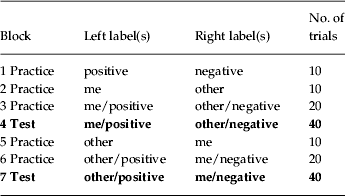
The IAT consisted of seven stages, with stages 4 and 7 both preceded by practice blocks (see Table 1). Following a correct response, the next stimulus was presented after 500 ms. Following an incorrect response, a red cross appeared on the screen, and the stimulus remained on the screen until the correct response was given. The order of the category combinations was fixed across participants to reduce method variance, thereby enhancing the sensitivity of the IAT as a measure of individual differences.
Arrangement of the different IAT blocks

IAT, Implicit Association Test.
The Revised Child Anxiety and Depression Scale (RCADS)
The RCADS (Chorpita et al. Reference Chorpita, Moffitt and Gray2005) is a 47-item self-report instrument using a four-point scale. The RCADS consists of several subscales. In this study we used the major depressive disorder (Cronbach's α=0.80) and social phobia (Cronbach's α=0.86) subscales RCADS-DD and RCADS-SP respectively.
The Rosenberg Self-Esteem Scale (RSES)
The RSES (Rosenberg, Reference Rosenberg1965) is a 15-item self-report with a five-point scale, assessing (explicit) self-esteem. The questionnaire has both positively formulated and negatively formulated items. The scores were recoded in such a way that high scores reflected high self-esteem. The psychometric properties of the Dutch RSES have been shown to be satisfactory (Franck et al. Reference Franck, De Raedt, Barbez and Rosseel2008). In this study, Cronbach's α was 0.89.
Procedure
The assessment was part of a screening process in the context of a large-scale study on the efficacy of two interventions designed to prevent social and test anxiety in adolescents. Participants were tested in the school environment in groups of a maximum of 15 participants. Following the recommendation of Bosson et al. (Reference Bosson, Swann and Pennebaker2000), participants always started with the IAT.
Data analyses
Data reduction
IAT scores were computed according to the now widely used algorithm (D4-measure) proposed by Greenwald et al. (Reference Greenwald, Nosek and Banaji2003). Accordingly, reaction times above 10 000 ms were discarded and error trials were replaced with the mean reaction times of the correct responses in the block in which the error occurred plus a penalty of 600 ms. The IAT effect was calculated by subtracting mean reaction times of block 6 from block 3 (practice) and block 7 from block 4 (see Table 1). The means of these two effects were divided by their pooled standard deviation based on all responses in blocks 3, 4, 6 and 7. Positive IAT effects indicate relatively fast responses when ‘me’ shared the response key with ‘positive’. The split-half reliability of the present IAT was good, with Spearman–Brown corrected correlation between test halves of 0.74 (test halves were based on trials 1, 2, 5, 6, 9, 10, etc. versus 3, 4, 7, 8, 11, 12, etc.).
Statistical analyses
First, bivariate correlations were computed to examine the inter-relationship between implicit self-esteem, explicit self-esteem (RSES), social anxiety (RCADS-SP) and depressive symptoms (RCADS-DD). To explore gender differences, this was also computed for girls and boys separately. Second, we tested whether the relationship between symptoms of social anxiety and depression can be (partly) attributed to individual differences in explicit self-esteem. Therefore, a partial correlation was computed between RCADS-SP scores and RCADS-DD scores while controlling for explicit self-esteem. To test whether the covariation of symptoms of depression and social anxiety is associated with the level of self-esteem independent of the effects of self-esteem on severity of depression and social anxiety symptoms, we subsequently carried out a regression analysis with RSES being the dependent variable, and RCADS-SP, RCADS-DD and the interaction term RCADS-SP×RCADS-DD as the independent variables.
Finally, we carried out two hierarchical regression analyses (one with RCADS-SP and one with RCADS-DD as the dependent variable) to test the relationship between implicit and explicit self-esteem on the one hand and symptoms of social anxiety or depression on the other. In block 1 we included gender as the background variable. In block 2 we added implicit self-esteem to examine its predictive value over and above gender. For the same reason explicit self-esteem was added in block 3. To test whether the relationship between low implicit self-esteem and social anxiety/depressive symptoms would be especially strong in people also showing low explicit self-esteem, the interaction between implicit and explicit self-esteem was added in block 4. To test whether the associations may be different for boys and for girls, we added all relevant gender-interaction terms in the final block.
Results
Descriptives
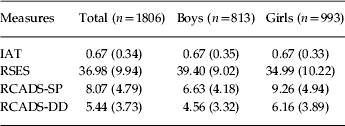
The means and standard deviations of the measures are shown in Table 2. Girls generally reported more symptoms of both social anxiety [F(1, 1805)=145.30, p<0.05, d=0.57] and depression [F(1, 1805)=86.68, p<0.05, d=0.45 ], and also showed lower explicit self-esteem than boys [F(1, 1805)=92.73, p<0.05, d=0.46]. No gender differences were found regarding implicit self-esteem (F<1). Based on the cut-off scores reported by Chorpita et al. (Reference Chorpita, Moffitt and Gray2005), 7.2% (n=130) of our sample showed RCADS-DD scores in the clinical range (>11), and 26.5% (n=479) showed RCADS-SP scores in the clinical range (>10).
Mean values for measures of implicit self-esteem (IAT), explicit self-esteem (RSES), social anxiety (RCADS-SP) and depressive symptoms (RCADS-DD)

IAT, Implicit Association Test; RSES, Rosenberg Self-Esteem Scale; RCADS-SP, Revised Child Anxiety and Depression Scale – social phobia; RCADS-DD, Revised Child Anxiety and Depression Scale – depressive disorder.
Standard deviations in parentheses.
Inter-relationships between self-esteem, social anxiety and depression
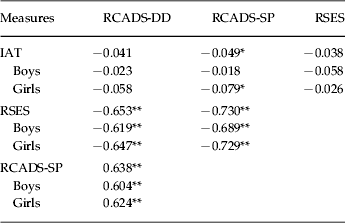
Table 3 displays the bivariate relationships between the measures of psychopathological symptoms and self-esteem. There was a strong negative correlation between explicit self-esteem and social anxiety, and between explicit self-esteem and depression. Consistent with the high co-morbidity of social phobia and depressive disorder, there was also a strong correlation between symptoms of social anxiety and depression (r=0.63, p<0.01). When controlling for explicit self-esteem, the strength of the correlation between social anxiety and depression fell substantially (r=0.31, p<0.01). To examine whether the covariation between symptoms of depression and social anxiety was related to the level of explicit self-esteem, we also tested the relationship between explicit self-esteem and the interaction of RCADS-SP and RCADS-DD. Although this bivariate correlation was significant (r=−0.36, p<0.001), subsequent regression analysis with the RSES being the dependent variable and RCADS-SP, RCADS-DD and RACDS-SP×RCADS-DD the independent variables indicated that the covariation of social anxiety and depression has no unique relationship with low self-esteem (p=0.34), independent from the relationships between self-esteem and RCADS-SP (B=−1.11, p<0.001) and RCADS-DD (B=−0.86, p<0.001).
Correlations between measures of implicit self-esteem (IAT), explicit self-esteem (RSES), social anxiety (RCADS-SP) and depressive symptoms (RCADS-DD), overall (n=1806) and for boys (n=813) and girls (n=993) separately

IAT, Implicit Association Test; RSES, Rosenberg Self-Esteem Scale; RCADS-SP, Revised Child Anxiety and Depression Scale – social phobia; RCADS-DD, Revised Child Anxiety and Depression Scale – depressive disorder.
* Correlation is significant at the 0.05 level.
** Correlation is significant at the 0.01 level.
Symptoms of social anxiety
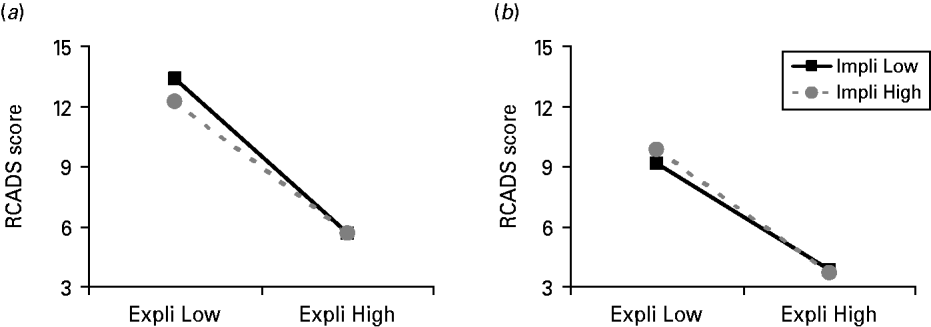
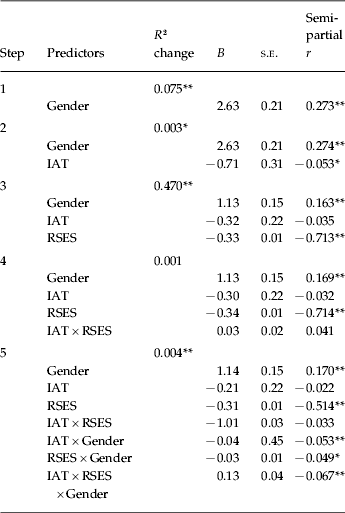
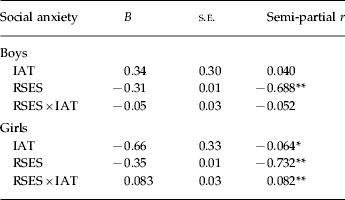
For social anxiety symptoms, implicit self-esteem had predictive value over and above gender (Table 4). Lower implicit self-esteem and being female were both independently associated with higher levels of social anxiety. The effect of implicit self-esteem disappeared when explicit self-esteem was entered into the model. Lower explicit self-esteem predicted higher levels of social anxiety. The interaction between implicit and explicit self-esteem showed no significant additional predictive validity. However, the final model showed that the interaction terms of gender×explicit self-esteem, gender×implicit self-esteem, and also gender×implicit×explicit self-esteem did show cumulative predictive validity for severity of symptoms. To interpret these findings, additional regression analyses were carried out for boys and girls separately (Table 5). For boys, explicit self-esteem was the single best predictor of symptom severity. For girls, both implicit self-esteem and the interaction term implicit×explicit self-esteem showed cumulative predictive validity. To interpret these findings, the predicted values for the interaction terms are presented in Fig. 1.
Interaction effects of explicit and implicit self-esteem on symptoms of social anxiety as indexed by the social phobia subscale of the Revised Child Anxiety and Depression Scale (RCADS) for (a) girls (n=993) and (b) boys (n=813). Values shown are predicted scores, calculated at ±1 s.d. from the mean on each type of self-esteem. Expli Low, low explicit self-esteem; Expli High, high explicit self-esteem. Impli Low, low implicit self-esteem; Impli High, high implicit self-esteem.

Results of the hierarchical regression analyses with gender, implicit self-esteem (IAT), explicit self-esteem (RSES) and the interaction terms as the independent variables, and symptoms of social anxiety (RCADS-SP) as the dependent variables

IAT, Implicit Association Test; RSES, Rosenberg Self-Esteem Scale; RCADS-SP, Revised Child Anxiety and Depression Scale – social phobia; s.e., standard error.
* p<0.05, ** p<0.01.
Results of the regression analyses restricted to boys (n=813) or girls (n=993), with explicit self-esteem (RSES), implicit self-esteem (IAT) and the interaction terms as the independent variables, and symptoms of social anxiety (RCADS-SP) as the dependent variable

IAT, Implicit Association Test; RSES, Rosenberg Self-Esteem Scale; RCADS-SP, Revised Child Anxiety and Depression Scale – social phobia; s.e., standard error.
* p<0.05, ** p<0.01.
The results indicate that girls with relatively low explicit self-esteem generally showed higher social anxiety scores than girls with relatively high self-esteem, whereas the social anxiety scores were increased further for girls who also showed relatively low implicit self-esteem.
Symptoms of depression
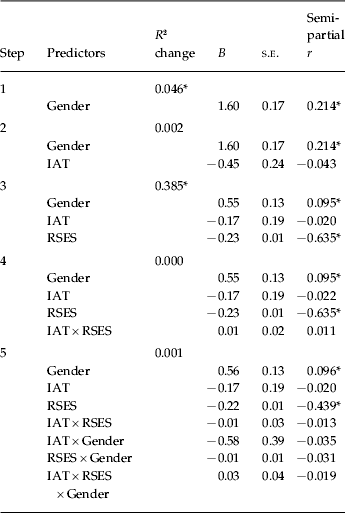
For symptoms of depression, implicit self-esteem had no significant predictive value over and above gender (Table 6). Only explicit self-esteem and gender showed independent predictive validity; lower explicit self-esteem and being female were independently associated with higher levels of depression.
Results of the hierarchical regression analyses with gender, implicit self-esteem (IAT), explicit self-esteem (RSES) and the interaction terms as the independent variables, and symptoms of depression (RCADS-DD) as the dependent variable

IAT, Implicit Association Test; RSES, Rosenberg Self-Esteem Scale; RCADS-DD, Revised Child Anxiety and Depression Scale – depressive disorder; s.e., standard error.
* p<0.01.
Discussion
The major findings are that: (i) overall, girls reported more symptoms of depression and social anxiety together with lower levels of explicit self-esteem than boys; (ii) independent of gender there was a strong association between low explicit self-esteem and symptoms of both social anxiety and depression; (iii) there was a strong association between symptoms of social anxiety and depression that could be largely explained by shared low explicit self-esteem; and (iv) specifically in girls, low implicit self-esteem added significantly to low explicit self-esteem in predicting social anxiety.
In line with previous research showing a frequent co-morbidity of clinically diagnosed social anxiety disorder and major depression among adult individuals (Ohayon & Schatzberg, Reference Ohayon and Schatzberg2010), in the present sample of early adolescents symptoms of social anxiety were also highly associated with symptoms of depression. Most important for the present context, the co-occurrence of social anxiety and depression could be largely explained by an individual's level of explicit self-esteem. The present results provide no evidence for a unique relationship between low self-esteem and the covariation of social anxiety and depressive symptoms independent of the effects of low self-esteem on the severity of depression and social anxiety symptoms. This suggests that low self-esteem increases the chance of concurrent symptoms of social anxiety and depression by independently increasing the chance of developing both types of symptoms. This pattern of findings is consistent with the view that it is the interaction of low self-esteem with other variables (e.g. particular learning experiences) that eventually determines whether people may develop symptoms of social anxiety, depression, or both (e.g. Brown et al. Reference Brown, Harris and Eales1996).
Replicating previous research (e.g. De Raedt et al. Reference De Raedt, Schacht, Franck and De Houwer2006; Bos et al. Reference Bos, Huijding, Muris, Vogel and Biesheuvel2010), there was no relationship between implicit self-esteem and symptoms of depression. Moreover, there was no evidence for depressive symptoms in adolescents being related to the degree of explicit–implicit self-esteem discrepancy. Thus, although previous research has shown that discrepancies in both directions are maladaptive and connected to impaired health and well-being (Schröder-Abé et al. Reference Schröder-Abé, Rudolph and Schüz2007), the present findings provide no evidence to indicate that discrepant self-esteem is also an important factor in the early development of depressive symptoms. Overall, the available evidence seems to indicate that automatic self-associations are not a crucial factor in depression. However, it might still be that negative implicit self-esteem does emerge after repeated depressive episodes and may be involved in the recurrent nature of depressive disorder (Risch et al. Reference Risch, Buba, Birk, Morina, Steffens and Stangier2010). In addition, it might be that other more specific self-associations (e.g. related to hopelessness, worthlessness) do play a role in the initial development of depressive symptoms (e.g. Glashouwer & de Jong, Reference Glashouwer and de Jong2010).
Corroborating earlier work showing that high socially anxious (female) students are characterized by lower levels of both explicit and implicit self-esteem (e.g. Tanner et al. Reference Tanner, Stopa and De Houwer2006), specifically for the female adolescents, implicit self-esteem added to explicit self-esteem in predicting social anxiety. Thus, the intensity of symptoms of social anxiety was especially high for girls who had low self-esteem on both the explicit and the automatic level. Perhaps the girls with relatively positive explicit beliefs about themselves are better able and/or more strongly motivated to neutralize or correct the influence of automatic negative self-associations than girls with more negative explicit self-esteem (cf. de Jong et al. Reference de Jong, van den Hout, Rietbroek and Huijding2003). In the girls with negative implicit and explicit self-esteem this correction might not take place, thereby enhancing the level of social anxiety. The finding that the influence of implicit self-esteem was only evident in girls may be explained by earlier work showing that women are more likely than men to base their judgments on intuition (Pacini & Epstein, Reference Pacini and Epstein1999). Perhaps boys typically discard automatic self-associations as irrelevant, whereas girls tend to rely more on these automatic associations as a guideline for their behaviour and self-judgments (cf. Pelham et al. Reference Pelham, Koole, Hardin, Hetts, Seah and DeHart2005).
It should be acknowledged, however, that the effects involving implicit self-esteem were small and the additional explanatory power was very low. Thus, the present findings provided no support for a major influence of low implicit self-esteem on the generation of social anxiety. Yet, although the differential effects involving implicit self-esteem are modest at best, the pattern of results is nevertheless consistent with the view that differential self-evaluative processes might be involved in social anxiety and depression. Low explicit self-esteem seems to be involved in both depression and social anxiety, whereas only for social anxiety did the independent predictive validity of low implicit self-esteem for the intensity of symptoms reach significance (in girls). However, given the relatively small additional predictive power of implicit self-esteem together with the finding that the overall pattern of associations with implicit and explicit self-esteem was very similar for symptoms of depression and social anxiety, the similarity of the self-evaluative processes in social anxiety and depression seems more striking than the differences. Thus the present findings seem to indicate that, in early adolescence, for both depressive and social anxiety symptoms, explicit negative self-views are more important than relatively automatically elicited negative self-associations.
On the basis of the present findings it seems premature to recommend preventive interventions that focus on ameliorating automatic self-associations (e.g. Clerkin & Teachman, Reference Clerkin and Teachman2010). The available evidence clearly suggests that more deliberate self-evaluative processes are the most obvious target for early interventions aiming at the prevention or reduction of symptoms (e.g. Bos et al. Reference Bos, Muris, Mulkens and Schaalma2006). If, indeed, enhancing early adolescents' explicit self-esteem would prevent the future onset of social anxiety disorder and/or depression, this would not only be of great clinical relevance but also corroborate further the view that low explicit self-esteem should be seen as a cause rather than a consequence of these psychopathological symptoms.
Limitations
First, the cross-sectional design precludes final conclusions regarding the direction of the relationships. Yet, previous longitudinal studies provided evidence to suggest that low self-esteem may be best considered as a cause rather than a consequence of depressive symptoms as low explicit self-esteem was found to predict subsequent levels of depressive symptoms, whereas depressive symptoms did not predict subsequent levels of self-esteem (Orth et al. Reference Orth, Robins, Trzesniewski, Maes and Schmitt2009). Second, this study examined a non-clinical sample. It remains therefore to be tested whether the present pattern of findings also applies to treatment-seeking adolescents. Third, symptoms of depression and social anxiety were merely assessed by self-report measures. Because implicit self-esteem might be especially relevant for relatively spontaneous responses that are not necessarily accessible through introspection (Spalding & Hardin, Reference Spalding and Hardin1999), the present findings may underestimate the relevance of implicit self-esteem in symptoms of depression and social anxiety. It is therefore important for future research to complement self-report measures with more indirect behavioural measures (Huijding & de Jong, Reference Huijding and de Jong2006; Vervoort et al. Reference Vervoort, Prins, Wolters, Hogendoorn, de Haan, Nauta and Boer2010). Finally, it is important to note that the IAT is only one of several instruments that are used to index implicit self-esteem (for a critical overview, see De Houwer, Reference De Houwer, Wiers and and Stacy2006) and, although the psychometric properties of the IAT have been well tested during the past decade, the IAT is not without its critics (e.g. Fiedler et al. Reference Fiedler, Messner and Bluemke2006).
Conclusions
This is the first large-scale study examining the relationship between implicit self-esteem and symptoms of social anxiety and depression in early adolescence. This study corroborates previous research among adult samples by showing that the intensity of depressive symptoms in adolescents was independent of implicit self-esteem but strongly associated with low levels of explicit self-esteem. Low explicit self-esteem was also closely linked to symptoms of social anxiety, and the strong association between symptoms of depression and symptoms of social anxiety can be largely explained by shared low explicit self-esteem. Of note, specifically in girls with low explicit self-esteem, low implicit self-esteem added to explicit self-esteem in predicting social anxiety. Together these findings support the view that both shared and differential self-evaluative processes may be involved in depression and social anxiety. This might help to explain the high co-morbidity and eventually perhaps also the dissimilarities between the two types of disorders.
Acknowledgements
We are grateful to K. Glashouwer for her helpful comments on a previous version of this article. This research was supported by grants from ZonMw, no. 62200027, The Netherlands.
Declaration of Interest
None.