


The concern of health professionals and authorities with the development and consequences of overweight on population health in several parts of the world is unquestionable. The WHO states that obesity is currently one of the most relevant and also one of the most neglected public health problems(1).
Although some studies have revealed a plateau and even a drop in the prevalence of overweight among children and adolescents in some countries of Europe in recent years(Reference Wilde, van Dommelen and Middelkoop2–Reference Péneau, Salanave and Maillard-Teyssier4), in general terms the estimates of past decades are alarming. In the USA, the number of overweight children and adolescents has doubled and tripled, respectively, since 1980. Overweight is not restricted to developed countries; its increase has been even faster in developing countries(5). Overweight (including obesity) in Brazilian adolescents has speeded up. Between 1974 and 2003, the prevalence grew from 3·2 to 12·6 %(6).
Several authors agree that the change observed in the prevalence of overweight in increasingly younger individuals is due mainly to factors related to individual and family behaviours and the characteristics of the environment in which children and youth live. Literature reviews (that have analysed information of developing and developed countries) have highlighted that the total amount of energy from the diet, the frequency of consumption of soft drinks, the absence of breast-feeding in the beginning of life, the frequency and intensity of exercising, the time spent in sedentary activities (mainly the amount of time watching television), having one or both parents obese and the socio-economic level of parents, among other factors, are associated with overweight in childhood or adolescence(Reference Agras and Mascola7–Reference Cardoso, Engstrom and Leite9). Specifically in developing countries, some factors have stood out in the literature: the fast growth and weight gain in early childhood(Reference Corvalán, Kain and Weisstaub10, Reference Victora and Barros11) and aspects related to diet, such as the number of meals and the unsatisfactory standard of having meals(Reference Barbiero, Pellanda and Cesa12, Reference Estima, Costa and Sichieri13). Studies on the influence of the environment on the occurrence of obesity are relatively recent. For about a decade, Swinburn et al.(Reference Swinburn, Egger and Raza14) have been drawing attention to the relevance of different contexts on the determination of obesity and to the need to take into account these contexts in interventions aimed at the prevention and control of obesity. Therefore, also recent are the epidemiological investigations assessing the effect of variables related to the home, neighbourhood and school environment on overweight during childhood and adolescence. Characteristics of schools have been less studied. Lee et al.(Reference Lee, Anindya and Simon15) have observed that schools with a higher percentage of students receiving low-price meals have a higher proportion of obese students even after adjusting for median income of the school neighbourhood. The studies mentioned were performed in high-income countries. No studies that investigated the effect of the environment (neighbourhood and/or school) on the occurrence of overweight during adolescence and the association between this outcome and environment variables adjusted by individual factors have been identified in low- and middle-income countries to date.
Identifying school characteristics that may explain variations in the individual level of overweight represents an important tool in building and/or redirecting evidence-based interventions. Our assumption is that some characteristics of the school scenario may explain the variability in the prevalence of overweight in adolescents. Therefore, the objective of the present study was to identify the association between individual and school environment factors and overweight in adolescents enrolled in public schools of the city of Rio de Janeiro, the second largest Brazilian metropolis.
Methods
Data source
Data examined in the present paper were extracted from the second survey (held between September and November 2007) that comprises the surveillance system on health risks of adolescents implemented in the city of Rio de Janeiro. Details on the concept and implementation of the system have been described elsewhere(Reference Castro, Cardoso and Engstrom16). A complex survey sample was designed to produce representative estimates of the population of students enrolled in the last year of primary education in municipal public schools of Rio de Janeiro. The school network had 1082 schools and 743 416 students in 2007, distributed in ten regions of the city. Schools were divided into ten strata according to the region of the city, and there were two sampling units (i.e. classrooms and students). Within each natural stratum (city regions), classrooms were selected using the probability proportional to size sampling procedure, in which the size was defined as the number of students in the classroom. In the next stage, eligible students were selected by means of a simple random sample, with a preset size of ten students per class. The estimate of the sample size totalled 1700 students, distributed in 170 classes and 136 schools, aimed at a lower sampling error, due to the resources available for the study. The students selected who accepted to take part in the study, presented a consent form signed by one of their parents/guardians, were present on the day of data collection at school, answered the questionnaire and participated in the anthropometric assessment were included in the survey. From the 1700 eligible students, fifty-two students were lost due to absence on the day scheduled for the study and the lack of an informed consent form signed by a parent; of the remaining 1648, sixteen were lost due to lack of information on sex or age. The resulting effective sample size was thus 1632. The study was approved by the Committee of Ethics in Research with Humans of the Rio de Janeiro Municipal Health Department.
The questionnaire for students was based on tools already used in surveillance systems on risk factors of youth in other countries(Reference Kann, Kinchen and Williams17, 18) and tested with students in the last two years of primary education of a public school of the municipality. The tool was built to be self-administered and anonymous, gathering information on: sociodemographic characteristics; food consumption and behaviours; physical activity; sedentary leisure habits; consumption of cigarettes, alcohol and other drugs; sexual health; safety; oral health; body image; and relationships with family, friends and school. During the questionnaire test–retest assessment, estimates of κ, κ adjusted for prevalence (when prevalence was higher than 80 % and lower than 20 %) and quadratic weighted κ (for ordinal variables) were observed to vary between 0·34 (habit of eating while watching television or studying) and 0·99 (sex and age). Most questions (60 %) had κ values above 0·61, a substantial level according to Landis and Koch(Reference Landis and Koch19). Information on the level of schooling of the head of household was provided by guardians in a form attached to the consent form.
Weight and height were measured by trained researchers and standardized techniques(Reference Lohman, Roche and Martorell20, Reference Habitch21). In order to obtain weight, a portable solar scale (Tanita®BF/BC-HS301: Tokyo, Japan) with maximum capacity of 150 kg and accuracy of 0·2 kg was used. A portable stadiometer (AlturExata®; Belo Horizonte, Brazil), with the main scale in centimetres and having 0·1 cm accuracy, was used to measure height. Measurements obtained were examined with regard to heterogeneity of terminal digits, and re-training and standardization were performed to minimize the occurrence of measurement errors. Measured height and weight were used to calculate adolescents’ BMI (weight in kilograms divided by the square of height in metres) in order to define their nutritional status.
Information on schools was obtained by means of an interview with the school principal and by direct observation made by researchers on the day scheduled for data collection. Information was collected on: the availability of human and physical resources; the performance of educational and health promotion activities at the school; resources related to the National School Food Program (NSFP); and the sale and advertisement of food at school.
Variables and indicators
Outcome
BMI for age and sex was used to diagnose the nutritional status of adolescents, adopting WHO cut-offs(Reference De Onis, Onyango and Borghi22) which define the presence of overweight as BMI Z-score ≥1.
Independent individual and school variables
The following individual variables were considered in the present study: age (in complete years); skin colour; sex; total number of appliances in the household (0 to 9) and presence of a maid more than 5 d/week; living with mother and father; years of schooling of the head of household (0–7; 8–10; ≥11); frequency of food consumption (raw salad, cooked vegetables, fresh fruit, milk, fried snacks, sweet cookies, soft drinks) in the past 7 d (0 to 7 d); usual number of meals/d (0 to 6); habit of having breakfast; weekly frequency of the presence of one of the parents/guardians during meals (0 to 6 times/week; every day); habit of eating or snacking while watching television or studying; use of medication or induction of vomiting to lose weight in the past 30 d; time (minutes accumulated) practising physical activity inside and outside school, with and without the guidance of a teacher, and travel on foot or by bicycle to school in the past 7 d; practising physical activity outside school on at least 1 d in the past 7 d; number of hours watching television daily; using the computer for ≥6 h/d; trying cigarettes and alcoholic beverages; and smoking among parents or guardians (none of the parents/guardians; one of the parents/guardians; both parents/guardians).
Variables analysed related to the school environment were: availability of human and physical resources (ratio between number of students enrolled and active teachers; percentage of physical education teachers over total active teachers; ratio between number of students enrolled and active physical education teachers; presence of a refectory, covered sports court and computer labs with Internet access; ratio of working drinking water fountains over existing drinking water fountains; ratio between number of students enrolled and working drinking water fountains); performance of educational activities (presence of educational, sports and health projects at school; partnerships with other public and private institutions); resources related to NSFP (availability of knives and forks or ceramic/glass plates in the school refectory); sale and advertisement of food at school (presence and what kind of food and beverage); population density in the school neighbourhood (number of inhabitants/ha); and presence of vendors around the school (sidewalks surrounding the school).
Statistical analysis
Treatment of missing data
Of the 1648 students studied, approximately 3 % (n 54) did not have information on weight and height. The main reasons for the lack of this information were refusal to participate in measuring and very extreme values registered. The imputation process for these variables was performed by modelling the present data as predictors for missing data and extreme values, and adding residuals of the adjusted model(Reference Silva23). Adolescents who did not have information on sex and/or age (n 16) were discarded, given these variables were used as ancillary to imputation.
The variable schooling of the head of household had a very high percentage of losses due to incomplete questionnaires (30·3 %) and non-response (8·6 %). Given losses were not randomly distributed. These missing data were imputed using the classification tree procedure, a multivariate non-parametric classification technique that enables one to identify which values would be imputed in the variable considered(Reference Breiman, Friedman and Olshen24).
Of the 136 schools studied, three principals were not present at the time of collecting data and were not able to answer the questionnaire. Therefore, information was collected on 133 schools.
Data analysis
The database was built with double entry, using the Entry module of the EpiData program (EpiData Association, Odense, Denmark)(Reference Lauritsen25).
In order to identify variables associated with overweight, two modelling procedures were used. Initially we used a multilevel logistic regression with two levels, schools and students(Reference Snijders and Bosker26, Reference Goldstein27), to assess how much the variability of overweight occurrence could be explained by the school level. However, in the null model the variance of the random effect of the school was observed not to be different from zero, indicating that no percentage of the variability of overweight occurrence in this population could be attributed to the school. Then, a one-level logistic regression model was used. The analysis was done in two stages. In the first, univariate logistic regression models were used and all variables statistically significant at the level of 25 % were initially selected for the multiple model. For numeric variables, adjustments in the presence of quadratic terms were also carried out. The variables selected were divided into groups (school variables; sociodemographic variables of adolescents and family; family behaviours; adolescent behaviours), then multiple models were generated for each block separately, and statistically significant variables at the level of 5 % were identified. After this stage a new multiple model was generated with the introduction of variables in the order of the blocks presented here, and the final model again comprised the variables significant at the level of 5 % after adjustment by the variables of the previous block. Sex and age of the adolescents were kept regardless of the P value associated with the estimate of the prevalence odds ratio (POR) of these variables. Variables with a borderline P value (0·05 and 0·06) were kept in the final model. The SPSS statistical software package version 17 (SPSS Inc., Chicago, IL, USA) was used.
Results
The number of adolescents evaluated ranged between three and thirty in the schools studied (mean 13·78, sd 5·32). The mean age of the students was 15·07 (sd 0·04) years. Most of the students included were girls (55·1 %), rated themselves as brown or mulato (45·0 %) and lived with both parents (52·9 %). On average, the families of adolescents had 7·13 (sd 0·04) appliances, most frequently a stove, refrigerator and television, and a bathroom inside the house (minimum of 99·5 %), and less frequently they owned a car (35·2 %) or a motorcycle (8·8 %). Less than 5 % of adolescents lived in homes that had a maid on 5 d/week or more. As for education, most of the heads of household had completed 7 years of schooling (45·5 %). The proportion of overweight ranged between 0 and 50 % in schools, with an overall proportion of 17·2 (sd 10·4) %. We observed that the mean proportion of overweight among schools in the first quartile of this variable was about four times lower than for the schools in the last quartile (7·2 % and 30·4 %, respectively).
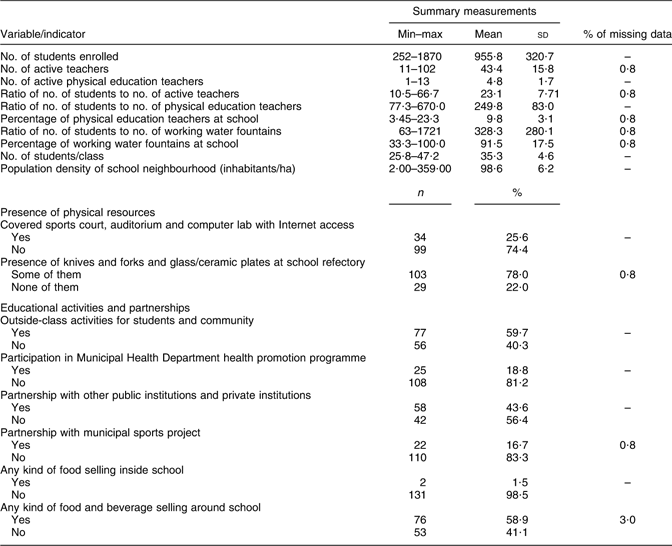
Schools presented a wide variation in availability of human and physical resources (Table 1). The minority of schools had a covered sports court, auditorium and computer lab with Internet connection (25 %), areas and equipment that help in the development of sports and educational activities. Only two schools sold food inside their facilities. Of the schools evaluated, a small percentage participated in health programmes and sports projects (18·8 % and 16·7 %, respectively).
Characteristics of schools and their locations, Rio de Janeiro Public Municipal School Network, 2007
Individual variables associated with overweight at a 25 % significance level are shown in Table 2. The age of adolescents had a quadratic relationship with overweight, as did the intake of raw salad in the 7 d before the study. Among behaviours included, the ones that presented the strongest associations were: the habit of eating or snacking while watching television or studying; and not practising physical activity outside school on at least 1 d in the previous 7 d. Schooling of the head of household presented an inverted U-shaped relationship with overweight: the chance of prevalence of overweight was higher among adolescents whose head of household had intermediate education (8–10 complete years of schooling) compared with adolescents whose head of household had less or more schooling. Other sociodemographic characteristics like skin colour, total number of appliances in the household and presence of a maid for 5 d/week or more did not present an association with overweight; nor did some behaviours related to diet, time dedicated to physical activity practice or habit of watching television. Behaviours like trying cigarettes or alcoholic beverages and using medication or induction of vomiting to lose weight did not present statistically significant associations either.
Individual factors associated with overweight among adolescents enrolled in public schools of the municipality of Rio de Janeiro, 2007: univariate analyses

POR, prevalence odds ratio.
*P value of Wald statistics.
†Adjusted by quadratic term.
Still in the univariate analyses, adolescents who attended schools with a covered sports court, auditorium and computer lab with Internet connection, that provided knives and forks or ceramic/glass plates in the school refectory, that were engaged in partnerships with municipal sport projects and that were located in areas with a smaller population density were less likely to be overweight (Table 3).
School characteristics associated with overweight among adolescents enrolled at public schools of the municipality of Rio de Janeiro, 2007: univariate analyses

POR, prevalence odds ratio.
*P value of Wald statistics.
In the multiple analyses, the unavailability of knives and forks or ceramic/glass plates for students in the school refectory was the only characteristic of the school that remained in the final model, increasing the adolescent's chance of being overweight by 40 %. As for individual factors, schooling of the head of household had the same association pattern identified in the univariate analysis and remained in the final model. Not living with both parents and not practising physical activity outside school on at least 1 d of the past 7 d were directly associated with the occurrence of overweight (Fig. 1).
Characteristics of the school and individual associated with overweight among adolescents enrolled in public schools of the municipality of Rio de Janeiro, 2007. Prevalence odds ratio (POR), with 95 % confidence interval represented by vertical bars, adjusted according to blocks of variables: PR (physical resources), knives and forks or glass/ceramic plates not available at school refectory; Sd (sociodemographic), not having both parents living in the same household as the adolescent; Sd1 (sociodemographic 1), head of household had 8–10 years of schooling; Sd2 (sociodemographic 2), head of household had ≥11 years of schooling; Bh (behavioral), not exercising outside school on at least 1 d in the past 7 d

Discussion
The multilevel analysis did not identify a context effect (school) on study outcomes. Our original hypothesis, that the school environment could explain the variation in the overweight proportion, was not confirmed in this population. This can be explained because of the sample design, which was not representative at the level of schools, and because a concentration of overweight frequency was not observed in any group of schools. Among the results of the few studies that tested this hypothesis, a small proportion of BMI variation (3–5 %) was found to be related to school(Reference O'Malley, Johnston and Delva28, Reference Richmond and Subramanian29). Other studies have also suggested that the school environment may influence behaviours associated with health, such as the different patterns in the consumption of alcohol, tobacco and physical activity practised by adolescents(Reference Kumar, O'Malley and Johnston30–Reference Richmond, Hayward and Gahagan33).
The only school characteristic that presented a statistically significant association with the presence of overweight among adolescents was the availability of ceramic/glass plates and/or knives and forks in the school refectory. The public schools of the municipality of Rio de Janeiro are assisted by the NSFP, which is supported by municipal and federal governments and complies with national guidelines(34). The city's departments of health and education have developed some actions to improve this programme(Reference Maldonado, Azevedo and Castro35). One of these actions was the incentive to change plastic plates for glass/ceramic plates and spoons for knives and forks, especially to encourage adolescents to have the balanced meals offered by school and avoid eating snacks with high energy and low nutrient density. This and other actions have been implemented heterogeneously among schools. Unfortunately, it was not possible to identify how this variable contributed to the reduction of the chance of prevalence of overweight among adolescents. We may assume that this is a marker variable to identify the schools that adhered more easily to NSFP's improvement recommendations or that were more concerned with the development of health promotion and healthy diet actions, which would promote healthier behaviours among adolescents, and could partly explain the results of the present study.
Indicators used in the present study as markers of socio-economic level (total number of appliances in the household and presence of a maid working regularly in the household) were observed not to be associated with overweight. However, the years of schooling of the head of the family were associated with overweight. Recent papers reveal that the association between socio-economic markers and overweight has changed its dynamics in past decades among children and adolescents, both in developed and developing countries(Reference Shrewsbury and Wardle36, Reference Matijasevich, Victora and Golding37). A systematic review published recently showed that the association between socio-economic level and overweight is inverse in developed countries and direct in developing countries in most studies(Reference Cardoso, Engstrom and Leite9). Specifically, among studies with Brazilian adolescents that identified an association between schooling of parents, head of household or of mother and overweight, there was no consensus between the criteria employed and the results found(Reference Ribeiro, Colugnati and Taddei38–Reference Fernandes, Codogno and Cardoso40). Completing 8–10 years of schooling, which encompasses heads of households who finished primary education but did not complete high school, may represent a part of the population studied who did not undergo food deprivation, but who still did not have healthier life habits due to lack of information, cultural or social values or economic conditions within the context. Furthermore, adolescents in developing countries also have bad food habits and their nutritional practice is not in accordance with their knowledge(Reference Mirmiran, Azadbakht and Azizi41). The absence of an association in our study may be due to the homogeneity of the target population with regard to socio-economic markers (at least for total appliances, about 67 % of the adolescents had between six and eight appliances in their households) or could effectively express the current status of this association in this group. However, we did not find studies in Brazil with similar results.
It should be noted that the presence of both parents at home reduced the chance of overweight among the adolescents studied. This characteristic may be related to a higher socio-economic level of families and/or closer monitoring of the behaviours of adolescents, including their diets, which could promote the adoption of healthier habits.
We did not find a positive association between overweight and food consumption characteristics mentioned previously in the literature such as the frequency of consumption of soft drinks, the habit of having breakfast and the number of meals. This result may be explained by the nature of the indicators analysed, given there was no quantification of consumption or a more detailed list of foods, and by the low reliability observed in this block of variables (detailed further below).
Practising physical activity outside school on at least 1 d in the past 7 d was shown to be a protective factor against overweight, which corroborates other studies that have already demonstrated the effectiveness of the practice of physical activity in the prevention and treatment overweight in many parts of the world(Reference Reichert, Baptista Menezes and Wells42).
Some aspects of the present study with greater potential for the occurrence of systematic errors are now examined. The estimated sample size (n 1700) was not the effectively studied sample (n 1632); however, the losses were small and we believe they did not affect the identification of associations. The goal of imputation was reached given that: (i) the distribution of data was conditionally preserved in relation to ancillary variables adopted for imputation; and (ii) the results extracted were not compromised by the imputation procedure. The modelling process (simple and multiple regressions) with the variable of years of schooling completed by the head of household and the outcome was conducted without and with values imputed, in order to identify a potential distortion of results due to the imputation. We observed that the association between this variable and overweight remained in the same direction in both situations; moreover, the estimate of POR was not significant in both the simple and the multiple regression analyses when the variable without imputed values was used, which suggests that the imputation contributed to the recovery of the expected variance in the population. No studies were conducted to assess the validity of the questionnaires used. However, other measures to control data quality were adopted, like the training, standardization and re-training of field researchers. We also performed a reliability study for the questionnaire answered by students. Lower κ values were observed for the variables related to food consumption and behaviours. The low reliability observed for this issue may be due to the existence of different categories in answer choices, days and times, which may have been understood differently by adolescents in the two moments they answered the questionnaire. One of the consequences of this result could be the underestimation of the measurement of association. Furthermore, it should be noted that the study design (cross-sectional) used herein does not allow one to consider the associations observed here as causal associations, because there was no guarantee of time precedence of exposures in relation to outcomes.
Finally, we highlight that there is scarce information in the literature about variables that refer to the school food environment and their possible effects on overweight. Some studies conducted in developed countries have analysed the effect of ecological indicators based on individual measures of school neighbourhoods or location on overweight(Reference Lee, Anindya and Simon15, Reference Richmond and Subramanian29). In Rio de Janeiro this type of indicator may lead to false conclusions, because a relevant portion of the students of municipal public schools live in areas close to schools, but have social and quality-of-life indicators that are very different from the areas where schools are located. Still, even when they live in the same neighbourhood, there are major social differences within.
We recommend that the results of the present study be taken into account in health promotion and overweight prevention actions in the municipal schools of the city of Rio de Janeiro. We also consider that evaluation of the effect of the school environment on populations with a more heterogeneous socio-economic profile, using other methods such as the analysis of social contact networks, could provide a better understanding about the occurrence of overweight among adolescents.
Acknowledgements
The data analysed herein are from the ‘II Health Risk Factors Surveillance Survey Students of Rio de Janeiro’, which was funded by the National Research Council of Brasil (CNPq, Universal Notice 2006, Case No. 478,262/2006-0). The authors declare no potential or real conflicts of interest in this study. L.O.C. was responsible for the study design, analysis and interpretation and discussion of the results, and writing the manuscript. F.S.G. participated in the analysis and interpretation of data and revision of the manuscript. I.C.L. and I.R.R.C. participated in the study design, analysis and interpretation of the data, and critical revision of the article. The authors thank Professor Carlos Augusto Monteiro from São Paulo University for his important contribution in the interpretation of results and also for his valuable suggestions on the final version of the manuscript.



