Stroke is a both physically and mentally disabling condition that can affect the long-term need for care. The cost for stroke care therefore extends beyond the acute phase as some individuals may need life-long assistance in daily life. The direct cost for stroke in Europe in the first 12 months has been estimated to almost €27 billion (purchasing power parity adjusted 2010 prices) (Reference Gustavsson, Svensson and Jacobi1). Including costs for individuals with prevalent stroke this figure was €61 billion, or 4.2 percent of the total healthcare expenditures. In addition, indirect costs for work absence and early retirement were €3 billion. In Sweden, the direct cost for first-ever stroke in 1997 has been estimated to €351 million in the first year, or €18,300 per patient in year 2009 prices (Reference Ghatnekar, Persson and Glader2). Including a lifetime perspective and indirect costs in terms of production losses, the cost was estimated to €1.53 billion. Similar results, €21,200 per patient in the first year, was reported in a more recent study analyzing first-ever strokes in 2008 (Reference Persson, Ferraz-Nunes and Karlberg3). In both these studies, the cost for long-term home- and residential care services and rehabilitation amounted to approximately 40 percent of total costs.
Quality improvement in stroke care is, therefore, important to reduce disability and the need for long-term care. The Swedish National Board of Health and Welfare has provided national guidelines for stroke care since year 2000 to encourage evidence-based and cost-effective technologies, for example, stroke units (SUs), and to phase out those who are not, for example, high-dose heparin use for progressive stroke (4). Riks-Stroke (RS), a national quality register for acute stroke, was established in 1994 to improve and to ascertain a uniform quality of care across geographic areas in Sweden (Reference Asplund, Asberg and Appelros5). It covers all hospitals in Sweden that admit patients with acute stroke and has a coverage of more than 90 percent of all hospital admissions for acute stroke (6). The registry has provided insights in the development of baseline patient characteristics (Reference Appelros, Jonsson and Asplund7), improved thrombolysis therapy rates (Reference Asplund, Glader and Norrving8–Reference Stecksen, Asplund and Appelros10), increased statin treatment (Reference Sjolander, Eriksson and Glader11), the effect of stroke units (Reference Terent, Asplund and Farahmand12), to mention a few.
The purpose of this study was to analyze the impact of the development in stroke management on costs, both in terms of cost per patient but also the structure of the cost components. As a comparator to the societal cost of first-ever stroke in 2009, we used a similar cohort study with stroke admissions from the RS register in 1997 (Reference Ghatnekar, Persson and Glader2). Although we aimed at using an identical methodology in the two studies, the improved data availability in 2009 allowed fewer assumptions and deeper analyses.
METHODS
All first-ever stroke events (International Classification of Diseases, 10th Revision: I61, I63, I64) registered in RS during the first half of 2009 were included in the study. Patients were followed until December 31, 2011, that is, an incidence approach, with a follow-up period between 2.5 and 3 years. The date of death was obtained from the national cause of death registry at the National Board of Health and Welfare. For censored cases in the last half of year 3, we assumed identical mortality rate as in the first half, according to age group and gender. Patient characteristics, resource use, living conditions, and activities in daily life (ADL) were retrieved from RS in the acute phase, 3 and 12 month follow-ups forms (see http://www.riks-stroke.org/index.php?content=form&lang=eng for the full forms). The remaining years of survival was estimated for each age cohort and gender assuming a constant excess mortality as in year 3 compared with the general population. The average annual cost in year 3 was applied to the estimated remaining survival years to calculate the expected lifetime present value. An annual discount rate of 3 percent was applied to account for time preferences.
Unit costs for the included resources (see Supplementary Material, which can be viewed online at http://dx.doi.org/10.1017/S0266462314000075) were taken from official sources and expressed in year 2009 Euros (€1 = SEK10.6). The average cost per bed-day was taken from the Cost per Patient database, disaggregated by gender, age group, and stroke subtype in the analysis (13). The in-hospital stay was split between acute (Diagnosis-Related Group classification [DRG] Reference Bjorkdahl, Nilsson and Grimby14) and post-acute (DRG 550A) phase as patients may be referred to other wards for rehabilitation or readmitted with a post-stroke status. Some hospitals provided rehabilitation at home through early supported discharge (ESD). The estimated ESD cost per patient was based on data from a randomized controlled trial and included staff, transportation, and overhead costs (Reference Bjorkdahl, Nilsson and Grimby14). The municipalities also provided rehabilitation after stroke for patients discharged to residential housing for elderly and disabled. We estimated this cost per rehabilitated patient by subtracting the costs for residential housing and home assistance from the total municipality cost for the elderly and disabled (15). Costs for outpatient follow-up visits in the first 3 months after stroke were split according to the level of specialty, hospital outpatient visits (DRG 758O), or primary care (13).
The increased need for domestic ADL assistance due to stroke among patients discharged to their home was estimated by calculating the difference in ADL costs (scores in parenthesis) for reduced mobility outdoors (Reference Gustavsson, Svensson and Jacobi1) or reduced mobility out- and indoors (Reference Ghatnekar, Persson and Glader2), assistance with clothing (Reference Gustavsson, Svensson and Jacobi1), and toilet visits (Reference Gustavsson, Svensson and Jacobi1). The summary score ranging from 1 to 4 was assigned 16, 36, 48, and 76 hours per month of domestic aid assistance, respectively, at €41.43 per hour (Reference Ghatnekar, Persson and Glader2;15). Likewise, the difference was estimated for individuals moving to residential housing for elderly and disabled provided by the municipality (16).
Prescription of secondary prevention drugs at hospital discharge were costed according to their Defined Daily Dose (DDD) and drugs in the same class were grouped together. The unit price for simvastatin was used for statins; antihypertensive drugs included a weighted average of diuretics, beta-receptor blockers, calcium antagonists, and ACE inhibitors; antiplatelets included a weighted average of acetylsalicylic acid, dipyridamol, and clopidogrel.
Production losses for premature death, early retirement, and temporary sick leave for 2 months were calculated up to the age of 65 using the annual income including pay-roll taxes of 43 percent (human capital approach). From the 12 month follow-up, we had information on the change in work force participation as fully returned, partially or planning to return (assumed 50 percent in year 2).
The cost of stroke in a cohort admitted for their first-ever stroke in the first 6 months of 1997 was used as comparator to the 2009 cohort (Reference Ghatnekar, Persson and Glader2). The 1997 cohort included 4,357 patients with RS data from the acute phase and 3 and 24 month follow-up forms. Survivors were followed until 31 December 2000. Assumptions on follow-up visits, rehabilitation, secondary prevention drugs and productivity losses were based on published literature and official sources as this information was lacking in RS at the time. Apart from these differences, we used an identical methodology to facilitate comparability. We inflated care costs in the 1997 study to year 2009 prices with the county council price index and production losses with the consumer price index (17).
All statistical analyses were performed in SPSS for Windows, version 20 (SPSS Inc.). Non-parametric Mann-Whitney U-test and Chi-squared test were used to determine significant differences for means and proportions (p < .05).
RESULTS
Year 2009 Cohort of First-Ever Stroke
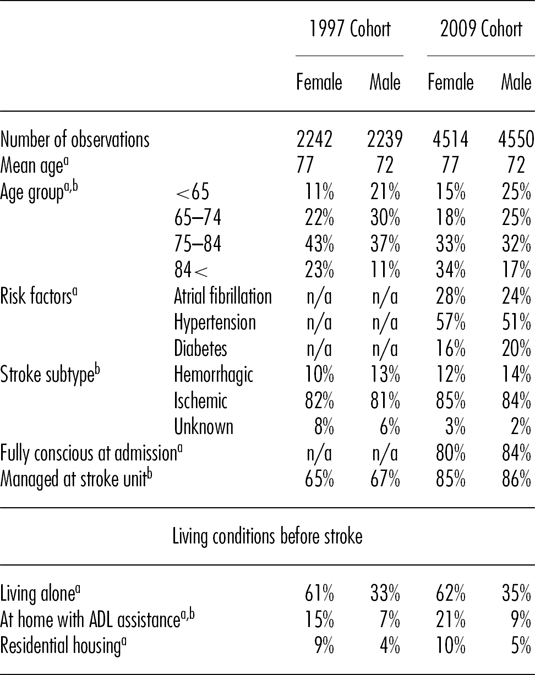
We retrieved in total 9,064 first-ever stroke patients during the first 6 months of 2009. The response frequency to the RS questionnaire was 88 percent and 74 percent among 3 month and 12 month survivors, respectively. Women were on average 5 years older than men (77 versus 72 years; p < .05), and twice as many women were 85 years or older (Table 1). Women were more frequently living alone at admission as a result of the higher age and longer expected lifetime than for men. Consequently, they needed more home assistance than men at baseline.
Patient Characteristics at Index Stroke Hospital Admission, by Study Cohort

a Indicates statistical difference between gender within each year (p < .05).
b Indicates statistical difference between study years (p < .05).
n/a, not available.
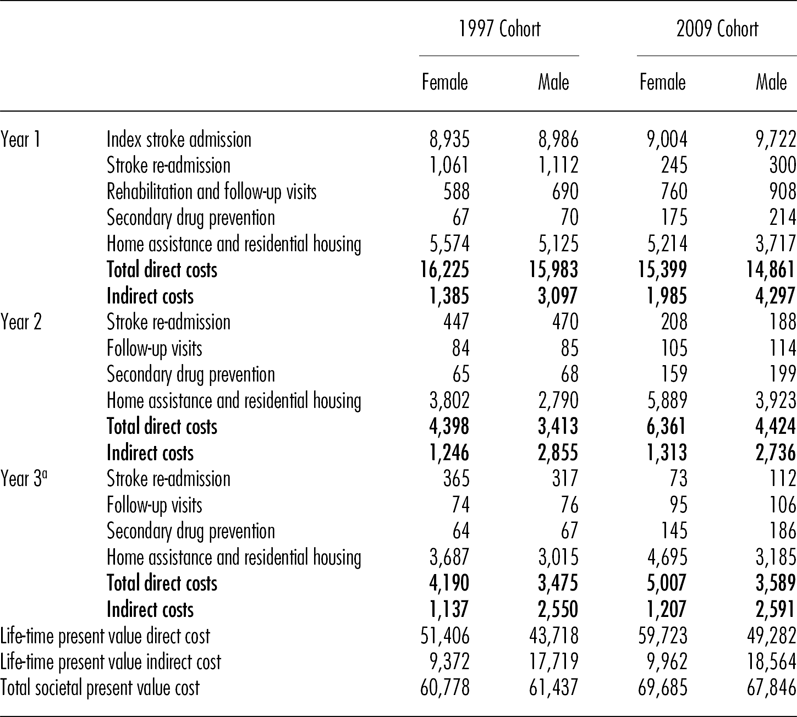
The index hospitalization cost constituted 62 percent of the direct costs in the first year (Table 2). Direct costs during the first 3 years was 86 percent and 70 percent for women and men, respectively (p < .01) due to women's greater need for home- and residential care services and lower production losses. The latter was a result of lower share of women in productive age and lower annual value of production. Costs for stroke re-admissions, follow-up visits, and secondary drug prevention were less than 10 percent of the direct costs in years 2 and 3. Applying an expected survival for censored observations, the societal present value cost for a first-ever stroke was €69,685 and €67,846 for women and men, respectively (p < .05; Table 2). The share of lifetime costs for home- and residential care services born by the municipality amounted to 67 percent and 50 percent for women and men, respectively. Indirect costs constituted 14 percent and 30 percent, respectively, and a retirement age of 63 years (instead of 65) reduced the lifetime indirect costs by 17 percent as fewer working days would be lost.
First-Ever Stroke Related Costs by Year of Admission and Gender (Euro, 2009 Prices)

aCosts and survival in year 3 for censored observations in the 2009 cohort were estimated by extrapolation of available survival data in year 3, on average by 91 days per observation.
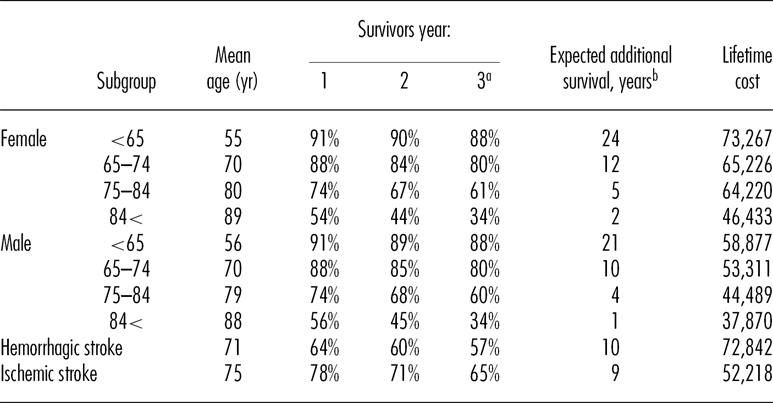
The oldest age-group had the lowest stroke related costs mainly as their expected additional survival was shorter, Table 3. This was partially off-set by a greater proportion moving to residential housing as they were not able to live at home with home assistance. Women were living alone to a greater extent and therefore needed more ADL assistance after the stroke. Production losses for the age group less than 65 years were €66,717 and €72,942 for women and men, respectively (not presented in Table 3). Hemorrhagic stroke had both higher direct costs, although not statistically significant, and higher fatality rate (p < .05) than ischemic stroke.
Expected Present Value Lifetime Direct Cost for Subgroups Experiencing a First-Ever Stroke in 2009 (Euro, 2009 Prices)

aCosts and survival in year 3 for censored observations in the 2009 cohort were estimated by extrapolation of available survival data in year 3, on average by 91 days per observation.
bAssuming same mortality as the general population after year 3 and onwards.
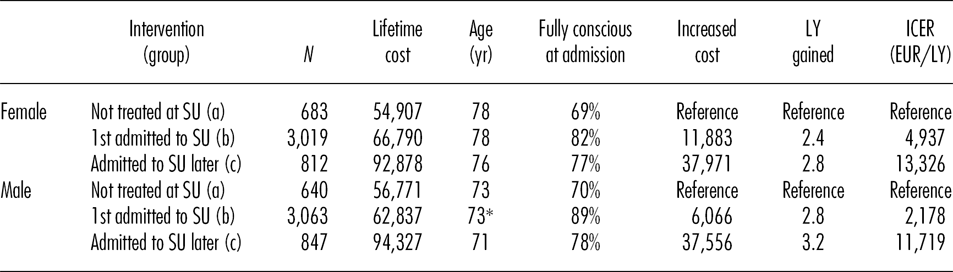
Patients first admitted to an SU (70 percent and 67 percent, female and males, respectively) had lower societal lifetime costs than those never treated or referred at a stroke unit later on (p = .92 for women; p < .01 for men). In addition, approximately 0.9 expected life-years were gained for patients first admitted at a stroke unit (p < .05). However, comparing costs and outcomes for patients that were never treated at an SU (a) to those first admitted to an SU (b) or referred to an SU later (c), increased both costs and life-years gained (Table 4). This indicated that patient characteristics needed to be controlled for more properly to make correct conclusions.
Expected Lifetime Societal Costs, Life-Years Gained and Incremental Cost-Effectiveness Ratio (ICER) per Patient with First Stroke in 2009 (Euro, 2009 Prices)

*Not statistically significant, all other values were statistically significant compared to the reference.
SU, stroke unit; LY, life-years; ICER, incremental cost-effectiveness ratio.
Comparison of the 1997 and 2009 Cohort Studies
Compared with the 1997 cohort, the number of observations more than doubled. The main reasons for this were the improved coverage in the RS register and the inclusion of all hospitals admitting acute stroke patients. Although the mean age differed only by 0.4 years (p < .01), the age structure changed over the time with higher proportions in both the youngest and the oldest age groups (Table 1). Improved diagnostic procedures led to fewer unknown stroke subtypes. Admission to an SU and the need for home assistance before the index stroke among women increased between the study periods. It was not straightforward to compare survival between the 1997 and the 2009 data as the coverage in RS improved and patient characteristics changed during the time period. In fact, the initial case fatality was higher in 2009 but should be viewed in relation to differences in patient characteristics and improved coverage also of early deaths in RS (see Supplementary Material). The development differed between genders as men gained in survival between the study periods.
The average length of stay for the index admission fell from 22 to 17 days but the total cost did not change due to a higher cost per day. Prescription of secondary prevention drugs improved and costs increased, although from low levels, despite lower unit prices due to generic substitution. This improvement was paralleled by fewer stroke re-admissions, even though the causality may be complex.
The changed age structure since 1997 had implications on long-term costs. Most elderly often had home- and residential care services before the stroke, reducing the excess cost due to stroke. In addition, although only 10 percent in the youngest age group reported need for ADL assistance, they had the longest expected survival. Therefore, the increase in these two age groups increased the overall long-term home- and residential care cost compared with the 1997 cohort, and especially so for women, although the cost per patient in the younger age-groups fell (Table 3). Long-term indirect costs rose slightly but were based on patient reported labor force participation in 2009 and not an assumption as for the 1997 cohort.
Costs for rehabilitation and follow-up visits for the 1997 cohort were based on assumptions from the literature, which today seem to have been an overestimation as active rehabilitation was limited to the first year after the index event in the 2009 study. Reducing the assumptions to the 2009 cohort values, the lifetime direct costs would be around €51,400 and €43,700 for women and men, respectively (year 2009 prices), that is, costs had increased in year 2009.
DISCUSSION
Information on the costs attributable to stroke provides an indication on the value of primary prevention. We estimated the societal lifetime present value for a first-ever stroke in 2009 to €68,800 per patient. Residential housing and home assistance constituted 59 percent and indirect costs for productivity losses for 21 percent of the costs. Hospitalization costs for the index stroke was 14 percent, while costs for recurrent stroke were almost negligible. Furthermore, we showed that lifetime costs were higher for hemorrhagic strokes and for women in all age groups. On a national level, the total societal lifetime direct cost for the approximately 22,000 first-ever strokes that occurred in 2009 would amount to €1.2 billion. As a comparison, the total healthcare expenditure in Sweden in 2009 was €29.1 billion, although not all home and residential care services were included in this figure. In addition, another €314 million would be lost in indirect costs. As we used an incidence approach, the lifetime calculations would correspond to a prevalence costing study assuming a constant incidence and relative prices, and a zero discount rate.
Compared with the 1997 cohort study, the improvement in data collection in the RS allowed for fewer assumptions, although the methodology was identical otherwise. As such, we identified the cost for outpatient visits and rehabilitation to have been overestimated in the 1997 cohort study. Adjusting it to year 2009 values, the resulting societal lifetime cost would be €61,100 (55 percent housing assistance and 22 percent indirect costs). During the 2000s, several improvements in preventive care and acute stroke management have resulted in improved outcomes:
-
• Higher proportion with primary prevention, such as of hypertensive treatment and oral anticoagulants for atrial fibrillation, before the index stroke
-
• Faster and more accurate diagnosis of acute stroke
-
• More patients receiving thrombolytic treatment due to:
-
° Stroke awareness campaigns shortened the time between symptom debut and presentation at the hospital
-
° Improved acute management with “stroke-alarm” to the hospital and early preparation of thrombolysis,
-
-
• Improved proportion of patients treated at a stroke unit,
-
• Improved rehabilitation, both “in-hospital rehabilitation” and “early supported discharge with rehabilitation”
-
• Improved follow-up after stroke and subsequently a higher proportion of patients with secondary preventive treatment (6;Reference Asplund, Glader and Norrving8–Reference Stecksen, Asplund and Appelros10;Reference Terent, Asplund and Farahmand12).
Although the causality is difficult to establish, the number of recurrent stroke fell, long-term survival tended to improve, and the pre-stroke functional status improved (Reference Appelros, Jonsson and Asplund7). Together with the revised assumptions, these improvements resulted in an increase of approximately 13 percent in direct costs since 1997. Riks-Stroke has reported improved coverage especially of fatal strokes during the acute phase (18). This could explain the higher fatality rate seen in the first year of the 2009 cohort. In parallel to the development in the healthcare sector, municipality services have shifted from residential housing to home assistance with higher thresholds for receiving care (Reference Rostgaard and Szebehely19). As a consequence, the number of users with tax deductions for privately purchased household services launched in 2007 doubled between 2009 and 2010 (Reference Rostgaard and Szebehely19).
Another interesting finding was that patients first admitted to a SU (group b in Table 4) generated cost savings compared with group c, that is, those admitted to some other ward and then transferred to an SU. These cost savings disappeared when we compared with patients that were never treated at an SU (group a), although the number of estimated life-years gained was quite substantial. Assuming conservatively a utility value of 0.5 for these life-years indicated that treatment at an SU could be a cost-effective intervention even at a utility value of 0.5, that is, a doubling of the incremental cost-effectiveness ratios in Table 4. It was beyond the scope of this study to match patient characteristics to analyze the determinants for this finding, but we believe that the RS data have the potential for assessing different healthcare technologies in real-life practice.
Such assessments can be used to assist decision makers in developing stroke management further. In the case of stroke units for example, the introduction of a pay for performance scheme could be feasible whereby the clinic receives a reward for admitting the patient to a stroke unit first, and not later (Reference Towse and Garrison20). These schemes should not be limited to cost saving interventions if they are desirable to promote for medical and/or political reasons. The extension of this study could therefore be to link costs to preference based quality of life instruments which would allow cost-utility analyses, suitable for horizontal prioritizations. That would demand matching control groups, and as RS has a national coverage, this ought to be fairly easy.
In a recent cost of illness study in a healthcare region in Sweden with 1.5 million inhabitants, the mean cost per stroke patient in the first year was €21,200 (year 2008 prices) (Reference Persson, Ferraz-Nunes and Karlberg3). This was slightly higher than our estimation mainly due to higher costs for home- and residential assistance and some additional cost items. They also concluded that a large share of the long-term cost of stroke was born by the municipality in terms of ADL assistance. It is therefore important for decision makers to avoid a “silo-mentality” as the gains from investments in health care can occur in other places in society (Reference Drummond and Jonsson21;Reference Ramsberg and Ekelund22).
A limitation with our study was that we did not include caregiver costs for unpaid informal care, which have been estimated to 6 percent of the total societal cost of stroke (Reference Persson, Ferraz-Nunes and Karlberg3). This limitation has bearings not the least in the gender perspective as more male stroke patients were discharged to home with a spouse assisting in the daily activities than vice versa. Hence, some of the care needed for men was provided by the spouse, whereas when women experienced a stroke, their spouses already had disease and/or had ADL support. Furthermore, indirect costs were estimated up to the age of 65, which is the official retirement age in Sweden, although some individuals chose to stay in, or quit, the labor force beyond, or before, this age. Still, we believe it is a transparent rule that allows comparisons with other studies that have used the same cutoff and the indirect costs were not very sensitive to retirement age. Accounting for declining drug persistence would reduce long-term drug costs by approximately 26 percent (Reference Glader, Sjolander and Eriksson23). Finally, a unit cost should reflect the value of an item or service. Therefore, as the content of the product evolves, so should the unit cost. In this study, we saw a fall in the number of hospitalization days while the cost per day increased to fully off-set this potential saving. This complicates the comparison of studies performed at different times in a similar way, such as comparison between countries (Reference Drummond, Barbieri and Cook24;Reference Peltola and Quentin25).
CONCLUSION
The societal lifetime cost per patient related to stroke increased between 1997 and 2009 by approximately 13 percent. This was mainly due to improved primary- and secondary prevention, pre-hospital management, greater fraction of patients treated at stroke units and rehabilitation, which changed patient characteristics and increased the expected survival. Some assumptions in the 1997 cohort study were also revised downward. The development of the RS data capture could allow future studies on health economic assessments of interventions in stroke care management.
SUPPLEMENTARY MATERIAL
Supplementary Material: http://dx.doi.org/10.1017/S0266462314000075
CONTACT INFORMATION
Ola Ghatnekar, PhD (olaghatnekar@gmail.com), Department of Public Health and Clinical Medicine, Umeå University, 901 87 Umeå, Sweden
Ulf Persson, Professor, Swedish Institute for Health Economics, Box 2127, Lund, Sweden
Kjell Asplund, Professor, Department of Public Health and Clinical Medicine, Umeå University, 901 87 Umeå, Sweden
Eva-Lotta Glader, PhD, Department of Public Health and Clinical Medicine, Umeå University, 901 87 Umeå, Sweden
CONFLICTS OF INTEREST
O. Ghatnekar reports a grant from Västerbotten county council (unconditional research grant). U. Persson reports no conflicts of interest. K. Asplund reports a grant to institution from Västerbotten county council (unconditional research grant). E.-L. Glader reports a grant to institution from Västerbotten county council (unconditional research grant).