Introduction
The natural environment of the Arctic is generally regarded as hostile for humans and is characterised by low economic capacity and population density. Better technology, accessibility and increased knowledge have created greater possibilities to utilise the natural resources in these regions, but has simultaneously posed a threat to the environment (Gössling and Hall Reference Gössling and Hall2006; Howard Reference Howard2009). Tourism is one of these booming economic sectors. In the Arctic, the number of visitors is increasing and it is already at a substantial level; it has been estimated that over five million tourist trips occur in the Arctic or sub–Arctic region every year (Hall and Saarinen Reference Hall, Saarinen, Hall and Saarinen2010). Indeed, Arctic wilderness environments have become a major attraction for tourists. Consequently, the tourism industry has become a vital stakeholder when discussing how to utilise the wilderness.
Iceland is an Arctic destination which has experienced a dramatic growth in international tourist arrivals with an approximately 9% average annual growth, from 72,600 in 1982 to about one million in 2014. The annual growth has been particularly strong in the last four years (about 20%) (Icelandic Tourist Board 2014), compared with 3% growth in tourist arrivals in Europe and 4% in the world in 2012 (UNWTO 2013). The significant devaluation of the Icelandic currency (króna) due to the economy crises in 2008 has led to Iceland becoming a cheaper destination. Furthermore in 2010 the volcanic eruption in Eyjafjallajökull drew the attention of the world. This lead to increased interest in the country as a tourist destination which is reflected in an increased supply of flights to the island, including flights by low fare airlines like EasyJet and Ryanair. This increased supply of flights to Iceland has resulted in even more travelers coming to the country. Nature is the most important attraction in Iceland almost 90% of all international tourists visit the country because of its nature. About one third of international summer tourists visit the central highlands, here referred to as the highlands (Icelandic Tourist Board 2012) (Fig. 1). The area covers about 40% of the country (Ministry for the Environment and National Planning Agency 1999), is uninhabited and is one of the largest remaining wilderness areas in Europe. The highlands did not become economically important, with the exception of sheep grazing, until the mid–1960s when the first hydropower plant was built. Since then, and with increased technology and knowledge of the highlands, their rivers and geothermal areas have become important potential resources for the power intensive sectors, such as aluminium smelters. At the same time tourist use of the area started to evolve (Sæþórsdóttir and others Reference Sæþórsdóttir, Hall and Saarinen2011).
The highlands, wilderness, existing power plants and power plant proposals in Iceland. Sources: the borderline of the Central Highlands: Ministry of the Environment & National Planning Agency 1999; Wilderness mapping: Ólafsdóttir and Runnstrom Reference Ólafsdóttir and Runnstrom2011. Power plant proposals: Björnsson Reference Björnsson2011.

The Icelandic economy has changed rapidly, from a poor traditional agricultural and fishing economy into an economy with a highly developed fishing industry, power intensive industries and a fast–growing tourism sector. Today, both tourism and power–generation are very important. The share of aluminium and other products of the power intensive industry in exports has increased from 10.4% in 1990 to 21.0% in 2013. The share of tourism in total export has, in the same period, increased from 11.2% to 26.8%. In contrast to this, the share of seafood has declined from 56.3% in 1990 to 26.5% in 2013 (Statistics Iceland 2013b). This economic transformation demonstrates the changing use of nature as a resource in which new kinds of resources are emerging. These have been significant in the Icelandic society and policy–making arena, as there is no consensus between tourism and power production on where and to what extent power plants should be built or what should be left for tourism or conservation.
What is a ‘natural resource’ is constantly defined and re–defined by a society, culture and economy and can only be transformed into an economic resource when society has the means and the desire to utilise nature as a resource (Castree Reference Castree2005). Related to this Zimmermann (Reference Zimmermann1951: 15) stated that, ‘resources are not, they become; they are not static but expand and contract in response to human wants and actions’. In this paper we follow this idea and consider natural resources, their use and values to be constantly changing, depending on discourses about socio–economic development. The aim of this paper is to analyse the development of tourism and power production in the highlands and the challenges created by the changing ideas of natural resources. It furthermore discusses a governmental project which is intended to solve the challenging conflicts about the use of natural areas and resources.
In the paper we use results based on questionnaire surveys among travellers in the highlands, gathered by one of the authors. The surveys focus on wilderness experience and some of them also on potential land use conflicts between tourism and power production (Sæþórsdóttir Reference Sæþórsdóttir2010a, Reference Sæþórsdóttir2010b, Reference Sæþórsdóttir2012a, Reference Sæþórsdóttir2013, Reference Sæþórsdóttir2014; Sæþórsdóttir and Ólafsson Reference Sæþórsdóttir and Ólafsson2010a, Reference Sæþórsdóttir and Ólafsson2010b, Reference Sæþórsdóttir2012a). In the paper we furthermore analyse official discourse on the utilisation of the natural resources in the highlands. The analysis is based on the annual reports of the National Power Company of Iceland (Landsvirkjun) and the Icelandic Travel Industry Association, various reports issued by the Ministry of Tourism Affairs, as well as parliamentary papers and parliament proposals from the National Parliament (Alþingi).
Wilderness as a resource
For a long time the word wilderness was used to describe wasteland that awoke feelings of terror and was outside the safe bounds of human settlement (Cronon Reference Cronon and Cronon1998). This changed in the nineteenth century when the Romantics began to admire the sublime and the wild in nature (Macnaghten and Urry Reference Macnaghten and Urry1998; Nash Reference Nash2014). Due to this social trend wilderness, natural areas and natural phenomena have become an important resource for the tourism industry (Nash Reference Nash2014; Talbot Reference Talbot, Callicott and Nelson1998).
Waterfalls were one of the natural phenomena which became loved and admired by the Romantics. However, they started to receive other kind of interest soon, as towards the end of the nineteenth century technological innovations made it possible to produce electricity with waterpower and transport it by power lines over large distances (Hughes Reference Hughes1983). In the 1880s hydroelectric power generation started in the USA. This created major conservation conflicts, such as the industrialisation of Niagara Falls versus its sublime presentation to tourism (Irwin Reference Irwin1996; Nash Reference Nash2014). In the modern environmental era hydro–electric generation development has increasingly come into conflict with wilderness conservation (Hall Reference Hall1992).
In the 1960s and early 1970s a substantial shift occurred in several western countries with respect to hydro–electric schemes being used for regional development purposes in peripheral areas, with the opposition to such schemes and development projects instead advocating the importance of wilderness in its own right and its value for tourism. This obviously created further conflict (see Hall and Shultis Reference Hall and Shultis1991; O’Riordan Reference O’Riordan1990; 7; Sewell and Dumbrell Reference Sewell and Dumbrell1989), which emerged partly because of the nature of wilderness experience: the experience involves high degrees of naturalness, primitiveness, solitude and limited accessibility (Castree Reference Castree2005; Cole and Hall Reference Cole and Hall2008; Hall and Page Reference Hall and Page2014; Hall and Cole Reference Hall and Cole2007; Lesslie and Taylor Reference Lesslie and Taylor1983; Sæþórsdóttir Reference Sæþórsdóttir2010b). Therefore human constructions, whether they relate to tourism or other economic activities, can reduce wilderness experiences considerably (Hallikainen Reference Hallikainen2000; Johnson and others Reference Johnson, Hall and Cole2005; Manning Reference Manning1999; Sæþórsdóttir Reference Sæþórsdóttir2010a, Reference Sæþórsdóttir2010b). The quality and value of wilderness, furthermore, depend on the neighbouring areas. In the words of Hendee and others (Reference Hendee, Stankey and Lucas1990, 190–191): ‘what goes on outside of, but adjacent to, a wilderness can have substantial impact inside its boundary’. This is also in line with what Lesslie and others (Reference Lesslie, Maslen, Canty, Goodwins and Shields1991, 20) argue: ‘. . .a development in lesser quality wilderness on the margin of an area of higher quality wilderness will reduce wilderness quality within the higher quality area’.
The above views indicate a dualistic division between humans and nature. In line with that approach the word wilderness has been influentially defined by Nash (Reference Nash2014: 3) ‘as uncultivated and otherwise undeveloped land. The absence of men and the presence of wild animals is assumed’. This traditional wilderness idea involves a rejection of the evidence of human action and ignores the fact that most supposed wilderness has been inhabited by indigenous peoples for thousands of years. On that base, the wilderness concept has been questioned, by claiming that nature is either completely, or to a certain extent, socially, culturally and economically constructed (Callicott Reference Callicott2000; Callicott and Nelson Reference Callicott, Nelson, Callicott and Nelson1998; Guha Reference Guha, Callicott and Nelson1998; Williams Reference Williams2002).
Tourism in the highlands of Iceland
The Icelandic concept ósnortið víðerni (unspoiled wilderness) was used for the first time in 1990 in the proposal for a parliamentary resolution on national tourism policy in which unspoiled wilderness is claimed to be one of the most important resources of Icelandic tourism. A decade later a definition of the concept appeared in the Icelandic Nature Conservation Act:
Wilderness: an area of land at least 25 km2 in size, or in which it is possible to enjoy the solitude and nature without disturbance from man–made structures or the traffic of motorised vehicles on the ground, which is at least 5 km away from man–made structures or other evidence of technology, such as power lines, power stations, reservoirs and main roads, where no direct indications of human activity are visible and nature can develop without anthropogenic pressures (Al_ingi 1999: Section 1).
According to the definition, wilderness characterises approximately 33% of the total area of the country (Ólafsdóttir and Runnstrom Reference Ólafsdóttir and Runnstrom2011) (Fig. 1). Most of the wilderness areas are located in the highlands, and about 60% of the highlands is wilderness according to the legal definition (National Planning Agency 2012). Since the 1930s the legally defined wilderness in Iceland has been reduced to about 70% (Taylor Reference Taylor2011) mainly due to the development of power plants and tourist activities, which also create the main threats to wilderness in the country (Ministry for the Environment 2011).
The landscape in the highlands is characterised by wide open spaces, with vast lava fields, sandy or stony deserts, large ice caps, geothermal areas and mountains (Thórhallsdóttir Reference Thórhallsdóttir, Watson and Alessa2002). Throughout its history, very few have travelled into the highlands due to the rough landscape, poor accessibility and harsh climate (Sæþórsdóttir and others Reference Sæþórsdóttir, Hall and Saarinen2011). During World War II four–wheel–drive US army trucks were imported, and they made it possible to access the area. In the 1950s the classical ‘highland safari’ was developed and became the first significant organised tourism in the highlands (Huijbens and Benediktsson Reference Huijbens and Benediktsson2007, Reference Huijbens and Benediktsson2013; Sæþórsdóttir and others Reference Sæþórsdóttir, Hall and Saarinen2011). In the mid–1960s when the first large hydropower plants were built in the southern highlands, the roads were improved and asphalted and bridges built. That led to increased access to some of the areas in the southern highlands, for example Landmannalaugar, the most visited highland destination in Iceland.
Nowadays about 36.3% of international summer tourists visit the area (Icelandic Tourist Board 2012). A study (Sæþórsdóttir Reference Sæþórsdóttir2010b) shows that the most important component of the Icelandic wilderness experience is unspoiled and unique nature, finding freedom from busy life, and solitude. The majority (73%) of highland visitors consider the number of tourists in the various highland destinations to be appropriate (Sæþórsdóttir Reference Sæþórsdóttir2014). However, there are warning signs, as one third of visitors to Landmannalaugar consider that there are already too many tourists, jeopardising the wilderness experience and character of the site. Furthermore, there has been a 50% increase in those who consider that there are too many tourists in the area, from 20% in the year 2000, to 30% in 2009 (Sæþórsdóttir Reference Sæþórsdóttir2013). Indeed, highland travellers mention Landmannalaugar most frequently as the place not to visit due to the large number of tourists (Sæþórsdóttir Reference Sæþórsdóttir2012a).
The rapid increase in tourism also has environmental impacts, especially on vegetation due to trampling from hikers (Gísladóttir Reference Gísladóttir2005; Ólafsdóttir and Runnstrom Reference Ólafsdóttir and Runnstrom2013). On the other hand this is not particularly visual to travellers as only a few of them noticed environmental damage due to tourism. Marks after off–road driving are the most noticed of the environmental effects while erosion from hikers, damage to vegetation, trampling by horses, garbage and damage to geological formations are also known to exist (Sæþórsdóttir Reference Sæþórsdóttir2014). Most visitors in the highlands are against infrastructure developments, such as power plants and the accompanying structures, as well as hotels, restaurants and asphalted roads (Sæþórsdóttir Reference Sæþórsdóttir2010a, Reference Sæþórsdóttir2010b, Reference Sæþórsdóttir2012a, Reference Sæþórsdóttir2014).
In 2010 a proposal for a parliamentary resolution on tourism policy in the central highlands was approved by the Icelandic parliament. There the task is said to be to develop a policy for tourism in the built upon the principles of tourism carrying capacity (Alþingi 2010). The annual meeting of the Icelandic Tourist Industry Association (2012) also focused on tourism carrying capacity and expressed concerns regarding the rapid growth of tourism. This reflects the recognition that there is a limit to the growth of tourism and that the wilderness experience is extremely sensitive to all kinds of development.
Utilisation of hydropower and geothermal power
Hydropower provides about 73% of the electrical power produced in Iceland, while the remaining 27% comes from geothermal sources (Statistics Iceland 2013a). With a population of 320,000 the country produces the most renewable electricity per capita in Europe. That is 2.25 times more than Norway, which is in the second place. Iceland is in the 14th place among European countries with regard to production of renewable electricity (U.S. Energy Information Administration 2013). Consequently, the opinion that the country possesses an abundance of energy is common in Iceland (Hreinsson Reference Hreinsson2007).
The use of hydroelectricity in Iceland started in the first half of the twentieth century when small hydropower plants were built in the lowlands (Karlsson Reference Karlsson2000). The large scale utilisation of these natural resources did not start until the mid–1960s, when the first hydro–power plant was constructed in the southern Highlands to produce electricity for the first aluminium smelter in the country. The plant was built by the National Power Company (Landsvirkjun) which was founded in 1965 to provide energy for the smelter (Karlsdóttir Reference Karlsdóttir2010; Karlsson Reference Karlsson2000). In the following years, more plants were built. Now there are seven plants in the Highlands, five in the south, one in the northwest and one in the northeast (fig. 1).
From the beginning of settlement in Iceland geothermal energy has been used for heating water for bathing and washing, but it became economically important in the 1930–40s when it was harnessed for heating houses in Reykjavík. Currently, geothermal energy is used by about 90% of all households in Iceland (Ragnarsson Reference Ragnarsson2005). The harnessing of geothermal energy for electrical generation started in 1969, when a power plant was built in the northern part of the country. Since then, five geothermal power plants have been built in Iceland, all located in the lowlands. The most powerful geothermal areas are, however located in the Highlands which makes the area highly interesting for future geothermal power production (Arnórsson Reference Arnórsson2012; Arnórsson and others Reference Arnórsson, Axelsson and Sæmundsson2008).
When the first aluminium smelter went into operation, half of the energy produced in Iceland was used by the smelter and the other half by local people and local industry. Since then the share used by power intensive industry has increased and is now about 83% of the total energy produced in Iceland (Statistics Iceland 2013a). Since the first aluminium smelter was built, five more power intensive plants have been built, all owned by foreign companies. The main reason that transnational power intensive industries are located in Iceland is the low price of energy (Jónsson and others Reference Jónsson, Hauksson, Jónsson and Þorgeirsson2013). The raw material for the production has to be imported and is often transported halfway around the globe, for example bauxite from Australia, and the final product is exported to Europe, North America or Asia for further industrial processing.
While this low price policy has been criticised locally, it has been difficult to negotiate a reference to the world market price (Hreinsson Reference Hreinsson2007; Jónsson et al. Reference Jónsson, Hauksson, Jónsson and Þorgeirsson2013). The fact that Iceland is an island far away from the European and American continents has so far hindered the direct export of electrical power. However, connecting Iceland's electricity grid with the Scottish grid, via a submarine cable, was first proposed over 60 years ago. If realized, the cable would be the longest submarine cable in the world, over 1,200 km long (fig. 2). The practicality of such a submarine cable has been repeatedly assessed over the last 30 years; while it has been found to be technically possible, the profitability of the project has remained negative due to high costs. However, global changes in the energy market, higher electricity prices in Europe and increased demand for renewable energy with no or low emission of greenhouse gases, have now made the submarine cable project economically feasible (Hagfræðistofnun 2013; Landsvirkjun 2013). This would result in an energy price far higher than the discount price the power intensive industries located in Iceland enjoy today. Firstly, a higher price is paid for green energy in Europe than can now be obtained in Iceland. Secondly, energy would only be exported when energy prices in Europe are at their maximum. Thirdly, direct connection with the European energy market would strengthen the negotiations with the power intensive industry located in Iceland about the price of electricity (Hagfræðistofnun 2013; Jónsson and others Reference Jónsson, Hauksson, Jónsson and Þorgeirsson2013; Anon. 2011). According to Hörður Arnarson (Reference Arnarson2012), the CEO of the national power company, Landsvirkjun, the cable is ‘probably the largest business opportunity Icelanders have faced’ and ‘might increase the profitability of the Icelandic electricity production to a great extent’ (Landsvirkjun 2011, 24).
Possible connections of submarine cable between Iceland and Europe. Source: Landsvirkjun 2013.
Solving conflicts relating to the utilisation of the natural resources
Public opinion in Iceland differs regarding the extent to which the natural resources should be harnessed, and land–use conflicts between power production and nature conservation and/or tourism have increasingly occurred (Karlsdóttir Reference Karlsdóttir2010; Sæþórsdóttir Reference Sæþórsdóttir2012b; Sæþórsdóttir and Ólafsson Reference Sæþórsdóttir and Ólafsson2010a, Reference Sæþórsdóttir and Ólafsson2010b; Thórhallsdóttir Reference Thórhallsdóttir2007a, Reference Thórhallsdóttir2007b). One of the strongest advocates for utilisation was the general director of the National Energy Authority who advocated in 1970 that all potential resources in the country should be fully harnessed, as this would benefit the nation. According to him, Icelanders could not afford to worry too much about nature conservation when utilising hydropower. He claimed that nature conservation and the utilisation of natural resources could easily go hand–in–hand without explaining how (Björnsson Reference Björnsson1970). On the other side was the Nobel Prize winner Halldór Laxness, who described in his famous and influential paper ‘Terror against the land’ (1970) how badly and disrespectfully Icelanders had treated their land through the ages.
The visual impact of power plants in Icelandic landscape is significant. Hydropower plants comprise dams, canals, reservoirs, and large buildings housing the turbines and transformers. The buildings are though often not very obstructive as they are partly located below ground level. Hydropower plants often alter the neighbouring environment and natural heritage values a great deal, as when waterfalls disappear or diminish, rivers and canyons become dry, and vegetation disappears under the reservoirs. The geothermal power plants require large buildings for turbines and steam separators, the drill holes are noisy and emit steam and are connected to the main buildings by pipelines that stretch between the drill holes and the plant. In addition, the geothermal areas, which are characterised by colourful boiling ground and steaming geysers, can be damaged and made less interesting to observe, both when buildings are erected there and when the geothermal activity of the area is altered. Both types of power plants are accompanied by electrical power lines and their visual impact is massive, especially in wilderness areas, as the land is very barren and there are no trees to conceal the masts.
Research among travellers in the Icelandic Highlands has shown that power plants have a negative effect on their wilderness experience. Furthermore, in a survey conducted in the periphery of the southern highlands, 66% of the visitors, both Icelanders and foreign, are against the power plant planned in that particular area (Hólmsá River við Atley) and 61% state that they would be less likely to travel in the area if a hydropower plant was built. According to the majority of the respondents, a power plant would reduce their wilderness experience, ruin the naturalness of the area and have negative effects on the visual landscape. In addition, improved access due to roads that accompany new power plants would lead to an increase in the number of travellers, which is not appreciated by the current travellers (Sæþórsdóttir and Ólafsson Reference Sæþórsdóttir and Ólafsson2012).
In order to create greater consensus on the use of natural resources a governmental project called Master Plan for Geothermal and Hydropower Development (Rammaáætlun um nýtingu vatnsafls og jarðvarma) was started. There a total of 84 proposed power plant proposals (Fig. 1) were evaluated by a group of scientists (Sæþórsdóttir and Ólafsson Reference Sæþórsdóttir and Ólafsson2010b, Reference Sæþórsdóttir and Ólafsson2010a; Thórhallsdóttir Reference Thórhallsdóttir2007a, Reference Thórhallsdóttir2007b). Of these, 44 were geothermal, 20 of them in the highlands, and 40 were hydropower projects, 24 of them in the highlands (Björnsson Reference Björnsson2011). Some of the proposals are in areas of wilderness according to Icelandic law or at important tourist destinations or places that are considered to have potential as tourist destinations (Sæþórsdóttir Reference Sæþórsdóttir2012b; Sæþórsdóttir and Ólafsson Reference Sæþórsdóttir and Ólafsson2010b, Reference Sæþórsdóttir and Ólafsson2010a).
In the final stage of the master plan project the power plant proposals were grouped into three categories; ‘utilisation permitted’, ‘needs further research’ or ‘conservation’ which were then drawn into a parliamentary proposal. The parliament then permitted utilisation in 16 areas (Fig. 3), 31 projects needed further research before a decision would be taken regarding utilisation or protection, and 20 of the proposed power plant projects were set aside in the interest of conservation (Alþingi 2013). This will allow harnessing of about 1.058 MW, which amounts to 12% of the total installed capacity of the proposed power plants. About 23% ‘need further research’ before a decision is taken regarding utilisation or protection, and 65% of the total proposed installed capacity (about 5.487 MW) is set aside in the ‘conservation’ group (Ministry for the Environment and Natural Resources 2013).
Results on utilisation or conservation of Iceland's energy resources. Source: analysed from Alþingi 2013.
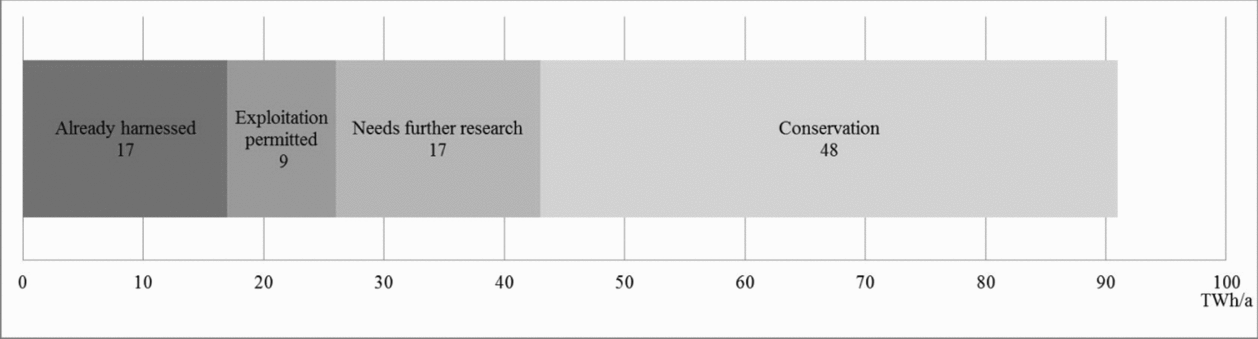
It has been estimated that the total hydro and geothermal energy that can theoretically be harnessed for electricity production in Iceland is 74 to 91 TWh/a (Fig. 4). Most of the variation can be explained by the uncertainty of the usable energy from geothermal areas. Of this about 17 TWh/a have already been harnessed, and with the decision in the master plan a further 9 TWh/a are permitted for power production. About 17 TWh/a, or 20% of the theoretically harnessable energy, need further research. Finally between one third (30 TWh/a) and half (50 TWh/a) of the theoretically possible energy resources have been given conservation status (Anon. 2011).
The division of total hydro and geothermal energy that can technologically be harnessed for electricity production in Iceland. Sources: Björnsson Reference Björnsson2011; Anon. 2011; Ministry for the Environment and Natural Resources. 2013.
To put the numbers in context the newest aluminium smelter in Iceland uses about 5 TWh/a, so the energy from power plants in the category ‘exploitation permitted’ could provide energy for about two such smelters. Additionally, if everything in the category ‘needs further research’ were to be permitted, there would be energy available for three more such smelters. Furthermore, the amount of energy that would be suitable for exporting through the submarine cable is about 500–900 MW (Hagfræðistofnun 2013), which is about half of the energy in the category ‘exploitation permitted’.
Discussion and conclusions
As the Icelandic nation is very dependent on the utilisation of natural resources for its economic welfare it is a major challenge for the nation to use its natural resources in a sustainable way so they can support socio–economic development in the future. While Iceland may represent a very specific case with its geothermal power production resources, similar developments in technology, accessibility and knowledge have created increasing possibilities to utilise natural resources in the wider Arctic region. These new resources include crude oil and oil sands operations in Alaska and northern Canada, gas and mining activities in Greenland, and oil drilling in Bear Island in Norway, for example. All these expanding interests in natural resources pose similar threats to the Arctic environment, including wilderness qualities, and other economic sectors and resource uses. As in Iceland, this has increased conflicts in development discussions and calls for sustainability.
This study has reflected on two of the three main economic sectors of the Icelandic economy, tourism and power production, and different views on how the natural resources in the highlands should be utilised. The utilisation approach has so far set its mark on the development in the highlands and many Icelanders still take wilderness for granted and consider that there is plenty of it (Árnason Reference Árnason2005). Those who favour power development argue that the abundance of natural resources has made it possible for Icelanders to live in this hostile environment, and thus the energy resources should continue to be utilised in order to maintain and increase the wellbeing of the nation (Björnsson Reference Björnsson1970).
So far human influence in the highlands of Iceland has been substantial due to power plant development and tourism development, with the result that wilderness in Iceland is now more a subjective and social idea than a physical reality in a natural science sense (Sæþórsdóttir and others Reference Sæþórsdóttir, Hall and Saarinen2011). Despite that, with increased tourism the idea about the value of the highlands as a place for wilderness experience, is starting to emerge and there is now the realisation that the wilderness and the highlands are one of the main resources of the tourism industry (Alþingi 2005; Ministry of Transport 2006). But wilderness as a playground for tourists is an extremely sensitive resource and both the tourism industry and some politicians are beginning to realise that. The government has recognised wilderness as being of great importance and stated that ‘wilderness should remain untouched in Icelandic uninhabited areas. It has also stated, ‘structures should preferably be built outside of defined wilderness areas’ (Ministry for the Environment 2002, 40).
On a general level, the situation resembles the origin of wilderness conservation in the North American context, where diminishing ‘wild’ created a public voice and governmental need to save the remaining wilderness environments by providing a scheme to organise and limit its economic utilisation (see Nash Reference Nash2014). Similarly in Iceland, the object of a governmental master plan project was to create greater consensus on the use of natural resources. The results of the master plan exposed the fact that the energy resources in the country are finite and that energy in Iceland is a far more limited resource than has previously been assumed. Thereby the idea about natural resources and their utilisation is being transformed among members of Icelandic society. The power production industry now has to share the limited natural resources with other industries like, for example, the tourism industry which puts further restrictions on their use for power production.
Despite the master plan project it is unlikely that the energy resources in Iceland have been defined for good. Global influences reflected in Europe's targets and technological development making the submarine cable project a potential reality, would lead to substantially higher prices for the commercial sale of energy for Iceland. It might then become tempting from the utilitarian perspective to redefine the potential resources and utilise some of the power that is now in the ‘conservation’ category. The challenges created by the changing ideas of natural resources will therefore continue although the master plan makes an interesting attempt to stabilise the situation and solve conflicts created by that development. However, the ideas about natural resources and their utilisation will be re–defined by future society, depending on technology, global influences and other social and political trends.