1. Introduction
In the early days of geology, lithostratigraphy often provided the most convincing of what were assumed to be time-correlations from one place to another, but with increasing recognition of the biostratigraphical evolution of fossils and hence, conversely, of diachronism in sedimentary successions, biostratigraphy of guide-fossils has generally found favour as one of the best means of establishing time-correlation. This is particularly true for the Jurassic System; in the British succession, 76 standard ammonite Zones are now recognized, many of them divided into Subzones (e.g. Cope, Reference Cope, Brenchley and Rawson2006). The finest age-diagnostic biostratigraphical units now recognized for some parts of the British Jurassic are the so-called ammonite faunal horizons (Callomon, Reference Callomon and Le Bas1995; Callomon & Chandler, Reference Callomon and Chandler1990; Page, Reference Page1992, Reference Page1995) that provide unparalleled levels of stratigraphical time-resolution. The numbers of ammonite horizons recognized within a particular time-frame suggest that they may on occasion equate with time intervals of significantly less than 100 ka, as pointed out by Callomon (Reference Callomon and Le Bas1995), but because the time intervals between successive horizons are unknown, individual horizons could well represent very short periods of time separated by large gaps in the record.
2. The Kimmeridge Clay Formation
2.a. Stage nomenclature, ammonite fauna and zonal scheme
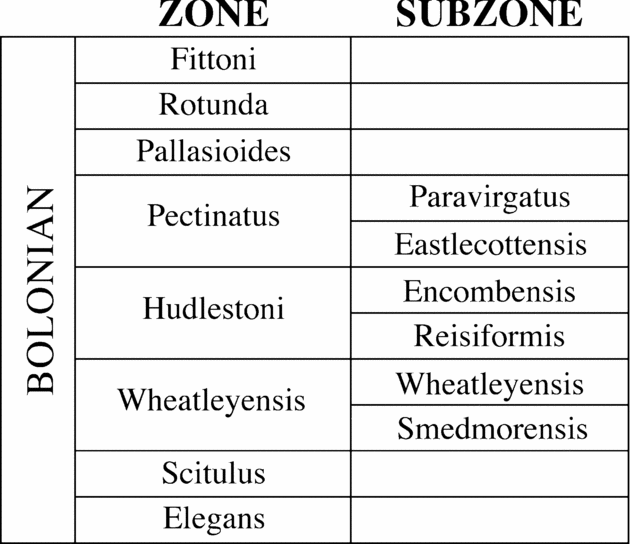
The Kimmeridge Clay Formation is the thickest mudrock formation in the British Jurassic succession; at least, this is the case with the 500 m succession in the type-section at Kimmeridge, Dorset. Its outcrop runs discontinuously across Britain from Dorset to Yorkshire. The lower part of the Kimmeridge Clay Formation belongs to the Kimmeridgian Primary Standard Stage, but the ammonites of the Upper Kimmeridge Clay differ from those of the coeval Tithonian Primary Standard Stage, making precise time-correlation at zonal precision impossible, and so a regional secondary standard (Callomon, Reference Callomon1985) is now used. Thus the Upper Kimmeridge Clay is assigned to the Bolonian Secondary Standard Stage (Blake, Reference Blake1881; Cope, Reference Cope1993, Reference Cope1996), whose zonation is the parallel equivalent of that of the lower part of the Tithonian Primary Standard Stage. This paper is concerned with the Upper Kimmeridge Clay belonging to the Bolonian, whose ammonite Zones and Subzones are listed in Figure 1.
Standard Zones and Subzones of the Bolonian Secondary Stage.

Unlike most of the Dorset Jurassic sequence, the Kimmeridge Clay did not receive early attention, as its fossils are almost invariably crushed and difficult to collect. Its ammonite fauna in Dorset was dismissed as forming ‘hopeless material for investigation’ (Neaverson, Reference Neaverson1925) and ‘specific determination. . . is impossible owing to the poor state of preservation’ (Arkell, Reference Arkell1947a). If that were not enough to deter further interest, Arkell also wrote that ‘the systematics of these ammonites is extremely complex and . . . collection is difficult’. These factors resulted in an almost total neglect of the ammonite faunas of the Kimmeridge Clay in Dorset until the 1960s.
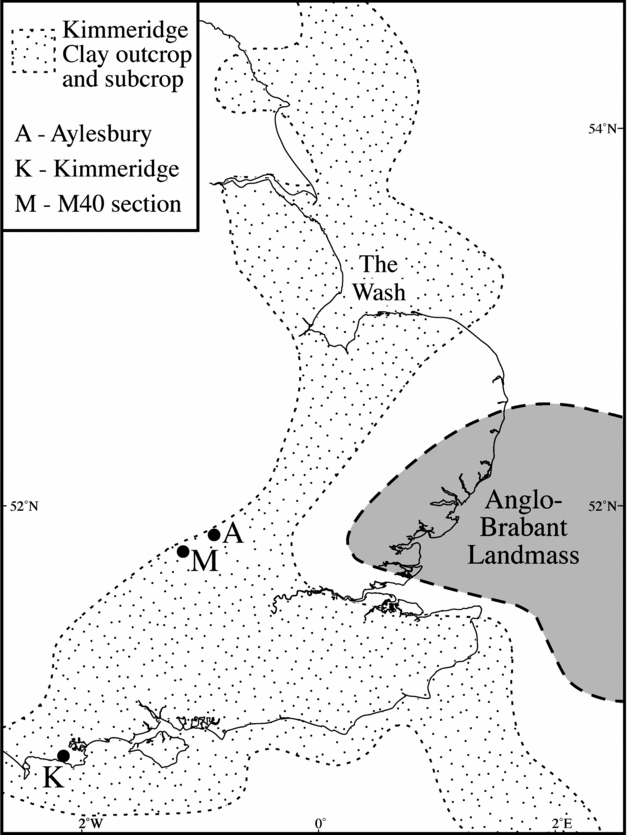
In contrast to Dorset, the Kimmeridge Clay in the south Midlands, exposed up to the 1950s in small brickpits in Oxfordshire and Buckinghamshire, provided some attractively preserved three-dimensional ammonites. These formed the basis of the zonation of part of the Upper Kimmeridge Clay (Neaverson, Reference Neaverson1924, Reference Neaverson1925), but the dangers of founding a zonal scheme on successions where the total thickness of the Formation is often less than one tenth of that at Kimmeridge soon emerged. The Midlands successions are attenuated due to their proximity to the London–Brabant landmass (Fig. 2).
Palaeogeographical map showing the position of the localities referred to in the text. Map based on Cope & Rawson (Reference Cope, Rawson, Cope, Ingham and Rawson1992).

The first attempt to study the ammonites of the Dorset Upper Kimmeridge Clay was made by Spath in the 1930s; his modest collection of ammonites (now in the Natural History Museum, London) was assigned to the genera Lithacoceras and Subplanites, both originally described from the Lower Tithonian rocks of Swabia and Franconia, underlying beds with Pectinatites and then Pavlovia. He recognized Neaverson's genus Virgatosphinctoides as, at most, subgenerically distinct from his Tethyan genus Subplanites (Spath, Reference Spath1936).
Cope (Reference Cope1967, Reference Cope1978) made bed-by-bed collections through the Upper Kimmeridge Clay in Dorset by developing collecting techniques that included in situ plaster casting and found that, apart from two species of the aulacostephanid genus Gravesia in the lowest part, the ammonites belonged to a single evolving plexus. The genus Pectinatites (Buckman, Reference Buckman1922) was represented by over 30 morphospecies belonging to three subgenera (Arkellites Cope, Reference Cope1967; Pectinatites Buckman, Reference Buckman1922 and Virgatosphinctoides Neaverson, Reference Neaverson1925); these provide a succession of often closely homeomorphic forms that can be distinguished by measurement of their inner whorl rib densities. Because many of these species are closely delimited stratigraphically, it is probable that the assemblages at any one level approximate to biospecies. Pectinatites evolved to produce Pavlovia (Ilovaisky, Reference Ilovaisky1917) and that in turn, Virgatopavlovia (Cope, Reference Cope1978). Sexual dimorphism was recognized throughout (Cope, Reference Cope1967, Reference Cope1978); the microconchs are isocostate and those of Pectinatites have an apertural horn, while the macroconchs are similarly isocostate on their inner whorls but their body-chambers modify to develop more widely spaced primary ribs, frequently with multiple secondary ribs. It was confirmed early on that these ammonites were not phyletically related to those of the Tithonian rocks of southern Germany, as Spath had supposed, but formed a quite distinct parallel lineage (Cope & Zeiss, Reference Cope and Zeiss1964).
This work resulted in a new zonal scheme (Fig. 1; Cope, Reference Cope1967, Reference Cope1978) and demonstrated for the first time how incomplete were the successions in the south Midlands. Not only had some ammonites from the Midlands been correlated with the wrong levels in Dorset (e.g. Arkell, Reference Arkell1947a), but two zones (Pallasioides and Rotunda) had been listed in the wrong order by Neaverson (Reference Neaverson1925). In the south Midlands, Casey (Reference Casey1967) found Rotunda Zone ammonites in the Upper Lydite Bed at the base of the contiguously overlying Portland Beds, resting on the Pallasioides Zone. This observation was confirmed in Dorset where shales with Pavlovia rotunda overlie rocks with P. pallasioides (Cope, Reference Cope1978). The beds in Dorset that Neaverson (Reference Neaverson1924, Reference Neaverson1925) had incorrectly correlated with his Pallasioides Zone were assigned to a new Fittoni Zone (Cope, Reference Cope1978). The revised zonal scheme and a subzonal scheme for part of the succession (Cope, Reference Cope1974) have stood the test of time, but as always, rely upon the correct identification of these often closely homeomorphic perisphinctid ammonites.
2.b. Lithology and depositional conditions of the Upper Kimmeridge Clay
The lower half of the Bolonian part of the Kimmeridge Clay Formation in the type-section consists of cyclical successions of mudstone, bituminous mudstone, oil-shale and coccolith limestone (the latter member often not developed) that began in the Eudoxus Zone of the Kimmeridgian. Within this succession there are notable intercalated thicknesses of calcareous mudstones in the Scitulus, Wheatleyensis and Hudlestoni zones. The succession is interrupted by laterally impersistent dolomitized stone bands that were diagenetically produced by replacement of mudstones by carbonate during deep burial in the methanogenic zone (Scotchman, Reference Scotchman1989).
Above the lower half of the Pectinatus Zone and continuing up to the Rotunda Nodule Bed in the middle of the Rotunda Zone, there are fewer oil-shales and the mudstones are more shelly; there was regional regression with non-sequences away from the basinal areas. Above the Rotunda Nodules up to the base of the Portlandian Stage, the beds become increasingly silty and bituminous horizons are rare.
Weedon, Coe & Gallois (Reference Weedon, Coe and Gallois2004) recognized in the Bolonian 103 larger wavelength cycles (1.87–4.05 m) that they identified with orbital obliquity, and smaller wavelength cycles (about half the above wavelengths) with precession; from these they calculated a duration of 3.9 Ma for the Bolonian Stage.
Tyson, Wilson & Downie (Reference Tyson, Wilson and Downie1979) were the first to propose the idea of a stratified water column to explain Kimmeridge Clay deposition and this idea has been modified in various ways by subsequent authors. The presence of oil-shales has been shown to be due to bottom-water anoxia in basinal areas that occurred when subsidence rates exceeded depositional rates. In tectonically more stable areas the mudstones are aerobic and carbonate-rich, suggesting balance between rates of subsidence and sedimentation, but in swell areas, where sedimentation outstripped subsidence rate, localized sedimentary patterns are developed, often with non-sequences.
The occurrence of oil-shales in areas close to the London–Brabant landmass, such as in the Aylesbury region (Oates, Reference Oates1991), implies deep water over a large area that also encompassed the basins. In the event of a gradual fall in sea-level, a change to aerobic mudstones would occur much earlier in such marginal areas than it did in basinal areas, such as the Wessex Basin. With continuing sea-level fall, even the deepest basins periodically lost their anoxia, and aerobic mudstones were developed. It therefore follows that, in such circumstances, facies changes were diachronous and, as shown below, this can be demonstrated by analysis of the ammonite faunas.
2.c. Bed numbering schemes
The earliest detailed lithological description of the Kimmeridge Clay type-section was by Blake (Reference Blake1875), who gave beds numbers; although he numbered his beds from the top downwards, they are for the most part well defined and easily recognizable. Blake's scheme formed the basis of bed numbering schemes that were used by later workers including Arkell (Reference Arkell1947a) and Cope (Reference Cope1967, Reference Cope1978). There was no attempt to number beds in any other Kimmeridge Clay sections.
In the 1970s, following the recognition of the Kimmeridge Clay as the principal source rock for North Sea oil, the British Geological Survey undertook an investigation of the Formation on land and offshore, and a series of boreholes provided much new information. More recently, the Dorset succession was examined in cored boreholes for the Natural Environment Research Council's Rapid Global Geological Events (RGGE) special research topic on the ‘Anatomy of a Source Rock’ (Morgans-Bell et al. Reference Morgans-Bell, Coe, Hesselbo, Jenkyns, Weedon, Marshall, Tyson and Williams2001).
Following the Geological Survey work, it became apparent that logs of lithology, combined with geophysical log signatures and faunal characteristics, presented a laterally persistent set of successive lithological packages. This led Gallois & Cox (Reference Gallois and Cox1976) to propose a numbering scheme of 35 stratal packages for the Lower Kimmeridge Clay, later extended into the Upper Kimmeridge Clay (Cox & Gallois, Reference Cox and Gallois1979), that they named ‘Beds’, which they claimed were isochronous and thus could be used for chronostratigraphic correlations across the whole Kimmeridge Clay outcrop from Dorset to Yorkshire and into the offshore areas. This work began in the area of the Wash, but was later applied to the Dorset type-section (Cox & Gallois, Reference Cox and Gallois1981).
In the Wash area, the succession in the Kimmeridge Clay terminates in the lower part of the Pectinatus Zone, and Cox & Gallois (Reference Cox and Gallois1981) applied numbers to the Dorset succession only up to this level (bed 48). Subsequently, Wignall (Reference Wignall1990) added bed numbers 51–55, and Coe (A. L. Coe, unpub. D.Phil. thesis, Univ. Oxford, 1992) completed the numbering up to the top of the Kimmeridge Clay with numbers 56–62. Unfortunately, Gallois (Reference Gallois2000) revised Beds 46–49 and then added a new set of numbers of his own (Beds 50–63) to complete the bed numbers up to the top of the Kimmeridge Clay. Morgans-Bell et al. (Reference Morgans-Bell, Coe, Hesselbo, Jenkyns, Weedon, Marshall, Tyson and Williams2001) used the Coe (unpub. D.Phil. thesis, Univ. Oxford, 1992) scheme, and their paper provides a comparison between their scheme and that of Gallois (Reference Gallois2000).
The application of the Cox & Gallois scheme to the type-section in Dorset caused immediate problems. These arise from the fact that, instead of founding their bed numbering scheme on the thick succession in Dorset, Cox & Gallois (Reference Cox and Gallois1979) had introduced the scheme based on successions in the Wash area that are notably thinner (40–80 m) than those of the type-section in Dorset (500 m). The first problem then lies in the Scitulus Zone. At the time of their original work in the Wash area, Gallois & Cox (Reference Gallois and Cox1974) had a thin Scitulus Zone there and followed Cope (Reference Cope1967) in taking the base of the Wheatleyensis Zone in Dorset at the Grey Ledge Stone Band (see fig. 4 in Gallois & Cox, Reference Gallois and Cox1974). In their (1979) scheme, the Scitulus Zone in the Wash area was restricted to their bed KC 37 (with base Wheatleyensis Zone at base KC 38). There were Wheatleyensis Zone ammonites in KC 40 (Cox & Gallois, Reference Cox and Gallois1979). Subsequently, when Cox & Gallois (Reference Cox and Gallois1981) came to investigate how the bed numbers could be applied to Dorset, they made some adjustments. They raised the base of the Wheatleyensis Zone from base KC 38 to base KC 40, the latter level lying, they believed, between the Cattle Ledge and Grey Ledge, an interval where there was no ammonite control (Cope, Reference Cope1967) (B. M. Cox, pers. comm. 2007).
However, the ammonite assemblage of Pectinatites (Virgatosphinctoides) wheatleyensis, P. (V.) grandis and P. (V.) pseudoscruposus recorded by Cox & Gallois (Reference Cox and Gallois1979) from bed KC 40 in the Wash area clearly belongs to the Wheatleyensis Subzone of the Wheatleyensis Zone (Cope, Reference Cope1967, Reference Cope1974); the ranges of these three species at Kimmeridge are virtually coincident and are very closely restricted stratigraphically. In the Wash area there is no representative fauna of the underlying Smedmorensis Subzone (Cope, Reference Cope1974), so there must be a break between the Scitulus Zone and the Wheatleyensis Subzone in the Wash area. Beds KC 38 and 39 either belong to the lower part of the Wheatleyensis Zone (the Smedmorensis Subzone), or they belong to the Scitulus Zone. As Bed 38 yields abundant Nanogyra virgula (Defrance) and this species last appears abundantly in Dorset low in the Scitulus Zone (8 m above its base), KC 38 is best assigned to the Scitulus Zone, and in fact correlates with a Nanogyra limestone in the same position at Aylesbury (see below). The soft mudstones of the Upper Cattle Ledge Shales of Dorset have yet to yield identifiable ammonites and the log of the Wash area boreholes shows no really similar lithology, suggesting that the break in the Wash area involves both the upper part of the Scitulus Zone and the Smedmorensis Subzone of the Wheatleyensis Zone. Beds 37, 38 and 39 total only some 6 m in the Wash area (Cox & Gallois, Reference Cox and Gallois1979), whereas the Scitulus Zone at Kimmeridge is some 27.6 m thick (Cope, Reference Cope1967).
Thus it is necessary to interpolate new bed numbers in the Cox & Gallois scheme for the upper part of the Scitulus Zone and the lower part of the Wheatleyensis Zone (the Smedmorensis Subzone) present in the Kimmeridge Clay succession in the type area.
2.d. Correlation of the Wheatley Nodule Bed
The second problem that has arisen through the application of the Cox & Gallois bed-numbering scheme is potentially more serious. Over the past two decades, temporary exposures have become available in the south Midlands that have allowed re-interpretation of the observations and collections made earlier in the 20th century, when numerous small brickpits were in work. One of the most important horizons to have been exposed is the Wheatley Nodule Bed, the source of many ammonites, particularly from Littleworth Brickpit, Wheatley, Oxfordshire, but also known from other former exposures in the area (Arkell, Reference Arkell1947b). This was the source of the holotype of Pectinatites (Virgatosphinctoides) wheatleyensis (Neaverson) and other ammonites that comprised an assemblage that was accorded zonal status by Neaverson (Reference Neaverson1925). The type locality of the Zone is listed as Wheatley, near Oxford, by Arkell (Reference Arkell, Donovan and Hemingway1963, p. 372).
Arkell (Reference Arkell1947a) identified the Wheatleyensis Zone in the Dorset type-section with calcareous clays (the Dicey Clays of Arkell) beginning some 11.5 m above the Blackstone oil-shale upwards for some 35 m to the White Stone Band. Cope (Reference Cope1967), however, identified the index P. (V.) wheatleyensis itself for the first time in Dorset and lower in the succession, and found that it is restricted to shales 2.7–5.2 m below the Blackstone oil-shale band, where it occurs with P. (V.) woodwardi (Neaverson) and P. (V.) wheatleyensis delicatulus (Neaverson), both also characteristic of the Wheatley Nodule Bed in Oxfordshire. For the beds in Dorset erroneously correlated with the Wheatleyensis Zone by Arkell (Reference Arkell1947a), Cope (Reference Cope1967) introduced a new Hudlestoni Zone (Fig. 1).
In 1990, Cox, Horton & Sumbler recorded the Wheatley Nodule Bed with its typical ammonites in excavations for the M40 Motorway east of Oxford, only 3 km east of the type locality. However, they stated (Reference Cox, Horton and Sumbler1990, p. 263) that ‘this correlates most readily within [Bed] KC 44 . . . [which] . . .is firmly fixed in the Hudlestoni Zone and not in the Wheatleyensis Zone of which the Wheatley Nodule Bed ammonite fauna has long been considered to be a classic assemblage. Further research into this anomaly is needed before it can be finally resolved’. The implication here is that there is something wrong with the zonal scheme and that the correlatives of the Wheatley Nodule Bed in Dorset lie higher in the succession than recorded by Cope (Reference Cope1967). Similar comments were made by Cox, Gallois & Sumbler (Reference Cox, Gallois and Sumbler1994) and in the Geological Conservation Review volume on the Upper Jurassic (Cox in Wright & Cox, Reference Wright and Cox2001); they also appear in the Geological Survey Thame Memoir (Horton et al. Reference Horton, Sumbler, Cox and Ambrose1995).
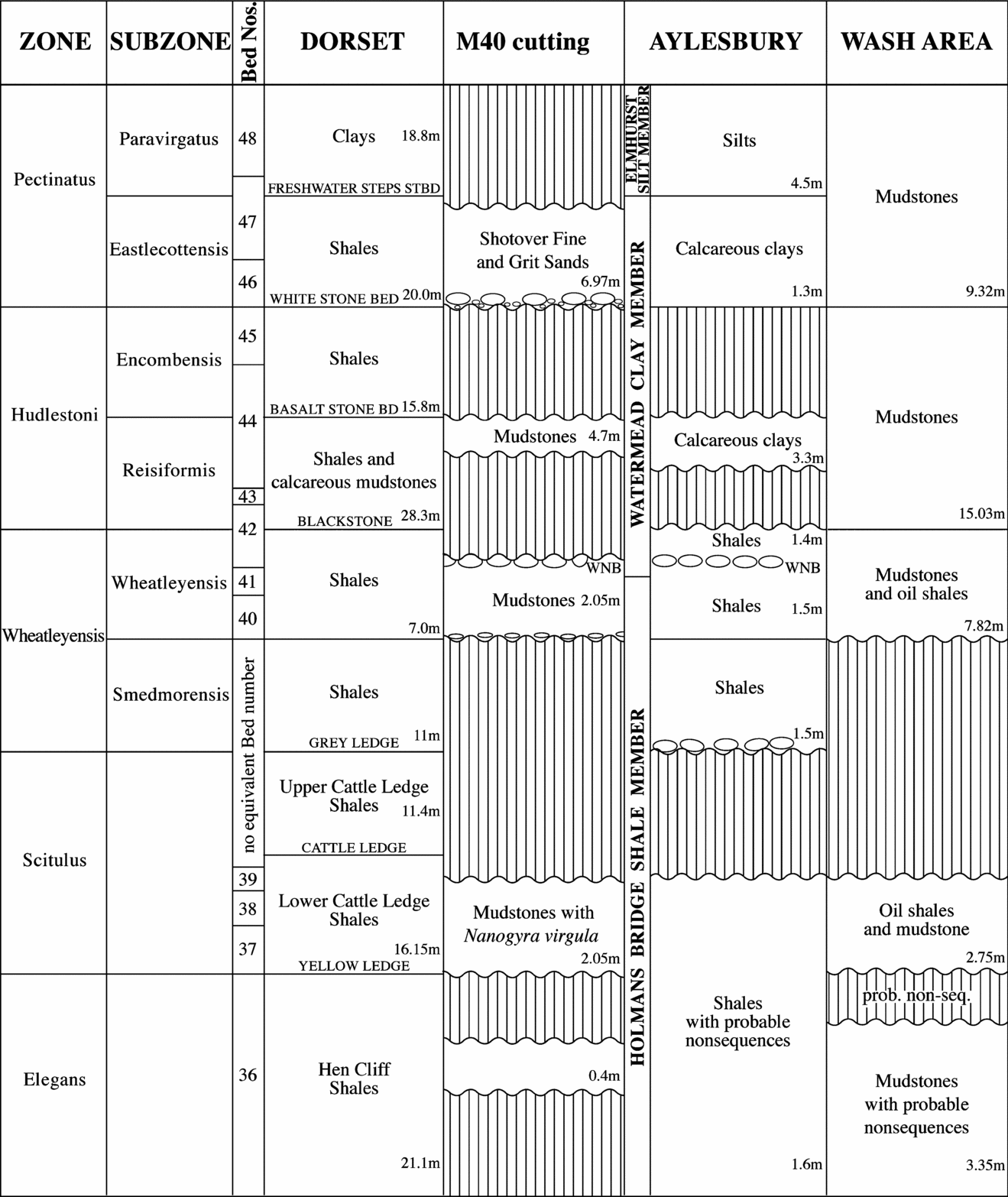
Oates (Reference Oates1991) has also recorded the Wheatley Nodule Bed with its characteristic ammonites from temporary exposures in the Aylesbury area (Fig. 4) and, following Cox, Horton & Sumbler (Reference Cox, Horton and Sumbler1990), identified the Nodule Bed as coming from Bed KC 44, apparently confirming their observation.
These observations are clearly at variance with correlations based on the ranges of the relevant ammonite species recorded in the much thicker succession at Kimmeridge. To clear up this apparent problem, I here figure Neaverson's holotype of Pectinatites (Virgatosphinctoides) wheatleyensis from Oxfordshire and show the same species from Dorset (Fig. 3). Although the holotype is incomplete, these ammonites are clearly conspecific. All the Dorset material of this species came from a restricted horizon, below the Blackstone oil-shale at Kimmeridge, where it was recorded by Cope (Reference Cope1967) and where it occurs together with P. (V.) woodwardi and P. (V.) wheatleyensis delicatulus, which are also similarly restricted stratigraphically, and that also characterize the Wheatley Nodule Bed in its type area in Oxfordshire.
Pectinatites (Virgatosphinctoides) wheatleyensis (Neaverson). (a) Holotype, BM C. 26897, macroconch, Wheatley Nodule Bed, Littleworth Brickpit, Wheatley, Oxfordshire; figured Neaverson (Reference Neaverson1925, pl. 1, fig. 1). (b) BM C. 73425, complete macroconch, 3.65 m below the Blackstone, Kimmeridge, Dorset, figured Cope (Reference Cope1967, pl. 21, fig. 1); for easier comparison the image has been reversed. Both figures reduced, × 0.62. X marks the last suture on the holotype and its presumed position on the Dorset specimen; on this basis the holotype lacks approximately one sixth of a whorl of body-chamber. Ribbing is more subdued on the holotype as it is an internal mould. Note closely-spaced polgyrate ribs (ribs with a double furcation) on the body-chambers (a particular attribute of this species) and occasional simple unbranched primary ribs on both body-chambers. The Dorset example appears slightly more involute, but crushing has reduced the umbilical diameter towards the aperture. Inner whorl rib densities are remarkably similar. BM – Natural History Museum, London.

So, how is this apparent paradox to be resolved? Examination of Oates' (Reference Oates1991) ammonite records from Aylesbury, which include some excellent figures, reveals some anomalies. Re-examination of the material in Aylesbury Museum together with Dr Oates, however, has solved the problems. His Pectinatites (Virgatosphinctoides) decorosus Cope (Oates, Reference Oates1991, fig. 7f) is correctly identified and placed in the Scitulus Zone; in Dorset this species ranges from 4.5 to 9 m above the base of the Zone (that is, in its lower part). Immediately above this is a shell bed composed of Nanogyra virgula. This is significant, as the highest that this oyster, primarily characteristic of the Lower Kimmeridge Clay, occurs abundantly in the Dorset succession is 8 m above the base of the Scitulus Zone, though rare specimens do occur as high as the Hudlestoni Zone (Clausen & Wignall, Reference Clausen and Wignall1990). Thus the shell bed is likely to be no younger than of lower Scitulus Zone age and could possibly correlate with KC 38 of the Wash area that has the same species in abundance.
About half a metre above this are calcareous nodules from which Oates figured an ammonite as P. (V.) wheatleyensis (1991, fig. 7g). It now appears that the original identification was incorrect. The ammonite is incomplete, and differential crushing suggests that about one fifth of a whorl of the body-chamber is preserved; this conclusion is supported by the beginning of variocostation (coarsening and wider spacing of the ribs compared to those of the inner whorls) at the same point. This ammonite lacks the abundant slender polygyrate ribs (ribs with a double furcation) on the preserved part of the body-chamber that characterize P. (V.) wheatleyensis (see Fig. 3) but has blunter rounded primary ribs, a few with polygyrate secondaries. Its rib density on the preserved inner whorls (~49 ribs at 40 mm) is coarser than that of the latter species (macroconch 57–62 ribs at that diameter) and more closely matches the rib density of macroconchs of P. (V.) clavelli Cope. This makes more sense stratigraphically, as the latter species is confined to the Smedmorensis Zone, whereas P. (V.) wheatleyensis is confined to the subzone above. This revised identification adds strength to Oates' suggestion (Reference Oates1991, p. 190) that these concretions can be correlated with the Grey Ledge Stone Band of Kimmeridge (see Fig. 4). An ammonite collected recently from the same nodular horizon (and now in Aylesbury Museum), although incomplete, has outer whorl ornament close to that of P. (V.) smedmorensis Cope.
Revised correlation of part of the Upper Kimmeridge Clay Formation showing the attenuation of the Midlands and East Anglian sections and a revised correlation of the Cox & Gallois Bed Numbers with the standard ammonite chronozonal scheme. (The upper half of the column for the Wash area should not be read to imply that the succession is there complete, free of gaps).

Oates' (Reference Oates1991) next ammonite record of P. (V.) clavelli transitional to smedmorensis then fits nicely into place in the Smedmorensis Subzone, as do (one metre higher) P. (V.) grandis (Neaverson) and P. (V.) pseudoscruposus (Spath), which are both characteristic of the Wheatleyensis Subzone (Cope, Reference Cope1967, Reference Cope1974). One and a half metres higher again are P. (V.) wheatleyensis and its subspecies delicatulus, then P. (V.) woodwardi (Neaverson) and above this again the Wheatley Nodule Bed, here yielding abundant P. (V.) woodwardi (Neaverson), lying here in the lowest part of Watermead Clay Member. Almost a metre higher, Oates (Reference Oates1991, fig. 3) recorded a further P. (V.) woodwardi, but this could not be found in the collections. Assuming this identification was correct, a Wheatleyensis Subzone age is required.
The incomplete macroconch ammonites recorded as P. (V.) donovani Cope (e.g. Oates, Reference Oates1991, fig. 7a) 1.8 m higher have proved to be not finely-ribbed enough to belong to that species. Rib density measurements for the best-preserved show 39 ribs at 40 mm, 42 at 50 mm and 44 at 60 mm. These rib densities are typical of P. (A.) hudlestoni (Cope, Reference Cope1967, fig. 3), whereas P. (V.) donovani macroconchs at these diameters typically have rib densities of 52, 54 and 55 (Cope, Reference Cope1967, fig. 7). The specimens also lack the variocostation typical of P. (V.) donovani and are virtually devoid of polygyrate ribs that the latter has in abundance (see Cope, Reference Cope1967, pl. 25, fig. 1). Comparison with the larger specimen of P. (A.) hudlestoni figured by Oates (Reference Oates1991, fig. 7d) is not easy, since the latter has incomplete inner whorls although it has a largely complete body-chamber. Comparisons made from the plate (Oates, Reference Oates1991, fig. 7) are further complicated by the differing scales used.
The best correlation of these ammonites is with the lower part of the Reisiformis Subzone of the Hudlestoni Zone, there being no obvious break above the Wheatleyensis Zone. This horizon in the type-section is in the highest bituminous shales before the change to carbonate-rich mudstones in the upper Reisiformis Subzone. The highest bituminous shales in the Aylesbury area occur in the Wheatleyensis Zone (Oates, Reference Oates1991, fig. 3); then a fall in sea-level introduced aerated sediments into that area while bituminous and oil-shales were still accumulating in the Wessex Basin.
There must be a break at Aylesbury above the highest P. (A.) hudlestoni; this reflects a continuing sea-level fall (reflected in the type-section by temporary loss of oil-shale lithologies and development of carbonate-rich mudstones). Thus, at Aylesbury there are no ammonites representative of the higher part of the Reisiformis Subzone, or of the Encombensis Subzone. Silt then appears in the succession and invites correlation with the Shotover Fine Sands of the Oxford area (Arkell, Reference Arkell1947b) and shortly after the appearance of silt, P. (P.) cornutifer is recorded, indicating the Eastlecottensis Subzone of the Pectinatus Zone. Then, some 2 m higher, P. (P.) aff. pectinatus indicates the overlying Paravirgatus Subzone.
I thus reinterpret the Aylesbury succession as showing Scitulus Zone terminated with a non-sequence at the Nanogyra shell bed, with the equivalent of the upper part of the Lower Cattle Ledge Shales and the whole of the Upper Cattle Ledge Shales of Dorset missing. These equate with Blake's (Reference Blake1875) bed numbers 32 and 33, although they do not seem to have a correct Cox & Gallois equivalent number (see Fig. 4). This is then succeeded by lower Wheatleyensis Zone (Smedmorensis Subzone) and then upper Wheatleyensis Zone (Wheatleyensis Subzone) and lowest Hudlestoni Zone (lower Reisiformis Subzone). A non-sequence at this point is followed by unfossiliferous silts, the base of which may possibly represent the uppermost part of the Encombensis Subzone (although a basal Pectinatus Zone age cannot be excluded). This latter is followed conformably by ammonites indicating both Eastlecottensis and Paravirgatus Subzones of the Pectinatus Zone.
In the M40 Motorway cutting described by Cox, Horton & Sumbler (Reference Cox, Horton and Sumbler1990), the situation is clear-cut. They recorded the Wheatley Nodule Bed as having oysters adhering to the top of the nodules (Cox, Horton & Sumbler, Reference Cox, Horton and Sumbler1990, p. 265). My interpretation here is that the nodules were formed during a depositional break, were exhumed from their growth-position within the sediment by submarine erosion and, while forming a hardground on the sea-floor, their upper surfaces were encrusted with oysters (cf. Hesselbo & Palmer, Reference Hesselbo and Palmer1992). Raiswell & Fisher (Reference Raiswell and Fisher2000) and Hendry et al. (Reference Hendry, Pearson, Trewin and Fallick2006) both quote the depth of calcareous concretion formation in mudrocks as varying from tens to hundreds of metres. However, evidence from the Kimmeridge Clay here suggests that they can form at much shallower depths. In the M40 cutting, in view of the thickness of all parts of the Kimmeridge Clay there, it is unlikely that erosion removed a great thickness of sediment before the concretions were exhumed to allow oyster colonization. Even allowing for post-sedimentary compaction, it seems likely that the concretions formed at a depth not exceeding 20 metres (possibly less), rapidly lithified, and were then exposed on the sea-floor by submarine erosion before becoming encrusted by oysters. Such clear sedimentological and faunal evidence of a significant depositional break and concomitant erosion, overlooked by Cox, Horton & Sumbler (Reference Cox, Horton and Sumbler1990), leads to the conclusion that identification of this calcareous clay with concretions with Bed KC 44 must be a simple mismatching of lithology.
So what is the correct lithological match? Examination of the log of the RGGE boreholes at Kimmeridge (Gallois, Reference Gallois2000, fig. 6) shows that at the level of the Wheatley Nodule fauna in the Kimmeridge succession there are some 2 m of calcareous mudstones assigned mainly to KC 41 but also to basal KC 42; thus, if a match is to be made lithologically it is at that level. In other words, in the M40 cutting most (if not all) of KC 42 is missing, as is all of KC 43. Sedimentation resumed briefly at the base of KC 44 and was then interrupted again. The Wheatley Nodule Bed then is correlated correctly placed in the upper part of the Wheatleyensis Subzone.
3. Sequence stratigraphy in the Upper Kimmeridge Clay
There have been various sequence-stratigraphical schemes proposed for the Kimmeridge Clay Formation, recognizing different sequence boundaries. That by Taylor et al. (Reference Taylor, Sellwood, Gallois and Chambers2001) recognized 12 sequence boundaries, more than in any other study. Wignall's (Reference Wignall1991) sequence boundaries at the base of the Elegans Zone, in the middle of the Wheatleyensis Zone and just above the base of the Hudlestoni Zone were recognized by him as coincident with hiatuses in marginal settings, and his model can explain the breaks above and below the Wheatley Nodule Bed, and by conflation of two sequence boundaries, the major break through the Elegans and Scitulus Zones in some marginal localities. Coe (unpub. D.Phil. thesis, Univ. Oxford, 1992), Ahmadi (Z. M. Ahmadi, unpub. Ph.D. thesis, Univ. Durham, 1997) and Taylor et al. (Reference Taylor, Sellwood, Gallois and Chambers2001) recognized an additional sequence boundary at the top of the Scitulus Zone that could explain the absence of the Smedmorensis Subzone in many localities. Melynk, Athersuch & Smith (Reference Melynk, Athersuch and Smith1992) identified their equivalent sequence boundary a little higher, within the lower part of the Wheatleyensis Zone (Smedmorensis Subzone) corresponding to a transgressive surface in the schemes of both Coe (unpub. D.Phil. thesis, Univ. Oxford, 1992) and Taylor et al. (Reference Taylor, Sellwood, Gallois and Chambers2001). Wignall (Reference Wignall1991) took his K7 sequence boundary a little higher, at a level corresponding to a maximum flooding surface in the scheme of Melynk, Athersuch & Smith (Reference Melynk, Athersuch and Smith1992). A sequence boundary in the basal Hudlestoni Zone was identified by all workers except Melynk, Athersuch & Smith, but that of Wignall (Reference Wignall1991) was slightly younger than the others. However, the lack of coincidence of these boundaries produced by different workers is perhaps not surprising, given the limited detail of ammonite biostratigraphy that they used and the fact that at least some of the work is based on correlations provided by the Cox & Gallois bed numbering scheme, the chronostratigraphical value of which is shown herein to be in doubt.
An alternative approach to sequence stratigraphy by Williams et al. (Reference Williams, Hesselbo, Jenkyns and Morgans-Bell2001) looked at levels of quartz silt in the Kimmeridge Clay and concluded that high levels of silt in the basins corresponded with lowstands and with shallow water sands on the basin margins. They found that a protracted shallowing had lasted through most of the Scitulus and Wheatleyensis chrons, thus providing a ready explanation for the major non-sequences in the Scitulus and lower Wheatleyensis zones of the Midlands' and East Anglian successions. However, it should be noted that in the Hudlestoni Zone, where most authors envisage low sea-levels, Williams et al. (Reference Williams, Hesselbo, Jenkyns and Morgans-Bell2001) suggested some of the highest sea-levels.
4. Conclusions
The bed numbering scheme of Cox & Gallois (Reference Cox and Gallois1979) has clear limitations that result from its founding on the attenuated succession in the area of the Wash. It is clear, from thickness considerations alone, that the succession there must contain numerous non-sequences. Gallois' (Reference Gallois2000) log also illustrates the other problem of this numbering scheme. The base of the Wheatleyensis Zone is therein shown in the wrong place (following Cox & Gallois, Reference Cox and Gallois1981) and KC 40 is shown as extending downwards into what is correctly Scitulus Zone when in fact it has yielded a Wheatleyensis Subzone fauna in the Wash area.
Thus, the Gallois & Cox bed-numbering scheme in reality has numbers neither for the Upper Cattle Ledge Shales (upper Scitulus Zone) nor for the whole of the overlying Smedmorensis Subzone in Dorset, amounting to some 22 m of the Dorset succession. These horizons are clearly lacking in the East Anglian successions on which Cox and Gallois founded their scheme. Because some of the horizons in the Wash area are so attenuated in comparison with those of south Dorset, it is likely that the scheme cannot identify even major non-sequences. Thus the whole of the Elegans Zone (21.1 m in Dorset) is represented by a mere 3.35 m in the Wash area, though both are accorded the single Bed Number, 36. Similarly the Scitulus Zone (27.6 m in Dorset) is represented in the Wash area by some 2.75 m of shales and mudstones, and although these were accorded three Bed Numbers in the Wash area (37–39) the individual bed packages cannot be matched in the Kimmeridge section (compare Cox & Gallois, Reference Cox and Gallois1979, with Cox & Gallois, Reference Cox and Gallois1981). Such attenuated successions as in the Wash area are most unlikely to represent continuous slow sedimentation, but to encompass short periods of normal deposition separated by undetected non-sequences. (For a discussion of ‘the completeness of the record’ and sedimentary time-scales in mudstone sequences, see Callomon, Reference Callomon and Le Bas1995).
It is thus clear that parts of this bed-numbering scheme have limitations, and that time-correlations derived from such lithostratigraphical correlations are subject to revision in the light of age-diagnostic fossil biostratigraphy.
Acknowledgements
Thanks are due to Mrs L. C. Norton, National Museum of Wales, Cardiff, for preparation of the figures. The manuscript has been improved by useful comments from J. H. Callomon, P. B. Wignall and an anonymous referee.