Scholarly consensus used to place the epigrammatist Palladas of Alexandria in Constantinople at one or two points during his life.Footnote 1 This judgement rested in large part on the authority of two lemmata in our Byzantine manuscripts of the Greek Anthology: AP 11.292 was thought to be a lampoon of Themistius composed during the philosopher's tenure as prefect of Constantinople (a.d. 384), and AP 9.528 was thought to describe bronze statues of the gods that were housed in the Palace of Marina (constructed no earlier than the 420s).Footnote 2 In the middle of the twentieth century, however, the lemmata and their implied chronology of Palladas’ life (c. a.d. 360–450) were thoroughly discredited.Footnote 3 This important demolition of Byzantine misinformation allowed for new historical work to be done. In the course of arguing for a revised set of dates (c. a.d. 319–400), C. M. Bowra and Alan Cameron dismissed all earlier claims that the poet had any connection with Constantinople. This, I think, is not quite right. The lemmata are indeed dubious, but several of Palladas’ epigrams find a natural home in the Eastern capital.
This might be a pointless debate to revive except for the fact that I am convinced that Palladas lived much earlier than anyone has realized. Recently, I have offered a comprehensive argument for situating his birth in the 250s or 260s and his death at some point after a.d. 331 (but presumably not much later than the middle of the fourth century).Footnote 4 If this is correct, then the debate over whether any of his epigrams should be situated in Constantinople takes on a new importance, for the early years of Constantine's city are very poorly documented. It is not that there is a dearth of sources; the problem is that most of them are late and unreliable. If we can demonstrate, therefore, that Palladas was present there very early on, there is a chance that he might add something to our meagre knowledge of the city during this period.
First, however, and on a more general note, it is possible that some will wonder whether it is a legitimate exercise to seek to identify historical or topographical referents in Palladas’ poetry. Judgement in this matter depends, of course, on what sort of poet one thinks that he is. This would clearly be a fruitless approach to some forms of ancient verse, but in the case of epigram it frequently is not. To take merely one example, it is uncontroversial that Martial alludes to Domitian's renewal of the lex Julia de adulteriis, to identifiable military campaigns, to specific topography in Rome, and much more.Footnote 5 Though Palladas’ commentators have always recognized a similar topicality in many of his epigrams, the misapprehension of his dates has prevented any comparable consensus. Once his oeuvre is read against its proper historical context, however, it is possible to identify with confidence a number of allusions — among these, allusions to Constantine's law restricting unilateral divorce (AP 11.378), to the civil war of a.d. 324 (AP 10.90 and 91), to the introduction of the solidus and a new gold standard (AP 10.97), and, I shall argue below, to features of the newly-founded Eastern capital. Palladas is unquestionably a topical poet. This is not to deny that there are risks in attempting to pinpoint some of these allusions; there is inevitably a measure of conjecture involved in this sort of endeavour. The only real test of worth, however, as always, is the coherence and explanatory power of the hypotheses. Each of the first five sections of this paper is an independent unit. If one is adjudged to be less convincing than the others, therefore, the central argument is not overturned. And the totality of the evidence points to the likelihood that Palladas was in Constantinople not long after its foundation.
I
Having become Christian, the owners of Olympian palaces dwell here unharmed; for the melting-pot that produces the life-giving follis will not put them in the fire.
Since I have treated this epigram elsewhere in some detail, I shall here merely restate the salient point.Footnote 6 On the revised dates for Palladas, there is now a very attractive historical context for these lines: Constantine's spoliation of the pagan temples (c. a.d. 330).Footnote 7 The statues confiscated by the government during this period were melted down for coins, except for some bronzes that were preserved and displayed in the newly-founded Constantinople. This accounts much better for the Olympians’ dilemma in AP 9.528 than any other known set of circumstances.Footnote 8
That the statues are said to find safety ‘here’ (ἐνθάδε) suggests that Palladas was in Constantinople when he composed this epigram.Footnote 9 Whether ἐνθάδε means simply ‘here in the city’ or rather ‘here in this particular spot’ (in accordance with epigraphic usage) is impossible to say. It is noteworthy, however, that he jokingly attributes the gods’ survival to the fact that they converted to Christianity. While it is true that the relocation of statuary had no inherent religious valence,Footnote 10 this contemporary pagan observer evidently thought that Constantine's spolia offered a clear message. Having ceased to be objects of pagan cult, these statues had also been imbued with the religion of the emperor and, it would seem, of the emperor's new city (see below, Section VI).
II
Fortune, who manages life like a tavern, who possesses a nature like unmixed wine, and who formerly mixed things up and poured them out — even she is now a tavern-keeper rather than a goddess, and she has chanced upon a vocation that suits her manner of life.
Things have been turned upside down, so I see, and we have now seen Fortune suffer misfortune.
And you, Lady Fortune, how is it that you have suffered misfortune? How have you, who furnishes fortunes, become unfortunate? Learn to bear your own twists of fate, and instruct yourself in the unfortunate vicissitudes that you furnish for others.
So, Fortune, you too are mocked for your changed circumstances; and at the end you have not even been spared your own fortune. You who once had a temple now keep a tavern in your old age, and in plain view you serve warm draughts to mortals. It is fitting that you too should groan at your lot, O volatile goddess, now that you, just like mortals, suffer your own change in fortune.
Tyche, in all of her guises, was one of Palladas’ favourite subjects.Footnote 11 This particular series of epigrams, however, evidently alludes to a singular event. Tyche, he says, who formerly managed life as if it were a tavern (180.1), is now a κάπηλος instead of a goddess (180.4); this is accordingly a suitable τέχνη (180.5); she works in a tavern though she had once governed a temple (183.3); she is even a humble server there of hot water or hot drinks (183.4).Footnote 12 There can be scarcely any doubt that these are allusions to a cult site of Tyche that had been converted into a drinking establishment. For Palladas this was an invitation to apply his wit to the subject of ‘Fortune's misfortune’.
The second of these four epigrams contains a clue to the approximate date of composition. Palladas says that things had been turned upside down: ἀνεστράφησαν, ὡς ὁρῶ, τὰ πράγματα (AP 9.181.1). It is the same verdict that he gives in the final line of another well-known poem:
O, the great wickedness of envy! A certain person hates the fortunate man whom God loves. Thus we are irrationally deceived by envy, and thus we are readily enslaved to folly. We Hellenes are men reduced to ashes, holding to our buried hopes in the dead; for everything has now been turned on its head.
This epigram has usually been dated to a.d. 391.Footnote 13 In fact, however, these lines are full of Constantine's religious and political propaganda after a.d. 324.Footnote 14 Palladas writes here about Licinius’ foolish opposition to Constantine (ὃν θεὸς φιλεῖ) and about the reversal of fortunes suffered by Hellenes in the East in the wake of the civil war. Everything, he says, has been turned upside down (line 7). As C. M. Bowra saw half a century ago, Palladas’ repetition of this trimeter in AP 9.181.1 and 10.90.7 (with slight alterations) is surely significant and suggests a temporal connection.Footnote 15 The date, however, is not a.d. 391, as Bowra thought, but at some point not too long after Constantine's seizure of the Eastern provinces in a.d. 324. The four epigrams on the converted temple of Tyche, therefore, are a further meditation on the upheaval experienced by the pagan cults under the new Christian regime.
But what of the location? There is more than one reason (apart from chronology) for thinking that Alexandria in a.d. 391 is not the correct setting.Footnote 16 We possess a relatively full record for the events of this period and not a single source mentions the conversion of the Alexandrian Tychaion into a tavern. We hear of three temples seized by Theophilus: a mithraeum, a temple of Dionysus, and the Serapeum.Footnote 17 Of these three, the latter two at least became the sites of Christian churches. The silence of our sources on the conversion of the Tychaion in Alexandria (had such a thing occurred) would be especially surprising in light of the temple's prominence. This was a grand and famous structure, known for its many spectacular statues and its bronze pillars inscribed with the city's laws.Footnote 18 In fact, if it had been seized at the end of the fourth century, how is it that such an impressive complex would have been turned over to a common tavern-keeper for commercial purposes? Surely it would have been converted into a church or put to some other monumental use. One late source indicates that this is indeed what eventually happened to Tyche's temple. At the end of the fifth century, the Alexandrian patriarch Peter Mongus reportedly interrogated a pagan priest there in front of imperial officials and the city council.Footnote 19 Apparently, it was serving as a kind of town hall. Another late reference to this site appears in the Ecumenical History of the Egyptian Theophylactus Simocatta. He relates the story of a man who came upon τὸ λεγόμενον τῆς πόλεως Τυχαιο͂ν one night in a.d. 602.Footnote 20 To this man's amazement, the statues that were apparently still assembled there jumped off their pedestals and loudly announced the death of the emperor Maurice.Footnote 21 What function was the building serving at this late date? Was it still a town hall? Simocatta does not tell us, but he gives no indication that it was at any point a tavern. All in all, it seems unlikely that this group of Palladan epigrams should be set in Alexandria.
There is also a compelling piece of positive evidence. We do hear of a cult site of Tyche that was converted into a tavern — not in Alexandria but in Constantinople. While describing a statue and inscription left by Pompey the Great in Byzantium in honour of Tyche, John Lydus remarks in passing: ὁ δὲ τόπος ὕστερον καπηλεῖον ἐγένετο.Footnote 22 Those who want to situate Palladas’ four epigrams in Alexandria rather than Constantinople have dismissed this inconvenient testimony without much comment.Footnote 23 But the only conceivable objection is that Lydus is vague about the nature of this cult site prior to its conversion; he does not say explicitly that it had been a temple.Footnote 24 One might counter that Palladas’ πρὶν νηόν (AP 9.183.3) is hardly a full description of what he thought might have preceded the tavern. But more importantly, it is quite possible that neither man had any notion of what the site looked like while it was still devoted to pagan cult. I would say that this is probable in the case of Lydus, who was simply familiar with a tavern in Constantinople that contained an ancient monument to Tyche, still prominently displayed there in the sixth century when he translated Pompey's inscription into Greek. One thing, however, remains certain: both Palladas and Lydus knew of a tavern that had formerly been home to some manifestation of the cult of Tyche. And since these are the only two ancient references to such a conversion, surely we are justified in thinking Constantinople far the more likely setting for Palladas’ four epigrams.
The conversion of this cult site probably occurred during the construction of Constantine's city. Contemporary evidence for this project is sadly lacking in detail and later sources are not always reliable. Nevertheless, as discussed above, Palladas’ reiteration of the judgement that things had been turned upside down (AP 9.181.1) places these epigrams in the late 320s or in the 330s — precisely the period of the creation of Constantinople.
As it happens, we are able to piece together some of the changes to the cult of Tyche in this city under Constantine. Reportedly, he commissioned two new ‘temples’ (ναοί), one housing a statue of Rhea, who was the Byzantine Tyche, and the other a statue of Roman Fortuna that the emperor had exported from the old capital.Footnote 25 Zosimus is the only source to report that there were two such structures; in truth there may have been only one.Footnote 26 But in any event he says that the statues were situated in ‘a large forum with porticoes’, at the summit of a long flight of steps. There can be little doubt that this large forum is the place known as Basilikê — a public square with porticoes on all sides lying just north of the Baths of Zeuxippus and the hippodrome (on the other side of the Mesê).Footnote 27 The fact that the ‘temples’ were situated at the top of a long staircase led Cyril Mango to speculate that they were in the north-eastern portico, since the ground to this side of the site still drops off quite steeply.Footnote 28 This same Constantinian monument is presumably what Hesychius had in mind when he recorded that a temple of Rhea in the Basilikê was the city's Tychaion.Footnote 29 He says that it was built by the legendary founder Byzas — a worthless claim that does not vitiate Zosimus’ clear and reliable attribution of its foundation to Constantine. This was also presumably the site where the emperor Julian offered public sacrifices to Tyche, for Socrates Scholasticus reports that this event took place in the Basilikê.Footnote 30
It is not clear what sort of structure or structures Constantine commissioned in this square. Gilbert Dagron has argued that they were not temples, properly speaking, but rather modest architectural accommodations made for the two prominent statues depicting Tyche in her Roman and Constantinopolitan guises.Footnote 31 Whatever one makes of his analysis, it is certainly true that these would not have been fully functioning cult sites with blood sacrifices and professional priesthoods.Footnote 32 The innovation seems rather to have been an instance of Constantine's tendency to take up some of the least offensive elements of pagan religion and transform them into expressions of imperial ideology.Footnote 33 In this case, the new Tychaion was obviously an expression of the emperor's audacious claim for his new capital, viz. that it was a second Rome.Footnote 34
All of this raises a very relevant question. What, if anything, happened at this point to the locus of Tyche-veneration where Pompey had erected a statue and inscription in the goddess's honour? John Lydus says that the place was converted into a tavern at some unspecified point between the first century b.c. and his own day (the sixth century).Footnote 35 Even if Constantine did not simply decommission some or all of the old cult centres of Byzantium, does it not seem likely that his installation of a new Tychaion in the Basilikê would have rendered the old monument or temple superfluous? And does this not seem the most probable period for the site's re-use? Palladas’ series of epigrams suggests that it was just so. Presumably, after her image had become synonymous with the power of imperial Rome expressed anew in Constantinople, the emperor (or his urban planners) saw no need for the outdated religious and political associations that attached to the ancient site. Tyche's former abode was free to be used for some other purpose. John Lydus and Palladas both attest that it was transformed into a tavern. And Palladas’ testimony allows us to date this transformation with high probability to the reign of Constantine I.
III
Here we are, the Victories, the laughing maidens, bearing victories to the Christ-loving city. Those who love the city fashioned us, stamping figures appropriate to the victories.
Commentators have traditionally identified this epigram's ‘Christ-loving city’ as Constantinople.Footnote 37 This is probably correct. It does, at least, seem a natural destination for victories in the fourth century, and it is perhaps (along with Jerusalem) the leading candidate to earn the epithet φιλόχριστος. Several decades ago, however, Palladas’ native Alexandria was proposed as an alternative.Footnote 38 The plausibility of this dissenting opinion rests on the claim that the Eastern capital is never (or not until very late) called φιλόχριστος, whereas Alexandria is designated as such several times during the Byzantine period.Footnote 39 The fact that none of the examples adduced is earlier than the seventh century may give one pause;Footnote 40 but if it is true that Constantinople was never known as ‘Christ-loving’, then the argument is not to be taken lightly. Since the adjective is more commonly applied to persons than to cities, its use as a civic epithet is going to be in any case quite rare. Nevertheless, it is a signal fact that Gregory Nazianzen, upon taking his leave of Constantinople in a.d. 381, called the city μεγαλόπολις καὶ φιλόχριστος.Footnote 41 And a few decades later the author of the Vita Melaniae applied the same epithet to the Eastern capital.Footnote 42 Both of these, while later than Palladas, are considerably earlier than the first attested application of the adjective to Alexandria. The one argument in favour of the latter is therefore vitiated. In fact, the evidence tends to support Friedrich Jacobs's claim that Constantinople was ‘prae ceteris ἡ φιλόχριστος πόλις’.Footnote 43 Constantinople appears to be the more probable referent, but a closer inspection of the poem may help to decide the matter.
This epigram has typically been interpreted as an ekphrasis of paintings or sculptures of Victory, but this is not perhaps the most obvious reading of Palladas’ language. He says that ‘those who love the city’ ἔγραψαν (line 3) and were ἐντυποῦντες (line 4). Γράφω is a very general word, which could indicate painting or sculpting but could equally refer to drawing, representing, inscribing, and so on; ‘to fashion’ is suitably vague. Ἐντυπόω, on the other hand, like the uncompounded form of the verb, is in the first instance ‘to stamp’ and is used of minting coins or marking wax seals. It is also used metaphorically, usually ‘to stamp on the mind or the soul’. Indeed, this seems to be the most common use of the word, though it is clearly not applicable here. It appears more rarely in an extended sense (that is, by analogy) of sculpting reliefs, and the only example provided by LSJ of its use for painting is this very epigram — an interpretation that appears to be unlikely at best. On the most natural reading, ‘those who love the city fashioned us, stamping figures appropriate to the victories’. Does Palladas not seem to be writing here of struck coins?Footnote 44
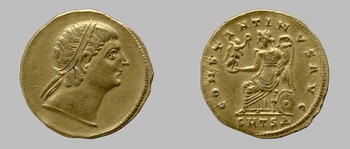
The frequent appearance of Victory on Roman currency commends this interpretation, but it is also an obstacle to speculating about what sort of coin may be in view or which emperor. Nevertheless, it is an intriguing coincidence that it was Constantine who introduced the VICTORIAE LAETAE legend on his vota coins. The reverse depicts two smiling Victories inscribing a shield that sits atop an altar (Fig. 1). Might this coin-type be the inspiration for Palladas’ Νῖκαι γελῶσαι? Perhaps, though the timing does not seem to be quite right. This legend first appeared on coins issued after Constantine's victory over Maxentius and continued to be struck at intervals until the early 320s. This obviously predates the founding of Constantinople, and it is difficult to imagine that any city would have been called ‘Christ-loving’ at this early date. If the reader is to seize rather on the detail that Victories are bearing victories (line 2), one might think of the Victoria who is seated and holding a globe upon which a smaller Victory is perched (Fig. 2). This is a gold solidus that commemorates Constantine's triumph over Licinius in a.d. 324. Neither of these two coin-types, however, captures what seems to be of central importance in Palladas’ epigram, namely the city.
RIC VII (Siscia), no. 59 (a.d. 319). Obv.: IMP CONSTANTINVS P F AVG; bust of Constantine laureate, helmeted and cuirassed r. Rev.: VICTORIAE LAETAE PRINC PERP; two Victories standing facing one another holding shield inscribed VOT / P R over altar. Marks: ASIS*. Scale 2:1. (© Yale University Art Gallery, Gift of Brian Weinstein, BA 1959: 2002.121.24)

RIC VII (Thessalonica), no. 131 (a.d. 324). Obv.: anepigraphic; head with plain diadem r., looking upwards. Rev.: CONSTANTINVS AVG; Victory seated l. on throne, holding Victory on globe and cornucopiae; behind, shield. Marks: SMTS[Δ]. Scale 2:1. (©Yale University Art Gallery: 2001.87.8735)

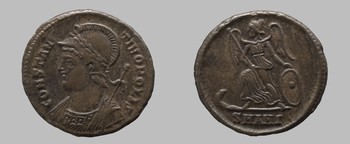
A much more plausible source of inspiration is one (or more) of the issues depicting a personification of Constantinople paired with an exultant Victoria. Constantine founded the city to commemorate his victories over Licinius in the civil war.Footnote 45 And the dedication of the Eastern capital in a.d. 330 was advertised on his coinage in subsequent years with complementary representations of Constantinople and Victoria. I have reproduced an image of one of these, a bronze coin minted at Antioch, which depicts a helmeted personification of the Eastern capital bearing the legend CONSTANTINOPOLIS; on the reverse stands Nikê in military attire with spear and shield (Fig. 3).Footnote 46 She is here quite literally bringing her victories to the city. In another contemporary issue, the two are depicted together on the reverse, Victory crowning Constantinople with a wreath.Footnote 47
RIC VII (Antioch), no. 92 (a.d. 335). Obv.: CONSTANTINOPOLIS; helmeted bust l., spear over shoulder. Rev.: anepigraphic; Victory standing on prow. Marks: SMANI. Scale 2:1. (© Yale University Art Gallery: 2001.87.17066)

If Palladas had one or more of these coins in view, this might also explain why he declares that the minted figures were appropriate to the victories (line 4). This has generally been taken to mean that the figures were somehow appropriate to the goddess. But why, after speaking in the first person throughout the poem, would the Nikai suddenly refer to themselves in the third person? Ought they not to say in this case πρέποντα ἡμῖν or simply πρέποντα? It seems to me that the figures were rather appropriate to the military victories that had been won. This might easily be a reference to the fact that the Constantinople-Victoria issues depict Nikê with military accoutrements (for which σχήματα is just the right word). But there is one other notable fact: she is also, on all of these coins, standing on the prow of a galley. This was a reference to the decisive naval conquest over Licinius’ fleet during the civil war.Footnote 48 Perhaps, then, it was the image of Victory both arrayed in military attire and also guiding a warship that elicited the comment of πρέποντα νίκαις.
I consider one of these commemorative coins to be a very plausible object of Palladas’ ekphrasis. If this is convincing, the epigram can be dated quite securely to the 330s. Given our poet's penchant for highly topical references, one would expect a date closer to — rather than further from — the foundation of the city and the first appearance of these images (sc. under Constantine). At the very least, however, I take it to be highly probable that (i) the city in question is Constantinople and (ii) the epigram describes coins rather than paintings or sculptures.
Finally, there is the question of tone. Some have suggested that the epigram is ironic. Johannes Irmscher, for example, thought that Palladas’ Victories were laughing scornfully at the Christ-loving city — a place whose religious character the poet himself despised.Footnote 49 But laughter had always been one of the primary characteristics of the Nikai.Footnote 50 If Palladas wanted his readers to imagine that they were sneering rather than joyful, he surely would have provided some indication. Alan Cameron, despite rejecting Irmscher's logic, has also detected irony. He places the poem in the context of Theophilus’ anti-pagan activities of a.d. 391.Footnote 51 ‘Those who love the city’, on his reading, are Alexandrians of earlier days who fashioned proper Victories for Alexander and the Ptolemies; it is these very statues that have now been captured, mutilated, and forced to bring victories to those who love Christ rather than the city. I have already made my case for dislodging Palladas’ poetry from the late fourth century, and for situating this epigram in Constantinople. But there is also nothing obviously disdainful or sarcastic about these four lines (even if we believe that the poet must have been winking when he wrote them). I see no reason to think that the poem was designed to be read as anything other than a serious commemoration of the new capital city and the victorious emperor. Of course, this does not mean either that Palladas was himself a Christ-lover, or even that he took any personal joy in the emperor's victories and the foundation of the city.Footnote 52 This epigram, like those on Licinius’ foolish opposition to God's favourite (AP 10.90 and 91),Footnote 53 may simply be a concession to Constantine's propaganda.
IV
We are left to trust in her oaths and in her religious scruples; but after her oath she can seek out twelve newer gods.
This is the final couplet of Palladas’ longest extant epigram — an eighteen-line attack on the infidelity of women. Nothing, he says — neither youth nor age, neither beauty nor deformity, neither gaiety nor severity — is a reliable indicator of a woman's chastity. Men are left to trust that their lovers remain true to their oaths; but even then, if a woman is unfaithful, she can seek out twelve newer gods. The end of the pentameter is emended (quite plausibly) from the manuscript's nonsensical and unpunctuated καινερεου.Footnote 54 The idea seems to be that after she has sworn an oath of fidelity by the twelve pagan deities, the unchaste woman can simply acquire forgiveness by means of twelve newer ones (sc. the Apostles). The Christian emphasis on forgiveness of sins was thought by some pagans to be a very reckless approach to ethics. It comes in for sharp criticism, for example, in Julian's send-up of Constantine in the Caesares.Footnote 55 Julian may also be the source of the rumour, found in later sources, that his uncle did not fully commit himself to the new religion until after the untimely deaths of Crispus and Fausta, when an opportunistic Christian priest was the only one who dared to absolve Constantine of his supposed guilt in the affair.Footnote 56 This slander probably has nothing to do with the couplet quoted above, but the verse may contain a Constantinian connection of a different sort.
As one would expect of Palladas, the sarcastic reference to Christian absolution at the end of this epigram is made in a riddling form. But why especially the Apostles? And why does he call them gods? The one thing that must have been obvious to even the least well informed was that Christians acknowledged only one deity (or, at any rate, no more than two or three). Perhaps it is possible that Palladas was willing to sacrifice a degree of intelligibility for the sake of gaining a vague parallelism between the pagan and Christian Dodecades. This is not altogether satisfying, however, nor does it explain why he would introduce this comparison in the first place. And we are still left with the puzzle of why a loose woman would turn to the Apostles (rather than to Christ) for forgiveness. It is a very odd way indeed of saying that her final option was conversion to Christianity.
If we believe that Palladas habitually chose his words with great care — and all of the evidence suggests that he did — then there must be an allusion in this couplet that would have made it sensible to his contemporary readers. This is not to say that we will be able to identify it. There are plenty of cryptic passages in his epigrams that are likely to remain obscure because we are lacking the information required to solve them. Perhaps the ‘twelve newer gods’ fall into this class. There is a potential context, however, from the period and place under consideration in this paper, that may go some way to explaining Palladas’ odd expression: the construction of the Holy Apostles in Constantinople.
As is the case with most of the fourth-century buildings in the capital, there are conflicting reports about who was responsible for the construction of this church and when it was begun. Eusebius’ seemingly unimpeachable testimony that it was Constantine who built it late in his reign has been suspected of interpolation.Footnote 57 Some have thought that the church was begun by Constantine and completed by his son Constantius; others still that it was conceived by Constantius alone. The best theory is probably that proposed by Cyril Mango, who suggests that Constantine commissioned only a circular mausoleum for himself and dedicated it to the Apostles.Footnote 58 According to Mango, this is what Eusebius describes with intentional vagueness about the building's scope so as to allow for the more flattering interpretation that this structure was actually a Christian basilica. It was only later, however, under Constantius II, that the church proper was built in the neighbourhood of the mausoleum. If this is correct, then Constantine's rotunda was constructed in the 330s, as Eusebius’ narrative suggests, and the bishop's testimony remains extremely valuable. He says that it was a tall building with a copper roof and gold-plated ceiling, and he reports that it was surrounded by a large courtyard with porticoes containing residences and shops. Eusebius further says that it possessed a central altar and that Constantine made provision for Christian services to be held there. Finally, he reveals that it contained twelve coffins, one for each of the Apostles, which were distributed evenly on either side of a thirteenth intended for Constantine himself. If his renovation of the city's cult of Tyche shows Constantine adapting pagan elements for the purpose of imperial propaganda, then this peculiar monument shows him putting Christian elements to a similar use.Footnote 59 In any event, after his death in a.d. 337, the emperor was buried in this mausoleum. If Palladas happened to be in Constantinople at the time of its construction, we might expect the novelty to have caught his attention. And it seems to me that the couplet quoted above is more intelligible — and perhaps also the joke funnier — if he is alluding to this new Christian ‘temple’ and its twelve tutelary ‘deities’.
This is a rather subjective argument, to be sure. And if it explains anything at all, it only explains why Palladas might call the Apostles θεοί. The very purpose of an allusion to the ‘twelve newer gods’ and their ‘temple’ — when what the couplet requires is merely a reference to religious conversion — is still obscure. There is, however, a historical notice that may offer a solution. In his late ecclesiastical history, Nicephorus Callistus declares that Constantine's mausoleum, dedicated to the Twelve Apostles, was in fact built on a site that had formerly housed an altar of the twelve pagan deities: ἐκήδευσε (sc. Constantius II) τὸν πατέρα ἐν τῇ ἐκκλησίᾳ ἣ τῶν Ἀποστόλων ἐστὶν ἐπώνυμος· ἔνθα ἔτι τῷ ζῇν περιὼν Κωνσταντῖνος, ἠρίον ἑαυτῷ κατεσκεύασεν, ὃ βωμὸς Ἑλλήνων πρότερον ἦν, δωδεκάθεον ὄνομα.Footnote 60 This is one of those late reports that are difficult to evaluate. It is plausible enough — Christian cult sites of the fourth century were frequently constructed over earlier pagan ones — but Nicephorus is far from the best authority. If, however, he is credible on this point, we might finally possess a full and satisfying explanation of Palladas’ couplet. After breaking the oath that she had made at the shrine of the pagan Δυωδεκάς, the unchaste woman could take refuge in the twelve newer ‘gods’ that had replaced them — and without even leaving the altar (as it were). What he means, of course, is simply that she could convert to Christianity and be absolved of her sins. But this simple thought is encoded in a typically Palladan allusion — this time to the recent conversion of a pagan cult site into a Christian imperial monument.Footnote 61
This is perhaps more conjectural than the arguments set out in Sections I–III. Its virtue, however, is that it is capable of answering the questions that impede our comprehension of Palladas’ couplet: What is the point of a comparison between the pagan and Christian Dodecades? What do the Apostles have to do with conversion in the first place? And why are they newer gods?
V
There is fear that the gnashing Scylla has been set up in this manner near the coast, O Caesar; fashion restraints before (she strikes). For the excellence of the breathing bronze has the power to deceive, that she might draw in [or seize?] the sailor before he is on his guard.Footnote 62
These two verses are found in the so-called Epigrammata Bobiensia, a collection compiled c. a.d. 400. According to the title that appears in the manuscript — in Scyllam Constantinopolitanam in circo — the epigram deals with a Constantinopolitan statue of Scylla that was erected in the hippodrome. This site was close enough to the sea to provide a plausible fit for the poem's ‘prope litoris oram’, and we know from later testimonia that there was indeed a large bronze Scylla on the spina of the city's hippodrome.Footnote 63 As others have noted, these lines are almost certainly based on a lost Greek original.Footnote 64 The lost model, therefore, was included in the fourth-century Greek anthology that Alan Cameron has posited as the sole source for the Latin imitations produced by Ausonius and the Bobbio poets.Footnote 65 Furthermore, the Greek original of this epigram was itself quite clearly a product of the fourth century. This is proved by the apostrophe of an emperor (line 2), who seems to be responsible for the placement of the statue. All of this has been noted by Cameron, who quite naturally thought of ‘Constantine and his immediate successors who adorned [the hippodrome] with the stolen statuary of the entire Graeco-Roman world’.Footnote 66 But there is only one epigrammatist contained in the fourth-century anthology who was late enough to have written the model — Palladas. The others are Hellenistic or early Roman; all were long dead by the founding of Constantinople.Footnote 67 Moreover, as several other Palladan epigrams are most plausibly situated in the Eastern capital during its early years, and as he wrote elsewhere about the statuary that was being imported into the city, it appears quite likely that he was responsible for the lost original of this epigram too. The only alternative — always an unsatisfying one — is to posit an anonymous and otherwise unattested poet.Footnote 68 This seems an unnecessary hypothesis when the timing, the locale, and the subject matter are all appropriate to Palladas, who was also demonstrably included in the anthology used by the Bobbio poets.
Since a number of Palladas’ epigrams reflect conditions during the sole reign of Constantine I (at which time the poet himself was apparently advanced in years), it is perhaps likeliest that this is the apostrophized emperor of line 2. The Scylla, therefore, was probably erected in the hippodrome very near the foundation of the city.Footnote 69 The law of percentages might also be invoked in support of this judgement, for it was undoubtedly Constantine who imported the majority of the city's antique statuary.Footnote 70 It is possible, however, even if there is no proof, that Palladas survived into the reign of Constantius II, in which case the statue could have been imported in the late 330s or in the 340s. The Greek original of this epigram almost certainly does not postdate the midway point of the century.Footnote 71
VI
Taken as a whole, the evidence for placing Palladas in Constantinople is quite strong. Six of his epigrams (on the converted Olympian bronzes, on Victories and the Christ-loving city, and the four on Tyche's tavern) very likely pertain to the Eastern capital; he may have made one passing allusion to the imperial mausoleum; and he is the likeliest source of an epigram (which now survives only in Latin translation) about a bronze Scylla in the Constantinopolitan hippodrome. What is more, everything points to his presence there during the 330s, when (on the corrected dates) he would have probably been in his seventies.
Given the generally sorry state of our information on Constantinople at the time of its foundation, the evidence supplied by Palladas is a welcome boon. He was an eyewitness to the extensive importation of pagan statuary that is elsewhere attested for the reign of Constantine. In particular, it appears likely on the evidence of Ep. Bob. 51 that the large bronze Scylla in the hippodrome was erected very early in the city's history. Palladas also encountered a cult site of the goddess Tyche that had been transformed into a tavern. John Lydus’ brief report to this effect has largely been ignored, presumably on account of its temporal vagueness. Palladas, however, allows us to date the site's conversion to Constantine's initial foundation (or very shortly thereafter). Finally on topographical aspects of the city, Palladas may lend some credibility to Nicephorus’ late claim that the imperial mausoleum, which was dedicated to the Twelve Apostles, had been built over an earlier altar of the pagan Twelve. Palladas should now assume his rightful place alongside Eusebius of Caesarea as an early (if also enigmatic) witness to the very early years of Constantine's city.
More important perhaps than the topographical hints to be gleaned from Palladas’ epigrams is his perspective on the religious character of Constantinople in the 330s. The conversion of Tyche's temple was one more example for him of the manner in which the traditional cults had suddenly been undermined (ἀνεστράφησαν, ὡς ὁρῶ, τὰ πράγματα). And statues of the gods that adorned the city's public spaces had, he says, converted to Christianity (Χριστιανοὶ γεγαῶτες). Not only had they ceased to be objects of pagan cult, they had taken on the religious character of the emperor and of the emperor's new capital. Most strikingly of all, Palladas calls Constantinople ‘the Christ-loving city’ (τῇ φιλοχρίστῳ πόλει).
None of this should be surprising. At about the same time, Eusebius of Caesarea was confidently declaring the birth of a new Christian capital, dedicated to the God of the martyrs and purged of all idol-worship.Footnote 72 In modern scholarship, however, not everyone has found this claim to be wholly credible. Some have detected incongruous elements in the public religion of the capital: from quasi-pagan monuments like the new Tychaion, to the appearance of Victories and other conventional figures, to the Helios imagery of Constantine's statue in the Forum.Footnote 73 The presence of these and similar features cannot be denied and may seem to contradict Eusebius’ claim. Indeed, if ‘pagan’ and ‘Christian’ are to be treated as pure categories, then there can be no doubt that Constantinople contained a ‘mixed’ or even ‘contradictory’ religious environment. But on this score others have already pointed the way forward.Footnote 74 Because Constantine himself was avowedly Christian, whatever he endorsed in the realm of public religion in his city was also perforce Christian — however much discomfort some elements might have caused a visiting bishop from Caesarea. Palladas is now our second extant witness from the 330s, and he seems to corroborate Eusebius’ testimony on this point. Whatever continuities with the pagan past that we might now detect, Constantinople was perceived by Constantine's subjects to be a Christian city from its inception.