INTRODUCTION
Scientific investigations on the Omani ichthyofauna started in the late 1800s, when Boulenger (Reference Boulenger1887) reported 172 species from the vicinity of Muscat (Randall, Reference Randall1995). Two years later, Boulenger (Reference Boulenger1889) reported on a second Jayakar collection of fishes from Omani waters. Since then several works have considered the fish fauna of Oman, including the Arabian Gulf and Sea of Oman (White & Barwani, Reference White and Barwani1971; Heemstra, Reference Heemstra1973; Fischer & Bianchi, Reference Talwar and Kacker1984; Kuronuma & Abe, 1986; Al-Abdessalaam, Reference Al-Abdessalaam1995; Jawad & Al-Mamry, Reference Jawad and Al-Mamry2009; Jawad et al., Reference Jawad, Louisy and Al-Mamry2010a, Reference Jawad, Al-Mamry and Al-Kharusib; Jawad, Reference Jawad, Al-Kharusi and Al-Mamry2011a, Reference Jawad, Al-Mamry and Al-Mamaryb).
The survey of RV ‘Al- Mustaqila 1’ in the territorial waters and exclusive economic zone of the Sultanate of Oman between Ra's Al Hadd and the Oman–Yemen border (McKoy et al., Reference McKoy, Bagley, Gauthier and Devine2009) represented the most recent and most comprehensive ichthyological exploration in the Omani waters since the surveys of RV ‘Dr Fridtjof Nansen’ (Kesteven et al., Reference Kesteven, Nakken and Strømme1976; Sætersdal et al., Reference Saetersdal, Strømme, Bakken, Piekutowsk, Nakken and Venema1982, Reference Saetersdal, Bianchi and Strømme1999; Stromme, Reference Stromme1986) and FRV ‘Rastrelliger’ (Johannesson, Reference Johannesson1990). Following the survey by the RV ‘Al-Mustaqila’, a large number of specimens were made available for taxonomic study at the Marine Science and Fisheries Centre, Ministry of Agriculture and Fisheries Wealth, Muscat, Oman. From this collection several new fish records for Omani waters were obtained (Jawad & Al-Mamry, Reference Jawad and Al-Mamry2009; Jawad et al., Reference Jawad, Louisy and Al-Mamry2010a, Reference Jawad, Al-Mamry and Al-Kharusib; Jawad, Reference Jawad, Al-Kharusi and Al-Mamry2011a, Reference Jawad, Al-Mamry and Al-Mamaryb).
In the present paper, we report on five new records, one in each of the following families: Centrophoridae, Stomiidae, Serranidae, Gempylidae and Percophidae.
All specimens of the five species represent new records for the Arabian Sea coasts of Oman, and were deposited in the ichthyological collection of the Marine Science and Fisheries Centre, Oman (OMMSFC). Standard length (SL), from tip of snout to base of caudal fin, was used for proportional measurements, and total length (TL) for the maximum length of specimens. Fish specimens were fixed in 10% formalin and stored in 70% ethanol. Measurements were made with dial calipers to the nearest 0.1 mm.
CENTROPHORIDAE
Deania profundorum (Smith & Radcliffe, 1912)
MATERIAL EXAMINED
OMMSFC 1082, 1: 873 mm TL, east of Masira Island, Arabian Sea coasts of Oman, 20°44′06.40″N 59°17′26.47″E, ‘Al-Mustaquila Trawler’, 2006–2008 (Figures 1 & 2).
Deania profundorum, 873 mm total length (OMMSFC 1082).

Deania profundorum, ventral side of head, 873 mm total length (OMMSFC 1082).

DESCRIPTION
Long, low and keel shaped first dorsal fin with smaller spine than the second dorsal fin spine. Pectoral fin with free and short tip. Snout greatly elongated and depressed dorsal-ventrally and compressed laterally. This species can be easily identified by the presence of a keel on the underside of the caudal peduncle (Compagno, Reference Compagno1984). Broader teeth in the lower jaw than those in upper jaw. Dermal denticles on sides of body have stellate bases, high pedicels, tricuspidate and triridged erect crowns. Brownish grey or dark grey in colour.
REMARKS
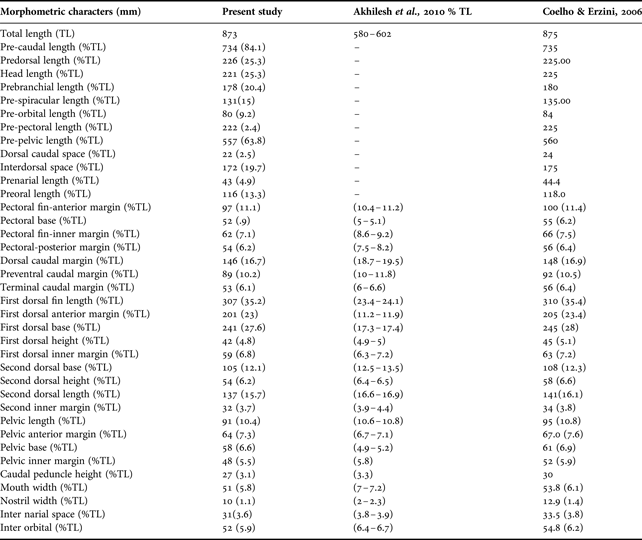
Arrowhead dogfish, D. profundorum lives at depths between 275 and 1785 m and has a very sporadic distribution in the world oceans (Akhilesh et al., Reference Akhilesh, Hashim, Bineesh, Shanis and Ganga2010). None of the four species of the genus Deania were recorded previously in Omani waters (Compagno, Reference Compagno1984). Deania profundorum differs from the other Deania species in having a subcaudal keel on the lower surface of the caudal peduncle (Compagno, Reference Compagno1984). The specimen obtained in this study is larger than that of Akhilesh et al. (Reference Akhilesh, Hashim, Bineesh, Shanis and Ganga2010) from Cochin, India and just smaller than that obtained by Coelho & Erzini (Reference Coelho and Erzini2006) from southern Portugal (Table 1).
Morphometric and meristic characters of Deania profundorum.

STOMIIDAE
Chauliodus sloani Bloch & Schneider, 1801
MATERIAL EXAMINED
OMMSFC 489, 490, 494, 567, 610, 613, 627, 9: 30–150 mm TL, south of Masirah Island, Arabian Sea coasts of Oman, 20°17′ 50.70″N 59°17′50.70″E, ‘Al-Mustaqila Trawler’, 2006–2008 (Figure 3).
Chauliodus sloani, 35 mm total length (OMMSFC 489).

DESCRIPTION
Body long, compressed with maximum depth of body at back of head. Head and snout short. Mouth gape wide extending to back of eye. Very large, fang-like teeth on premaxilla extending over front of head to above eye when mouth is closed. Upper jaw shorter than the lower, armed with four fangs on each side. Forward situated dorsal fin, close to head, the first ray prolonged; dorsal adipose fin present near tail; anal fin close to tail.
REMARKS
The distribution of this species is mainly in warm and temperate parts of oceans around the world but with several distributional gaps in the southern central Atlantic, northern Indian Ocean, eastern Pacific north of the equator. Also found in the western Mediterranean. South China Sea and East China Sea. In the key for the species of the genus Chauliodes given by Parin & Novikova (Reference Parin and Novikova1974), the species of the genus Chauliodes are characterized in set of characters that separate them from C. sloani. In C. barbatus, the photophores of the lateral row are arranged under the scale sections of the fourth row, antenna has widening on its end; for C. macouni, the photophores of the lateral row are arranged under the scale sections of the fifth row, antenna is conical shape; for C. pammelas, the antenna is reduced in fish which is about 150 mm long; for C. schmidti, antenna is reduced in fish 160–200 mm long; for C. danae, antenna do not have visible terminal widening; for C. minimus, antenna has widened terminal lobe and it reduces in fish which are about 90 mm; and for C. vastnetzovi, dorsal fin begins over the 7th or the 9th photophores, the median and marginal photophores are pigmented.
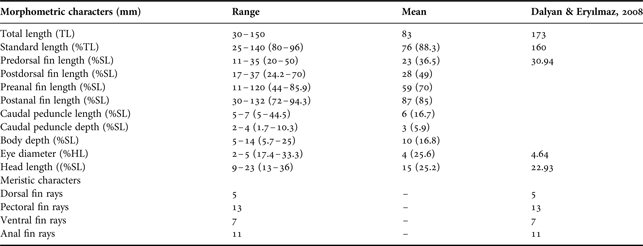
The description of the present specimens agrees with descriptions given by Gibbs (Reference Gibbs, Whitehead, Bauchot, Hureau, Nielsen and Tortonese1989). The specimens obtained in this study are smaller than those obtained by Dalyan & Eryılmaz (Reference Dalyan and Eryılmaz2008) from the Turkish waters of the Levant Sea (Table 2).
Morphometric and meristic characters of Chauliodus sloani.

SERRANIDAE
Epinephelus chabaudi (Castelnau, 1861)
MATERIAL EXAMINED
OMMSFC 1083, 1: 590 mm TL, east of Masirah Island, Arabian Sea coasts of Oman, 19°43′17.18″N58°22′10.07″E, ‘Al-Mustaqila Trawler’, 2006–2008 (Figure 4).
Epinephelus chabaudi, 590 mm total length (OMMSFC 1083).

DESCRIPTION
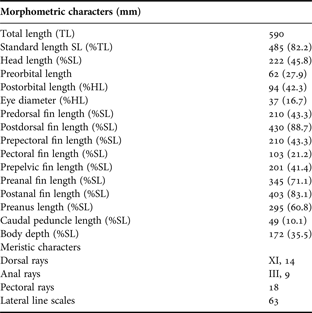
This species is characterized and can be separated from congenerics by the following set of characters: dorsal rays XI, 13–14; anal rays III, 8–9; pectoral rays 17–18; lateral line scales 61–69; longitudinal scale series 100–114. Body covered with ctenoid scales except anterodorsally, thorax and abdomen. Maxilla long reaching or extending posterior edge of orbit. Two rows of teeth on midside of lower jaw of specimens less than 600 mm SL and 3–4 rows in specimens of 900 mm SL. Interorbital area slightly convex. Adults with oblong posterior nostril. Corner of preopercle with slightly enlarged serrae, ventral side with 1–2 small spines. Dorsal fin with deeply incised membrane and long third or fourth spines. Caudal fin with truncate shape. Pelvic fins not reaching anus. Morphometric and meristic characters are shown in Table 3.
Morphometric and meristic characters of Epinephelus chabaudi.

REMARKS
In its distribution area on the western coasts of Africa and coasts of Kerala, this species was recorded from the nearby Arabian Gulf by Manilo & Bogorodsky (Reference Manilo and Bogorodsky2003). Epinephelus chabaudi showed a remarkable confusion where several synonyms were assigned to this species (Talwar, Reference Talwar1975; Talwar & Kacker, Reference Talwar and Kacker1984; Bouhlel, Reference Bouhlel1988). This species is closely related to E. septemfasciatus. On the other hand, the western Indian Ocean epinephelid species, E. marginatus is most likely to be confused with E. chabaudi (Randall & Heemstra, Reference Randall and Heemstra1991).
GEMPYLIDAE
Neoepinnula orientalis (Gilchrist & von Bonde, 1924)
MATERIAL EXAMINED
OMMSFC 71, 85, 213, 219, 222, 226, 562, 604, 12: 75–198 mm TL, off Madrakah Peninsula, Arabian Sea coasts of Oman, 18°58′31.59″N 57°48′41.50″E, ‘Al-Mustaqila Trawler’, 2006–2008 (Figure 5).
Neoepinnula orientalis, 86 mm total length (OMMSFC 71).

DESCRIPTION
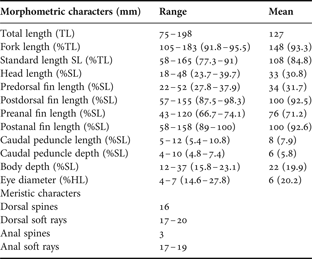
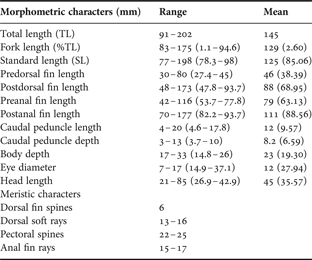
Deep body with depth 3.9 to 4.2 times the standard length. Three immoveable and 1 to 3 moveable fangs at anterior part of upper jaw. One fang anteriorly on each side of lower jaw. First dorsal fin inserted above insertion of pectoral-fin base; pectoral fins with 13 or 14 (rarely 15) soft rays; pelvic fins inserted beneath or behind middle of pectoral fin. Body greenish brown to dark brown; buccal and branchial cavities usually black. Morphometric and meristic characters are shown in Table 4.
Morphometric and meristic characters of Neoepinnula orientalis.

Neoepinnula orientalis differs from its congener in the following set of characters: body less deep (3.9 to 4.2 times the SL in N. orientalis and 4.2 to 4.7 times the SL in N. americana); anteriorly, there are 3 immoveable fangs in upper jaw and 1 to 3 moveable fangs and 1 fang anteriorly on each side of lower jaw; insertion of first dorsal fin above insertion of pectoral-fin base; pectoral fins with 13 or 14 (rarely 15) soft rays; pelvic fins inserted beneath or behind middle of pectoral fin; body greenish brown to dark brown; membranes between anterior 3 or 4 first dorsal fin spines pigmented more intensively; buccal and branchial cavities usually black.
It is reported from the Indo-West Pacific region from Kenya, Natal, South Africa, Saya de Malha Bank and the Arabian Sea. It is also reported from Flores, Banda, Arafura Sea, Sulawesi and Sulu Seas, off the Ryukyu Islands and southern Japan. It is also found in Fiji and Tuvalu.
REMARKS
Although this species is shown to be recorded from the Arabian Sea coasts of Oman in the map given by FishBase, Oman is not present in the country list where this species is found given by FishBase. The nearest localities to the Omani coasts where this species is recorded are the Arabian Sea coasts of Pakistan from the west and the Somali coasts from the east (Froese & Pauly, Reference Froese and Pauly2010). The lack of sampling in the area prevents the regular detection of this species in the Sea of Oman although it has been present since the postglacial recolonization of the Sea of Oman by marine fish and has been overlooked in the past.
PERCOPHIDAE
Bembrops platyrhynchus (Alcock, 1894)
MATERIAL EXAMINED
OMMSFC 42, 304, 311, 448, 11: 91–201 mm TL, south of Al-Hilaniyah Island, Arabian Sea coasts of Oman, 17°21′ 46.12″N 56°05′31.82″E, ‘Al-Mustaqila Trawler’, 2006–2008 (Figure 6)
Bembrops platyrhynchus, 95 mm total length (OMMSFC 42).

.
DESCRIPTION
Lateral line gradually descending, 2–4 rows of scales separate it from origin of first dorsal fin and by 4–6 from origin of anal fin. Upper jaw long, passing the anterior margin of eye. Long, slender maxillary tentacle somewhat pointed at its tip. First spine of first dorsal fin elongated in adults. Moderately pointed pectoral fin at its posterior edge. Caudal fin rounded. Gill rakers 3–5 on upper limb and 11–15 on lower limb of branchial arch. Presence of grey to black pigmentation on distal edge of membranes between all spines of first dorsal fin. The morphometric and meristic characters are shown in Table 5.
Morphometric and meristic characters of Bembrops platyrhynchus.

It is reported from the Indo-West Pacific region at the Bay of Bengal, the South China Sea, the Philippine Sea, the Tasman Sea, and off the coast of Somalia and South Africa.
REMARKS
Because of the similarity in their morphology, Alcock (Reference Alcock1899, Reference Alcock1902), Kuroda (Reference Kuroda1950) and Smith (Reference Smith1965) regarded Bembrops platyrhynchus as a junior synonym of B. caudimacula. Das & Nelson (Reference Das and Nelson1996) confirmed a close resemblance between the two species but they recognized B. platyrhynchus as a valid species due to the differences in coloration in the spinous dorsal fin (dark pigmentation present distally on the membranes between all six spines of the first dorsal fin in B. platyrhynchus) and in some osteological characters. This species can be distinguished from B. caudimacula in having fewer scales between lateral line and origin of anal fin (4–6 in B. platyrhynchus versus 5–7 in B. caudimacula). This species is also distinguished from B. greyi in having dark pigmentation only along distal edge of first dorsal fin. In having lateral line descending abruptly, this species differs from B. macromma, B. macromma, B. nematopterus, B. morelandi, B. caudimacula and B. magnisquamis. With dark grey to black pigmentation on 1st dorsal fin confined to distal edge and lateral-line scales ranging 47–57, it differs from B. cadenati, B. filifera, B. anatirostris, B. curvature and B. gobioides.
ACKNOWLEDGEMENTS
We thank the Ministry of Fisheries Wealth, Marine Science and Fisheries Centre, Ministry of Fisheries Wealth and the Directorate of Agriculture and Fisheries Developmental Fund for giving us the opportunity to work on the fish samples within the qualitative and quantitative distribution of marine organisms in Sultanate of Oman and for providing the appropriate financial support. Our sincere thank is due to Dr Stephen Goddard, Sultan Qaboos University for reading the manuscript.