

INTRODUCTION: THE DEMOCRATIC PROCESS AND SOCIAL WELFARE POLICIES
The late twentieth-century proliferation of new democracies provides a remarkable opportunity for investigating the effects of democratisation processes on social welfare development. Yet few studies have examined empirically the impact of third-wave democratisation processes on social welfare systems in developing countries. This is particularly true for Africa, a continent in desperate need of measures that could help tackle widespread economic and social hardship. Very limited research, in particular, has been carried out on whether the democratic reforms undertaken by many sub-Saharan African states during the 1990s actually delivered the social welfare advances that many citizens anticipated (cf. Bratton & Mattes Reference Bratton and Mattes2001).Footnote 1
This paper investigates whether and how the advent of democracy affects social welfare policies by examining one of Africa's most prominent cases of recent democratisation. Ghana underwent a democratic transition during the early to mid 1990s, starting with a controversial election and gradually improving its democratic credentials up to the point at which, today, many observers consider the country a shining star on Africa's poorly performing democratic scoreboard. While Ghana did have some prior experience with elected governments, it was only recently, and partly thanks to the economic progress achieved during the previous decade, that democracy began to take root and appeared to become resilient. As a low-income developing country in which democratic politics has been played out for over fifteen years now, Ghana represents a most interesting case for learning about the social impact of open electoral politics. Towards this end, a specific and crucial social sector – health – is selected for investigating empirically the evolution of social policy.
It is important to note that what, on the face of it, may appear to be a single case study is actually a diachronic comparison between two cases – authoritarian Ghana (1981–91), and democratic Ghana (after 1992) – that allows a test of the main hypothesis (i.e. the impact of regime change on health policy). A diachronic comparison, in other words, makes not just one but two distinct observations on both the independent and the dependent variable (cf. Bartolini Reference Bartolini1993; Gerring Reference Gerring2007: 162–4), thus helping us control for the potential effect of a host of other variables such as culture or demographics that, because we are comparing one country with itself, essentially remain constant.
The paper proceeds as follows. First, the theoretical argument about the democracy-welfare connection is spelled out, followed by a review of the main alternative hypotheses in the literature on the development of welfare policies. Next, an analysis is presented of the evolution of health policy in Ghana. This is divided into two parts, the first focusing on the post-independence and pre-democratic period, and the second examining health policy developments after democratic politics was introduced. To better understand the shift from the first to the second phase, a section is inserted between the above two parts to examine the historical roots, ideological orientation and political constituencies of the main political parties that emerged with the country's democratic transition in the early 1990s. The paper then articulates a full explanation of Ghana's recent health reform based on the interaction of three factors – one major and two complementary – namely, democratic competition, a policy feedback effect on politics, and the international diffusion of policy recipes. It argues that the new dynamics of electoral competition played a crucial role in triggering change in health policy. Existing health financing arrangements, deeply despised by many Ghanaians, became an attractive ground on which the opposition could challenge the ruling party. Yet, in order to do this, the opposition needed an alternative policy option. The latter was formulated by drawing from domestic community-based and government pilot experiences, as well as from evolving international thinking about viable health strategies for developing countries. The combination of the above-mentioned three factors was so prevailing that an ambitious social health insurance policy for universal coverage was hastily introduced, after winning office, by an opposition-turned-government party whose liberal orientation would have made it, in principle, a least likely actor for adopting such socially oriented initiatives.
ACCOUNTING FOR SOCIAL POLICY DEVELOPMENTS: DEMOCRATISATION AND BEYOND
When a country undertakes democratic reforms, expectations about improvements in social welfare typically run high. The idea that the introduction of political participation and open competition will affect the development of social policies is based on two simple assumptions. The first is a view of democracy as a political market in which voters are in a position to demand the delivery of certain goods, while elected politicians are under pressure to provide some kind of policy answers to such requests, if they are not to suffer electoral defeat. Thus, if the electoral process functions properly and is supported by free public discussion and open scrutiny of public affairs, policy making will be relatively responsive to popular demands.
The second assumption is that, in a country where most people are poor, the development of social policies will be a popular concern. Under democratic rules, as a mass of poor voters have the opportunity to cast their ballots, social needs and demands become important issues for politicians looking for electoral mandates. In turn, increased social protection becomes a likely outcome of the policy-making process.
A number of specific causal mechanisms are supposedly at play in linking democratic politics to social policies, including the development of a public sphere and discourse, the formation and activities of interest groups and political organisations, the dynamics of electoral competition, and accountability.Footnote 2 In a democratic context, for example, interest group activities, political mobilisation, information flows, open public debates and media scrutiny will all help the worse-off organise and voice their demands as well as monitor government responses and policies. But the key mechanism is electoral competition. Competitive elections strengthen citizens' capacity to influence policy makers by holding them accountable for the outcomes of their decisions. It is the ambition to gain power that drives electoral competitors into pledging to address voters' demands, and the fear of losing office that drives incumbent governments to make an effort to realise such pledges. The more competitive the political system, the stronger the pressures both for addressing voters' concerns with proper election platforms, and for actually delivering policy responses once in power.
The notion that the many and the needy will benefit from democratic change, however, has not gone unchallenged. The classic objection is that some authoritarian developmental states – particularly in East Asia – have achieved impressive results in tackling social problems. In these cases, leaders who were largely insulated from bottom-up demands nevertheless introduced policies that addressed issues such as poverty or inequality. Other objections question the extent to which democracy really implies inclusive politics, whether the poor will actually have the will and the capacity to give prominence to their social-welfare needs, and whether electoral processes can replace neopatrimonial and clientelist dynamics where the latter constitute the core business of politics (cf. Bollen & Jackman Reference Bollen and Jackman1985; de Waal Reference de Waal2000; Khan Reference Khan2005; Lindberg Reference Lindberg2003; Ross Reference Ross2006; Varshney Reference Varshney2000).
Ultimately, whether democratic rule actually leads to the development of social policies is a question for empirical investigation. Our hypothesis is that, where elections are fairly conducted, with fierce democratic competition, effective public scrutiny and relatively open policy making, politicians will have a strong incentive to adopt policy measures for the provision of such crucial public goods as health or education. On the contrary, where no free elections are conduced, no electoral challenge is conceivable, and no public scrutiny or open policy making is available, politicians will have little incentive to address these same public concerns, and thus will not adopt such socially oriented measures. Empirically examining the validity of this hypothesis requires a focus on the key mechanism, namely the nature of electoral competition.
The advent of democracy is certainly not the only explanatory factor to which the literature on the origins and developments of national welfare systems has drawn attention. A sound assessment of the role democratic change may play in the adoption of social protection policies thus requires an examination of other factors, whether as alternative or complementary causes.
Works on the emergence and expansion of welfare states can largely be grouped into five clusters (cf. Carnes & Mares Reference Carnes, Mares, Boix and Stokes2007; van Kersbergen & Manow Reference van Kersbergen, Manow and Caramani2008). A first group has traditionally looked at the welfare state as a by-product of modernisation and economic development processes. In this view, profound socio-economic transformations and the emergence of a prevailing ‘logic of industrialism’ (Wilensky Reference Wilensky1975) bring about the appearance of new social needs. Welfare policies are thus originally introduced as part of a broader process of economic, social and political change. The same can be said of successive welfare state developments and reforms, as, even in advanced countries, processes of modernisation are on-going rather than completed affairs (Ferrera Reference Ferrera2006: 16).
A second group of explanations focuses on the dynamics of political mobilisation. In this view, social spending levels and types of welfare tend to reflect the balance of power resources between labour-based organisations and conservative socio-political forces (Esping-Andersen Reference Esping-Andersen1990; Korpi Reference Korpi1983). But political mobilisation is not the same as democratisation. Indeed, according to some interpretations, workers' mobilisation achieved earlier successes, in terms of concessions of social protection measures, in countries that were late in democratising. On the other hand, a more specific and democracy-related version of this approach concentrates on whether a state is governed by left-wing or right-wing political parties, with the former deemed to be more favourable to redistributive state interventions. An important critique of this line of reasoning, however, was developed by scholars who emphasise the role of cross-class alliances, as opposed to class-based political forces, in promoting the adoption of specific social policies (Baldwin Reference Baldwin1990).
The policy-making role of state bureaucrats is at the core of a third stream of arguments (Grindle & Thomas Reference Grindle and Thomas1991: 49–51; Skocpol et al. Reference Skocpol, Evans and Rueschemeyer1985). Technocrats, in particular, supposedly play a crucial role in developing countries, where non-state actors are particularly weak and lack the resources necessary to articulate their policy positions, leaving ample room for bureaucracies to influence the agenda and the content of social policy (cf. Carnes & Mares Reference Carnes, Mares, Boix and Stokes2007: 879).
A fourth and related perspective emphasises the impact of existing institutional or policy arrangements on the policy process. In a specific policy area, for example, both the presence of non-state actors, with their own forms of social interventions, and the pre-existence of public policies may affect the adoption and implementation of any new policy measure. Existing policy programmes are thus an independent factor affecting the evolution of politics and policy: in this sense, it has been observed, ‘policies create politics’ through a so-called ‘policy feedback’ effect (Pierson Reference Pierson1994).
Finally, scholars have investigated the role of international actors, pressures and processes in the building and development of welfare systems. These works have raised two main issues. One concerns the impact of a country's exposure to the global economy on its domestic social policies. Here, at least three distinct positions exist. The first argues that globalisation favours economic development and modernisation, and thus tends to strengthen welfare systems. The second, by contrast, posits that globalisation limits a country's autonomous policy making and thus hinders the adoption of welfare policies, particularly where the latter require social spending increases. The third suggests that any link between global processes and social policies is likely to hinge upon contextual factors. In many cases, for example, opening to the international economy requires that a country invests in welfare policies as domestic compensation strategies (Cameron Reference Cameron1978; Fiori Reference Fiori2008; Garrett Reference Garrett1998; Katzenstein Reference Katzenstein1985).
Second, scholars examining external influences on domestic policy making have focused on international processes of policy diffusion. Policy diffusion is a phenomenon characterised by temporal waves, spatial concentration, and content commonality in diverse settings (Weyland Reference Weyland2005: 265). The substantive content of the policy being diffused may vary significantly. With regard to developing countries, the best-known example is that of economic adjustment policies. Yet recent years have also seen a noteworthy cross-country transmission of social policies, often in connection with the development of global welfare agendas in such fields as poverty eradication, education or health. Besides the content of policies, the actual modes and causes of policy diffusion also vary. Diffusion may take place through a ‘soft’ process, for example, when it largely occurs through the spread of ideas, or it may involve ‘hard’ influences and pressures, when policy choices are more directly determined by outside actors such as foreign governments or international institutions.
POLITICS AND HEALTH POLICY IN GHANA (i): THE POST-INDEPENDENCE ERA
Stable democratic rule in Ghana is a relatively recent achievement. While the country held multiparty elections on the eve of independence in the 1950s, it subsequently failed to institutionalise pluralist politics. For over three decades, authoritarian rule remained prevalent, only briefly interrupted by short spells during which attempts were made to re-introduce competitive elections and civil government, in 1969–72 and 1979–81. It was only with the multiparty opening of 1992 that the country successfully embarked on a process of democratic change. Jerry Rawlings, the soldier who had ruled Ghana for over a decade after taking power in 1981, presided over the country's transition and early democratic steps.
In spite of the great potential that was attributed to the country's economy in the early post-independence period, Ghana's development also went through dramatic ups and downs. At its most difficult time, GDP per capita fell from US$281 in 1970 to US$180 in 1983 (World Bank 2010), as the country moved from economic decline to disaster. This gravely damaged state institutions and public services. During the 1980s, however, Ghana made one of the most impressive economic turnarounds in independent Africa. The Rawlings regime quickly abandoned its early plans for radical reforms and embraced a neo-liberal reform agenda. Unlike elsewhere in the region, the new policies rapidly delivered important results, as both the economy and state revenues reversed course and began to recover and grow. By the end of the century, the country put up a ‘stellar economic performance’ (Tsikata Reference Tsikata, Devarajan and Holmgren2001: 47) that made it a major darling of foreign donors.
Modern social policies, in some embryonic form, were first established in Ghana under colonial rule. The British, however, aimed at minimising colonial state interventions and costs. Since colonies had to find their own resources for financing social services, a decentralised approach was chosen that would merely offer some supplement to the existing welfare arrangements of local communities. A slightly more interventionist approach to social welfare was introduced in the 1940s and 1950s, but the beneficiaries of colonial health and school services remained few, largely confined to some categories of ‘detribalised urban Africans’ who fell outside the traditional safety nets of extended families in rural areas (MacLean Reference MacLean2002: 70–1).
The end of colonial domination in 1957 brought a remarkable U-turn in social policies. Under independence leader Kwame Nkrumah, the country saw a sustained and substantial expansion of social spending and services. While the urban population remained the main target of government initiatives, these now aimed to make health and education services vastly more available and accessible. In health policy, in particular, a new emphasis was placed on preventive and community-based health care, as opposed to a hospital-based curative system, while the relatively low user fees that had been introduced during colonial times were abolished, as services came to be entirely financed through general taxation (Agyepong & Adjei Reference Agyepong and Adjei2008: 154; Senah Reference Senah2001: 85; SEND-Ghana 2010: 14). Soon, however, Ghana found itself struggling not only to build up, but even to sustain its newly created national health system. The country's economic conditions were gradually worsening, as were the functioning and quality of free public health care. It was not long before post-Nkrumah governments decided to introduce measures aimed at cutting health spending and reintroducing a degree of cost recovery (1969 Hospitals Fees Decree, 1970 Hospitals Fees Act, and 1971 Hospitals Fees Act). Out-of-pocket fees at point of service, however, were kept at very low levels and were largely meant to discourage unnecessary use. Meanwhile, rather than recovering, the country plunged ever deeper into economic crisis.
By the mid 1970s and the early 1980s, the social services system, like many other state institutions and services hit by a dramatic dearth of resources, had weakened to the point of virtual collapse. While, due to the very low level of official fees, public health care was almost free, the system was hardly capable of delivering any services. Health points suffered, in particular, a chronic lack of drugs. The need to restore the system became a priority, and it was therefore not surprising that professional and business interests, such as the Ghana Medical Association and the Ghana Pharmaceutical Association, met little resistance when they demanded that out-of-pocket payments be substantially raised to provide the resources that the system needed.
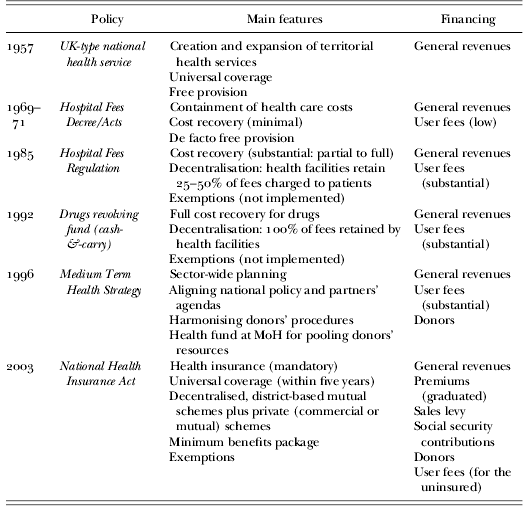
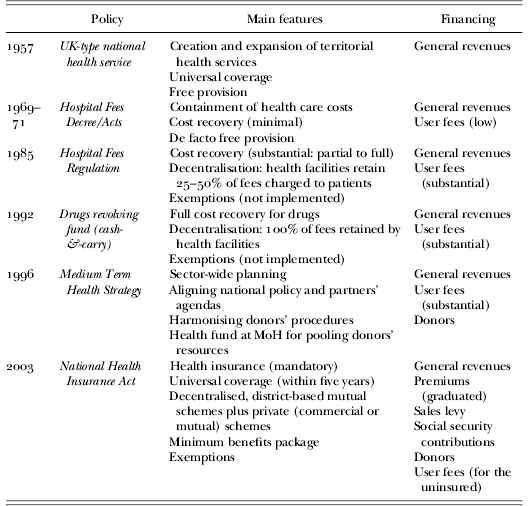
Rawlings had meanwhile taken over on 31 December 1981, and the new regime soon realised the urgency of re-establishing basic services. With the World Bank and the International Monetary Fund pressing for the government to cut public spending, the Hospital Fees Regulation was adopted in 1985. This aimed to recover 15% of recurrent health costs by substantially increasing the level of official fees. Much of the real terms value of fees for consultations, diagnostic procedures, surgery, hospital accommodation and the like, however, was gradually lost over the years, as the original level at which they were set was never revised (Nyonator & Kutzin Reference Nyonator and Kutzin1999: 332). But the level of drug fees, intended to recover the full cost of medicines, was continuously adjusted to inflation. Following the recommendations of the Bamako initiative, a revolving fund scheme was also introduced in 1992 that linked user fees directly to drug purchase. Under this scheme, the government would only provide health facilities with an initial amount of free drugs, and health facilities would then sell the drugs to patients – at a price based on the procurement cost of each item plus a significant mark-up – and use the proceeds to buy more drugs (Asenso-Okyere et al. Reference Asenso-Okyere, Osei-Akoto, Anum and Adukonu1999: 586). Since the share of the revenues generated by out-of-pocket payments for drugs and services that local health facilities retained was raised from 25% and 50% (for health centres and hospitals, respectively) under the 1985 fee system to 100% under the revolving fund, the process increased the decentralisation of the health system (Badasu Reference Badasu2004: 290; Cassels & Janovsky Reference Cassels and Janovsky1992: 146).
The new system reinforced the popular use of the expression ‘cash-and-carry’, which stressed the need for Ghanaians to put down their money the very moment they asked for drugs or services at public health facilities. In principle, certain categories of people, such as pregnant women, were exempted from payments. Nor was any disbursement required for a few services deemed to be of public interest, such as immunisation or health care for leprosies and tuberculosis. Official exemptions were even gradually broadened to the point where, by 2001, indigents had been included in the guidelines issued by the Ministry of Health. But it was never made clear who belonged to this category (Atim et al. Reference Atim, Grey, Apoya, Anie and Aikins2001: 9n., 63). More generally, practical difficulties hindered a sound implementation of the exemption policy. Information was inadequately disseminated among potential beneficiaries, for example, and health staff only had poor instruments to determine who was to be exempted. Charging fees, on the other hand, was often the preferred option for managers of health facilities who had to deal with declining central funding (Badasu Reference Badasu2004: 293; Norton et al. Reference Norton, Bortei-Doku Aryeetey, Korboe and Dogbe1995: 43). Eventually, the state proved to have a very poor capacity for targeting social services and, in practice, virtually every Ghanaian ended up paying for public health services at point of use (cf. Aryeetey & Goldstein Reference Aryeetey, Goldstein, Morales-Gomez and Moher2000; Atim et al. Reference Atim, Grey, Apoya, Anie and Aikins2001: 10, 17; Sulzbach et al. Reference Sulzbach, Garshong and Owusu-Banahene2005: 3).
The extent to which a system based on user fees actually excluded from public health care all those who could not afford to pay was soon exposed by a number of empirical studies (Agyepong Reference Agyepong1999; Nyonator & Kutzin Reference Nyonator and Kutzin1999; Waddington & Enyimayew Reference Waddington and Enyimayew1989, 1990). Under ‘a significantly regressive spending regime’, between the late 1980s and early 1990s, the country's poorest quintile received only about 11–12% of government health spending, whereas the top quintile received 30–3% (Aryeetey & Goldstein Reference Aryeetey, Goldstein, Morales-Gomez and Moher2000). Yet the middle classes were far from happy about the existing system, for they themselves struggled to cater for the health of their extended families. In addition, the intrasectoral allocation of health funding placed further stress on community-level primary health care, since personnel costs as a share of the health budget had grown ever larger, at the expense of resources for drugs and services. In a country that was reaping economic benefits from adjustment reforms, the social costs of the latter were becoming increasingly tough and evident, and Ghanaians developed ever harder feelings about their cash-and-carry system of cost recovery.
DEMOCRATIC TRANSITION AND POLITICAL CONSTITUENCIES
Under the pressure of donors and of a democratic movement that was beginning to sweep through Africa, the Rawlings government undertook a regime transition in the early 1990s. Politics was opened to political parties and national elections were held, gradually establishing accountability mechanisms that linked political leaders to the voters. To investigate whether the dynamics of electoral competition actually allowed demands to be raised by voters, possibly pushing ruling parties to adopt new welfare measures, one has to understand the social constituencies of Ghana's main political parties.
Modern political alignments in Ghana were shaped during the immediate pre-independence period. The country's first political party, the United Gold Coast Convention (UGCC), was created after World War II by Joseph B. Danquah and other educated Africans. The UGCC soon split, as a breakaway faction led by Nkrumah set up the Convention People's Party (CPP), which concentrated primarily on reaching out to workers, farmers, market women and the youth. It was the CPP that ruled the country at independence.
For some thirty years, the political alignments originally shaped by Danquah and Nkrumah retained their influence over Ghanaian politics, surviving underground during periods when no party was allowed (1966–9, 1972–9 and 1981–92), and intermittently re-emerging when two short-lived attempts to reintroduce elections were made (in 1969 and 1979). In terms of principles and policy orientation, this rivalry has often been interpreted as a centre-left versus a centre-right division, although the ‘ideological’ cleavage always combined with ethno-regional antagonisms. The professional and business elite of the country, largely hailing from the Ashanti region, constituted the nucleus and the focal point of political moderates, whose language was littered with liberal references to multiparty democracy, individual rights and liberties, respect for the rule of law, and private business-based economic competition. A more state-centred approach, by contrast, characterised the CPP and its legacy, with a political rhetoric abounding with allusions to socialist ideals and public intervention in the economy, equality-oriented development, pan-Africanist and anti-imperialist positions.
When Ghana moved towards multiparty reform, in the early 1990s, these two underground ‘political traditions’ resurfaced. Yet only the Danquah–Busia strand was able to turn itself into an electorally successful political party. The New Patriotic Party (NPP) was linked to the liberal and entrepreneurial elites that suffered the most under the military regime of the 1980s, including the professional and business communities of the Ghana Bar Association, the Association of Ghana Industries, the Ghana Employers Association and the Ghana National Chamber of Commerce. These historical links and political continuity helped the party to gain 30% of the vote in 1992. At the same time, however, the NPP's electoral success in 2000 was largely due to the fact that it was ‘able to transform itself from a party perceived as one for educated middle class and urban dwellers to one which appealed to rural dwellers’ (Ayee Reference Ayee and Ayee2001: 52; cf. Nugent Reference Nugent1995: 223).
In spite of the relative influence the Nkrumahists retained on the public discourse, by contrast, they were gradually eclipsed as a political force. Their political space had been essentially occupied by Rawlings, who, since his first coup in 1979, had become a new reference for the radical youth and the rural poor. This was despite the fact that, while he preached populist ideals of social justice (largely through anti-corruption crusades and grass-roots democracy initiatives), he practised a neo-liberal economic policy. To some extent, in other words, Rawlings had merged elements from both pre-existing political traditions. The electoral effectiveness of the party he set up in the 1990s – the National Democratic Congress (NDC) – was not only the result of his own charisma, but also of ‘the political infrastructure that had been laid in the 1980s’ (Nugent Reference Nugent1995: 215, 247). The activities of para-party organisations such as the 31 December Women's Movement, the Committees for the Defence of the Revolution and the Mobisquads of the National Mobilisation Programme proved crucial to the political mobilisation of rural areas (Gyimah-Boadi Reference Gyimah-Boadi and Joseph1999: 418; cf. Jeffries Reference Jeffries1998: 200).
Under the new democratic regime, therefore, the country's party system once again consisted of two major parties. Their different ideological orientation was complemented by both NPP and NDC banking votes from electorally loyal regions. Rawlings was half-Ewe, and the strong personal following he enjoyed in the Volta Region translated into that region's stable support for his party. The NPP, on the other hand, referred back to a robust regionally rooted party tradition and was formed by a network of people who mostly hailed from the Ashanti region. Ultimately, however, ethnicity only partly explains the voting behaviour of Ghanaians. In spite of the links that the Volta and Ashanti Regions have with the big parties, the country retains a number of areas where competition is real and often close. Between the 1996 and the 2008 parliamentary elections, for example, five regions out of ten (Greater Accra, Central, Western, Eastern and Brong-Ahafo) swung at least once from one party to the other.
The democratic reforms introduced in the 1990s, the formation of new political forces, the competition between the two major political parties, and the evolution of the latter's election platforms, soon began to affect the development of Ghana's social policies.
POLITICS AND HEALTH POLICY IN GHANA (ii): THE NATIONAL HEALTH INSURANCE SCHEME REFORM
In the new democratic constitution enacted in 1992, Ghanaians included a few provisions addressing social rights and policies. While with regard to education, the fundamental law spelled out both a precise goal (i.e. universal primary education) and a timeframe for the government to take steps towards its achievement, it only acknowledged Ghanaians' ‘right to good health care’ in a much more general manner (Republic of Ghana 1992, art. 34.2). Yet the introduction of a universal health insurance scheme in 2003 was to prove one of the most remarkable, if not the most remarkable, social policy measures adopted during the country's two decades of democratic politics.
With the multiparty opening of the 1990s, health care quickly became a major political issue. Early in the decade, the British development agency had agreed with the Ministry of Health that there was a case for moving from rigid, predetermined and time-limited projects to a holistic approach that would leave more freedom of manoeuvre to the Ministry, and help develop the system and the institutional capacity of the entire health sector. The elaboration of a Medium Term Health Strategy, adopted in 1996, marked the birth of Ghana's sector-wide approach to health policy. Accordingly, a Health Fund was launched in 1997 in which development partners could pool resources for the sector (Addai & Gaere Reference Addai and Gaere2001).
But user fees remained the main public concern. At first, it was the NDC government that tried to respond to this. In his 1997 presidential address, for example, Rawlings announced an expansion of exemptions from health fees. These and other measures, however, had relatively little impact. Between the end of the decade and the early 2000s, infrastructural improvements raised the percentage of Ghanaians with proper geographical access to a health facility (i.e. living within thirty minutes of it) from 37% to 58%. Yet overall use of health structures over the same period fell from 22% to 18%, indicating that obstacles other than distance still hindered access. Prominent among such obstacles was inability to pay for health care under the existing arrangements (Agyepong & Adjei Reference Agyepong and Adjei2008: 153–4).
A much more substantial and vigorous approach was taken by the NPP, which defeated the NDC in the 2000 election and went on to form a government. By the end of John Kufuor's first presidential term, a National Health Insurance Act (August 2003) had been adopted, and the National Health Insurance Scheme (NHIS) it envisaged had been officially launched (March 2004), with actual implementation following early the next year.
The NHIS aimed to achieve universal coverage within five years (see Table 1). It was based on a decentralised structure that combined the use of private commercial schemes, private mutual schemes, and newly established public schemes in each of Ghana's 138 (now 170) districts. All Ghanaians, regardless of their capacity to contribute to the scheme, would take part in one of the three insurance options and would thus be covered by a minimum but comprehensive package of services. The scheme was financed through the collection of individual premiums (from a minimum of US$8–10 per year up, depending on income), a 2·5% value-added tax on commercial transactions, called the National Health Insurance Levy, and 2·5% of formal sector workers' contributions towards retirement benefits, taken from the Social Security and National Insurance Trust (SSNIT). With the health levy accounting for some 70–5% of NHIS revenues, and only the remaining part coming from SSNIT contributions (20–5%) and premiums (5%), the system was in fact a hybrid one, combining the features of a proper social health insurance with those of a tax-based universal system (cf. Witter & Garshong 2007: 14).
Key developments in Ghana's health policy
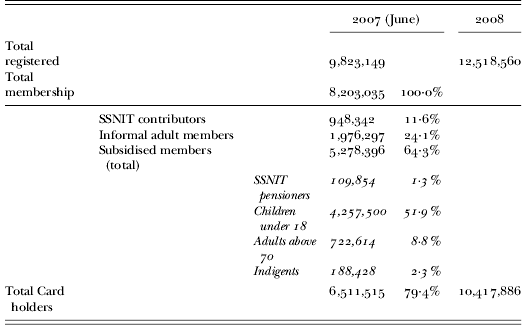
The early stages of implementation were not unproblematic. Planning had been relatively poor, particularly with regard to cost estimates, and questions were soon raised over the financial sustainability of the scheme, due to the extensive benefits it promised and the escalating costs of the first few years. In addition, little information had been disseminated among medical staff and the population at large; among the latter, many did not know about the existence of the NHIS. The administration of the new health cards also initially proved burdensome. Most of all, the scheme seemed unlikely to make access to health services actually equitable. Coverage remained limited to the district where a person registered. Indigence had been defined in an extremely stringent manner, and verification procedures discouraged districts from enrolling the exempted poor beyond a pathetically low threshold of 0·5% of local membership.Footnote 3 As a result, only about 2·3% of total NHIS members were subsidised as indigents, in spite of the fact that between a quarter and a half of Ghanaians – depending on which standard measure of poverty is adopted – are usually deemed poor. Unsurprisingly, people belonging to the poorest quintile appeared to be much less likely to register than the rest, largely due the fact that premiums, despite being relatively low, were often perceived to be too expensive (Asante & Aikins Reference Asante and Aikins2007: 1). Medium and higher quintiles also complained about subscription costs, although these social strata benefited the most from a system largely financed through indirect, regressive taxation. Under the NHIS, the poor continued to suffer significant exclusion (Ramachandra & Hsiao Reference Ramachandra, Hsiao, Hsiao and Shaw2007: 74; UNDP 2007: 4, 92; cf. Wahab Reference Wahab2008: 8, 17).
Yet, overall, the scheme was relatively effective and the country's health policy as a whole appeared to benefit from the reform (Mensah et al. Reference Mensah, Oppong and Schmidt2010; SEND-Ghana 2010: 6; Witter & Garshong Reference Witter and Garshong2009: 7, 13–14). Enrolment rose rapidly from 3·2 million or 15% of Ghanaians in 2005, to 8·2 million or 38% in 2007, and 10·4 million or 45% in 2008 (see Table 2): an impressive pace if measured against the experience of other countries, rather than against the over-optimistic original plan to have the whole population insured within few years. This may be an ex post confirmation that there was a strong demand for replacing the cash-and-carry. About two thirds of members belonged to the relatively broad categories identified as vulnerable groups and were therefore exempted from paying individual premiums, including the poor, the elderly (over seventy) and the youth (under eighteen with two premium-paying parents, or children of a single parent). While not all registrants had regularly paid up their fees, over 80% of paid-up members were card holders with actual access to NHIS services. Some early evidence suggests that the scheme was relatively favourable to the country's vulnerable groups in lowering financial barriers, establishing a more equitable access to health care, and increasing recourse to health services and user satisfaction (Asante & Aikins Reference Asante and Aikins2007: 4; Durairaj et al. Reference Durairaj, D'Almeida and Kirigia2010: 2; Rajkotia Reference Rajkotia2007; SEND-Ghana 2010: 6; Witter & Garshong Reference Witter and Garshong2009: 7, 13–14).
Membership of Ghana's National Health Insurance Scheme (NHIS)
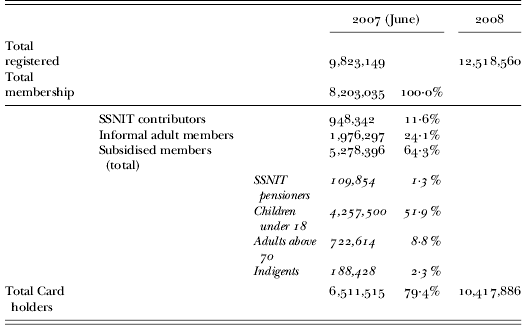
Sources: Ministry of Health 2009 and ‘Mid-year operational status report 2007’, NHIS 2007 (the latter in Asante & Aikins Reference Asante and Aikins2007: 1).
EXPLAINING REFORM: DEMOCRATIC POLICY MAKING, POLICY FEEDBACK AND POLICY DIFFUSION
In the age of adjustment policies, user fees have been favoured by donors as a strategy for financing public health care in developing countries, and despite the many criticisms their introduction raised, they have become predominant (WHO 2008: 24). Until recently, Ghana was no exception. What caused the country to break with this policy and replace out-of-pocket payments with an insurance-based system? The process of health policy change is largely explained by the political competition set off by the new democratic regime, combined with a policy feedback effect and an international process of policy diffusion as additional but secondary factors.
A policy feedback effect
The notion of a policy feedback effect on politics and policy making is generally used to stress the way in which existing policies tend to constrain change and further path dependence by generating vested interests in the continuation of existing programmes. In the case of Ghana's health policy, however, user fees had generated widespread resentment among the general population since the late 1980s. The out-of-pocket payment policy was regarded by a large proportion of Ghanaians as having failed them, by making health care too expensive and thus excluding many from access to it. Rather than disfavouring policy changes, therefore, existing arrangements caused popular reactions largely aimed at demanding and finding alternative solutions.
The extent to which Ghanaians felt the urge to seek alternatives was testified by the proliferation of self-help initiatives that explored the possibility of financing health in an entirely new manner, that is, by pooling resources through prepayment schemes. Under the initiative of Catholic missions and hospitals, a number of private health insurance schemes had started to operate in some areas, normally based on joint management by a health facility and the community, to relieve individuals from the payment of fees at the time and point of use. The Nkoranza Health Insurance Scheme was the first such community-based experiment and became a model soon after being set up in 1992. Its 48,000 members, as of 2001, made it vastly bigger than any comparable arrangement in the country. ‘By its mere survival’, it was observed, the scheme ‘in no uncertain terms demonstrated the feasibility of a community-based approach to risk sharing and resource pooling’ (Atim et al. Reference Atim, Grey, Apoya, Anie and Aikins2001: 44). Under the auspices of the Ministry of Health, and with support from Danida and USAID, the number of mutual health organisations operating in Ghana increased at a remarkable pace, from 4 in 1999 to 47 in 2001, 159 in 2002 and 168 in 2003 (Atim et al. Reference Atim, Grey, Apoya, Anie and Aikins2001: 35–43; Sulzbach et al. Reference Sulzbach, Garshong and Owusu-Banahene2005: 3). Yet these arrangements only covered about 1% of the population (Sulzbach et al. Reference Sulzbach, Garshong and Owusu-Banahene2005: 3).
By the mid 1990s, plans and pilot projects for replacing the cash-and-carry system with some form of public health insurance were also being discussed and examined at the Ministry of Health, where the issue had first been tabled when user fees had become more substantial, in 1985 (Agyepong & Adjei Reference Agyepong and Adjei2008: 154; Asenso-Okyere Reference Asenso-Okyere1995: 89; Atim et al. Reference Atim, Grey, Apoya, Anie and Aikins2001: 5). In 1997, a pilot project covering four districts in the Eastern Region was launched, with the aim of testing the terrain for the establishment of a nation-wide scheme. But lack of consensus within the Ministry about the best health financing strategy – particularly about the prospect of the government directly running an insurance scheme – stalled the pilot. By 1999, the Ministry was once more examining insurance schemes, but again resolved to encourage the development of a multi-scheme approach in which it would retain a role as ‘a promoter and facilitator, and not an implementer’ (Atim et al. Reference Atim, Grey, Apoya, Anie and Aikins2001: 7).
After the political reform in the early 1990s, popular demands for a change in the public health system were voiced ever more openly. Such demands affected electoral and post-election competition between the two main parties, particularly since health policy became a key opportunity for the opposition to challenge the ruling party. The cash-and-carry system thus helped set the agenda by causing ‘a strong perception of a crisis and a need for change among political as well as technical and bureaucratic decision makers and civil society … High-level decision makers including the president and his cabinet were concerned’ (Agyepong & Adjei Reference Agyepong and Adjei2008: 158). The experience of community-based mutual schemes favoured the formulation of a new policy that drew lessons from and tried to incorporate them. Thus, the moment the health issue was picked up by the main parties, this feedback turned into a clear case in which policies contributed to shaping politics.
Interparty democratic competition
Health insurance plans, as pointed out, had been the object of technical and political debates in government circles in Accra since the 1980s. Yet discussions had long failed to translate into actual policy change. Why, then, was a radical reform initiated in 2003? By far the most relevant factor accounting for Ghana's health reform process, and the key object of this paper, were the new rules of the political game introduced with the country's transition to a democratic regime. In an entirely new context, increasingly free and fair elections made rulers progressively accountable to voters. Moreover, a political competition centred on only two parties, as opposed to more fragmented party systems, and on a presidency that, so far, has always counted on a loyal parliamentary majority, helped to clarify where political credit and political blame stood.
Health policy became rapidly a key electoral issue. The new pluralist system opened up the realm of health policy making to several new actors. A vigorous system of free media provided a critical tool for constant scrutiny and open debates on health issues. Interest groups mobilised to influence public discussions and have their voices heard in the health policy process. Political parties articulated various demands by presenting alternative health policy platforms in their bid for power. All these actors came to share policy-making arenas with executive, ministerial and donor agencies that had previously played predominant and essentially unaccountable roles.
Important differences, however, characterised the new actors taking part in the health policy process. Some of them remained inextricably tied to existing policy, as were the technocrats at the ministry, the community-based insurance schemes and, at least initially, donors such as the IMF (cf. Rajkotia Reference Rajkotia2007: 10; Wahab Reference Wahab2008: 12). The leadership of the NDC, in particular, appeared to be most constrained by the legacy of a policy that had been introduced, back in the 1980s, by the Provisional National Defence Council (PNDC), that is, the military regime's top organ from which the NDC leadership, acronym and organisation drew their origins. Despite supposedly being Ghana's major left-of-centre, socially oriented political force, and despite having unchallenged control of executive and parliamentary institutions for two consecutive mandates (1992–2000), Rawlings' party failed to replace the unpopular cash-and-carry system with some alternative arrangement. A content analysis of the NDC's election manifestos reveals this political slowness. In the mid 1990s, the insurance schemes option was being explored by the party, but the latter remained cautious about it: ‘feasibility studies on the proposed Health Insurance Scheme have been completed, and the scheme will be tested on a pilot basis. If successful, it will be introduced on a national scale’ (NDC 1996). A new strategy was then announced on the eve of the 2000 election, but the ‘mix of insurance schemes’ proposed by the party was meant to work side-by-side with a ‘reviewed’ and ‘improved’ cash-and-carry system, rather than fully replacing it (NDC 2000). Ultimately, a party that had yet to experience an electoral defeat and loss of power proved unable to react and respond to the intense demands for a health policy change. It was only after the NDC was forced into opposition that it tried to catch up with the NHIS reform adopted by the NPP government. In 2004, the party manifesto espoused the notion that ‘one of the most effective ways of keeping the cost of health care to a minimum is through a Health Insurance Scheme’. It suggested that, were the NDC to win back power, it would abolish both the use of pension contributions and the health levy, while limiting the premium to a one-off registration fee – thus moving closer to a tax-financed system – and transforming the NHIS into a ‘Universal Health Insurance Scheme’ that would no longer be district-based (NDC 2004, 2008).
Other actors, however, felt far from tied to the existing health policy framework. For the NPP, in particular, the user fees policy proved a great political opportunity, rather than a constraint, as the party developed a strong interest in challenging the cash-and-carry system and proposing new options. The party's 2000 election victory was thus a crucial event, opening a ‘critical juncture’, or a phase during which key policy changes would take place. Had the NDC carried another election, the user fees policy, at least in the medium term, would probably have been prolonged.
The health reform introduced by the NPP was the result of its long-standing effort to capitalise on the unpopularity of cash-and-carry. While in opposition, the party had condemned the existing system as ‘notoriously callous and inhuman’, pledging to change it ‘with a view to evolving a more equitable system including health insurance and other repayment schemes’ (NPP 1996). The NPP's 2000 election platform made it plain that the party would ‘abolish the iniquitous cash-and-carry system’, so that ‘nobody in Ghana will be denied medical attention because of his or her inability to pay … payment of fees, if any, will be discussed when the patient is out of danger. … exemptions shall be extended on account of health and age’ (NPP 2000).
At the time, however, the NPP believed that a single national health insurance scheme was not a feasible solution for a variety of reasons, including the low percentage (10–15%) of people employed in the formal sector, the seasonal income of farmers, and the high levels of unemployment and poverty (Evening News 26.4.2000). Its election campaign programme merely suggested that various collectivities (workers, employers, local communities, religious bodies, private health companies, etc.) would be encouraged to establish their own insurance schemes, with the government retaining a regulatory and monitoring role and ensuring the provision of health ‘quality service at affordable cost even to those not covered by any insurance scheme’ (NPP 2000).
After coming to office, however, the NPP felt pressed to go beyond its own election pledges and sped up its plans for health reform. The NPP government was on the lookout for highly visible measures that it could showcase in seeking a new mandate in 2004. Thus, as the work of the committee set up in 2001 with the task of designing the health financing reform appeared to slow down because of technical concerns, and it merely recommended building on existing local mutual health organisations and continuing the piloting, its composition was changed to better reflect the political priorities and the haste of the executive. Contrary to the past, no time could be wasted on technical details. The new political nominees came to dominate the drafting process in the committee, whereas the traditionally strong role played by the technocrats of the Ministry of Health – some of whom were proving too cautious, when not sceptical, about the reform – was downsized (Agyepong & Adjei Reference Agyepong and Adjei2008: 155–6; Rajkotia Reference Rajkotia2007).
The party government model thus applies cogently to the policy-making process for health reform. The democratic policy process had begun with the direct and indirect demands for change, including the self-help community-level insurance programmes, raised by Ghanaian individuals and organisations. These inputs were taken up by the NPP in articulating its election platform. After the party's advent to power, the initiative shifted to the executive – with the president's direct involvement – which started formulating a more detailed policy proposal. In the process, as mentioned, the minister for health progressively aligned the positions of key ministerial personnel working on the drafting to those of the cabinet. Once the proposal was outlined, parliamentary approval of the NHIS bill was necessary. The government opted for combining a compensation strategy (e.g. some concessions were made both to the pharmaceuticals and, in part, to the unions) and a more adversarial approach (i.e. towards the extra-parliamentary protests of the unions and, especially, the NDC opposition, who walked out of parliament in dissent with the decision to limit debate on the bill to one week only).Footnote 4
The ruling party had not only pressed for obtaining a health insurance scheme ‘here and now’ (Agyepong & Adjei Reference Agyepong and Adjei2008: 158), but, to some extent, also for one that would ‘ensure that the poor and destitute are covered’ (NPP 2004). Unsurprisingly, projected resources were bound to be too scarce (as premiums were set at relatively low, popularly palatable levels) and costs too high (on the one hand, an inclusive benefits package was devised which covered as much as 95% of diseases; on the other, pharmaceutical reimbursement rates were set high so to appease providers), generating problems of sustainability that began to be addressed only at a later, post-reform, stage. In democratic Ghana, electoral pressures and political reasoning prevailed over both the concerns raised by some technocrats, and the ideological principles of a supposedly centre-right party historically rooted in the country's liberal tradition.
International policy diffusion
A process of policy diffusion at the international level was the third factor that contributed to the reform of the health system in Ghana. Traditionally, the health policies of African countries have been widely shaped by an international public health agenda that emerged in the late 1970s and originally revolved around notions such as Health for All and Primary Health Care. During the 1980s, two major plans launched by UNICEF and the World Health Organisation (WHO), the Bamako and the Harare initiatives, prescribed that health systems in developing nations should be structured around decentralisation and cost-recovery mechanisms. By the mid and late 1990s, further ideas were promoted which largely concerned the need for sector-wide strategic planning and financing.
While external agendas never ceased to exert an influence on the development of health policy in Ghana, the politicisation of health policy making that followed the country's democratic transition greatly reduced the weight of international actors. The emergence and primacy of domestic demands was particularly evident in the NHIS reform. It was the dynamics of electoral competition that proved the crucial factor behind the introduction of the scheme. For a country like Ghana – with a quarter to a third of its people living in poverty, a high number of informal workers, a prevalence of rural dwellers, and a relatively poor infrastructure – this represented a bold policy, as the new legislation marked ‘the first attempt in the region to institute a nationwide insurance scheme with the ambitious goal of achieving universal coverage’ (Sulzbach et al. Reference Sulzbach, Garshong and Owusu-Banahene2005: 5). As of 2007, only twenty-seven countries worldwide had established the principle of universal insurance (Hsiao & Shaw Reference Hsiao, Shaw, Hsiao and Shaw2007: 1), and these included no low or medium development country, except for Thailand:Footnote 5 universal coverage is found essentially only in advanced countries, and, even there, it gradually evolved over a long period.
In past decades, universal insurance was not high on the international public health agenda. In the early 1990s, for example, a World Bank report focusing on health issues cautiously suggested that ‘only a few middle-income countries that have adequate financial resources, political resolve, and administrative capacity will be able to achieve … universal insurance coverage’ (World Bank 1993: 161). More recently, however, compulsory social health insurance aimed at universal coverage has become increasingly fashionable (Carrin et al. Reference Carrin, Doetinchem, Kirigia, Mathauer and Musango2008: 2; Hsiao & Shaw Reference Hsiao, Shaw, Hsiao and Shaw2007: 1; Schiller et al. Reference Schiller, Hensen, Kuhnle, Ervik and Nilssen2009). In 2005, the WHO assembly adopted a resolution recommending this strategy for developing countries, and a subsequent report noted that ‘there is now widespread consensus that providing such coverage is simply part of the package of core obligations that any legitimate government must fulfil’ (WHO 2008: 25–7).
This growing consensus contributed to defining the direction Ghana's health reform took. In its search for an alternative to the cash-and-carry system, the NPP drew lessons both from domestic experiences (notably, the community-level schemes), and from the budding process of diffusion of social health insurance arrangements at the international level. While at the time, in the early 2000s, health insurance was not yet a policy donors were actively pushing for, it was increasingly seen as a legitimate and acceptable option and, as mentioned, was about to become a core international prescription for developing countries. Some key donors that had initially been sceptical of the reform plans of the government gradually became more supportive and eventually gave their green light (cf. Rajkotia 2007: 7; Singleton 2006: 24; Wahab 2008: 12). By granting legitimacy and additional support to the government's reform, the influence of external actors turned out to be a supplementary, if not a secondary, factor explaining not so much why the country opted for changing its health financing policy, but the solution that was chosen to replace existing arrangements. In this sense, Ghana lay at the forefront of a developing process of policy diffusion.

For over three decades after independence, Ghana failed to hold two successive multiparty elections. One-party rule and military coups interrupted and frustrated democratisation efforts, and the country was plagued by long periods of political instability and authoritarian rule. By the 1980s, Jerry Rawlings, himself a coup-maker, promoted the political stabilisation and economic recovery of the nation, but retained a military regime. Foreign donors had ample scope to influence what were largely technocratic policy-making processes.
From the early 1990s, Ghanaian politics was gradually transformed into one of the most vibrant democratic games on the African continent. Two large and relatively responsible parties – the National Democratic Congress and the New Patriotic Party – consistently challenged each other in five successive electoral rounds, one winning two and the other three. Besides an elected and electorally accountable executive, a parliament was established and developed as well as independent courts of justice. Hundreds of civic associations sprung up, fostering rights advocacy, open debates and political mobilisation. Private media emerged and multiplied, providing abundant coverage of public affairs and political issues. Did these developments increase the political saliency of popular demands and create incentives for social reforms? Or, in other words, what does the case of Ghana tell us about the impact of democracy on social policies?
This paper has addressed these questions by examining the country's democratic developments and the evolution of policy in the crucial sector of public health. It has shown that health did undergo a crucial reform, and argued that the latter resulted primarily – if not exclusively – from electoral competition between Ghana's two main parties. The NDC, which ruled throughout the 1990s and was the direct successor to the previous military government, was slow in responding to the voters’ demand for reforming a system that, since the mid 1980s, had recovered part of the costs of health care by requiring Ghanaians to pay at point and moment of use. The NPP opposition, by contrast, was quick to exploit the health issue to challenge the government, articulate an electoral platform that would win it power, and, once in office, adopt a health financing reform that would help it gain a second mandate. Time thus played an important role (cf. Carbone 2009: 126), as it took a few years before the newly introduced democratic regime produced a tangible impact on social (health) policy making. The maturity of the political system came when the incumbent party was electorally defeated in 2000, which made it clear that voters' demands somehow had to be addressed. Ultimately, it is difficult to overestimate the relevance of electoral competition in accounting for Ghana's recent health reform.
Democratic political dynamics, however, were not the only factor at play. The push for reform was supported by at least two additional, if secondary, elements. A domestic process of policy feedback explains the political relevance acquired by the health issue – a relevance largely due to strong popular feelings against the cash-and-carry arrangement – as well as the government's choice of a solution based on prepayment, for community-based insurance schemes had already been experimented with in some local areas. An international process of policy diffusion also accounts for the support that Ghana's reform plans received from foreign donors, as the proposed social health insurance matched some emerging trends in the global health agenda. However, the fact that the negative feedback caused by user fees had failed to prompt a policy change prior to the country's regime transition, and that Ghana's remains a pioneering reform, as donors have not yet raised pressure for universal health insurance among other developing nations, indicates that neither of the above two factors would have been enough to ignite the health reform process in the absence of democratic politics.