Introduction
In the United Kingdom, just 16% of autistic adults are in full-time employment and only 32% of autistic people are in some sort of paid work (National Autistic Society, 2016). This rate is much lower than the 47% of other disabled groups who succeed in obtaining paid employment (Office for National Statistics, Reference Statistics2016). Likewise, in the United States, just 58% of young autistic adults held a job at any point during their early 20s compared to over 90% of those with reported emotional disturbance, speech impairment or learning disability and 74% of young adults with intellectual disability (Roux, Shattuck, Rast, Rava, & Anderson, Reference Roux, Shattuck, Rast, Rava and Anderson2015). Yet many autistic people could thrive in a structured working environment and want to be given that opportunity (National Autistic Society, 2016). The minority of autistic adults who are employed are all too often in posts that are deemed unsuitable: either not consistent with their skill set and abilities (malemployment) or for which they are overqualified (underemployment) (Interagency Autism Coordinating Committee, Baldwin, Costley, & Warren, Reference Baldwin, Costley and Warren2014). Indeed, the cost of lost employment for autistic adults equates to over £9 billion per year in the United Kingdom (Knapp, Romeo, & Beecham, Reference Knapp, Romeo and Beecham2009) and US$23.5 billion per year in the United States (Buescher, Cidav, Knapp, & Mandell, Reference Buescher, Cidav, Knapp and Mandell2014). For an individual, however, the consequences of not having a job are often far greater. Employment is associated with independence, identity, community engagement and self-esteem (Chiang, Cheung, Li, & Tsai, Reference Chiang, Cheung, Li and Tsai2013; Chen, Leader, Sung, & Leahy, Reference Chen, Leader, Sung and Leahy2015). Not being in employment therefore places autistic people at serious risk for problems with their mental, emotional and physical wellbeing. This study investigates the apparent disproportionate challenge that autistic people appear to face when seeking employment, compared with other disability groups.
Literature review
On a practical level, there are increasing efforts to improve employment outcomes for those on the autistic spectrum (e.g., the revised Autism Strategy, UK – HM Government, 2014 and the 2014 US Workforce Innovation and Opportunity Act). Yet the limited existing research on these efforts means that we do not know the most effective ways of helping autistic people get into jobs or how to make sure they retain them. Research on disabled people more generally has indicated that although regulatory environments that prohibit discrimination and support diversity are important, they are not sufficient in themselves to reduce the disability employment gap (Saleh & Bruyère, Reference Saleh and Bruyère2018). Moreover, pro-diversity workplace policies often overlook autism: although many companies have initiatives aimed at diversity and inclusion, in the majority of cases these efforts do not extend to disability or neurodiversity (Erickson, Schrader, Bruyère, & VanLooy, Reference Erickson, Schrader, Bruyère and VanLooy2013).
Although specific research on employment in autism is scarce, insight may be offered from past studies on workplace inclusion for disabled people more generally. This research highlights the many employment barriers that exist, including those linked to company legislation, organisational characteristics and characteristics of individual employees and managers (Stone & Colella, Reference Stone and Colella1996). Among these factors, there is a striking impact of stereotypes and fear of the unknown – with employers who do not currently hire disabled individuals raising concerns about their employment (e.g., lower quality of work, high costs incurred and negative customer reactions) that are unfounded and rarely supported by research (Bruyere, Erickson, & Ferrentino, Reference Bruyere, Erickson and Ferrentino2002; Lengnick‐Hall, Gaunt, & Kulkarni, Reference Lengnick‐Hall, Gaunt and Kulkarni2008). It is well established that experience working alongside disabled people reduces this stigma and changes attitudes – a crucial step in increasing inclusive behaviour in the workplace (Stone & Colella, Reference Stone and Colella1996; Popovich, Scherbaum, Scherbaum, & Polinko, Reference Popovich, Scherbaum, Scherbaum and Polinko2003; Nelissen, Hülsheger, van Ruitenbeek, & Zijlstra, Reference Nelissen, Hülsheger, van Ruitenbeek and Zijlstra2016). Together, these findings suggest the importance of work placement schemes that reduce prejudice by allowing employers to experience first-hand the reality of employing disabled people – and most relevant to the current study, autistic people.
It is important to note, however, that equating autism with other disabilities is not straightforward. While historically described in terms of deficits (Pellicano & Stears, Reference Pellicano and Stears2011), the condition is now widely accepted to be associated with many areas of strength and ability. Indeed, while it is estimated that over half of autistic people have typical IQ levels (CDC, 2008; but see Dawson, Soulieres, Gernsbacher, & Mottron, Reference Dawson, Soulieres, Gernsbacher and Mottron2007 for caveats about IQ measurement in autistic people), much of the general disability literature focusses on those with intellectual impairment, and how this is related to poor employment outcomes (Holwerda, van der Klink, Groothoff, & Brouwer, Reference Holwerda, van der Klink, Groothoff and Brouwer2012). As such, specific research into autistic individuals’ experience of seeking and maintaining employment is needed. We must understand why autistic individuals – even with average or above average IQ and abilities – appear to be encountering barriers in the workplace.
One possibility is that the types of diversity associated with autism, such as socio-communicative difficulties and sensory differences, are judged more negatively than other disabilities. For example, in one model of disability, it was hypothesised that interpersonal style was of crucial importance: a warm, outgoing interpersonal style predicted to be associated with more positive perceptions of capability, inclusion with coworkers, favourable performance reviews and willingness of supervisors to mentor them (Stone & Colella, Reference Stone and Colella1996). As such, the models of employment for disabled people outlined in the literature mentioned earlier are likely to be insufficient for those who are autistic – perhaps borne out by the observation that employment rates in autism are far lower than those for other disability groups. The current research examined whether, for autistic graduates in a corporate setting, these sensory and social aspects of the workplace prove challenging for them and their coworkers.
The small body of work that has begun specifically to examine barriers to employment for those on the autism spectrum, and ways to overcome them, highlights the value of work experience, internships and supported employment schemes (Hendricks & Wehman, Reference Hendricks and Wehman2009). For example, a study of autistic adults (aged 21–25 years) in the United States revealed employment rates that were over twice as high for those who worked for pay during high school (90%) versus those who did not (40%) (Roux et al., Reference Roux, Shattuck, Rast, Rava and Anderson2015). Similarly, a US internship programme that arranges work placements for young autistic adults embedded within a community business (e.g., banks, hospitals or government departments) has shown very positive findings: 87.5% of participating autistic individuals achieved subsequent employment compared to 6.25% who did not take part (Wehman, Schall, Carr, Targett, West, & Cifu, Reference Wehman, Schall, Carr, Targett, West and Cifu2014).
With growing recognition of the importance of such schemes, it is vital to understand the experiences of those taking part, both the employees and their employers. To our knowledge, there is no research that examines the benefits and challenges of employing autistic individuals from the viewpoints of the autistic employees, their managers and their non-autistic colleagues. To promote autistic employment, this full, multi-informant approach is crucial: businesses need to know how autistic employees and interns (and those with whom they work) respond to life in the workplace. This insight can lead to simple adjustments to accommodate autistic people’s needs and potentially lead to a greater chance for the business to profit from the wide range of skills and interests that autistic people can bring to the workplace. Autistic people’s perspectives should reduce any ‘fear of the unknown’ by suggesting best-practice approaches to supporting employment for those on the spectrum and by undermining unfounded negative preconceptions.
The current study
The current study examined a 3-month graduate internship programme at Deutsche Bank (DB), UK in London, offered solely for those on the autism spectrum. Our study aimed to determine the experiences of all those involved in the internship programme, focussing particularly on their prior expectations, and perceived triumphs and difficulties during the scheme. To address this aim, we conducted semi-structured interviews with the autistic interns and their hiring managers twice within the space of 3 months – once before the internship commenced and again when it had finished – as well as interviews with those who worked with them at the end of the internship. As such, our work provides the first multi-informant, longitudinal picture of corporate experiences for autistic individuals.
Methods
Internship programme
DB is Germany’s leading bank, with a strong presence internationally. In the United Kingdom, they employ 9,000–10,000 people across a number of sites nationwide. The autistic graduate internship programme arose from a partnership with Autistica, a UK autism research charity, and was devised and implemented by a few key individuals within DB committed to promoting diversity and inclusion, one of whom also has personal experience of autism. The DB internship for autistic graduates ran from October to December 2016. Eight hiring managers volunteered to be involved, in response to an internal email asking for internship posts. In advance of the scheme commencing, training was offered to DB staff by Ambitious about Autism, a UK charity. This training comprised two sessions: one for those conducting interviews (with guidance on how best to communicate with autistic individuals), and a second more extensive session for those who would be working directly with the interns. Those interested in the scheme (16 in total) submitted a CV and eight eligible candidates (those who had completed an undergraduate degree within the past 3 years, with a grade of 2:1 or above) were then asked to provide written answers to a set of questions specifically designed for this scheme, which covered some aspects of their previous experience (‘Can you give us an example of when you have been in a position of responsibility?’) and more abstract reasoning challenges. To increase the accessibility of the recruitment process, first round testing was not done face-to-face (as with the regular graduate scheme), but instead the interns were sent questions in advance and asked to return answers within a week. This was followed by an in-depth interview to discuss candidates’ written answers and past experience. The rooms chosen for these interviews were selected based on minimal sensory distractions (e.g., no artwork).
All eight interviewees were subsequently offered a place on the programme and were assigned to teams across various business areas, including finance, operations, risk and technology. They were based across five DB offices in Central London, with one subsequently moving to a regional office (to reduce his travel time). Interns were paid a salary equivalent to that received by those on the regular DB graduate scheme. As per the regular scheme, all interns were assigned a buddy (mentor) from outside their own team. The buddies themselves had responded to an internal email inviting them to be a mentor as part of the autistic internship programme specifically. Interns were encouraged to turn to this buddy if they had queries or needed support at any point over the 3-month period. The interns were also offered weekly ‘lunch and learn’ sessions, monthly career dinners, monthly intern lunches and ad hoc sessions (e.g., for networking). This information was given to the interns on their first day, and was reiterated in a follow-up email.
Participants
Thirty-six adults took part in this study, including eight autistic interns (2 female, 6 male), eight hiring managers (1 female, 7 male), nine DB employees (5 female, 4 male) who acted as buddies to the interns, and eight other DB employees who worked alongside the interns (‘team members’; 3 female, 5 male). Hiring managers, buddies and team members had been working at DB for varying lengths of time (from seven months to 33 years, although most had between 2 and 10 years of DB employment), and were in a variety of roles and departments.
The interns, aged 22–26 years, were predominantly from White backgrounds and came from cities across England (three from London). All had received an independent clinical diagnosis of an autism spectrum condition, some very early in life (e.g., at 2–3 years) and others only a few years ago (e.g., at 20 years). Three interns had received diagnoses of one or more additional co-occurring conditions either in the past or currently, including anxiety (n=3), depression (n=2), dyslexia (n=1) and developmental coordination disorder (n=1). All had completed undergraduate degrees in a range of topics (e.g., Politics, English Literature, Natural/Computer sciences, Mathematics). Four interns were employed elsewhere full-time (n=1) or part-time (n=3) before being awarded the internship, while the remaining four were unemployed. Current autistic features were assessed using the Social Responsiveness Scale – second edition (SRS-2 [Constantino & Todd, Reference Constantino and Todd2003]). One intern scored within the typical range, while all others scored about the cut-off for clinical significance (one classed as mild, three moderate and two severe; M=69.6, SD=9.4, range=53–79). Lastly, all interns showed a high level of independence, scoring highly (M=31.0, out of a maximum possible score of 34; SD=3.2) on the Waisman Activities of Daily Living Scale (W-ADL, Maenner, Smith, Hong, Makuch, Greenberg, & Mailick, Reference Maenner, Smith, Hong, Makuch, Greenberg and Mailick2013).
Procedure
Before the internship began, individual semi-structured interviews were conducted with interns and hiring managers, asking about their hopes and expectations for the upcoming programme and any concerns they might have. Interns also completed a questionnaire about their previous experiences, level of independence and autistic traits. Three months later, during the final week of the internship, the same researchers spoke to the interns and hiring managers again. In addition, buddies and team members were interviewed. All participants were asked to share their experiences of the internship period. Particular emphasis was placed on understanding perceived barriers and opportunities for success.
Each interview lasted around 30 min, and were conducted either face-to-face or over the phone, depending on people’s preferences. All interviews were digitally recorded with participants’ prior consent, and subsequently transcribed verbatim. Data were entered into NVivo 11 (2015) and analysed using thematic analysis following Braun and Clarke (Reference Braun and Clarke2006). An inductive approach was adopted, providing descriptive overviews of the key features of the semantic content of data within an essentialist framework. Specifically, data were coded without any pre-existing coding schemes, or preconceptions of the researchers. Both authors read all of the transcripts multiple times and independently assigned codes to reoccurring themes. These were then organised into categories of best fit (initial themes). These preliminary themes were identified using a semantic approach, that is, by identifying ‘surface’ level themes, without theorising beyond the actual content of the quotes. Themes were generated for each participant group at each time point separately and were then merged across participant groups to identify areas of overlap and discrepancy. In this way, a multi-informant view of the internship was obtained. Importantly, while the views of both autistic and nonautistic participants were reflected in the themes, both authors did not identify as autistic and so approached the analysis as outside researchers. The themes and associated quotes were sent to all participants before publication to ensure they had been accurately represented. The authors met several times during the coding process to review areas of divergence and decide on final themes and subthemes across the groups and time points.
To preserve anonymity of the participants involved, all are referred to as male and quotations reported are identified only by letters. All procedures were granted ethical approval by UCL Institute of Education’s Research Ethics Committee (REC 843).
Results
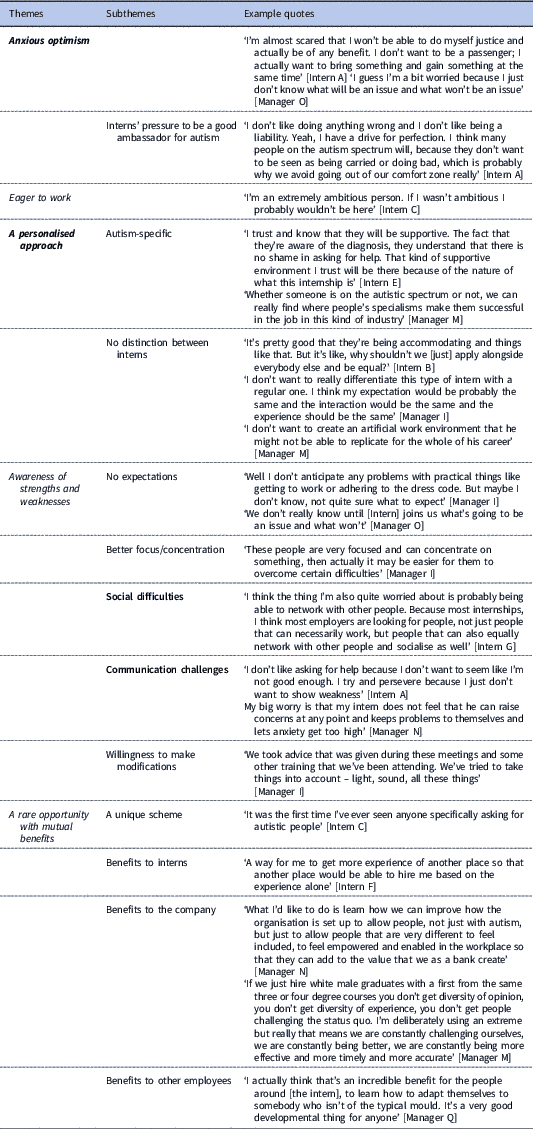
Themes and subthemes identified from the pre- and postinternship interviews are presented in Tables 1a and 1b. As we identified similar themes across the various groups at each time point, we report the themes from all groups together here. Similarities and differences between the groups are highlighted within the text (Table 1a).
Expectations of the internship

Note. Themes identified both in intern and manager interviews are highlighted.
Themes from preinternship interviews
Anxiously optimistic
All interns and managers were positive about the upcoming programme. Interns spoke of an eagerness to work and a sense of resilience that had enabled them to overcome the odds and that led them to this point: ‘people like me aren’t meant to get into these places […] ’ [Intern D]. They spoke of challenges finding work in the past, but a drive and determination to keep going. They also felt they had much to offer DB: ‘the ability to work for a very long time without a break; and a lot of the perks, like the analytical thinking, the general work ethic’ [Intern C]. Though positive about the opportunity, many were nervous about the new role. This anxiety seemed to centre on a perceived lack of qualifications and prior knowledge, as well as the issue of taking on responsibility and a fear of the unknown: ‘[I feel] nervous, because I still don’t know what I’m actually supposed to be doing’ [Intern C]. Similar sentiments were expressed by the managers: ‘they [colleagues] are a little bit, let’s say apprehensive. It’s like anything; it’s something different’ [Manager J]. It was also clear that the interns were determined to do well in the scheme and were worried about achieving the goals they had set for themselves: ‘I don’t like doing anything wrong and I don’t like being a liability. Yeah, I have a drive for perfection. I think many people on the autism spectrum will, because they don’t want to be seen as being carried or doing bad, which is probably why we avoid going out of our comfort zone really’ [Intern A].
A personalised approach
For managers (but not interns), one area that consistently raised concerns was the extent to which they would treat the autistic interns differently from other interns. Many managers wanted to push for a greater sense of equality: ‘I don’t want to really differentiate this type of intern with a regular one. I think my expectation would be probably the same and the interaction would be the same and the experience should be the same’ [Manager I]. In contrast to these sentiments, the recruitment process had been altered significantly from DB’s usual practices (as noted earlier). Interns also had mixed views of the application process. Some found it more accessible than other schemes for which they had applied, while others still encountered difficulties.
Awareness of strengths and weaknesses
There were mixed expectations about the performance of the interns during the programme. Some managers thought that the interns would contribute well to the work of the team, while others, perhaps due to a lack of prior knowledge about autism, approached the internship without any expectations regarding the performance of the autistic interns.
The interns themselves were perceptive about their own differences and how they might impact on the upcoming work placement. Some commented on the fact that being different might prove to be difficult and worried that they might be forced to conform: ‘I always find it a bit annoying when I’m forced to try and think how someone else would think because my thought process tends to be somewhat fundamentally different’ [Intern C]. Others, however, were more positive about their abilities: ‘obviously starting any new job isn’t easy for anyone, but I like to think I can get on with people. I think that it’s taken me a long time, I’ve had to teach myself to try and do it, but I certainly think that once I get to know people on both their personal and professional level, I certainly think I could get on with them really well’ [Intern E]. The social communication components of the role were of particular concern, particularly with regard to knowing how to ask for help: ‘I don’t like asking for help because I don’t want to seem like I’m not good enough. I try and persevere because I just don’t want to show weakness’ [Intern A]. Some interns were apprehensive about practical aspects of the programme such as living away from home, or coping with the sensory environment of the office. But a sense of willingness to embrace the challenges, and adapt where necessary, was reiterated by many of the interns.
Managers raised similar concerns about specific areas that they thought would be challenging for interns, for example, social aspects, the need for confidence, dealing with uncertainty or multitasking. Communication was also flagged up as being a potential issue, both with respect to interns being overly direct, or hesitant to come forward. One manager was concerned ‘that my intern does not feel that he can raise concerns at any point and keeps problems to themselves and lets anxiety get too high’ [Manager N].
The managers recognised that they would play a crucial role in helping navigate these challenges, both with respect to their own behaviour and that of their team:
I will re-emphasise some basic behaviours that I would expect people to generally do and that actually may have an outsized impact on someone with autism than that it would have on a neurotypical person. Say you’re going to do something; do it. If you say you’re going to meet them; meet them. If you want them to do some work; send them exactly what you want them to do. These are things that people should be doing but they’ve had the luxury of not doing it [Manager N].
Likewise, managers were ready and willing to make practical changes to facilitate a successful internship. These changes generally centred around encouraging breaks from work, providing a quiet area for interns when necessary, a dedicated desk (even in a hot-desking environment), keeping a rigid structure to the work, forming a routine for each day and minimising distraction in the office. Many managers also reported planning to be led by the intern when it came to making decisions regarding these adjustments. Not everyone agreed with these accommodations, however. Some were concerned that making accommodations might be doing the intern a disservice and creating a false sense of ability: ‘I don’t want to create an artificial work environment that he might not be able to replicate for the whole of his career’ [Manager M].
A rare opportunity with mutual benefits
The interns mentioned that they felt the DB scheme was unique: ‘It was the first time I’ve ever seen anyone specifically asking for autistic people’ [Intern C] and welcomed the chance to be part of it. The rarity of the approach was not explicitly mentioned by the managers, perhaps suggesting an underestimation of the need for such programmes.
There were high hopes that much could be gained from the experience, with both interns and managers anticipating new skills, both technical and transferrable (such as networking and negotiation), improved confidence, CV development and experience of the workplace. Tied to this was the sentiment that the internship should offer a meaningful experience for the participants: ‘The whole purpose of this is that they actually have a proper work experience. If I’m going to make up a role which is just sit in the corner and go and make me a cup of tea every two days, then actually that’s not doing them any benefit at all [Manager J]’. The financial benefits were also emphasised and some hoped that the internship would result in permanent employment.
Although the interns could see the key benefits for themselves, they expressed some scepticism about DB’s motivation: ‘Sometimes I feel like they’re just doing it because it makes them look good, helping out a charity and stuff’ [Intern B]. Managers identified the importance of corporate social responsibility but stressed, however, that the interns’ contribution was important to the company: ‘I think that will be the biggest challenge, not seeing this as some charitable thing, but seeing this as a commercial endeavour’ [Manager N]. For DB as an organisation, managers were optimistic that the scheme would add diversity, develop a culture of inclusivity and encourage new ways of thinking.
The interns were positive that the scheme would offer them the freedom to be autistic in the workplace – which was in contrast to their previous work experiences where disclosure of their condition was often met with negativity. This sense of pride in their own identity was felt by several of the interns, however, there was also wariness about disclosing their diagnoses: ‘it’s still got this negative sort of […] it’s not unjustified because a lot of autistic are badly affected. But I’m not, so if I tell somebody I’m autistic then I get tarred with that same brush’ [Intern D].
Themes from postinternship interviews
One of the key indicators of success for any internship programme is retention within the company. It is notable therefore that, of the eight interns in the DB programme, five interns had their contracts extended for an additional period. In the following, we identify the main themes from conversations with each group at the conclusion of the internship (see also Table 1b).
Experiences of the internship

Note. Themes identified both in intern and manager interviews are highlighted.
A meaningful positive experience
In the main, the interns were happy with their time at DB: ‘I think I’ve grown as a person. Sometimes you just need someone to take a chance on you and let you demonstrate your skills and what you’ve got’ [Intern A]. They were proud to be the start of what they hope is a lasting legacy at the firm and spoke of how the programme had helped them in a number of areas, both work-related and more broadly. They felt they had learnt quickly and contributed well to various projects and that their individual skills were taken into consideration, allowing them to perform at their best: ‘I think they recognised I’m brilliant with numbers and data and not good with walking around talking to everyone, so they gave me more of the data stuff and no more of the talking’ [Intern B]. Interns also commented on their increased social connectedness, and highlighted the value of other ‘soft skills’ that they had learnt (more informally) from other more experienced colleagues, such as time management, networking and responding to deadlines.
Managers, buddies and team members echoed these sentiments, remarking not only on work-based skills, soft skills and project contributions but also that the interns were a welcome addition to the team: ‘he’s left us with a very good packet of work that he’s done. And secondly, he really made a good impact on us socially as well’ [Manager M]. In some cases, the success was surprising, exceeding expectations and countering the stereotypes that managers reportedly had regarding autism: ‘The things that I was concerned about, like let’s say doing his presentation to the management team, he was perfectly comfortable with’ [Manager J]. The success of the scheme was also measured in terms of the managers’ and buddies’ own learning: ‘we’ve learned a lot, sometimes more than I was expecting. And I think we end up writing a way of doing this properly that is meaningful and that can be shared with other institutions as well’ [Manager N]. They also found a new perspective on embracing diversity that extended beyond autism: ‘that’s made me think about other people who perhaps haven’t got the same challenges as [intern], but they do have their own challenges, to try and be able to be more sympathetic and accommodating in that situation’ [Manager K]. One team member was particularly struck by his experience and went on to express a controversial but apparently deeply held view: ‘I think definitely you’ve got to enter this with an open mind. Don’t see this as a disability, because autism is certainly not a disability. Play to people’s strengths’ [Team Member U].
Buddies and team members also commented on the ways in which they believed DB has benefited from the programme by recruiting new talent: ‘This diversity element is really important for business, to have people with different perspectives and different ideas’ [Buddy R]. Those who worked with and supported the autistic interns reported forming good relationships with the interns, some of which they felt would continue well beyond the programme.
Interns’ self-confidence also appeared higher following the scheme: ‘the most useful thing is really my confidence. It’s actually me knowing that I can do a graduate job. It’s made me realise that I can do anything’ [Intern E]. This was also noted by the managers, buddies and team members: ‘I think that success really is measured in the way their confidence grows over that period of time. Whether they stay or leave at the end of the internship, do they leave more confident in themselves and about going into another workplace than when they arrived?’ [Buddy X].
Others, however, were less positive about the outcomes, questioning whether they truly played a meaningful role at DB: ‘I partly kind of felt a bit embarrassed to be on the scheme because quite a lot of the time it feels like the only reason I’m here is because I have autism. Because I just want to be seen as an employee, not as the autistic employee’ [Intern B]. Managers also acknowledged that the experiences of those involved were mixed at times: ‘We’ve had an outcome which I would consider one I was not expecting, which was somebody has been put forward to be interviewed for a permanent role, which is phenomenal. And there have been outcomes that I wasn’t expecting on a downside, uncovering mental health issues and stuff. So I think the volatility of outcomes was much higher than I was expecting’ [Manager N].
A supportive environment
For the most part, the interns reported feeling accepted within the workplace and well supported by their managers, buddies and colleagues. In the best cases, this support was tailored to the individual and was available if needed, but not forced: ‘I didn’t want to be mollycoddled in any way, but I wanted to know that there was support there and I wasn’t just going to be sent down the river without a paddle’ [Intern A]. They were divided, however, about issues related to disclosing their diagnosis and seeking special support or assistance. While some did not want much, if any, special assistance, others commented that more support should have been offered. The variability of views within the intern group highlights the difficulty of making decisions regarding support before discussing it with the individual in question. In some cases, however, the inappropriate support-offering perhaps reflected limited understanding of autism for some managers, with a couple of interns stressing the need for all managers to attend the training. One remarked, when asked about adjustments made for him in the workplace: ‘Not with my manager. He didn’t know what autism was’ [Intern H].
Buddies and team members spoke of feeling overly concerned with providing support, which meant that they felt that they either provided too much (when it was not needed or wanted) or that the support that was offered was not well coordinated: ‘We were very, very supportive. Maybe a little bit too supportive initially’ [Team Member U]. In other cases, support was indeed needed, and seemed to revolve around a few key areas, including office etiquette (knowing how chatty to be with colleagues while working), practical aspects (adhering to working hours, moving between buildings), workload (not having enough to do, not finding the work fulfilling), the sensory environment (too much noise, too many people around) and anxiety (often linked to uncertainty).
A sense of equity
In keeping with the variety of viewpoints held by the interns, an issue that divided opinion for the managers was the extent to which the autistic interns should be given ‘special treatment’. Some managers felt that no distinction should be drawn, with a sense that making accommodations might be doing a disservice to the intern: ‘I got a sense that through their lives they have been supported, people have been trying to build confidence, support them and tell them they’re fantastic and so they come in thinking all of those things, which is true, but within this environment they’re here to work’ [Manager N].
In contrast, there were managers who felt it was important to recognise and attend to individuals’ needs and personalities: ‘You need to work out what the strengths are of your candidate and what the weaknesses are and find the right way’ [Manager J]. Modifications were made accordingly, for example, giving very specific instructions, communicating in writing or addressing sensory issues.
Challenges along the way
Despite the many positive sentiments outlined earlier, this was not uniformly felt across the group: ‘The scheme has proved to me that if I want a job somewhere like this then I can’t be myself’ [Intern B]. There were a number of difficulties that interns faced over the 3-month period. In many cases, they felt that the work offered to them was unfulfilling, boring, not challenging enough and did not match their skills. Some managers reportedly did not support interns’ requests for extra roles and would not facilitate introductions. Instead, the interns spoke of needing to be resourceful and create their own opportunities to maximise their experience at DB. Buddies and team members agreed that with respect to the work demands placed on the interns, their abilities may have been underestimated.
As predicted by both groups in advance of the internships, communication was a key area of difficulty. With respect to communication, interns felt that there was a lack of clarity and issues with conflicting information: ‘I think the hardest thing was getting time with people to explain what they wanted me to do. And also people not doing what they say they’re going to do’ [Intern B]. In a number of cases, interns reported on promises from managers that did not materialise, and managers who they felt failed to appreciate the impact of not delivering on a seemingly unimportant issue that was in fact crucial for the intern. The buddies recognised that this was an issue (‘Say what you mean and mean what you say’ [Buddy S]) and also reflected on their own communication challenges during the internship and spoke of working hard to build the relationship with the intern.
For most interns, social aspects did not prove to be a major struggle. For some, however, they were problematic: ‘I didn’t realise that there was a hierarchy. I completely missed that. The other interns were like, “oh I was just emailing her secretary”, and I’m just like, oh right; really? Secretary? I mean it was great that she responded to me but it just didn’t really occur to me that it would matter so much’ [Intern H]. Some interns also emphasised how the sensory environment could be challenging at times (‘Well it was just a bit loud and there were people every side of me’ [Intern B]) and in particular the social components of the work day: ‘The lunches I like […] the evening ones I don’t like as much; it’s so loud’ [Intern B].
For hiring managers, interns’ difficulties responding to feedback, being overly focussed on details, issues with social interaction and elevated anxiety were all cited as particularly challenging: ‘that anxiety affected him slightly more and certainly differently to how it would affect other people in the team’ [Manager M]. Anxiety issues also seemed to be the most serious challenge encountered by team members and buddies, with some reporting incidents of interns showing high levels of distress. In these cases, staff tried to help, but felt that they were ill-equipped for the task.
All involved recognised that many interns were aware of these areas of difficulty, and worked hard to overcome them. Interestingly, in our interviews, interns did not mention issues with feedback and detail-focussed approaches – perhaps reiterating difficulties in communication between managers and interns. All groups suggested the need for more preparation before the scheme begins and better communication between colleagues to maximise the experiences for all involved. Managers expressed the need to have access to on-going coaching or advice throughout the scheme: ‘I would have liked a bit more real-time guidance. I just think it’s something I could have done with at the time. I wouldn’t do it again if I didn’t have a 24/7 mental health line or something I could call [for advice] or something like that’ [Manager N]. In addition, several managers, buddies and team members suggested that autism training should be made mandatory for all involved (it was offered, but not enforced).
Nevertheless, managers, team members and buddies wholeheartedly recommended the scheme and hoped that the 2016 programme would be the start of a lasting legacy:
You know, be brave and go for it. Teams, even teams that are stretched and busy and feel that there’s not enough of them and feel that they’re underfunded, find time to help interns to be successful. We’ve always needed to hire from a much more diverse pool. So it’s just another reason why we should be casting the net far wider with our candidates and internships like this help us do that. So yeah, be brave [Manager M].
Discussion
This study examined the experiences of all those involved in a unique internship scheme for autistic graduates within a corporate environment, DB UK. On the whole, participants reported they found the scheme to be a success – for the interns themselves, for those working with them, and for the company more broadly – and went beyond many participants’ expectations. In addition, however, participants identified, with remarkable agreement, a number of challenges that they encountered throughout the duration of the internship. These centred on elevated anxiety, difficulties in judging communication in the office environment and some confusion regarding office rules.
The positive outcomes of the scheme for interns (extended contracts, improved confidence, meaningful contributions and skill development) are borne out by the small amount of existing literature on the topic. It has been suggested that the outcomes of competitive or supportive employment are far superior to sheltered workshops or other day services in terms of financial gains, wider social integration and worker satisfaction (Hendricks, Reference Hendricks2010).
Similarly, the perceived benefits mentioned by managers and colleagues – both to them personally and to the company as a whole – are in keeping with prior research. Companies have often remarked on the loyalty, trustworthiness and reliability of their employees on the autistic spectrum (Hendricks, Reference Hendricks2010), and have rated autistic individuals as outstanding employees (Hagner & Cooney, Reference Hagner and Cooney2005). Of note were the almost universally positive attitudes of all managers and colleagues towards the scheme. It was clear that there was widespread support from both upper management and those who were working alongside the interns. This is likely to have contributed to the high retention rates (five of the eight interns remained at DB following the conclusion of the programme) and largely beneficial outcomes experienced by the interns. Company attitudes and culture have been shown to be instrumental in affecting the daily experiences of those with disabilities who work there (Schur, Kruse, Blasi, & Blanck, Reference Schur, Kruse, Blasi and Blanck2009). Indeed, changing attitudes within a company has previously been designated a key ‘reasonable adjustment’ to facilitate meaningful employment for diverse individuals (Harlan & Robert, Reference Harlan and Robert1998).
One positive outcome noted by all groups was the increase in confidence and perceived self-efficacy of the interns. To our knowledge, this factor has rarely been highlighted in the previous literature, yet it is an aspect that stands to impact greatly on employment outcomes. In the general population, positive correlations have been found between self-efficacy and employment-related factors such as workplace performance, job satisfaction, health and wellbeing (Judge & Bono, Reference Judge and Bono2001). One recent study by Lorenz, Frischling, Cuadros, and Heinitz (Reference Lorenz, Frischling, Cuadros and Heinitz2016) revealed that individuals in autism-specific employment (a company with support specifically for autistic employees) tended to have higher occupational self-efficacy than autistic employees in other companies.
Although many benefits were evident, the internship process was not necessarily straightforward for all involved. Many of the challenges noted by our participants map onto the key characteristics of autism, namely social communication difficulties. Communication was identified as an area of particular difficulty, particularly with respect to the way in which interns were given instruction by managers and colleagues. These experiences highlighted the importance of setting out clear expectations about the programme from the outset, and that those interacting with the interns should be clear in their use of language and sincere in what they offer. Wherever possible, promises should be kept, deadlines met and offers fulfilled. Several of those involved in the internship – from the interns themselves to hiring managers, buddies and team members – spoke about difficulties in communicating concerns, particularly when potential disagreements between interns and managers emerged. Consistent with this finding, research has noted previously that communication difficulties with supervisors and colleagues are a primary barrier to job performance, often leading to termination (Hendricks, Reference Hendricks2010; Baldwin et al., Reference Baldwin, Costley and Warren2014).
It is noteworthy that the difficulties were often bi-directional, with examples of interns, managers and colleagues struggling to communicate effectively with each other. This resonates with the ‘double empathy’ problem, where the apparently instinctive empathy of neurotypical people is not always applied when it comes to considering the needs of autistic people (Milton, Reference Milton2012). Indeed, recent experimental research demonstrates that neurotypical adults show problems in understanding autistic people’s facial expressions (Brewer et al., Reference Brewer, Biotti, Catmur, Press, Happé, Cook and Bird2016), find it difficult to interpret the behaviour of autistic people (Sheppard et al., Reference Sheppard, Pillai, Wong, Ropar and Mitchell2016) and are less willing to interact with autistic people based on first impressions (Sasson & Morrison, Reference Sasson and Morrison2017). Together, this research suggests that both parties – autistic employees and their nonautistic coworkers – need to embody an attitude of reciprocity in formal and informal interactions at work (Gernsbacher, Reference Gernsbacher2006; Pellicano, Reference Pellicano2013), beginning with mutual understanding of each other’s needs and ways of working.
A necessary building block of future programmes will be improving knowledge about autism in managers and nonautistic colleagues (Hendricks, Reference Hendricks2010). Indeed, many suggested that there should be more widespread training for all those who will interact with the interns (i.e., all team members, staff in human resources) and on-going professional support during the internship. This could take the form of a helpline or regular meeting with a job coach with expertise of autism to allow managers or colleagues to seek guidance – which may well improve retention rates (Keel, Mesibov, & Woods, Reference Keel, Mesibov and Woods1997). Indeed, some managers reported having no expectations (positive or negative) regarding the performance of their interns, which may reflect a lower level of autism knowledge, and which ultimately might prevent adequate planning for support and adjustments – or result in an overly comprehensive offering based on stereotypical views. Interestingly, in our findings, the most common discrepancies between managers’ expectations and experiences (pre- and postinternship) highlighted an underestimation of abilities and an overestimation of challenges. In addition, recent research indicates that knowledge of autism leads nonautistic people to have more favourable impressions of those on the spectrum (Sasson & Morrison, Reference Sasson and Morrison2017). These observations are in keeping with findings from literature on employment of those with disabilities more generally, which showed a positive impact of managers’ – and specifically HR staff’s – knowledge and experience (Lengnick‐Hall, Gaunt, & Kulkarni, Reference Lengnick‐Hall, Gaunt and Kulkarni2008; Chan, Strauser, Maher, Lee, Jones, & Johnson, Reference Chan, Strauser, Maher, Lee, Jones and Johnson2010).
Another key challenge in the DB internship centred on interns’ mental health is, specifically, elevated levels of anxiety. It is known that around 70–80% of autistic children and adults experience mental health problems; most commonly anxiety and depression (Stewart, Barnard, Pearson, Hasan, & O’Brien, Reference Stewart, Barnard, Pearson, Hasan and O’Brien2006; Simonoff, Pickles, Charman, Chandler, Loucas, & Baird, Reference Simonoff, Pickles, Charman, Chandler, Loucas and Baird2008; Lever & Geurts, Reference Lever and Geurts2016). In the workplace, autistic employees could have highlighted high levels of anxiety because of efforts to fit in socially, and problems dealing with office noise and other sensory sensitivities (Burt, Fuller, & Lewis, Reference Burt, Fuller and Lewis1991; Hurlbutt & Chalmers, Reference Hurlbutt and Chalmers2004). The sensory challenges did not seem to significantly reduce workplace performance, which is interesting with regard to our initial predictions that autistic sensory differences may be driving an aspect of the employment gap. We note, however, that managers made a number of simple sensory modifications pre-emptively (considering light level, noise etc.), so the impact of any such difficulties may have been lessened. This is no doubt an encouraging sign that the diversities that are judged to be most disruptive for employment can be easily accommodated. However, in light of the observed struggle with anxiety, triggered by a number of factors, our clear recommendation for those who are aiming to embark on similar programmes would be to ensure managers have access throughout the scheme to professional support regarding how to prevent and, if necessary deal with, mental health issues.
Despite these common features, autism varies widely from person to person – even in individuals who are intellectually able and articulate, like the interns described herein. Embracing individuality – and matching a job to the specific skills and abilities of autistic employees – appears to be key to creating meaningful and long-lasting employment (Mawhood & Howlin, Reference Mawhood and Howlin1999). In the current study, there were examples of well-intentioned managers making mistaken assumptions regarding the needs and wishes of the autistic interns, based on the most common characteristics of those on the spectrum. This highlights one interesting discrepancy between the views of interns and managers in our study. Though by no means in the majority, there were cases where the modifications and support implemented were viewed as obstructive by the autistic employee. This may well reflect a curvilinear relationship between support and self-efficacy: research on those with general disabilities suggests that while support may help those with low self-efficacy, it can in fact hinder those who are more able (Baumgärtner, Böhm, & Dwertmann, Reference Baumgärtner, Böhm and Dwertmann2014).
As such, though it may be tempting to provide a concrete set of practical suggestions for support that facilitates employment of autistic individuals, this would be misguided. It is imperative that we make adjustments to remove the disadvantages faced due to disability but a ‘one size fits all’ approach to autism support may not be the answer. Instead, the most successful outcomes were seen where the autistic person themselves played a role in decision-making regarding the nature of these adjustments, the work placement and the office environment. This person-centred approach is very much in keeping with the broader disability rights movement’s mantra, ‘nothing about us, without us’. That is not to say, however, that we should not ignore the striking commonalities that exist across the views of the various respondents in our study. We suggest that the recommendations that emerge from the current research (clear communication, on-going support for managers, wider autism training for colleagues, realistic deadlines and expectations) form a meaningful starting point for a conversation between the individual employee and their manager.
It is worth noting also, however, that many of the suggestions made above, and revealed to be effective during the DB internship, are also fundamental aspects of good management per se. Developing relationships with colleagues and employees, and understanding their idiosyncratic strengths and weaknesses is an important management principle (Buckingham & Coffman, Reference Buckingham and Coffman1999). This highlights the potential to create a workplace environment that is not modified for those with specific needs, but is set up to be inherently accessible to all. Linked closely to this issue was a thread that cut across many of the above themes, concerning whether there should be any ‘special treatment’ for those on the autistic spectrum. Both managers and interns were divided about whether autism should be disclosed, and adjustments made, or if all interns should be treated equally. A conflict emerged between the need for certain modifications in order to facilitate successful employment, and the interns’ wish that they should be treated just like everyone else. This is echoed by recent work on the risk of ableism in the workplace due to ‘othering’ of those with disabilities (Mik-Meyer, Reference Mik-Meyer2016). A move towards an internship scheme, or workplace, that is open to all – and adapts to all – rather than specific schemes for those on the spectrum might help maintain this fine balance between equality and support.
In conclusion, our findings offer a first step in understanding the experiences of those taking part in autism-specific programmes such as the one offered by DB UK. In addition to furthering understanding of workplace challenges and how to overcome them, this work also promotes success stories and publicises the benefits of employing neurodivergent individuals. Previous literature on disabilities more generally has urged this celebration of positive outcomes: underlining the great importance of modelling good practise to help other companies overcome unfounded fears and move towards embracing a more inclusive hiring strategy (Lengnick‐Hall, Gaunt, & Kulkarni, Reference Lengnick‐Hall, Gaunt and Kulkarni2008).
The current work investigated, however, only the immediate experiences of a small group of autistic interns and their non-autistic colleagues. Further quantitative work is needed to establish whether specific positive impacts of the scheme (increased self-confidence, workplace experience) are seen in a broader sample, and whether they translate into better employment outcomes in the long term. In addition, the internship scheme examined here was situated within an organisation that was ready to embrace and accommodate individuality in the workplace, rendering it possible that the overwhelmingly positive views of managers, buddies and nonautistic colleagues are attributable to the strong diversity champions within DB. It will be therefore important to understand the experiences of autistic individuals in companies with a less proactive approach to diversity. Finally, many participants expressed the view that the challenges encountered herein were not specific to autism, but were inherent difficulties associated with starting any new role. As such, it will be critical to examine the experiences of nonautistic interns in similar schemes to tease apart the effects of these factors.
We were heartened, however, to see that the impact of the research findings has already begun. Following our initial report of the findings, DB implemented many of the recommendations in the subsequent rounds of the internship programme. On-going research is tracking the impact of these modifications. Such increased understanding should, in the words of one DB employee, ensure that ‘candidates of untapped talent will be given the opportunities that they deserve.’
Acknowledgements
This research was funded by Autistica, UK. We are indebted to all the interns, hiring managers, buddies and team members at Deutsche Bank, UK for being so generous with their time. We are also grateful to James Cusack (Autistica), Koral Anderson and Alex Wilson (Deutsche Bank) for their support during the project, Kate Copeman and Jorja Preston for their help with logistical aspects of the research, and Melissa Bovis, Laura Crane and Marc Stears for their helpful comments on previous drafts of this manuscript.