


Introduction
In the UK, Black people (defined as people of Black African and/or Caribbean heritage, including those of mixed Black heritage) have over three times higher rates of detention under the Mental Health Act (MHA) than White British people (Care Quality Commission (CQC), 2018; Barnett et al. Reference Barnett, Mackay, Matthews, Gate, Greenwood, Ariyo, Bhui, Halvorsrund, Pilling and Smith2019). They are also more likely to access mental healthcare via the criminal justice system than through primary care (Ghali et al. Reference Ghali, Fisher, Joyce, Barnaby, Hobbs, Soni, Chisolm, Rahaman, Papada, Lawrence, Bloy, Marlowe, Aitchison, Power and Johnson2013), have police involved in their detention (Halvorsrund et al. Reference Halvorsrund, Nazroo, Otis, Hajdukova and Bhui2018); experience more detentions in forensic settings; experience longer admissions (Ajnakina et al. Reference Ajnakina, Lally, Di Forti, Kolliakou, Gardner-Sood, Lopez-Morinigo, Dazzan, Pariante, Mondelli, MacCabe, David, Gaughran, Murray and Vassos2017); and be re-admitted or repeatedly detained (Barnett et al. Reference Barnett, Mackay, Matthews, Gate, Greenwood, Ariyo, Bhui, Halvorsrund, Pilling and Smith2019). This results in poorer care experiences and outcomes, lower trust in mental healthcare providers (Gilburt et al. Reference Gilburt, Rose and Slade2008; Pugh et al. Reference Pugh, Perrin, Rybarczyk and Tan2021) and increased service costs (Smith et al. Reference Smith, Gate, Ariyo, Suanders, Taylor, Bhui, Mavranezouli, Heslin, Greenwood, Matthews, Barnett and Pilling2020). Almost half the published explanations for these variations have limited or no supporting evidence (Barnett et al. Reference Barnett, Mackay, Matthews, Gate, Greenwood, Ariyo, Bhui, Halvorsrund, Pilling and Smith2019). Interventions based on such explanations are unlikely to be effective, and current methods of supporting Black people previously detained are insufficient (Department of Health and Social and Care, 2018; Smith et al. Reference Smith, Gate, Ariyo, Suanders, Taylor, Bhui, Mavranezouli, Heslin, Greenwood, Matthews, Barnett and Pilling2020).
Advance Choice Documents (ACDs) are currently the only evidence-based intervention for reducing detention rates, with particular benefit for Black people (Barrett et al. Reference Barrett, Waheed, Farrelly, Birchwood, Dunn, Flach, Henderson, Leese, Lester, Marshall, Rose, Sutherby, Szmukler, Thornicroft and Byford2013; de Jong et al. Reference de Jong, Kamperman, Oorschot, Priebe, Bramer, van de Sande, Van Gool and Mulder2016). ACDs, variously termed Advance Statements, Psychiatric Advance Directives, and Joint Crisis Plans, are created when a service user is well and details their preferences for mental health care in relation to a future crisis or relapse. They aim to increase service users’ control of their care whilst holding health staff accountable in delivering service users’ preferences (Wessely et al. 2018; Lenagh-Glue et al. Reference Lenagh-Glue, Thom, O’Brien, Potiki, Casey, Dawson and Glue2020). Studies show they can improve therapeutic relationships between staff and service users (Swanson et al. Reference Swanson, Swartz, Ferron, Elbogen and Van Dorn2006; Thornicroft et al. Reference Thornicroft, Farrelly, Szmukler, Birchwood, Waheed, Flach, Barrett, Byford, Henderson, Sutherby, Lester, Rose, Dunn, Leese and Marshall2013) and be cost-effective for Black people compared with treatment as usual, due to reduced inpatient service use (Thornicroft et al. Reference Thornicroft, Farrelly, Szmukler, Birchwood, Waheed, Flach, Barrett, Byford, Henderson, Sutherby, Lester, Rose, Dunn, Leese and Marshall2013). US studies found creating an ACD was a more empowering experience for Black people than other ethnic groups (Elbogen et al. Reference Elbogen, Van Dorn, Swanson, Swartz, Ferron, Wagner and Wilder2007) and demand for ACDs is higher amongst non-White people (Swanson et al. Reference Swanson, Swartz, Ferron, Elbogen and Van Dorn2006). ACDs therefore present a way to reduce unwarranted race/ethnicity-based treatment variation by intervening in the interrelated issues of dissatisfaction with services (Parkman et al. Reference Parkman, Davies, Leese, Phelan and Thornicroft1997); impaired therapeutic alliance and trust; disengagement from services; reduced help seeking; and repeated compulsory admissions associated with reduced quality of life (Memon et al. Reference Memon, Taylor, Mohebati, Sundin, Cooper, Scanlon and de Visser2016; Smith et al. Reference Smith, Gate, Ariyo, Suanders, Taylor, Bhui, Mavranezouli, Heslin, Greenwood, Matthews, Barnett and Pilling2020).
The Independent Review of the Mental Health Act (2018) (Department of Health and Social Care 2018) recommended ACDs be introduced under a reformed MHA. The Bill is currently undergoing parliamentary scrutiny.
The USA and Scotland have legislation for Psychiatric Advance Directives and Advance Statements respectively, but uptake is low (Sellars et al. Reference Sellars, Fullam, O’Leary, Mountjoy, Mawren, Weller, Newton, Brophy, McEwan and Silvester2016). In England, stakeholders found ACDs to be important for Black people; however, barriers to creating them exist, such as a mistrust in mental health services (Stephenson et al. Reference Stephenson, Gergel, Ruck Keene, Rifkin and Owen2022; Devenport et al. Reference Devenport, Ward, Morrissey, Burt, Harris, Burt, Patel, Manning, Paredes and Nicholls2023). Research in the US, UK, and New Zealand shows most service users need support to make an ACD (Swanson et al., Reference Swanson, Swartz, Ferron, Elbogen and Van Dorn2006; Lenagh-Glue et al. Reference Lenagh-Glue, Thom, O’Brien, Potiki, Casey, Dawson and Glue2020; Morriss et al. Reference Morriss, Mudigonda, Bartlett, Chopra and Jones2020). However, mental health professionals express reservations about accessing and honouring ACDs and also question their usefulness (Ridley et al. Reference Ridley, Rosengard, Hunter and Little2009; Thornicroft et al. Reference Thornicroft, Farrelly, Szmukler, Birchwood, Waheed, Flach, Barrett, Byford, Henderson, Sutherby, Lester, Rose, Dunn, Leese and Marshall2013; Shields et al. Reference Shields, Pathare, van der Ham and Bunders2014). Thornicroft et al. Reference Thornicroft, Farrelly, Szmukler, Birchwood, Waheed, Flach, Barrett, Byford, Henderson, Sutherby, Lester, Rose, Dunn, Leese and Marshall(2013) identified three barriers to ACD implementation: 1) lack of recognition of the benefits; 2) not recognising the need for change in the clinician-patient relationship, including discussing treatment options and supporting patient choice; and 3) difficulties in implementation when working across the healthcare system. Moreover, whilst some clinicians believed an independent facilitator was necessary for empowering service users to participate in shared decision making, others feared interference (Farrelly et al. Reference Farrelly, Lester, Rose, Birchwood, Marshall, Waheed, Henderson, Szmukler and Thornicroft2016).
Hitherto, no studies have focused on Black people’s views of ACD implementation. The aim of the Advance Statements for Black African and Caribbean people project (AdStAC) (Babatunde et al. Reference Babatunde, Ruck Keene, Simpson, Gilbert, Stephenson, Chua, Owen, Simpson, Smith and Henderson2023) was to co-produce and test ACD implementation resources for Black people previously detained under the MHA. Our first objective was to ascertain barriers to and enablers of completing, accessing, using, and reviewing ACDs in respect to Black service users.
Methods
Design
Six workshops defined by stakeholder group (two Black service users workshops, one carers/supporters workshop, and three mental health staff [MHS] workshops) occurred online. If participants had multiple roles, they decided which workshop they attended. Topic guides addressed barriers and enablers and were informed by research on barriers and enablers regarding completion, access, training, use, and documentation (see Supplementary file 1 for topic guides). A subsequent in-person consensus workshop at an events venue was attended by Black service users, carers/supporters, and MHS, to gain consensus concerning recommendations.
Both co-PIs provided input at staff workshops. Co-PI SS and co-applicant SG provided input at service user and carer/supporter workshops. Both co-PIs and AB provided input at the consensus workshop.
Workshops were chosen instead of focus groups due to the need to first inform participants about ACDs and their implementation.
Setting
The study sites were four South London, England boroughs with relatively large proportions of Black people (22.6–26.8%) (Office for National Statistics, 2022). These boroughs are served by the same National Health Service (NHS) mental health service provider (Trust), where previous studies on similar intervention had been undertaken (Henderson et al. Reference Henderson, Flood, Leese, Thornicroft, Sutherby and Szmukler2004; Thornicroft et al. Reference Thornicroft, Farrelly, Szmukler, Birchwood, Waheed, Flach, Barrett, Byford, Henderson, Sutherby, Lester, Rose, Dunn, Leese and Marshall2013)
Participants
All participants were over 16 years old and were either:
-
Black (defined as above) service users who had previously been detained under the MHA and lived within the South London boroughs;
-
Carers/supporters of a Black service user who had previously been detained under the MHA;
-
MHS in the Trust.
Current inpatients were excluded to avoid feelings of coercion to participate. Participants were recruited via presentations to clinical teams and service providers; flyers in target service locations; the Trust’s intranet and website; a digital app used to connect service users, carers, and MHS; voluntary sector, faith-based, and carer and service user groups; and social media platforms (Twitter and Instagram).
The recruitment target was 60 participants.
Data collection
The workshops were 1.5–2 hours long. Both the separate stakeholder workshops and the multi-stakeholder consensus workshop were led by the research team. The stakeholder workshops were videotaped, and the consensus workshop was audiotaped. All recordings were transcribed, including the input from researchers. Data collection occurred between March 2022–May 2022.
The separate stakeholder workshop comprised (see Supplementary file 2 for presentation slides):
-
Detailing ACDs and the proposed Mental Health Act reforms
-
A summary of the research
-
The workshop aims
-
Discussions about training, completion, access, and use
-
Evaluation of ACD processes/documents used previously or currently within the NHS Trust
Analysis
Workshop transcripts were initially analysed using inductive analysis (Thomas, Reference Thomas2006) to identify recommendations from each stakeholder group and determine the topics for the consensus workshop and subsequent co-production workshops (Simpson et al. Reference Simpson, Babatunde, Simpson, Gilbert, Ruck Keene, Stephenson, Chua, Owen, Crowe, Edwards and Galloway2024). Recommendations were grouped in a table by stakeholder type to identify consensus existence or absence. This was done by AB, with CH and SS contributing.
Informed by initial analysis and existing literature, the themes Training, Completion, Access, and Use were deductively generated, then all transcripts were analysed using thematic analysis (Braun & Clarke, Reference Braun and Clarke2006) to develop subthemes. A reflective and collaborative process was used: AB read through and noted down initial ideas and discussed with CH and SS to inform the next phase. AB and JS then separately coded all the transcripts using NVivo12. AB then compared JS’s framework to theirs to see whether any further codes and amendments to codes or subtheme names would enhance analysis and then modified their coding framework correspondingly. The utility of this modified framework was checked by AB applying it to a transcript. Discrepancies, subthemes and quotes were then discussed with the whole research team to agree final subthemes. The research team contributed expertise in mental health and mental capacity law (ARK), racial justice and service user engagement (SG), staff engagement and mental health nursing (AS), expertise in ACDs (CH, LS, and GO) and implementation and improvement science (KCC).
Patient and public involvement
A lived experience advisory group, chaired by SG, and a staff advisory group, chaired by AS, were convened before data collection started. The lived experience group comprised service users who met eligibility criteria for the workshops (none attended the workshops) and they informed the design of the workshop recruitment materials and methods; informed the design of the workshops for service users and carers/supporters; reflected on the results of these workshops to inform the consensus workshop; and discussed the design of the project’s later workshops on implementation resources. The staff advisory group included senior professionals working across acute and community services in the study setting. They provided recommendations for staff recruitment and broader engagement to facilitate participation in subsequent study phases.
Results
Overall, 13 service users, seven carers/supporters, three service users and carers/supporters, and 18 MHS participated. Stakeholder workshop size ranged from 3–8 participants, with 23 recorded as female and ten as male, and included six carers/supporters, three service users and carers/supporters, ten service users, and 14 MHS (professions included: social worker (n = 4), assistant psychologist (n = 2), clinical psychologist (n = 2), business manager, clinical service lead, head occupational therapist, service manager, support worker, and team leader). One service user workshop had two people who were both service users and carers/supporters, the other service user workshop had one such person. Participants attended one stakeholder workshop only. The consensus workshop involved 11 participants, eight recorded as female, three male, and included four service users, two carers/supporters, one service user and carer/supporter, and four MHS (professions included: assistant psychologist, consultant clinical psychologist, director of social care, and peer support worker). One service user, one service user and carer/supporter, and one carer/supporter that attended the stakeholder workshops also attended the consensus workshop.
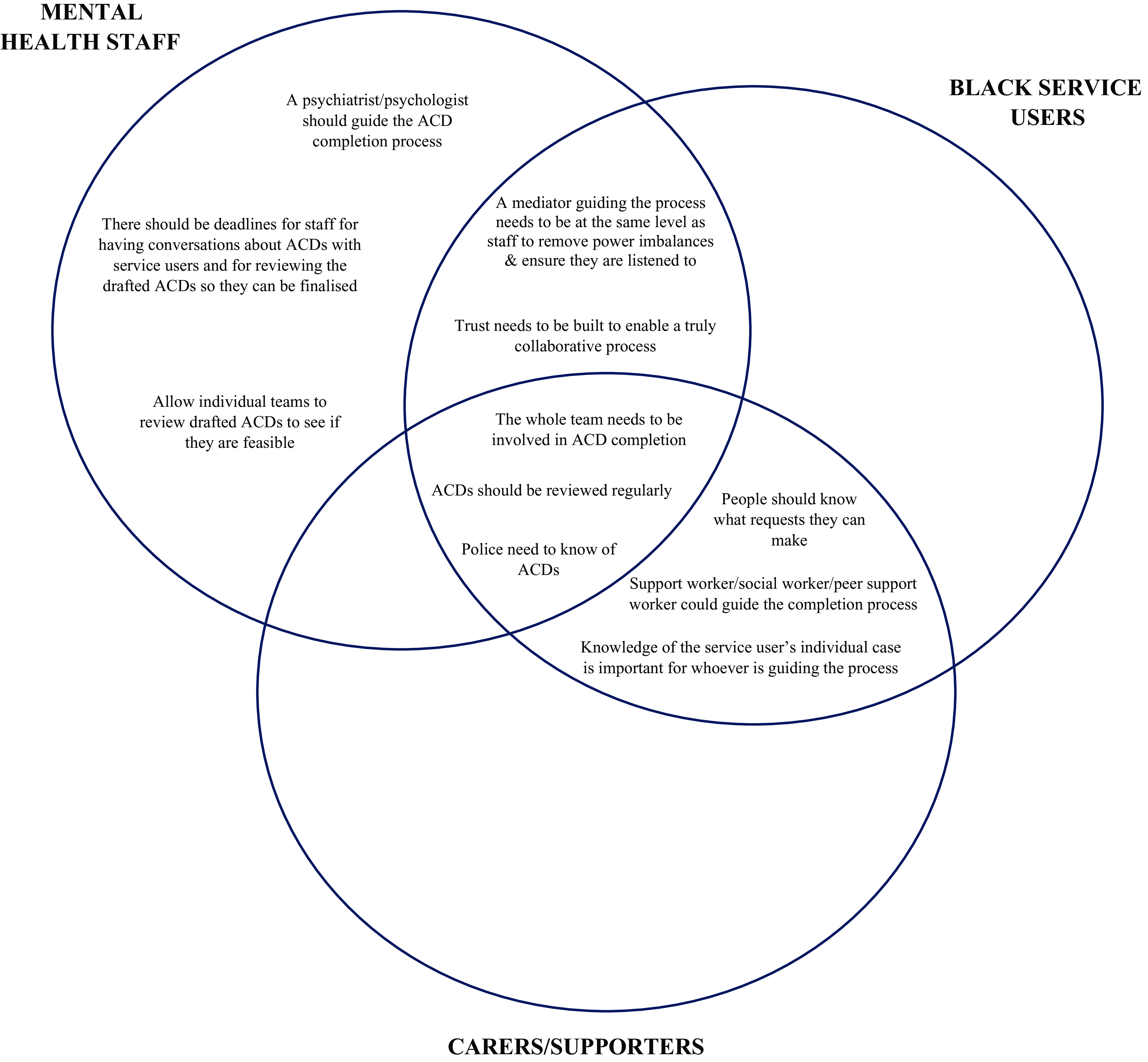
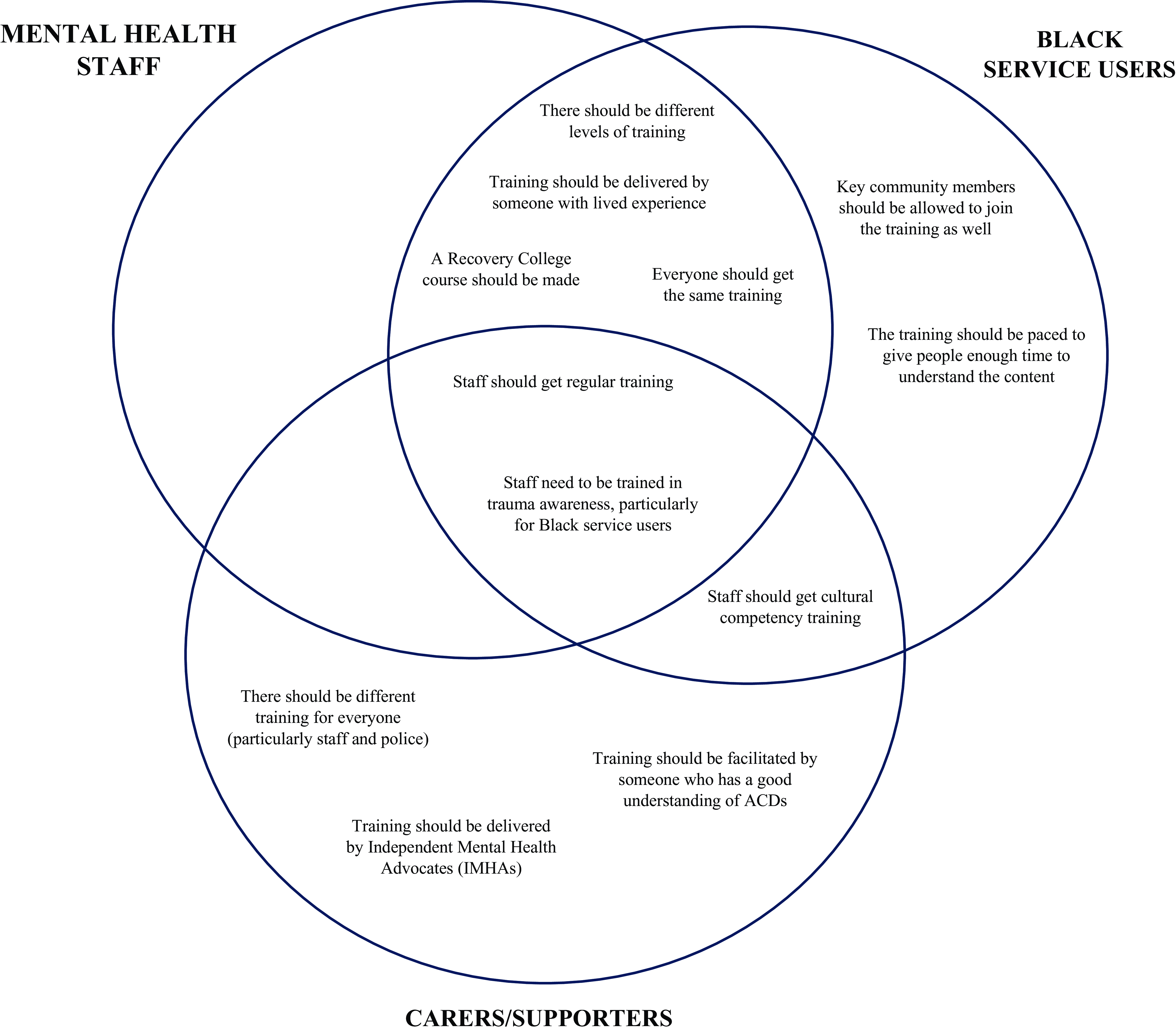
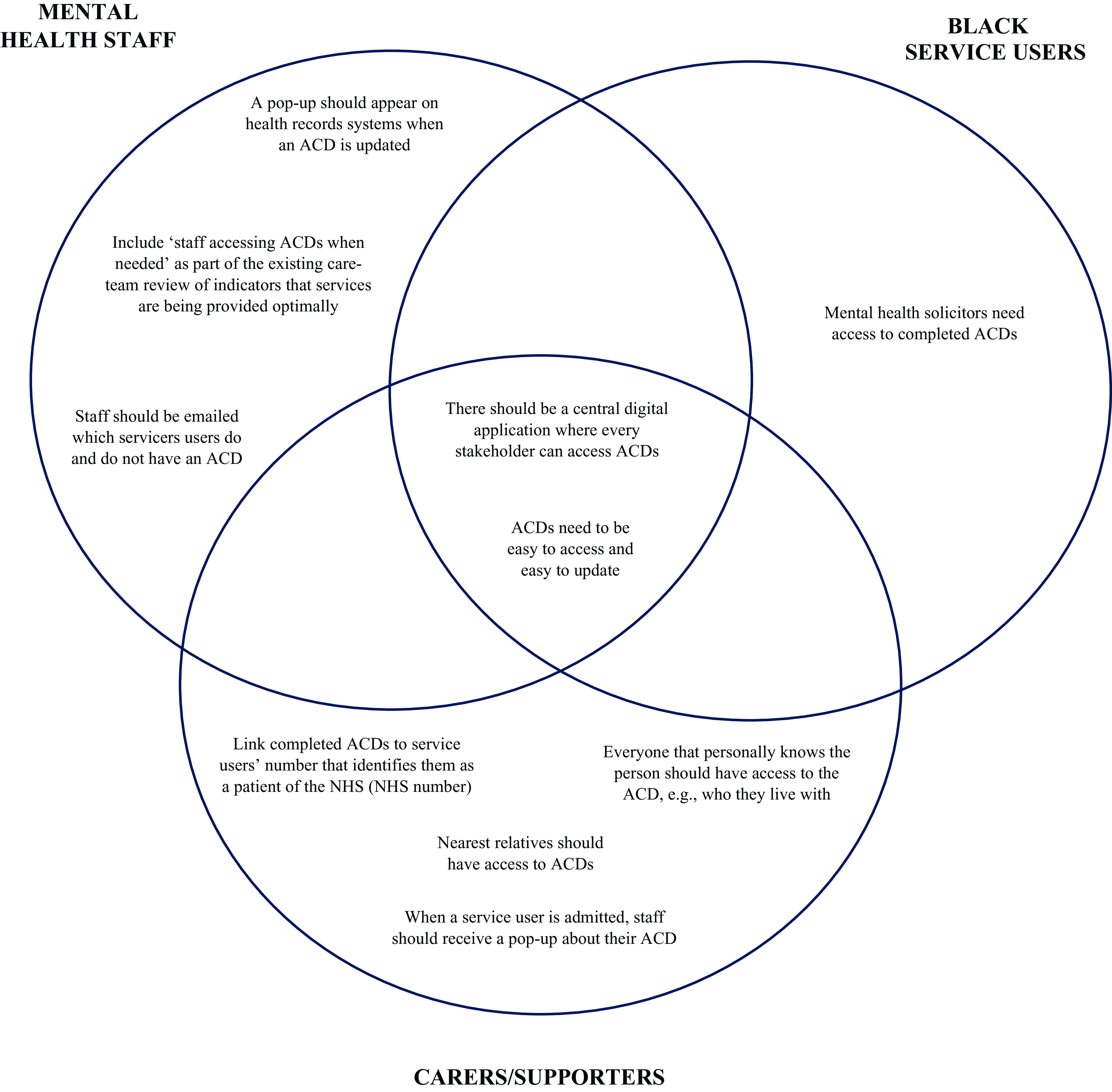
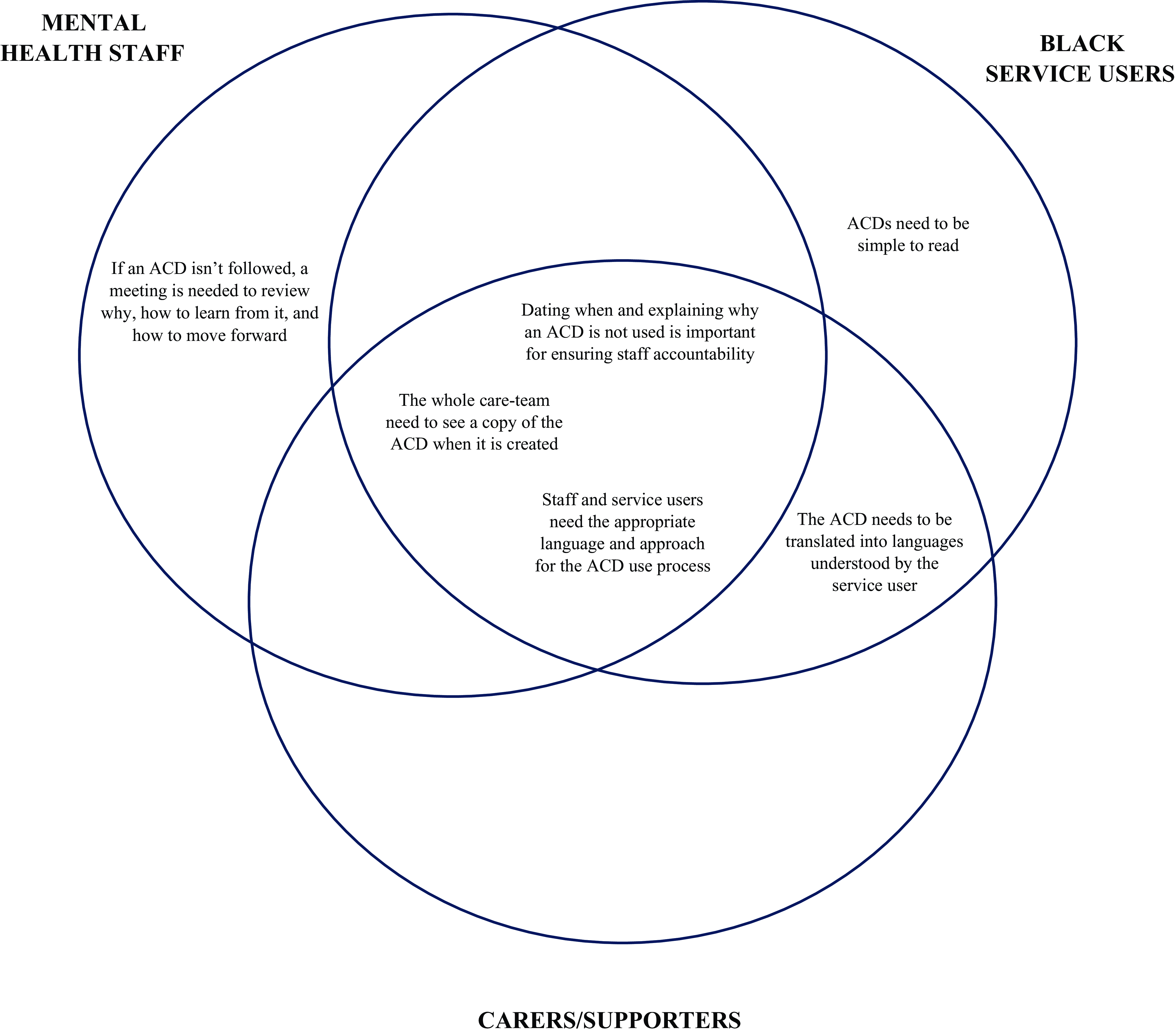
Initial analysis of stakeholders’ recommendations from workshops 1–6 (see Figs 1–4) identified a lack of consensus. This required a further consensus workshop to discuss accountability, training, police, and the role/independence of the person leading the ACD creation process.
Stakeholder workshop ‘Completion’ recommendations. This figure shows recommendations from the separate stakeholder workshops made by each stakeholder group in relation to completing Advance Choice Documents. Recommendations that are in more than one circle are those suggested by multiple stakeholders. Recommendations that are only in one circle were only made by that stakeholder group.

Stakeholder workshop ‘Training’ recommendations. This figure shows recommendations from the separate stakeholder workshops made by each stakeholder group in relation to training around Advance Choice Documents. Recommendations that are in more than one circle are those suggested by multiple stakeholders. Recommendations that are only in one circle were only made by that stakeholder group.

Stakeholder workshop ‘Access’ recommendations. This figure shows recommendations from the separate stakeholder workshops made by each stakeholder group in relation to accessing Advance Choice Documents. Recommendations that are in more than one circle are those suggested by multiple stakeholders. Recommendations that are only in one circle were only made by that stakeholder group.

Stakeholder workshop ‘Use’ recommendations. This figure shows recommendations from the separate stakeholder workshops made by each stakeholder group in relation to using Advance Choice Documents. Recommendations that are in more than one circle are those suggested by multiple stakeholders. Recommendations that are only in one circle were only made by that stakeholder group.

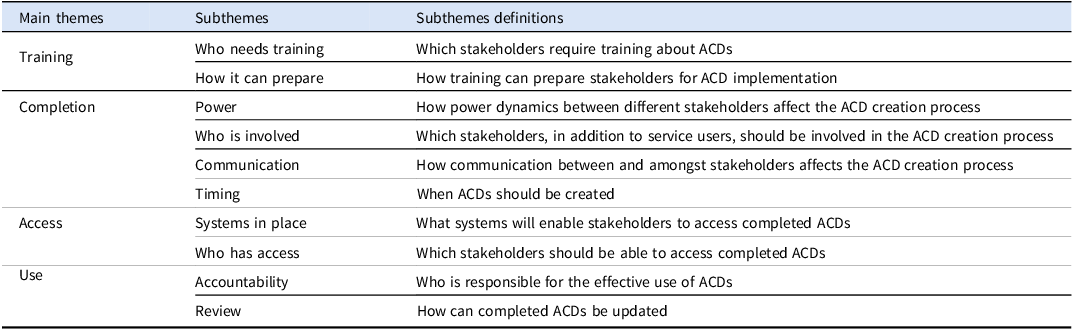
Secondary analysis of all workshops produced subthemes of the themes Training, Completion, Access, and Use (Table 1).
Workshop themes and subthemes

Table 1 Long description
A table with four main themes and their corresponding subthemes and definitions. The table has three columns: Main themes, Subthemes, and Subthemes definitions. The main themes are Training, Completion, Access, and Use. Under Training, the subthemes are Who needs training and How it can prepare, with definitions about stakeholders requiring training and preparation for ACD implementation. Under Completion, the subthemes are Power, Who is involved, Communication, and Timing, with definitions about power dynamics, stakeholders involved, communication effects, and timing of ACD creation. Under Access, the subthemes are Systems in place and Who has access, with definitions about systems enabling access and stakeholders who should access completed ACDs. Under Use, the subthemes are Accountability and Review, with definitions about responsibility for effective use and updating completed ACDs.
Themes
Training
Who needs training
It was widely considered that MHS needed training around ACD creation and use, even though they have demanding workloads. It was also felt service users would benefit from training, and carer/supporters were mentioned to a lesser extent. As police are likely to interact with service users it was felt they should have ACD awareness training. There was however a lack of consensus around the extent that different stakeholder types needed training. Opinions also differed on who should learn together. Some MHS thought it would benefit service users to learn from each other.
‘I think there was a strength in getting our clients together to think about their future and, to learn from one another around things that helps them…I do not know whether actually something like advance choice documents…could be done [by] getting a bunch of different clients together, so…they can start thinking and learning about things and then they could…continue that with their care coordinator’ (MHS1 - staff workshop)
Others thought if different stakeholders were together, they could all learn from one another. This was said to potentially help address unequal power dynamics between Black service users and MHS, as everyone is a learner and MHS’s roles or knowledge are not prioritised, as is in other care planning.
How it can prepare
Participants largely felt that everyone should receive basic knowledge about ACDs, as well as training tailored towards their level of involvement. For MHS, for example, it was mentioned how they should be trained in cultural competency and that this should inform the creation and use of ACDs with Black service users.
Training being empowering was emphasised more so for service users than other stakeholder groups. Recommendations regarding their training highlighted service users’ impact on the effectiveness of ACDs, due to their role in creating the document, and hence the need of developing self-advocacy skills for this.
‘I think there’s the skills about how do you represent yourself in those forums, when you’re speaking to professionals, who seem highly skilled, just wanna section you, sign the papers, get you out the door and, you know, treat you with utter disrespect…So there’s skills to make sure that people sit down and talk to them appropriately and challenge them in that process as well. Basic skills’. (SU1 – service user workshop)
Completion
Power
Across stakeholders, power was repeatedly a theme of discussions about ACD completion. This included power imbalances between stakeholders and MHS in favour of MHS, and power needing to be redistributed or used differently. One service user expressed doubt that the Black community would trust that ‘a piece of paper’ would influence their mental health care experience and would be sceptical of the power it would give them. All stakeholders felt MHS needed to engage in discourse to address Black service users’ negative past experiences of mental health services to improve therapeutic relationships and aid ACD completion. To increase a perceived lack of empathy for service users and ensure their personhood is respected, stakeholders suggested an ACD section detailing who a service user is as a person outside of their mental health diagnosis.
ACDs were also seen as giving Black service users more say over their care, replacing a dynamic where their say felt limited and mental health services felt like they were being ‘done to them’. However, due to past experiences of mental health services, often from negative experiences of MHS’s use of power, stakeholders expressed why even choosing to complete an ACD may still be difficult for services users.
‘But I trust the mental health service less than I trust the police… obviously this [ACD] is trying to help people, to prevent, but nobody wants to get sectioned again. It’s almost like asking how do you want to get beaten up the next time’. (Service User 2 – consensus workshop)
Who is involved
Opinion varied on what the role of the person leading the supporting of the ACD creation should be. This ranged from peer support workers (due to their lived experience making candid conversations easier), care-coordinators (for the relationship and knowledge they have), psychiatrists (for their medical knowledge), to someone who is external to the team (for impartiality). However, scepticism was expressed at some stakeholders’ capacity to do so in terms of time and expertise. It was widely thought a care-team member should be involved. Some believed multiple MHS, including advocates, should be present. Others wanted service users to have the option to decide who was present. It was also mentioned how it may be seen as low priority in the context of care-teams’ demanding workload and so may not be completed. MHS mentioned how someone should lead on monitoring ACDs to make sure they are completed. All stakeholder types expressed the belief of needing someone, not necessarily a member of a service user’s care-team, involved in some way to ensure the completion of the ACD.
‘I am thinking about the individuals that do not have carers, how are you going to ensure that care coordinators, social workers, adult social workers complete the form as necessary, because I find that, not being funny, I’ve had really bad experiences with adult social workers and care coordinators and they haven’t liaised or, or been able to communicate my mother’s details properly in order for her to get the right support and help that’s needed’ (CS1 – carer/supporter workshop)
Family members and carers were also said to need to be involved for various reasons. This included their relationship providing insight that could inform the ACD creation, and because the ACD contents may affect them due to 1) them possibly being named in it as a contact 2) the mental health experience of the service user affects them as a carer/supporter.
Communication
Communication was deemed important in uptake and quality of ACDs. Discussion concerning communication between MHS and other stakeholders covered how little the Black service users and carers/supporters felt they were informed about available services. They also reported feeling ignored or given limited care options. MHS also acknowledged that the way in which services are offered can impact how able Black service users feel to take advantage of what is offered.
Concerns were also cited around the lack of information sharing between different mental health teams and how this would negatively impact ACD quality, and hence undermine the perceived usefulness of created ACDs.
‘…the only way that form is gonna get filled out with all the information of me, is…if…all the different services are working together to be able to put that information together. That’s [what’s] lacking’. (CS2 – carer/supporter workshop)
Stakeholders emphasised the need for all departments to have input into ACDs to ensure awareness of a service user having an ACD. It was thought this may help aid fluidity of communication between services.
Timing
Most participants thought that ACDs should be created in the community. It was felt that all stakeholders generally want service users out of the hospital as soon as possible and that anxiety exists around being in hospital as well as leaving, and creating an ACD in hospital may negatively impact this.
‘So I probably would think potentially in the community, when they’re working within their community mental health team, they’re a bit more relaxed because again, even there’s anxiety when you are coming out of hospital’ (SU3 – service user workshop)
It was also suggested that discharge meetings could include the initial conversations about ACDs, so that people are thinking about it once they go back into the community.
Access
Systems in place
Participants questioned the capability of current systems for accessing created ACDs and the negative impact this would have on them being honoured. Service users and carers/supporters believed if there was not a central system that all staff could access, then one should be created. MHS added that carers/supporters access needed to be considered. Staff also questioned the efficiency of the current electronic health record systems, citing issues with tasks being lost in the numerous notifications they receive, either through low visibility or alert fatigue.
‘[Electronic health record system] is so busy and it’s full of a lot of stuff, some of it’s outdated, and no one’s caught up with it… we also have [Beth - electronic health records accessible by service users]. Now Beth, I hardly use, and I’m supposed to get patients interested in it but there’s so much so, maybe even that document…’ (MHS2 – staff workshop)
Concerns were also expressed about how service users would access their created ACDs without MHS, particularly those who are homeless or do not have access to personal technology such as a smartphone.
Who has access
Who can access the ACD was an important factor for stakeholders, particularly for service users. It was felt that it was a necessity that carers/supporters and a variety of staff types, including those outside of mental health services, such as supported accommodation staff, had access. However, service users stressed the importance of security measures to ensure their ACD could not be freely accessed. There were also suggestions of the service user being the one who permits access to their ACD. This was not mentioned by MHS and carers/supporters.
‘A central system [where] you can get access to it. Whoever…needs it, i.e., social worker, maybe the police, so maybe it could be a central place. You know what I mean? Then it can be accessible to whoever needs to, but obviously there has to be some form of security and then clearance because you wouldn’t want everybody to know your information, especially in terms of your mental health’. (SU4 - service user workshop)
Regarding the police, service users and carers/supporters expressed their apprehension and uncertainty of them having access to a person’s ACD. This was due to the belief this information would be misused to the detriment of a service user’s wellbeing. This was said in the context of a mistrust in the police due to personal and historical negative experiences from the police for Black people. Further complicating the matter was the mixture of helpful and negative experience with police participants had had or observed.
Use
Accountability
All stakeholders discussed accountability in ACD use. Most discourse concerned MHS, including their attitudes to provision of services and how they needed to see value in ACDs. It was also said that poor use of ACDs would reinforce unjust power structures affecting Black people. Additionally, service users and MHS talked about the responsibility of the service user in preparing themselves for ACD creation meetings, so that the ACD was most relevant to them and therefore most useful. Both were discussed within the context of the challenges to do so, such as service users’ past demotivating or disempowering experiences of services and MHS being overwhelmed.
The Trust itself was said to need to make higher level changes for ACDs to be used properly, including having processes where discussions and consequences occur when ACDs are not adhered to. The type of consequences were not agreed upon, with some believing their needed to be legal ramifications.
‘…that then would probably make the Trust feel uncomfortable and that tells you, well, hold on a minute, you’re not commissioning your services properly… I guess there should definitely be some discussion around why it wasn’t followed. What got in the way, like what led to it not being used, and kind of [a] conversation to have with individuals that…maybe in the process should have used it, and I imagine that’s going to be quite difficult to identify’. (MHS3 – staff workshop)
Review
The need for processes enabling updating ACDs, so they are meaningful and useful documents, was highlighted across stakeholders. Reasons for this included service users becoming more knowledgeable about ACDs and how to utilise them, as well as the changeable nature of preferences.
‘...maybe I want to change my advance [choice] document just like my will. You know, things [happen] in your life, you wanna change your will...Do I have the ability to change my advance [choice] document? How can I do it and how can I get access to do it and how to get [it] recognised as a part of the way I’m working with other professionals as well, so I’m not just doing it [on] my own? I think this is [a] really important thing to do. Now I want to make it more advanced than it was before.’ (SU1 - service user workshop)
This quote also underlines a sentiment expressed in the workshops that reviewing should be a joint process. Concerns were also raised around the responsiveness of staff in documenting changes in service users’ needs.
Consensus workshop outcome
Some topics prompted conflicting opinions, and further discussion was had to attempt establishing consensus. No unanimous consensus was reached, but some key takeaways were gained.
Training – who and how
The varied opinions on who should receive what training and how were brought to the consensus workshop. Most supported joint learning that involved service users, carers/supporters, and MHS. They also supported this happening in two forms: an awareness raising training with the Recovery College (which offer courses and workshops taught by people with lived experience and people with expertise by profession), and a more intensive training for those who were involved in the creating and using of ACDs.
Completion – who’s involved
It was felt that an independent MHS member may be useful to guide the ACD creation process, one argument being that it reduced the potential for the care-teams desires to be prioritised over the service user’s, defeating the goal of ACDs. It was also felt that although someone who knows the service user well may not be best to lead it, that they should be present in the meeting.
Access - police
Service users and carers/supporters although wary of police involvement, acknowledged the likelihood of police interacting with service users. From this they felt it was best to facilitate their access to ACDs as it may be useful for them to have some information about a service user, but they should not be permitted access to the entire ACD.
Use – staff accountability
After further deliberation, participants still felt that there needed to be some form of consequential accountability for ACDs to be implemented effectively but did not know what this would be exactly. What was agreed was that the consequence should not be too punitive as it was felt that the impact of MHS’ existing demanding workloads should be considered.
Discussion
This AdStAC project phase identified barriers and enablers to ACD implementation as identified by Black service users, their carers/supporters, and MHS. Some were consistent with existing literature, whilst others pertained specifically to Black service users’ experiences.
For ACD implementation to be effective, stakeholders believed the following are needed: MHS need to respect what ACDs stand for, i.e. service user choices; MHS training; more balanced MHS-service user relationships for ACD creation; consequence for MHS not honouring ACDs; and reliable and helpful records systems for ACD access, which are consistent with previous findings (Ridley et al. Reference Ridley, Rosengard, Hunter and Little2009; Farrelly et al. Reference Farrelly, Lester, Rose, Birchwood, Marshall, Waheed, Henderson, Szmukler and Thornicroft2016; Jankovic et al. Reference Jankovic, Richards, Berrisford and Priebe2020; Lequin et al. Reference Lequin, Ferrari, Suter, Milovan, Besse, Silva, Golay, Bonsack and Favrod2021). Other factors, such as concerns with current staffing and resource levels, are consistent with reports about the impact of mental health funding (Trades Union Congress (TUC), 2018).
This study deepens the understanding of the interaction between these ACD implementation barriers and enablers, and others, and the experiences of Black service users and those who support them. For example, the need for a good therapeutic relationship for successful ACD creation is a known enabler (Farrelly et al. Reference Farrelly, Lester, Rose, Birchwood, Marshall, Waheed, Henderson, Szmukler and Thornicroft2016), and our results highlight that cultural and racial considerations are believed to be necessary to achieve such a relationship for Black service users. Relatedly, this study highlights the need for MHS to engage with Black service users and carers/supporters to address negative and racialised experiences during ACD creation. This is important for personal lived experience and historical traumatic contact between Black service users and mental health services and resulting scepticism toward such services from Black communities (Halvorsrund et al. Reference Halvorsrund, Nazroo, Otis, Hajdukova and Bhui2018). This supports the notion that ‘colour-blind’ approaches to health services, which treats all service users as if their experiences are the same, maintain and promote health inequalities (Penner & Dovidio, Reference Penner, Dovidio, Neville, Gallardo and Sue2016). In line with this, cultural competency was also requested for MHS creating ACDs.
As this mistrust also applies to the police due to poor existing and historical relations (Joseph–Salisbury et al., Reference Joseph-Salisbury, Connelly and Wangari-Jones2021), it follows that service users and carers/supporters expressed mixed feelings about police having access to ACDs, and that they believed there is a risk of the police misusing the information in a way that negatively impacts service users.
All stakeholders welcomed the potential benefits of ACD implementation; however, no service user participants later created an ACD as part of the AdStAC project.
Strengths and limitations
The focus on Black service users afforded consideration of ACD implementation for a group experiencing health inequities. The Black ethnicity of three members of the research team, one of whom attended all workshops, may have encouraged Black service users to discuss their community’s experiences of mental health services and the role of the police as they relate to ACD implementation.
The service provider covers a large city area with a high rate of psychosis and large proportions of Black people within its population. However, the restriction to this setting may limit the generalisability of the results.
The use of online workshops for the separate groups is likely to have encouraged participation by those who would not have travelled to an in-person workshop. The ability for people to turn their cameras off may also have made people feel more comfortable to talk about sensitive topics due to the facilitated anonymity. However, it may also have excluded some who have difficulty accessing online meetings. Additionally, what participants shared may have been affected by the fact that the workshops did not occur in a controlled space, e.g., the potential existed for the workshop conversation to be overheard by people not in the workshop. Conversely, whilst an in-person workshop was aimed at promoting interaction and clarification of areas of consensus and dissensus, this may have excluded those more comfortable with online meetings.
Implications for research and practice
The study findings imply cross-stakeholder, attitudinal, and system wide changes in approach are needed to address ACD implementation barriers.
Without measures to encourage high quality ACD creation and their effective use with Black people with previous experience of compulsory psychiatry admission, existing inequities may widen due to disproportionate uptake across ethnic groups. Our results reinforce existing evidence for the need for independent facilitators for ACD creation due to their impartiality. They also highlight how independent facilitation may avoid adding to existing care-team member pressures from workforce shortages, insufficient role delineation, and resource constraints (Trades Union Congress (TUC)), 2018). No preferences for a Black facilitator were expressed, and recommendations of cultural competency training suggests an expectation that the facilitator may not be of their community.
Explicit acknowledgement of historical and individual poor experiences and time spent listening to experiences that underline treatment preferences expressed by Black people, are critical aspects of ACD creation. This is essential to improving therapeutic relationships, which may in turn lead to less coercive care.
Skills to interact with MHS to obtain the potential empowerment from having an ACD are needed in a context of longstanding power imbalances between service users and MHS that intersect with their being racialised as Black and subject to systemic racism historically and presently (Cole, Reference Cole2022). This can be supported by another stakeholder recommendation: joint training (where all stakeholders learn together) to help address power imbalances. This type of training has also been shown to prompt MHS reflection on power dynamics and improve therapeutic relationships (Salkeld et al. Reference Salkeld, Wagstaff and Tew2013).
Evaluation and monitoring of implementation will be vital to assess ACD quality and impact, while their content will be a resource to inform wider service improvements. Our group has co-produced and tested implementation resources for Black and African people (Simpson et al. Reference Simpson, Babatunde, Simpson, Gilbert, Ruck Keene, Stephenson, Chua, Owen, Crowe, Edwards and Galloway2024) and will be evaluating the implementation of ACDs across an NHS mental health Trust (Kings College London, 2024) to help achieve these goals.
Supplementary material
The supplementary material for this article can be found at https://doi.org/10.1017/ipm.2025.11.
Availability of data
Full transcripts are not available due to potential identifiability
Financial support
This study was supported by Maudsley Charity grant 2560.
Competing interests
The authors declare none.
Ethical standard
The authors assert that all procedures contributing to this work comply with the ethical standards of the relevant national and institutional committee on human experimentation and with the Helsinki Declaration of 1975, as revised in 2008. Approval was granted by Bradford Leeds NHS Health Research Authority Research Ethics Committee (22/YH/0012) on 07/02/2022. Participants gave written consent for their data to be used in the research.


 Open access

