The Diagnostic and Statistical Manual of Mental Disorder-IV-TR (DSM-IV-TR) describes panic disorder with agoraphobia (PD/Ag) as the presence of panic attacks (sudden onset of symptoms of apprehension, intense fear or terror accompanied by a feeling of imminent death) and agoraphobia (onset of anxiety or avoidance behavior in places or situations from which it is difficult to escape, or it is impossible to find help if a panic attack occurs) (American Psychiatric Association [APA], 2000).
Prevalence of PD/Ag is imprecise, according to APA (2000), with world prevalence data of panic disorder (PD)—with or without agoraphobia—ranging between 1.5 and 3%, with an annual prevalence between 1 and 2%. It is estimated that between 33 and 50% of patients with PD present agoraphobic symptoms (APA, 2000). Specifically, in Spain, the data from the “Mental Health Strategy” (Ministerio de Sanidad y Consumo [Ministry of Health and Consumption], 2006) indicate an annual prevalence of 0.69% for PD (0.38% males, 0.98% females), and 0.39% for agoraphobia (0.15% males, 0.60% females). The lifetime prevalence of PD is 1.70% (0.95% males, 2.39% females) and 0.62% for agoraphobia (0.47% males, 0.76% females). Comorbidity is present in 63.1% and 58%, respectively, of PD and agoraphobia.
Furthermore, this type of disorder generates marital, social, occupational, and recreational interference or impairment. Familiar and personal spheres are affected the most (Bados, Reference Bados2009). This leads to the necessity of effective and efficient treatments.
The psychological treatment of choice for PD/Ag is exposure and self-exposure, as well as cognitive behavioral therapy (CBT). This is mentioned by The Task Force Reports on empirically supported treatments (EST) (Chambless et al., Reference Chambless, Baker, Baucom, Beutler, Calhoun, Crits-Christoph and Woody1998), treatment guidelines (Barlow, Esler, & Vitali, Reference Barlow, Esler, Vitali, Nathan and Gorman2008), and the 12th Division of the APA, taking as a reference the works of Barlow, Craske, Cerny, and Klosko (Reference Barlow, Craske, Cerny and Klosko1989) and of Clark et al. (Reference Clark, Salkovskis, Hackman, Middleton, Anastasiades and Gelder1994). The efficacy of these treatments for PD/Ag is also supported by meta-analysis and efficacy studies (Mitte, Reference Mitte2005; Öst, Thulin, & Ramnerö, Reference Öst, Thulin and Ramnerö2004; Ruhmland & Margraf, Reference Ruhmland and Margraf2001). A brief summary of these investigations is presented below.
Ruhmland and Margraf (Reference Ruhmland and Margraf2001) compared the efficacy of 7 psychological treatments for PD/Ag in a 52-work meta-analysis. They calculated the pre-post effect size (ES) for: presence of main symptoms, number and intensity of panic attacks, general anxiety, depression, degree of dysfunction, and general psychopathology. The ES for exposure treatment was d =1.64, and for CBT, d = 1.13; both ESs were large (Cohen, Reference Cohen1988). They concluded that, for all clinical variables, exposure and CBT achieved important and long-lasting improvements.
Öst et al. (Reference Öst, Thulin and Ramnerö2004) examined whether the combination of cognitive therapy plus exposure obtained better results for PD/Ag than exposure alone. They assigned 73 patients to one of three conditions: in vivo exposure, CBT, and waiting-list. Treatment was individual and weekly, lasting 12–16 weeks, according to Clark (Reference Clark, Hawton, Salkovskis, Kirk and Clark1989). Results show significant pre-post reductions in active treatments (exposure and CBT), both significantly more efficacious than waiting-list, but with no differences between them. They concluded that interventions with in vivo exposure are preferable for PD/Ag.
Mitte (Reference Mitte2005) analyzed the efficacy of psychotherapy, pharmacological therapy, and their combination for PD/Ag in a 124-study meta-analysis: 53 pharmacological therapies, 47 psychological, and 24 combined. The results of behavioral treatment (BT) or CBT, compared to no-treatment, obtained high ESs in measures of avoidance/cognition/panic (d = .87), clinical significance (d = 1.36), depression (d = .72), and quality of life (d = .85). When compared to placebo groups, these ESs dropped in avoidance/cognition/panic (d = .51), clinical significance (d = .55), depression (d = .27), and quality of life (d = .47). The author’s conclusions are that CBT was more effective than no-treatment or placebo treatment.
In view of the aforementioned studies, the efficacy of CBT for this disorder is well established.
In contrast, interest in the effectiveness of psychological treatment for PD/Ag is more contemporary. It has led to less data accumulation, especially in Spain. However, there are some well-designed studies that are beginning to indicate the suitability of applying efficacy results in clinical setting. The works of Addis et al. (Reference Addis, Hatgis, Krasnow, Jacob, Bourne and Mansfield2004), Hahlweg, Fiegenbaum, Frank, Schroeder, and von Witzleben (Reference Hahlweg, Fiegenbaum, Frank, Schroeder and von Witzleben2001), Kenardy et al. (Reference Kenardy, Dow, Johnston, Newman, Thomson and Taylor2003), Rosenberg and Hougaard (Reference Rosenberg and Hougaard2005) and Wade, Treat and Stuart (Reference Wade, Treat and Stuart1998), among others, can be cited. The most significant results are shown below.
Wade et al. (Reference Wade, Treat and Stuart1998) studied the effectiveness of Barlow and Craske’s (Reference Barlow and Craske1994) treatment of for PD with or without agoraphobia for the first time in 110 patients in a mental health center. Therapists from the center were trained to apply the treatment in 15 sessions, obtaining significant pre-post changes in all measures, with improvements similar to those of efficacy studies like that of Barlow et al. (Reference Barlow, Craske, Cerny and Klosko1989). There was a 26.4% of dropouts.
Hahlweg et al. (Reference Hahlweg, Fiegenbaum, Frank, Schroeder and von Witzleben2001) determined whether high density exposure (exposure tasks every day for 2–3 weeks) is effective for PD/Ag. The treatment, applied to 416 patients with PD/Ag, consisted of: (a) psychological assessment; (b) feedback of diagnosis and psychoeducation of the problem; (c) high density CBT, of varying duration, according to the patient’s needs. At posttreatment, 81% of patients had improved, 5% had worsened, and in 8.5%, there was little improvement. In all measures, ESs exceeded the value of 1.09 at posttreatment and at a 1-year follow-up.
Kenardy et al. (Reference Kenardy, Dow, Johnston, Newman, Thomson and Taylor2003) analyzed the effectiveness of 12-session CBT in a multicenter study with 163 patients with PD/Ag. They used diverse variants of Barlow et al.'s (1989) therapy (6-session CBT or the same plus 6 computerized support sessions), comparing it with a waiting-list group. At posttreatment, all treatment conditions had improved more than the waiting-list, with 12-session CBT showing the greatest changes (mean ES d = 2.16). This ES is comparable to efficacy studies such as that of Clark et al. (Reference Clark, Salkovskis, Hackman, Middleton, Anastasiades and Gelder1994).
Addis et al. (Reference Addis, Hatgis, Krasnow, Jacob, Bourne and Mansfield2004) compared the effectiveness of Barlow et al.’s (Reference Barlow, Craske, Cerny and Klosko1989) panic control therapy (PCT) in an assistential clinic with the habitual treatment used in the clinic for panic with agoraphobia in 80 patients (38 and 42, respectively). At posttreatment, 41.9% of the PCT patients had improved significantly (versus 18.8% of the other group). They concluded that application of a manualized CBT in an assistential sphere also achieves important improvements in the main measures (panic severity, depression, and general well-being).
Rosenberg and Hougaard (Reference Rosenberg and Hougaard2005) administered PCT to 53 patients in a clinic, comparing them with a waiting-list group. They administered an average of 14 group sessions plus 3.8 individual sessions. At posttreatment, 47.2% of the patients were panic free (12.5% in the waiting-list group), with results improving at an 18-month follow-up, and all differences were significant. Moreover, in pre-post measures, large ESs were achieved in frequency of panic attacks (d = .82) and means of measures of anxiety (d = .50) and phobia (d = .52). The authors conclude that the results are modest in comparison with efficacy studies, perhaps due to patients' high levels of agoraphobia.
Knowing the current state of the efficacy and effectiveness of psychological treatment for PD/Ag, it is also interesting to determine the effectiveness of drug treatments, as this is the first choice in psychiatric consultation and primary care. Some studies, such as that of Bakker, van Balkom, Anton, and van Dyck (Reference Bakker, van Balkom, Anton and van Dyck2000) or Mitte (Reference Mitte2005) indicate that medications like fluvoxamine, fluoxetine, paroxetine, sertraline, and citalopram have been shown to be better than placebo treatment for PD/Ag, although with no differences between the diverse medications.
In addition, van Apeldoorn et al. (2008), comparing pharmacological treatment with exposure treatment or CBT, indicate that the combination of both treatments is better than either one of them separately at short term, but results at follow-up are better in treatments of CBT alone. They concluded that pharmacological treatment does not substitute CBT or exposure, although it can serve as a short-term adjuvant.
Finally, little information about cost of treatment for PD/Ag is provided in the assistential sphere. For PD/Ag, alone or together, the recommendation of the British Associaton for Psychopharmacology (Baldwin et al., Reference Baldwin, Anderson, Nutt, Bandelow, Bond, Davidson and Wittchen2005) is to continue the drug treatment for six months if the response to it is positive for the first 12 weeks. It is also recommended to leave a period of at least 3 months for the gradual reduction of pharmacological therapy. The drugs of choice in this case are clomipramine (tricyclic antidepressant), followed by selective serotonin reuptake inhibitors (SSRIs) (fluoxetine or fluvoxamine). According to these recommendations, the drugs alone would cost approximately 870€.
Otto, Pollack, and Maki (Reference Otto, Pollack and Maki2000), in their review of therapy costs for panic disorder, reported an expenditure of $1186 (871€) for a total of 10.4 visits to a psychologist (individual format), similar to Kenardy et al. (Reference Kenardy, Dow, Johnston, Newman, Thomson and Taylor2003) in their international multicenter trial on the efficacy of psychological therapy, of 12-session duration (led by a therapist).
There are no studies in Spain reporting the cost of therapy in a clinical setting.
Within this framework, it would be useful to have more evidence to establish the effectiveness of psychological EST in the assistential sphere. This is the goal of this work, to assess the clinical effectiveness of EST for PD with agoraphobia and to analyze its cost in a Spanish University Psychology Clinic.
Method
Description of the center
The University Psychology Clinic of the Universidad Complutense (CUP-UCM), is a Health Center acknowledged by the Autonomous Community of Madrid. Among other functions, it provides effective and efficient psychological assistance. The center provides free access on demand and at market prices to any kind of patient who does not require hospitalization. A description of the center and the therapists can be seen in Labrador, Estupiñá, and García-Vera (Reference Labrador, Estupiña and García-Vera2010).
Participants
Patients
Patients were selected from the CUP. They were over 18 years of age, diagnosed with Panic Disorder with Agoraphobia (PD/Ag), and had received treatment for this problem between 1999–2008. Out of the total of 1550 patients, 50 met these criteria (3.5% of the total sample, and 14.2% of the anxiety disorders).
Therapists
All were university-degree psychologists with at least a postgraduate Master's degree accrediting their specialization in the assessment and treatment of psychological disorders. Age ranged between 25–29 years, 71% were women. They had undergone cognitive–behavioral training and between 1 and 3 years of supervised clinical practice before their incorporation in the CUP-UCM. They use ESTs in their interventions (exposure, self-exposure and CBT), which are supervised weekly by professionals of acknowledged prestige in clinical psychology.
Instruments and variables
Sociodemographic variables
Sex, age, marital status, educational level, and work situation, obtained by means of a questionnaire applied when initiating the intervention.
Independent variable
Administration of psychological treatment. Each therapist applied the ESTs for PD/Ag (based on Barlow & Craske, Reference Barlow and Craske1994) that she/he considered appropriate, according to the patient’s features and evolution, in accordance with the therapist’s supervisor.
Clinical Variables:
Directly related to the disorder
- Number of assessment, treatment, and follow-up sessions.
- Stage of patient's treatment: discharged (reached the goals), refusal (did not start treatment), and dropout (began treatment, but left before achieving goals).
- Score in Body Sensations Questionnaire (BSQ) (Chambless, Caputo, Bright, & Gallagher, Reference Chambless, Caputo, Bright and Gallagher1984; Spanish adaptation of Comeche, Díaz, & Vallejo, Reference Comeche, Díaz and Vallejo1995).
- Score in Agoraphobic Cognitions Questionnaire (ACQ) (Chambless et al., Reference Chambless, Caputo, Bright and Gallagher1984; Spanish adaptation of Comeche et al., Reference Comeche, Díaz and Vallejo1995).
Treatment Cost: amount of money paid (€) for the entire therapeutic relationship. It is considered as the number of sessions; the cost was 48€/session Footnote 1 .
Indirectly related to the disorder
- Scores in Beck Depression Inventory-II (BDI-II) (Beck, Steer, & Brown, Reference Beck, Steer and Brown1996; Spanish adaptation of Sanz, Perdigón, & Vázquez, Reference Sanz, Perdigón and Vázquez2003).
Procedure
Patients who demand assistance are assigned to a therapist, who performs the pretreatment assessment using semistructured interviews (Muñoz, Reference Muñoz2003), self-reports, and questionnaires recommended by the literature for each disorder, establishing the clinical diagnosis according to DSM-IV-TR criteria. On the basis of the clinical formulation of the case and the ESTs for PD/Ag, an individualized treatment is established in one-hour weekly sessions. After the treatment, the therapist performs a postreatment assessment using the same instruments. To verify that the objectives were achieved, the questionnaire scores had to be below the cut-off point indicated by the authors: that is, a score of less than 3.05 for the BSQ, and of less than 2.32 for ACQ (Chambless et al., Reference Chambless, Caputo, Bright and Gallagher1984). In addition, the semistructured interview (Muñoz, Reference Muñoz2003) was re-administered to ensure the absence of the PD/Ag diagnosis.
The data presented were obtained from these patients' case files, written by their therapists.
Data Analysis
Data were analyzed with the statistical program SPSS 15.0. As the scores of the BDI-II, BSQ, and ACQ questionnaires were not normally distributed, Wilcoxon's test was used to compare the means. The ESs (Cohen's d) were calculated with participants’ pre- and post-scores (means and standard deviations) in the questionnaires.

The value of ES was considered low, medium, or high magnitude if d exceeded .2, .5, and .8, respectively (Cohen, Reference Cohen1988). To calculate ESs and the nonparametric Wilcoxon statistic, for each analysis, patients with pretreatment and/or posttreatment measures were considered, so the number of participants may be different in each analysis.
Results
Sociodemographic variables
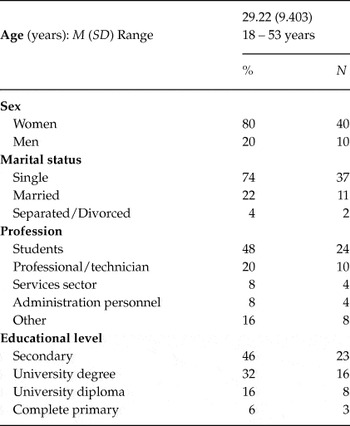
The data of the sociodemographic variables for the entire sample are presented in Table 1. Noteworthy aspects are the low mean age of the sample (29.22 years); a significant majority of women (80%) and single people (74%); similar percentages of workers (52%) and students (48%); and a high educational level, as almost 50% had university studies, and only 6% did not have secondary studies.
Sociodemographic Variables of the Sample

(N = 50)
Clinical variables
The average number of assessment sessions was 3.26 (SD = 1.10), the average number of treatment sessions was 13.39 (SD = 9.24), and the average number of follow-up sessions was 1.06 (SD = 1.33). A reduced number of assessment and treatment sessions were expected. The high standard deviation of the number of treatment sessions is noted. The data of the clinical variables for the entire sample are presented in Table 2.
Treatment Variables
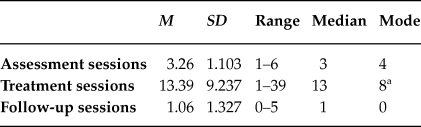
Note: ª There are several modes. The lowest value is shown. N = 50.
The distribution of the sample regarding treatment stage was: 14 (28%) in treatment, 30 (60%) discharged, 4 (8%) dropped out of treatment, and 2 (4%) refused treatment.
In Table 3 are presented the percentages of discharges/refusals/dropouts at the end of the treatment relationship and the number of assessment and treatment sessions for each category. It is noteworthy that the mean number of treatment sessions in the discharged group was 15.13 versus 11.5 in the dropout group. The high percentage (83.33%) of patients who completed treatment and were discharged is also notable.
Treatment Outcomes

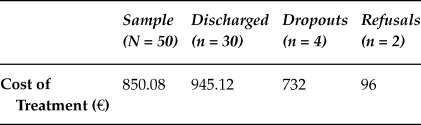
To obtain the information about treatment cost, we multiplied the average number of sessions by the CUP prices in 2009 (48€/session). There are slight differences in the cost of the treatment of the entire sample (850€), those who achieved therapeutic success and were discharged (945€) and dropouts (732€). Obviously, patients who refused treatment spent less (96€). Table 4 presents the average cost (in Euros) for PD/Ag treatment in a clinical setting.
Treatment cost

Note: To obtain this information, the average number of sessions was multuplied by the CUP prices in 2009 (48€ / session) as reference.
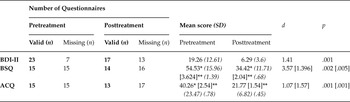
Table 5 presents the ES values and level of significance calculated for the Wilcoxon test. We emphasize that in, all the considered measures, the pre-posttreatment differences were significant. We also note the high values of ES: d = 1.41 for the BDI-II; d = 3.57 for the total BSQ score (d = 1.396 for the mean score); and d = 1.07 for the total ACQ score (d = 1.57 for the mean score).
Results according to the Questionnaires

Note: BDI-II = Beck Depression Inventory, II; BSQ = Bodily Sensations Questionnaire; ACQ Agoraphobic Cognitions Questionnaire.
BSQ and ACQ offer two types of scores, the total score * and the average score [**] of the questionnaire.
Discussion
Sociodemographic Variables
It is noteworthy that 80% of the cases were women. Other works have indicated that approximately two thirds of patients who seek assistance in psychology clinics are female, in Spain (Labrador & Ballesteros, Reference Labrador and Ballesteros2011; Labrador et al., Reference Labrador, Estupiña and García-Vera2010; Ministry of Health and Consumption, 2006) and in other countries (Addis et al., Reference Addis, Hatgis, Krasnow, Jacob, Bourne and Mansfield2004; Kenardy et al., Reference Kenardy, Dow, Johnston, Newman, Thomson and Taylor2003; Rosenberg & Hougaard, Reference Rosenberg and Hougaard2005). But in this work, the rate of women is is greater. It would be interesting to know whether this is due to the type of disorder (PD/Ag), to anxiety disorders in general, or to other factors. It is far from clear why anxiety disorders are more frequent among women, but these data are repeated in many studies.
Mean age (29.22 years) is very similar to that of patients with general anxiety disorders (30.01 years) from the CUP-UCM, although it is lower than the average age in other reference works. Thus, Rosenberg and Hougaard (Reference Rosenberg and Hougaard2005) indicate a mean of 33.1 years; Kennardy et al. (2003), Öst et al. (Reference Öst, Thulin and Ramnerö2004), and Mitte (Reference Mitte2005) of more than 36 years, or Addis et al. (Reference Addis, Hatgis, Krasnow, Jacob, Bourne and Mansfield2004) of almost 40 years. These differences may be partially explained by the higher cultural level of our sample, which leads to seeking psychological aid sooner. Thus, 48% of patients in this work had university studies, whereas in other works, the main category of patients is secondary studies (33.1% in Kenardy et al., Reference Kenardy, Dow, Johnston, Newman, Thomson and Taylor2003; 35% in Addis et al., Reference Addis, Hatgis, Krasnow, Jacob, Bourne and Mansfield2004). Easier access for university personnel may be another factor, especially if students, usually under 30 years, are considered. Therefore, a high cultural level and easy access for students may be two factors that explain the reduced mean age of the patients of this study.
The sociodemographic profile of the PD/Ag patient at the CUP-UCM is: female, single, about 29 years old, employee or student, with secondary or university studies. This profile is similar to that indicated in the Spanish Mental Health Strategy (Ministry of Health and Consumption, 2006), and also to that of the entire sample of patients at the CUP-UCM (Labrador et al., Reference Labrador, Estupiña and García-Vera2010).
Treatment Variables
As shown in Table 2, the mean number of assessment (3.26) and treatment sessions (13.39) is relatively low and close to the values obtained for the general sample of patients (13.9) demanding psychological assistance at the CUP-UCM (Labrador et al., Reference Labrador, Estupiña and García-Vera2010). The mean number of treatment sessions in discharged patients (15.13) is close to the 12 sessions of Craske and Barlow (Reference Craske and Barlow2007) or the 16 sessions of Öst et al. (Reference Öst, Thulin and Ramnerö2004) in studies of efficacy.
Nevertheless, a longer treatment time has been observed in effectiveness studies than in efficacy studies, for instance, that of Bados (Reference Bados2009) with a mean of 44 hours, or of Addis et al. (Reference Addis, Hatgis, Krasnow, Jacob, Bourne and Mansfield2004) with a mean of 39 sessions. But although psychological treatments in the clinical setting usually seem to be longer than in research, in the present work, the results indicate a relatively low number of sessions to achieve positive results, and very close to the number obtained in efficacy studies. These results indicated that treatments in clinical settings can be no longer than treatments in research studies.
Nevertheless, the way to arrive at that average number of sessions is very different in both types of studies. In the efficacy studies, when applying a standard protocol, the number of sessions is similar in all cases. On the contrary, in this study, as there is no standard treatment protocol but instead, an individual treatment designed for each patient, the number of sessions in each case can vary a lot. This is indicated by the high values of the standard deviation (9.24) and the large range of intervention sessions (1–39). This is partially due to some patients dropping out after a few sessions, but also to the prolongation of some cases.
Designing a specific treatment for each patient probably has additional advantages over using the same protocol for all patients. In some cases, the presence of more of than one problem can also prolong the number of treatment sessions.
The percentage of discharges (83.33%) is high, and higher than the average for psychological interventions in the general sample of the CUP-UCM (68.34%). This percentage was even more satisfactory than some efficacy studies indicating a significant improvement in 67% of patients using exposure and in 79% of CBT patients (Öst et al., Reference Öst, Thulin and Ramnerö2004). Also, compared with effectiveness studies, the percentage of discharges is similar to those of the study of Hahlweg et al. (Reference Hahlweg, Fiegenbaum, Frank, Schroeder and von Witzleben2001), where 81% of patients improved, but very superior to those of Rosenberg and Hougaard (Reference Rosenberg and Hougaard2005), who reported 47.20%, and those of Addis et al. (Reference Addis, Hatgis, Krasnow, Jacob, Bourne and Mansfield2004), who found 42.90%.
To obtain similar results to those of the efficacy studies indicates the appropriateness of using EST in applied clinical settings. EST are used within a fixed treatment protocol or in a treatment program specifically designed for each patient, the results are very positive, and—at least in some cases—can even reach similar rates of discharges. It seems that the effectiveness of the intervention is more closely related to the type of treatment than to nonspecific characteristics of the intervention.
To conclude, the data show that one should expect very positive results for PD/Ag, with not too prolonged treatments, when EST from efficacy studies are used in applied settings. The scarce number of follow-up sessions (1.06) prevents determining whether the effects are maintained. This is an ongoing problem in applied settings: when patients feel better, they usually see no need for follow-up.
These positive outcomes are supported by the scores in the specific questionnaires. The pre-post changes are significant in all cases, with ES values higher than 1.05 in all cases except for one, achieving a BSQ score of 3.57. The change outcomes in the BDI-II are also significant with an ES of 1.41, indicating the relationship between ADs and depression and how they can affect each other. The results for depression are better than those presented in effectiveness studies, such as that of Rosenberg and Hougaard (Reference Rosenberg and Hougaard2005), d = .58, or the meta-analysis of Mitte (Reference Mitte2005), with ES between .27 and .72, depending on whether CBT is compared with placebo or with no-treatment.
The percentage of dropouts (11%) reached similar values as those of efficacy studies (Bados, Reference Bados2009, 12–16%; Mitte, Reference Mitte2005, almost 13% of dropouts) and of effectiveness studies (Hahlweg et al., Reference Hahlweg, Fiegenbaum, Frank, Schroeder and von Witzleben2001, 8.50%; Kenardy et al., Reference Kenardy, Dow, Johnston, Newman, Thomson and Taylor2003, 14.10%; and Wade et al., Reference Wade, Treat and Stuart1998, 26.40%). This datum is also better than the data of 23.50% (Mitte, Reference Mitte2005) or 25–34% (Bados, Reference Bados2009) of refusals/dropouts from pharmacological treatments. The dropouts were also fewer than those reported in combined treatments, 20.50% in the study of Mitte (Reference Mitte2005), and 26.30% in that of Bados (Reference Bados2009). Almost the same can be said about the refusals (people do not initiate treatment), 5.50% versus 11.70% of Rosenberg and Hougaard (Reference Rosenberg and Hougaard2005); 13% in that of Hahlweg et al. (Reference Hahlweg, Fiegenbaum, Frank, Schroeder and von Witzleben2001); or 9.75% in that of Öst et al. (Reference Öst, Thulin and Ramnerö2004). There may be several reasons for these dropouts: the treatment was not applied properly; it did not conform to the patient’s characteristics; or interference variables unrelated to treatment.
If we consider the cost of psychological treataments, they are not too expensive. The average treatment consists of 3.26 assessment sessions, plus 13.39 treatment sessions, and 1.06 follow-up sessions, that is, 17.71 sessions. The cost of each session, according to 2009 rates, was 48€ per session. Therefore, the average cost of treatment was 850.08€. Even if only considering the discharged patients, the estimated cost was 945.12€. This cost is very similar to the 1200$ of Kenardy et al. (Reference Kenardy, Dow, Johnston, Newman, Thomson and Taylor2003), and probably cheaper than alterantive treatments.
There are no precise data about pharmacological treatment for PD/Ag but following the hypothesis and taking as reference the pharmacological treatment of choice for PD/Ag indicated by the British Association for Psychopharmacology (Baldwin et al., Reference Baldwin, Anderson, Nutt, Bandelow, Bond, Davidson and Wittchen2005)— Clorimipramine—and the minimum dosage recommended by Bravo (Reference Bravo2002) and the General Delegation of Pharmacy in Spain (BOE, 2007), the estimated cost would be 870€. This amount only reflects the cost of medication, estimated using generics and optimal sessions/dose (reality may be very different). The cost of health professionals, services, buildings, other personnel, etc., was not computed. If we could also contrast the rates of effectiveness, at short, medium, and long term, and the side effects and effects of interrupting medication, we could also establish which treatment (or combination of treatments) is more efficient. Studies like those of Otto et al. (Reference Otto, Pollack and Maki2000) or Heuzenroeder et al. (Reference Heuzenroeder, Donnelly, Haby, Mihalopoulos, Rossele, Andrews and Vos2004) should be replicated in Spain to verify these data.
On the basis of the data, we conclude that the use of ESTs in the treatment of PD/Ag has been shown to be effective in an assistential context, with a high percentage of discharges, high ES values, and relatively low cost. There is a good cost/results relationship, and these treatments are probably more efficacious and cheaper than pharmacological treatments.
This study has some limitations which should be taken into account, such as the small sample size, or the experimental design (a retrospective study). The specific features of the CUP-UCM, such as the population that seeks help or the therapist's training, may also limit the generalization of the results. It would also be advisable to have a control group in future research. But each assistential clinical sample has its own biases, and it is difficult for such samples to be very large. In our work, the use of alternative samples would allow us to clarify whether the results could be generalized.