Prostaglandin-E2 therapy has been used since the 1970s to maintain patency of the arterial duct in patients with duct-dependent congenital cardiac lesions.Reference Olley, Coceani and Bodach 1 , Reference Freed, Heymann, Lewis, Roehl and Kensey 2 Short-term therapy is common. However, some may need a prolonged course for reasons such as prematurity, recurrent sepsis, or waiting to gain adequate weight in order to allow performing corrective surgery. Common side effects include apnoea, fever, rash, skin flushing, hypotension, diarrhoea, and periosteal changes.Reference Lucron, Chipaux and Bosser 3 – Reference Sone, Tashiro and Fujinaga 5 Two cases were identified in which infants developed periosteal changes while on prolonged, high-dose prostaglandin-E2 with a concurrent rise in C-reactive protein levels.
Case 1
A term female infant, with confirmed ventricular septal defect, overriding aorta and pulmonary valve atresia, was commenced on a prostaglandin-E2 infusion to maintain ductal patency. Prostaglandin had to be increased to 50 ng/kg/minute to maintain adequate oxygen saturations. The dose was reduced once saturations had improved. A cranial ultrasound scan on day 3 of life showed features suggestive of ischaemia in the right occipital lobe. A subsequent MRI scan confirmed bilateral occipital haemorrhages with underlying watershed infarction. Over the subsequent days, the infant was extubated onto high-flow humidified nasal cannula support. Cardiac surgery was delayed to allow resolution of bilateral occipital haemorrhages and to avoid extension of these haemorrhages from perioperative heparinisation. On day 16 of life, saturations were trending downward and the prostaglandin was increased to 15 ng/kg/minute. Blood cultures were obtained and the infant was commenced on a course of intravenous antibiotics. C-reactive protein was in the normal range, but blood cultures grew Staphylococcus epidermidis. The infant required increased respiratory support in the form of mechanical ventilation. Owing to the clinical deterioration and reducing saturations, prostaglandin-E2 was increased to 18 ng/kg/minute to improve saturations.
As the prostaglandin-E2 requirement was increasing, an attempt was made to site a stent in the arterial duct, but this was unsuccessful. On day 32, blood was re-cultured and the infant was started on antibiotics owing to increasing ventilatory support. C-reactive protein had increased to 36 mg/L. Definitive corrective surgery was considered at this point but was postponed owing to presumed sepsis. However, blood cultures remained sterile. C-reactive protein continued to increase and peaked at 92 mg/L prompting a further delay in surgery. During this period, prostaglandin-E2 was continued at a dose of 20 ng/kg/minute. A chest X-ray at this stage showed osteopenic bones with periosteal reaction in both humeral shafts. Osteomyelitis was ruled out. Abdominal ultrasound scan did not show any collections. No other source for infection was identified. All cultures remained negative.
On day 49 of life, although the C-reactive protein was still elevated at 100 mg/L, the child underwent corrective surgery. The prostaglandin-E2 infusion was discontinued following surgery. Antibiotics were stopped 5 days post-surgery. The C-reactive protein peaked to 221 mg/L in the immediate postoperative period but normalised by day 12 post-surgery.
Case 2
A male term infant with pulmonary atresia, ventricular septal defect, and 22q11 deletion was commenced on prostaglandin-E2 to maintain ductal patency at 5 ng/kg/minute. On day 5, the infant developed respiratory distress and was commenced on high-flow humidified nasal cannula support. Septic screen was carried out and intravenous antibiotics were started. C-reactive protein has raised to 75 mg/L. Prostaglandin-E2 was increased to 10 ng/kg/minute owing to worsening oxygen saturations. Blood cultures were subsequently negative and C-reactive protein decreased. Infant’s clinical status has improved and prostaglandin-E2 was weaned to 5 ng/kg/minute.
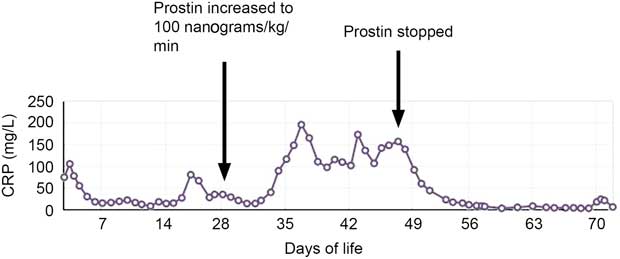
However, owing to clinical deterioration, the infant required mechanical ventilation on day 9. C-reactive protein was 15 mg/L at this time. Antibiotics were restarted and prostaglandin-E2 was increased to 10 ng/kg/minute. Echocardiogram showed a constricting arterial duct; therefore, prostaglandin-E2 was continued at 10 ng/kg/minute. C-reactive protein remained raised between 14 and 27 mg/L. Blood from the infant was re-cultured when C-reactive protein increased to 27 mg/L, and intravenous antibiotics were recommenced. C-reactive protein continued to rise and peaked at 81 mg/L. Blood cultures remained negative. While undergoing a procedure, there was an occlusion in the line infusing prostaglandin-E2 that resulted in an acute drop in saturations. An echocardiogram at this time demonstrated that the arterial duct was closed. As a result, the infusion was increased to 100 ng/kg/minute. Following the increased prostaglandin-E2 dose, the arterial duct reopened and infant’s clinical condition improved. The prostaglandin-E2 was weaned to 50 ng/kg/minute. C-reactive protein continued to rise to 197 mg/L, 2 days after his acute deterioration. All cultures were negative, including urine cultures, blood cultures, endotracheal tube secretions, oral swabs, nasopharyngeal aspirates, eye swabs, umbilical swabs, throat swabs, and ear swabs. The prostaglandin-E2 was weaned gradually to 20 ng/kg/minute on day 34 of life, and C-reactive protein at this time had decreased to 166 mg/L.
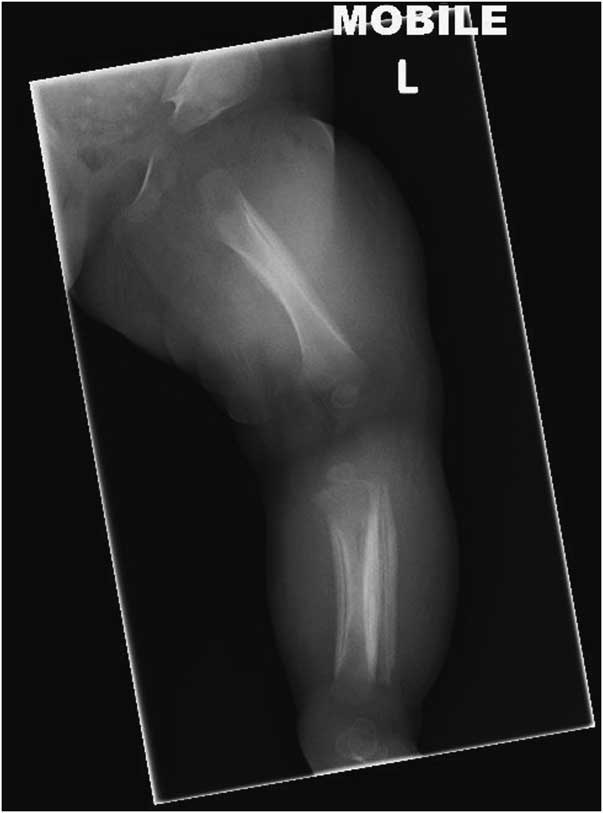
A radiology report commented on osteopenic bone changes and a marked periosteal reaction in the infant’s long bones (Fig 1). The infant continued to have episodes of instability and the prostaglandin-E2 was increased to 100 ng/kg/minute. C-reactive protein remained elevated and intravenous antibiotics continued. Owing to ongoing requirements of high-dose prostaglandin-E2, a decision was made for cardiac catheterisation on day 45 of life. At this time, C-reactive protein was 149 mg/L. The infant had ductal stents placed, and prostaglandin-E2 was stopped following the procedure.
X-ray of child’s leg showing marked periosteal reaction.

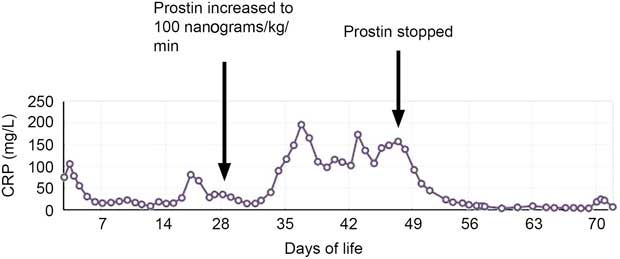
Over the next week, C-reactive protein decreased from 149 to 11 mg/L. Intravenous antibiotics were stopped on day 58 of life, 13 days after stopping prostaglandin-E2. C-reactive protein had normalised to 5 mg/L (Fig 2).
Graph showing serial C-reactive protein measurements over time.
Discussion
In both the cases described above, infants have received both high-dose and prolonged prostaglandin-E2. Prostaglandin-E2 is known to cause ostesoclast stimulation resulting in bone resorption, which is visible on X-rays as periosteal reaction.Reference Boyce, Aufdemorte, Garrett, Yates and Mundy 6 Furthermore, prostaglandin-E2 through its immunomodulator effect appears to mimic the systemic inflammatory response causing side effects such as fever, apnoea, and vasodilation.Reference Tai and Adamson 7 It may also result in raised C-reactive protein through its effect on interleukin-6 synthesis.
In vitro studies in mice have shown that the addition of exogenous prostaglandin-E2 to macrophages induces interleukin-6 protein synthesis. This suggests that prostaglandin-E2 stimulates interleukin-6 production, most likely, at the level of gene expression.Reference Hinson, Williams and Shacter 8 , Reference Inoue 9 In addition, a dose-dependent relationship between prostaglandin-E2 and interleukin-6 has been demonstrated. When fibroblasts were treated with increasing doses of prostaglandin-E2, there was a 12-fold rise in interleukin-6 levels.Reference Inoue 9 Interleukin-6 plays an important role in inducing the production of acute phase proteins, especially C-reactive protein, which is only produced by hepatocytes under transcriptional control by interleukin-6.Reference Schmidt-Arras and Rose-John 10 , Reference Pepys and Hirschfield 11 On the basis of these findings, it is reasonable to hypothesise that exposure to prolonged and high doses of exogenous prostaglandin-E2 can lead to increased production of interleukin-6, which in turn can result in raised C-reactive protein levels.
Infants exposed to high-dose, prolonged courses of prostaglandin-E2 may mimic the clinical picture of sepsis including a raised C-reactive protein. This may result in exposure to repeated and prolonged courses of antibiotics. In addition, the corrective surgery may be delayed further prolonging the treatment with prostaglandin-E2. It is important to recognise the association between prolonged prostaglandin-E2 therapy and raised C-reactive protein to avoid such adverse consequences.
Acknowledgements
None.
Financial Support
This research received no specific grant from any funding agency, commercial, or not-for-profit sectors.
Conflicts of Interest
None.