The fall of Communist rule in Eastern Europe between 1989 and 1991 brought about drastic changes to the thriving lines of communication that had fostered exchanges in higher education and dissemination of cultural practices between Cuba and the territories of the former Soviet Union as well as cities in former East Germany, Poland, former Czechoslovakia, and Bulgaria. For the infrastructure of academic music in Cuba, the 1990s marked a point of retraction or withdrawal from burgeoning relationships with European institutions. After the demolition of the Berlin Wall, the wealth of cultural and musical interactions that characterized musical life on the island since the 1960s simply vanished.
Left behind in the new political and cultural reality of the Old World was support for lavish events that took place in Cuba, such as the Jornadas de Música Contemporánea de La Habana, the Festival de Música Contemporánea de los Países Socialistas, and the Festival Internacional de Música Contemporánea de La Habana. These three events stand out for including the participation of stellar European composers such as Krzysztof Penderecki (b. 1933), Witold Rudzinski (1913–2004), Hans Werner Henze (1926–2012), Giya Kancheli (1935–2019), Siegfried Matthus (b. 1934), Luigi Nono (1924–90), Francesco Galante (b. 1956), Luis de Pablo (b. 1930), Ramón Barce (1928–2008), Xavier Montsalvatge (1912–2002), and Luc Ferrari (1929–2005).
For musicians on the island, the impact of this political shift also meant a decrease in access to prestigious festivals and competitions such as the Warsaw Autumn International Festival of Contemporary Music, which Alex Ross called ‘the Warsaw Pact's answer to Darmstadt and Donaueschingen’;Footnote 1 the Prague Spring International Music Festival; and the International Tchaikovsky Competition. To this impoverishment we must add the cancellation of concert tours, premieres of new works, and fellowships for Cuban performers, musicologists, and composers, who had profited from educational opportunities in European cultural centres, such as Moscow, Kiev, East Berlin, Weimar, Wittenberg, Sofia, Varna, Prague, and Warsaw, the cities favoured, up to the late 1980s and early 1990s, by the now extinct Consejo de Ayuda Mutua Económica (CAME) (Council for Economic Mutual Aid).Footnote 2
Disguised under the name of ‘Período Especial en Tiempos de Paz’ (Special Period in Times of Peace), actually an euphemism for ‘Opción Cero’, the new socio-political conditions had a profound impact on Cuba during the 1990s.Footnote 3 The economic crisis was particularly severe between 1991 and 1993, when the gross domestic product (GDP) contracted between 32 and 36 per cent.Footnote 4 One of the immediate responses to these distressing economic conditions was the massive migration of thousands of Cubans, which stands out as one of the largest exoduses in the country's recent history. The so-called ‘crisis de los balseros’ or ‘ferryboat crisis’, marked the peak of expatriation in the summer of 1994.Footnote 5
As the island's cultural infrastructure for professional development deteriorated, many Cuban intellectuals, artists, and musicians opted for temporary or indefinite relocation in other American or European nations. Among those seeking permanent repatriation in Europe were composers of academic music who, through an array of different circumstances, contributed to configuring a multifaceted soundscape of Cuban music abroad. Age and generational differences were basic factors, given that some emigrated after establishing successful careers at home and abroad, while others left Cuba before they could consolidate a presence in the cultural life of their homeland. Some composers were able to enter into contracts with Cuban or foreign companies and institutions ensuring them work abroad, while others, actually the majority, proceeded independently and had to endure restrictions and resort to a measure of extra-official juggling. In the latter case, they succeeded by applying for fellowships, participating in festivals and competitions, and joining programmes of foreign educational and cultural exchange with European centres and universities.
Inevitably, a majority of young composers who were anchored in cultural practices on the island had to confront the difficult experience of migration. Regarding the relocation of this generational group, we know that, among the 25 composers who were graduated from the Instituto Superior de Artes of Havana (ISA) between 1990 and 1999, only five stayed in Cuba, namely 20 per cent. The remaining 80 per cent relocated in the United States, Mexico, Uruguay, El Salvador, Ecuador, Spain, Italy, Switzerland, The Netherlands, and Denmark.Footnote 6
Within the framework of circumstances described previously, this article explores the different situations generated by the relocation of Cuban composers during the 1990s and the reception of their works in the political and socio-cultural context of Europe toward the end of the twentieth century. Special attention is paid to four composers who relocated in Europe between 1992 and 2002: Leo Brouwer (b. 1939), Eduardo Morales-Caso (b. 1969), Keyla Orozco (b. 1969), and Louis Aguirre (b. 1968). These four composers, who represent two generations, frame a significant transterritorial presence of Cuban music in the cities of Córdoba (Spain), Madrid, Amsterdam, and Aalborg (Denmark), respectively.
Taking a step forward from an understanding of transterritoriality as transit between/among territories, this article builds on notions of ‘de/re-territorialization’ and identity contributed by the Argentine-born anthropologist Néstor García Canclini, the Brazilian geographer Rogério Haesbaert, and Jamaican-born sociologist and cultural theorist Stuart Hall. From this conceptual scaffolding, it is possible to comprehend de/re-territorialization as two processes referable to ‘the loss of the “natural” relation of culture to geographical and social territories and, at the same time, certain relative, partial territorial relocations of new and old symbolic productions’.Footnote 7 In this regard, Haesbaert writes that
Deterritorialization can never be dissociated completely from reterritorialization, and, consequently, can carry both positive and negative implications … at the most general level, deterritorialization means that all processes and all social relations always and simultaneously imply a territorial destruction and reconstruction. Therefore, in order to construct a new territory, it is necessary to vacate the former one, or construct a different one in the same place. For Deleuze and Guattari … the concept of deterritorialization … carries a positive connotation: the opening toward something new, the ‘line of escape’ as point of departure from past territoriality and toward construction of new territory.Footnote 8
From the foregoing, the concept of territory is here understood from a dynamic perspective of motion and action. In Haesbaert's words, the concept should be understood ‘as product … of power relations built in space, considering the dimension of space as constitutive [namely, as essential component rather than optional] and consequently not separable from social relations’.Footnote 9 Accordingly, the concept of power is used here in the concrete sense of ‘political and economic domination, as functional domination, and, at the most symbolic level, as cultural appropriation’.Footnote 10
Consistent with the protagonism of diasporic movements in these reflections, identity is therefore thought ‘not as that which fixes the play of difference in a point of origin and stability, but as that which is constructed in or through différance and is constantly destabilized by what it leaves out’.Footnote 11 In other words, and following Hall,
I use ‘identity’ to refer to the meeting point, the point of suture [articulation], between on the one hand the discourses and practices which attempt to ‘interpellate’, speak to us or hail us into place as the social subjects of particular discourses, and, on the other hand, the processes which produce subjectivities, which construct us as subjects which can be ‘spoken’. Identities are thus points of temporary attachment to the subject positions which discursive practices construct for us.Footnote 12
Leo Brouwer: Córdoba's orchestra
The network of European journeys configured by our four Cuban composers starts with Leo Brouwer (b. 1939), one of the most internationally renowned living composers not only in his native island but also throughout Latin America.Footnote 13 A representative figure of the classical guitar worldwide, a beacon of the musical vanguard in Latin America, and an accomplished orchestral conductor, Brouwer settled in the Spanish city of Córdoba between 1992 and 2001, contracted to found and conduct the Orquesta de Córdoba. His arrival in the Autonomous Community of Andalusia owed much to an ambitious cultural movement that, since the mid-1980s, promoted the creation of symphonic orchestras in Spain.
In Andalusia, one of Spain's most populated regions, the enterprising symphonic map includes four orchestras: the Orquesta Ciudad de Granada, founded in 1990; the Real Orquesta Sinfónica de Sevilla, established in 1991; the Orquesta Sinfónica de Málaga, also from 1991; and the Orquesta de Córdoba, created in 1992. The symphonic splurging in the Community dates from the early 1990s, when ‘the Junta [governing board] of Andalusia confronted the need to … endow its territory with instruments capable of maintaining a steady schedule of symphonic concerts’.Footnote 14
From the early years of Spanish democracy until about January 2019, the Left has stood as the dominant political force in Andalusia, becoming a centre of socialist and communist ideologies on Spain's political map. By the same token, the municipality of Córdoba, capital of the homonymous Andalusian province, has been, since 1979, an important axis for Left-wing politics in this southern region of Spain. For almost four decades, Córdoba was governed by the Spanish Communist Party (Partido Comunista Español), the Left-United (Izquierda Unida), and the Partido Socialista Obrero Español (Spanish Socialist Worker's Party). Given this history, the arrival of Leo Brouwer in Córdoba was neither surprising nor merely coincidental. Add to this, on the one hand, the intense activity centred on the guitar that characterizes the city, as the site of the prestigious Festival de la Guitarra de Córdoba held since 1981, and, on the other hand, the irrefutable reputation of the Cuban master as ‘one of the most valuable exportable assets of Revolutionary Cuba’.Footnote 15
Theoretically, Brouwer was sharing the music directorship of Córdoba's orchestra with the directorship of the Orquesta Sinfónica Nacional de Cuba (1981–2003). This allowed him to spend six months in Córdoba and six months in Havana, thereby satisfying official requirements. In addition, after his arrival in Spain, he was followed by a number of Cuban musicians who were members of Havana's symphony orchestra, thus becoming a dynamic force in the circulation of musicians across the Atlantic.Footnote 16
From the foregoing, two aspects of this situation should be emphasized. On the one hand, we must mention the integration of approximately ten Cuban musicians to Córdoba's orchestra, among them the members of the Cuarteto de Cuerdas de La Habana, a noted chamber music group, and the Bulgarian violinist Elena Ivanova Anguelova, who had settled in Havana for a decade and was a prominent member of the Cuban orchestra. On the other hand, we should note the number of Cuban soloists (living on the island or elsewhere) who were invited by Leo Brouwer to participate in concerts of Córdoba's symphony orchestra, among them the pianists Jorge Luis Prats, Pura Ortiz, and Leonel Morales; the guitarists Joaquín Clerch, Manuel Barrueco, and Rosa Matos; the singer Omara Portuondo; and, as guest conductors, Elena Herrera and Irina Trujillo.
Brouwer's activity as music director of the Orquesta de Córdoba can claim a total of nearly 400 concerts. In addition to regular subscription concerts, the 400 events included special performances and educational outreach in churches and neighbourhoods; participation in opera seasons, choral concerts, and the notorious Festival de Guitarra de Córdoba; and tours of Andalusian cities and other regions of Spain, as well as Athens, Marseille, and Porto.
In the concerts Brouwer conducted, he included a considerable number of works by composers from the Americas, such as Charles Ives, Aaron Copland, Leonard Bernstein, George Gershwin, Heitor Villa-Lobos, Silvestre Revueltas, Egberto Gismonti, Arturo Márquez, Alberto Ginastera, Ástor Piazzolla, and John Williams. Not only did Brouwer's programming do much to disseminate knowledge of Latin American composers, but also this rapprochement to the Americas stands as a remarkable exception by comparison to the norms of programming followed throughout Spain by other orchestras up to the present.
Needless to say, the Cuban symphonic repertoire took centre stage in Brouwer's programming practices. As an example, he exhumed La rebambaramba (1928) by Amadeo Roldán (1900–39), an iconic work in Cuba's musical history that was seldom heard in Havana itself during the last four decades. Other Cuban composers conducted by Brouwer with the Orquesta de Córdoba include Ernesto Lecuona (1895–1963), Gonzalo Roig (1890–1970), Jorge López Marín (b. 1949), and Harold Gramatges (1918–2008). Not surprisingly, Brouwer regularly conducted performances of his own works. These included significant compositions from his catalogue (La tradición se rompe… pero cuesta trabajo, 1969, for symphonic orchestra; Canción de gesta, 1978, for winds, harp, piano, and percussion; and Concierto elegíaco, No. 3, 1986, for guitar and orchestra), and also world premieres of such works as his Triple concierto (1995) for violin, violoncello, piano, and orchestra, and Lamento por Rafael Orozco (1996) for clarinet and string orchestra.
Most importantly, the model of artistic direction re-territorialized by Leo Brouwer when he established the Orquesta de Córdoba fostered the philosophy of bringing the cultural institution to the people. His unprejudiced view of symphonic music, clearly manifested during the previous years as head of the Orquesta Sinfónica de Cuba, was transferred to Spain by a constant flux between the semantic fields of academic and popular music. This is why such representative figures of flamenco dance and music as Carmen Linares, Lole Montoya, and Vicente Amigo became a habitual presence in Brouwer's concerts. Along the same lines, one of the distinctive features of his leadership was the promotion of concerts in open public spaces whose outreach went far beyond the limited capacity of traditional symphonic halls. As examples, we can cite the concerts that took place at the Palacio Municipal de Deportes ‘Vista Alegre’ on 6 June 1997, with an audience of 4,000, as well as performances at the Plaza de la Juventud, on 4 May 2001, which attracted 2,000, and at the Plaza de la Corredera, on 14 July 2001, also with an audience of 2,000.
Perhaps the Concierto flamenco para un marinero en tierra (1992), an homage to the Spanish poet Rafael Alberti for solo guitar and orchestra, captures most persuasively the spirit of Brouwer's activities in the Andalusian capital. Orchestrated by Brouwer and composed by the Flamenco guitarist and composer Vicente Amigo, this work is characterized by an attractive amalgam of references to both Flamenco music and Havana's rumba. Its impetuous and descriptive character summons narrative codes redolent of Brouwer's music for films. Hand-clapping, the strumming of modal patterns on the guitar, cante flamenco, Cuban tumbadoras (congas), and Alberti's poetry converge to shape a work that evokes fragments from the Gaditan poet's life, who was a member of the Spanish Communist Party. It is interesting to note that Concierto flamenco para un marinero en tierra is the most frequently played work by the Orquesta de Córdoba, with twenty performances up to 2019 and its recording in 1997 by the Sony Music label.Footnote 17 Moreover, the world premiere of the work took place on 1 July 1992, at the Gran Teatro de Córdoba, with guitarist and composer Vicente Amigo as soloist and the Orquesta Sinfónica de Cuba under the baton of Leo Brouwer.
The warm reception from the people of Córdoba propitiated a far-reaching professional experience for the Cuban composer. His success in the Andalusian capital resulted in eight CDs recorded by the Orquesta de Córdoba under his leadership,Footnote 18 and also by a number of prestigious distinctions. He received the ‘Fiambrera de Plata’ from the Ateneo of Córdoba in 1997; the ‘Premio Manuel de Falla’, bestowed upon Brouwer by the governing Junta of Andalusia in 1999; a nomination for ‘Mejor Artista Clásico’ (Best Classical Artist), one of the categories of music prizes from the Sociedad General de Autores y Editores de España (SGAE) in 1999; and, in 2001, Brouwer was declared ‘Adoptive Son’ of the city of Córdoba, and, by extension, of Andalusia.
Eduardo Morales-Caso: The Hispanic legacy
By contrast, the experience of young composers who emigrated to Europe in the late 1990s stood in diametrical opposition to Brouwer's tenure in Spanish Córdoba.Footnote 19 For the most part, their careers unfolded within subaltern spaces in the communities where they settled. They had to confront diverse reactions to alterity, namely situations of ‘cultural difference’, or, in Homi Bhabha's words, ‘a split between the traditional culturalist demand for a model, a tradition, a community, a stable system of reference, and the necessary negation of the certitude in the articulation of new cultural demands, meanings, strategies in the political present, as a practice of domination, or resistance’.Footnote 20
In tracing these composers’ journeys, we cannot overlook the strategic ambiguities imposed by circumstances in their new intercultural contexts, which confronted them with a tense dynamic of functional and critical interculturality. That is to say, they found themselves inserted between a search to promote dialogue without dwelling on the causes for cultural asymmetry, and a search to suppress the causes of such asymmetry.
The poetics of the Cuban composer Eduardo Morales-Caso (b. 1969), whose extensive and successful output centres mainly on the classical guitar's creative domain, stands out in the midst of this complex multicultural cauldron. A pupil of the distinguished Cuban composer Carlos Fariñas (1934–2002), Morales-Caso arrived in Spain with a fellowship to study at the Real Conservatorio Superior de Música de Madrid. Particularly noteworthy was his swift appropriation of the social, cultural, and professional environment. For instance, he immediately adopted Spanish citizenship – his mother's nationality – and obtained it the year of his arrival. For familial or other reasons, the works of Morales-Caso display a strong affinity with the new cultural milieu. Evidence of an identification with his mother's homeland surfaces in a number of titles, dedications, and themes of many compositions, while others are anchored in different cultural referents. Beyond territorial identity and a complex ‘teleology of origin/return’,Footnote 21 Spain has provided Morales-Caso with a space for encounters, inspiration, and invaluable growth.
The omnipresence of this composer in the contemporary musical life of Spain is a measure of his success: in addition to frequent premieres, his works are performed at concerts, festivals, and competitions, as well as recorded on CD. In this regard, among the twenty-five recordings that include compositions by Morales-Caso, six are dedicated solely to his works and produced, in their majority, by Spanish labels.Footnote 22
The musical language of Morales-Caso can be defined by an emphasis on sensitivity, intimacy, and strongly poetic postmodern undertones. There are glimpses of stylistic intersections between the timbral and harmonic colour of French Impressionists and the discourse of tonal expansion by Scriabin, Prokofiev, or Shostakovich. Interestingly, Morales-Caso avoids using the typically Caribbean syncopated patterns as a crutch to express his cultural and ‘historical continuity’. Instead, his compositional poetics are anchored in a solid narrative, structured on neoclassical formal conceptions channelling the prominent role that literature, romantic symbolism, and visual arts play in his sonic language.
More than twenty of his works feature the guitar, a paradigmatic trope in the organology of Spain as well as Latin America, which is used as a solo instrument, as soloist with orchestra, or as accompaniment. The composer's tendency to resort to traditional and renewed musical resources, such as the Phrygian mode, the Andalusian cadence, strumming of flamenco lineage, and, for instance, the configuration of sonic images that summon Renaissance styles, are among the features that define his de/re-territorialization in Madrid's musical and cultural environment. In this regard, we can mention such titles as El jardín de Lindaraja (1999), a fantasy for solo guitar inspired by the Alhambra's mystique; O pássaro triste do mar (2003), a piece for solo guitar dedicated to Galicia; Homenajes (2004), a song-cycle for mezzo-soprano and guitar that pays tribute to three Spanish composers (I. ‘Homenaje a Joaquín Rodrigo’; II. ‘Homenaje a Frederic Mompou’; and III. ‘Homenaje a Manuel de Falla’); La fragua de Vulcano (2008), a fantasy for solo guitar based on the homonymous painting (Apollo in the Forge of Vulcan) by Diego Velázquez; Volavérunt (2009), an homage to Francisco de Goya for violin and guitar; Concierto de La Herradura (2012) for guitar and orchestra, dedicated to the homonymous Andalusian town – now the site of the International Guitar Competition and former summer residence of Andrés Segovia, in whose memory Morales-Caso composed the concerto; and Cantares del güelu (2014), a cycle of three songs for mezzo-soprano and guitar inspired by the Asturian culture of the composer's maternal grandfather.
The wealth of features intersecting in La fragua de Vulcano, one of Morales-Caso's most successful works for guitar, merits further examination.Footnote 23 The piece is representative of the composer's guitaristic discourse, and weaves a dense sonic narrative redolent of imagery and suggestive symbolism. In his syntax, the contrast between evocatively lyrical and strongly rhythmic motifs sets in motion a narrative discourse of quasi-programmatic character. Consistent with its theme, the work's generative motifs can be identified with the respective symbolic realms of the protagonists in the scene recreated by the Sevillian painter, namely Vulcan and Apollo. The first of these generative motifs characterizes Vulcan with an incisive rhythmic figure and the use of the Spanish guitar's idiomatic strumming; the second, which alludes to Apollo, evokes the god with a lyrical and expressive melodic motif that resorts to the Phrygian mode's harmonic colour.
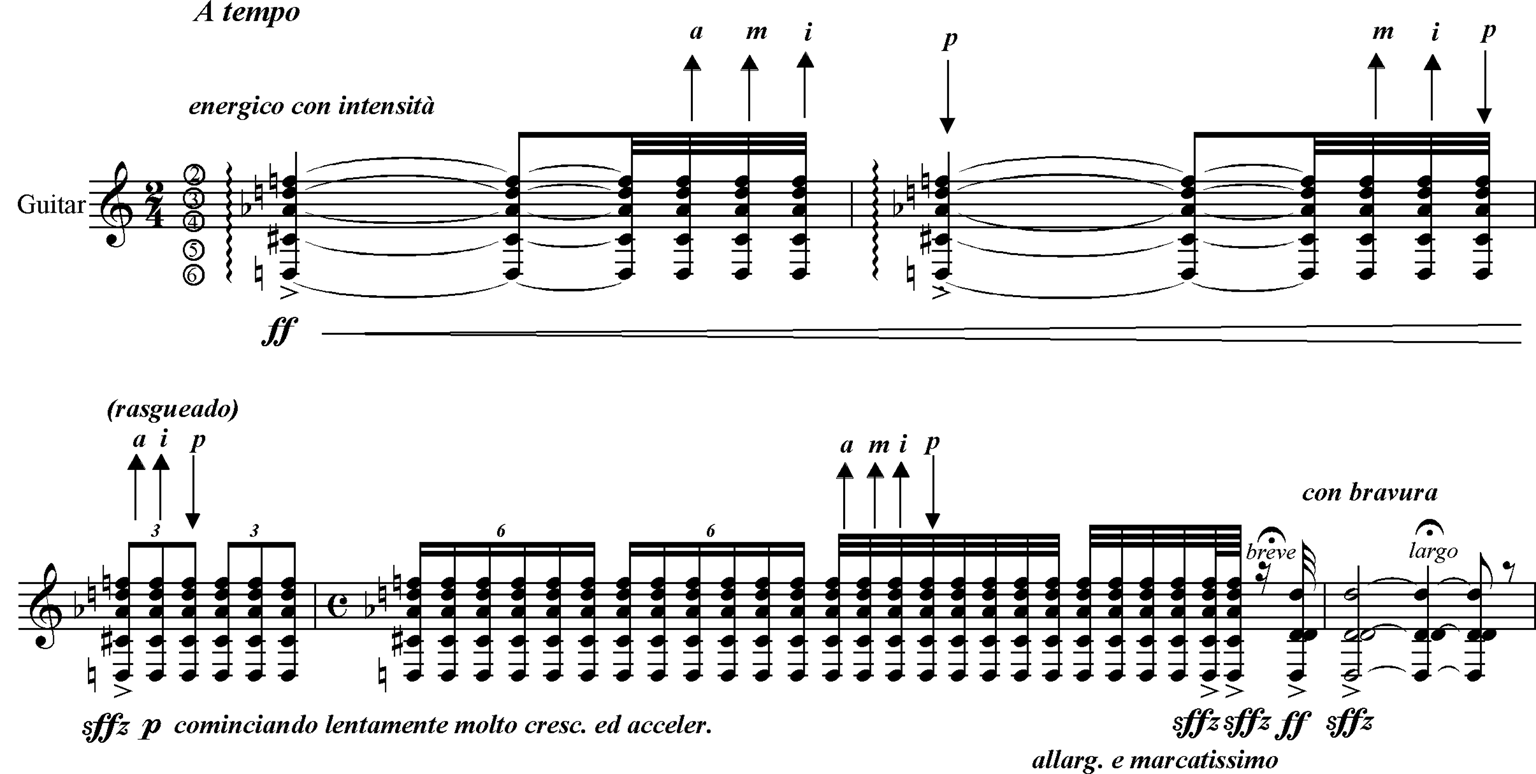
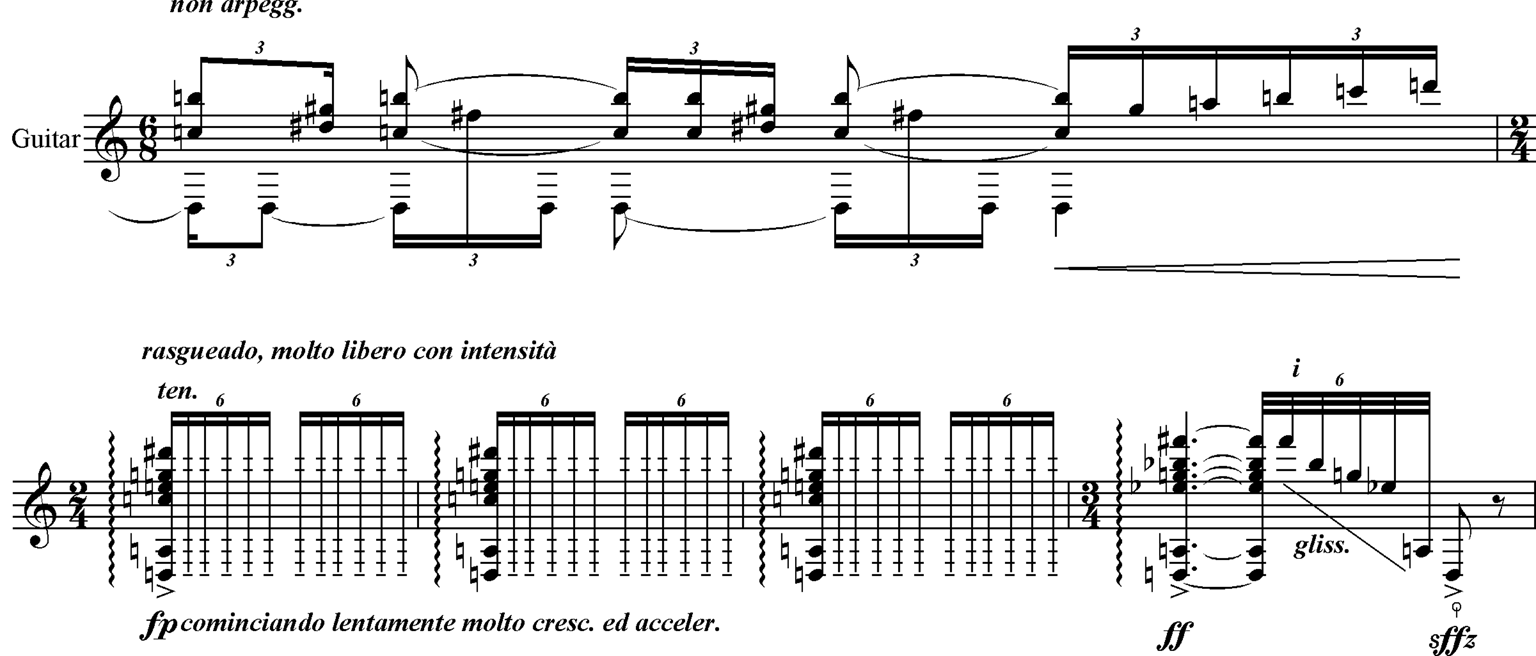
Specifically, one of the resources that best connects this work with the semantic field of Spanish musical culture is the characteristic use of guitar strumming, which the composer summons in a revealing manner at points of maximum tension. However, it is precisely the way the composer treats this persistent topic of Spanish music that allows him to open boundaries towards a far more pluralist and renewed conception of ‘Spanishness’ in music. Examples 1 and 2, for instance, illustrate how the composer expands the boundaries of traditional strumming by resorting to irregular rhythmic figures in semiquaver and demisemiquaver notes subjected to progressive agogic accents that shape an expressive prosody, cominciando lentamente molto cresc. ed accelerando, with markings such as energico con intensità, con bravura, and allarg. e marcatissimo. To this control of expressive directionality in the strumming, the composer adds registral expansion of chords spanning over three octaves at the expressive climax (from d to F♯4), interspersing accents and sforzandi to weave a denser and intensely dramatic texture.
La fragua de Vulcano (2008), E. Morales-Caso, bb. 36–9. Periferia Sheet Music, Barcelona, 2009, 6–7.

La fragua de Vulcano (2008), E. Morales-Caso, bb. 136–40. Periferia Sheet Music, Barcelona, 2009, 11–12.

Beyond the complexities involved in the experience of re-territorialization under any circumstance, namely ‘a shared, ongoing history of displacement, suffering, adaptation, or resistance’,Footnote 24 the connection between the work of Morales-Caso and the semantic field of Spanish music is particularly significant. Confidently, it is possible to construe that, more than any forced negotiation of identity with the new cultural environment, his was a voluntary process, even an intentional and desired assimilation and identification with Spanish culture. The Hispanic tradition that was already present in his Cuban works was reinforced by his life experience in Spain and his interaction with Spanish creators, such as his teacher Antón García Abril.Footnote 25
Keyla Orozco: Irony and intercultural dialogue
From a different perspective, the European journey of Keyla Orozco (b. 1969) is noteworthy for her commitment to self-improvement and conscious efforts to assimilate to the Dutch capital's socio-cultural environment.Footnote 26 The cultural distance between Amsterdam and Havana, however, must have contributed to honing the depth of her subaltern experience, to the extent that, after seventeen years in The Netherlands, Orozco decided to relocate in cosmopolitan New York.
She emigrated to The Netherlands in 1996, with a fellowship to study at the Royal Conservatory in The Hague with Dutch composer Teo Loevendie. On the island, Keyla Orozco, daughter of Danilo Orozco, one of Cuba's most influential musicologists,Footnote 27 had studied composition with Harold Gramatges and the exposure to the Dutch approach changed her creative vision for the future. Unlike the limitations imposed on students at Havana's Instituto Superior de Arte (ISA) to one annual premiere within the context of the Festival de Música Contemporánea de La Habana, the Royal Conservatory in The Hague offered her an exceptional experience in that almost all the works by composition students were performed in a two-week festival of contemporary music devoted to this purpose. In The Netherlands, explains Orozco, ‘I realized how much you learn when you can listen to your compositions. That is not in the books. I learned more in one year at the Dutch conservatory than in my five years of study at ISA.’ (‘Me di cuenta de lo que aprendes escuchando tus obras. Eso no está en los libros. Nunca en mis cinco años en el ISA había aprendido tanto como aprendí allí en un año’.)Footnote 28
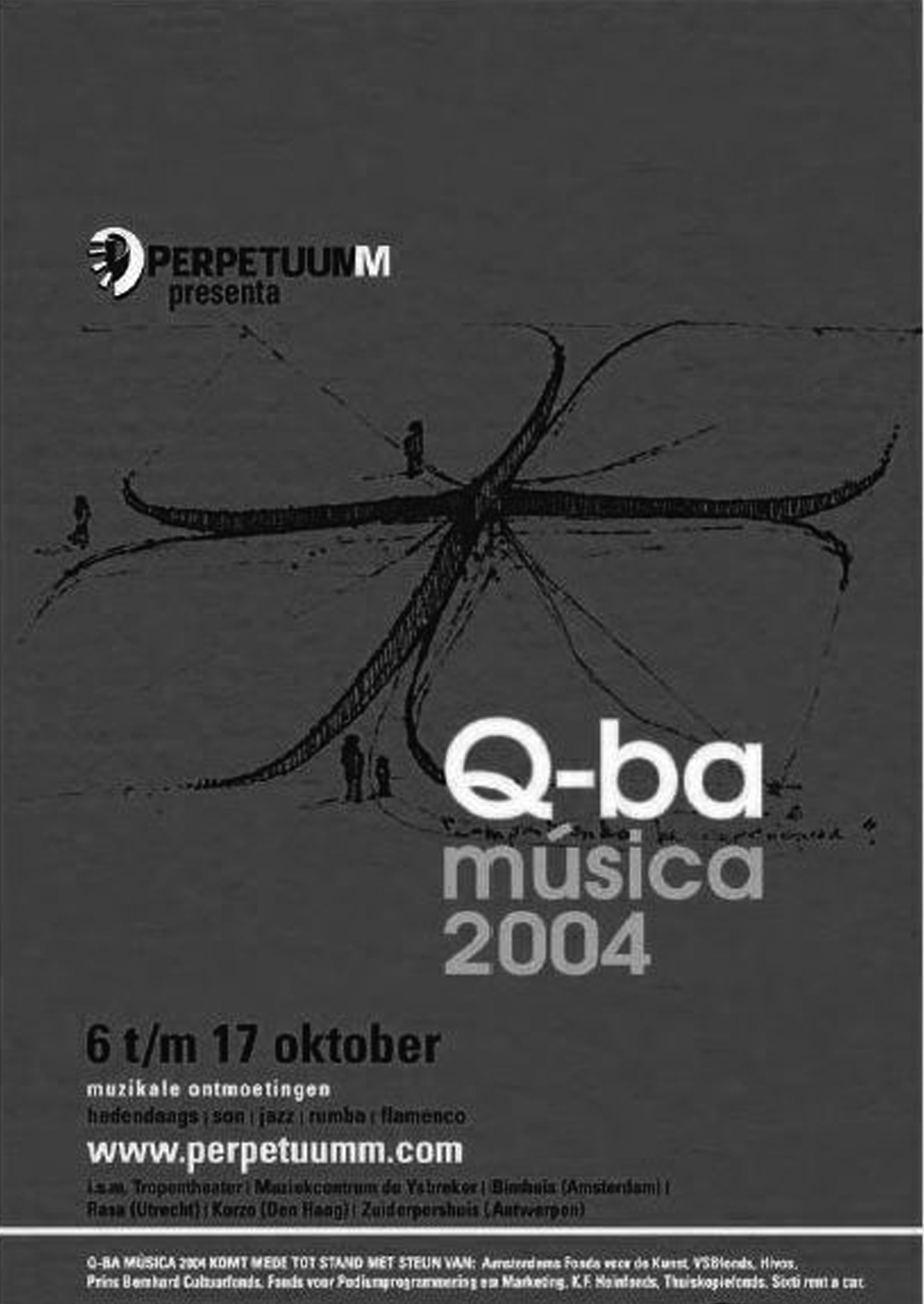
To the foregoing, we must add Orozco's agency in promoting cultural initiatives that enabled her to bring Cuban researchers and musicians of different generations to The Netherlands, including some of her former fellow students at ISA. Noteworthy in this regard is the creation of ‘Stichting PerpetuumM’, a multicultural project founded and co-directed by Orozco (in 2004 and 2008) and the Dutch Hispanist Ernestina van de Noort, presently the Foundation's director. It was within this context that Orozco developed substantive initiatives, such as the Festival Q-ba Música (2004) (Figure 1), for the purpose of promoting Latin American arts and culture in The Netherlands.
Poster for the Festival Q-ba Música (2004), Amsterdam, The Hague, Utrecht, and Antwerp.

Orozco's music summons an interplay of distant and diverse references to build intercultural dialogues among such iconic signifiers as the traditional Cuban son, the Venezuelan joropo llanero, Argentinian tango, the jazzy sound of US big band, and metal idiophones from an Indonesian gamelan. Her postmodern appropriation of disparate resources moves comfortably between the semantic fields of academic and urban popular music, as well as between tradition and modernity, past and present. However, the dynamics of negotiations and appropriations she sets in motion do not destabilize a discourse firmly anchored in the ‘point of origin and stability’ provided by the musical traditions of her native country.
In her readings of the transcultural space that defines Orozco's compositional poetics, irony is inscribed as a strategic and catalytic tool. Irony surfaces not only in timbral surprises, the subversion of discursive predictability, and pervasive intertextuality and hybridization, but also in an array of intentionally ludic and light-hearted gestures. Evidence of humour, for instance, abounds in her titles: Tres piezas en forma de… (I. ‘Tocata caprichosa’, II. ‘Vals diabólico’, and III. ‘Marcha del musibarista’) (1990), for violin and piano; De chismes y confidencias (1991), danzón for piano; Won't Blue (1997), for piano; Tres pregones alamarenses (2003), for some instruments of an Indonesian gamelan (two extended saron, bonang barung, gender panerus, gender barung, kempul, and gong (B♭, D♭)), violin, bass clarinet, and alto voice; Maní sinfónico (2003), for orchestra; Met de schoenen (With the Shoes) (2008), for tap dancer and big band; Habanera en pajarillo voor de gestolen fiets (Habanera and Little Bird for the Stolen Bicycle) (2010), for orchestra; and Piezas de bolsillo (I. ‘Cha-cha-plus’, II. ‘Merengada de frutas’, III. ‘Canción de cuna’, and IV. ‘Seis por izquierdo’) (2011), for viola and piano. In the words of the composer:
I am of the opinion that we, the artists, are here to satirize what is happening and what is not happening. Moreover, just by being Cuban, a derisively jocular people by nature, I really can't help it … Often, these ironies are not related to specific extra-musical issues, but are simply musical ironies, jokes I enjoy … When I am creating a work, I can stumble upon something that doesn't work, or that supposedly shouldn't work … This irreverence is spontaneous. Perhaps I inherited this attitude from my father, that is, something he called ‘de-sacralization’. I dismantle/de-sacralize everything. I don't want my works to sound too earnest.
(Soy del pensamiento de que los artistas estamos para burlarnos de todo lo que pasa y lo que no pasa. Y encima, siendo cubanos, que de naturaleza tenemos eso, no lo puedo evitar. … Muchas veces estas ironías no están relacionadas con asuntos extramusicales específicos, simplemente son ironías musicales, chistes musicales que me gustan. … En el momento de crear una obra me suele pasar que quiero hacer algo que no va, o que se supone que no va. … Es algo que me sale espontáneamente. Y creo que heredé eso de mi padre, eso que él llama “desacralización”. Yo desacralizo todo. Me gusta que mis obras no me suenen demasiado serias.)Footnote 29
One of the works that can illustrate this stance is, for instance, Flutemos/Flauteamus (2001), for orchestra of flutes.Footnote 30 The title's equivocal subtext suggests ‘a joke, an ironic play on words combining my music editor's name [Donemus] with that of the most important organization for contemporary music in The Netherlands [Gaudeamus]’ (‘un chiste, un juego de palabras que combina el nombre de mi editor [Donemus] y el de la organización de música contemporánea más importante de Holanda [Gaudeamus]’).Footnote 31 The work was created for a concert centred on the premise of basing a musical composition on a specific painting by a plastic artist. Subverting the concert's theme itself, Orozco changed the premise's perspective and produced an homage to the iconic Cuban flute in the danzón.
One of Flutemos/Flauteamus's salient features is the composer's ability to cross functional and stylistic boundaries between the semantic fields of academic and urban popular music from a risky compositional perspective. In this instance, allusions to the flauta danzonera are hybridized by a more aggressive discourse that exploits textural and timbral effect. Other sound sources converging on the central section of the work (IV) include a chorus, hand-clapping, finger-snapping, and foot-tapping, all means Orozco summons to exorcise the sensual and performatic character of Cuban dancing. This she does by playfully invoking an intertextual dialogue, subversively courting with onomatopoetic sounds and rhythmic patterns characteristic of the cha-cha-chá (‘cha – cha – cha-chá ¡Un! ¡Dos!’).
The parodic humour captured in this central section stems mostly from a carefully crafted and complex web of articulations built from actual and implicit accents in the rhythmic praxis of the cha-cha-chá. The introductory line to this central section, played on the contrabass flute, shows this interplay of articulations (Example 3). The segmented rhythmic design and disposition of accents summons simultaneously the typical tumbao or melodic-rhythmic pattern of the Cuban son, and, with touches of irony and some degree of abstraction, some distinctively performative features of the cha-cha-chá, namely, the rhythmic marching on tumbadoras with its characteristic strokes (open/abiertos, cupped/tapados, with palm/de palmas, and fingertips).
Flutemos/Flauteamus (2001), K. Orozco, Part IV, bb. 1–8. Donemus, Amsterdam, 2008, 8.

Louis Aguirre: Hyper Afro-Cubanism
The last composer to be discussed, Louis Aguirre (b. 1968), emigrated to Europe in 2002.Footnote 32 However, his interactions and negotiations with the European socio-cultural milieu date back to the late 1990s, specifically to the première of Ebbó, his opera-oratorio, first performed at the Brotfabrik Theater in Bonn in 1999.Footnote 33 After studying in Cuba with Harold Gramatges and Roberto Valera, Aguirre's European journey started in Amsterdam, with a two-year period of study at the Conservatorium van Amsterdam, followed by the Royal Academy of Music in Aarhus, Denmark, where he graduated with a Master's degree in composition. These years of training were a preface to a period of prolific creative activity in the Danish city of Aalborg.
The reception of Aguirre's works in Danish and other European music circles has been significant, although his condition as a foreign-born resident has not always worked in his favour. As he states, as a foreigner he could not find a position in a conservatory, although his work is internationally recognized. This is also connected to aesthetical differences with the prevailing ‘new simplicity’ in the north European countries, which contrasts with the excessive difficulty and ‘brutality’ of his own work. Only few interpreters dare to play his music.Footnote 34
If there were difficulties he overcame them, given that he was an active participant in some of the most prestigious festivals, such as the Internationale Ferienkurse für Neue Musik, Darmstadt, 2010; Nordic Music Days, Helsinki, 2013; and Wien Modern/Vienna's Festival for Contemporary Music, 2018. He also was awarded the ‘Three Years Grant’ (2015) from the Danish Arts Foundation, thereby becoming the first foreign composer to receive this honour.
Aguirre's music is defined by its ritual character and by the thunderous and frenetic sonorities that summon its magico-religious Afro-Cuban lineage. This is due in great measure to the fact that Aguirre, between 1999 and 2000, became a consecrated Palero (practitioner of the Regla de Palo Monte) and also a consecrated Santero (practitioner of Santería or Regla de Ocha/Ifá), two religious systems based on African practices known as Kongo and Yoruba, respectively. Religion is undoubtedly one of the guiding forces driving the creativity of Louis Aguirre in his re-territorialized setting.
Circumventing more external means of musical representation, Aguirre's hyper Afro-Cuban aesthetic probes the visceral inner worlds of Black expression. Anchored in the experience of Santería's and Palo Monte's ritual practices, his music is quite distant from the more or less epidermic and/or romantic approach to Afro-Cubanism that has characterized the creative output of many of his compatriots.Footnote 35 More heterogeneous and intemperate, his aesthetic breaks boundaries and opens up spaces for an expanded range of strategies and a wider canvas of creative possibilities. In close complicity with his performers, who are always established virtuosos able to master a multitude of skills, Aguirre's music is defined by the shaping of micro-sensorial sonic gestures. Converging in these gestures are complex counterpoints, intricate rhythmic designs, saturated microtonal sonorities, and wide spectrums of pitch and noise displayed over an array of physical gestures carrying a wealth of densely woven meaning. In other words, Aguirre appropriates any resource within his reach to make manifest the most secret and blaring effects surrounding the elusive and quasi-psychedelic inner experience of ancestral Afro-Cuban rituals.
The prominence of Afro-Cuban religion as a theme to which Aguirre has dedicated an unusual number of works is evident from a cursory look at his extensive catalogue. Only those composed after he emigrated to Europe include Eshu-Elegguá (2003), for amplified harpsichord; Añá, liturgia de la transmutación (transmutation liturgy) (2005), concerto for percussion and ensemble; Bembé (2008), sextet for percussion; Yemayá (2008), for accordion; Orula, liturgia de la adivinación (divination liturgy) (2011), for amplified flute and three percussionists; Nsambia Mpungun (2012), for amplified viola; Toque a Aggayú, Ikolé y Shangó (2013), for amplified chamber ensemble; Oru de Igbodú III (2016 / rev. 2018), for quartet of saxophones; and Toque a Oggún (2018), for flute, piccolo, alto saxophone, bass clarinet, percussion, and piano.
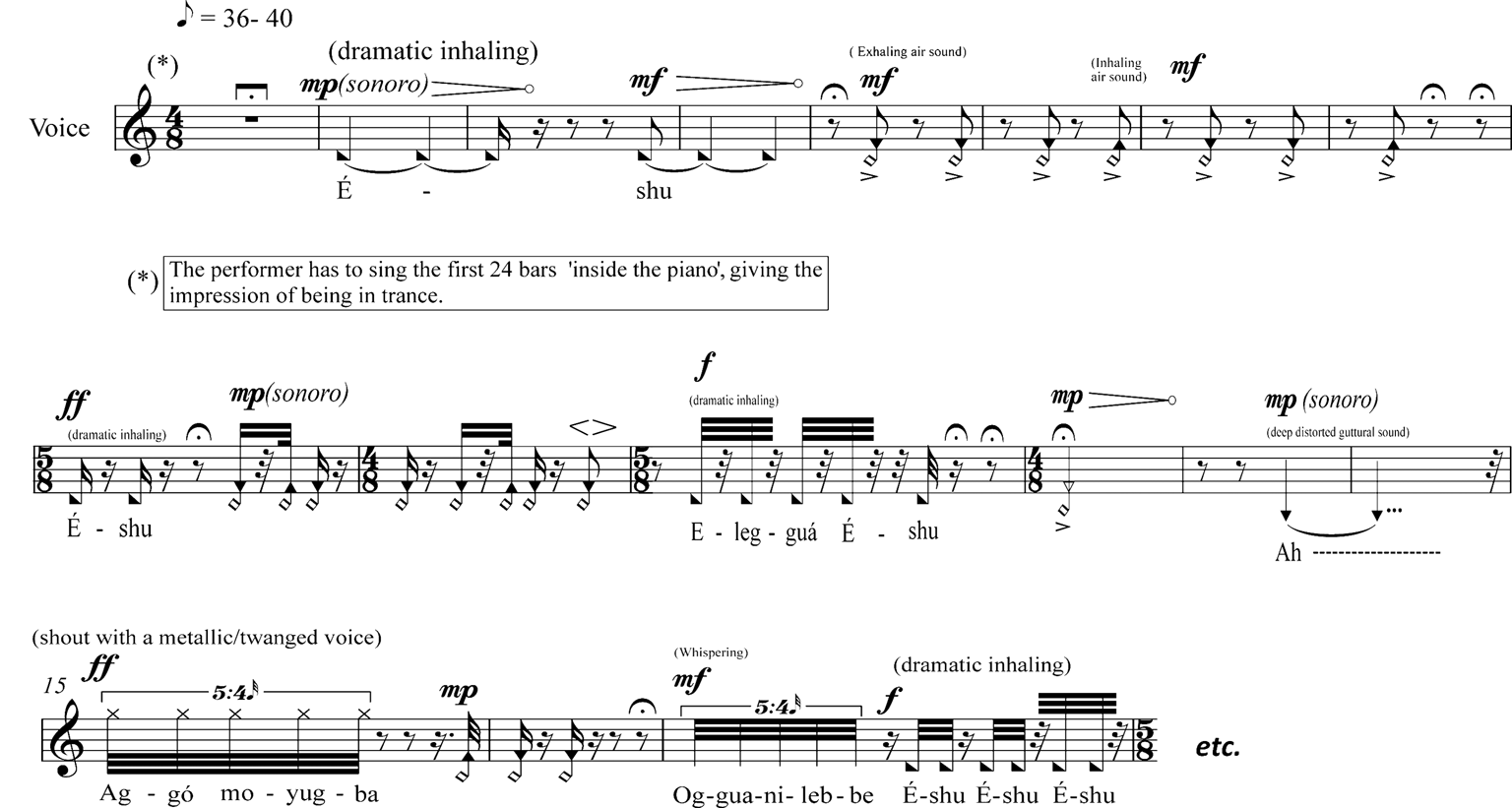
Ogguanilebbe, liturgy of the divine word (liturgia de la palabra divina) (2004), for soprano solo, bass clarinet, double bass, and piano, is, undoubtedly, one of the most representative works of Aguirre's hyper Afro-Cubanist aesthetic from his early years in Europe.Footnote 36 This composition, based on ancient Yoruba prayers, invokes Éshu Elegguá, one of the major orichas (spirit-gods). One of the most significant features of the work is the treatment of the solo voice, which can reach levels of fierce distortion. For the vocal plot of the piece, the composer relies on an array of resources, such as inhaling and exhaling, guttural and distorted sounds, susurrando or whispering, and screamed or spoken words in extreme registers of the voice, in addition to making dramatic use of multiphonics (Example 4). At the climactic point, the irregular and microtonal oscillations of the carnatic ‘shake’ are summoned to trans-substantiate the power of psychic energy driving invocation, trance, and possession in Afro-Cuban rituals. It is also clear that Aguirre's broad canvas of sound resources, which in his case stems from the cosmovision of Afro-Caribbean religions, links him to the aesthetic tenets of Helmut Lachenmann's ‘musique concrète instrumentale’.
Ogguanilebbe (2004), L. Aguirre, vocal line, bb. 1–17. Igbodú, 2005, 1–4.

With only three instruments, in addition to the voice, this work displays considerable creativity in its textural choices and timbral saturation. From its dense texture, rich in detail, a strident sonority impacts the listener at visceral levels. Conceptualized by the composer as a ‘monodrama of a santera in trance’, Ogguanilebbe can also be linked to the poetics of distortion and altered states of consciousness that characterize the work of composers identified with the aesthetics of sound saturation, such as Fausto Romitelli, Raphael Cendo, and Franck Bedrossian. However, unlike these European contemporaries, whose sonic imaginary stems from hallucinogens or incursions into the worlds of rock and punk, the transterritorial music of Aguirre remains submerged in the depths of the magical and sensorial realm of Afro-Cuban ritual.
Conclusions
Among the different situations catalyzed by the relocation and reception of Cuban composers in Europe during the 1990s, two aspects stand out as significant: on the one hand, generational differences; and, on the other hand, the dynamics of socio-political and cultural power to which each of these composers were exposed in the contexts of reception. How each of them reached Europe also remains significant. In the case of Brouwer, he left Cuba with a substantial contract to work for almost a decade, with the support of a Leftist government that was both pro-Cuban and in favour of promoting culture; in the instance of Morales-Caso, he operated under official protection, given that he established his Spanish citizenship almost immediately and therefore could take advantage of opportunities granted exclusively to Spaniards; and, in the cases of Orozco and Aguirre, they left Cuba as Latin American students who were to become foreign composers in their new settings.
These situations differ. If Brouwer operated within a space of relative power and control, given the recognition that preceded him, the others had to adapt to dynamics of appropriation and negotiation imposed by subaltern spaces. Whether adopting an uncontested identification with the new cultural milieu, or by resorting to strategies (irony) or identity (Afro-Cuban religions), their de/re-territorialized journeys constitute valuable experiences of reconstruction in new aesthetic and creative territories. In other words, they developed trajectories that, in retrospect, have contributed novel creative turns to the sonic map of Cuba itself and, by extension, Latin America, from their European experience at the turn of the twentieth century.