Gastrointestinal morbidity in neonates and infants after cardiac surgery is common and can have devastating consequences.Reference McElhinney, Hedrick and Bush 1 – Reference Ostlie, Spilde and Peter 3 The reported incidence of necrotising enterocolitis is between 3.3 and 13% in neonates with cardiac diseases. Feeding intolerance is also common, particularly in children with single ventricle physiology.Reference Weiss, Gossett, Kaushal, Wang, Backer and Wald 2 Although the pathophysiology of necrotising enterocolitis remains unclear, evidence suggests that, in the cardiac population, intestinal ischaemia plays a critical role.Reference Carlo, Kimball, Michelfelder and Border 4 Compromised perfusion can also, conceivably, be linked with poor gut motility and feeding intolerance.Reference McClave and Chang 5 Reduced mesenteric flow and tissue hypoxia may occur before, during, and after surgery for congenital heart defects.Reference Harrison, Davis and Reid 6 – Reference Luce, Schwartz and Beauseau 8 Intra-operative factors such as cardiopulmonary bypass and hypothermia and post-operative low cardiac output and imbalances between systemic and pulmonary circulations can compromise gut perfusion and predispose the patient to intestinal mucosal injury.Reference Hebra, Brown and Hirschl 9 , Reference Booker, Romer and Franks 10
Near-infrared spectroscopy provides a non-invasive, real-time, and sensitive estimation of regional venous oxygen saturation, and can potentially detect early changes in organ perfusion.Reference McQuillen, Nishimoto and Bottrell 11 – Reference Ortmann, Fontenot, Seib, Eble, Brown and Bhutta 16 The use of near-infrared spectroscopy to estimate mesenteric venous oxygen has been shown to correlate with markers of intestinal perfusion – that is, gastric tonometry – in infants after surgery for CHD.Reference Kaufman, Almodovar, Zuk and Friesen 17 Cerebral and renal venous oxygen saturations as measured by near-infrared spectroscopy following cardiac surgery have been found to be associated with increased post-operative morbidity.Reference Slater, Guarino and Stack 18 – Reference Owens, King, Gurney and Charpie 20 We, therefore, speculated that near-infrared spectroscopic estimation of mesenteric regional perfusion could identify children at risk of gastrointestinal complications following surgery for CHD. The study hypothesis is that lower mesenteric near-infrared spectroscopy values are associated with a greater incidence of gastrointestinal complications in children weighing <10 kg who are recovering from cardiac surgery. This is intended to be a “proof-of-principle” study to advice on the design of a larger multi-centre study.
Materials and methods
Patients
The study was prospectively approved by the Institutional Research and Development Department at the Royal Brompton Hospital, London, United Kingdom. Given the non-interventional nature of the study, parental consent was waived. All children <1 year of age, weighing <10 kg, who underwent a corrective or palliative surgical procedure with cardiopulmonary bypass for a congenital cardiac lesion with risk-adjusted congenital heart surgery category-1 of 2 or above were deemed eligible.Reference Jenkins 21 Patients with a known gastrointestinal anomaly, including previously diagnosed gastro-oesophangeal reflux disease, were excluded from the study. Patients were recruited consecutively, and data collection was undertaken prospectively by the study investigators. Clinical management was at the discretion of the attending clinician. The diagnosis of any morbidity and management of organ dysfunction including inotrope usage and the progression of feeds was undertaken by the attending clinicians, and was independent of the data collection. All values for regional mesenteric perfusion were collected continuously using a near-infrared spectroscopy monitor (see below). Owing to the nature of the study, the clinical team was not blinded to the data from the monitor.
Near-infrared spectroscopy monitoring
An INVOS 5100 device (Somanetics, Troy, Michigan, United States of America) was used to monitor regional organ perfusion. Near-infrared spectroscopy relies on the Beer–Lambert law and the fact that haemoglobin has different absorbance spectra depending on its oxygenation status. The INVOS device emits near-infrared light at two wavelengths – 730 and 805 nm – which corresponds to the spectral absorption of oxygenated and deoxygenated haemoglobin and uses two detectors to measure the intensity of the reflected light. The difference in intensity of the detected light can be used to calculate the oxyhamoglobin-to-deoxyhaemoglobin ratio and ultimately can be expressed – using a proprietary calculation – as regional oxygen saturation. Subtracting from two different source detector positions – one detector is closer to the source and measures superficial tissue oxygenation – eliminates the effect of superficial tissues.
Each eligible patient enrolled in the study had near-infrared spectroscopy monitoring started on arrival to the ICU after surgery (within 30 minutes). Self-adhesive Somasensors (neonatal for patients <4 kg and paediatric otherwise, Somanetics Corp) were placed 1–2 cm below the umbilicus (mesenteric) and attached to a Somanetics near-infrared spectroscopy monitor. All probes were placed by two of the investigators (I.I. and R.G.B.) who received the same training and were assessed for their ability to perform the complete monitoring process. We allowed for a variation of 1–2 cm, accounting for changes in the size of the participant. Post-operative near-infrared spectroscopy monitoring continued for maximum 48 hours or until the patient was moved from the intensive care unit to high-dependency care – that is, that they were extubated and off inotropic support – for patients transferred before 48 hours. Data collection of outcome variables continued for 7 days.
The usual feeding practice for post-operative patients in our unit is to initiate nasogastric feeds as soon as possible at the discretion of the attending intensivist once haemodynamic stability has been achieved and end-organ perfusion is satisfactory. Typically, the use of epinephrine at doses higher than 0.03 mcg/kg/minute as well as the use of norepinephrine and vasopressin are considered contraindications to enteral feeding. Low-dose epinephrine is a relative contraindication. We start feeds with 20 kcal per ounce (30 ml) of formula, breast milk or other standard formula based on cow’s milk. Human breast milk, maternal or donor, is preferred over formula milk. For high-risk patients, we start at 0.5 ml/kg/hour and advance by 0.5 ml/kg/hour every 12 hours. For intermediate-risk patients, we typically start at 1 ml/kg/hour and advance by 1 ml/kg/hour every 8 hours, and for low-risk patients we start at 1 ml/kg/hour and advance by 1 ml/kg/hour every 4 hours. Depending on progress, the clinical team may accelerate the rate of advancement on a case-to-case basis, once more that 50% of goal feeds are tolerated. We typically start with hourly bolus feeds until we achieve full volume of feeds (120 ml/kg/day) and we then condense to 2 hourly and 3 hourly feeds. Once feeds are tolerated at volumes of 120 ml/kg/day as 3 hourly bolus feeds, we start increasing the caloric density by increments of 2 kcal per ounce daily up to 30 kcal per ounce if required. Nutritionists are part of the multi-disciplinary team who check on each patient daily and play a significant role in determining the feeding plan. Typically, parenteral nutrition is discontinued when 2 ml/kg/hour of enteral feeds are tolerated. Prematurity, low birth weight, intra-uterine growth restriction, neonate not previously fed, low cardiac output with impaired end-organ perfusion, episode of cardiac arrest, ventricular dysfunction, and Stage 1 palliation are all considered risk factors used by the clinical team to determine the rate of advancement of feeds. Typically, three or more of the above risk factors will result in “high feeding risk” and two in “intermediate risk” patients, but the clinical team were allowed to determine “feeding risk” on a case-to-case basis. Our feeding strategy is conservative, and we typically advance to full feeds as per protocol before we offer ad libitum feeds. Abdominal distention, two or more episodes of emesis over 12 hours, and increased gastric residuals – >50% of 4 hourly feeding volumes – are considered triggers for a diagnostic evaluation for feeding intolerance. The diagnosis of feeding intolerance is left at the discretion of the clinical team and typically requires two or more of the above-mentioned symptoms/signs that led to cessation of feeds for >4 hours and re-initiation at a lower rate. We view feeding intolerance in the post-operative cardiac patient as a potential early sign of compromised gut perfusion, and we take aggressive action to avoid progression to necrotising enterocolitis. We typically include abdominal radiographs and inflammatory markers in our diagnostic work-up. We consider post-pyloric feeds only if impaired gut perfusion and necrotising enterocolitis has been ruled out.
Data collection
Data collection was performed by two of the investigators (I.I., R.G.B.) not directly involved in the clinical care of the patients. Continuous near-infrared spectroscopy data were electronically stored using a USB flash drive connected to the INVOS monitor for the entirety of the study period for each subject. Demographic data, co-morbidities, and procedural variables were collected from the medical records. Physiological variables such as heart rate, mean arterial pressure, temperature, and pulse oximetry as well as laboratory data were extracted from the patient’s electronic medical record (CareVue), where physiological and clinical variables were recorded hourly by the bedside nurse and blood gas and laboratory results appear automatically. Blood gases and laboratory results were obtained at the discretion of the clinical team as per standard clinical care in our unit. Central venous saturations were obtained from blood gases taken from in-dwelling catheters in the superior caval vein.
Definitions
Mesenteric near-infrared spectroscopy was defined as the regional mesenteric perfusion estimation as described above. This was a continuous measurement during the first 48 hours of admission or until the time of transfer out of the intensive care unit, whichever earlier; admission mesenteric near-infrared spectroscopy was defined as the regional perfusion reading on the INVOS monitor when the first blood gas was obtained, within 15 minutes of starting monitoring; mean mesenteric near-infrared spectroscopy was the average of the mesenteric near-infrared spectroscopy readings for each patient; mesenteric arteriovenous difference of oxygen was estimated by subtracting the near-infrared spectroscopy saturation from arterial oxygen saturation, from arterial blood gas. Time to establish enteral feeding was defined as the length of time from ICU admission to the time the child tolerated >2 ml/kg/hour of enteral feeds; Feed intolerance was defined by our unit protocol as described above; Duration of feeds was defined as the time (in hours) that enteral feeding was tolerated from PICU admission until day 7; and Necrotising enterocolitis was a clinical diagnosis by the attending team based on clinical, biochemical, and radiographic evidence as defined in the modified Bell staging criteria.Reference Bell, Graham and Stevenson 22 Gastrointestinal complication was defined as the presence of necrotising enterocolitis and/or feed intolerance.Reference Ghanayem, Dearani and Welke 23 Diagnosis of morbidity was made independently by the attending clinical team. All data were collected from patient notes by the investigating team using the defined criteria described above.
Data analysis
Statistical analyses were performed using the Statistical Package for the Social Sciences 17.0 for Windows (SPSS, Chicago, Illinois, United States of America) and the Statistical Discovery software (JMP Statistics; SAS Institute, Cary, North Carolina, United States of America). Categorical data were expressed as proportions, and groups were compared using the χ2 test. Continuous variables were expressed as median with interquartile range. Comparisons between groups were made using Student’s t-test for variables with normal distribution and the Mann–Whitney U test for variables with non-normal distribution. Correlations were performed using Pearson’s test for variables with normal distribution and Spearman’s test for variables with non-normal distribution. The variance inflation factor was used to identify multicollinear variables. Dummy coding was performed for the analysis of categorical variables. The possible factors associated with gastrointestinal complications were evaluated using univariate analysis. Those factors that showed p<0.15 by univariate analysis were evaluated using multivariate logistic regression. The area under the receiver operating characteristic curve was used to assess the ability of mesenteric near-infrared spectroscopy to discriminate gastrointestinal complications. In addition, multiple regressions were performed to identify clinical variables associated with mesenteric near-infrared spectroscopy and variables associated with ICU length of stay. Statistical significance was defined at p<0.05. For a one-sided analysis with 80% power and an alpha error of 5%, assuming a baseline mesenteric near-infrared spectroscopy of 70% (15% standard deviation) and a gastrointestinal complication prevalence of 1 in 5, and defining a clinically significant change in mesenteric near-infrared spectroscopy as an absolute reduction of 15%, we would require 44 patients – 7 with gastrointestinal complication and 37 without gastrointestinal complication – for the study.
Results
Patient characteristics
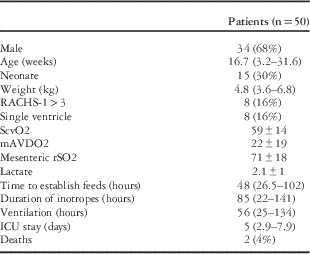
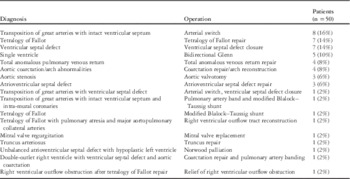
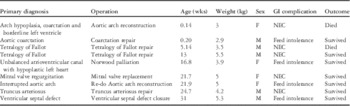
A total of 50 children were included in this study, of which 34 (68%) were male. No child was excluded. The median age was 16.7 (3.2–31.6) weeks, and 15 (30%) patients were neonates. The median weight was 4.8 (3.8–6.8) kg. Further clinical characteristics are shown in Table 1. Primary cardiac diagnoses and operations performed are shown in Table 2. The risk-adjusted congenital heart surgery category-1 distribution was 2 to 6, with the most common categories being category 2 (54%), 3 (30%), and 4 (14%). The most common diagnoses were transposition of the great arteries (20%) and tetralogy of Fallot (18%). Among all, eight (16%) children had single ventricle physiology. Our single ventricle group included two patients with systemic-to-pulmonary shunts – one with tetralogy of Fallot and one with transposition of great arteries – one patient after Norwood palliation – unbalanced atrioventricular septal defect with hypoplastic left ventricle – and five patients after bidirectional Glenn procedure – two patients with tricuspid atresia, two with double-inlet left ventricle, and one with hypoplastic left heart syndrome. The median duration of mechanical ventilation was 2.3 (1.1–5.6) days, and the median length of ICU stay was 5 (2.9–7.9) days. The median time to establish enteral feeds was 48 (26–102) hours; nine (18%) children had gastrointestinal complications, of which three (6%) had confirmed and one (2%) had suspected necrotising enterocolitis, the remaining had abdominal distention and feed intolerance. Diagnoses and operations performed in patients who developed gastrointestinal complications are shown in Table 3. In all, two (4%) children died. Both patients developed necrotising enterocolitis, but the deaths were likely unrelated to this complication: one was a male neonate with aortic hypoplasia, coarctation, and borderline left-sided structures and underwent biventricular repair, developed left atrial hypertension, and died from late post-operative complications; and the second was a female infant with tetralogy of Fallot who developed right ventricular failure after complete repair at 5 weeks of age.
General characteristics of the population.

RACHS-1=risk adjustment for congenital heart surgery category-1, ScvO2=central venous oxygen saturations
mAVDO2=mesenteric arteriovenous difference of oxygen. It was estimated by subtracting mesenteric near-infrared spectroscopy (NIRS) saturation from arterial oxygen saturation
Mesenteric rSO2=mesenteric regional venous oxygen saturation. This was the value obtained from the NIRS monitor
Values shown are median (IQR) or mean (±SD) (the latter for normally distributed data)
Patient diagnoses and operations performed.

Characteristics of the gastrointestinal (GI) complications group.

F=female; M=male; NEC=necrotising enterocolitis
On admission following surgery, the average value for mesenteric near-infrared spectroscopy was 71±18%, and the systemic oxygen saturation was 93±7%, with a median mesenteric arteriovenous difference of oxygen of 21 (6–33) %. The duration of mesenteric near-infrared monitoring was 45±7 hours. The average of all mesenteric near-infrared values during the study period was 69±14%. Although systemic saturation was significantly lower in children with univentricular physiology in comparison with children with biventricular physiology following surgery (81±8% versus 95±5%, p<0.01), mesenteric near-infrared spectroscopy was similar between these groups on admission (68±25% versus 70±16%, p=0.5) and during the whole study period (66±21% versus 69±13%, p=0.5).
Mesenteric near-infrared spectroscopy association with feeding outcomes and gastrointestinal morbidity following surgery for CHD
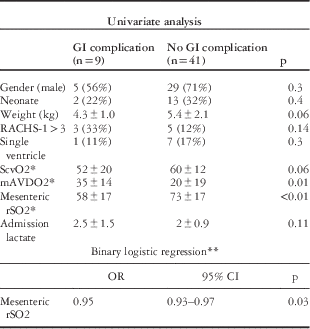
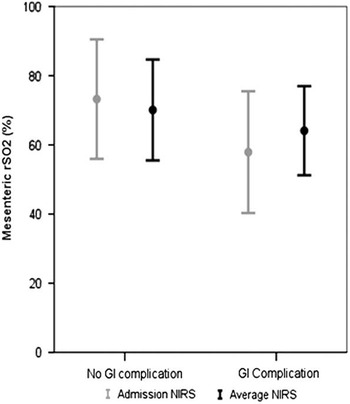
Lower admission mesenteric near-infrared spectroscopy correlated with longer time to establish enteral feeds (r=−0.58, p<0.01) and shorter duration of feeds at 7 days (r=0.48, p<0.01). Smaller admission mesenteric arteriovenous difference of oxygen correlated with shorter time to establish enteral feeds (r=0.52, p<0.01) and longer duration of feeds at 7 days (r=−0.51, p<0.01). Children with gastrointestinal complications had significantly lower admission mesenteric near-infrared spectroscopy (58±18% versus 73±17%, p=0.01) and higher mesenteric arteriovenous difference of oxygen at admission [39 (23–47) % versus 19 (4–27) %, p=0.02].
Univariate analysis identified admission mesenteric near-infrared spectroscopy, admission mesenteric arteriovenous difference of oxygen, risk-adjusted congenital heart surgery category-1 >3, weight, lactate, and central venous oxygen saturations as possible factors associated with gastrointestinal complications (all p<0.15) (Table 4). Interestingly, univentricular physiology was not associated with gastrointestinal complications, nor was there any significant difference in admission or mean near-infrared spectroscopy between those with univentricular and biventricular physiology. Based on multiple logistic regression analysis, only admission mesenteric near-infrared spectroscopy was independently associated with gastrointestinal complications (Odds ratio, 0.95; 95% confidence interval, 0.93−0.97; p=0.03), both admission and mesenteric arteriovenous difference of oxygen were independently associated with gastrointestinal complications, but these variables were multicollinear and we kept the variable with the strongest association with gastrointestinal complications – that is, admission mesenteric near-infrared spectroscopy.
Regression analysis of factors associated with GI complications.

GI=gastrointestinal
* ScvO2, mAVDO2, and Mesenteric rSO2 are multicollinear variables and were analysed individually in the regression models
** Binary logistic regression using forward stepwise method. The variables weight, RACHS-1 (categorical), ScvO2, mAVDO2, and Lactate were tested in the regression, but were not included in the final equation/model
As admission mesenteric near-infrared spectroscopy was strongly associated with gastrointestinal complications in our study, we went on to evaluate the ability of admission mesenteric near-infrared spectroscopy to discriminate between children who subsequently went on to develop gastrointestinal complications (Fig 1).
Mesenteric NIRS in children with and without GI complication. Mean (±SEM) admission mesenteric NIRS in children with and without subsequent GI complications. GI=gastrointestinal; NIRS=near-infrared spectroscopy.

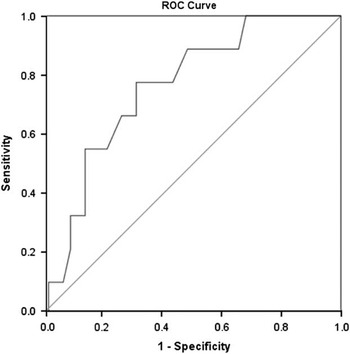
The ability of admission mesenteric near-infrared spectroscopy to discriminate children with gastrointestinal complications was assessed using the receiver operating characteristic curve. Admission mesenteric near-infrared spectroscopy showed an area under the receiver operating characteristic curve of 0.76 to identify children who developed gastrointestinal complications (Fig 2), suggesting that admission mesenteric near-infrared spectroscopy is a good discriminator of gastrointestinal outcome. A cut-off value of 72% showed a sensitivity of 78% with a specificity of 68%, whereas a cut-off value of 75% showed a sensitivity of 89% with a specificity of 51%.
ROC curve for mesenteric near-infrared spectroscopy (NIRS) predicting gastrointestinal (GI) complication. The area under the ROC curve for mesenteric NIRS of 0.76 suggests that mesenteric NIRS is a reasonably good discriminator of adverse GI outcome. ROC=receiver operating characteristic.

We also studied factors associated with the time to establish enteral feed. Based on univariate analysis, the variables potentially associated with the time to establish enteral feed were admission mesenteric near-infrared spectroscopy, admission mesenteric arteriovenous oxygen difference, lactate, age, and weight (all p<0.15). Based on multiple regression analysis, only lactate and admission mesenteric near-infrared spectroscopy – or mesenteric arteriovenous difference of oxygen, multicollinear variables – were independently associated with time to establish feeds (p<0.01 for both).
Contribution of impaired mesenteric perfusion to other markers of clinical morbidity
We explored the association between admission mesenteric near-infrared spectroscopy and clinical outcomes or markers of disease severity. Admission mesenteric near-infrared spectroscopy showed weak, but statistically significant linear correlations with the worst lactate and central venous oxygen saturations levels during admission (r=0.33 and 0.27, respectively, p<0.05 for both) and with the time free of ICU at 28 days (r=0.28, p<0.05). Children with admission mesenteric near-infrared spectroscopy lower than 75% had higher admission lactate and longer duration of mechanical ventilation and ICU stay than children with mesenteric near-infrared spectroscopy ⩾75% (p=0.05, 0.01, 0.04, respectively). There was no association between near-infrared spectroscopy and inotrope score, core temperature, post-operative plasma creatinine levels, or maximum hepatic enzymes such as levels of aspartate aminotransferase and alanine aminotransferase (all p>0.05).
Discussion
In this study, we found that mesenteric near-infrared spectroscopy was associated with enteral feeding outcomes such as duration of feeds and time to achieve full enteral feedings. We also found that mesenteric near-infrared spectroscopy on admission to ICU is independently associated with the development of gastrointestinal complications.
Gastrointestinal complications are relatively common and potentially serious adverse events in infants undergoing surgery for CHD.Reference McElhinney, Hedrick and Bush 1 – Reference Ostlie, Spilde and Peter 3 , Reference Luce, Schwartz and Beauseau 8 The current management of gastrointestinal health and feeding strategies following congenital heart surgery is largely based on clinical observation, and no specific markers of safety or viability are routinely used in clinical practice. Evaluation of gut mucosal perfusion could provide a direct method to identify patients at risk of developing gastrointestinal complications and allow clinicians to stratify feeding and gut-protective strategies objectively. Monitoring of mesenteric near-infrared spectroscopy is a simple and non-invasive technique that provides real-time and continuous information on gastrointestinal perfusion. These features make mesenteric near-infrared spectroscopy an ideal candidate to guide therapy and stratify young children for interventions to protect the gut following surgery for CHD. There is growing evidence to support the use of near-infrared spectroscopy as a marker of regional perfusion in critical vascular beds and its correlation with adverse clinical outcomes. Intra-operative low cerebral near-infrared spectroscopy has been associated with increased risk of cognitive delay in adults undergoing coronary artery bypass grafting.Reference Slater, Guarino and Stack 18 In the paediatric cardiac population, both cerebral and renal near-infrared spectroscopy have been associated with clinical outcomes. In particular, peri-operative low cerebral near-infrared spectroscopy is associated with poorer neurodevelopment at 1 year after surgeryReference Kussman, Wypij and Laussen 19 and flank (renal) near-infrared spectroscopy with post-operative renal dysfunction in cardiac neonates.Reference Owens, King, Gurney and Charpie 20
To our knowledge, our study is the first report to correlate post-operative mesenteric oxygenation measured by near-infrared spectroscopy with adverse gastrointestinal outcomes in children following CHD surgery. The link between mesenteric near-infrared spectroscopy and enteral feeding has, however, already been described in the (non-cardiac) neonatal population. Mesenteric near-infrared spectroscopy has been shown to increase in response to enteral feedingReference Dave, Brion, Campbell, Scheiner, Raab and Nafday 24 and to be reduced in neonates with abdominal pathology.Reference Fortune, Wagstaff and Petros 25 Animal studies have confirmed the association between mesenteric near-infrared spectroscopy, mesenteric perfusion, and gastrointestinal complications. Low mesenteric near-infrared spectroscopy were described in animal models of abdominal compartmental syndrome,Reference Varela, Cohn and Giannotti 26 haemorrhagic shock,Reference Cohn, Varela and Giannotti 27 feed intolerance,Reference Cortez, Gupta, Amaram, Pizzino, Sawhney and Sood 28 and necrotising enterocolitis.Reference Gay, Lazar and Stoll 29
It is interesting that in our data the admission mesenteric near-infrared spectroscopy had the strongest association with gastrointestinal complication. Both the average mesenteric near-infrared spectroscopy during the study (45 hours) and the mesenteric arteriovenous difference of oxygen were statistically associated with gastrointestinal complications, but these associations were weaker than the admission mesenteric near-infrared spectroscopy. Critical changes during surgery, such as cardiopulmonary bypass and hypothermia, can have a damaging effect on the gut mucosa and can increase the risk of developing gastrointestinal complications.Reference Booker, Romer and Franks 10 Further studies should include an assessment of the association between intra-operative mesenteric near-infrared spectroscopy and clinical outcomes. We were surprised that the ICU admission mesenteric near-infrared spectroscopy values were similar in children with univentricular and biventricular physiology. These data are in contrast with those from previous studies showing reduced mesenteric flowReference del Castillo, Moromisato and Dorey 7 and higher incidence of necrotising enterocolitis in the single ventricle population.Reference McElhinney, Hedrick and Bush 1 Explanation of these findings is problematic. Our study included only eight children with single ventricle physiology. Given that the standard deviation of the mesenteric near-infrared spectroscopy value was high, the small size of this group may partly explain this unexpected finding. Furthermore, five out of our eight single ventricle patients were patients after bidirectional Glenn procedure with excellent haemodynamics, cardiac output, and end-organ perfusion; however, further studies in larger populations are needed to address this paradoxical observation.
We identified an admission near-infrared spectroscopy value of <75% as being a good discriminator of adverse gastrointestinal outcome. Further validation could allow a threshold such as this to be used in risk stratification, feeding, and treatment plans.
Our study has several limitations. First, we studied a small cohort of 50 children. In addition to the small size, our study population was very heterogeneous. Larger cohorts of patients with similar characteristics, preferably single anatomic lesions, will be needed to establish mesenteric near-infrared spectroscopy thresholds that could be extrapolated to other populations and applied in clinical practice. Moreover, the mesenteric near-infrared spectroscopy reading could be adversely affected by severe oedema, ascites, or abdominal distention. To minimise this limitation, we recruited only children weighing <10 kg, where there is good evidence on clinical relevance of regional perfusion evaluation.Reference Ortmann, Fontenot, Seib, Eble, Brown and Bhutta 16 , Reference Kaufman, Almodovar, Zuk and Friesen 17 , Reference Kussman, Wypij and Laussen 19 , Reference Petros, Heys, Tasker, Fortune, Roberts and Kiely 30 , Reference Bernal, Hoffman, Ghanayem and Arca 31 In addition, the clinical team was not blinded to the near-infrared spectroscopy values. Although this could influence clinical decisions, the outcomes evaluated in our study – enteral feeding and gastrointestinal complications – were protocol-driven, and mesenteric near-infrared spectroscopy is not currently used as a decision-making tool in our service. Finally, we did not evaluate intra-operative mesenteric near-infrared spectroscopy. We would expect that values measured during surgery and bypass could significantly improve the potential for regional mesenteric perfusion to identify gastrointestinal complications of children undergoing cardiac surgery.
In conclusion, we found that admission mesenteric near-infrared spectroscopy values are associated with gastrointestinal complications and enteral feeding tolerance in children after cardiac surgery. Our data suggest that admission mesenteric near-infrared spectroscopy may be useful in guiding feeding and establishing gut-protective strategies in children following cardiopulmonary bypass; however, further studies are required to verify our findings.
Acknowledgements
The authors acknowledge the patients, parents, and staff of the Paediatric Intensive Care Unit of the Royal Brompton Hospital. They thank Mr. James Woods for providing data support.
Financial Support
This study received no financial support.
Conflicts of Interest
None.