INTRODUCTION
The Molidae family comprises three genera and five species of large marine fish, of the order Tetraodontiformes. Generally such fish are variously diffuse in the open ocean areas but can be found in coastal waters (Sims & Southall, Reference Sims and Southall2002; Dulčić et al., Reference Dulčić, Beg Paklar, Grbec, Morovic, Matic and Liplj2007). Mola mola and Ranzania laevis are numbered among the Italian fish (Tortonese, Reference Tortonese1975). The two species of Mola, M. ramsayi and M. mola, can be separated by the number of ossicles in the clavus (the tail frill): Mola ramsayi has 16 ossicles that are wider than the spaces among them and M. mola has 8–12 ossicles that are narrower than the spaces among them. There is a distinct band of smaller denticles at the base of the clavus in M. mola that is lacking in M. ramsayi.
Mola mola is a cosmopolitan species and seems a pelagic and oceanodromous fish and breeding is likely to take place in the tropical to subtropical regions of the oceans (McCann, Reference McCann1961; Chirichigno, Reference Chirichigno1974; Eschmeyer et al., Reference Eschmeyer, Herald and Hammann1983; Robins & Ray, Reference Robins and Ray1986; Riede, Reference Riede2004). The exact extent of Mola depth-range is not known, but according to Houghton et al. (Reference Houghton, Doyle, Davenport and Hays2006) ‘Indeed, recent studies have shown Mola mola to be a more accomplished diver than once thought, venturing on occasion to depth of 600 m up to 20 times a day (Thys, Reference Thys2002)’. Diurnal movement patterns of sunfish off southern California are given by Cartamil & Lowe (Reference Cartamil and Lowe2004).
In the Mediterranean Mola mola, known as fishmoon, is rather widespread, but not so frequent in the Italian Seas. Along the Italian coasts the molas stranded were, above all along some stations in the Adriatic Sea: at Foce Bevano, August 1966, at Foce Reno, March 1998, at Cervia beach, 24 March, 1999 (a specimen of 900 kg); and at Lido degli Estensi, 6 April 2002 (a male of 1050 kg). Specimens of this unusual fish of 5–10 kg have been captured in the Strait of Messina. The key aims of this paper are to provide information about this sunfish stranding in the Gulf of Taranto, to contribute to a better knowledge of the Mola ecological role with an account of the few recent studies and to refer on the parasites found.
With the present note I report on an adult specimen stranded along the oriental coast of the Mar Grande (Gulf of Taranto) (17°14′9″E 40°25′33″N) and recovered on 11 November 2007 (Figures 1 & 2). Mola mola is uncommon in the Gulf of Taranto and the stranded subject is the first specimen from the Italian Ionian coast. The subject is a male of 128 cm in length, with the skin diffuse white apart from an obscure brownished area on the back and the flanks.
The stranded sunfish specimen in frontal view.

The gills: in particular the 1st branchial arch (see the arrow) is a unibranchiate short arch.

MATERIALS AND METHODS
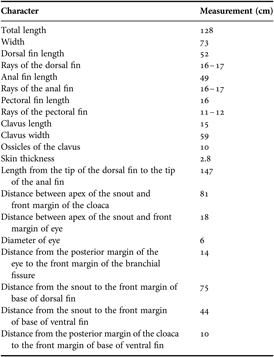
An external examination and necropsy was conducted at the Istituto per lo Studio degli Ambienti Marini Costieri (IAMC–CNR) di Taranto, on 11 November 2007. The morphometric and meristic characters are supplied in Table 1.
Morphometric and meristic characters.

Five branchial arches: the 1st of whose unibranchiate of No. 84 short branchiostegites; the other of No. 190 long branchiostegites in double rows (counted on the external row of the 3d arch).
DISCUSSION
In agreement with the description of this species in the literature, the fish is less than twice as long as deep, strongly flattened sidewise. The total length, 128 cm, represents nearly 2/5 of the maximum length and 390 kg represent nearly 1/3 of the weight that Mola mola reaches in adult specimens (300.8 cm in length and about 1000 kg in weight).
Tortonese (Reference Tortonese1975) reports 4 branchial arches as a family character while I have counted a 1st unibranchiate short arch (Figure 2, arrow) and 4 other double-branchiate arches with the branchiostegites four times longer than the 1st.
The skin thickness, 2.8 cm, and the lack of any slime coating the skin, attest to a specimen stressed for a long time (usually skin thickness is about 3.5–3.8 cm in one specimen 120 cm long, and the skin is covered with a thick layer of tough slime, according to the literature) or indicate that the animal had been dead for some time before its stranding.
The mouth, oesophagus and gills of the subject were occluded with vegetable detritus of Cymodocea nodosa that extends from the beach to a depth of 15–20 cm along the coast of the Taranto area.
In the third left gill, the Cecropid calanoid copepod Cecrops latreilii, Leach 1816, was present with a male and a female in copula as observed also by Grabda (Reference Grabda1973). Often Mola mola is affected by tapeworm larvae (Arru et al., Reference Arru, Garippa and Sanna1991), and Citrobacter freundii (Sato et al., Reference Sato, Yamane and Kawamura1982). When molas have been studied after their death, the parasites which very likely caused the death have remained alive for at least 17 hours after the removal of the specimens from the water (Schwartz & Lindquist, Reference Schwartz and Lindquist1987).
The liver of the subject was yellowish coloured and parasitized by Pennella rubra; the heart consisted of one auricle and one ventricle, without parasites and a mucous substance was present in the stomach. The total length of the intestine was 384 cm (measured from the back oral cable to the cloaca) without any parasites.
Various round worms and flat worms inhabited the liver of the stranded specimen. Such observations were also noted in Gustinelli et al. (Reference Gustinelli, Nardini, Aureli, Trentini, Affronte and Fioravanti2006). The slimy liquid found in the stomach probably represents the partially digested remains of its diet. Ocean sunfish have been reported to feed on a range of different prey items ranging from gelatinous zooplankton such as jellyfish, Portuguese man-o-war, ctenophores and salps (Norman & Fraser, Reference Norman and Fraser1949), crustaceans (Edwards, Reference Edwards1990) and molluscs (Bigelow & Schroeder, Reference Bigelow and Schroeder1953). No hard exo-skeletal material from crustaceans and molluscs was found in the digestive tract of the present specimen, with the viscous liquid most likely suggesting that the specimen had been feeding on gelatinous organisms, as observed by Tortonese (Reference Tortonese, Quero, Hureau, Karrer, Post and Saldanha1990). Future studies of the foraging ecology of ocean sunfish are urgently needed using more robust techniques such as stable isotope analysis (Hansson et al., Reference Hansson, Hobbie, Elmgren, Larsson, Fry and Johansson1997) or aerial surveys (Houghton et al., Reference Houghton, Doyle, Davenport and Hays2006a) employed to resolve potential prey types and patches. The known behaviour of basking during the day could be a means for digesting the previous night's meal as many sharks are known to do (McCann, Reference McCann1961).
Finally, because ocean sunfish are such large fish that are easily sighted from both the air and sea and because they prefer to swim in nutrient-rich waters, information on the distribution of Mola mola may serve as a useful ‘indicator’ of nutrient rich areas of the ocean where other endangered marine animals may be found such as tuna, sea turtles and whales.
ACKNOWLEDGEMENT
I wish to thank Michele Lenti for the help given during the necropsy of the subject.