Tulum cheese is a Turkish artisanal cheese made from raw sheep's milk. It is white and cream-colored, not easily dispersed, semi-hard/hard and has a high-fat content, homogeneous texture, and acidic taste caused by long-term ripening. It is commonly produced from raw sheep or goat milk without starter cultures by traditional methods in the Central Taurus region of Turkey. In the production of the artisanal Tulum cheese, rennet is added to raw milk whose temperature is set around 30 °C, and milk starts to coagulate. After the curd is formed, it is cut by knives, heat treatment (45–50 °C) is applied and then whey is removed. The curd is crushed by hand, salted, and filled into a goatskin (Tulum). After the goatskin is closed, it is allowed to ripen for about 6 months in a cool place (2–10 °C) such as a cellar, cenote, or cave (traditional) or cold storage with 85% relative humidity. Tulum cheese, which is known to be produced by traditional methods in mountainous areas and small family businesses or dairy units, is produced especially between March and June and is ready for consumption in September–December.
Differences such as the vegetative flora of the area where the animals graze, type of milk (sheep, goat, or cow), milk mixing ratio, salt amount, coagulant type, ripening time or environment have a significant effect on the microbiota of the Tulum cheese. Culture-dependent methods are frequently used in determining the microbiota of the Tulum cheese (Öksüztepe et al., Reference Öksüztepe, Patir and Çalicioǧlu2005; Hayaloglu et al., Reference Hayaloglu, Cakmakci, Brechany, Deegan and McSweeney2007) but these studies did not monitor the change during storage, only the final product. Indeed, culture-dependent methods always provide limited information, and they should be confirmed by culture-independent techniques. There are some disadvantages in culture-dependent methods such as cross-species variation and poor reproducibility, always needing alternative systems, making a diagnosis at gender level, taking a long time and being affected by contamination and handiness. Culture-independent techniques are used more often to investigate the microbial diversity and to analyze the structures of microbial communities in cheeses (Randazzo et al., Reference Randazzo, Caggia and Neviani2009; Quigley et al., Reference Quigley, O'Sullivan, Beresford, Ross, Fitzgerald and Cotter2011). One of the most important advantages of these methods is that they are independent of growth conditions. Also, these methods can distinguish from species-level to strain-level. In this study, the DGGE technique has been successfully applied in Tulum cheese samples produced in the Anamur region for determining the lactic acid bacteria (LAB) population. In this technique, after direct DNA isolation from a sample containing microorganisms, the target regions are amplified with the PCR technique. Variable regions of the 16S rRNA gene are widely selected as target regions, and VI, V2, and V3 variable regions are often used to determine the cheese microbiota from these variable regions (Bonetta et al., Reference Bonetta, Bonetta, Carraro, Rantsiou and Cocolin2008; Giannino et al., Reference Giannino, Marzotto, Dellaglio and Feligini2009; Arcuri et al., Reference Arcuri, El Sheikha, Rychlik, Piro-Métayer and Montet2013).
This research is the first study to examine the microbial composition of the Tulum cheese with the PCR-DGGE technique. To the best of our knowledge there is no other study using both culture-independent and dependent techniques to monitor lactic acid bacteria (LAB) diversity during the ripening process of the Tulum cheese. Such information could be used to identify optimal starter cultures, and contribute to the international recognition and hence sustainability of these artisanal cheese varieties.
Material and methods
Sampling
Tulum cheese samples were produced in the Anamur region of Mersin province, which is located in the Central Taurus region of Turkey (online Supplementary Fig. S1). Eight samples (8 biological repetitions) produced from raw sheep milk by local farms using traditional methods were taken from this location, and each sample was divided into 7 equal portions. Each piece was placed in 2000 g bags made of goatskin and analyzed at a separate storage period. Cheese samples were subjected to two-stage ripening comprising a pre-ripening (15°C for 4 d) and then a main ripening (2–4°C for 180 d) at 85% relative humidity. Sampling times were determined as the 7th, 15th, 30th, 60th, 90th and 180th days of ripening. Samples were collected under aseptic conditions from different parts of the cheese portions. The samples were then delivered to a laboratory in the cold chain to avoid any microbial differences between cheese samples, and analyses were carried out immediately.
Physicochemical analysis
Protein, fat, dry matter, pH, titratable acidity and NaCl content in the samples were routinely performed with the methods given by Kirk and Sawyer (Reference Kirk and Sawyer1991).
Culture-dependent analysis of the samples
10 g of each cheese sample was taken for the counting and isolation of microorganisms, and 90 ml of sterile 2% sodium citrate (Merck, Darmstadt, Germany) solution was added and homogenized with a Stomacher® blender. Serial dilutions were prepared with peptone water (0.1% w/v) and then 100 μl of the appropriate dilutions were plated using the spread plate method. The necessary incubation medium for facultative anaerobic and microaerophilic microorganisms was provided with Anaerocult A and Anaerocult C (Merck, Darmstadt, Germany). The media and the incubation conditions recommended by Helmark et al. (Reference Helmark, Hansen, Jelle, Sørensen and Jensen2004) and Randazzo et al. (Reference Randazzo, Vaughan and Caggia2006) were used for cultivation (online Supplementary Table S1). Colonies were picked from agar plates of cheese samples, isolated, and purified twice by streaking. Finally, phenotypic and biochemical characterization of lactic isolates was performed and the isolates were stored in Eppendorf tubes with 25% glycerol at −80 °C.
PCR amplification and sequencing of 16S rRNA genes
The purified colonies that developed on the above media were suspended with 10 μ of PCR-grade water in sterile Eppendorf tubes. 1.2 μl MgCl2, 3 μl PCR buffer, 1 μl reverse and forward primers, 0.5 μl Taq DNA polymerase, and 1 μl dNTP solutions were added to each sample suspension (1 μl) in 30 μl final volume. The used chemicals were provided by Thermo Scientific. F365 (forward) (5′-ACWCCTACGGGWGGCVVGC-3′) and R1064 (reverse) (5′-AYCTCACGRCACGAGCTGAC-3′) primers provided by Sentegen (Sentegen Biotech, Ankara/Turkey) were used to amplify the V3 region of 16S rRNA gene. PCR amplification circumstances: initial denaturation at 95 °C for 5 min, followed by denaturation at 95 °C for 30 s; annealing at 58 °C for 30 s; extension at 72 °C for 45 s to complete 35 cycles and ending with a final extension step at 72 °C for 10 min. Each amplified PCR product was mixed with a loading dye at a ratio of 1: 6. The stained PCR products were analyzed by electrophoresis in a 1 × TBE buffer by using agarose gel containing GelRed Nucleic acid stain (Merck) on the purpose of purity control. Electrophoresis conditions were set to run for 1 h at 100 V. The remaining PCR products were stored at −20°C until they were sequenced. The 16S rRNA V3 regions sent to the sequence were compared to those in the Standard Nucleotide BLAST (http://blast.ncbi.nlm.nih.gov/) database.
Culture-independent analysis of the samples: Total DNA extraction from the samples and PCR amplification of total cheese DNAs
Cheese samples were dissolved in sterile Ringer's solution at a ratio of 1:10 and homogenized using Stomacher. 1 ml of cheese suspension was taken and enriched for 24 h at 30°C in Nutrient Broth. The protocol of the bacterial DNA extraction kit (Vivantis Technologies Sdn. Bhd. Selangor Darul Ehsan, Malaysia) was implemented after incubation. Quality of extracted DNA and amounts were measured by NanoDrop Spectrophotometer (Thermo Fisher). All DNAs obtained from cheese samples were used as template DNA material to amplify the V3 region of the 16S rRNA. PCR amplification was performed using a method similar to the culture-dependent method but differently PCR was performed together with the reverse primer 518R (5′-ATTACCGCGGCTGCTGG-3′) by linking the forward primer F338 (5′-ACTCCTACGGAGGCAGCAG-3′ to the ribosomal region of bacterial cells and a GC clamp (5′-CGCCCGCCGCGCGCGGCGGGCGGGGG CACGGGGG-3′) to the 3′ terminal end.
Culture-independent analysis of the samples: DGGE conditions and DGGE profile analysis
DGGE analysis was performed on D-Code (Bio-Rad, Richmond, CA, USA) apparatus. Samples were applied to 6% (w/v) polyacrylamide gel in 1 × TAE buffer. Electrophoresis was carried out at 60°C by using gels containing a 30–50% urea-formamide denaturing gradient (Bio-Rad). The gels were run primarily for 10 min at 50 V and then for 6 h at 150 V. After electrophoresis, the gels were stained for 15 min in TAE buffer (1X) containing 50 ml 3X Gel-Red (Sigma-Aldrich, Germany), and the bands were visualized on the Chemi-Doc (Bio-Rad, Richmond, CA, USA) apparatus. The bands on the polyacrylamide gels were selected and cut to represent each base pair. The pieces of bands were transferred into water and incubated overnight at 4°C for DNA diffusion. The mixture containing 5 μl chromosomal DNA, 1.2 μl MgCl2, 3 μl PCR buffer, 1 μl primer, 0.5 μl Taq polymerase, and 1 μl dNTP were re-amplified under the PCR conditions described above. Finally, amplified PCR products were sequenced and compared with similar sequences in the Standard Nucleotide BLAST database (http://blast.ncbi.nlm.nih.gov).
Statistical analysis
The data obtained for results of physicochemical analysis were analyzed using SPSS program and reported as the mean ± standard deviation. The significant differences compared by Tukey multiple comparison test with significance being declared at P < 0.05.
Results
Physicochemical analysis
The physicochemical characteristics of Tulum cheese samples are shown in online Supplementary Fig. S2. The pH and the titratable acidity values of the samples measured at the end of the storage were higher than the values measured at the beginning of the ripening. The moisture loss significantly increased over 180 d of ripening (P < 0.05). The dry matter (%) of the cheese samples ranged from 51.15 to 66.78%. In contrast with the increase in dry matter, a numerical decrease in the ratio of fat in dry matter (FDM) and protein in dry matter (PDM) was observed at the end of storage but was not found to be statistically significant. In agreement with other studies about Tulum cheese (Öztürkoğlu, Reference Öztürkoğlu2014; Yıldırım, Reference Yıldırım2014), salt in dry matter (SDM) values of all samples decreased during the storage period. While the average SDM values of the samples at the beginning of the ripening process was 4.08%, it decreased to 3.71% at the end of storage (P < 0.05).
LAB dynamics determined by culture-dependent method during ripening
Microorganisms identified by the culture-dependent method with 16S rRNA sequencing are given in Table 1. E. faecium is the most common species in cheese samples at all storage stages. After 60 d, it was seen that it dominated the microbiota until the end of storage. Enterococcus hirae was seen to be more dominant especially until the 60th day, but this species was detected at varying rates throughout the ripening process. The percentage of L. plantarum species was 30.76% in the first period of storage, and they were seen less frequently on days 15 and 30. They were not detected in the microbiota at any subsequent storage stage. Similarly, Enterococcus mundtii, Enterococcus ratti, and Enterococcus italicus species were also detected at a low level at certain stages during storage, although they could not be found at the end of storage. Lactococcus species were observed in the first week of ripening at a ratio of 7.69% while Lactococcus lactis appeared in the following weeks. Lactoccus lactis, which is among the species expected to be found in the microbiota of the Tulum cheese, was detected on the 30th, 60th, and 90th day of ripening but was not observed in the microbial composition at the end of storage. It is clear that the Enterococcus species were the dominant species throughout the l80-day storage process. In addition to this, Lactobacillus, Lactococcus, and Bacillus species were observed at low rates in certain periods. Although primers and media suitable for LAB were used in this study, Sphingomonas and Bacillus species were also identified. Enterococcus species and surprisingly a colony belonging to the genus Sphingomonas were detected on the last day of ripening.
Distribution of microorganisms isolated and identified by the culture-dependent method with 16S rRNA sequencing

LAB dynamics determined by the culture-independent method (PCR-DGGE) during ripening
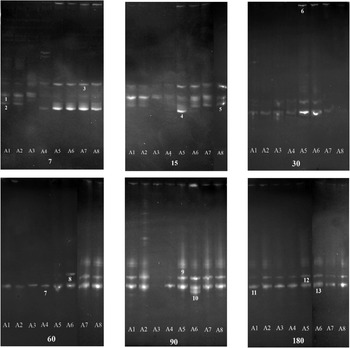
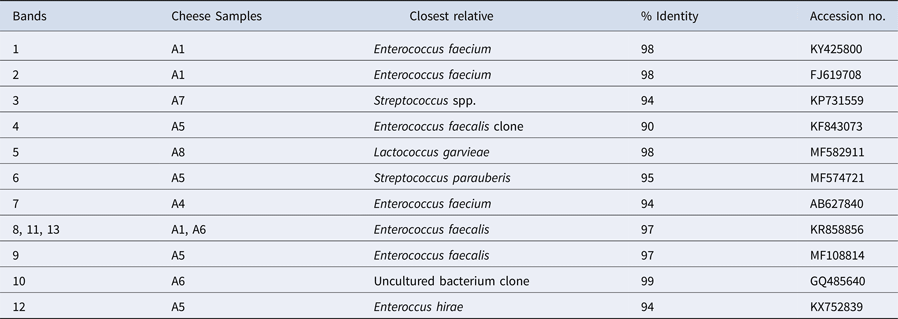
Figure 1 shows the bands obtained after the DGGE analysis of the DNA extracted from the samples in the ripening period. The profile consisted of 18 detectable bands for sequencing. Thirteen of these were identified, and five of them could not be identified, possibly due to their low rates. Since three of the identified ones are the same bacterial strains, 11 different bacterial strains were detected in total. The sequence results are shown in Table 2. In brief, three E. faecium strain, three E. faecalis, one E. hirae, one S. parauberis, one Streptococcus spp. and one Lactococcus garvieae strain were detected. The cheese sample with the highest number of isolates was determined as A5 (bands 4, 6, 9, 12). We also found one uncultured bacterium clone in one cheese sample (lane A6/band 10) on the 90th day of ripening.
DGGE images of PCR products obtained from Tulum cheese samples in different ripening period (7th, 15th, 30th, 60th, 90th and 180th days of ripening). Lanes represent 8 different Tulum cheese samples (A1, A2, A3, A4, A5, A6, A7, A8) taken from the Anamur region of Turkey. The bands identified as a result of the sequence analysis are numbered and the numbers are placed under the bands.

The sequence results of the bands obtained after DGGE analysis of the Tulum cheese samples. The band numbers match the numbers on the DGGE images in Fig. 1

As can be seen from the band images, E. faecalis and Streptococcus spp., as well as E. faecium strains, were detected in cheese samples in the first period of storage. The same bacterial strains were found again on the 15th day of ripening. Furthermore, Lactococcus garvieae was sequenced in some cheese samples (band 5) differently at the same ripening period. It has been reported that this bacterium contributes positively to the sensory character of cheeses during ripening (Fortina et al., Reference Fortina, Ricci and Borgo2009). On the 30th day analysis, E. faecium and E. faecalis strains were weakly present in lanes A1 to A4, became intense in lanes A5 and A6, but were not present in lanes A7 and A8. A strain of S. parauberis was found in some cheese samples (lanes A5 to A7 (weakly in A8) /band 6) at this storage period. On the 60th day of ripening, E. faecium (band 7) and E. faecalis (band 8) strains were observed in A1 to A8 and A6 to A8 lanes, respectively. E. faecalis (band 9) was the most prevalent species in the microbiota on the 90th day, and also uncultured bacterium clone was observed only in lane A6 (band 10). E. faecalis (bands 1113) and E. hirae (band 12) were found in all cheese samples in the last period of storage.
Discussion
It was seen that the titratable acidity and the pH values increased as the ripening process progressed. Indeed, various studies on Tulum cheese have reported a clear increase in pH values during the ripening process (Yıldırım, Reference Yıldırım2014; Ozturkoglu Budak et al., Reference Ozturkoglu Budak, Figge, Houbraken and de Vries2016). Researchers reported that this may be due to the assimilation of produced acids by yeast and molds, deamination of amino acids at later ripening stages (Schlesser et al., Reference Schlesser, Schmidt and Speckman1992), proteolysis products with amphoteric properties and ammonia formation together with breakdown of fatty acids to methyl ketones (Kaminarides et al., Reference Kaminarides, Anifantakis and Alichanidis1990). As a result of microorganism activities during cheese ripening, it is expected that various nutrients in cheese will break down and the metabolites will increase the acidity. Çakır (Reference Çakır2012) and Hayaloglu et al. (Reference Hayaloglu, Cakmakci, Brechany, Deegan and McSweeney2007) also encountered similar titratable acidity increases during the ripening period. The results for increased dry matter throughout the ripening process accord with (Güven and Konar, Reference Güven and Konar1994). It was observed that goatskin with very high humidity at the beginning of storage started to dry out by losing moisture day by day. The porous structure of the goatskin is thought to increase this loss and hence the other parameters such as protein, fat and salt values. The pH and titratable acidity of the Tulum cheese samples was generally determined in the range of 4.86–4.92 and 1.87–2.34. NaCl content of the samples ranged from 3.71–4.08% according to the results of the physicochemical analysis. Also, mild heat treatment (45–50°C) was applied to the coagulated milk during the manufacturing process. Montel et al. (Reference Montel, Buchin, Mallet, Delbes-Paus, Vuitton, Desmasures and Berthier2014) noticed that Enterococcus strains are resistant to low acidities such as pH 4.9, high salt concentration such as 6% NaCl/water, and a temperature range of 2–53°C. Some other researchers also noted that Lactococcus species had a low tolerance to low pH and temperature in the range of 45–48°C (Franciosi et al., Reference Franciosi, Settanni, Cavazza and Poznanski2009; Delgado et al., Reference Delgado, Rachid, Fernández, Rychlik, Alegría, Peixoto and Mayo2013). These conditions may be a stress factor for the mesophilic bacteria and stop or slow down the growth of this species. In a study examining the microbial dynamics of Casisolu cheese, Mangia et al. (Reference Mangia, Fancello and Deiana2016) attributed the high rate of species to their resistance to very hard conditions such as high temperature, high salt concentration, and low pH compared to other LAB. Considering all these results and the researches described above, it is not surprising that the Enterococcus genus is very dominant in all Tulum cheese samples throughout the ripening period.
According to the results of our analysis performed by the culture-dependent method, E. faecium, L. plantarum, and E. hirae strains were common in the first weeks of maturation, while E. faecium became dominant towards the end of storage. Only four different species were identified on the 180th day of ripening, and all were enterococci except for Sphingomonas sp. which are generally isolated from soil and water habitats and can use lactose as a carbon source. It is thought that they can adapt to the cheese environment due to this ability or the appearance of this bacterial genus in the last ripening period of the samples may be due to contamination. In their study on Divle cave cheese, Ozturkoglu Budak et al. (Reference Ozturkoglu Budak, Figge, Houbraken and de Vries2016) found Lactococcus lactis, Lactobacillus spp. and Enterococcus faecium on the 60th day of storage, which is similar to our findings, but at the end of storage, none of these species were detected except Lactobacillus paraplantarum. Also, when the variety of LAB during the ripening of Şavak Tulum cheese was examined using cultural methods, it was seen that Streptococcus spp., Enterococcus spp., Lactococcus lactis subsp. lactis and Leuconostoc mesenteroides subsp. cremoris were the microorganisms that played the most important role in ripening. Especially Enterococcus species have been reported to be dominant during storage, and low amounts of lactobacilli were detected in certain periods (Öksüztepe et al., Reference Öksüztepe, Patir and Çalicioǧlu2005).
In the culture-independent method, only E. faecalis and E. hirae were detected on the last day of ripening. It was determined by both methods that when the samples were ready for consumption, enterococci dominated the microbiota. Although E. faecium was found to be the dominant species in the culture-dependent method, the culture-independent method revealed that it shared dominance with E. faecalis and Streptococcus strains. E. hirae strain was the most observed strain after E. faecium while E. faecalis was not observed in the culture-dependent method. Furthermore, nine different species and five genera were determined in the culture-dependent method, whereas eleven species were identified in the culture-independent method. Eight and ten of these species were identified as LAB in culture-dependent and independent methods, respectively. As can be understood from these results, there are differences between the methods in terms of the number and types of species determined. Some other researchers who examined the microbiota changes during cheese ripening also reached similar results. For example, Pangallo et al. (Reference Pangallo, Šaková, Koreňová, Puškárová, Kraková, Valík and Kuchta2014) reported that the two methods did not yield the same results in their study, where they examined the microbial dynamics of traditional May Bryndza cheese. Also, in a study conducted by Mangia et al. (Reference Mangia, Fancello and Deiana2016) to investigate the dynamics of Casisolu cheese, the dominant type was determined as L. paracasei in the culture-dependent method, whereas it was determined as L. helveticus in the culture-independent method. According to Quigley et al. (Reference Quigley, O'Sullivan, Beresford, Ross, Fitzgerald and Cotter2011), the disadvantage of the culture-dependent method may be due to the presence of viable but unculturable bacteria and the fact that some of the media is very selective, causing a weak microbiota when used in the cultivation of microorganisms. The differences in lysis of the microbial population, the availability of amplified DNA of dead microorganisms and differential amplification of some sequences have also been reported as negative aspects of the culture-independent method. As a result, due to such limitations in both methods, the results do not concur. It was observed that the microbial diversity in Tulum cheese samples produced in Anamur region decreased clearly during the ripening period in the culture-dependent method, while the culture-independent method did not yield such a clear decrease. According to our microbial dynamic analysis results yielded by culture-dependent and culture-independent methods, enterococci were predominantly detected in the samples at the end of the ripening period. In this context, a lot of studies have also obtained similar findings. Some researchers reported that these bacteria originate from the milk used for making cheese in the regions especially in Southern European countries and play an important role in the development of aromatic compounds (Foulquié Moreno et al., Reference Foulquié Moreno, Sarantinopoulos, Tsakalidou and De Vuyst2006; Abriouel et al., Reference Abriouel, Martín-Platero, Maqueda, Valdivia and Martínez-Bueno2008). In their study where they examined the microbiome of cheese varieties made from raw milk, Montel et al. (Reference Montel, Buchin, Mallet, Delbes-Paus, Vuitton, Desmasures and Berthier2014) found that Enterococcus strains were isolated from milking equipment, raw milk tanks, udders and animal feces and noted that these strains spread to the cheese in these ways.
In conclusion, LAB diversity analysis was performed by culture-dependent and culture-independent (PCR-DGGE) methods on eight Tulum cheese samples traditionally produced in the Anamur region of Central Taurus throughout the 180-day ripening process. It was observed that Enterococcus was the prevalent genera throughout the storage period in the cheese varieties produced in this region. In the culture-dependent method, prevalent bacterial group (E. durans and E. hirae species, as well as E. faecium) were observed in cheese samples at the end of storage. In the PCR-DGGE technique, E. faecium was seen until the 90th day but could not be detected from day 90 until the end of ripening. E. faecalis and E. hirae became dominant on the 180th day of storage. It was concluded that combining the two methods is important for characterizing the whole LAB microbiota of the Tulum cheese produced in Anamur region.
Supplementary material
The supplementary material for this article can be found at https://doi.org/10.1017/S0022029921000765
Acknowledgments
This research was supported by a research project from The Scientific and Technological Research Council of Turkey (TUBITAK-TOAG/Grant number 214Z054). The authors are grateful to Ms Edibe Rabia Özkan and Mrs Sümeyye Demirci for their contribution to this research.