The article describes the design and application of a keystone Indigenous education subject EDU3IED, as presented in the third year of a 4-year Bachelor of Education degree in central Victoria, Australia. The unit focuses on challenging white perceptions, and strengthening Aboriginal perceptions, of Indigenous education. We do this by situating Aboriginal affairs within a cultural, historical and social context.
The article begins with a brief introduction to participants and the setting. Next, we discuss the evolution of our Indigenous Education unit and explore the theoretical framework used to ensure that at all times the totality of being Aboriginal is considered and that this focus is clearly demonstrated within the unit design. Then we use the same 4Rs model of reflective process used by our pre-service teachers to explore the unit structure, content and pedagogy.
Participants and Setting
Our campus of La Trobe University is situated in Bendigo, a rural city in central Victoria, Australia. Indigenous education was previously taught as a stand-alone, valued component of the Faculty of Education's offerings. However, as Australia continues to mature as a nation, we became increasingly concerned that what we offered was not enough.
If we were genuine about leading by example, about building cultural competence, then, as discussed in current literature (Craven, Halse, Mooney, & Wilson-Miller, Reference Craven, Halse, Mooney and Wilson-Miller2005), we needed to offer more than was currently offered. We needed to: demonstrate ways to incorporate Aboriginal perspectives across school curriculum; equip pre-service teachers with understandings on how to teach Aboriginal Studies; develop an awareness of Aboriginal culture and an understanding of contemporary issues and Aboriginal history; and for those given opportunities to work directly with Indigenous children, we needed to engage pre-service teachers in what Sarra (Reference Sarra, Wrigley, Thomson and Lingard2012, p. 62) calls:
A ‘Stronger Smarter’ philosophy — a strengths-based approach that signals a ‘belief in the capacity’ of indigenous children to perform as well as any other child regardless of the complexity of their social and cultural context.
We also had to consider that in redesigning a third year, cross-campus unit of work, we not only had to take account of the overall number of academics involved, but also the limited number of Australian Indigenous staff members.
With full support from the Faculty, we developed a core keystone subject to link broader in-situ work from across the entire curriculum. Indigenous Education (EDU3IED) is now taught via multi-campus curricula, involving both a central Victorian campus and a northern Victorian campus at Mildura. Currently, EDU3IED houses around 195 students per year, approximately 8% of whom are Indigenous. Our teaching team comprises Indigenous and non-Indigenous staff members. This combination of staff members is purpose built into the design as it allows coordination, where necessary, by non-Indigenous academics.
This work really started in 2010 when a pre-service teacher education course review found that the challenges facing the university in Indigenous education were not dissimilar to those identified by Craven et al. (Reference Craven, Halse, Mooney and Wilson-Miller2005, p. vi) in the report Teaching the Teachers Mandatory Aboriginal Studies. These challenges included: funding, staffing and staff shortages, course structure, and an already overcrowded curriculum. We therefore acknowledge that the redevelopment and redesign of our Indigenous Education subject was heavily influenced by the work of Craven et al. (Reference Craven, Halse, Mooney and Wilson-Miller2005). We also acknowledge that due to the review, while we had licence to build something new and aimed to use the opportunity to demonstrate sensitivity to the underlying power relationship between non-Indigenous and Indigenous peoples, we also wanted to retain and build on the strengths of prior Indigenous curriculum.
Developing the Content
We began consultations with the Bendigo Local Aboriginal Consultative Group (LAECG), the Dja Dja Wurung Aboriginal Association (Bendigo), the Mildura Aboriginal Corporation, and The Office of the Director, Indigenous Education La Trobe University and representatives on each campus. During these consultations we discussed and developed the subject Indigenous Education (EDU3IED), its content and pedagogical approaches. We built strong relationships and developed a subject with a positive sense of Aboriginal identity. We also worked to acknowledge and connect with Aboriginal leadership in schools and school communities. We established partnerships in government, Catholic and independent schools, particularly those situated in the Northern Territory and Western Australia, and schools within Aboriginal and Torres Strait Islander communities. This connection with interstate schools, which continues to grow, ensured access to practicum placement opportunities within Aboriginal and Torres Strait Islander communities.
Theoretical Framework
To ensure we could meet the high level challenges set, our foundational work was built using what Pridham, O’Mallon, and Prain (Reference Pridham, O’Mallon and Prain2012) later published as the Applied Learning ‘Reciprocal Venn’ model (Figure 1), a framework developed from applied learning, which focuses attention on the interplay of elements at the macro, meso and micro levels.
Applied Learning ‘Reciprocal Venn’ framework.

Pridham et al. (Reference Pridham, O’Mallon and Prain2012) developed this framework to promote deeper student learning by highlighting knowledge construction as reliant on developing an understanding of the interplay of different levels of influence. In this case, the framework focused attention on the totality of Aboriginality. As our aim was to present sound analysis of policies, processes and understandings from the inside, to acknowledge and embrace Aboriginal perceptions of being Aboriginal, we found that basing the structure of work within this framework ensured we were able to concentrate attention on ‘the story’ of Aboriginal society and Aboriginal people.
By framing pre-service teachers’ learning experiences within the context of the macro level, the socio-cultural, economic, political and historical factors are duly considered, meaning the content reflects a broad and expansive interpretation of Aboriginal and Torres Strait Islander histories within the very political and social constructs that impact on Indigenous learners, communities and Australian society. The meso, or middle level, impacts on program design task and sequencing. Here there is consideration of teacher and learner roles in Aboriginal and Torres Strait Islander education. The micro level influences and reflects a student's personal learning needs, style, individual history and modal preferences (micro). The micro level is the ‘in here’: it recognises the affective domain and acknowledges that learning cannot happen if emotions are left out of the process (Pridham et al., Reference Pridham, O’Mallon and Prain2012; Wilson, Reference Wilson2002). Work in this area of knowing is detailed by Anuik and Gillies (Reference Anuik and Gillies2012), who note the benefits of a shift in learning from a Eurocentric model of education to one that incorporates other world views. The micro level provides learners with the opportunity to inquire and learn (Battiste, Reference Battiste and Battiste2000) and teachers with the opportunity to ‘establish an environment that evokes . . . critical thought (brain) and passion (heart) as a means to overcome [any] fear and resistance’ (Anuik & Gillies, Reference Anuik and Gillies2012, p. 2).
It is through the interplay of the macro, meso and micro levels that we believed we had the greatest opportunity to influence and shape learners’ knowledge, practice and attitude. It was here that we believed we would enable pre-service teachers to combine deepened understandings of Indigenous history, culture and issues. When building the weekly units of work, we ensured each of the three levels — macro, meso, and micro —were considered, connected and explored.
For example, if considering the Australian curriculum, we would explore how at the macro level that Aboriginal and Torres Strait Islander education more or less reflects specific government agendas (specific to the time each policy was developed). We would consider recent articles such as those by Nakata (Reference Nakata2011), Andersen (Reference Andersen2012), Norman (Reference Norman2012) and others that reflect this politicisation. At the meso level we would focus on the plethora of research and approaches to the planning and delivery of educational programs, and consider strategies for Aboriginal and Torres Strait Islander education. Recent dialogue about and presentation of the Australian Teaching and Learning Council (ALTC) funded curriculum renewal project is a case in point. As outlined by MacKinlay and Barney (Reference MacKinlay and Barney2012), this work provides a clear exploration of PEARL (Political, Embodied, Active and Reflective Learning) as critical pedagogy and critical race theory in education. MacKinlay and Barney's (Reference MacKinlay and Barney2012) research describes the shift from Problem-Based Learning (PBL) to PEARL. At a micro level we would connect the work of Sarra (Reference Sarra2014), which focuses attention on how young Aboriginal students typically aspire downward, conforming to mainstream Australia's negative stereotypes. We would consider how this perception was conceived. We would add discussion on the work of Harris's (Reference Harris1984) study of learners in the Milingimbi community. Harris argued that in general, Aboriginal people learnt by observation, modelling and imitation rather than through talking and listening. And we would focus attention of current understandings of ways to personalise student learning and place students at the centre of the educational process (Department of Education & Early Childhood Development, 2007). Work would centre on that of Sarra (Reference Sarra, Wrigley, Thomson and Lingard2012), who has criticised rhetoric that undermines wellbeing and self-esteem of Indigenous students; work that unequivocally promotes the enabling of Aboriginal children to feel positive about their identity, to reject negative societal messages and stereotypes to promote educational success, and to build student self-esteem and self-efficacy.
Utilising the Applied Learning ‘Reciprocal Venn’ framework ensured we gave due consideration to all issues at multiple levels of engagement and positioned us to dismantle and reconstruct our approach to Indigenous Education. Our next task was to make sure our pre-service teachers were engaging with and appreciating the work set.
Constructive Alignment
In designing our program of work, we recognised a need to apply a holistic approach, as discussed by McLaren (Reference McLaren2011). We therefore engaged experts on Aboriginal and Torres Strait Islander knowledge and ways of knowing to be involved in the development of culturally appropriate pedagogical practice and in the building of a culturally inclusive curriculum. We applied a whole-of-system approach, wherein all stakeholders had an opportunity to contribute to the outcome, as discussed by Brabrand (Reference Brabrand, Jensen, van der Aalst and Billington2008). And we used the theory of constructive alignment, developed by Biggs and Tang (Reference Biggs and Tang2009), which originated in curriculum theory and constructivism, as a way to emphasise that it is the learner's actions that define what is learned (Brabrand, Reference Brabrand, Jensen, van der Aalst and Billington2008). Using constructive alignment meant that as teachers we were able to measure how well we had created a learning environment to support students’ learning. Via a constructive alignment design, we could create learning activities that ensured our intended learning outcomes were achieved. Then, through the use of carefully designed assessment procedures, we could ensure the aims of the ILO were assessed. Constructive alignment enables all components in the teaching process to be aligned — the teaching methods, the learning activities, and the assessment tasks (Biggs & Tang, Reference Biggs and Tang2009; Martin, Reference Martin2011).
So far in this article we have established why we saw a need for action; we have set the scene, introduced our participants and described the setting. We now turn to a discussion of how the subject content was negotiated and introduced. The next section provides an overview of the structure and the schedule of work involved in the subject Indigenous Education.
The Program
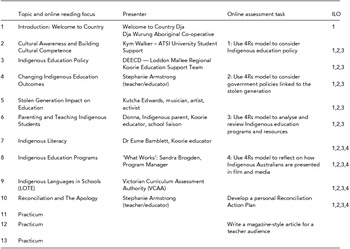
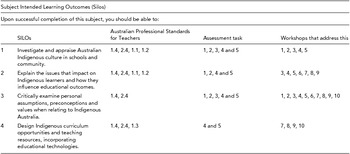
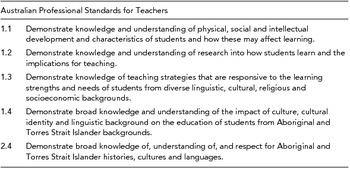
The following tables provide detail on the structure of the subject. Table 1 demonstrates the schedule of weekly workshops. Each workshop is supported by online readings, which pre-service teachers are required to work through prior to each presentation, and which directly relate to structured fortnightly reflections and response assessment tasks. As discussed, these responses align directly with the subject's Intended Learning Outcomes (ILOs) and professional teacher standards, as represented in Tables 2 and 3.
Schedule of Learning Activities for EDU3IED

ILO Contribution to Australian Standards, Assessment task, and Activity

Excerpt From the Australian Professional Standards for Teachers

Tables 2 and 3 offer a snapshot of where the subject's ILOs and Australian Professional Standards for Teachers are evidenced in assessment tasks.
Information obtained from reading the program structure assists in building some understanding of the process undertaken to build respect for, and to enable development of, cultural competence. However, to add a sense of greater clarity, the following dot points are used to tease out what is explored in the Indigenous presenter-led workshops:
• In Week 1, students are introduced to the significance of an Indigenous Welcome to Country, a brief local Aboriginal history in the broader Australian context, and an introduction to protocols for working with Aboriginal people.
• The focus in Week 2 is on cultural inclusivity and building cultural competence. These key themes are explored with the university's Academic Tertiary Support Unit (ATSU), student support staff and members of the Bendigo Aboriginal Education Consultative Group. In this session, Kim Walker from ATSU and pre-service teachers discuss the rhetoric around racism and discrimination. They explore alternate interpretations and consequences of terms and actions both explicit and seemingly innocuous. Through involvement in a first-hand account of Aboriginal perspectives, pre-service teachers begin the process as a group, and more importantly for many, on a personal level, of really thinking through what their beliefs are and then examining the consequences that these personal paradigms hold. The structure for the reflections pre-service teachers contribute in this week really focuses on challenging their beliefs and understandings. This work is revisited during the semester.
• In Weeks 3 and 4, there is a focus on Australian government policies and initiatives that influence and promote the education of Aboriginal people. Government policies on a national, state and local level are explored. Educational outcomes for Indigenous learners are analysed and successful programs are highlighted. The focus on successful programs signals a belief in the capacity of Indigenous students to perform as well as non-Indigenous students, and encourages pre-service teachers to adopt a positive view about the potential for change and improvement — a strengths-based approach, as advocated by Sarra (Reference Sarra, Wrigley, Thomson and Lingard2012, Reference Sarra2014).
• In Week 5 there is an exploration of the policies relating to forcible removal of Indigenous children from their families. Kutcha Edwards, a musician, artist and activist, provides a first-hand account of how he was affected by forced removal. Edwards talks about the devastating effect on communities of these policies. He challenges pre-service teachers to consider how, for example, legacies of alcoholism, domestic violence and abuse connect to the impact of these policies, rather than to what many simply consider a consequence of being Aboriginal.
• Weeks 6 to 9 relate specifically to education programs, resources and Aboriginal and Torres Strait Islander culture through art, singing and dance. For example, presenters engage pre-service teachers in focused consideration of media that demonstrates Aboriginal and Torres Strait Islander knowledge. The class considers both how Indigenous people are portrayed and what the audience takes away from the information provided. The presenters also discuss educational programs and resources that nurture Indigenous identity, promote self-esteem and enhance learning capacity, and provide counsel on how to develop cultural identity as a natural part of delivering quality curriculum.
• Week 10 provides a powerful account of our public acknowledgment of Indigenous Australians and many of the questions that relate to their past and their future. Reconciliation is examined in detail. Pre-service teachers use critical listening skills to connect new experiences from the weekly workshops and personal accounts, drawn from reflective work, to better understand the content and messages contained in Paul Keating's Redfern speech, and Kevin Rudd's Apology to the Stolen Generation. It is deemed important to note here that the speeches were selected in consultation with Kim Walker, ATSU and the Bendigo Local Aboriginal Consultative Group (LAECG) during meetings to monitor progress and ensure coherence across the semester's cohort of annual speakers. For example, these particular speeches were selected as they offer a clear and current reflection of national conversations and because some of the relevant history is discussed in some detail by Kutcha Edwards, in week 5.
Overall, how to teach Aboriginal children awareness of Aboriginal culture, contemporary issues and Aboriginal history are all explored throughout the weekly workshops. Learning support materials and assessment tasks are all mapped against the AITSL Professional Standards for Teachers and align with the ILO for the subject. Our learners construct understandings through relevant experiences. Knowledge development is supported via the provision of learning environments where the workshop activities support the pre-service teachers to achieve the intended learning outcomes, which are demonstrated through the assessment tasks. For example, assessment task 1 is a series of online reflections, assessment task 2 requires pre-service teachers to develop a Reconciliation Action Plan that could be implemented in a school setting, while assessment task 3 is a magazine-style article for an educator audience. These assessment tasks provide opportunities for pre-service teachers to reflect on and demonstrate further research and to then apply this knowledge to inform and support teachers and practitioners dealing with Aboriginal Studies issues and content. In addition, we have built in a demonstration of how the work undertaken specifically meets the National Program Standards for Initial Teacher Education National Professional Standards for Teachers (Australian Professional Standards for Teachers, 2012).
Bringing Things Together
To recap, the subject Indigenous Education (EDU3IED) aims to develop pre-service teachers’ understanding and appreciation of Aboriginal and Torres Strait Islander education in Australian schools. Pre-service teachers examine how cultural, political, social, economic and health issues impact on Indigenous learners. They explore educational strategies and pedagogies to both support Aboriginal and Torres Strait Islander children and to maximise learning outcomes. Additionally, pre-service teachers investigate teaching about Aboriginal and Torres Strait Islander education, and in a direct effort to promote positive attitudes across communities, they are involved in applying Indigenous cultural protocols when teaching and working with Indigenous students and community.
Of importance here is a quick discussion of the scheduling of the subject as a stand-alone option in the third year of the 4-year Bachelor of Education course. This scheduling is predicated on the inclusion of in situ Aboriginal and Torres Strait Islander Education content in the first and second year of the overall program. For example, in 2014, in Theories of Learning (EDU1TL), pre-service teachers design a learning experience that reflects the four theoretical paradigms of ‘behaviourist, cognitivist, humanistic and social constructivism’. As part of this subject, students map the ‘Eight Aboriginal Ways of Learning’ (Yunkaporta, Reference Yunkaporta2009) and include Aboriginal pedagogy to evidence their capacity to cater to learner diversity; while in Mathematics Education in 2014, Professor Peter Sullivan delivered a lecture on the ‘Connect’ program, exploring ways to engage with Indigenous and Torres Strait Islander learners. These examples demonstrate that as a consequence of being involved in the third-year subject Indigenous Education (EDU3IED), pre-service teachers have had 2 years of university and practicum/school-based experiences to draw on, thus giving the content quite a deep context. Pre-service teachers’ contact extends over a 10-week program of face-to-face delivery for the subject.
Integral to the structure of delivery for Indigenous Education is that all lectures are supported with workshop-based tutorials, practically all delivered by Indigenous presenters (Table 1, Schedule of Learning Activities for EDU3IED). The one exception to this is the principal of a local Catholic primary school and his Koorie education support staff. The school has a significant enrolment of students who identify as Aboriginal or Torres Strait Islander that exceeds 30% of total student population. This enrolment is the highest average of any Catholic primary school in the state of Victoria.
In providing Aboriginal presenters we enable pre-service teachers to engage with genuine cultural experiences. There is tremendous value in having Indigenous people talk about and demonstrate their own cultural positions. As noted by Andersen (Reference Andersen2012), Indigenous perspectives and ways of knowing and understanding have a lot to offer Western ways of thinking. One hidden message, which becomes explicit during the presentations, is how limited the opportunity has been for many of our students to learn these ways of thinking, due to the nature of mainstream Australian schooling. Through genuine engagement opportunities, our students build an awareness of how Indigenous content is generally lacking in Australian classrooms, and they experience primary contact with Indigenous culture. To ensure the benefits of these experiences are as rich as possible, we involve pre-service teachers in a series of introspective examinations of their values and beliefs about particular issues. Next, we discuss how this works through the use of what we call the 4Rs reflection model.
Developing a Reflective Model
In creating the third-year subject Indigenous Education, we built an opportunity for pre-service teachers to work with Aboriginal and Torres Strait Islander presenters, to share lived experiences. We provided opportunity for participants to question erroneous beliefs, challenge attitudes and understandings, and to build cultural safety or cultural competence:
Indigenous cultural competency refers to the ability to understand and value Indigenous perspectives. It provides the basis upon which Indigenous and non-Indigenous Australians may engage positively in a spirit of mutual respect and reconciliation. (Universities Australia, 2010)
While doing this we embraced a version of the 5Rs of Reflection model, as produced by Bain, Ballantyne, Mills, and Lester (Reference Bain, Ballantyne, Mills and Lester2002). The 5Rs, as proposed by Bain et al. (Reference Bain, Ballantyne, Mills and Lester2002), are: Reporting, Responding, Relating, Reasoning and Reconstructing. While we valued the 5Rs model from work carried out in other curriculum areas, we found it acceptable to collapse the first two headings into one. Our version, the ‘4Rs model’, combines Reporting and Responding, into Reporting. Why? Our work aimed to elicit students’ responses, both verbally and through online contributions, in a way that combined observations, feelings and questions about issues, and in a way that enabled the tabling of these emotions within an information-rich storytelling context.
The 4Rs Model of Reflective Process
In introducing our 4Rs model for reflective practice (Figure 2) we work to demonstrate how learning actions and reflection on professional practice, and the broader issues confronting school education, connect with Indigenous ways of learning (Bain et al., Reference Bain, Ballantyne, Mills and Lester2002).
4Rs model for reflective practice.

The 4Rs reflective model is used by our pre-service teachers within episodes of structured journal writing to assist them to provide evidence of personal responses to an array of presentations, readings and resources. The reflective journal and the structured reflective process that underpin each of the entries provide an evidential trail of any impact on personal ideas and/or theories and/or professional practice. For, as described by Loughran (Reference Loughran2002), ‘It is through the development of knowledge and understanding of the practice setting and the ability to recognize and respond to such knowledge that the reflective practitioner becomes truly responsive to the needs, issues, and concerns that are so important in shaping practice’ (p. 9).
Each of the key elements of our 4Rs model is explored contextually within this next section of the article. We do this to provide, as a direct demonstration, how these four areas add value to any investigation. The work uses excerpts from a current pre-service teacher's Honours thesis (Wadley, Reference Wadley2014) to support any claims from pre-service teachers involved. Wadley experienced what could be termed a cathartic experience during her involvement in EDU3IED, one that inspired her to research the following year's cohort to see if others had similar experiences and to see if there were common points of interest.
We begin with a consideration on the value of reporting, and emphasise the importance of having pre-service teachers engage with readings and learning support materials prior to weekly workshops. This preparation work was specifically linked to assessment tasks to ensure pre-service teachers build some degree of background knowledge prior to workshops and to encourage stronger engagement with the content (O’Toole & Absalom, Reference O’Toole and Absalom2003).
Reporting: A Descriptive Account of the Situation, Incident or Issue (Storytelling)
There is no disputing the plethora of report findings, such as the one from the Organization for Economic Co-operation and Development (OECD, 2010, p. 2) that highlights how, despite opportunities for rich, shared learning experiences, ‘Indigenous students in Australia do not enjoy equal educational outcomes with other Australians’.
In 2013, Australian educational practices are driven by the National Curriculum, which is built on key documents such as The Melbourne Declaration on Educational Goals for Young Australians (Council on Education, Employment, Training and Youth Affairs, 2008) and The Shape of the Australian Curriculum (Australian Curriculum Assessment and Reporting Authority [ACARA], 2011). The National Curriculum impacts on the National Professional Standards for teachers, which through teacher accreditation requirements, impacts on all Australian university teacher education courses. Overall, in 2013, Australian education authorities are working to ensure that all beginning teachers have the opportunity during training to value Aboriginal current cultural practices. This focus, perhaps sparked or at least fuelled by the 1991 Royal Commission into Aboriginal Deaths in Custody, Commonwealth Government Recommendation 295, encourages the opportunity for pre-service teachers to consider ‘Aboriginal viewpoints on social, cultural and historical matters’.
However, universities are not neutral sites of knowledge production. They demonstrate a dominant discourse that informs choices in relation to what knowledge is made valuable and accessible and this flows in to the curriculum. In adopting an inclusive approach to the reporting and examination of content for our subject EDU3IED, we focus pre-service teachers’ attention on how they may unwittingly foster disempowering environments for Indigenous students, and how to address this by recognising their own ideological positions. We challenge students’ pre-conceptions of Aboriginal and Torres Strait Islander Australians by moving beyond the ‘fix it’ deficit mentality towards an approach that values Indigenous worldviews and culture. We ask our students to report descriptive accounts of what they are involved in during the course of the subject.
Our pre-service teachers read descriptive accounts of Indigenous issues. Set readings preempt explicit examination of issues later explored in workshops by Indigenous presenters. The readings are specifically designed to set the scene, to provide a descriptive account of situations, incidents or issues, then, through episodes of inimitable storytelling, Indigenous presenters share their perspective and educate about Indigenous life. The storytelling aspect is perhaps the richest part of the entire subject as it is here that Indigenous culture is truly reflected. Storytelling for Indigenous Australians is vital in educating about life.
In their reflections, pre-service teachers describe ‘. . . limited knowledge of Indigenous history . . . no real knowledge of what the First Australians went through’ (Wadley Reference Wadley2014, p. 23). They discuss realisations of how any misconceptions impact on Indigenous and non-Indigenous students, and freely disclose concerns of how to address Indigenous education and how to include more accurate cultural information (Wadley, Reference Wadley2014). They describe how, through reflection and sharing in their storytelling, they feel uncertain about how to relate respectfully to Indigenous students. They question their levels of cultural competence.
Relating: Drawing a Relationship Between Current Personal or Theoretical Understandings and the Situation, Incident or Issue (Indigenous Relationship)
The direct engagement opportunities discussed above support the philosophy of West (Reference West2000) that identifies relationships (relating) as keys to knowledge production. What we find in our subject is that by exploring the empowerment of Indigenous cultures in their own rights, we connect these rights to Australian history and culture. We expose pre-service teachers to a consideration of a pedagogy that respects and adheres to Phillip's (Reference Phillip, Carrington and MacArthur2012) key principles of centring Aboriginal and Torres Strait Islander Australian people's knowledge and experiences as the focal point of all investigations into Indigenous cultures and history, and to creating a space for the acknowledgment and action of this focus on investigations into Australian history, identity and cultural diversity.
Pre-service teachers explore, through meaningful discussion opportunities, Aboriginal and Torres Strait Islander knowledge and the powerful relationships that this knowledge has within traditional organisational structures. For example, Walker, the third author of this article, advocates an Indigenous pedagogy and an understanding of Indigenous epistemology aimed at providing all pre-service teachers with the opportunity to understand the original people of the land. This work is full of ways to explore and build cultural competence. For many pre-service teachers this opportunity to consider a holistic approach (Walker, Reference Walker2003), to consider new ways of recognising and valuing the role of traditional land and a learner's relationship to the environment, assists them to build an Indigenous relationship. They find a way to begin to connect personal or theoretical understandings with the requirements of a supportive learning environment. For many, they begin to connect how to teach in a curriculum reflective of social, cultural and historic matters, addressing Recommendation 295 of the Australian Royal Commission into Aboriginal Deaths in Custody and Johnston (1998), as discussed earlier. This work on building cultural competence through building an awareness of social, cultural and historic matters powerfully addresses what we mean by learning to relate, because it encourages pre-service teachers to relate to Aboriginal and Torres Strait Islander knowledge/perspectives and aids the process of reconciliation in practice by improving knowledge, understanding and appreciation. By encouraging pre-service teachers to relate to Aboriginal and Torres Strait Islander knowledge/perspectives we strengthen storytelling foundations and incorporate experience from Aboriginal cultures.
To date, we have provided an account of the connections between the first two stages of the 4Rs model. In continuing with the third stage, Reasoning, we note that the next two sections demonstrate the value of authentic engagement as a foundation for Indigenous Education.
Reasoning: An Exploration, Interrogation or Explanation of the Situation, Incident or Issue (Lore)
The pre-service teachers’ act of reasoning became apparent via discussions on the importance of Indigenous education. In Wadley's thesis, pre-service teachers discuss ‘how rich, intense, and diverse this area of teaching [is]’ (Wadley, Reference Wadley2014, p. 26). As evidence of demonstrable growth, many pre-service teachers express concern that they do not have the authority to teach Indigenous education to Indigenous or even to non-Indigenous students. Being ‘. . . nervous if I teach something the wrong way’ or comments relating to cultural barriers were perceived as a genuine challenge to their ability to teach in this area. However, after the unit of work and the many opportunities to consider and build levels of cultural competence, many pre-service teachers revised their view of Indigenous education being ‘a scary and unknown topic to teach about’, to one that requires continuous research and practice, an area that definitely requires attention in every classroom and across the curriculum. Indigenous lore became something that needed to be seen as an ‘. . . act of national importance [where] all Australian students have the opportunity to develop a deep and respectful understanding of Australia's Indigenous people, culture, history and perspectives’ (Wadley, Reference Wadley2014, p. 26). Wadley reported in her Honours thesis that many pre-service teachers developed a determination ‘to ensure students don't lack authentic learning experiences about Indigenous Australians’ (Wadley, Reference Wadley2014, p. 26).
In drawing these reflective opportunities together, the following section on reconstruction demonstrates just how the previous three sections enable pre-service teachers to prepare for future action.
Reconstructing: Drawing a Conclusion and Developing a Future Action Plan Based Upon a Reasoned Understanding of the Situation, Incident or Issue
From the beginning of the subject through to the end, we ensure pre-service teachers are alert to an overriding tenet for Indigenous Education: ‘who’ is able or allowed to do the teaching (Ma Rhea & Russell, Reference Ma Rhea and Russell2012, p. 21). The subject works because our workshops are led by Indigenous speakers, the very people who have the right to share their knowledge and the very people best equipped to build cultural competence in our pre-service teachers. While we argue our position as being influenced by the purpose of the teaching, we also acknowledge how privileged we are to offer pre-service teachers these opportunities. We discuss how our aim is for every one of them to feel competent and capable of teaching in this area. This particular point is constantly highlighted to demonstrate their role as part of a community of educators to situate themselves within the context of Australian Aboriginal and Torres Strait Islander education.
Our framework for teaching and learning encourages pre-service teachers to accept that Indigenous education is ‘. . . about pedagogical approaches, curriculum developments and assessment issues [centred] around the learning needs of Aboriginal and Torres Strait Islander students and how to teach non-Indigenous students about Aboriginal and Torres Strait Islander society’ (Ma Rhea & Russell, Reference Ma Rhea and Russell2012, p. 20).
By establishing that our focus on Australian Aboriginal and Torres Strait Islander education studies centres on Indigenous cultures, identities, politics and history, we encourage pre-service teachers to consider content, and though reflective opportunities we explore and gain insight into the ongoing development and aspirational needs of Indigenous students. We demonstrate, as a part of the university sector, a preparedness to work in a way that Rigney (Reference Rigney2011, p. 1) highlights as ‘well functioning, equitable, diverse and inclusive . . . [where there is] immense promise for improving societal injustice’. Through creative and consultative planning we believe that more than ever we are striving to we meet the needs of Aboriginal and Torres Strait Islander and non-Indigenous community members.
Overall, pre-service teachers draw together rich levels of understanding. Wadley (Reference Wadley2014) describes how pre-service teachers interviewed for her Honours thesis found a ‘love for teaching Indigenous students and content’, achieved through misconceptions being abolished and replaced with more positive views about Indigenous Australians (Wadley, Reference Wadley2014, p. 24). They attribute their growth directly to empowerment as they uncovered hidden information, and believe they have a stronger grasp of Indigenous Australian culture and traditions and a stronger idea of how to implement a curriculum program designed to provide all students with a sense of belonging.
Overall, pre-service teachers feel better equipped to teach in the area of Indigenous education than they did before involvement in the subject. And while this may be an expected outcome for any subject, the reflective journal entries of our pre-service teachers readily convey a reasoned understanding of how to go about this work.
In Conclusion
This article charters new territory in design and application of content for a keystone Indigenous Education subject. The discussion has centred on both the power and the value of situating Aboriginal affairs within cultural, historical and social contexts. In recognising and working to incorporate a wide variety of contextual influences, and accounting for both local constraints and opportunities, we have demonstrated how to positively influence what is possible in an educational setting.
At the semester conclusion of EDU3IED we find many of our students become quite passionate when engaged in discussion about their experiences. We believe the 4Rs model is instrumental here, as it has forced them to build unique records of their learning. Through the semester they are encouraged to revisit these records, and this in turn has enabled them to recognise that through direct engagement with the issues they have taken time to really consider personal beliefs and understandings. They describe being more able and more responsible as decision makers, and demonstrate, through assessment, a developing self-awareness of cultural competence and a capacity to present as informed teachers, ready to teach in an environment alert to the needs of Indigenous education.
We have described how the Applied Learning ‘Reciprocal Venn’ model (Pridham et al., Reference Pridham, O’Mallon and Prain2012) provided foundational structure and ensured maintenance of a culturally inclusive, useful, and respectful approach. While the juxtaposition of constructive alignment in the program design identified the importance of goodness-of-fit between the teaching and learning processes and assessment strategies. All work was supported with the 4Rs model of reflective learning, to create maximum congruence between high-quality learning outcomes and opportunities for formative feedback, as endorsed in the Australian Professional Standards for Teachers (2012). Indeed, we found that using the 4Rs model as a framework for this article demonstrates a value in maintaining a professional focus on what can be a complex situation, as the process of reflecting challenges our assumptions. Pre-service teachers found that the opportunity for professional reflection requires constant consideration of the suppositions you bring to teaching, the nature of those you work with, as well as the context in which the teaching and learning takes place — the political, sociocultural and cultural issues that impact on your work (Ryan, Reference Ryan2005).
We purposefully engaged you, the reader, in the process of how the reflective model is useful when drawing comparisons with what you already know, relating this experience to the theories you have and modifying your own ideas and professional practice in light of this reflection.
Of course, the work discussed here is ripe for stronger investigation. We heed a call from pre-service teachers for more exposure and for ‘. . . further . . . experiences to be developed and put into practice’ (Wadley, Reference Wadley2014, p. 23). The work of Wadley reveals pre-service teachers who argue for the potential benefits of both more field experience and more opportunities to work with Indigenous leaders (Wadley, Reference Wadley2014).
Against this background, our work to provide greater insights, greater clarity of outcomes continues. With pre-service teachers now graduating and entering teacher service around Australia, we are now at the stage of having somewhat of a dichotomy of focus for data collection. We are now able to collect data to demonstrate how our alumni deal with Indigenous education in the real world of teaching, while at the undergraduate level, we have strengthened our position to now disseminate, through explicit discussions and detailed analysis of methodologies, what we expect to be explicit, insightful perspectives on how to create positive school cultures, positive learning environments, and in many cases profound change in Aboriginal identity in schools and school communities. Indeed, on many levels our work has just begun.
About the Authors
Bruce Pridham lectures in Indigenous education and learning theory, specialising in applied learning. Bruce is a passionate educator and researcher in student engagement and programs enabling participation and successful pathways. Bruce was a recipient of the VAEAI Warreker University Pathways Award for innovative program design promoting pre-service teacher and Indigenous learner partnerships.
Dona Martin has demonstrated expertise in conceptualising innovative higher education curricula, particularly in relation to teacher education. Dona is adept at designing highly effective subjects that promote sustained quality student learning.
Kym Walker is a Batjala person from the Fraser Coast, Queensland. She has a long history in cross-discipline curriculum development and consultation with Indigenous Studies and Cultural Competence programs.
Rosie Rosengren is a Senior Research Assistant who worked closely with the project partners. Rosie specialises in the conceptualisation of research protocol, direction, literature searches, and editing.
Daniele Wadley completed a dissertation, Pre-service teachers’ self perceptions and attitudes toward engagement of teaching Indigenous learners, Indigenous content and Indigenous perspectives, as part of the Bachelor of Education Honours degree, La Trobe University, Bendigo.