Introduction
Elderly persons with dementia have substantially lower life expectancy compared with those who have normal cognition (Tschanz et al., Reference Tschanz2004; Ganguli et al., Reference Ganguli, Dodge, Shen, Pandav and Dekosky2005; Wilson et al., Reference Wilson2009). In 2011, Alzheimer disease (AD) ranked in the top ten causes of death for the first time among Korean women (Korean National Statistical Office, 2012). Because there is no cure for dementia, including AD, it is important to learn how to delay its progression and to extend survival among dementia patients. Reliable information about mortality and associated risk factors can help clinicians and healthcare providers plan appropriate therapeutic services and help patients and their caregivers manage the illness.
Median survival for dementia patients ranges from 3.2–6.6 years after diagnosis (Todd et al., Reference Todd, Barr, Roberts and Passmore2013). However, most available data are from Europe, North America, and Oceania in population of European ancestry. Few studies have focused on mortality among dementia patients in Asian countries including South Korea (Suh et al., Reference Suh, Yeon, Shah and Lee2005; Matsui et al., Reference Matsui2009; Zhao et al., Reference Zhao, Zhou, Ding, Guo and Hong2010; Go et al., Reference Go2013), and these studies show similar mortality rates compared with European ancestry studies. Because mortality rates can be influenced by a wide range of variables such as physical illness, we need to control these variables to determine the contribution of cognitive impairment to mortality. Furthermore, to the best of our knowledge, there has been no large community-based naturalistic study to investigate mortality among elderly with cognitive impairment in South Korea.
In this study, we assessed mortality rates and predictors in elderly individuals with untreated dementia residing in a rural community. We also examined survival rates among individuals with cognitive impairment, no dementia (CIND), a possible prodrome of dementia that is more common in the elderly. Recently, CIND and mild cognitive impairment (MCI) have been given more attention by clinicians and researchers as keys to help understand and develop interventions for dementia. Comparisons of mortality and its risk factors among those with CIND and dementia can yield more information about the progression of dementia.
Methods
Participants and data collection
From December 1996 to August 1997, a total of 1,035 individuals aged 65 years and older, who resided in Yonchon County, participated in a prevalence study, the Korean Yonchon Survey (KYS). Yonchon is a typical Korean rural agricultural area with a low educational level. According to the 1995 nationwide population census (the census most relevant to the study year), 10.2% of the population was over 60 years of age, and 15.1% of the population worked in agriculture. In contrast, among rural areas, 22.5% of the population was over 60 years of age, and 82.7% was engaged in agriculture, which was similar to Yonchon. Meanwhile, the proportion of “no schooling” among older people was 42.3% nationally, whereas it was 57.0% in rural areas. Similarly, 61.1% of the Yonchon study population was included in the “no schooling” category. At that time, the region had no asylums or nursing homes for the aged, so sampling was conducted according to random multistage cluster sampling on the basis of household. The sampling methods and study design have been well described in previous papers (Suh et al., Reference Suh, Kim and Cho2003; Lee et al., Reference Lee2008).
We included all 1,035 participants as a population at risk in the first-wave survey (1996–1997), and conducted follow-up surveys in 2000, 2003, and 2005 to assess the mortality of the participants. We collected final information about the vital status of participants on January 1, 2005, approximately eight years after the date of clinical diagnosis.
All participants were fully informed about the objectives and methods of the study before completing the interview, and informed consent was obtained prior to participation. This study was approved by the Institutional Review Board at Seoul National University Hospital.
Clinical evaluation
Clinical assessment was conducted using a two-phase procedure, a screening phase and an extensive diagnostic interview phase, to confirm the diagnosis of dementia and identify dementia subtypes.
The screening examination included interviews of both the participant and the informant (spouse, child, other relatives, or close friends). A semi-structured interview was used to collect information about demographic variables and risk factors, such as age, sex, years of education, living arrangement, economic status, chronic medical conditions, problematic alcohol use, and smoking history. Economic status was measured using a subjective 5-point Likert scale. We divided groups into below or not below average economic status (point 3; neither sufficient nor deficient). Participants were asked whether they had ever received a medical diagnosis of hypertension, diabetes, dyslipidemia, heart disease, stroke, or cancer. If any of these diseases were present, the individual was considered to have a chronic medical illness. Although we could not access formal medical records, informants confirmed physical illness. Conversely, we used the CAGE (Cut-off; Annoyed; Guilty; Eye-opener) scale to determine problematic alcohol users. Positive smoking history within a year of the baseline study was considered a history of smoking.
Global cognitive functioning was measured by Mini-Mental State Examination (MMSE). Cognitive impairment, stroke, depressive symptoms, and behavioral changes were assessed using the Korean version of the Psychogeriatric Assessment Scale (PAS-K). PAS is a standardized instrument that gathers information on the major psychogeriatric disorders, dementia and depression (Jorm et al., Reference Jorm1995). Each question yields a score of “0” (No), “1” (Yes), or “?” (Does not know). Scores are then calculated at the end of each section. For each of the PAS scales, higher scores were indicative of greater impairment. PAS-K has been shown to have good psychometric properties for screening dementia and depression among Korean individuals, and to have excellent validity and reliability based on several parameters (Cho et al., Reference Cho, Park and Shin2000). Additionally, the Katz activities of daily living (ADL) and instrumental ADL tools were used to measure everyday activities among respondents. Blood samples were obtained from consenting participants (n = 362) to analyze apolipoprotein E (APOE) genotyping.
During the diagnostic phase, participants who scored more than 9 on the cognitive impairment scale or more than 4 on the depression scale of the PAS-K in the screening phase were selected as populations at risk and participated in the diagnostic interview. Suitably trained psychiatrists conducted clinical interviews and neurological examinations. Clinical diagnoses of dementia or depressive disorder were based on Diagnostic and Statistical Manual of Mental Disorders, Third Edition, Revised (DSM-III-R) criteria (American Psychiatric Association, 1987). Participants who satisfied the criteria recommended by the National Institute of Neurological and Communication Disorders and Stroke-Alzheimer's disease and Related Disorders Association (NINCDS-ADRDA) were diagnosed as having probable or possible AD (McKhann et al., Reference Mckhann, Drachman, Folstein, Katzman, Price and Stadlan1984). Participants who satisfied the criteria recommended by the National Institute of Neurological Disorders and Stroke and Association Internationale pour la Recherché et l’Enseignement en Neurosciences (NINDS-AIREN) were diagnosed as having probable or possible vascular dementia (VD; Roman et al., Reference Roman1993). Conversely, participants who did not satisfy the criteria of dementia but were screened by the PAS-K cognitive impairment scale were defined as having CIND (Tuokko et al., Reference Tuokko2003).
Determination of vital status
Information about deaths in the cohort prior to January 1, 2005 was obtained from the Korean National Statistical Office (KNSO). The date of death and primary cause of death were collected from the national database of death statistics. Because every Korean has a personal identification number, we were able to match each individual with his/her accurate death record. Additionally, as far as nationality does not change, family members are obligated to report the death of an individual even if they have migrated to another country. Therefore, the vital records we used in the study enabled us to reliably determine the actual status of participants.
Statistical analysis
Demographic and clinical variables were analyzed for the three groups: no cognitive impairment, CIND, and dementia. Descriptive statistics were compared among these groups using Pearson's χ 2 test or analysis of variance (ANOVA). To calculate survival years, we used the date of the screening interview as the starting point and the date of death as the ending point. Median survival was calculated from all censored cases including participants who were still living at follow-up.
We analyzed the relationships between cognitive status and risk of death using the Cox proportional hazards model. Mortality risk in the CIND and dementia groups was assessed by contrasting it with the mortality risk in the group without cognitive impairment. The model controlled for age, sex, and years of education; in subsequent analyses, we added terms for comorbid chronic medical illness. We also examined demographic and clinical variables as possible risks for death within the CIND and dementia groups; each possible predictor was also reported as a hazard ratio (HR) with adjustments for age, sex, and years of education. To assess if the influence of each variable had differential significance between CIND and dementia, we performed formal tests to determine the interaction between significant variables and cognitive diagnoses. Additionally, we performed time-dependent covariate analysis using the Cox regression model to confirm the proportionality for covariates, which included an interaction term between the time variable and covariate of interest. Statistical significance was determined at a p-value <0.05. All statistical analyses were conducted using SPSS, version 21.0 (IBM Corp., Armonk, NY, USA).
Results
Cohort characteristics
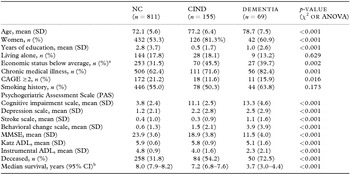
Of the 1,035 participants, 811 had no cognitive impairment, 155 had CIND, and 69 had dementia (43 with AD; 26 with VD). Table 1 lists the demographic and clinical characteristics of the study sample, according to cognitive diagnosis. The diagnostic groups differed significantly in terms of all characteristics except living arrangement and smoking history. Those with dementia were older and had more chronic medical illnesses than did those with normal cognition or CIND. The PAS-K subscale scores, including cognitive impairment, depression, stroke, and behavioral changes, were higher in the dementia group than in the other groups. Global cognitive function (measured by MMSE) and functional status (measured by Katz ADL and instrumental ADL) decreased with impaired cognition.
Characteristics at clinical evaluation by diagnostic group

NC = normal cognition; CIND = cognitive impairment no dementia; MMSE = Mini-Mental State Examination; ADL = activity of daily living; CAGE = Cut down, Annoyed, Guilty, and Eye-opener; 95% CI = 95% confidence interval.
aSubjective economic status was measured by 5-point Likert scale. Point 3 (Neither sufficient nor deficient) was regarded as average.
bMedian survival was assessed from the time of diagnosis.
Cognitive diagnosis and mortality
Our follow-up of the first-wave surveys revealed that 392 (37.9%) persons had died during eight years: 155 individuals died during the first three years (2000), 133 individuals during the second three years (2003), and 104 individuals during the last two years (2005). Table 1 shows that the mortality rates and the median survival of the three diagnostic groups differed significantly (p < 0.001). We used the Cox proportional hazards model to examine the relationship between cognitive diagnosis and risk of death while adjusting for age, sex, and years of education (Table 2 and Figure 1). Participants without cognitive impairment were regarded as a reference group. As shown in Table 2, mortality risk was nearly doubled for the CIND group compared with the reference group, and the risk of death was more than three times higher for the dementia group than the reference group. Results were similar after adding chronic medical illness as a potential confounding variable; 1.90 [1.44–2.51] for CIND and 3.04 [2.18–4.22] for dementia. We also conducted separate analyses by sex for examining the interaction between sex and cognitive status for mortality risk. The association of CIND and dementia with the risk of death in men seemed to be stronger than that in women (Table 2). However, this difference was not significant in the analysis that included terms for the interactions between sex and cognitive diagnoses (sex × CIND: estimate [95% CI], –0.004 [0.553–1.793], p = 0.989; sex × dementia: –0.358 [0.375–1.303], p = 0.260).
Relation of cognitive impairment, no dementia (CIND) and dementia to risk of death

CIND = cognitive impairment, no dementia; HR = hazard ratio; CI = confidence interval.
aFrom Cox proportional hazards models that controlled for age, gender, and years of education.
bFrom Cox proportional hazards models that controlled for gender and years of education.
cExamined among subjects with dementia and controlled for age, gender, and years of education.
*p < 0.05; **p < 0.01.
Comparable risks of death among those with cognitive impairment, no dementia (CIND) and dementia relative to those with normal cognition, adjusted for age, gender, and educational level.

Risk factors of mortality within diagnostic groups
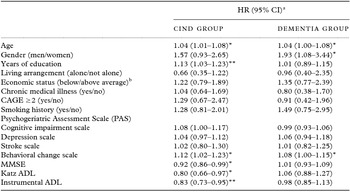
To determine the risk factors for mortality by each cognitive condition, we conducted separate analyses within CIND and dementia groups. Demographic and clinical variables at the time of diagnosis were examined as possible risk factors for mortality in each diagnostic group (Table 3).
Relation of baseline characteristics to risk of death among subjects with cognitive impairment, no dementia (CIND) and dementia

HR = hazard ratio; CI = confidence interval; CIND = cognitive impairment no dementia; MMSE = Mini-Mental State Examination; ADL = activity of daily living; CAGE = Cut down, Annoyed, Guilty, and Eye-opener.
aFrom Cox proportional hazards models that controlled for age, gender, and years of education.
bSubjective economic status was measured by 5-point Likert scale. Point 3 (Neither sufficient nor deficient) was regarded as average.
*p < 0.05; **p < 0.01.
With regard to demographic variables, old age and higher level of education increased the eight-year mortality in the CIND group, whereas old age and male sex were associated with increased risk of death in the dementia group. Because the mean number of years of education was low in our sample (0.5 year in the CIND group and 1.0 year in the dementia group), we also analyzed the association of education and mortality after dividing the sample according to educational background: “no formal schooling” and “formal schooling.” Similar results were observed in that that formal schooling increased mortality in individuals with CIND but not in those with dementia (2.28 [1.20–4.36] for CIND and 0.78 [0.36–1.70] for dementia). However, these differences were not significant in analyses that included terms for the interactions between significant demographic variables (age, sex, and education level) and the indicators for CIND and dementia.
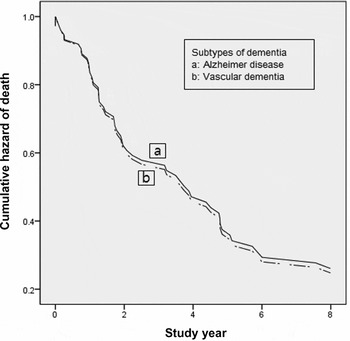
With regard to clinical variables, severity of cognitive impairment, depression, and stroke (measured by PAS-K) did not affect mortality risk in the CIND or dementia groups after adjustment for age, sex, and years of education. However, the degree of behavioral changes at diagnosis increased mortality for both CIND and dementia (Table 3). Furthermore, among behavioral change factors, impairment in social behavior, decreased spontaneity, and poor hygiene were associated with mortality in participants with CIND, whereas impairment in social behavior, excessive emotionality, and irritability were associated with mortality in patients with dementia (see Table S1, available as supplementary material attached to the electronic version of this paper at www.journals.cambridge.org/jid_IPG). Conversely, global cognitive function (MMSE) and functional status (Katz ADL and instrumental ADL) were associated with mortality only in the CIND group but not in the dementia group. Within the dementia group, we examined subtypes of dementia (whether AD or VD) as possible risks for death (Table 2 and Figure 2), and found that subtypes were not associated with mortality risk. After including terms for the interactions of significant clinical variables with CIND and dementia in the Cox model, only behavioral changes were confirmed to be different with significance in accordance with the cognitive diagnosis (behavioral changes × CIND: estimate [95% CI], 0.12 [1.03–1.23], p = 0.012; behavioral changes × dementia: 0.10 [1.03–1.18], p = 0.005).
Comparison of risks of death among those with Alzheimer disease (AD) and vascular dementia adjusted for age, sex, and educational level.

APOE genotyping was performed only for a limited number of persons (n = 362). The size of the dementia sample was insufficient to identify genotyping as a possible risk factor for death as only five individuals were examined. However, genotyping was performed for 38 individuals in the CIND group; six had the APOE ε4 allele and 32 did not. Those with the ε4 allele tended to be at increased risk of death (4.92 [0.80–30.28]), but these results were not significant (p = 0.086).
Discussion
We classified elderly people from a rural community into three groups according to cognitive status (normal cognition, CIND, and dementia) and monitored their survival rates over eight years. Those with CIND had a nearly doubled risk of death, and those with dementia were more than three times more likely to die than were those without cognitive impairment. Our results support previous community-based studies worldwide (Johansson and Zarit, Reference Johansson and Zarit1997; Tschanz et al., Reference Tschanz2004; Ganguli et al., Reference Ganguli, Dodge, Shen, Pandav and Dekosky2005; Guehne et al., Reference Guehne, Angermeyer and Riedel-Heller2006; Reference Guehne, Luck, Busse, Angermeyer and Riedel-Heller2007; Wilson et al., Reference Wilson2009; Todd et al., Reference Todd, Barr, Roberts and Passmore2013).
Cognitive impairment, no dementia
CIND is recognized as a precursor to dementia (Tuokko et al., Reference Tuokko2003). Although CIND involves clinically heterogeneous individuals with differing risks of developing dementia, the common hypothesis is that mortality among individuals with cognitive impairment may be related to an underlying developing dementia (Frisoni et al., Reference Frisoni, Fratiglioni, Fastbom, Viitanen and Winblad1999). The association between CIND and mortality has been observed in population-based studies (Johansson and Zarit, Reference Johansson and Zarit1997; Tuokko et al., Reference Tuokko2003; Guehne et al., Reference Guehne, Angermeyer and Riedel-Heller2006; Reference Guehne, Luck, Busse, Angermeyer and Riedel-Heller2007), whereas other studies have reported negative results (Fisk and Merry, Reference Fisk, Merry and Rockwood2003), possibly due to a lack of statistical power. In our large community-based sample, CIND doubled the risk of death, but the risk was lower for this group than for the group with dementia. Some previous studies found that the severity of cognitive impairment among dementia patients was associated with mortality (Dewey and Saz, Reference Dewey and Saz2001; Tschanz et al., Reference Tschanz2004; Andersen et al., Reference Andersen, Lolk, Martinussen and Kragh-Sorensen2010). Our results support this finding, and extend it by serially comparing mortality among normal-cognition, CIND, and dementia groups.
Dementia
We replicated the findings of previous studies that showed dementia increased risk of death (Tschanz et al., Reference Tschanz2004; Ganguli et al., Reference Ganguli, Dodge, Shen, Pandav and Dekosky2005; Wilson et al., Reference Wilson2009). The median survival from the time of diagnosis in our sample of individuals with dementia (3.7 years) was similar to that in prior reports; one review reported that the median survival from the time of diagnosis in those with dementia or AD ranged from 3.2–6.6 years (Todd et al., Reference Todd, Barr, Roberts and Passmore2013). However, since our study used prevalence cases, the median survival cannot be compared with that from other studies that used incident cases. Conversely, dementia subtype (AD or VD) did not affect the risk of death among individuals with dementia, consistent with prior reports (Matsui et al., Reference Matsui2009; Zhao et al., Reference Zhao, Zhou, Ding, Guo and Hong2010).
Predictors for mortality
Various factors have been reported as predictors for mortality in dementia; old age, male sex, advanced disease stage, and functional impairment have often been associated with mortality in patients with dementia (Brodaty et al., Reference Brodaty, Seeher and Gibson2012; Todd et al., Reference Todd, Barr, Roberts and Passmore2013). We separately examined demographic and clinical factors as predictors of death for those with CIND and dementia.
We identified two common predictors of death among those with CIND and dementia. Increased age was the first common risk factor. Because older people are already closer to the end of their life expectancy than are younger people, older adults with CIND or dementia may die proportionately earlier than younger people due to other causes.
Another common predictor for mortality in participants with CIND and dementia was behavioral changes at the time of diagnosis. This finding is consistent with previous reports that behavioral and psychological symptoms of dementia (BPSD) affect survival rates among individuals with dementia (Tun et al., Reference Tun, Murman, Long, Colenda and Von eye2007; Russ et al., Reference Russ, Batty and Starr2012). Furthermore, we found that behavioral changes were associated with mortality not only among individuals with dementia, but also among individuals with CIND. The behavioral changes scale used in our study included 15 items, including those addressing depressed mood, apathy, irritability, suspiciousness, and low sociability. Among these items, impairment in social behavior was the most common risk factor for both individuals with CIND and dementia. An association between the quality of social behavior and the prognosis for cognitive impairment has rarely been reported. However, one study reported that a better relationship between caregiver and care-recipient was related to caregiver burden, which could affect the prognosis of dementia (Quinn et al., Reference Quinn, Clare, McGuinness and Woods2012). Moreover, because people who have impaired social behavior may have problems asking for support or participating in social networks, they may also have difficulty finding help for their cognitive impairment. Therefore, low sociability can increase mortality among those with cognitive impairment, as we observed in this study. Conversely, less spontaneity and poor hygiene were also associated with mortality in participants with CIND, whereas excessive emotionality and irritability increased risk of death in dementia patients. Less spontaneity and poor hygiene may be associated with avolition. Although the PAS-K depression scores were not related to mortality in those with CIND, these avolitional symptoms may influence mortality rates among individuals with CIND by delaying diagnosis and hindering treatment (Ganguli et al., Reference Ganguli, Dodge, Shen, Pandav and Dekosky2005; Tun et al., Reference Tun, Murman, Long, Colenda and Von eye2007). In contrast, behavioral symptoms, such as the excessive emotionality and irritability of dementia patients, may contribute to an increased risk of death via rapid progression or early institutionalization (Tun et al., Reference Tun, Murman, Long, Colenda and Von eye2007; Russ et al., Reference Russ, Batty and Starr2012).
Few studies investigating risk factors for mortality have been conducted among those with pre-clinical stages of dementia, CIND, or MCI. We found that higher educational level was also associated with increased mortality among those with CIND. Education is an inconsistent risk factor for death in individuals with dementia: some studies have reported that higher education increases mortality rates, whereas other studies were unable to replicate these findings (Todd et al., Reference Todd, Barr, Roberts and Passmore2013). Individuals with higher education levels may also have more cognitive reserves, and their development of dementia may be detected and treated much later. Conversely, we found that global cognitive functioning can be a mortality risk factor for those in the pre-clinical stages of dementia because these stages can develop into dementia. Additionally, impaired ADL and instrumental ADL increased death rates in the CIND group but not in the dementia group. Functional impairment is a well-known risk factor for mortality in dementia patients (Ganguli et al., Reference Ganguli, Dodge, Shen, Pandav and Dekosky2005), but we found that it may also affect mortality among individuals with CIND. Among individuals with CIND, those with lower functional levels might be more likely to develop dementia, so they may also die earlier. Another possible explanation is that they may have had medical problems that may have affected their functional status; however, when we analyzed the data after adjusting for chronic medical illness, a significant association remained. Finally, possession of the APOE ε4 allele was associated with mortality risk in the CIND group, although the association was not significant, possibly due to the small sample size. APOE ε4 alleles can accelerate progression to dementia (Xu et al., Reference Xu, Caracciolo, Wang, Santoni, Winblad and Fratiglioni2013), and it is known as risk factor of death among dementia patients (Hayden et al., Reference Hayden2005), so it may also affect survival rates among those with CIND.
In addition to old age and behavioral changes, sex was another predictor for mortality in the dementia groups. Many studies have reported that men with dementia are more at risk of death than are women with dementia (Hayden et al., Reference Hayden2005; Todd et al., Reference Todd, Barr, Roberts and Passmore2013). This can be explained by the generally longer survival rates among women; our male sample with normal cognition was also more likely to die earlier (HR [95% CI], 1.07 [1.05–1.09]).
Strengths and limitations
This longitudinal cohort study used a community-based sample. Participants were sampled from one rural area in which individuals share similar characteristics, such as economic status and occupation in the agricultural industry. Clinical classifications of CIND and dementia were based on established criteria and uniform clinical evaluations by experienced psychiatrists. Participants were not being treated with drugs for dementia, which enabled true naturalistic observation.
The study had some limitations. First, we used a two-step diagnostic procedure by excluding the participants who scored above the cut-off value during the first phase. However, as the screening tool did not have perfect sensitivity, we could have missed some false negatives. Second, with regard to individuals with dementia, analyses did not include the duration of the illness at the time of baseline evaluation. Because individuals in the study area had little access to medical services, it is possible that participants who were diagnosed with dementia were already far progressed. This could make it more difficult to determine the risk factors for mortality in the dementia group compared with the CIND group. Lastly, we did not evaluate cognitive status at the time of death, and were unable to assess whether participants with CIND had progressed to dementia at the time of death.
Conclusions
We found that the presence of cognitive impairment, not only dementia but also CIND, affected the risk of death. This finding was consistent with previous studies that mainly focused on non-Asian samples. Further, the finding remained significant after controlling for various confounders, such as chronic medical illness, which can affect the mortality risk. Old age and behavioral changes were the most common risk factors for mortality among those with CIND and dementia. In terms of behavioral factors, impairment in social behavior commonly affected mortality risk in both groups. This study suggests that identifying and helping people with low sociability can be important in reducing mortality among those with cognitive impairment.
Conflict of interest
None.
Description of author's roles
Maeng Je Cho designed the study. Jee Eun Park analyzed the data and wrote the paper. Jun-Young Lee collected the data and supervised the writing of the paper. Guk-Hee Suh and Byung-Soo Kim also collected the data. All authors contributed to and approved the final manuscript.
Acknowledgments
This study was supported by grants from the Korea Research Foundation Grant (KRF-2002-041-E00150) and Korea Healthcare Technology R&D Project, Ministry for Health & Welfare, Republic of Korea (A070001). These agencies had no further role in study design; in the collection, analysis, and interpretation of data; in the writing of the report; or in the decision to submit the paper for publication.