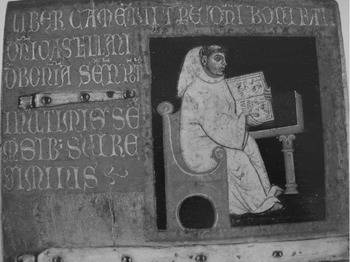
In the late 1250s, an anonymous Sienese painter produced a miniature of a now obscure monk, Ugo, from the major Cistercian abbey of San Galgano in southern Tuscany (Figure 1).Footnote 1 He is portrayed with his white habit and tonsure, sitting at a desk or cathedra, presenting an open book. It is the conventional pose known to art historians as the author-portrait, used to present an Evangelist, a scribe or perhaps a Master.Footnote 2 What makes this image unusual is that the book is not held open to reveal a biblical quote or an appropriate monastic text, but is furnished simply with dates: ‘i(n) a(nno) d(omini) mcclviii mense iulii’, confirming that this is not a book of the Bible or a monastic chronicle, nor even a text for classroom use. Instead, it is a representation of the author as treasurer (camerarius). Ugo's image has been painted on what was originally the wooden cover of one of the books of the Biccherna, the treasury of the commune of Siena, about sixteen miles across the hills from his remote, rural monastery. The dates on the open book, combined with what remains of the larger inscription framing his depiction, identify this as the communal account book for which he had been responsible in the second semester of 1258.Footnote 3
Anonymous, Ugo, monk of San Galgano. Tavola di Biccherna, Siena, Archivio di Stato, 1 (July–December 1258), detail. Reproduced by permission of the Archive.

If this image is unexpected, it is because the Cistercians, like most medieval monks professing the rule of Benedict, are conventionally defined in terms of their commitment to a life of chastity, obedience and personal poverty in a more or less inaccessible and enclosed monastic community. Most historians would acknowledge that this is shorthand for a more complex social reality, but one that is justified as a categorisation by the normative texts produced by the monks themselves.Footnote 4 In terms of such texts, Ugo must count as an anomaly. There is nothing in the rule of Benedict, or the constitutions used by the Cistercians, to indicate that its author expected his monks to serve as treasurers in a city such as Siena, one of the major centres of the Italian mercantile world; still less that they should be portrayed gripping a book of urban accounts. Nor is there any such indication in the various ‘institutes’ or customs adopted to supplement the succinct language of other monastic rules. Yet, though the form of this particular image is apparently unique, Ugo the monk-treasurer was by no means unusual as an ante-litteram public servant. He is just one of countless men of religion, most of them inevitably recorded in texts rather than visual images, on whom, from the middle of the thirteenth century, cities increasingly relied to fill key administrative and financial roles. The evidence for this phenomenon can be used to construct hypotheses about why the monk Ugo was to be found in this position, and some of these will be outlined below.Footnote 5 The main focus here will, however, be on the way in which it allows a more nuanced understanding of the varying expectations of clerical and, in particular, monastic behaviour in the late Middle Ages, the uses to which those expectations might be put and ways in which they could be negotiated.
Before pursuing this in detail, it is worth pausing both to underline the importance to contemporaries of such officials in the administration of public life, and to recall the growing emphasis on the separation of lay and clerical roles which the phenomenon described here would seem to defy. Both secular and ecclesiastical writers in the period point to the critical significance of government officials. Treatises on city government most often focused on the office of podestà, the chief magistrate and, at this date, still usually the head of communal government. They produced texts such as Orfino da Lodi's poem De sapientia potestatis (1245/6), or the anonymous Oculus pastoralis (c. 1222 or later), which also includes guidelines on the selection and training of officials.Footnote 6 The high expectations of men holding elected office in city governments at all levels (as in the Church) can, however, most succinctly be illustrated by reference to the widely circulated constitutions issued in November 1215 at the Fourth Lateran Council, staged in Rome by Pope Innocent III (1198–1215).Footnote 7 The third rubric, part of an attempt to engage the energies of secular authorities against heretics, placed the onus for action on ‘secular powers, whatever office they may hold’.Footnote 8 To its recipients in the early thirteenth-century Italian cities, the generic term ‘secular powers’ might evoke an imperial presence (or absence), as also a podestà, elected members of an urban council or indeed a communal treasurer. The association is evident in the ensuing enumeration of penalties for those who listened to heretics or otherwise patronised them. Should they refuse to mend their ways within a year of excommunication, they were ipso iure rendered infamous, to be excluded from ‘public offices or deliberations’, and from ‘the election of others to such offices’.Footnote 9
The constitutions of Lateran IV thus epitomise the public, exemplary, role attributable to elected office holders by clerics. The same constitutions also include a rubric which implies that the canon lawyers drafting the text assumed that in writing about secular office they were describing laymen, or at least that clerical involvement in such offices should remain minimal. Reiterating and extending a provision of the Third Lateran Council (1179), which had advocated the disengagement of clergy from acting as proctors or otherwise engaging in the secular courts (quoting the Pauline epigram ‘nemo militans deo implicat se negotiis secularibus’, 2 Timothy 2, 4), the sixteenth constitution of Lateran IV prescribes that ‘clerics shall not engage in secular offices or affairs, above all dishonest ones’ (‘clerici officia vel commercia saecularia non exerceant, maxime inhonesta’).Footnote 10 This attempt at the ‘clericalisation of the clergy’ did not rule out the possibility of carrying out ‘officia vel commercia honesta’.Footnote 11 But there can be little doubt about the thrust of what was intended: ‘officia vel commercia saecularia’ were to be the business of laymen, a clerical view of secular office also accepted by some lay legislators. It was used, for example, as a reason not to employ churchmen as royal bailiffs (baiuli) in the Liber Augustalis (1231), a book of laws issued for the kingdom of southern Italy in the name of Emperor Frederick II (and a collection which also began with anti-heretical legislation). The 1231 rubric simply asserts that the very fact of clerical status bars clergy from affairs of court and therefore from this role: ‘clerici quoque quos a forensibus negotiis ipse ordo clericalis excludit’.Footnote 12
The arguments for a separation of clerical and secular roles underlying the thinking of these lawmakers had acquired increasing currency in the aftermath of the eleventh-century reforms usually identified with Pope Gregory VII (1073–84), their most radical advocate. Both lay and ecclesiastical reformers had set out to distinguish clerical behaviour from that of the laity and to enhance clerical rather than secular authority in spiritual and political terms.Footnote 13 The nature and impact of this ‘Gregorian’ reform has, of course, been widely debated and, in a useful contribution to that discussion, Maureen Miller has argued that insufficient credit has been given to the redefinition of clerical mindsets and behaviour in the wake of reform. Positing that ‘religion makes a difference’, or, at least, more of a difference than usually acknowledged, she draws on the material culture of bishops – in particular the building and decoration of their halls – to underline the divergence.Footnote 14 The enforcement of changes such as clerical celibacy was, as she remarks, never complete, but ‘institutional pressure, particularly through the training of clerics, was strong enough to inculcate different patterns of thought and behavior’.Footnote 15 At the same time, the laity expected their clergy to be different, to be held to higher standards of behaviour, not to ‘live like lay people’.Footnote 16 Miller also very acutely observes that as well as race, ethnicity and gender, common subjects for the historical analysis of difference, ‘religion can share the defining characteristics that Joan Scott once set out for gender as an analytical category’. In other words, religion may be a ‘“constitutive element of social relations based on perceived differences” and a “primary way of signifying power relations”’.Footnote 17 She concludes that the clergy were different from the laity, and that ‘understanding these differences is important because power was at stake’.Footnote 18
Miller's focus was the diocesan bishop and her primary aim was to show that clergy and laity were divided by material culture, not just a clerical mindset, but her arguments about divergence might be expected to resonate all the more powerfully if we turn to the sort of monastic figure represented by Ugo of San Galgano. Monks were committed to a rule of life centred on prayer: to state the obvious, they were regulars because they followed a rule. In their hairstyles, their celibacy, their routines, they were (or were supposed to be) the antithesis of male secular culture. This need not, despite the legislation noted above, exclude them from economic activity. By the early thirteenth century the Cistercians, for example, were already managing huge estates and had evolved into famously efficient entrepreneurs.Footnote 19 But the ideal purpose of their lives and these communities remained the praise of God. Their economic activity was, broadly conceived, directed at the well-being of their own communities: if they held offices it was as a cellarer or infirmarer, prior or abbot. And, indeed, there is currently no evidence that in November 1215, when the constitutions were read out at the spectacular climax of the Lateran Council, either Cistercians or other professed religious of whatever status were assuming elected or paid offices in the Italian cities. At all levels such positions seem to have been held by laymen, elected or appointed by urban councils protective of their autonomy from imperial and ecclesiastical power, and often men of substance, since the poor were expected to be more susceptible to temptation.Footnote 20 This exclusion of the clergy is, somewhat paradoxically, both what medieval religious reformers probably desired and what modern historians, at least since the work of Jakob Burckhardt, might have expected of the political and social world that generated the Italian Renaissance: a world of growing lay confidence and emergent secularism, with churchmen gradually disappearing from positions of temporal authority or responsibility.Footnote 21 Within a few years, however, the situation began to transform.
Some of the earliest known cases of men of religion employed as salaried urban officials were lay penitents and members of the order of the Humiliati.Footnote 22 Thus for example, in the northern lakeside town of Como the two ‘religiosi et honesti viri in religione comorantes’ to be employed as ‘massari’ with oversight of the communal treasury seem to have been Humiliati tertiaries.Footnote 23 In numerous cities, however (though not Como), they were soon joined, and in several cases superseded, by Cistercians like Ugo of San Galgano, as well as, much less systematically, by other monastics bound by profession to a rule.Footnote 24
From the end of the 1250s men of religion like Ugo were thus to be found holding a multiplicity of paid, term-bound offices in urban governments in ever-increasing numbers across central and northern Italy. Alongside tertiaries, lay penitents and conversi (in this case lay religious belonging to Cistercian houses), they served in positions previously reserved to the laity, sometimes alone, sometimes sharing their tasks with those same laymen. In serving as a treasurer in Siena, for example, Ugo worked alongside a whole team of scribes and messengers and, in particular, four laymen, known as provisores, who acted as general overseers of the accounts and were chosen, like the treasurer, to hold office for fixed terms. And men like Ugo were to return to office again and again, in many cases over several decades, even, in a few, over centuries.Footnote 25
As already indicated, there is abundant evidence for this practice of employing men of religion outside the Church. It survives not only in the rubrics of urban legislation like that of Como, but also in the (much less common) minutes recording the debates and decisions of urban council meetings. The men employed also left behind ever-increasing numbers of books of accounts and, in one case at least, to which we will return, their activities are recorded in a concession granted by an urban to a monastic community.Footnote 26 Although typically incomplete, when brought together this material exposes the different ways in which religious status might be envisaged and exploited in the late medieval urban Italian world. It thus allows an alternative approach to the divergence of lay and clerical behaviours and mindsets discussed by Miller. It suggests that religious status (treated as a subset of ‘clerical culture’) could become an important object of negotiation between city and churchmen, a tool in the repertoire of power relations and, it will be argued, more contingent and fluid than the norm-based models with which we are more usually resigned to working.
This discussion concentrates on the role of treasurers, perhaps the key administrative figures after the podestà. Their relative importance is reflected in the usual location of rubrics concerning them, in the first book or ‘distinction’ of statute compilations, immediately following those concerning the podestà. The focus here is also intended to highlight what is perhaps the least likely role for professed religious in the age of Francis of Assisi (d. 1226), whose horror of coins was to be profoundly influential, as well as increasingly controversial.Footnote 27 But it should be borne in mind that the figure of treasurer also stands for a still more complex reality. Men of religion could be found holding a wide range of different administrative and supervisory roles in the late medieval Italian cities. They were employed to look after the lion kept as a symbol by Florence and, more prosaically, they manned tolls, served as scrutineers in elections, as ambassadors and messengers on behalf of governments or overseers for public building works. In numerous cities the face of administration must often have been a religious one.
The present paper sets out a number of case studies, prioritising the evidence for communal treasurers in the thirteenth- and early fourteenth-century city of Florence and a few of her Tuscan neighbours, where the surviving sources are particularly extensive. It then briefly broadens the discussion to sample cases from other cities, before seeking to draw these different elements together to a conclusion.
Florence in the thirteenth and early fourteenth centuries
From the middle of the thirteenth century, monastic treasurers in the commune of Florence were generally recruited either from among the Humiliati of Ognissanti or from the Cistercians of San Salvatore di Settimo. The Humiliati, a daughter house of San Michele in Alessandria (Piedmont), had first settled at San Donato in September 1239, but in 1251 moved to a larger church, which became Ognissanti, within the city but outside the twelfth-century circuit of walls.Footnote 28 The monks at Settimo on the other hand, who replaced a Benedictine community, were a daughter house of San Galgano, established in June 1236 in the Arno valley ten miles down river from Florence, and were soon employed to administer the estates of the bishop, Ardingo, who had been instrumental in bringing both orders to his diocese.Footnote 29
The first evidence of the use of these men as communal treasurers coincides with the rise of the new men of the primo popolo (1250–60), mostly non-noble guild members, who were at this date (but by no means always) aligned with anti-imperial, pro-papal politics (‘Guelf’ in Florentine politics and beyond).Footnote 30 The choice of monastics as holders of the communal purse strings may in this instance have had something to do with a relative lack of skills: at this early date in the history of the Florentine popolo, monks perhaps had greater administrative experience than their lay counterparts. But the popolo rose to power in a reaction against the domination of elite factions, so it might be expected that a perception of monastics as detached from the manoeuvrings of those elites played an equally important role.
In the following century the Florentine chronicler Giovanni Villani (d. 1348), seems to have accepted a correlation of this arrangement with contemporary political imperatives.Footnote 31 He reports on the re-configuring of the commune and popolo by the elite faction of the Guelfs after the arrival in the city in 1267 of the papally appointed servator pacis, Charles of Anjou, and the expulsion of the ‘Ghibellines’ (who had in turn replaced the primo popolo in 1260, having defeated them in battle at Montaperti).Footnote 32 Villani's account of this realignment closes with a brief note, adding that the Guelfs appointed religious by turn from the houses of Settimo and Ognissanti as treasurers for six-month terms: ‘In questo modo s'ordinò lo stato e corso del Comune e del popolo di Firenze alla tornata de’ Guelfi; e camerlenghi della pecunia feciono religiosi di Settimo e d'Ognesanti di sei in sei mesi.’Footnote 33
Like modern historians, Villani viewed the past of his city with the troublesome benefit of retrospection, though undoubtedly with more information at his disposal than can now be obtained. It is not immediately obvious why he associated this detail about monastic treasurers with the arrival of the Angevins and the shift to government by the elite faction of the Guelfs. It may simply be that he neither knew nor cared when the practice started, or saw the changes of 1267 as a move away from political neutrality. Or perhaps Villani never saw it as a question of impartiality. Whereas the documented origins of the practice – sometime in the mid-1250s – might suggest either a lack of expertise among the laymen of the popolo or a link with their attempts to establish non-elite government, Villani's account tends to confirm that at least by the time he was writing, there was an accepted nexus between the faction of the Guelfs and monastic treasurers.
Whatever its origins, Villani's retrospective association of religious working in the communal treasury with Guelf political interests in Florence (and in turn with the popolo) can also be constructed directly from thirteenth-century evidence. From 1278, for example, in apparently unforced partnership with the Pars Guelfa, the Humiliati undertook a major development project in the area around their convent, which saw the construction of a new borgo and the expansion of the Pratum comunis (communal open ground), also to be known as the Pratum Omniumsanctorum.Footnote 34 The Cistercians too obtained land in the city which, over the following decades, they developed into a substantial residential district.Footnote 35
These associations with the elite faction were also, inevitably, enacted in the councils of government. In May 1289, for example, twenty-two years after the return of the popolo, Angelo, a monk of Settimo (‘honestus vir dominus dompnus Angelus de septimo cisterciensis ordinis’), treasurer of the commune, made a speech before the Council of the popolo. He requested authority to spend up to 1,200 gold florins on welcoming to the city the Angevin Charles II of Sicily (who had been released from Aragonese imprisonment in October of the previous year). The request was approved by a vote of 280 to 35.Footnote 36 Charles appears only to have come to Florence in the mid-1290s, but it seems unarguable that Angelo, like other monastic spokesmen in such circumstances, was hereby identified with both the government and the Angevin/Guelf faction that Charles represented.Footnote 37
Numerous monastics had held office as treasurers in Florence by this date, but there is also continuing evidence for laymen in the role. In February 1289 for example, three months before Angelo's speech, a layman, Ghinus Davançi, camerarius comunis florentie, presented a petition to the government on behalf of himself and his associates in the office of the treasury.Footnote 38 The autumn of that year then witnessed a major innovation, which amounted to an increased laicisation of the role. Provisions issued in September laid down that there were now to be four men appointed as treasurers, only one of whom was to be a religious, alternating ‘as is the custom, from the usual religious [houses]’. The three laymen chosen were to be experienced seculars from the guilds of Florence, of proven integrity and fairness (literally ‘law worthiness’).Footnote 39 The text setting out the reasoning behind this new arrangement is a devastating assessment of recent procedures. According to the rubric, there had been constant disputes and complaints against the treasurers and the government itself, caused by inadequate care shown towards the money and property of the commune and slipshod book-keeping, so that the accounts (rationes) of the treasury could not be reviewed unless with some confusion, because of the indiscriminate way in which income and expenditure were described, without appropriate division (‘qui sine discretione aliqua speciei vel generis modo promischuo describuntur’). The situation, it was claimed, needed to be remedied so as to protect the reputation (fama) of the officials of the treasury.Footnote 40
For some years the government of Florence had been engaged in dispute with the Cistercians of Settimo over a mill and weir on the river Arno, constructions which were hindering navigation to the city. The controversy was to rumble on for decades, finding resolution only in the 1330s, and it is not impossible that this influenced the decision to reduce the presence of religious in the treasury.Footnote 41 Yet, as the Humiliati appear not to have been implicated in the disagreement, it seems unlikely. The increasing complexity of the Florentine economy and attempts to improve transparency may have driven a demand for greater proficiency.Footnote 42 It is possible that this rubric alludes to a general failure on the part of the treasurers – monastic and lay – to match the growing expertise among laymen keeping personal accounts, for which there is good evidence by this date, so that lay members of the popolo could now do a better job than the religious.Footnote 43 As constructed here, however, it was incompetence, perhaps exposed by auditors, which was endangering the reputation of the officials themselves, their office and the government (regimen). It is a view of reputation which chimes with the importance attributed to office holders in the constitutions of the Fourth Lateran Council and which the canon lawyers of 1215 had sought to exploit: officials could be intimately associated with the good (and bad) name of government. We do not know why the change was made, but whether or not they were at fault, the criticisms cannot have done much for the reputation of the monastic houses involved. And yet, while the decision was made to increase the numbers of laymen in the treasury, men of religion were still to be employed.
At this legislative level, professional religious appear to have become indispensable in the treasury of Florence. In practice, for several years after 1289, the only treasurers documented appear to be laymen, though the evidence is far from comprehensive.Footnote 44 With the new century, however, monks are again to be found working regularly in the treasury: in August and September 1303 for example, Ubaldo, a monk of Settimo, was serving as treasurer alongside three laymen, each appointed, as required by the provisions of 1289, from a different administrative division (sesto) of the city.Footnote 45 And in 1307, after the podestà had been caught taking off with the communal seal, it was retrieved and handed for safekeeping to the monks at Settimo.Footnote 46
Evidence from the early fourteenth century provides further insight into the dynamics of this relationship between monastics and commune. In 1312, when the German emperor Henry VII, who had come south of the Alps seeking to reassert imperial rule, was besieging the city, he took the monastery of Settimo into his protection, a move undoubtedly designed to build support for his cause.Footnote 47 In April of the following year, with Henry no longer at the gates, the governing body of the city (the Priors and Standardbearer of Justice) in turn undertook to bring the rights and property of the abbot, monks, conversi and oblates of Settimo into their protection. According to the surviving copy of the agreement in the books of the Cistercians, this concession was made for several reasons, each of which is briefly itemised. The first was the continual disruptions of war and the inability of the religious houses in the district of Florence to defend and sustain themselves and their rights. Protection was also explicitly offered so that the abbot and monks would remain ‘loyal to the commune and popolo of Florence and the primary advocates of its peaceful and tranquil state’, and as a response to ‘the alms and prayers offered to God in the monastery’, again so that God would ‘maintain Florence and its contado in a state of peace’. These were not uncommon grounds for promoting jurisdictional expansion.Footnote 48 But the reiteration also reads as an anxious rejoinder to Henry's earlier privilege, and points to the urgency of ensuring Settimo's peaceful relations with the city. The last reason specified, however, adopts a very different tack: the city also undertook to protect the house as an acknowledgement of the labours which monks and conversi of the monastery had ‘endured until then and daily tolerated’ (‘tollerant et subportant’), both in the treasury of the commune and in other communal offices (offitia comunis).Footnote 49 The monastery of Settimo thus acquired protection from its powerful neighbour, almost certainly in response to an immediate and urgent need on both sides. This was also presented, at least in part, as recompense for specific, long-standing endeavours by the monks and lay brothers in the administrative service of the commune. To someone involved in the preparation of this text, the employment of religious in the city appeared to be a matter for negotiation.
The link between service and reward in this document is unusually explicit. The candour may stem from the Cistercian context in which it survives, since detailed elaboration of government decisions is rare outside either chronicle accounts or the more succinct official minutes of communal assemblies and legislative bodies. Its echo is nonetheless found in near-contemporary urban legislation, which also encompasses the Humiliati, and reiterates the emphasis on the labours of both religious communities on behalf of the popolo and commune. Two rubrics in the statutes produced in the name of the Florentine Capitano del popolo, datable before 1321, connect the service rendered to the popolo and commune by the Cistercians and Humiliati, not with protection, but instead with tax immunities awarded to the two houses. In the case of the Humiliati of Ognissanti, the concession is also linked to their role in accommodating officials. Fiscal immunity is thus granted:
Cum fratres humiliati Omnium Sanctorum de Florentia cotidie quasi labores tollerent et incommoda et expensas in servitium populi et communis Florentie, et maxime in retinendo offitiales ipsius Communis et populi qui ad condendum leges et statuta et fatiendum alia negotia populi et communis eiusdem deputantur, et ad egestatem devenerint.Footnote 50
The early archives of the Humiliati of Ognissanti are not accessible (they were damaged in the disastrous flood of the river Arno in 1966), so this assertion of the house's financial vulnerability cannot be tested, but it seems unlikely. Claims of poverty were in any case a standard strategy used, for example, in petitions to the papal and episcopal authorities to justify changes in monastic affairs.Footnote 51 Yet its use here implies at least that the authors of this rubric thought sufficient numbers of Florentines would be likely to accept its logic: engagement in the service of the commune was an onerous affair and justified the mitigation of any tax burden. The location of the passage in the Statutes of the Capitano also reinforces the link with a particular political body and, of course, it is the (Guelf) popolo.
The Cistercians of Settimo and the Humiliati of Ognissanti had been serving regularly as treasurers in Florence for more than half a century by this date. They had also remained in office through changes of regime from ‘Guelf’ to ‘Ghibelline’ elites (and between Black and White Guelfs).Footnote 52 So, if the protection and immunity offered were new, they cannot have been the initial triggers. Both texts may simply have refreshed long-standing but undocumented arrangements, rendered critical by the actions of Henry VII. But there are other clues to suggest that there was more to this picture than protection in time of war. In 1313 the city government offered itself (its signoria) to King Robert of Naples, heir to Charles II and leader of the Guelf alliance against Henry VII in Tuscany and southern Italy.Footnote 53 Barely eighteen months later, in September 1314, the administrative burden in the treasury reverted from one religious and three laymen to just two religious personnel, to alternate as before between the Humiliati of Ognissanti and the Cistercians of Settimo.Footnote 54 On 25 September 1314 the change was approved in the Council of One Hundred by a vote of ninety-one to two.Footnote 55 There might of course be no necessary cause and effect in this juxtaposition of a key political alliance with increased use of religious in the treasury. The practice of using men of religion had after all already reacquired its customary quality by this date. Nonetheless, the heightened dependence on men of religion may well have had political overtones and this is confirmed by details in the new provvisioni. Alongside the two religious treasurers there was to be the usual team of laymen: notaries, judges and accountants, ‘all of whom must be Guelfs’ (‘qui omnes sint et esse debeant Guelfi’).Footnote 56
The powers ascribed to the two religious treasurers in 1314 are explicitly equated to unspecified earlier periods when there had been just three lay treasurers (perhaps before the 1250s or at some point in the 1290s), or three laymen and one religious, as instituted in 1289. In future, according to the statutes, no laymen were to be elected as treasurers. Moreover, the men of religion appointed as treasurers were now explicitly exempted from attending council meetings and from any requirement to engage in activities which might infringe ‘ecclesiastical liberty’, or involve payment of an executioner.Footnote 57 This last provision accommodated both the canon law prohibition on clerical participation in the spilling of blood and the reform agenda of church leaders for whom ‘liberty’, understood in terms of autonomy over property and person (and of course tax exemption), remained an essential principle of action.
The explicit promise of protection for the Cistercians does not seem to have been necessary to the Humiliati, who had probably never occasioned the particular interest of Henry VII and were in any case based at the church of Ognissanti, by this date enclosed within the new circuit of walls which had been hurriedly thrown up around the western part of Florence, in the winter and spring of 1310–11.Footnote 58 On the other hand, it is significant that a further concession to both houses was now also made. The abbot of Settimo and provost of Ognissanti were assigned responsibility for distributing 2,000 florins, donated by the commune in alms each year to religious houses and hospitals in the city and contado.Footnote 59 In a diocese where, like many another, there was endemic tension between the different ecclesiastical communities, regular and secular, this must have been a delicate but perhaps also an attractive position.Footnote 60
Analysis of this Florentine evidence points to the agency of both commune and professional religious. Each had potential needs which the other might supply: protection, fiscal immunity, resources (both influence and property), in exchange for loyalty, politically (and perhaps financially) trusted officials and, of course, prayers and alms. Each made compromises to allow this practice to continue. Whatever explanation we choose to highlight – the impartial separateness attributed to men of religion, their integrity, their particular expertise or their political affinities – this evidence suggests above all that negotiation lay at the core of the appointment of professional religious to urban office.
That negotiated agreement was a key to office holding (and not just in Florence) is further underlined by the fact that cities could and did survive without professional religious as office holders, or alternated between lay and religious officials and varying combinations of the two. Some urban authorities forbade the employment of religious altogether. In 1265 in Padua for instance, a city where, incidentally, neither Humiliati nor Cistercians were to be found, but a Benedictine congregation of monaci albi built close ties with the commune, it was decreed that: ‘no lay brother [tertiary, penitent or conversus] or other person following a religious rule [may] be established in any ordinary or extraordinary office, honour or civil responsibility by the commune of Padua, nor hold such position’.Footnote 61 Elsewhere, monks, tertiaries and lay penitents could be, and often were, replaced in public office by laymen or by other religious, either because those making the rules changed their preference – as in Florence in 1289 and 1314 – or because the professional religious withdrew. Evidence from the city of Siena illustrates this last point. From the 1250s when monastics like Ugo of San Galgano were employed as treasurers in the city, the accounts reveal that the monastery was contacted to ensure that their appointment was confirmed.Footnote 62 By 1280 this had become both a matter of statute and a problem.Footnote 63 The Sienese podestà for that year, Matteo Rosso Orsini, reported to the general council of the commune on 26 December that in accordance with statute, the abbot and convent of San Galgano had been asked and required (requisiti et rogati) to produce a treasurer by means of letters and ambassadors from the commune. All requests had nonetheless been rejected: the monastery absolutely denied that it could provide (concedere) a treasurer, so they would have to look elsewhere.Footnote 64 Orsini may indeed have been describing a fait accompli: a Vallombrosan monk from San Michele in Poggio San Donato was already to be found as camerarius in January 1281 and remained until the end of 1282. By 1284 the Cistercians of San Galgano were to return.Footnote 65
We do not know what reason the abbot of San Galgano had given, if any, for his refusal, nor the wider context that led to this stalemate. But this episode underscores the negotiated nature of the choices made, and the verbs ascribed to Orsini by the communal scribe are revealing. On one hand the commune set out to ask and demand (requirere), on the other, the abbot refused to grant (concedere). Both verbs lay claim to authority, but as the holder of a resource the commune wanted (men of religion, whether monks or conversi), the monastery (presumably in the person of the abbot) is portrayed as the benefactor choosing and able to say no, however fleetingly.
The minutes of the communal assembly in the small town (burgum, castrum) of San Gimignano, between Florence and Siena, introduce a further element to this relationship of monastic superior to city office.Footnote 66 In the winter of 1264/5:
Donnus Petrus Prior Abatie de Murchio [a Camaldolese house a mile or so from the town] electus camerarius communis Sancti Geminiani, habita licentia a donno Barthal[ome]o Priore ordinis Camaldulensium ipsum camarlingatus officium acceptauit; promittens id ipsum officium bene et legaliter facere et exercere in omnibus et per omnia secundum quod continetur in capitulo constituti communis Sancti Geminiani ipsius camarlingatus.Footnote 67
Pietro's promise was delivered to Rosselmino, judge of the commune, in the choir of the pieve (the main urban church), before the principal assembly of the city, the Council of the Bell. The parallels and dissonances with a monastic profession of vows are manifest. He performed a predetermined ritual promise (not an oath, which was forbidden to professed religious), according to a normative text or set of rules. He delivered this promise to an individual who, together with the witnesses, personified the commune of San Gimignano. He did so as the result, however, not of a noviciate but of some sort of election, and it was to be a temporary arrangement, for six months (though in practice he was reelected for the following semester).Footnote 68 Far from being broken, the monastic vow of obedience was publicly endorsed by reference to the permission of the superior.Footnote 69
Pietro is unusual because he was himself a monastic superior and took office explicitly with the licence of his own superior, Bartolomeo, the prior general of his order (1263–5). Bartolomeo was frequently active in Florence, where he had been prior of San Salvatore di Camaldoli, so obtaining this authorisation was perhaps relatively straightforward.Footnote 70 It is remarkable, nonetheless, because it never seems to be matched for religious from other orders. Reference to local abbots allowing, even encouraging, individuals to take office can be traced, both implicitly (as above) and explicitly.Footnote 71 The approval or disapproval of the wider Cistercian order is, however, never alluded to in these sources, despite substantial evidence in their General Chapter statutes for discussions of loans of monks and conversi to various secular and episcopal lords (loans which were generally, though not always, refused, reflecting an undoubted ambivalence).Footnote 72 Nor is there evidence for the approval of the Master General of the Humiliati. Papal bulls reacting to petitions from both Humiliati and lay penitents point instead to their opposition to this sort of employment for the fully professed, though in the case of the Humiliati, for example, they are restricted to the middle of the thirteenth century and never touch upon either Florence or Siena.Footnote 73
Just as statute drafters like those in Florence in 1289 insisted on the need to appoint men who were honest, prudent and law-abiding or an analogous combination of qualities (honestus, bonus, prudens, legalis), so – like the monk Angelo encountered above – in the records of office themselves the individuals chosen were usually given soubriquets in the same terms, all related to ‘integrity’.Footnote 74 These were of course frequently used epithets, applied in a formulaic, office-driven manner comparable to the magnificus vir habitual for innumerable podestà, whether or not such men were ever truly superb.Footnote 75 Nor were such terms exclusive to the clergy, either regular or secular.Footnote 76 The insistence of communal councils on the uprightness and suitability of all office holders does nonetheless tend to support the thesis that men of religion may have been sought because they could be deemed less likely to engage in fraud. Monks like Ugo were also, theoretically at least, less able to use money than their lay counterparts, as they had no personal property and so, it might be argued, no reason to embezzle.Footnote 77
Extending the evidence beyond Tuscany also allows us further to demonstrate the flexibility of lay attitudes towards the status of men of religion. As we have seen, in Siena a Vallombrosan could replace a Cistercian, despite rubrics requiring exclusive appointment of Cistercians. This is unremarkable, but in Perugia in the 1340s, the statutes suggest that another kind of equation of religious was also possible. The statutes of 1342 underline that in future the treasurer (masaio del comuno): ‘essere degga per lo tenpo che verrà relegioso e de relegione e eleggase la religione overo el capitolo de la relegione tanto e non alcuno nomenatamente secondo co’ de la relegione piacerà al conselglo del popolo ordenare’.Footnote 78 The frequent repetition of relegione, even allowing for its distinct uses to indicate both a religious order in general and a particular house, points to the magnitude of the issue. The following rubric again reiterates that the treasurer may not be a secular, thereby demonstrating a different kind of duplication, typical of urban statutes which are, of course, documents generated by continuous redrafting. It does not tell us why Perugia wanted a man of religion, but it is, nonetheless, a renewed indication of the particular importance assigned at this moment to avoiding the engagement of laymen. The definition of religioso supplied at the end of the first rubric is particularly revealing. As a gloss to the previous passage, it asserts that for the purposes of the office of treasurer the friars of penance are also to be understood to be religious: ‘E che ei frate de la Penetentia se entendano essere, quanto a l'offitio del masariato, relegiose e de relegione.’Footnote 79 There are questions of jurisdiction at play here: the friars of penance are not being defined as fully professed religious on a par with those who live within a monastic community (the usual meaning of de relegione). Nor are they being exempted from taxes and military service. They are being equated to such fully professed religious for a single, contingent purpose – holding office in the treasury.
The Perugia legislators’ gloss serves as a reminder that vir religiosus was a flexible term, which in some contexts simply indicated a pious individual. It need not apply only to those dedicated to a rule. In the texts discussed here it is titles and labels such as dompnus, monachus or frater which confirm specific, religious status. These are also the distinctions upon which canon lawyers would insist. But the city legislators thought nothing of redefining lay penitents in monastic terms to meet a presumably pressing need: lay expectations and demands of religious status could and did change.
Broadening the range of examples still further beyond central Italy allows us to explore yet other ways in which this issue might be approached. The rubric from Como mentioned above asserts that the podestà should use coercion to compel the men of religion to perform the task: ‘Religiosi et honesti viri in professione religionis comorantes quos fratres potestas teneatur modis omnibus habere et eos cohercere ad ipsum officium faciendum.’Footnote 80 In a similar tone, a rubric of 1288 from the statutes of the north-eastern city of Verona requires ministers and brothers of the religious houses involved to give of their ‘most useful and best’ men to take office (‘de utilioribus et melioribus’). If they fail to do so and if for that reason the commune is defrauded in any way, the podestà is to compel the religious community to refund the loss.Footnote 81 Like the Como statute, the language of compulsion used here fits well with a financial line of reasoning: the unpleasant prospect of exposure to risk might well explain the coercive tenor.Footnote 82 Yet this very tone points equally to the rhetorical and discursive purpose of these rubrics: they voice an aspiration, which may or may not have been capable of practical enactment. After all, while the tertiary Humiliati may have been relatively vulnerable, it cannot have been easy to force a monastic community to pay any monies due. Lay patrons invested substantially in the wealth and beauty of religious houses. Although little now survives of Humiliati buildings in Como or Verona, for example, the order enjoyed generous patronage of its churches in these cities, as it did in Florence, Siena and in numerous centres all over central and northern Italy. Other regular orders benefited from similar or still greater lay generosity. To what purpose would they, or their patrons, allow this prosperity to be put at risk or turned to other purposes? And, indeed, there is very little, if any, evidence for such payments. Luigi Zanoni, the historian of the Humiliati, noted a sum demanded in Parma, but it is recorded because the money was to be returned.Footnote 83 It might be objected that there must have been unrecorded transactions, but if this practice were widespread, we might equally expect to find these payments entered in the many extant books of communal accounts. There can be little doubt that strapped-for-cash communes were keen to tap into ecclesiastical wealth: evidence abounds of communes instituting taxes on ecclesiastics, not without success.Footnote 84 What little corroboration there is for office holding as a way to access or exploit the wealth of religious houses implies, instead, that it was not effective.
A further reason which may have guided the employment of religious is their relative expertise. The statutes of Bologna of 1288 for example refer frequently to tasks which would entail the ability to count (numerari), and not just in the treasury. A rubric requiring the appointment of two friars of penance as supervisors of bridge-building works and other construction projects paid for with communal monies further specifies that one of the two must know how to write: litteratus qui scribere sciat.Footnote 85 A comparable insistence on using litterati (most appropriately translated in this context as ‘experts’) is found in a description of Dominican and Franciscan friars to be appointed to supervise elections in Brescia in 1313.Footnote 86 That the drafters of these statutes highlighted such expertise is, naturally, an acknowledgement of the potential lack of such abilities within Mendicant ranks, as among the laity. Any equation of cleric with litteratus, in the case of friars of penance and even of monks or Mendicants, could never be inevitable at the level of the individual. Choir monks and Mendicant friars were very likely to be highly literate and numerate by contemporary standards, but the monopoly of the Friars over such skills centred on the new universities and the production of more sophisticated tools for theological study and preaching, not book-keeping.Footnote 87 Monks and conversi did keep the books to enable them to administer large estates – as we have seen, in the early days of the primo popolo in Florence this may have been a key consideration in their appointment – but, if literacy or numeracy were really the main issue behind urban office holding, within a very few years such skills were widely available among the mercantile laity, without resort to men like Ugo of San Galgano.Footnote 88 Accounting was not taught with the abacus at school but was learned on the job.Footnote 89 This was the period when laymen in Florence and other Italian cities were developing the financial acumen which would eventually result in the emergence of techniques such as double-entry book-keeping. It seems equally likely that laymen could also have been found who had substantial administrative experience. Italian merchants and bankers were, after all, developing extensive and sophisticated parchment and paper trails to support their international trade networks.
A final concern is that of detachment: that those appointed could be considered to be distant from any direct relations with others holding office.Footnote 90 As we have seen, it might be argued that this is what drove the choice of monastics in the Florence of the primo popolo. Yet in many other cases, the assumption on which hypotheses of detachment are based may in practice be an illusion resulting in part from ignorance about the social status of individuals. Family names based on lineage or location emerged in the thirteenth century as a way for elites to denote their status.Footnote 91 At the same time detachment from family was encouraged in monastic rules. As a mark of their new life, therefore, on entering a monastic house, monks of all types usually abandoned any family name, so that in the written record they do indeed appear ‘family-less’, detached from kin in a way comparable to outsider-appointees such as a podestà. This makes it difficult to identify the social background of many of the professional religious involved in holding office. There seem, for example, to be just two exceptions to this rule in the thirteenth-century Sienese treasury, one of whom, a man named Bartolomeo de Alexis, monk of San Galgano, served as communal treasurer in the 1270s and became abbot of his house in the early fourteenth century – an unlikely candidate for detached status.Footnote 92 His case implies, incidentally, that being an urban treasurer need not damage an ecclesiastical career, though one case hardly substantiates the broader argument. Other examples have been unearthed in Milan and will be discussed below, but in practice, in most cases we cannot know whether the individual Cistercians chosen as treasurers in Siena, as in Florence, came from low- or high-status families, from the politically engaged or from the politically and socially disenfranchised. Similar uncertainties surface if we try to pin down the social status of individuals from the other orders typically involved, including the Humiliati, who encompassed men of varying social status, dominated perhaps by the ‘middle class’.Footnote 93 Nonetheless, it is very probable that many of the monks of San Galgano were originally Sienese and that the majority of the Humiliati in Florence or Siena were also indigenous.Footnote 94 If so, whatever their original social status, any detachment would have depended on the construction of difference, on Miller's ‘different patterns of thought and behavior’, since client–patron relations certainly crossed social groups.
On the other hand, whether it was practicable or not, there is evidence that the degree of ‘detachment’ was indeed sometimes a factor in the thinking of legislators about urban appointments. In Como, alongside the religiosi viri in the treasury, the statute makers explicitly sought homines religiosi without wife or family to serve as assessors against fraudulent weights and measures and to check the quality of the salt.Footnote 95 In San Gimignano, the statutes assigned different rates of pay for appointees to the treasury, allowing foreigners to be paid more than their domestic counterparts.Footnote 96 In other cases, outsiders were explicitly preferred: thus the Dominican and Franciscan friars chosen to scrutinise elections in the Lombard city of Brescia in 1313 were also required to be foresterii.Footnote 97 Such thinking of course tends to confirm that their opposites – local, indigenous religious – need not be detached from politics, nor expected to be. Like the men of the Florentine treasury in 1314, in Bologna in 1288 the link is once again made clear. A rubric in one copy of the city statutes specifies that the penitents appointed to supervise communal works must be aligned with the faction of the Church, the Geremie.Footnote 98 The examples could be multiplied, but the point would remain the same: status as a man of religion need not mean either exemption from factional interests or inevitably being deemed to be detached. Whether a monk from San Galgano or Settimo, a Vallombrosan or Camaldolese brother, or a Humiliati frater from the Sienese or Florentine houses could (or would wish to) remain sufficiently aloof to act as a check on the activities of their lay associates in the communal treasuries remains at best uncertain. It is, on the other hand, clear that contemporaries, at least those generating and drafting statutes, did sometimes think of religious office holders in terms of detachment (qua outsiders) or attachment (to a pars).
This last point in particular is verifiable in further evidence from other cities. A detailed study of the Humiliati in the northern city of Bergamo demonstrates, for example, that their employment by the commune was ‘more substantial in periods of city life characterised by a Guelf tendency’.Footnote 99 Evidence from Milan gives added weight to this factional perspective. Details about the brothers from the Cistercian abbey of Chiaravalle Milanese, some three miles south-east of the city, make it possible to identify the kin groups of some of the men chosen as urban treasurers. This reveals that they came from the same families of the popolo who, after the middle of the thirteenth century, dominated the commune.Footnote 100 As in Florence, this may have had something to do with their relatively high proficiency as administrators when compared to the men of the popolo. But clerical separateness is here subsumed into political or factional affiliation. And here the effect this might have on a religious community when the politics changed is also apparent: like the Cistercians, the Humiliati held offices in Milan in the third quarter of the thirteenth century. After 1277, when the della Torre faction was ousted by Ottone Visconti, who initiated his family's domination of the city, the popolo lost its position and with it Humiliati engagement in office holding declined. The role of exactors of the ecclesiastical fodrum (hearth tax), for example, passed from Humiliati to brothers of the Hospital of the Brolo.Footnote 101 Perhaps the Humiliati had become politically untrustworthy because they were identified with the della Torre faction, while the Brolo was close to the Visconti. It should be noted, nonetheless, that the replacements were still fratres, still men of religion: the choice being made was between groups of professional religious, not between religious and laymen. As in Florence, the principle of employing men of religion survived the change of regime.Footnote 102
It is not difficult – and, indeed, not an unreasonable activity for historians – to use the evidence presented here to set out a list of possible explanations for the employment of men such as Ugo of San Galgano, or his Humiliati, Camaldolese and other regular and penitent associates. I have outlined some of the arguments in the cases considered above. They remain useful ways to approach lay constructions of clerical mindsets and behaviours. The regular clergy might indeed be thought to be impartial, men of integrity, trustworthy. These factors, given different emphases by previous historians, might be used to construct an account of normative clerical behaviour in the period. The common thread to the urban sources here is, however, their contingent, conditional nature. Fragmentary as they are, they tell us more about how men of government responded to and manipulated the possibilities than they do about the realities of difference or any fundamental motivation driving their decisions. Even in the disconnected form in which they have inevitably been presented here, they reveal a great deal about the fluidity of expectations of men of religion. City governments might depend on men of religion in office, curb their dependence, or decide not to use them at all. Churchmen like the abbot of San Galgano might allow his monks to participate in city office, encourage them or refuse outright. The men of religion holding urban office in this period, like their lay counterparts, might be considered detached and impartial or required to be attached (and partial). Whatever their origins, the practice of using them in government offices acquired the weight of custom, and was embodied in statute; but custom could, of course, be changed. The sort of negotiation found in these texts draws attention to the conditional implications of religious status. Its separateness was a tool used in the engagement between city authorities and monastic communities. Like gender, the expectations of professional religious could be socially or politically determined and contingent. Power was at stake and like gender, religious status, often narrowly defined as membership of a particular house, determined the activities allowed to particular individuals or communities, and, at times, access to resources. The distinction between laymen and clergy might be underlined by the insistence on employing one to the exclusion of the other. Yet it might also be obscured by the requirement that, once in office, they undertake (almost) the same tasks.
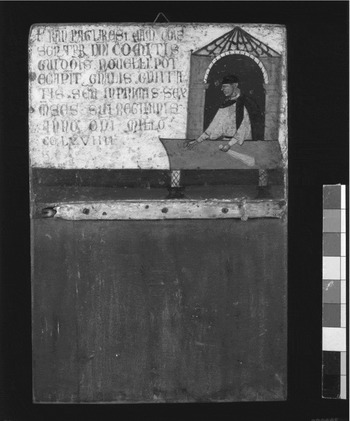
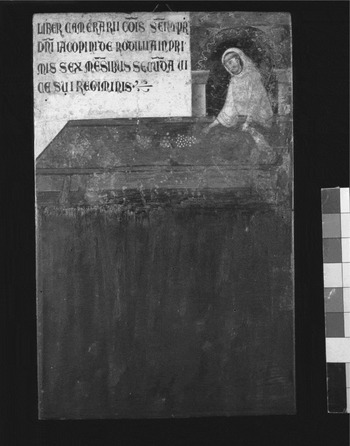
As we have seen, laymen and men of religion, as in Florence in the thirteenth and early fourteenth centuries, often worked alongside each other. There are some key differences: laymen were usually elected by scrutiny, whilst men of religion were generally selected by the superior of their house (in turn identified by the communal authorities). A rubric might also explicitly safeguard libertas ecclesie. Otherwise, the duties required of the men appointed were, inevitably, more or less identical.Footnote 103 At different junctures city legislators might determine a preference for lay or religious officials, but the rubrics guiding their activities suggest that the two were to some degree interchangeable and might be viewed in closely comparable ways. Such overlapping perceptions can be seen in two slightly later covers of the books of the Sienese Biccherna with which we began. One portrays a lay treasurer, Ranieri Pagliaresi, who held office in 1270 (Figure 2), the other shows Bartolomeo, a monk of San Galgano, in the same role six years later (Figure 3). Bartolomeo's pose is notably similar to the depiction of Ranieri: both stand in a booth behind a trestle table.Footnote 104 Both are shown with a moneybag, indicating or counting coins. Bartolomeo is in three-quarter view, leaning forward in his hooded white habit with his head bent towards the piles of coins he is counting into the bag. Ranieri is in profile, wearing a black skullcap, cloak and belt over a white tunic with elegant buttoned sleeves, a delicate red ribbon at his neck. His fingers too are counting coins, though his face looks to the distance. The special status of Bartolomeo as monk-treasurer is restricted to his clothing and tonsure: in this instance the habit did indeed make the monk.
Attributed to Diotisalvi di Speme, Ranieri Pagliaresi. Tavola di Biccherna, Siena, Archivio di Stato, 4 (January–June 1270). Reproduced by permission of the Archive.

Anonymous, Bartolomeo, monk of San Galgano. Tavola di Biccherna, Siena, Archivio di Stato, 6 (January–June 1276). Reproduced by permission of the Archive.

The iconography of these two images of course depends as much on artistic convention and the painters employed as it does on the office portrayed. Yet it suggests that it was unobjectionable not just to employ a monk in the treasury, but to depict him in an explicitly financial position, his eyes focused on coins. Like the drafters of urban statutes, the painters apparently found nothing strange in allotting the two men such similar roles. Miller has observed that the laity demanded different moral standards of their religious leaders, the clergy.Footnote 105 What the evidence presented here suggests is that the regular clergy and lay penitents were indeed expected to be different, but that this difference might be exploited in ways which sometimes involved blurring the distinction, if not (quite) living like the laity.