1. Introduction
This paper deals with the semantics of the English word over. This word is particularly interesting to study since it can be a preposition, but also a particle, an adverb, and even a prefix. Its semantics is therefore difficult to grasp, as the word appears in a wide range of contextsFootnote 1 with apparently many potential meanings depending on these contexts. Over has been the subject of a large number of scientific papers attempting to describe its meaning, using different points of view and different theoretical frameworks (see Section 2).
Most studies interested in the semantics of over enumerate a number of meanings in the hope of accounting for all its different uses in context (Deane, Reference Deane1993; Dewell, Reference Dewell1994; Lakoff, Reference Lakoff1987). These descriptions are rather unsatisfactory, however, as they are based on the questionable assumption that humans have access to a repertoire of meanings among which they choose the correct one depending on the context, and which are therefore largely static. This kind of assumption leads to polysemy and multi-categorization of the word, whereas we contend that it is more plausible to consider that the meaning of over appears gradually in interaction with the information provided by the context.Footnote 2
Very few studies refer to an ongoing process to explain how the semantics of the word could ‘appear’ during communication, depending on the context. One of the most recent and most inspirational studies along these lines is that by Tyler and Evans (Reference Tyler and Evans2001, Reference Tyler and Evans2003). They explicitly say in the introduction to their paper (Tyler & Evans, Reference Tyler and Evans2001) that the meaning of over is not stored in a repository of meanings but must be construed depending on the context. They also introduce the idea of a ‘protoscene’ from which all the other meanings of the word can be derived. However, the process itself is not explicitly described in their paper: the protoscene is the centre of a network of meanings but these meanings finally seem to be rather static. Moreover, their protoscene presupposes that a concrete, spatial representation comes first, whereas this assumption has not yet been verified in corpora.
Finally, another reason to take a fresh look at the word over is the fact that few publications take into account the full complexity of the word: most studies focus on the preposition only, and some of them only take into account some of its uses. There is therefore a need to focus on real examples to get an idea of the productivity of the different uses of the word.
Our main hypothesis is that the meaning of over is not polysemic by nature. Rather, we believe that it is the context of use that triggers the different meanings of over. We suggest the idea of ‘a schematic form’ that provides an underspecified account of the meaning of the word. Depending on the context, this schematic form can produce the different shades of meaning associated with over, but also the different categories associated with the word (in this framework, over is not a preposition or a particle in itself, it is the context of use that gives the word its category).
Our study is based on a corpus made up of occurrences of over extracted from the BNC (British National Corpus). The use of a real corpus has several advantages. One is the fact that it makes it possible to focus on real data that are representative of the usage of the word. A second important point, amply demonstrated by corpus linguistics studies, is the relevance of frequency information to semantic analysis. Last, but not least, the use of real data gives access to actual contexts that are fundamental in defining the features relevant for a dynamic approach to meaning.
Of course, we agree that over in context conveys several potential meanings. We thus took Tyler and Evans’ study as a starting point for our corpus analysis and annotated a series of examples using the different word meanings defined by these authors (their repertoire of senses of over is one of the most precise and complete). However, this is not our endpoint but rather our starting point: taking into account the different meanings in context and the main co-occurring features, we attempt to define (i) how a schematic meaning can be ‘profiled’ to give birth to the full meaning of the word in context and (ii) what the core meaning of over is, i.e., its ‘schematic form’. The investigation of these two questions is the main goal of this paper.
The study is structured as follows. In Section 2, we give an overview of previous approaches and explain what their limitations are. In Section 3, we describe the corpus used and the method followed for the exploitation of the data. We then observe the main features associated with the different meanings of the word, which allows us, in Section 4, to offer an answer to our two initial questions: we try to define the ‘schematic form’ associated with over and to explain how this form can be profiled depending on the context to explain the different uses of the word.
2. The state of the art
2.1. polysemic frameworks
Over seems to be the favourite unit of many cognitive studies (see Deane, Reference Deane1993; Dewell, Reference Dewell1994; and Taylor, Reference Taylor and Rudzka-Ostyn1988, for the last century, and Deane. 2005; Talmy, Reference Talmy and Hamp2005; Tyler & Evans, Reference Tyler and Evans2001, Reference Tyler and Evans2003; Van der Gucht, Willems, & De Cuypere, 2007; or Zlatev, Reference Zlatev, Cuyckens, Dirven and Taylor2003, more recently). All of them derive from the seminal work by Brugman (Reference Brugman1981) and Lakoff (Reference Lakoff1987). We can nonetheless make a clear-cut distinction between analyses advocating a polysemic approach and those that favour a monosemic one.
The earliest work on over within cognitive semantics drew on the radial network analysis by Lakoff (1987, after Brugman, Reference Brugman1981). They have inspired many other studies on semantics as they oppose a non-objectivist view to a conception of meaning committed to necessary and sufficient conditions. The lexical network theory puts forward the idea that meaning is represented by images and image schemas. This theory also advocates that meaning is present in a network of family resemblances based on Wittgenstein’s (Reference Wittgenstein2001) model.
Lakoff considered that an expression like over cannot be analyzed and represented by a single core meaning because it is too polysemic. An abstract sense would not be able to:
distinguish among the cases and [would be] so devoid of real meaning that it is not recognizable as what people think of as the meaning of [the] word. (Lakoff, Reference Lakoff1987, p. 416)
A polysemic word like over is best represented by a motivated semantic network in a radial model in which:
the senses of each expression form a radially structured category, with a central member and links defined by image-schemas transformation and metaphors. (Lakoff, Reference Lakoff1987, p. 460)
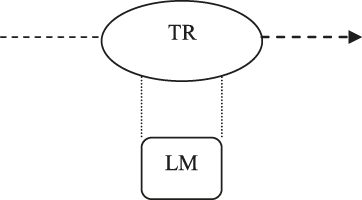
From this perspective, the ‘central’ or ‘primary’ sense is spatial insofar as semantic structures are grounded in human experience and perception, notably the perception of space. The Above−Across Sense – a combination of above and across − is then the central node of the radial network, as expressed in (1):
(1) The plane flew over.
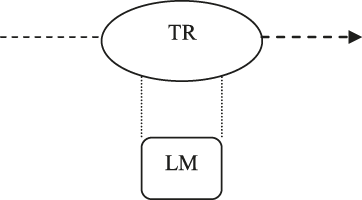
In (1), a trajector (TR) moves above an unidentified landmark (LM), as shown in Figure 1.
The Above−Across Sense (Lakoff, Reference Lakoff1987, p. 419).
By adding information, for instance about the nature of the landmark (yard, hill, wall) and by specifying the presence of contact or not, the basic schema will be enriched and become more complex, as in (2):
(2) Sam lives over the hill.
In example (2), information is added by the verb and the noun. The LM is vertically extended, the TR is in contact with it, and the sentence yields an endpoint focus corresponding to a new schema linked to the basic one. This sort of extension produces a very fine-grained conception of polysemy, based on what Lakoff called motivation.
Meanings such as ‘Excess’ or ‘Repetition’, for instance, are actually metaphorical extensions from the central spatial schema. They are not fully arbitrary, but they cannot be predicted from the central senses like the Covering Schema (Lakoff, Reference Lakoff1987, pp. 426 ff.) or the Reflexive Schema (p. 430). ‘Excess’ or ‘Repetition’ are actually motivated by various elements of the semantic chaining: “they are conventional extensions” (p. 116). Words like overlook, oversee, or look over are thus a “specialized assembly of independently existing parts” (p. 438), but their meaning cannot be predicted from the meaning of look, see, or even ‘over’. Lakoff is actually concerned not by “why those expressions mean what they mean, but why those are natural meanings for them to have” (p. 438).
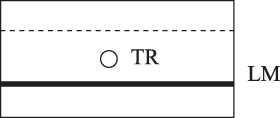
Lakoff’s radial conception of polysemy is considered too fine-grained by Tyler and Evans (Reference Tyler and Evans2001, Reference Tyler and Evans2003). Instead, they propose what they call ‘principled polysemy’. They argue that the polysemy of over can be schematized as a proto-scene “involving a spatial configuration in which the TR is located higher than the LM” (Tyler & Evans, Reference Tyler and Evans2003, p. 64) and associating a functional aspect: “the LM (or the TR) is conceptualized as being within the sphere of influence of the TR (or the LM)” (p. 66). They suggest the schema shown in Figure 2.
Proto-scene for over (Tyler & Evans, Reference Tyler and Evans2003, p. 66).
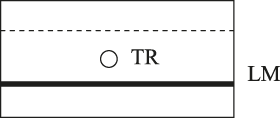
Such a proto-scene is highly schematic insofar as its purpose is to capture configurational information, i.e., the conceptual−spatial relation between the TR and the LM. Tyler and Evans’s view – based on Lakoff (Reference Lakoff1987) and Langacker (Reference Langacker1987) – is that:
the meaning assigned to any utterance is radically underdetermined by the lexical items and the grammatical structures in which they occur. Rather, sentential interpretation is largely the result of various cognitive/inferential processes and accessing appropriate world knowledge. (Tyler & Evans, Reference Tyler and Evans2003, p. 69)
Hence according to them, sentences (3) and (4):
(3) The cat jumped over the wall.
(4) The tree branch extended over the wall.
do not represent two different senses, as argued by Lakoff, but they prompt for the same one, as exemplified in (3). In this example, the Path sense is derived by inference from knowledge of the real world, namely of the way a cat jumps (not straight up in the air):
we argue that the interpretation regarding the ‘above-across’ trajectory of the movement assigned in sentence [(3)] is not prompted for by ‘over’, but rather from the integration of linguistic prompts at the conceptual level, in a way which is maximally coherent with and contingent upon real-world interactions. (Tyler & Evans, Reference Tyler and Evans2003, p. 71)
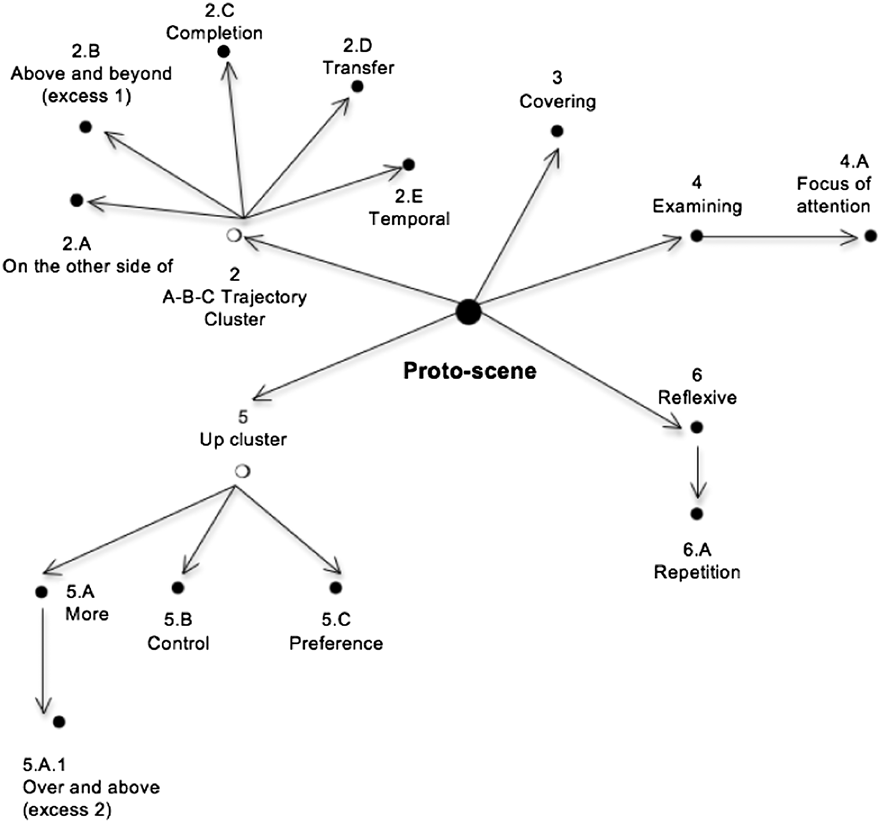
Even though Tyler and Evans put forward a unique schematic scene, in contradistinction to classical lexical network theory, they nonetheless propose a semantic network for over with different clusters (the A-B-C Trajectory Cluster, Up Cluster) and senses (‘Covering’, ‘Examining’, ‘Reflexive’), as shown in Figure 3.
The semantic network for over (Tyler & Evans, Reference Tyler and Evans2003).

Figure 3 shows that some senses are not connected directly to the central schematic meaning of over. ‘Covering’, for instance, or ‘Examining’, are rather connected to the proto-scene by usage – they are attested meanings – and not intrinsically, i.e., directly to the proto-scene. Deane (Reference Deane, Hampe and Grady2005) points out, however, that the connection between senses “appears to be incidental, contingent upon inferential processes that remain relatively open and unspecified” (Deane, Reference Deane, Hampe and Grady2005, p. 244), and considers this sense discontinuity to be the main drawback of Tyler and Evans’ approach. He comments that the ‘covering’ schema motivates an example such as (5a) as well as an example like (5b):
(5) a. The wig is over his head.
b. The wig is over his face.
Deane (Reference Deane, Hampe and Grady2005) suggests that the core meaning of over applies to both examples, whereas Tyler and Evans argue that the interpretation of an example like (5b) derives from the context. They actually argue for a distinct meaning for the ‘covering’ sense, with an example like the following:
(6) They put a transparent plastic sheet over the painted ceiling of the chapel during repairs. (Tyler & Evans, Reference Tyler and Evans2003, p. 91)
In (6), the TR (‘a transparent plastic sheet’) is physically lower than the LM, namely ‘the painting ceiling’. Still, over is used in the utterance, and not under, and:
unless ‘over’ had a distinct Covering Sense associated with it, we would expect this sentence to be semantically anomalous because the TR is higher than the LM, a canonical part of the meaning of ‘over’. (Tyler & Evans, Reference Tyler and Evans2003, p. 92)
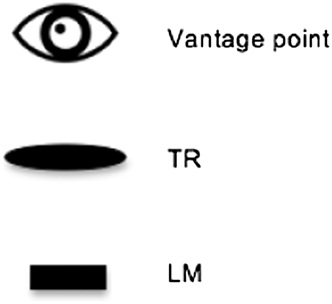
The explanation given by the authors is that the vantage point in the case of (6) is higher than the TR and no longer off-stage, as shown in Figure 4. Hence, they conclude that “the covering implicature can be reanalysed as distinct from the spatial configuration designated by the proto-scene” (p. 91) and that “the ‘covering’ component comes to be instantiated in the semantic network, via pragmatic strengthening as a distinct sense” (p. 91).
The covering sense, from Tyler and Evans (2001, p. 746).
Deane (Reference Deane, Hampe and Grady2005) reformulates Tyler and Evans’ position on over in a more dynamic way. His analysis concerns over as a spatial preposition (which excludes its use as a particle or a prefix). He rejects both geometrical approaches such as Lakoff (Reference Lakoff1987) or Brugman (Reference Brugman1981) and more functional ones such as Herskovits (Reference Herskovits1986) or Vandeloise (Reference Vandeloise1991). He suggests instead that multiple reference frames are needed to understand prepositions, and that the role of these multiple frames is to capture the complexity of spatial thought. Deane’s position is that prepositions ought to be defined as “clusters of sensorimotor representations” (2005, p. 250). By introducing visual notions borrowed from the world of photography like resolution, occlusion, or viewpoint, Deane analyses over in contrast with on and above in examples such as the following:
(7) a. The balloon is over the table.
b. The balloon is above the table.
c. The balloon is on the table.
In Deane’s perspective, the difference between examples (7a) and (7b) resides in a difference of resolution and occlusion. From the same viewpoint (the side) and at the same level of resolution (i.e., low resolution), the TR is separated from the LM by a gap in (7b) whereas it is not separated from the LM in (7a). There is nonetheless no difference between these examples at high resolution. Viewed from the top, which is taken into account in the case of over only, the TR partially occludes the LM. This is also the case in (7c), with on, but this preposition differs from over as regards the viewpoint: from the side, the TR is not separated from the LM by any gap.
By introducing force dynamics notions such as movements, paths, and forces interacting in space, Deane proposes to define over in three image-sequences:
(a) the LM functions as a barrier on the locomotor space and the TR is on the far side of the LM from its initial position;
(b) the LM functions as a barrier for movement over the locomotor surface and the force-dynamics impetus of the TR carries it to a location higher than the LM;
(c) the TR has a force-dynamics impetus downward towards the LM and consequently the TR exerts force upon the LM.
Deane completes the definition of over by introducing an allocentric space (‘manoeuver space’). The manoeuver space comprises notions such as distance, relative orientation, and the consequences of manipulation, the basic concern being clearance, defined as:
the open space from a point within the edge of a figure to the nearest point on the ground. An object’s position may therefore be defined by systematically mapping its clearance under different manipulations such as rotation, motion toward the ground, or motion parallel to the ground. (Deane, Reference Deane, Hampe and Grady2005, p. 264)
Over is then defined by the following manoeuver-space image complex (p. 264):
a- Initial position: there is clearance between the TR and the LM, with the TR orientated parallel to the ground.
b- Image after vertical displacement: zero clearance
c- Image after horizontal displacement: no change in clearance
d- Image after rotation: zero clearance.
Deane’s dynamic model aims at “provid[ing] an account of the mechanisms which relate a word’s polysemy to its prototype [whose] effect is to enforce a close relationship between a word’s conceptual representation and its potential for polysemy” (2005, p. 271). Starting from the premise that giving a general definition of the various senses of over lumped together is as unsatisfactory as keeping these senses distinct (which could mask the semantic coherence even if each sense has its own definition), Deane puts forward the idea of a central prototype via the application of a “preference rule upon structured sets of images to produce contextually induced semantic interpretation” (p. 272).
Deane’s study concerns the spatial meaning of over and very little is said about the other senses (temporal, examining, control, etc.), whereas Tyler and Evans offer a more general study and hence a more complete definition. Besides, in Deane’s study, nothing is said either about the other uses of this unit, such as for instance its role as a verb particle.
What transpires from the various semantic networks under consideration, and notably from Lakoff (Reference Lakoff1987), is that they are too fine-grained – about 100 different meanings are described in Lakoff, for instance. Moreover, the very structure of the network is not made clear in most (or all?) of the studies. Nothing is explicated about the orientation of the branches for instance, or about the distance between the nodes. While the absence of rules on the one hand and the proliferation of meanings on the other hand tend to show that over is indeed polysemic, Sandra and Rice (Reference Sandra and Rice1995) highlight a major problem stemming from this kind of approach:
the least that can be said is that prepositional network-style networks are minimally committed to a psychological process (or several such processes) of human categorization. (Sandra & Rice, Reference Sandra and Rice1995, p. 100)
They argue convincingly that networks create a real confusion between semantic extension and semantic representation: a network helps represent polysemy, but not its extension nor its proliferation. They recognize that speakers do make distinctions between the different uses of over, but “what is in the network is only in the structure of the language and not at all in the structure of the mind” (p. 104). For all these reasons, we will favour monosemic models rather than polysemic ones.
2.2. a monosemic answer
Rejecting polysemic approaches and the proliferation of values that they promote, Van der Gucht et al. (Reference Van Der Gucht, Willems and De Cuypere2007) put forward a monosemic account of over. The authors try to give a more complete definition of the unit – even if nothing is said about over as a verb particle, as we shall see. They choose to root the debate on polysemy in the classic opposition between Locke and Leibniz (see 1765). Locke (1689) promotes the idea of a general polysemy insofar as he stresses that words cannot be translated from one language into another and that basically they are means to record human thoughts. He nonetheless makes a distinction between words that are “names of ideas in the mind” and words “that are made use of to signify the connexion that the mind gives to ideas, or to propositions, one with another” (1689, III, 7, §1, quoted by Van der Gucht et al.). The latter, called ‘Particles’, have a functional role, and their meaning is not directly calculated, as compared with the particle ‘but’ for instance, which has a great number of meanings but from which it is not always possible to draw a general, formal meaning. Locke’s position is to some extent mirrored in today’s cognitive framework, developed in particular by Lakoff, Langacker, or Taylor. In Lakoff’s (Reference Lakoff1987) view, for instance, polysemy is largely natural and characterizes any linguistic item. This view promotes a radial network conception of over with one or more centres (‘above’ meaning and ‘across’ meaning) in the network since:
One subcategory is the center; the other subcategories are linked to the center by various types of links. Non-central categories may be subcenters, that is, they may have further center-periphery structures imposed on them. (Lakoff, Reference Lakoff1987, p. 287)
As Lakoff favours a model of the mind as being ‘embodied’, the central values of the network are essentially spatial, and semantic structures are grounded in experience and perception. The non-central meanings are derived by different links (metaphor, metonymy, similarity, etc.) and are not predictable from the central sense.
Leibnitz’s view on polysemy is less radical, even if he shares Locke’s conviction that it is difficult to find a single general meaning for particles like but. In fact, he favours a paraphrase, which can substitute for the word on every occasion, provided that this paraphrase is chosen once all instances of the linguistic item have been analyzed. Van der Gucht et al. follow Leibnitz’s position and reject a conception of polysemy which enables meaning to proliferate rather than to form a coherent unit:
the radical polysemy hypothesis leads to a semantic analysis that not only is too fine-grained but also fosters a highly problematic rampant polysemy. (Van der Gucht et al., Reference Van Der Gucht, Willems and De Cuypere2007, p. 741)
They therefore favour Tyler and Evans’s moderate view on polysemy, akin to Leibnitz’s conception, mainly because Tyler and Evans reject the primacy of spatial meanings. Van der Gucht et al. do not follow them, however, on the embodiment postulate as, according to them, “the embodied meaning postulate can lead to assuming unnecessary polysemy.” (2007, p. 744). They consider that the ‘covering’ sense that Tyler and Evans underscore in their paper is in fact the projection of extralinguistic categories onto semantic ones and does not constitute a distinct meaning. Hence, Van der Gucht et al. consider that the following example:
(8) Joan nailed a board over the hole in the ceiling.
has two different readings and is thus ambiguous:
a-reading: the board is situated in a lower position with regard to the ceiling
b-reading: the board is situated in a higher position with regard to the ceiling
These readings construct two different perceptions of the situation, one in which we consider that the board is nailed below the hole and the other one where the board is considered to be nailed on the upper side of the ceiling.Footnote 3 This distinction is supported by the fact that this sentence could be uttered by two different speakers from two different viewpoints:
Interpreting the scene from a focal perspective means that one interprets the meaning of over from the own point of view of the speaker ((a)-reading). By contrast, interpreting the scene from a disfocal perspective implies that one takes the point of view of the board or, by way of extension, the point of view of another speaker who is to be located at the attic or another room above the ceiling ((b)-reading). (Van der Gucht et al., Reference Van Der Gucht, Willems and De Cuypere2007, p. 746)
This leads Van der Gucht et al. to support the idea that over is not ambiguous but is realized in a distinct, unpredictable sense in this sentence. Their explanation is that:
over, being a means to conceptualize the relation between a spatially ‘superior’ TR and an ‘inferior’ LM and conceivable as a semantically invariable meaning bearing linguistic item, can be said to display a structured polyvalence (or: polyreferentiality) at the experiential level, i.e. at the level of interpreting extralinguistic reality, which is perfectly explainable. We stress that the item is polyvalent in a structured way, because the linguistic meaning constrains the range of interpretations in a principled fashion, due to the fact that over invariably expresses that one object is situated in a specific relation to a lower reference point. Therefore, to assess the relation between the invariable meaning proper and the polyvalence of over, it is imperative not to interpret the specific configuration which holds between the TR and LM in a single – call it ‘prototypical’ – way, excluding other possibilities which then have to be accounted for by invoking polysemy or certain kinds of ‘extension’. (Van der Gucht et al., Reference Van Der Gucht, Willems and De Cuypere2007, p. 746)
Their view is then that the meaning of over and the relation it refers to have to be distinguished: the relation established by over between two entities X and Y should be differentiated from the same relation which can be experienced and perceived in various ways by the speaker. The weakness of Tyler and Evans’s methodology, they claim, is that it does not enable them to make a clear-cut distinction between the semantic contribution of over to the meaning construction of the utterance and the semantic contribution of the other linguistic units of the utterance. Building their own methodology on Coseriu (Reference Coseriu1985, Reference Coseriu2000), Van der Gucht et al. propose to assign a single, non-ambiguous meaning to the preposition over and to reconsider the ‘battery of senses’ associated with the preposition as a side effect of our connection with the outside world:
The main reason why a battery of senses is postulated in the first place derives from a non-linguistic criterion we term the ‘iconicity of embodied meaning’. This criterion prompts the linguist to accept as many distinct senses as there are prototypical common sense experiences commonly associated with (or, ‘reflected by’) the use of a specific linguistic item in various instantiations. (Van der Gucht et al., Reference Van Der Gucht, Willems and De Cuypere2007, p. 734)
Van der Gucht et al. distinguish instruments from lexical items. A lexical item has a self-contained conceptual meaning, whereas prepositions have an instrumental meaning in that their main goal is to connect two different words. Therefore, the meaning of a preposition can be underspecified: its full meaning will be derived from the meaning of the words connected using this preposition. In other words, the meaning will be self-contained when and only when the preposition is analyzed together with the words that it connects.
In contrast to Tyler and Evans’s view, the authors propose that:
the meaning of over is an instrumental meaning which can only be instantiated in combination with lexical meanings;
the meaning of the linguistic context should not be projected into the meaning of the preposition;
the meaning of over should be conceived of as a ‘general’ non-lexical meaning which only specifies a relation between slots that have to be filled by autosemantic items, e.g., Noun over Noun, Noun BE over, Verb over Noun, etc. (Van der Gucht et al., Reference Van Der Gucht, Willems and De Cuypere2007, p. 748)
Van der Gucht et al. then postulate a general instrumental meaning for over which is paraphrased as follows: ‘positioning of X vis-a-vis a reference point Y which is inferior to X’ (2007, p. 748), where X is an object and Y a landmark.
The present study will broadly follow Van der Gucht et al.’s position concerning polysemy and its processing in natural language. In particular, we agree with their attribution of an instrumental meaning to over rather than a proliferating semantic network based on Lakoff’s model or even a more moderate view of polysemy. However, we think that it is of prime importance to determine the meaning of over thanks to the analysis of attested data, contrary to Van der Gucht et al., who only consider a small set of examples and no attested corpus data. Furthermore, we consider that it is essential to take into consideration the use of over as an adverb, since Hallan’s (Reference Hallan, Bybee and Hopper2001) corpus-based study clearly showed that the adverbial use is primary in preschool children’s speech as well as in adult speech (Van der Gucht et al., Reference Van Der Gucht, Willems and De Cuypere2007, only consider over as a preposition).Footnote 4 Section 3 presents our study of a representative set of utterances containing over (whatever its category), extracted from the British National Corpus.
3. Data analysis: a closer look at the polysemy of over
3.1. a corpus-based method
Cognitive linguists now frequently make use of corpus data to ground their theories by the examination of attested examples (see, for example, Gries, Reference Gries, Gries and Stefanowitsch2006). This paper will use a similar method to explore the semantics of over since previous studies of this word have been mostly based on introspection.
To provide a clear account of the diversity and frequency of the different values associated with over, a corpus-based approach is fundamental. Besides, the systematic annotation of data requires making the decision process explicit (‘How should one choose the right semantic value for this example?’) and helps identify borderline cases. It may even lead to the discovery of categories that have not been previously described.
On the other hand, we are aware that the precise analysis of all the slight differences of meaning of over would require the annotation of thousands of examples. This approach was clearly not realistic in our context. Moreover, all the relevant linguistic features for the analysis were not known in advance.
We therefore set up a four-stage process for data analysis:
1. First, a series of examples was annotated and discussed in order to find the different semantic values, the relevant variables, and their contribution to the meaning of the lexical unit.
2. A detailed analysis of the different meanings along with the corresponding contexts was done through manual corpus annotation, in order to obtain an appropriate level of generalization on the basis of which senses could be distinguished.
3. Then, an instructional schematic form was developed from the analysis of examples, unfolding the core semantic of the word (schematic form) and its interaction with the context (the set of instructions it gives and/or receives).
4. Lastly, some old and new examples were analyzed using the conclusions reached during the second stage, to ensure that the model was coherent and practically manageable.
This method is very close to Corpus Pattern Analysis (CPA), a lexicographic method defined by Hanks in co-ordination with various other linguists (see Hanks, Reference Hanks2004, and the website <http://nlp.fi.muni.cz/projects/cpa/>). The key point of CPA and other corpus-based approaches like Gries (Reference Gries, Gries and Stefanowitsch2006) is that the lexical meaning of linguistic items cannot be defined for words in isolation.
However, while verbs have been intensively studied in corpus linguistics (e.g., the flagship of CPA is the DVC project: Disambiguation of Verbs by Collocation, see <http://clg.wlv.ac.uk/projects/DVC/>), connectors have received less attention, probably because the problem is more challenging. A word like over corresponds to several parts of speech, with a wide range of different meanings, as we have just seen in Section 2.
Our corpus was automatically extracted from the British National Corpus using over as a keyword. Some 325 utterances were extracted containing more than 346 occurrences of over (over may appear twice in the same utterance; it can also be part of the collocation over and over). This corpus was then manually annotated using a specifically designed multilevel annotation scheme. For the annotation itself, we chose to use ANALEC, a piece of software especially designed for this kind of problem:Footnote 5 ANALEC uses an XML structure for annotation but, contrary to other annotation tools, ANALEC makes it very easy to add a new feature, remove another one, or merge two initially distinct features (taking into account conflicts and proposing a nice interactive process to solve them, etc.). ANALEC also provides various visualization modules to identify relevant features, correlations of relevant features, and exceptions.
As already said, a crucial point is that that the annotation was not done with a fixed set of a priori features. Several cycles of annotation and revision of the annotation scheme (involving several annotators) were necessary to reach a consensus, and define an annotation scheme that was at the same time rich, tractable, and storable in generic formats (to ensure that the corpus and the annotation are reusable). Thus, the use of a corpus makes it possible to have a data-driven approach to meaning.
Practically, the syntactic value of over was first tagged: over can be a preposition, a particle, or an adverb. All the occurrences were then annotated with a semantic value derived from Tyler and Evans (2003, p. 125; see Figure 3). We then coded information concerning the context of over. We annotated dependencies around over (e.g., trajectory/landmark); lastly, information about these elements was annotated as well (lemma and tense of the verbs, etc.).
One of the main problems of corpus linguistics is to be able to annotate all or most of the useful information in context, but still get a tractable annotation scheme. We made several practical experiments to find an optimal solution using different annotation schemes and different annotators. Lastly, disagreements between annotators were solved by consensus after discussion. During the last stage of the annotation process described above, new examples were extracted from the BNC to check the adequacy of the linguistic description on new, unseen sentences.
3.2. results of the corpus annotation
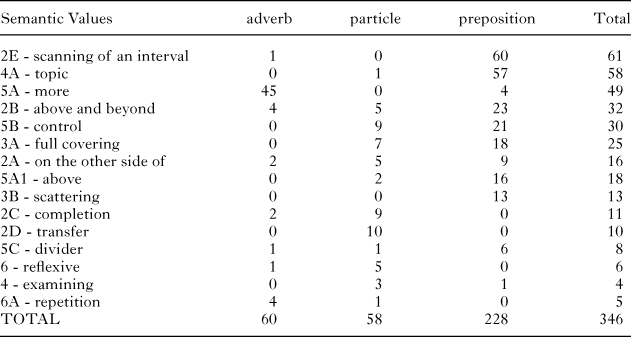
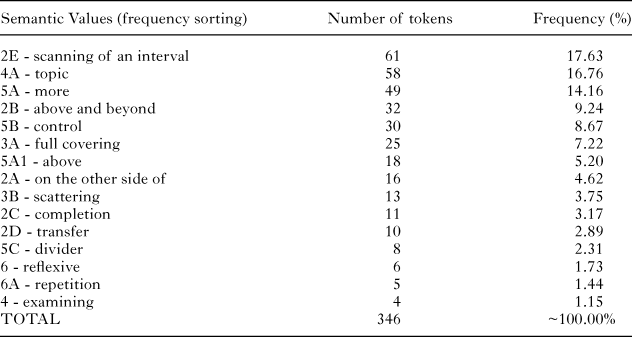
We annotated the 325 sentences using the semantic categories identified by Tyler and Evans (Reference Tyler and Evans2003) and presented in Figure 3. Yet this classification needed to be refined so as to integrate recurrent values of over, such as, for instance, temporal values. So, even if this classification remains a good starting point for the study of over, it had to be modified. We relabelled certain meanings (see Tables 1 and 2), such as 2E (‘Temporal’ became ‘Scanning of an interval’), 4A (‘Focus-of-Attention’ became ‘Topic’), and 5C (‘Preference’ became ‘Divider’). These new labels actually suit the data we found in our corpus and provide a better account of their meanings. ‘Scanning of an interval’, for instance, is more precise than ‘Temporal’ since the data showed that over is generally followed by a period rather than just a date: “over a number of years”, “over the course of the last 25 years”, “over time”, etc. ‘Topic’ (a subject people talk or write about) is also more precise than ‘Focus of Attention’ insofar as, in the majority of the examples we analyzed, over was associated with a noun or a verb of debate, opposition, or agreement:
(9) a. French Museums proved unable to agree over the price at which the paintings should go to the Museum of Melun
b. Methodists’ main concern was not so much the debate over collectivism v. individualism as over reunion of the various Methodist divisions.
The matching of semantic values of over with its categories
The distribution of the semantic values of over
In the case of ‘Divider’, we found that the context of most of the utterances in our corpus were mathematical, as in “A hundred and seventy over eighty”, which drove us to change Tyler and Evans’ label.
We also suggested new labels, which were not included in Tyler and Evans’ classification. These new meanings are in fact derived from the Covering node, which we divided into 3A ‘Full covering’ and 3B ‘Scattering’. These new meanings came to light through the annotation of the corpus and the analysis of the data. Thus, we made a distinction between two different cases:
(10) a. ZEPPELINS of World War One by Wilbur Cross, tells of the little-known aerial battles that took place over England during the Great War, when Germany attempted to paralyse the British by dropping tons of bombs from a fleet of super-Zeppelins.
Example (10a) construes the case of ‘Scattering’ because the battle took place over different parts/regions of England, but not all over the land itself.
(10) b. I do thank you for stopping and not running poor Nellie over.
Example (10b) construes the case of ‘Full covering’ because the pet (Nellie) could have been entirely ‘flattened out’ by the car.
Apart from distinctions of labels, we obtained results in terms of correlations and regularities that are presented and discussed in the Section 3.3.
3.3. data analysis: correlations and regularities
The results obtained thanks to our annotations make it possible to establish correlations between the semantic values of over and the various linguistic features observed in the corpus, notably concerning the matching of semantic values and categories (Table 1) and the distribution of the different semantic values (Table 2).
What clearly appears in Table 2 is that semantic values are not evenly distributed. Values 2E (‘Scanning of an interval’, 61 occurrences, 17.38% of the total), 4A (‘Topic’, 58 occurrences, 16.52%), and 5A (‘More’, 49 occurrences, 13.96%) are by far the most representative cases, whereas semantic values related to a spatial meaning (2A, ‘On the other side of’, 16 occurrences, 4.6%; 2B, ‘Above and beyond’, 32 occurrences, 9.12%) are less used in our corpus. Text genre might have an impact on this feature (abstract texts may entail more abstract semantic uses of the word) but as the BNC comprises different text genres, the impact of the genre should be limited. This general observation shows that the spatial use of over whatever its syntactic status is not pervasive.
Now, if we take a closer look at the data (considering both Table 1 and Table 2), finer-grained regularities can be observed. These regularities, or selectional preferences, show that some patterns (be they lexical, syntactic, or semantic) are to be found in the context of over, and that these patterns can explain why a given semantic value is associated with the occurrence.
The most frequent tag is ‘Scanning of an interval’ (examples 2E, 61 occurrences, 17.38%). When expressing this value, it is clear that over is a preposition and this preposition establishes a link between a process and (generally) a period of time:
(11) The process has evolved over the decade with the linking up of what used to be short runs into long, cross-country routes.
(12) Distinguished architecture matures over time
(13) progressive impoverishment of the flora and vegetation over thousands of years
This usage of over is massive and regular. The range of nouns governed by over is rather restricted (decade, time, thousands of years, past decade, lunch, Sabbath).
The same can be said for ‘Topic’ (4A, 58 occurrences, 16.52%). Even if this usage of the word seems more abstract (because the noun appearing after over itself is abstract), over is here clearly a preposition establishing a link between a noun or a verb that expresses the idea of debating and the topic of the debate itself.
(14) The Party’s formative years were marked by controversy over its relations with the Labour Party, over its internal reorganization along ‘Bolshevik’ lines, over its attitudes towards parliamentary democracy, but not significantly over its allegiance to the Communist International and the Soviet Union
(9) b. Methodists’ main concern was not so much the debate over collectivism v. individualism as over reunion of the various Methodist divisions
(15) Interest was also expressed over another site in the village, adjacent to the school
Regularities concerning the headword are also noteworthy. Most of the time, the headword is related to the idea of debate, discussion, or controversy. The idea of ‘Control’ (5B, 30 occurrences, 8.55%) reflects the same pattern: the headword itself expresses the idea of control, while the dependent noun expresses the entity under control, a country for instance in (16) and (17):
(16) In the fifth century, the Pauline orthodoxy of Rome was still attempting to impose its hegemony over Egypt.
(17) B’nai B’rith International’s decision-makers now seek total control over their empire.
Note that in this case the second noun may not be expressed, in which case over is categorized as a particle:
(18) In fact Leamington got a few things wrong, because they’ve now been taken over.
When over corresponds to ‘More’ (5A, 49 occurrences, 13.96%), it is generally followed by a quantitative expression (expressing quantity, distance, time, etc.):
(19) Chernobyl, the Soviet nuclear reactor which blew up in January 1987 caused nuclear traces to be recorded over 2000 miles away in the sheep of Scotland.
(20) The distance from his grandmother’s house was just over a mile.
(21) The time between sleep onset and active sleep onset thus tends to be either very short indeed (less than ten minutes) or over fifty minutes.
As for 2A (‘On the other side of’, 16 occurrences, 4.6%) and 2B (‘Above and beyond’, 32 occurrences, 9.12%), they clearly emerge from the spatial relationship between two objects/surfaces associated with a verb of motion:
(22) Go over the bridge and turn right immediately onto a track leading into the trees.
(23) Wood arrived at the conclusion that the compass error they were experiencing was opposite to the error they had found coming south over the Timor Sea
(24) Lions jump over obstacles in their home territory or laze around under a favourite tree
Note that in some examples, when the dependent noun is not expressed, over is categorized as a particle expressing the manner of motion, as in the following pair:
(25) Why don’t you come over?
(26) Not far from the citadel, should you choose to cross over to that less appealing side of Bayonne
The spatial relationship between a surface and an entity can also be observed with the ‘Full covering’ (3A, 25 occurrences, 7.12%) and ‘Scattering’ (3B, 13 occurrences, 3.7%) meanings. The verb found in the pattern is not a motion verb in that case:
(27) My eyes were open, just able to discern the tent staked out over me. (‘Full covering’)
(28) I was interested last year to see Tim Jonke’s article and his method of spraying acrylic paint over oil paint. (‘Scattering’)
The difference we make between 3A and 3B is relevant to the distinction of two situations of covering. In (27), the function of the tent is to cover (and protect) the people inside, whereas what is important in (28) is that the acrylic paint is sprayed over the oil paint and not spread onto it (i.e., it does not cover it completely). However, over can be categorized as a preposition in both cases. Here again, one can find frequent uses of over as a particleFootnote 6 when it expresses ‘Full covering’:
(10b) I do thank you for stopping and not running poor Nellie over. (‘Full covering’)
4. Towards a dynamic solution
Polysemy has been intensively studied in linguistics (Apresjan, Reference Apresjan1974; Lyons, Reference Lyons1977), and even more in cognitive linguistics (Cuyckens & Zawada, Reference Cuyckens and Zawada2001; Nerlich, Todd, Herman, & Clarke, Reference Nerlich, Todd, Herman and Clarke2003, Ravin & Leacock, Reference Ravin, Leacock, Ravin and Leacock2000). The omnipresence of polysemy makes a purely bottom-up calculation of meaning along with a homonymic processing of polysemy totally unrealistic, both from a computational and cognitive point of view (the consequence of the polysemy approach being either a combinatorial explosion of meaning potentials or undecidability issues in the disambiguation process).
We advocate instead a non-homonymic treatment of polysemy and consequently a context-dependent specification of an abstract meaning shared by all the uses of a polysemic unit. This point of view is not new since we are following in the footsteps of famous ancestors within the framework of cognitive grammar (Langacker, Reference Langacker1987; Talmy, Reference Talmy2000, etc.), or in theories of enunciation (Culioli Reference Culioli1990, Reference Culioli1995; Ducrot, Reference Ducrot1984; Victorri, Reference Victorri, Fuchs and Victorri1994), and other semantic-based theories (Cadiot & Visetti, Reference Cadiot and Visetti2001; Ruhl, Reference Ruhl1989; Van der Gucht et al., Reference Van Der Gucht, Willems and De Cuypere2007; Visetti & Cadiot, Reference Visetti, Cadiot, Feigenbaum and Kurzon2002). The following quotation from Fauconnier (1997, pp. 37−38), for instance, is particularly illuminating:
A language expression does not have a meaning in itself; rather, it has a meaning potential, and it is only within a complete discourse and in context that meaning will actually be produced. The unfolding of discourse brings into play complex cognitive constructions. They include the setting up of internally structured domains linked to each other by connectors; this is effected on the basis of linguistic, contextual and situational clues.
We assume that linguistic units are perceived dynamically. In this context, the Necker cube can provide an interesting analogy. The Necker cube is an ambiguous line drawing: each part of the picture is ambiguous by itself, yet the human visual system picks an interpretation of each part that makes the whole consistent (as a completion process). The same is true with human languages: each word of a sentence is ambiguous by itself but the human brain is able to dynamically choose a meaning that will make the whole sentence meaningful. Victorri and Fuchs (Reference Victorri and Fuchs1996) coined the term ‘gestalt compositionality’ to describe the calculation process that leads to the simultaneous attribution of a global meaning to an utterance and a particular meaning to each unit composing the utterance. Gestalt compositionality is a dynamic process implying a non-homonymic treatment of polysemy: each unit taken out of context is characterized by an instruction describing how the unit has to behave in context during the process of meaning construction (this model is detailed below).
4.1. a continuous model of meaning
To describe the meaning of over without rejecting its polysemy, we chose to ground our model on the description of meaning construction during the unfolding of discourse, as detailed in Col, Aptekman, Girault, and Poibeau (Reference Col, Aptekman, Girault and Poibeau2012). As a matter of fact, cognitive psychology has shown that the processing of a sentence has four major features: it is automatic, very quick, non-conscious, and irrepressible – it cannot be stopped.
As a listener or a reader perceives an utterance, the information carried by it is processed and interpreted without any effort, and its meaning is constructed extremely rapidly without his being conscious of the words used in the utterance, or of the grammatical structure or of the style and even less of the way his mind has operated to understand. (Le Ny, Reference Le Ny2005, p. 116; our translation)Footnote 7
Another fundamental feature of the process is that it is continuous, as Spivey (Reference Spivey2007) points out:
real-time language comprehension takes place not just ‘incrementally,’ as the field of sentence processing is fond of saying, but in a genuinely continuous fashion, without breaks, without stops and starts. As phonemes, words, and sentences flow into a listener’s ears, this stream of input is continuously processed into an evolving estimate of the communicative message and of plans for motor action. (Spivey, Reference Spivey2007, p. 172)
These features drive us to propose a constructivist model, following Barsalou (Reference Barsalou1999, Reference Barsalou2008, Reference Barsalou2010) or Coulson (Reference Coulson2001, Reference Coulson2006). Barsalou puts forward the idea that cognition is grounded in multiple ways including simulation and ‘situated actions’ as well as ‘bodily states’. In the field of language and language comprehension, Barsalou highlights the central role of simulation:
As people comprehend a text, they construct simulations to represent its perceptual, motor, and affective content. Simulations appear central to the representation of meaning. (Barsalou, Reference Barsalou2008, p. 633)
From our perspective, ‘information processing’ corresponds to the construction of a series of representations that are continuously modified during processing. In order to truly account for the construction of meaning, what ought to be described is the continuous evolution of these representations, including what Coulson calls Frame Shifting, i.e., an “operation of semantic reanalysis that reorganizes existing information into a new frame” (Coulson, Reference Coulson2001, p. 34).
Consequently, our model is grounded on both the perception and the comprehension of meaning, and considers the construction of meaning as on-line information processing. What now needs to be specified is the kind of information actually processed.
4.2. an instruction-based model
We consider that the meaning of an utterance depends on the instructions given by the linguistic units of the utterance. An instruction is a ‘directive’ associated with each linguistic unit that is used to guide the dynamic process of meaning construction. In the framework of cognitive science, several researchers have already used the term with a related meaning (see, for example, Barsalou, Reference Barsalou1999, or Fauconnier, Reference Fauconnier1997):
On parsing the sentences in a text, surface syntax provides instructions for building perceptual simulations. (Barsalou, Reference Barsalou1999, p. 592)
the space building instructions associated with a particular grammatical construction are unique. […] But the effect of such instructions may be widely different, depending on the configuration they operate on when they come into the discourse. (Fauconnier, Reference Fauconnier1997, p. 65; original emphasis)
Besides being unique and producing various effects, the most typical feature of an instruction is its under-specification: it is not sufficient to provide the full meaning of a linguistic expression. In fact, an instruction makes a contribution that may bend the previous contribution and may in turn be bent by the instruction provided by the following linguistic expression. This process is dynamic and progressive since the meaning of an expression expands as the discourse unfolds.
a language expression entering the discourse at stage n constrains the construction of a new configuration, together with the previous configuration of stage n−1 and various pragmatic features. (Fauconnier, Reference Fauconnier1997, p. 38)
As argued in our previous study (Col et al., Reference Col, Aptekman, Girault and Poibeau2012), any linguistic unit provides an instruction, whether lexical or grammatical. We also consider that the instruction provided by a linguistic unit must be generic enough to ensure its compatibility with a large number of co-texts. There is only one instruction per linguistic unit and this instruction must remain independent of any particular context.
4.3. the instruction given byover
To attribute a specific meaning to over that takes into account both its apparent polysemy in context and the different categories it belongs to drives the linguist to put forward the mechanisms producing the various meanings rather than a single artificial meaning. We must avoid selecting one meaning associated with one particular category even if this meaning and this category are the most frequently used ones (for instance, considering over as a ‘spatial preposition’) or else we would run the risk of creating two different units, a proposition on the one hand, and a particle on the other. What should be central is the unique meaning potential associated with over and hence its capacity to produce one meaning or another. This potential is actually ‘beyond’, as it were, any categorization and polysemy. The instruction presented here is therefore based on the three main groups of meanings observed in corpus data (scanning of an interval, excess and repetition, completion and transfer). This instruction may nonetheless display both general and under-specified features, and it may even appear insufficient insofar as it is in the interaction with the contextual elements called up by over that the meaning of the unit will gradually and temporarily emerge and be staged. We suggest formulating the instruction given by over as follows:
overconvokes a bounded domain and evokes a movement of covering of the domain, including its bounds.
The notions of ‘covering’, ‘domain’, and ‘bound’ are to be understood as topological, thus encompassing spatiality, temporality, and more abstract meanings. Note that this instruction does not reflect diachrony: we assume the point of view of a contemporary speaker who uses the word without any metalinguistic knowledge (or ‘epilinguistic’ knowledge, to refer to the kind of knowledge of a language a non-linguist would have). We claim that a unique instruction can explain the different usages of over in all kinds of context, as we will try to show in Section 4.4.
4.4 application to the different usages ofover
It is now necessary to detail how the under-specified schematic form we propose for over makes it possible to explain the different usages and meanings in context. It is thus necessary to show that the different meanings in context are due to the interaction between over and other lexical units, and not to the sole meaning of over itself.
On the other side of (2A)
Let us begin with an example where over has the meaning ‘On the other side of’:
(22) Go over the bridge and turn right immediately onto a track leading into the trees
The bounded domain construed in this example is a spatial one, as is almost always the case with the ‘On the other side of’ meaning: the space under the bridge (a river or a road) is minimally delimited by both ends of the bridge itself. Example (22), where over is used as a preposition, is rather obvious; over is part of the spatial meaning of the sentence.
(29) Jenny rose lethargically from her bed and went over to the wash basin and began bathing her eyes.
In (29), the bounded domain is also a spatial one: the space between the bed and the wash basin. Thus, Jenny ‘covered’ the space delimited by the bed (one of the bounds) to reach the wash basin (the other bound). In both examples, over is used with a motion verb (go). But the domain does not need to be spatial, as in (30):
(30) The day Ruth walked out of this family − when she went over to the Roman Church − she cut herself off from us.
The bounded domain is actually delimited by two entities, family on the one hand and Roman Church on the other, which are not spatial but construed as the bounds of the domain anyway. The idea of conversion is indeed the product of the interaction between these lexical units and over. This example shows that the meaning of the sentence is distributed over more than one unit and at the same time that the instruction given by over is compatible with more metaphorical meanings.
In the first two examples (22 and 29), the bounded domain is a location (i.e., a physical object, a geographical entity) that describes a closed surface. In the third one (30), the domain is associated with a metaphor (conversion as a journey) and it is also construed as a space covered and eventually crossed. The covering process for 2A means to go from one side of this closed surface to the other, be they banks of a river or different religions.
Above and beyond (2B)
As for 2B, the bounded domain is generally physical or geographical but one of the bounds is not merely covered because the movement of covering the domain goes further. Let us consider example (31):
(31) ‘That policewoman I was telling you about’, she exclaimed over her shoulder.
It is obvious that the sound of her voice will be heard even beyond the domain itself, i.e., her shoulder. Hence, the domain is fully covered, including its bounds. What is most interesting in this example is the notion of bound, since it enables the idea of exceeding. The following example, associated with a spatial domain, still construes the ‘Above and beyond’ meaning:
(32) “He could see over the tops of the trees of the demesne; over bog and river and plain to the distant Partry mountains.”
In this example, ‘the tops of the trees’ as well as ‘bog and river and plain to the distant Partry mountains’ correspond to the bounded domain and the gaze covers the trees, up to the distant Partry mountains. But we also find examples where the domain is not spatial yet physical, as we saw in (31) and (32):
(33) Inside I am delirious, but then comes the bombshell: Ma turns to me and, shouting over the screams, says: “Let baby have your spoon, dear, there’s a good boy.”
In (33), the domain is actually a quantity of noise delimited by a sound level. Once beyond this level, i.e., once the full domain covered up to its highest level, Ma can be heard.
Completion (2C)
The ‘Completion’ meaning is massively associated with a temporal dimension, thus in the following examples, the bounded domain is a period of time:
(34) By the time the summer was over, the predictions that Syria was about to release all the hostages had come to nothing and the issue was dead again.
(35) Her on-off romance with 27-year-old Rob Camilleti, who she met serving pizzas, is also definitely over.
In (34) the bounded domain is the summer and time has ‘covered’ all the duration of summer, and in (35) the bounded domain is the romance which has been lived through until it came to an end. More generally speaking, the bounded domain is a period of time and this period of time has been completely covered, i.e., the corresponding time has expired.
Transfer (2D)
Here again, over interacts with a specific environment, namely a limited group of verbs such as hand, take, or turn. In these cases, over is almost always a verb particle and the ‘Transfer’ meaning is largely dependent on the meaning of the verb itself. These verbs specify the orientation of the covering movement, the domain being covered either ‘from one bound to the other one’ (hand over) or ‘toward one bound from the other one’ (take over or turn over). The domain may be spatial or even physical, as in (36), or rather abstract, as in (37):
(36) ‘Oh, do lend me your anorak, Seb dear’, Nutty said, and he nobly took it off and handed it over.
(37) In or before 1814 Augustus Applegath and his younger brother Joseph ran a printing establishment in Covent Garden, until 1815 when Augustus Applegath took over the printing firm of Cornish & Co. at Nelson Square, Peckham.
The domain in (36) is bounded by Seb and Nutty, and in this case, it is a spatio-physical domain: the anorak fully ‘covers’ the space between the two persons, from one hand to the other. In (37) it is more abstract as it refers to the notion of power and control. The printing firm of Cornish & Co is controlled by new owners and the domain is a blend of time (the period bounded by ‘in or before 1814’ and ‘1815’) and physical elements (previous owners and new owners). The firm goes from one owner to the other over a period of time.
Temporal (or Scanning of an interval) (2E)
The ‘Temporal’ meaning is close to the ‘Completion’ one as regards the domain, since it is temporal and corresponds to a period of time.
(11) The process has evolved over the decade with the linking up of what used to be short runs into long, cross-country routes.
(38) At least her show of independence may have avoided an intolerable sense of strain over lunch, in Sandringham’s pale green dining room.
In (11), the bounded domain is the decade (the process has covered the whole decade and during that time, it has evolved) and in (38) the bounded domain is the time taken to have lunch. Even if the domain is generally temporal, we also encounter examples where it is spatial:
(39) If it is transported over long distances, it can be dangerous.
The domain is the distances covered by the product and its possible dangerous evolution during transportation. In the case of the ‘Temporal’ meaning, the idea of ‘covering’ of the bounded domain is closer to the idea of ‘scanning’: the bounds themselves are not as important as the interval between them and they are not taken into account as is the case with the ‘Completion’ meaning. The period of time or the distances are covered but what is salient is the scanning itself, whereas in the case of the ‘Completion’ meaning, the ‘result’ of the covering is essential.
Covering (3)
The specificity of this value is that the domain may be either fully covered or partially covered, as specified in Section 3.2, where we made a distinction between two different cases: ‘Scattering’ in (10a):
(10a) ZEPPELINS of World War One by Wilbur Cross, tells of the little-known aerial battles that took place over England during the Great War, when Germany attempted to paralyse the British by dropping tons of bombs from a fleet of super-Zeppelins.
(the battle took place over different parts/regions of England, but not all over the land itself); and ‘Full covering in’ (10b):
(10b) I do thank you for stopping and not running poor Nellie over.
(here, the pet could have been entirely ‘flattened out’ by the car).
The bounded domain is then either England or a pet. The first example could be glossed by ‘the bounded domain is England and the battles took place somewhere in the partially covered domain’ and the second example could be glossed by ‘the bounded domain is a pet and the domain has not been fully covered’. The difference between them is the extension of the covering, but in both cases the domain is bounded, whether the bounds are reached and salient or not.
Topic (‘Focus-of-Attention’ in Tyler and Evans’ (Reference Tyler and Evans2003) terms) (4)
Contrary to most of the meanings examined so far, the ‘Topic’/’Focus of attention’ meaning is massively expressed by the same pattern: N1 overprep N2. N1 is generally a ‘cognitive’ noun like nouns evoking speech (argument, debate, settlements, etc.) or thought (concern, confusion, position, etc.). The bounded domain is generally a topic for discussion and debate and corresponds to N2. It may be bounded for different reasons. In the following example:
(40) Though Perkins, Stubbes, and Chamberlain hardly convey this, the controversy over dress was no less complex than the social shifts which provoked it.
it is bounded because the speakers cannot have a controversy about every type of dress in the world but about the idea of dress among other notions. In (41):
(41) As he released his anger, he felt his love for his ex-wife, and wept over their divorce.
the boundedness rather comes from the specificity of the divorce, i.e., theirdivorce. This last example is particularly interesting as (i) the pattern is different (V over N) and (ii) we clearly notice that it is in the interaction with weep and divorce that over succeeds in giving the ‘Topic’ meaning to the sentence. Still, over alone does not make the ‘Topic’ meaning emerge; it needs the other lexical units to construe it, and particularly an ‘object to weep over’. The interaction between over and the lexical units of (41), for instance, as well as its recurrence in regular pattern like N1 overprep N2, facilitate the emergence of the ‘Topic’ meaning. But it does not prevent other meanings from emerging with some of the same units, like weep in (42):
(42) These children weep, will weep as long as they live. There are other children who have wept over the decades, have grown into adulthood in the midst of their tears. (GloWbE CorpusFootnote 8)
In (42) over makes a contribution to the emergence of the ‘Temporal’/‘Scanning’ meaning together with the decades and the more general context (enhancing the weeping of dead parents).
More (5A)
The ‘More’ meaning depends on a regular pattern like the previous meaning: over + quantity. This quantity is the bounded domain and its bounds are included since one of them is ‘exceeded’:
(43) Radio 1 is heard by an average audience of over seventeen million every week.
The bounded domain is seventeen million (people) and the sentence may be glossed as the following: ‘the audience “covers” seventeen million people’. All our examples of ‘More’ contain a quantity; the difference between this meaning and the ‘Temporal’ one is to be found in the difference of category. The preposition over is part of the temporal meaning, as in (11) and (38), whereas in (43) and the examples expressing the ‘More’ meaning, it is the adverb over.
Control (5B)
Most of the examples expressing this meaning contain nouns or verbs belonging to the semantic field of control: control, victory, win, hegemony, right, power, influence, triumph, etc. The bounded domain is the controlled entity, as in:
(44) B’nai B’rith International’s decision-makers now seek total control over their empire.
The bounded domain is ‘their empire’ and we could rephrase the sentence by: ‘B’nai B’rith International’s decision-makers now want to have full coverage of their empire’. The difference with the ‘Transfer’ meaning is that in the case of the ‘Control’ meaning, the mastering of the bounds is central, hence the bounds are salient, whereas in the ‘Transfer’ meaning, the process of ‘transferring’ is central and salient.
Preference (5C)
The ‘Preference’ meaning requires at least two entities making up the set which is covered. One of them is selected, but the full domain is covered first.
(45) a. Since 1961 (to be precise, since Selwyn Lloyd’s ‘pay pause’ that summer) British people had given sustaining the economy the priority over foreign affairs among their concerns.
The bounded domain is the ‘concerns’ and one of the entities of the set is ‘preferred’. Most of the examples we encountered are taken from mathematical contexts, hence the ‘Divider’ meaning that we suggest in Section 3.2:
(45) b. A hundred and seventy over eighty.
Reflexive (6)
As in the case of the ‘Transfer’ meaning, over is most of the time a verb particle when it takes part in the construction of the ‘Reflexive’ meaning.
(46) My stomach turned over as I watched the ball heading for the out-of-bounds, but to my relief it looked as though it had stayed in, even if it seemed in an awful spot.
The bounded domain in this sentence is ‘my stomach’ and to some extent, it ‘covers itself’ as it ‘turns over itself’. The following example describing a physical movement and not a state functions the same way:
(47) Yeah but even so, even so you could still fall over.
In (47), the bounded domain is the body which could fall headfirst. The domain would be vertically covered, ‘from head to foot’ so to speak.
Repetition (6A)
This meaning is expressed by regular patterns such as over and over or start over:
(48) She wept and spoke at the same time − uttering fragments of sentences, half completed threats, pieces of swear words, repeating the name Richard over and over with the intonation of a child calling for its mother.
We could assume that the ‘Repetition’ meaning comes from the repetition of over, but in fact it comes from the verb repeat. The bounded domain is the process of repeating the name of Richard. But in the following example:
(49) Taking out of his pockets whatever might be in them − keys, pencil, purse, or pen-knife − and laying himself parallel with the edge of the hill, he actually descended turning himself over and over till he came to the bottom.
the repetition meaning comes from the verb turn himself implying some circularity (of the body) and the repetition of the same motion. The bounded domain is the process turn himself, and once its aspectual interval is fully covered, the covering movement is repeated. Over and over hence implies two coverings of the same domain. The repetition of over is in fact not necessary:
(50) The mechanical voice intoned, ‘The number you require is’ and he found he hadn’t got a pen handy, nor anything to write on, and had to start all over again.
Here again, the whole process is repeated, hence the bounded domain (the process of calling) will have to be covered a second time.
4.5 discussion: relevance of the instruction-based definition ofover
4.5.1. Spatiality
As we pointed out in Section 3, over expresses a large range of meanings, which cannot be accounted for by the prototypical values ‘Across-Above’ only. Actually, this sense sometimes seems to be the least suitable one to describe over. As a preposition, over may of course evoke spatiality, as in (51), which is the closest example to the ‘Across-Above’ meaning:
(51) 200 walks organised by The Ramblers’ Association to be held all over England, Scotland and Wales.
Yet the spatial meaning of over in (51) largely depends on the adverb all, which is by the way the most frequent adverb connected with over as a preposition expressing spatiality in our corpus (50% of the combination <adv. + over>):
(52) a. All over the country, and particularly in American libraries abroad run by the International Information Administration, intelligent men rushed to destroy books by ‘suspect’ authors, embracing among others Sherwood Anderson, W. H. Auden, Theodore Dreiser and Edmund Wilson.
b. He is an expert in grading wools that come from all over the world and blending together the many different types for yarn production.
It also closely depends on the noun country in (52a), which evokes in this example a spatial domain (‘a nation’ for instance would have evoked something more than spatiality). By definition, this domain is bounded and when it is convoked by over, together they give pride of place to the notion of covering. The same analysis can be made of (52b) even if the spatial domain evoked by ‘world’ in this example is bigger. This domain is actually seen as bounded insofar as all enables a full vision of it, hence again a covering including the bounds of the domain.
When analyzing corpus data, one can notice that the majority of the occurrences of the preposition over Footnote 9 actually mirrors two meanings, which are either only partially spatial − ‘Scanning of an interval’, as in (11) and (53) − or not spatial at all − ‘Topic’ in (14):
(11) The process has evolved over the decade with the linking up of what used to be short runs into long, cross-country routes.
(53) But to be able to hunt successfully, males have to remain close together − sometimes, when hunting success is low, for many hours and over several kilometres, and so unusual tolerance of each other is called for.
(14) The Party’s formative years were marked by controversy over its relations with the Labour Party, over its internal reorganization along ‘Bolshevik’ lines, over its attitudes towards parliamentary democracy, but not significantly over its allegiance to the Communist International and the Soviet Union.
As explained in Section 3.2, it is the very nature of the noun governed by over which drives us to suggest the ‘Scattering’ meaning. This noun massively refers to a period of time. The domain convoked by over is then more temporal than spatial. Furthermore, as (11) shows, the evolution of the process mentioned in the example is accomplished at the end of the period: the domain is then covered from one bound to the other. The notion of interval actually enables us to explain the meaning of over in (53), which is apparently spatial (thanks to kilometres) but which puts forward a notion of length rather than space, especially as it is in the neighbourhood of for many hours.
4.5.2. Covering and Boundedness
Over contributes to evoking the notion of ‘Topic’ in many examples of our corpus. The instruction supplied by over in terms of covering of a bounded domain is again relevant. We actually chose the term ‘covering’ for at least two reasons. We are conscious that ‘Covering’ is one of the meanings listed in Tyler and Evans (Reference Tyler and Evans2003), but it is isolated in the semantic network and this is why we prefer to give the term ‘covering’ a usage that does not suit Tyler and Evans’. Besides, the notion conveyed by ‘cover’ implies some kind of multidimensionality.
The multidimensional aspect of the notion of covering actually includes the notion of focusing on a specific point as well as the notion of ‘surrounding’ that we find in (41):
(41) As he released his anger, he felt his love for his ex-wife, and wept over their divorce.
In this example, the domain has a temporal dimension because the process of getting divorced is accomplished (cf. ex-wife) and hence is comparable to a boundary. The meaning of ‘Topic’ that (41) construes is then based on the fact that this domain is entirely covered in all its dimensions. The divorce is presented here in its interaction with weep and over and not from a legal point of view or from the financial one, for instance. It is presented as an entity compacting its different steps in a non-sequential way, in a global vision or “summary scanning” (Langacker, Reference Langacker1987). To some extent, this domain could be reduced to a point and, thanks to this discrete character, it encompasses its bounds.
In the formulation of the instruction supplied by over, the notion of boundedness is of crucial importance. It accounts for various meanings such as the spatial or temporal ones, as well as the ‘More’, ‘Control’, or ‘Transfer’ ones, thanks to the alternative between an open bounded domain and a closed bounded one. Thus, the notion of covering of a bounded domain also accounts for the meaning of ‘More’, as we find in (54):
(54) Rescue workers had battled for over an hour to revive them.
As a matter of fact, we assume that the boundedness of the domain includes the possibility for the covering to extend beyond the bounds themselves. Examples (54) and (55), like the majority of the examples encountered in our corpus, convoke a quantified domain which contains intrinsic limits (from 1 to 60 minutes in (54), from 1 to 50 per cent of social workers in (55)):Footnote 10
(55) Over 50 per cent of social workers gave the questions in all dimensions a rating of 4 or 5.
If we examine less frequent semantic values construed by over, notably when over is a particle or an adverb, the instruction given by the unit in the construction of the meaning of the utterance is still relevant. As a particle, the meaning associated with over is the idea of ‘Transfer’ (2D) in (56), or ‘Completion’ (2C) in (57):
(56) They will hand over to new operators at the end of this year, and are likely to sell their shareholdings in ITN.
(57) Her on-off romance with 27-year-old Rob Camilleti, who she met serving pizzas, is also definitely over.
In the case of ‘Transfer’, we saw that over is mainly combined with the verb hand, which is actually essential to this meaning. In this specific context, hand expresses the idea of change, in which the notion of boundary is central. As for ‘Completion’, the idea of a topological interval fully covered from one bound to the other seems obvious. Once again, the nature of the phrase governed by over or the nature of the governing verb are of paramount importance; the context plays an essential role whatever the category of over.
4.5.3. Semantic continuity
What consequently appears is the necessity to make allowance for both the variety of syntactic categories and the heterogeneity of meanings. The appeal to networks, as in Lakoff (Reference Lakoff1987) or Tyler and Evans (Reference Tyler and Evans2003), hardly promotes true continuity in the various meanings of over or in its different categories, especially as no real cues are given so as to calculate the distance between the meanings or the congruence between them and the exact usage of over. If we consider the following pair of examples:
(58) “Quickly they spread it out, and it became a sail; the boat flew over the waves, faster than the sea-people could follow.”
(59) When we were flying over Holland I did steel myself to look out and I remember seeing where miles of land had been submerged under sea water to keep the Germans out, and houses, trees and roads were still under water.
We notice that with the same verb, the difference of aspect (flew vs. were flying) brings a slight difference of interpretation to the meaning of over. In the latter example, over expresses the ‘Over and above’ meaning (5A1) as the process is not accomplished, whereas (58) rather conveys the ‘Above and beyond’ meaning (2B) as the process is finished. This simple comparison shows that the interpretation of over depends, in this particular case, on an aspectual difference only. More generally, this comparison enhances a true continuity of the meaning of this unit. In (58) and (59), the semantic difference between 5A1 and 2B actually relies on grammar, but we may also assume that the nature of the phrase governed by over has consequences on the categorization of the unit itself, and similarly on its semantic interpretation. Thus (60) clearly expresses the idea of ‘examination’ (4 or 4A) and over is categorized as a particle:
(60) Now breathing, breathing in erm poisons, we’ll go over this in more detail erm, there’s so many things as we’ve already gone through that can cause us asphyxia, one of them’s poison in itself isn’t it?
Yet in the following utterance:
(22) Go over the bridge and turn right immediately onto a track leading into the trees.
which contains the same verb go, over is clearly categorized as a preposition thanks to the noun clause the bridge referring itself to a spatial entity. Consequently, over makes its contribution to the emergence of the spatial meaning of (22), i.e., ‘On the other side of’ (2A). This example shows that the dynamic interaction between the unit (over) and its context − the governed noun clause in (22) or the aspectual markers in (58)/(59) – are central in the interpretation of over, and more generally in the comprehension of the utterance. What appears through these observations is that the process of meaning construction is twofold, as it comprises the categorization of over (as a preposition, adverb, or particle) and the simultaneous emergence of a specific meaning. Consequently, what we need is a more regular and schematic meaning which presents two essential features: it should be corpus-based, as we have already shown, and it should be defined in a continuous semantic model.
5. Conclusion
The ‘story of over’ has mostly been a spatial one, as can be seen from the literature. As a result, the spatial meaning is generally considered to be the core meaning of a large semantic network whose aim is to show the polysemy of the unit. The starting point of our paper was dissatisfaction with this kind of approach: the spatial meaning is unable to explain every meaning of over, even thanks to semantic extensions. Finer-grained analysis cannot cover every particular meaning and usage of the unit, especially as most of the time in the literature over is studied as a preposition. Arguably, the risk with a monosemic definition of the unit is that of suggesting a general meaning devoid of any kind of dynamicity or continuity, thus erasing what makes semantic diversity possible.
What we propose here is a corpus-based study of the unit over considered in its different usages and categories (preposition, particle, adverb). Our purpose is not to suggest a finer range of meanings for over, but rather to describe a new theoretical framework so as to capture its semantic dynamics as well as its categorial dynamics. As the role of the context is central here, our compositional gestalt framework enables us to take into account the dynamic shifting from one meaning to another through an instructional definition of over.
What we intend to work on now is a systematic analysis of a large number of grammatical units of the English language in the same continuous, dynamic framework. The purpose of this kind of analysis is to compile the instructions given by these units in a repertoire which would be the first step towards an ‘instructional grammar’ of the English language.