

Over the last several decades, volatility and crisis have been central themes in the scholarly treatment of party systems in many democracies around the globe. For the most electorally volatile country cases, scholars have invoked metaphors of disaster: hurricanes, collapse, bankruptcy, and breakdown (Seawright Reference Seawright2012; Morgan Reference Morgan2011; Mainwaring et al. Reference Mainwaring, Bejarano and Leongómez2006; Haughton and Deegan-Krause Reference Haughton and Deegan-Krause2015; Lupu Reference Lupu2016). These epithets are justified. In these cases, waves of new electoral challengers lodge serial assaults on the traditional representative institutions and actors, and often leave the party system in chaos. They usually fail to secure their own enduring success, yet occasionally, they project themselves into power. Three such victors arose in the Andean region, all members of the “new left” or “populist left”: the Movement Toward Socialism (MAS) in Bolivia in 2002, the United Socialist Party of Venezuela (PSUV) in 1998, and the Proud and Sovereign Fatherland Alliance (PAIS) in Ecuador in 2006.
These parties have cultivated large and devoted followings (and oppositions), even while they have provoked or exploited systemic transformation of the party system. Does their rise lead to the stabilization of party competition? Measures of electoral volatility would suggest not. In each case, Pedersen’s index of electoral volatility has been markedly higher over the period since the new left party entered. In Bolivia, average volatility increased by 57 percent, from 32 between 1985 and 1997 to 50 beginning in 2002. In Ecuador, it rose 78 percent, from 26 between 1978 and 2002 to 45 from 2006; and in Venezuela it increased by 62 percent, from 27 between 1958 and 1993 to 44 from 1998.Footnote 1
This study shows, however, that these results are misleading. This project decomposes volatility into two dimensions to show that these party system transformations are characterized by volatility at the systemic level, alongside signs of stabilization at the individual level. Indeed, notions of crisis and instability are arguably inapplicable to the latter dimension: compared to some of the systems they have replaced—dubbed “inchoate” (Mainwaring and Scully Reference Mainwaring and Scully1995), “incongruent” (Luna and Zechmeister Reference Luna and Zechmeister2005), and with majorities of “floating” voters (Conaghan Reference Conaghan1995)—these transformations may presage the end, rather than the beginning, of representational instability (Madrid Reference Madrid2005b; Carreras Reference Carreras2012).
The changes in volatility are not independent of the larger regime transformations that these challengers have instigated. All three have undermined their countries’ democratic credentials (Levitsky and Loxton Reference Levitsky and Loxton2013). Still, to the extent that vote choice is conceptually and analytically independent of the unconstitutional procedures the parties have sometimes used, these parties may stabilize the representativeness of their party systems by expanding participation and incorporating previously marginalized sectors of society.
This study asks, has individual-level voting behavior stabilized, even through the extreme systemic volatility? Volatility of these two types, moving simultaneously and in opposite directions, would be difficult to detect and disentangle. This article develops their conceptual and analytic independence. The result is a more qualified account of electoral volatility that draws particular attention to the stabilization of individual-level partisan attachments.
This article proceeds as follows. It develops the conceptual distinction between system volatility and individual volatility, building on Converse’s distinction between the “normal vote” and election-specific oscillations (1966). Then it develops three central expectations about individual-level volatility. First, individual volatility will increase in the run-up to the entry of the new left party. Second, it will decline after the entry of the new left party. Third, in Bolivia, the strong indigenous character of the new left party will interact with the large and concentrated indigenous population to produce larger declines of individual volatility in the indigenous highland departments compared to the less-indigenous lowland departments.
The research design proceeds in two steps. Three separate large-N analyses are conducted to estimate the two forms of volatility; then the results are used to compare individual-level volatility before and after the entry of the new left party.Footnote 2 The subsequent section develops the multilevel growth curve model and describes why it is preferred to several other, more conventional methods of estimating electoral volatility. The findings generally support the hypotheses, but they are situated in the country-case literatures, and several case-specific qualifications and explanations are added where expectations and findings diverge. The article concludes by summarizing the contributions and limitations of this research.
Conceptualizing the Outcome: Distinguishing Systemic Volatility from Individual Volatility
Electoral volatility has multiple dimensions (Morgenstern and Potthoff Reference Morgenstern and Potthoff2005). Therefore, it is helpful to think of overall instability as an aggregation of subtypes. This study uses a decompositional approach (first conceptually, and later analytically) to identify two broad classes: system-level volatility and individual-level volatility. This distinction discriminates between long-term tendencies and cycle-specific oscillations. Of course, all volatility comes from the mobility of individual voters, but the theoretical value of this distinction arises from the fact that each type reflects different forces acting on the individual. Each has familiar conceptual referents, as well as distinct, observable signatures in aggregate electoral data. System-level volatility encompasses concepts such as realignment, dealignment, and changes in the nationalization of electorates. It concerns alterations in the long-term trend of party support. By contrast, individual-level volatility concerns individual and cycle-specific variations in voter behavior. It, too, represents a basket of concepts, in the sense that electoral swing between consecutive elections can arise from a wide range of short-term forces.
This framework adapts Converse’s concept of the “normal” vote. He summarizes: “Although we start with a single variable (the vote itself) to be explained in any situation, we now commission two variables: the ‘normal’ partisan division of the vote for the group over a long period of time, and the deviation of the group’s vote from that norm in a specific election” (Converse Reference Converse1966, 14).
Converse was confronting the electoral environment of the United States in the 1950s, where the average vote for the two main parties over time was relatively stable. He was interested in accounting for deflection around the normal vote, which “underscores the importance of distinguishing between long-term and short-term components, for it is clear in such cases that two radically different explanatory chores are involved” (1966, 14–15).
This study incorporates two revisions to his framework. First, he characterizes the support of a single party, whereas this study treats all the parties in a party system. Second, he confronts a party system where the long-run trend is flat, whereas here, we seek to characterize systems where “normal” is profound systemic change. Other scholars have also invoked the distinction between an average level of support and variation around that average (Stokes Reference Stokes1967; Morgenstern and Potthoff Reference Morgenstern and Potthoff2005; Mustillo and Mustillo Reference Mustillo and Mustillo2012). I will treat them in the analytical section; on the matter of conceptualization, Converse is particularly useful because his treatment of the “normal” vote is explicitly temporal—a long-term trend line.
The principal outcome of interest in this article is individual-level volatility, but it will begin with a discussion of system-level volatility because it is convenient to identify the forms of systemic change so that we can then set them aside and isolate the individual volatility.
System-level Volatility
In this framework, system-level stability arises when party systems are populated by a fixed set of party actors, each winning a relatively steady percentage of the vote over time. By contrast, system-level volatility refers to secular (that is, sustained) trends of change in party support. In this approach, the volatility may infect only a part of the system and still pertain to the category of system-level volatility. The scholarship on system-level volatility encompasses a variety of phenomena. Considering that the goal of this study is merely to control for system-level forms of change, I will highlight only two examples in order to anchor the category: changes in alignment and changes in nationalization.
Alignment is “constancy in party coalitions and aggregate partisan equilibrium” (Dalton et al. Reference Dalton, Beck and Flanagan1984, 11). By extension, changes in alignment involve changes out of, into, or between equilibria. To the extent that these changes generate secular trends of growth or decline in party support, they are system-level forms of volatility.
Alignments are typically anchored in partisanship, which can be constructed from policy, ideology, or clientelist linkage (Kitschelt et al. Reference Kitschelt, Hawkins, Luna, Rosas and Zechmeister2010). Thus, system volatility most commonly implies shifts in the long-term partisan attachments of voters. Voter migration to, from, or between parties is distinctly systemic to the extent that those voters are captured by or departing from durable relationships of electoral support. The migration of voters can happen quickly or slowly, and either nationally or variably across subnational or sectoral constituencies (Nardulli Reference Nardulli1995). For example, Luna charts a complex realigning transformation of the Uruguayan party system that varies by sector, by region, and by rate of change (2007). The very capacity to chart and explain the migration of constituencies from the two traditional parties to the Frente Amplio over the course of two decades betrays a form of electoral volatility that is fundamentally “systemic.”
Another form of system volatility arises when one or more parties in a system grows more or less nationalized. “Static nationalization” refers to the territorially sourced differences in a party’s electoral support. Gains in static nationalization have been theorized to arise from long-term macrosocial and economic processes (Caramani Reference Caramani2004), or from the strategic adaptation of parties to institutional configurations (Chhibber and Kollman Reference Chhibber and Kollman2004) or regime openings (Mustillo Reference Mustillo2017). These types of change create the conditions under which parties can construct constituencies that are ever more national in scope. As with changing alignment, change in static nationalization is a form of system-level volatility because it arises when voters are migrating to (or from) relatively durable relationships with the parties they support. In sum, system-level volatility pertains to adaptations in relatively long-term temporal and spatial patterns of party support.
Individual-level Volatility
In contrast to secular trends of change, individual-level volatility in a party system happens on the scale of the individual or electoral cycle. It arises when voters migrate fluidly between parties. Cyclical change has long attracted scholarly attention. These highly mobile voters were called swing voters and floating voters in the early voting behavior literature on the U.S. case (Campbell et al. Reference Campbell, Converse, Miller and Stokes1960). The language has also been applied to voters in Latin America, as in Conaghan’s treatment of the Ecuadorian case (1995).
Of course, an enormous number of factors may account for voter mobility on the scale of the individual or electoral cycle, including incumbency, scandal, and economic performance. The forces that keep voters moving between parties may be operating at the national, subnational, or individual level. For example, voters may swing en masse at the national level toward the party of a compelling presidential candidate in one election cycle, and swing en masse away from that party during the next cycle, in light of perceived performance failures. They did this in response to Ecuador’s Social Democratic Party governance during the elections of 1988 and 1990 (Roberts Reference Roberts2014; Mustillo and Jung Reference Mustillo and Jung2016). Alternatively, the impetus may arise from the local level, as when voters shift to the party of the candidate who distributes the most valued gift in one election, only to drop that party in the next election when a candidate from another party outbids. These behaviors are purposeful, but their signature characteristic is that they arise from factors that operate on the scale of the election cycle (Brady et al. Reference Brady, D’Onofrio and Fiorina2000), or on the scale of the cycle district, as, for example, in the literatures on the “local vote” and the “personal vote” (Morgenstern and Swindle Reference Morgenstern and Potthoff2005; Cain et al. Reference Cain, Ferejohn and Fiorina1987; Carey and Shugart Reference Carey and Shugart1995). Whatever the particular source, individual volatility arises from voters’ weak, fractured, or temporarily deflected loyalty to a party in the system.
A Matrix of Outcomes
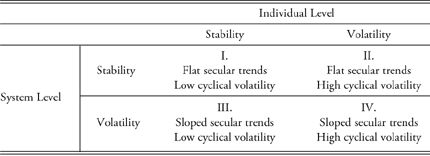
The (partial) independence of these forms of volatility implies that a party system can be systemically stable, but with individual-level volatility; systemically volatile, but with individual-level stability; stable in both respects; or unstable in both respects. Table 1 synthesizes the possible outcomes in a 2 × 2 matrix. Each concept is dichotomized for this discussion, but they vary continuously.
Two Dimensions of Volatility

Note: See online appendix 3 for a conceptualization and empirical referent for cell II.
We know that overall electoral volatility is much higher in the phase of new left party rule in the three Andean party systems studied here. The core purpose of this article is to test whether volatility is a general condition afflicting both dimensions—which would place them in cell IV—or a condition operating primarily at the system level—which would place them in cell III. I argue that the overarching narrative of crisis has obscured the extent to which these new left parties have reduced individual-level volatility, beginning immediately on entry and in spite of the continuing system-level volatility.
A Theory of Individual-Level Electoral Volatility
This study develops a set of expectations about individual-level electoral stabilization (net systemic volatility) that operates in contexts with a successful new left party in the system. The theory rests on the argument that new left party entry creates the conditions that lead to lower individual volatility. The stabilizing influence of large new left parties on individual volatility theoretically has three observable implications: it will be increasing before the new left party appears; it will decline when the new left party enters; and it will be lower among the target constituency of the new left party than among the opposition.
The Pre-entry Increase in Individual-level Volatility
Many party systems across Latin America faced crisis and adjustment through the late twentieth century. In the three countries studied here, where party systems ultimately collapsed, the view that party-voter bonds eroded in the run-up to the collapse is well established (Coppedge Reference Coppedge1994; Centellas Reference Centellas2009; Mainwaring et al. Reference Mainwaring, Bejarano and Leongómez2006; Lupu Reference Lupu2016; Morgan Reference Morgan2011; Seawright Reference Seawright2012; Levitsky and Roberts Reference Levitsky and Loxton2013; Roberts Reference Roberts2014). Morgan’s study of partisanship in Venezuela from 1973 to 2003 is particularly informative because she is able to assemble individual-level survey responses that show partisanship declining in the late 1980s (2007). In its place, the percentage of respondents identifying as independents approached 40 percent by 1990, even before the 1993 defection of a key traditional party leader (Rafael Caldera) from his party (COPEI). Carreras et al. (Reference Carreras, Morgenstern and Su2015) qualify the consensus view somewhat by emphasizing that two of these three party systems, Bolivia and Ecuador, were not well aligned in the first place.
The first hypothesis here serves in part to validate the analytic approach against a widely accepted conclusion: I seek confirmation in aggregate district-level data that individual-level volatility is relatively high or growing in the run-up to the entry of the new left party. It will also inform Carreras et al.’s partial qualification concerning Bolivia and Ecuador, which, if true, would suggest that individual volatility increases less dramatically (or not at all) in the period before the new left party enters.
Hypothesis 1. Individual-level volatility will increase through the elections leading up to the entry of the new left party, net the system-level forms of electoral volatility.
The Postentry Decline in Individual-level Volatility
If electorates are to stabilize by the conversion of floating voters into more loyal partisans, a theory is needed of how those new parties captured the formerly marginalized electorates. All three espouse “twenty-first-century socialism” (Ellner Reference Ellner2012) and are variously classified in the literature as the “populist left,” “radical populist,” or “new left” to demarcate their ideology, organization, and style from that of the more traditional leftist parties operating in the region (Roberts Reference Roberts2014).
Their ideology emphasizes social incorporation and direct participation. The movements arose as a strong rebuke to partisan politics as it had been practiced in each country. The leaders of each have been charismatic, and have deployed a highly polarizing Manichaean discourse of “the people” versus the elite (Hawkins Reference Hawkins2003; de la Torre and Conaghan Reference De la Torre and Conaghan2009; de la Torre Reference De la Torre2000). The leader claims to represent the popular will, and the cause is framed in revolutionary terms; in Ecuador, Correa led a “citizens’ revolution.” In each case, the campaign of the initial election emphasized constitutional and institutional reforms to “refound” the political regime, and each leader ultimately succeeded in this endeavor by convening a constituent assembly to replace a constitution that was rooted in representative democracy with one based on participatory democracy. In Bolivia, Evo Morales and his party lost their initial 2002 presidential election bid and had to wait another cycle. Correa and his movement in Ecuador took the strategy the farthest by boycotting the initial legislative election (2006) in order to parlay a strong presidential victory into a justification to discredit the legislature and convene a constituent assembly.
The organizational underpinnings of the three movements at their origin varied from strong (MAS), to moderate (PSUV), to weak (PAIS). The MAS in Bolivia had a strong social and organizational inheritance, built as it was on unions and indigenous groups (Madrid Reference Madrid2012). In Venezuela and Ecuador, the mobilization was created anew and from above. Roberts describes Hugo Chávez’s grassroots organizing as beginning in 1994, and notes that little explicit partisan organizing took place through 2000. Nevertheless, the movement was placed in a “permanent state of electoral mobilization” surrounding constitutional reform and ratification (Roberts Reference Roberts2006, 141). Hawkins and Hansen describe the Bolivarian Circles—one of the networks of ancillary organizations that Chávez cultivated to build local-level support—as “a surrogate form of partisan organization” that “met important goals of diffusing revolutionary ideals and providing ‘nonpartisan’ political organization for Chavistas” (2006, 106, 125). In Ecuador, by contrast, the initial bond between the movement and the electorate was newer and shallower (de la Torre Reference De la Torre2010), and relations with traditional leftist and indigenous organized civil society were strained (Becker Reference Becker2013).
As a group, these movements all generated a large and devoted following from the outset (Hawkins Reference Hawkins2010; Ellner Reference Ellner2008; Roberts Reference Roberts2003; Conaghan and de la Torre Reference Conaghan and de la Torre2008; Ellner Reference Ellner2012; Madrid Reference Madrid2012; Levitsky and Roberts Reference Levitsky and Loxton2013); nevertheless, the organizational differences would be expected to yield differences in each party’s ability to generate aligning identities among the electorate. Therefore, in the terms developed here, individual-level stabilization would be highest in Bolivia and lowest in Ecuador, with Venezuela in an intermediate position.
In sum, the literature is replete with descriptions of strong affinities that were born with the rise of these political outsiders. Some authors have argued that new left parties have led to improvements in democratic representation (Bruhn Reference Bruhn1997; Carreras Reference Carreras2012). Morgan uses survey evidence to show that as early as 1998, just before the presidential election that brought Chávez to power, left-leaning voters were the most likely voters to abandon the traditional parties and align with the “new left.” Bruhn shows that the “new left,” as a bloc, drew the most support, at 35 percent of the respondents (2007). If the very voters who were floating under the old regime—informal sector workers, marginalized indigenous communities, and leftists abandoned by traditional parties—encounter a credible alternative that speaks to their concerns, individual-level volatility should decline. These voters will migrate to the new party and then stay put, even amid dramatic systemic adjustments of the electorate that are unfolding at different rates for different sectors. Furthermore, in light of the successful campaigns of plebiscitary politics that these parties used to gain control and eventually to dominate the new political regime (Madrid Reference Madrid2009; Levitsky and Roberts Reference Levitsky and Loxton2013), I would expect the reductions in individual volatility to endure.
Hypothesis 2. Individual volatility in the new left party period will be lower compared to the elections immediately before its entry, net the system-level forms of volatility.
The Conditional Effect of Ethnic Diversity
Outside Latin America, ethnic diversity has been shown to stabilize electoral competition (Bartolini and Mair Reference Bartolini and Mair1990); but this has not historically been the case in Latin America (Madrid Reference Madrid2005a, Reference Madridb, Reference Madridc). Madrid explains this exceptionalism by arguing that the stabilization thesis is contingent on the existence of a competitive ethnic party (see also Carreras Reference Carreras2012; Birnir Reference Birnir2007). Where no such party is present to represent distinctively ethnic interests, ethnic voters are untethered from parties and float among them in response to cycle- and district-specific stimuli. In relatively closed party systems with high barriers to entry, these voters are pawns in an elite game of party competition (Van Cott Reference Van Cott2005). This explanation would lead to the expectation of a reduction in individual volatility where indigenous voters encounter indigenous parties.
In all three countries, ethnic politics has emerged as a salient dimension of political competition since the 1990s. However, only Bolivia offers the conditions to test the impact of the new party on individual-level stabilization using district-level data.
Three conditions make this evaluation possible. First, the indigenous population is nationally large (about 62 percent). Second, it is concentrated in the five highland departments (where it constitutes 75 percent of the population on average) and relatively absent in the four eastern lowland departments, collectively called the Media Luna (27 percent on average). Third, MAS is an explicitly (though not exclusively) indigenous political party; Madrid calls it “ethno-populist” (2012). Thus, a comparison of individual volatility between districts that are more or less indigenous would offer support to the argument if individual volatility were reduced more in the highland departments after the entry of MAS than in the Media Luna departments.
For Ecuador and Venezuela, there is no strong expectation that the new party will stabilize indigenous electoral support because PAIS and PSUV are not ethnic parties. In both cases, the indigenous communities retain parties that are independent of (though at times allied with) the new left parties.
Hypothesis 3. In Bolivia during the new left party period, individual-level volatility will be lower in the more indigenous departments than in less indigenous ones.
Research Design and Data
The research design has two parts. First, three separate large-N analyses were conducted to estimate the two forms of volatility. Then those results were used to compare the individual-level component of volatility in the periods with and without the new left party. If estimates of individual-level volatility are lower in the phase with the new left party than the phase without it, this will constitute support for the causal influence that left parties have in reducing individual volatility. In the Bolivian case, I am further able to exploit the geographic concentration of MAS’s indigenous constituency by comparing individual volatility between departments that have high and low indigenous populations.
The advantage of comparing between phases within each country separately is that it controls for features that are constant within each country over time, and which would otherwise confound individual volatility in a cross-country comparison. However, this design does not strictly rule out all alternative explanations. In particular, the arrival of the new left parties accompanied other changes—especially institutional reforms and undemocratic practices—that may influence individual-level volatility. It is noteworthy, however, that the reforms of the institutional environments amounted largely to openings of the political space that would have produced increases, not reductions, in individual-level volatility. Furthermore, at least early in the new left party era, the constitutional heavy-handedness of these party actors did not impinge deeply on voters’ freedom of choice, as evidenced by the extremely high levels of social mobilization for and against these regimes (Levitsky and Loxton Reference Levitsky and Loxton2013). Also, we can have heightened confidence in the results if they align with survey-based research projects on partisanship, where they exist (Morgan Reference Morgan2007).
In principle, there exists another research design that would eliminate the influence of a different set of confounding variables. A large-N comparison between country cases, one set that has a new left party and another that lacks such a party, would allow us to control for factors that differ between countries. However, two obstacles arise. First, the leverage of a large-N design would be partially undermined by the relatively few cases in which large new left parties compete within a (semi)democratic system. Second, the quantitative part of this research design (described below) requires continuous party panels of district-level election results. These are not generally available for a large number of countries and are difficult to construct by any individual scholar. The three original panels produced for this study—with a total of 7,109 district-level observations of vote share—required field research in Ecuador, access to rare bound volumes published by the Venezuelan election authorities for the early decades, and case knowledge of all three countries. Thus, a quantitative research design using many countries is not feasible.
How do I estimate individual-level volatility? I conduct a quantitative analysis of district-level election results. This stage of the analysis builds a longitudinal model of party competition that estimates electoral performance trajectories for each party, in each district (Converse would call these the normal vote, and I use these to model “system volatility”) together with estimates of individual volatility (Converse would call these the “deflections” from the average).
In order to estimate the longitudinal models of electoral performance, I measure the percentage of the voter support for each party, in each district, at each election for the province/department/state-level representatives to the lower (or only) house of the national legislature, from the democratic transition to 2014. These statistics come from the national electoral authority of each country. The collection procedures and data modifications are described in online appendix 2. These election results are a preferred gauge of partisan affinity because they are not subject as much to the personalism of presidential elections or the strategic voting of the single-member constituencies (when elections are held under mixed systems).
In Bolivia, the analysis treats eight elections between 1985 and 2014; in Ecuador, 13 elections between 1979 and 2013; and in Venezuela, 12 elections between 1958 and 2010. Despite small differences in the number of districts and magnitudes both between country and within country over time, the three countries are broadly similar. Bolivia has 9 departments throughout, with magnitudes ranging from 2 to 28; Ecuador has between 20 and 24 provinces, with magnitudes between 1 and 18; and Venezuela has between 23 and 24 states, with magnitudes between 1 and 43. Changes in the number of districts in Ecuador and Venezuela arise when a district splits into two parts. I treat all districts from the time they are created. I ignore the fact that boundaries have changed; however, I do not expect the consequence to be large because the splits are rare, the district boundaries are otherwise intact, and many of the subnational forces that govern vote choice arise from the geographic unit as a legally defined district.
Among the full set of parties that have competed, I exclude parties that never earn 2 percent of the national vote. This yields 22 parties with 495 district-level observations in Bolivia, 36 parties with 3,895 observations in Ecuador, and 20 parties with 2,719 observations in Venezuela.Footnote 3
Measurement and Statistical Models
Just as Pedersen offered up his index of electoral volatility in order to come to terms with the new emerging instability in the European electorate of the mid-twentieth century (1979), scholars of the late-twentieth- and early-twenty-first-century democracies strive to come to terms with high, growing, and more varied forms of electoral change. These cases make the volatility that motivated Pedersen look mild by comparison, and raise the question of how to estimate patterns of stability and change using aggregate electoral data.
A large methodological literature using variance decomposition on aggregate district-level data has arisen to study volatility and spatial variation in party support. The core insight of this tradition is that aggregate election results embody multiple dimensions of spatial variation and volatility, and that estimates of these dimensions are valid only when they are all treated simultaneously in a single model. These models exploit the ability to estimate one form of volatility and variation while exercising statistical control over the other forms.
This insight was first introduced in studies of the U.S. electorate in the mid-twentieth century. Stokes (Reference Stokes1967, Reference Stokes1965) and Converse (Reference Converse1966) proposed what are probably the earliest versions of these decompositional approaches. Stokes was interested in nationalization. He proposed using a “variance components model” on district-level election results to generate “a partition of the total variance” in voter support into national, state, and district components; these components represented the relative influence of forces emanating from these levels (1965, 65). Converse took up temporal variation when he distinguished the long-term “normal vote” from the “current deviation from the norm,” as discussed above (1966, 11).
Four decades later, with a new abundance of district-level data, Morgenstern and colleagues adapted these ideas and methods for applications in comparative politics. They synthesized a wider diversity of concepts pertaining to electoral variation—what they eventually came to call volatility, static nationalization, and dynamic nationalization—and incorporated statistical advances from the intervening years (Morgenstern et al. Reference Morgenstern, Swindle and Castagnola2009; Morgenstern and Potthoff Reference Morgenstern and Potthoff2005; Morgenstern and Swindle Reference Morgenstern and Potthoff2005).
My collaborators and I further expanded the range of conceptual phenomena (i.e., modeling changes in static nationalization) and further revised the model specification by allowing for time trends of party performance (Mustillo and Mustillo Reference Mustillo and Mustillo2012; Mustillo and Jung Reference Mustillo and Jung2016; Mustillo Reference Mustillo2017). Converse conceived of the “normal vote” as a simple average of vote shares over many elections because the long-term support for Democrats and Republicans was relatively stable over the period analyzed; it amounts to assuming a secular trajectory with a slope of zero. My colleagues and I relaxed it by allowing the “normal vote” to trend positively or negatively, at variable rates, and with differences between districts (2012). This was an important capability for treating the dynamic party systems in Latin America, where secular change (not secular stability) is “normal.” The common feature across all these models, spanning the five decades, is that they generate estimates of district election cycle specific mobility—what I call individual volatility. Statistically, it is always the residual (or unmodeled) variation in electoral performance, net the mean estimates of electoral support.
Systemic volatility is modeled as the fitted mean trajectories of performance. When the fitted trajectories correspond closely to actual performance, one can say that the volatility in the system is dominated by system-level forms. In the three country cases under consideration here, the system-level forms of volatility arise from (among other things) the trajectories of decline in the traditional parties and the trajectories of growth of the new left parties.
By contrast, individual-level volatility will appear in the model to the extent that support is not strongly structured by either the spatial or secular temporal processes. Analytically, these deviations from the fitted trajectories are in the residual term. In other words, individual-level volatility is the form of instability that is not well modeled by fitting a trajectory through a series of district-level observations; when it is high, actual party performance will correspond poorly to the fitted lines.
Before proceeding, an explanation is in order for why this approach to estimating electoral volatility was chosen over other more popular measurement approaches. Before Morgenstern and Potthoff introduced the components of variance approach to the comparative study of electoral volatility (2005), the comparative field had been relying heavily on other measures of aggregate electoral variation. Pedersen’s index of electoral volatility (1979) is the most prominent, but growing interest in the nationalization of electorates was also generating new measures of static nationalization, such as Gini-based indices (Jones and Mainwaring Reference Jones and Mainwaring2003). Morgenstern and Potthoff dubbed these “unidimensional” indicators of electoral variation because they estimate one form of electoral variation at a time.
These authors show that unidimensional approaches yield biased estimates, wherein bias is defined technically as an estimation procedure that generates systematically over- or underinflated estimates of the concept it seeks to measure. The bias arises because in failing to control for other forms of spatial variation and volatility, the estimates incorporate those other types of variation. A thorough review of these arguments is beyond the scope of this article, but they have been carefully summarized and tested in a growing body of work on these measurement and estimation issues (Morgenstern and Potthoff Reference Morgenstern and Potthoff2005; Morgenstern et al. Reference Morgenstern, Polga-Hecimovich and Siavelis2014; Mustillo and Jung Reference Mustillo and Jung2016; Mustillo and Mustillo Reference Mustillo and Mustillo2012; Morgenstern Reference Morgenstern2017). Since the core purpose of this study is to distinguish different dimensions of change and variation, it adopts the variance components tradition rather than some of the more common estimation procedures.
Analytic Models of System and Individual-level Volatility
The forms of volatility in these party systems are measured with growth mixture models (Singer and Willett Reference Singer and Willett2003). The models are multilevel: in each country there are multiple parties (level 3); each party competes in multiple districts (level 2); for each party in each district, there are multiple observations over time (level 1). Time is treated by counting years starting with zero and consecutively from the first election. For example, for Venezuela, time at the first election in 1958 is coded as zero, at the second election, in 1963, as 5, and at the 12th election, in 2010, as 52.
The modeling strategy here is fully detailed in Mustillo and Mustillo Reference Mustillo and Mustillo2012, but I introduce one important modification. The earlier study builds models using panels of three elections and test specifications with second-order polynomials. Generalizing, it uses polynomials of one degree fewer than the number of elections. This specification makes it impossible to distinguish between long-term secular trends and short-term cyclical effects. Instead, here, the analysis discriminates between secular trends and cycle-specific sources of a party’s changing support by treating longer panels of elections, and by using polynomials that are two or more orders lower than the number of elections. As it turns out, polynomials are never higher than the third order, which allows for a point of inflection in performance (that is, an S-shaped function). This is especially relevant for long-lived parties. The fully specified model appears as equation 1, though the final model for a given country will vary from this, depending on the formal assessment of model fit, the Bayesian information criterion, and the Akaike information criterion.
 $\matrix{
{VOT{E_{ijk}} = [{\beta _1} + {\pi _{1k}} + {\zeta _{1jk}}]} \hfill \cr
{ + [\left( {{\beta _2} + {\pi _{2k}} + {\zeta _{2jk}}} \right)yea{r_{ijk}}]} \hfill \cr
{ + [\left( {{\beta _3} + {\pi _{3k}} + {\zeta _{3jk}}} \right)year_{ijk}^2]} \hfill \cr
{ + [\left( {{\beta _4} + {\pi _{4k}}} \right)year_{ijk}^3]} \hfill \cr
{ + {\varepsilon _{ijk}}} \hfill \cr
{with{\varepsilon _{ijk}} \sim N(0,\sigma _\varepsilon ^2);} \hfill \cr
{and\left[ {\matrix{
{{\pi _{1k}}} \hfill \cr
{{\pi _{2k}}} \hfill \cr
{{\pi _{3k}}} \hfill \cr
{{\pi _{4k}}} \hfill \cr
} } \right] \sim N\left( {\left[ {\matrix{
0 \hfill \cr
0 \hfill \cr
0 \hfill \cr
0 \hfill \cr
} } \right],\left[ {\matrix{
{\sigma _1^2} \hfill & {{\sigma _{21}}} \hfill & {{\sigma _{31}}} \hfill & {{\sigma _{41}}} \hfill \cr
{{\sigma _{12}}} \hfill & {\sigma _2^2} \hfill & {{\sigma _{32}}} \hfill & {{\sigma _{42}}} \hfill \cr
{{\sigma _{13}}} \hfill & {{\sigma _{23}}} \hfill & {\sigma _3^2} \hfill & {{\sigma _{43}}} \hfill \cr
{{\sigma _{14}}} \hfill & {{\sigma _{24}}} \hfill & {{\sigma _{34}}} \hfill & {\sigma _4^2} \hfill \cr
} } \right]} \right);} \hfill \cr
{and\left[ {\matrix{
{{\zeta _{1jk}}} \hfill \cr
{{\zeta _{2jk}}} \hfill \cr
{{\zeta _{3jk}}} \hfill \cr
} } \right] \sim N\left( {\left[ {\matrix{
0 \hfill \cr
0 \hfill \cr
0 \hfill \cr
} } \right],\left[ {\matrix{
{\sigma _1^2} \hfill & {{\sigma _{21}}} \hfill & {{\sigma _{31}}} \hfill \cr
{{\sigma _{12}}} \hfill & {\sigma _2^2} \hfill & {{\sigma _{32}}} \hfill \cr
{{\sigma _{13}}} \hfill & {{\sigma _{23}}} \hfill & {\sigma _3^2} \hfill \cr
} } \right]} \right);} \hfill \cr
}$
where VOTE is the vote percentage for each party, k, in each district, j, for each occasion, i. The estimates of β represent the fixed effects, which parameterize the mean vote trajectory over time in all the data. β1 is the mean intercept at time 0; β2, β3, and β4 specify the linear, quadratic, and cubic time trends, respectively, to allow for nonlinear secular trajectories.
The seven estimates of ζ and π represent the model random effects (or variance components). They are estimates of the variance in the corresponding higher-level parameter. ζijk and π1k in the first set of brackets estimate the variance in the mean intercept, β1, that are attributed to the district and party levels, respectively. That is, of all the variation in observed vote percentages at the initial observation (where year = 0), a certain amount is attributable to variation between parties, and a certain amount is attributable to variation within parties but between districts. Similarly, β2, β3, and β4 each have one or two variance components, ζjk and πk. These parameters and their covariances collectively specify all the mean trajectories of party support nationally and in each district. Together, they model what I call the system-level volatility: all the spatial and temporal patterns purged of their cycle-specific variability.Footnote 4 Converse would call these the normal vote.
After accounting for these, the residual variance is estimated as ϵijk, which is assumed to be normally distributed with a mean of zero and a variance of  $\sigma _\varepsilon ^2$. Singer and Willett aptly describe this parameter as summarizing “the scatter of each [district’s] data around its own estimated … change trajectory” (2003, 98–99). Converse (Reference Converse1966) might have described it as the “deflection” from the normal vote. It corresponds with the conceptualization of individual-level volatility developed above.
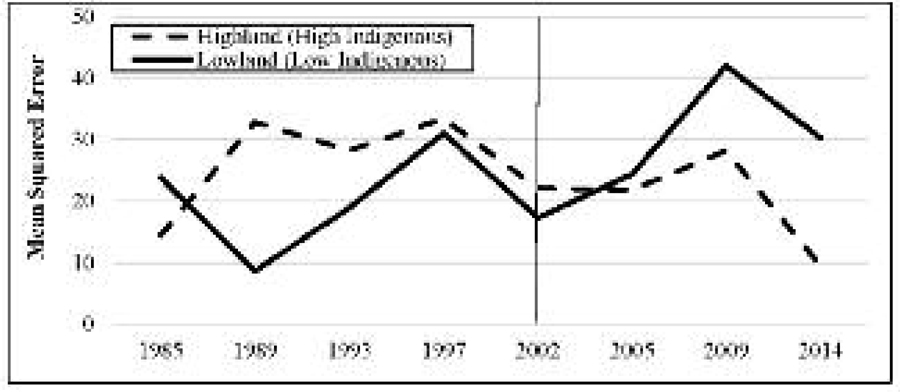
In order to estimate individual-level volatility at each election, I use the model to predict the residuals for each observation, and then aggregate them at each election by computing the mean squared error. The mean squared error is the difference between the fitted value and the observed value for each observation, which is squared, and averaged for the election. The result is a single estimate of individual-level volatility for each election (reported later in figure 3). In order to distinguish individual volatility in regions with high and low indigenous populations, I will also compute the mean squared errors for those subsets of the data (reported later in figure 4). The parameter estimates themselves are only indirectly informative; the best-fitting models are reported in online appendix 5.
RESULTS
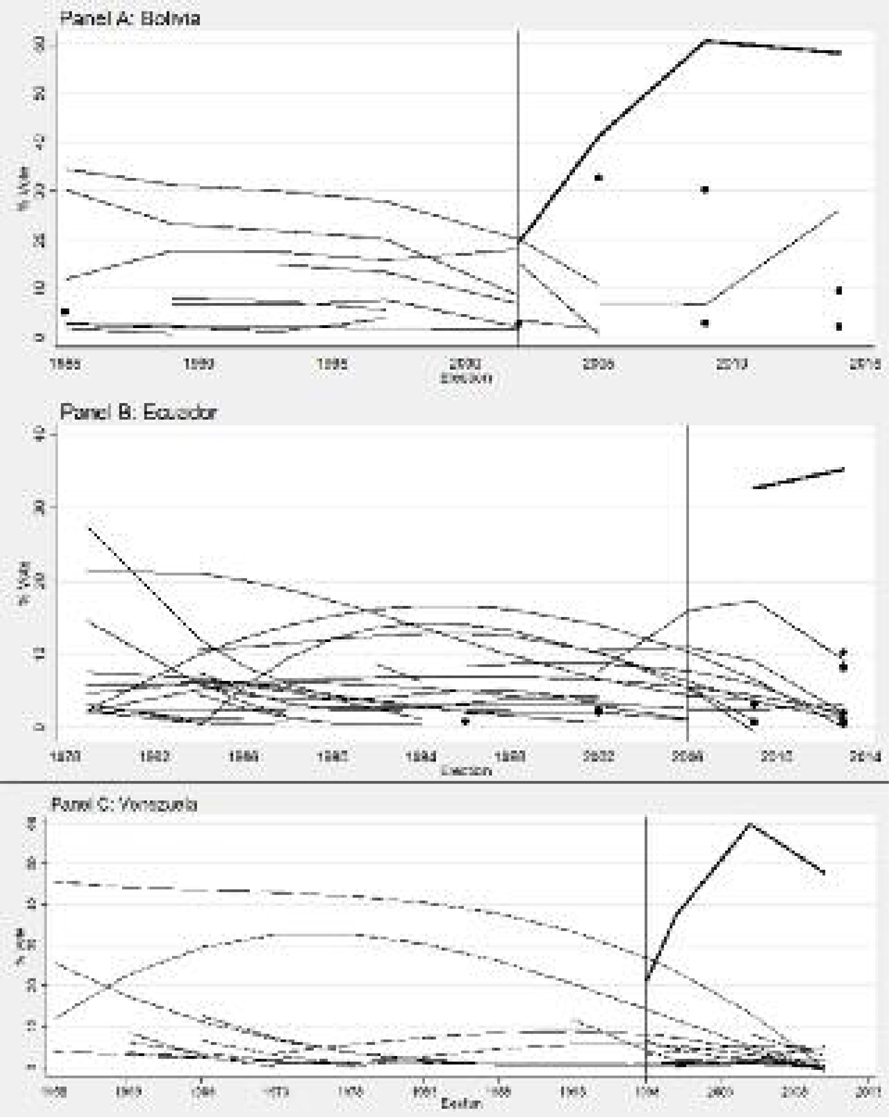
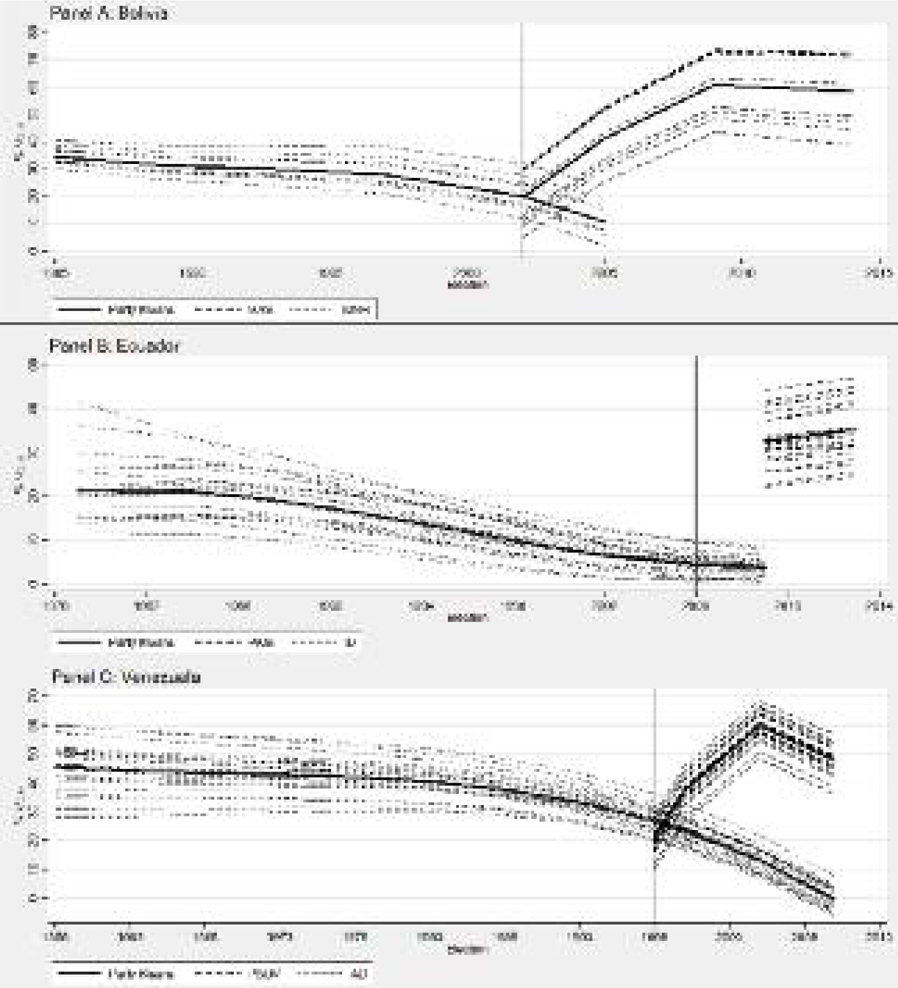
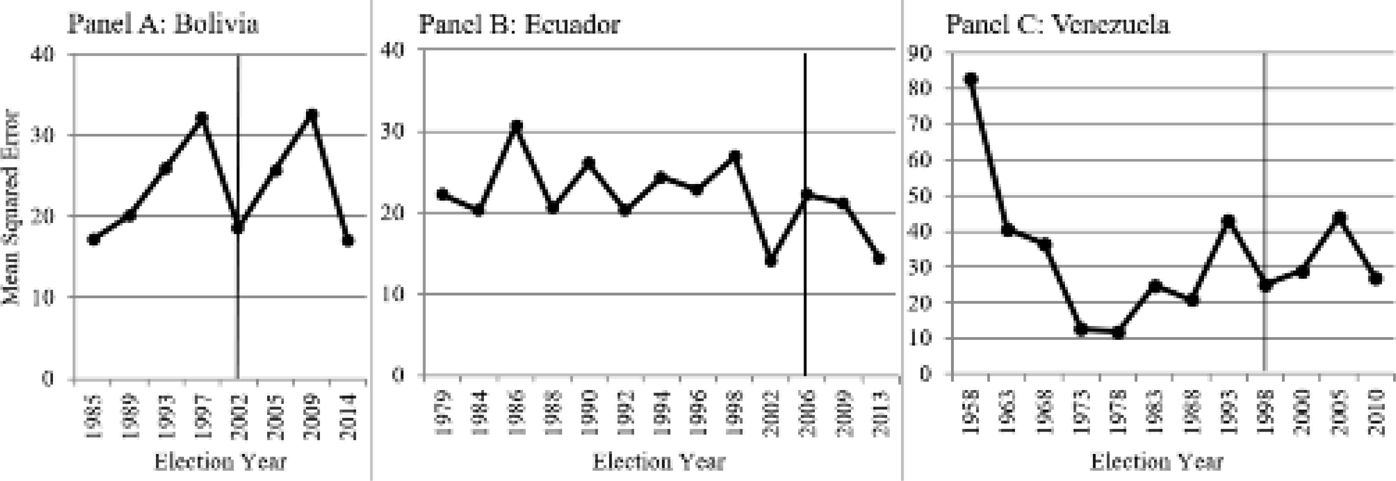
Results are reported using plots of system-level and individual-level volatility. We begin with plots of the former, which amount to controls, using figure 1 to report party-level trajectories and figure 2 to report district-level trajectories. Then we turn to individual-level volatility using figures 3 and 4. Figure 3, which plots the mean squared residuals for each country before and after new left party entry, is used to evaluate hypotheses 1 and 2. Figure 4, which plots the mean squared residuals in the high and low indigenous departments of Bolivia, is used to evaluate hypothesis 3.
Mean Party Trajectories

Mean District Trajectories, New Left Party and Another Main Party

Individual-level Volatility by Country

Individual Volatility, Bolivia, by Region

Figure 1 reports the fitted mean party trajectories of all parties in the analysis. The vertical line demarcates the entry of the new left party. Party labels have been omitted to reduce clutter. (See online appendix 6 for a version with a legend). In each country, the left party is the bolded trajectory that appears after the vertical line and reaches the highest level of success in the series. Parties that compete only once are identified with a marker but no line. In Ecuador, PAIS boycotted the legislative election in 2006 and is not observed until 2010. These figures reveal the decline or collapse of the traditional parties and the explosive emergence of the new left parties.
Figure 2 plots the predicted district-level result for the new left party (dashed lines) and one other important party (dotted lines). The figure is limited to two parties for each country to reduce clutter. These are sufficient to convey some of the distinctively district-level dynamics that constitute system-level forms of volatility. District-level plots for all parties are available using the replication files.
In each case, one of the strong traditional parties is plotted alongside the left party. In Bolivia, the MNR is plotted; in Ecuador, ID; and in Venezuela, AD. The mean party-level trajectory for all parties is plotted in bold; it reproduces the trajectory for that party from figure 1. Figure 2 reveals changes in static nationalization: a fanning-in (or -out) pattern indicates gains (or losses) in static nationalization. By the last election, PSUV has the most nationalized support of the three parties, MAS is least nationalized, and PAIS occupies an intermediate position. Furthermore, the fanning-out pattern for MAS shows that it has grown less nationalized between 2002 and 2014, and the district lines correspond with expectations: the four bottom trajectories are Media Luna, the five upper ones are highland.
The central findings in this project derive from the estimates of individual-level volatility. Figure 3 reports the mean squared error at each election. In Bolivia, individual volatility grows steadily from 1985 until 1997. It drops markedly for the 2002 election when the new left party enters, and then follows an inverted U–shaped pattern, growing through 2009 before ending in 2014 at the lowest level in the series.
In Ecuador, individual volatility vacillates between about 20 and 30 from the democratic transition through the 1980s and most of the 1990s. The low point in the series occurs in 2002 in the election immediately before the emergence of the left party. Otherwise, during the period of left party rule beginning in 2006, individual volatility is lower than in three of the other four elections immediately before the left party entered.
In Venezuela, individual volatility is at a maximum during the transitional election of 1958 and trends downward until 1973. From 1973 on, it begins to increase through the 1970s and 1980s, and reaches a local maximum in 1993, during the election immediately before the entry of the new left party in 1998. During the period of PSUV rule, from 1998 to 2010, the estimate of individual volatility is moderate—generally higher than in the 1970s and 1980s but generally lower than in the initial three elections. The election of 2005 has an exceptionally high level of individual volatility.
Next, for Bolivia, figure 4 reports the mean squared error broken down by region. Individual volatility is generally higher in the five more indigenous departments before the entry of MAS, whereas afterward these districts are, on average, more stable, with an especially large gain in stability by 2014. In contrast, the lowland Media Luna region has higher individual volatility since the rise of the MAS.
DISCUSSION
This study investigates electoral volatility by distinguishing individual volatility from other systemic forms of volatility and spatial variation, such as static nationalization and secular trends in party performance. Even when system volatility is quite dramatic—as when old parties collapse and new entrants begin to construct support—this study investigates whether more coherent and routinized patterns of party-voter support arise when the new entrant is a new left populist party that eventually comes to dominate the electoral arena.
The first hypothesis predicted that in the run-up to the emergence of the new left parties, individual volatility would increase, net the system-level forms of volatility. In all three cases, the years predating the transformations were times of escalating social and political mobilization against the traditional parties, their policies, and the regime. The results confirm the expectation for the cases of Bolivia and Venezuela. In both, as traditional parties weakened and short-lived populist parties increasingly challenged, individual volatility trended upward, with a peak at the last observation before the new left party entered. The trend in Venezuela mirrors the declining partisanship that Morgan found using individual-level data (2007).
In Ecuador, before the entry of PAIS in 2006, there was no increase. Instead, individual volatility oscillated. The peaks in 1986, 1990, and 1994 correspond with midterm elections, while the low points of 1984, 1988, and 1992 correspond with presidential election years. This pattern suggests that concurrent presidential elections reduce individual-level mobility. Though formally untested here, it would support an important premise of this article: that quite apart from the long-term trends of party support, there are distinctive election-cycle influences that deflect voters from their “normal” state of alignment. In this particular case, the pattern is compatible with work showing that institutions differentially impact different dimensions of electoral variability (Morgenstern et al. Reference Morgenstern, Swindle and Castagnola2009).
The absence of a general increase in Ecuador may have arisen because there were few strong voter loyalties to erode in the first place. It is compatible with research finding that the posttransitional party system inaugurated in the late 1970s did not embody any particular aligning orientation. Roberts argues that unlike Bolivia and Venezuela, Ecuador did not contain a “labor-mobilizing” party (2014). Relatedly, Carreras and colleagues find that the party system was only “partially aligned” through this period (2015).
In 2002, individual volatility in Ecuador dropped to the low point in the entire series. In order to understand this anomalous result, I examined mean squared errors by party. Doing so reveals that individual volatility at each election since 1979 was strongly influenced by large swings in support toward the parties of the leading presidential contenders in years of concurrent elections, and large swings toward opposition parties in midterm elections. This tendency was strongest when these main governing and opposition parties were traditional parties with an established electoral trend from which to deviate. The election of 2002 was different in this respect. The top two presidential candidates were political outsiders from new parties. Their parties made weak efforts in the 2002 legislative races and won only a combined 16 percent of the seats. The combination of outsider presidential candidates with weak parties, and traditional parties that lacked the coattails of a leading presidential contender, yielded an outcome in which none of the traditional parties experienced the typical large swings in legislative support.
The second hypothesis stated an expectation that individual volatility in the left party period would decline and stabilize at a level lower than that of the period before its entry, net the system-level forms of volatility. This trend was expected to develop as the new party captured reliable support, transformed the regime, and then consolidated its domination. The results offer support to this hypothesis, but with two qualifications.
First, the extraordinary success of these three new governing parties instigated high individual volatility among regime opponents, whose parties collapsed everywhere. Thus, even though new left party entry does generally coincide with an initial drop in individual volatility and returns to a relatively low level by the final observation, there is an interregnum during which it rises. For example, in Bolivia, the election of 2002 was a moment of individual-level stability. Why? The electoral contest included the new “ethnopopulist” party that began to capture and hold the support of the previously marginalized majority. At the same time, the three traditional parties that opposed MAS held together in a coalition that won the presidential election. But within the year, their government collapsed in the face of mass social mobilization, and the parties themselves then collapsed. Thus, individual volatility climbed again through the 2005 victory of the MAS, which faced a disorganized opposition; and through the 2009 election, which had as a backdrop a new constitution and failed bids for autonomy in the opposition stronghold departments. By the 2014 election, the opposition had nominally coalesced around a partisan vehicle that, though personalistic, had at least competed repeatedly over three elections and had begun to draw together a set of provincial politicians into an alliance with national reach (Centellas Reference Centellas2015).
Second, electoral boycotts of legislative elections—by PAIS in Ecuador in 2006, and by the opposition to PSUV in Venezuela in 2005—elevated the levels of individual volatility during these two elections. Why? When a large segment of the electorate sits out, the nonboycotting parties turn in an inflated vote share. This registers as a large positive deviation from their estimated mean trajectory and inflates the mean squared error.
The third hypothesis predicted that in Bolivia—where the indigenous population is large and concentrated—the entry of the new left ethnic party would stabilize individual electoral support more in regions that were more heavily indigenous than in regions that were not. The expectation is clearly borne out. The reductions in individual volatility were concentrated in the five highland departments and the growth in the four Media Luna departments of the lowlands. This finding underscores Madrid’s clarification of the argument that ethnicity stabilizes electorates: the stabilizing influence of ethnic populations is conditional on the existence of a strong ethnic party (2005b).
These results sustain the independence of two broad categories of electoral volatility, as summarized in table 1. They show that the emergence of large left parties occupies cell III (individual-level stability) rather than cell IV (individual-level volatility). However, the framework is informative in a more broadly comparative perspective. First, proper cases for cell IV are likely to be those where parties or systems collapse but no large ideological parties take their place (as in Colombia). Where a nonideological, strong populist emerges (as in Italy under Silvio Berlusconi and Peru under Alberto Fujimori), patterns of individual volatility bear further investigation; however, without a social basis of support, volatility is likely to remain high even through the tenure of the strongman.
Second, the confirmation of hypothesis 1 shows that voters were fleeing their partisan homes even before the new left party arrived. However, systemic adaptations can arise in which the transformation of voter affinities proceeds with more structure, as in the Uruguayan realignment. Third, this project examines party systems through the emergence of a left party. However, once the performance trajectories level out, the result may be systems that are stable in both respects (i.e., cell I).
CONCLUSIONS
This project contributes to research on representational crisis and electoral volatility in democratic political systems around the globe. Prior research using aggregate electoral data has correctly detected electoral volatility in diffuse terms, but has not sufficiently discriminated between different forms, which, this study argues, can operate partially independently. In particular, that research has failed to detect a form of stabilization of electorates that can arise when new left parties mobilize stronger and more durable partisan bonds. This research shows that growth curve models can uncover these more subtle distinctions.
The new left parties that have emerged in three Latin American states have reduced the high levels of individual-level voter mobility that arise from weakly aligned floating voters. This stabilizing effect probably reflects the partisan political incorporation of large segments of the electorate that previously had been marginalized. It arises even while the confrontational plebiscitary tactics of the new entrants instigate deep system-level volatility, and sometimes increased individual-level volatility among the opposition during transitional election cycles. Also, this research lends support to the literature on the stabilizing influence of ethnic heterogeneity by showing that stability is conditional on the presence of a party that represents people’s distinctively ethnic demands.
Although the results offer confirmation of many of the theoretical expectations and inform our understanding of the patterns in the stabilization of electoral support of some of the most turbulent electorates of the last 25 years, several limitations exist. First, despite being rooted in a district-level treatment of electoral support, the analysis here takes place at a relatively high level of aggregation. It gets closer to the assessment of individual-level voter mobility than studies that use national aggregate measures, but it does not attain the resolution required to isolate the diverse forces that shape individual behavior.
Second, to argue, as argued here, that individual-level volatility is captured in the residual term of these models is not to say that it is not explainable; it simply means that within the scope of this analysis, I make no effort to incorporate predictors of deflections from the “normal vote.” Individual volatility is the sort of instability that arises from three sources: national cycle-specific sources, district cycle-specific sources, and sources of distinctly individual-level fluidity. Morgenstern and Swindle call these dynamic nationalization (2005). Indeed, some of these issues were raised in the discussion (i.e., election boycotts, midterm elections). The model I use here to estimate volatility is a so-called unconditional model because it estimates performance trajectories without incorporating explanatory variables; the model merely seeks to represent the spatial and temporal structure of the data. I use the results to make qualitative comparisons of the party systems before and after the entry of the new left party; however, future applications might incorporate predictors of these deflections if the quality and availability of subnational data improve.
The system-disrupting parties that have charged onto the scene in these Latin American countries may ultimately form the basis of a party system that represents diverse constituencies more regularly. Despite their democratic deficiencies, and the post-2016 crisis in Venezuela notwithstanding, the new left parties can often stabilize subsets of the electorate—especially the popular, indigenous, and informal sectors—that were adrift under the previous regime. Eventually, electoral support writ large may stabilize as these advances in individual stability combine with system-level stabilization when support for the new parties levels off. The challenge in all three countries on the matter of individual volatility is whether and how a viable opposition will coalesce. As Duverger once suggested (1954), if, in response to this coherence on the left, the generally fragmented regime opponents are able to come together organizationally, build a coherent alternative vision, and form partisan bonds with opposition voters, these party systems may attain (in Bolivia and Ecuador) or restore (in Venezuela) representative systems that are broadly stable, both systemically and individually.
Supplementary Material
To view supplementary material for this article, please visit https://doi.org/10.1017/lap.2018.22
For replication data, see the author’s file on the Harvard Dataverse website: https://dataverse.harvard.edu/dataverse/laps