Before Sir Thomas Barnardiston of Kedington, Suffolk, and Great Cotes, Lincolnshire, died in 1503, he named his widow Elizabeth as his sole executor. Since the will itself has not survived and we know these facts from a subsequent Chancery case, we do not know where Sir Thomas asked to be buried. Nonetheless, Dame Elizabeth was probably following his directions when she chose Great Cotes, Lincolnshire, where they had lived until around 1500, for his final resting place rather than Kedington, Suffolk, to which they had recently moved. His tomb was marked by a large brass containing a picture of the resurrection, portraits of Sir Thomas and Dame Elizabeth with inscription scrolls coming out of their mouths, and representations of their fifteen children.Footnote 1 Sir Thomas's scroll reads, “Jesus, have pity on me”; Dame Elizabeth’s, “Your will be done.”Footnote 2 The inscription under the picture begs viewers for prayers: “In the worship of the Resurrection of Our Lord and the Blessed Sepulchre and for the soul of Sir Thomas Bernardiston Knight and Dame Elisabeth his wife and of your charity, say a Pater Noster [and] six credos. Ye shall have a hundred days of pardon to your name.”Footnote 3 A second inscription around the margins of the brass also asks for prayers.Footnote 4
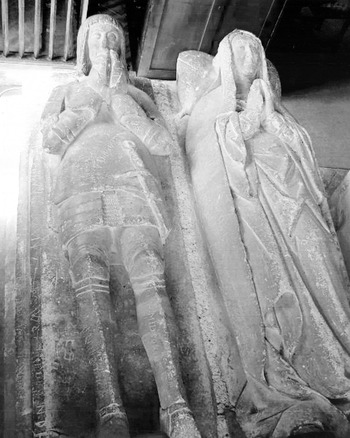
Before her own death in 1526, Dame Barnardiston apparently resided at Walsingham Priory. Although she hoped to be buried at Walsingham, she was in fact laid to rest at Kedington. A stone tomb chest there has effigies of her and her husband and an inscription stating explicitly that he was buried in Lincolnshire and she under the Kedington monument.Footnote 5 Since the inscription left the date of Elizabeth's death blank, she probably built it during her lifetime (fig. 1).Footnote 6 She may also have been responsible for the stained glass window over the monument showing her, her husband, her seven sons, and their arms.Footnote 7
This article argues that Dame Barnardiston and scores, probably hundreds, of aristocratic widows, paid for and/or directed construction of their husbands’ and their own chantries and tombs, most often in their parish churches. Chantries took various forms: simple altars, new chapels intended to become mausoleums for successive generations of the family, and endowed almshouses and schools that required the beneficiaries to pray for the founders and their families. Their activity demonstrates that Yorkist and early Tudor aristocratic women's patronage played an important part in the expensive and wide-ranging investment in parish churches that peaked in the first decade of the sixteenth century and created many of the most visible and appealing material remains of the period.Footnote 8 The essential role they played as executors of their husbands’ wills, the wealth they controlled during their long widowhoods, and their commitment to providing for their husbands’ and their own salvation provided the motives and resources for their accomplishment. Furthermore, as the data presented below show, the wives' participation in these projects was an active one: their wills often included detailed directions about the design and location of the monuments they were commissioning.Footnote 9
The commissions of these women represent significant contributions to English art in the late fifteenth and sixteenth centuries. Art historian Brian Kemp has noted: “Monuments in general, and effigies in particular, are of the greatest importance in the history of English sculpture. Without the survival of medieval effigies and such
Effigies of Sir Thomas Barnardiston (d. 1503) and Dame Elizabeth Barnardiston (d. 1526), Kedington Suffolk. Photograph by author.

ancillary figures as weepers, angels and saints … our knowledge of sculptural skills in the middle ages would be sadly impoverished.”Footnote 10 Yet, in contrast to the considerable attention literary historians have given to women's patronage of manuscripts and books, historians have paid little attention to their contribution to religious architecture, sculpture, engraving, and painting, with the exception of that of a handful of unusually wealthy and visible noblewomen such as Alice de la Pole, duchess of Suffolk (d. 1475), Margaret Beaufort, countess of Richmond (d. 1509), and Margaret Hungerford, Lady Botreaux and Hungerford (d. 1478).Footnote 11 Nonetheless, there is a good chance that the late fifteenth- or early sixteenth-century monuments and chapels we admire were commissioned by women.
Studying the tombs built by Yorkist and early Tudor aristocratic women also provides us with an entrée to a dimension of the past—their definition of their identity and subjectivity—largely invisible in written documents. As used here, subjectivity refers to women's outward expressions of their identity and the actions they took as a consequence.Footnote 12 In a period before the appearance of journals and autobiographies, and one in which writers rarely used letters for self-reflection, scholars have few ways of discovering how women identified themselves and how these identifications shaped their choices and action. Faced with the task of building their own and their husbands’ tombs, however, women were forced to embody their view of themselves, their status, and their place in their successive families in stone and marble. In addition, the break with Rome and halting measures of religious reform in the late 1530s gave them an unprecedented opportunity to preserve or reshape their spiritual identities.
To understand Yorkist and early Tudor aristocratic women's subjectivity in terms of choices they made in relation to the family and religion corresponds to the evidence in contemporary sources. However, it also requires historians and literary critics to revise the influential but ahistorical paradigm that defines subjectivity in terms of the modern autonomous self that emerged in opposition to these institutions.Footnote 13 As long ago as 1986, Natalie Davis argued that, in sixteenth-century France, the individual's understanding of her or his self always involved relationships—with God, one's family, one's patron, and especially one's family and lineage. In Davis's view, the patriarchal family, more than any other social unit, stimulated people within its boundaries toward self-discovery, self-presentation, and devising strategies for achieving some personal autonomy.Footnote 14 Davis's analysis applies equally well to the evidence about Yorkist and early Tudor women presented in this article.Footnote 15
Finally, focusing on the tombs and chapels women commissioned contributes to the ongoing debate about the origins of the English Reformation. Most historians of the period—myself included—accept the revisionist argument that widespread, often active, support for the church and the religious status quo existed in the generation or two before Henry VIII's break with Rome. The evidence presented here supports that interpretation. However, it also suggests the need for a more nuanced interpretation of the scale and cost of church building in these decades. Revisionist scholars have cited this building as still further evidence for their position.Footnote 16 As we shall see, however, the tombs and buildings aristocratic women paid for were equally important as symbols of their and their families’ status and wealth. In a culture that believed that the social and political hierarchy was part of the divine order of creation, they saw no contradiction in designing projects that embodied both their worldly and their spiritual aspirations. In fact, like the Barnardistons, many noble and knightly families took a proprietary attitude toward their parish churches and turned them into family mausoleums.Footnote 17 While many historians and art historians have recognized the interpenetration of spiritual and secular concerns evident in the monuments and chapels that women and men constructed during the period, their assessment has not modified the revisionist interpretation of the motives that fueled their activity.Footnote 18
Sources
Aristocratic wills written between about 1450 and 1560 provide the core data for this article. In this study, the term aristocratic refers to noblemen, knights, and their daughters, wives, and widows. Although knights are often categorized as the top stratum of the gentry, in crucial ways they were much more akin to the nobility with whom they governed England in partnership with the crown, intermarried, and shared ownership of a huge proportion of the land that did not belong to the church or crown.Footnote 19
My analysis began with 763 male and 281 female wills from every region of England. They survive in the records of the Prerogative Courts of Canterbury and York, where most of them were probated, in the Cotton and Harleian Collections at the British Library, and in local record offices. Of the male testators, 523 had surviving widows, 403 (77 percent) of whom they appointed executors or supervisors of their wills. Thirty-five percent of the 403 named the widow as the sole executor. As executors, these women were usually responsible for the spouse's funeral and tomb. The longevity of aristocratic widows meant that they had ample time to oversee the monuments and chapels they commissioned: in a group of 351 couples where the death dates of both male testators and their widows are known, 63 percent of the women outlived their husbands by more than ten years; 37 percent did so by more than twenty years.Footnote 20 Of the 403 men who appointed their widows as executors or coexecutors of their wills, 276 (68.4 percent) specified where they wanted to be buried. A similar percentage—189 (67.3 percent)—of the 281 female testators also indicated where they wanted to be buried.Footnote 21 Because some of the testators were married to each other, this group of 465 represented 414 couples where the widow was a potential tomb builder for her deceased spouse, herself, or both of them and the testators’ wills contained instructions regarding their monuments.
Beginning with the information in the wills themselves, my research continued in antiquarian sources, local histories, and reference works, such as the Victoria County Histories of England, the publications of the Royal Commission on Historical Monuments, and the exhaustive county surveys of the buildings of England begun by Nikolaus Pevsner and continued by his colleagues. As a result of this work, I have identified sixty-nine widows in this group of 414 couples who definitely built and/or financed their own or their husbands’ tombs and another seventy-three who almost certainly did so. An additional 157 women may well have been tomb builders. I have no doubt that further research will establish that many of them also commissioned funerary monuments.
In addition, sixty-seven (47 percent) of the 142 women who built tombs left bequests to endow chantries, chapels, or almshouse and hospitals that served a chantry function. This figure is almost certainly an undercount since men occasionally claimed credit for founding chantries that women endowed. For example, Elizabeth Holles's executor, Andrew Judd, took credit for the almshouses he established with her property.Footnote 22 In other cases the women's intentions were frustrated because their executors did not carry out their instructions. No evidence exists, for example, that the income from the manor Dame Elizabeth Brandon, widow of Sir William, left to found a chantry was used for that purpose.Footnote 23
In scale, chantries ranged from the elaborate chapels that Alice (née Chaucer) de la Pole (d. 1475), duchess of Suffolk, had constructed at three different sites to the single altar that Dame Elizabeth Frowick (d. 1516) had built at Black Friars, London. Overwhelming evidence records the duchess's major role in designing her chapels and overseeing their construction.Footnote 24 But she was not the only woman who actively supervised the building for which she paid. Anne (née Harling), Lady Scrope (d. 1498), a childless heiress, had built an elaborate tomb for her first husband, Sir William Chamberlain, in her native parish at Harling, placing it between the chancel and a chapel dedicated to St. Anne. Almost twenty years later, she commissioned stained glass for the east window that included portraits of Chamberlain and her second husband, Sir Robert Wingfield.Footnote 25 When Wingfield died in 1480, she buried him at Rushworth, Norfolk, where she endowed a chantry with a grammar school attached to it and built a new chapel for his monument.Footnote 26
Female chapel builders also came from the knights’ families. After her husband died, Dame Isabell Newton (d. 1498) arranged her election as a church warden in their parish in order to oversee construction of the chapel they had planned together.Footnote 27 Lady Anne Petre (d. 1582) commissioned the chapel at East Horndon, Essex, where her first husband, John Tyrell, was buried. It was called the “Petre Chapel” even though the church itself was the traditional mausoleum of the Tyrells.Footnote 28
Of the 142 tombs or groups of tombs that aristocratic women built, seventy-three, or 51.4 percent, survive today in various states of preservation and decay. The destruction of funeral monuments all over England began in the sixteenth century with the dissolution of the monasteries and the popular iconoclasm of the Edwardian and early Elizabethan periods and has continued to the present day. But the bare majority that remain and the accounts or drawings of those that have disappeared provide more than enough evidence for the analysis in this article.
The Monuments
Throughout the Yorkist and early Tudor period, monuments for members of the aristocracy took the form of tomb chests with images and inscriptions for the deceased, his/her spouse(s), and their children. The actual bodies were buried in vaults beneath the tombs. Less frequently, the monuments resembled altars that functioned as Easter sepulchres and were located either in the chancel or a niche at the east end of the church's north wall.Footnote 29 These tombs became the site of the central dramatic ritual that marked the Easter holiday. On Good Friday, the priest placed the host on the altar and covered it. A candle burned in front of it, and members of the parish kept vigil at the altar until Easter morning, when the cover on the host was removed and mass celebrated.Footnote 30 Of the 142 women tomb builders examined here, ten commissioned Easter sepulchres.
Images on tomb chests took a number of forms: effigies of stone or marble, figures engraved in brass tablets, and carvings cut into the stone itself. From about 1350, craftsmen working in alabaster dominated this kind of tomb making. They constructed the tomb chests and altars and carved the effigies placed on top of them as well as the shields and other figures on the sides. The most expensive altar tombs had marble effigies resting on marble slabs. In addition, the sides of many tombs contained sculpted figures who represented the deceased couple's children. The cost of these tombs ranged from the £10 paid for Henry Foljambe's tomb in Derbyshire in 1508 to the 100 marks (£66.6) paid for William, Lord Hastings's tomb in St. George's Chapel at Windsor Castle.Footnote 31 Even £10 was a goodly sum at a time when it was the annual income from a respectable benefice for a parish priest. Alternatively, effigies engraved into brass sheets were set into indentations in the marble or stone slab on top of the monument. They were a less expensive alternative. According to one survey of forty bequests for brass memorials between 1465 and 1538, twenty-seven ranged in size from £1 to £2 13s 4d and sixteen were less than £1 13s 4d.Footnote 32 The brass sheets were produced on the Continent and imported into England from the Low Countries, often through East Anglian ports. As a result, brass memorials were common in the eastern counties, while stone effigies and inscriptions were dominant in the midlands, the location of most of the alabaster quarries. In Norfolk, for example, only four stone effigies of knights have survived from the period 1450–1549, as compared to 265 brasses.Footnote 33
However prominent the sculpted and engraved effigies were on funerary monuments, most authorities agree that they were not portraits in the modern sense.Footnote 34 Rather, they were idealized figures in the prime of life that represented the deceased as she or he would appear at the resurrection.Footnote 35 Surviving contracts indicate that patrons had little to say about the images they were ordering.Footnote 36 Nonetheless, a few effigies—those of Sir Alexander Culpepper (d. 1540) and his wife Constance (d. 1541) at Goudhurst, Kent, and of Sir Richard Knightley (d. 1534) and his wife Jane (d. 1550)—may well be exceptions to the rule.Footnote 37 In both cases, the women were their husband's sole executor and were responsible for their tombs. The handful of men—Sir Thomas Cokayne (d. 1537), William, Lord Parr of Horton (d. 1547), and John, earl of Bedford (d. 1555)—shown with beards may also be portraits, or at least more realistic representations than the standard idealized figures.Footnote 38
With these relatively few exceptions, the majority of effigies studied in this project conformed to conventions that controlled their pose, shape, and setting.Footnote 39 These conventions shaped the distinct styles that emerged in particular regions and local workshops. A general pattern was evident despite these variations. Sculpted effigies were recumbent with their hands in an attitude of prayer. While brass figures might also be shown this way, they also appeared kneeling at prayer desks.Footnote 40 These representations expressed the deceased person's confidence in her or his eventual resurrection, contrasted the natural body liable to corruption with its eternal form, and elicited prayers from those who viewed them. The effigies blurred the boundary between life and death, perpetuating the deceased person's physical presence in the church, albeit in a different form. The costumes of the effigies and the coats of arms decorating them also reminded the congregation of their high status. Cumulatively, therefore, aristocratic monuments embodied and preserved the social hierarchy.Footnote 41
Patrons had much more to say about two other features of the monuments: their inscriptions and their heraldic shields. In many ways these were the most important forms of commemoration and certainly the ones most likely to reflect the wishes of the donor. The lettering, iconography, and text of the inscriptions, written in either Latin or English, were too important to be left to craftsmen. Like the effigies themselves, they served both religious and secular purposes: they identified the person or couple being commemorated, recorded the family's ownership of the monument, and asked God to have mercy on their souls.Footnote 42 The simplest and most common form for tomb chests—adopted, for example, on the Barnardiston tomb at Kedington—was a simple inscription carved into the sides of the chest just under the slab on top that identified who was buried there, recorded the dates of their deaths, and requested prayers for their souls. Windows or tablets mounted on the wall often expanded on this information. At Kedington, an adjacent tablet records: “This is the monument of Sir Thomas Barnardiston, knight, being buried in Co[t]ys in the County of Lincolnshire, and of Dame Elizabeth his wife buried under this tomb; which Sir Thomas by his last will gave certain lands in the town called Brokholes, of the yearly value of 7 marks toward the maintenance of a chantry in the church: and the said Dame Elizabeth after his death obtained license to amortise the said chantry [at Kedington] perpetually, and made the possesions thereof to the yearly value of 12 marks, and besides builded the church roof new, and covered it with lead. Which Dame Elizabeth died the ___day of ___anno domini 1520 (sic; s/b 1526).”Footnote 43
At Fawsley, Northamptonshire, the inscription on the earliest Knightley tomb simply reads: “Pray for the souls of Richard Knightley and Joan his wife which Richard died the 8th days of Dec in the year of our lord 1534 and which Joan died____day of the month___in the year of our lord 1550.” But the expansive dedication of the high window elaborates considerably: “Pray for the good state of Richard Knightley knight and Joan his wife, daughter and heir of Henry Skineerdon and Margaret his wife, which said Margaret was sister and heir of Thomas Harwedon, esq., which Thomas was brother and heir of Richard Harwedon, esq., quo istae fenestras una cum tecto istius ecclesie fecurunt in the year of our lord 1518.”Footnote 44
Brass inscriptions provided more opportunity than those in stone for long texts. In some cases they were set in the top surface of the tomb chest, usually with images of the deceased and her or his family. The most elaborate—the brass that Elizabeth Barnardiston commissioned for her husband at Great Cotes and described at the beginning of this article, for example—had scrolls coming from the mouths of the donors’ portraits with their petitions written on them.Footnote 45 Dame Elizabeth Tame, Sir Edmund's second wife, widow, and sole executor, constructed an elaborate group of brass memorials in the Lady Chapel at the east end of the north aisle at Fairford, Gloucestershire, the location of the chantry her husband had endowed.Footnote 46 A large slab of blue Purbeck marble in the floor at the foot of the altar steps marks the vault where Sir Edmund was buried.Footnote 47 The brass set into the marble depicts Sir Edmund between his two wives (Agnes née Greville and Elizabeth née Tyringham), standing with their hands joined in prayer. Edmund's and Agnes's two sons and three daughters are shown beneath them. A border of brass around the slab entreats viewers for prayers: “Of your charity pray for the soul of Sir Edmund Tame knight here under buried which deceased the first day of October in the year of our lord god 1534 and for the soul of Mistress Agnes his first wife which deceased the 25 day of July the year of our lord 1506 [and] the prosperity of Dame Elizabeth his last wife. [On whose souls] and all Christian souls Jesu have mercy. Amen.”Footnote 48 The prayer for Dame Elizabeth and the omission of the date of her death confirm that she was alive when the brass was made.
A second brass on the north wall of the same chapel portrays Sir Edmund kneeling before a prayer desk with one son behind him, his shield above him, and his two wives facing him on their knees. His first wife, Agnes, has their three daughters behind her. A shield above Sir Edmund shows Tame impaling Greville and another over Elizabeth with Tame impaling Tyringham. The scroll from Sir Edmund's mouth reads: “Jesus, lord that made us”; another from Dame Agnes’s, “with thy blood us bought”; and the third from Dame Elizabeth's mouth, “Forgive us our trespass.” Above them at the center of the brass is a picture of the Trinity. An inscription beneath the figures records: “Here lies Edmund Tame knight, and Agnes and Elizabeth his wives, which Edmund died on the 1st day of October 1534, and in the 26th year of the reign of King Henry VIII, on whose souls may God have mercy.”Footnote 49
Whether they appeared on tomb chests, slabs in the floor, or walls, the religious purpose of inscriptions before the break with Rome was the same—to elicit prayers for the souls of the deceased. Because iconoclasts, thieves, or financially strapped parishes removed brasses from the monuments or walls on which they were mounted, fewer epitaphs have survived than tombs. But enough remain to prove this point. Thirty-two (31 percent) of the 103 monuments that aristocratic women commissioned before 1536 have epitaphs that include prayers for the soul of the deceased. An additional twenty-four (23.3 percent) were built by women or couples who endowed chantries or almshouses with a chantry function, indicating their belief in prayers for their souls although their epitaphs have disappeared.
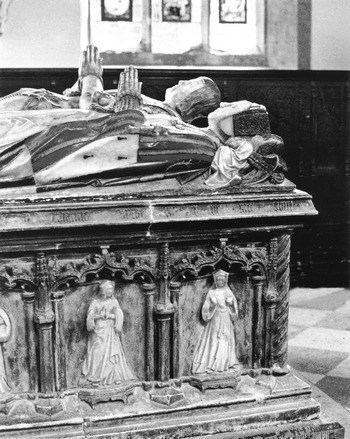
In 1536, the crown issued Ten Articles that initiated a program of doctrinal reform. Although the articles cast doubt on the doctrine of purgatory, they permitted prayers for the dead as an act of charity. In this context, aristocratic women continued to commission inscriptions with prayers.Footnote 50 Eleven of the thirty tombs (36.6 percent) they ordered after 1536 contained these petitions. In 1543, for example, the inscription on the tomb that Eleanor, countess of Rutland, built for her husband in 1543, read: “Here lieth the body of Thomas Manners earl of rutland, lord of Hamlake, Trusbut and Belvyer and knight of the most honorable order of the garter, who deceased the 20th day of September at 4 of the clock at the afternoon the year of our lord 1543; and the body of the Lady Eleanor countess his wife, daughter of Sir William Paston of Norfolk knight, who died the ____day of ______in the year of our lord 15____, whose souls Jesus pardon. Amen.”Footnote 51 Two years later, Dame Bridget Willoughby constructed a monument for her and her husband with the epitaph: “Pray for the soul of Thomas Willoughby Knight, one of the justices of the King's Bench, son of Christopher Willoughby Knight and Lord Willoughby in the county of Suffolk and Bridget, wife of the foresaid Thomas Willoughby, daughter and heir of Sir Robert Read Knight … which Thomas died 28 Sept. 1545.”Footnote 52 Nor did these requests disappear during the period of Edwardian reform.Footnote 53 In 1550, Dame Jane Knightley constructed a tomb for herself and her husband at Upton, Northamptonshire, that included the inscription: “Pray for the soul of Rich Knightley esq. which died the 30th day of the month of March in the year of our Lord 1537 and for the soul of Jane, his wife, which died ______ [day and month are missing] 1550.”Footnote 54 (See fig. 2.) A small number of epitaphs included traditional petitions for prayers even after Queen Elizabeth's accession.Footnote 55 Thus, the inscription on Dame Mary Fitton's tomb (ca. 1566) requested prayers for her soul, while the inscription on John Scudamore's monument
Monument of Sir Richard Knightley (d. 1534) and Dame Jane Knightley, Fawsley, Northamptonshire. This is one of the few monuments that preserves its color. Photograph reproduced with permission of Bee Gee Photos, United Kingdom.

(d. 1571) at Holme Lacey, Herefordshire, specifically asked onlookers to say a Pater Noster and Ave Maria for him.Footnote 56
Yet construction of chantries ceased almost completely after 1536. The beginning of the assault on religious houses combined with the Ten Articles to undermine confidence that they would survive. Before 1536, there is no indication that members of the aristocracy had lost confidence in their efficacy or ceased to believe in the doctrine of purgatory. Between 1450 and 1485, sixteen (76 percent) of twenty-one women tomb builders also commissioned chantries, chapels, or almshouses with a chantry function; between 1486 and 1510, seventeen of thirty-nine (43.6 percent) female tomb builders did so, whereas between 1511 and 1535, twenty-six (67 percent) of forty-two did so.Footnote 57 Although the percentages vary, there is no secular trend that suggests a decline in either the aristocracy's continued belief in the doctrine of purgatory or confidence in the efficacy of prayers for the dead.
Between 1536 and 1547, when the government passed the statute dissolving chantries completely, only four aristocratic women endowed new chantries, none later than 1540.Footnote 58 Susan Kingston, who retired to Syon after she was widowed in 1514, constructed a chantry at Childrey, Berkshire, in accordance with her husband's will, soon after his death. But when she herself died in 1540, she left a bequest to fund instruction for poor children for twenty years. The fervent traditional piety that had prompted her to become a vowess at Syon strongly suggests that she would have endowed a chantry in Buckinghamshire where she was buried had she any confidence that her bequest would take effect.Footnote 59
As in Susan Kingston's case, the effective end of new chantry foundations redirected aristocratic testators’ charitable impulses to the endowment of schools, almshouses, and similar charities.Footnote 60 Thus, Dame Elizabeth Holles (d. 1554) endowed six almshouses in her London parish, St. Helen’s, in her will.Footnote 61 Other women converted their family chantries into legal charitable benefactions to avoid their confiscation and perpetuate their founders’ memories. Dame Anne Worsley (d. 1557) turned the chantry her father, Sir John Leigh (d. 1522), had founded at Godshill in the Isle of Wight into a free school. Her will records that she bought land worth twenty marks a year from the existing chantry and used it for the new foundation.Footnote 62
The conversion of the Peyton chantry at Isleham, Cambridgeshire, took three decades. In 1547, the crown sold the confiscated chantry land to a Londoner, who resold it to Sir Robert Peyton the following year. When Sir Robert died in 1550, he bequeathed the land to his son and heir, also named Robert, who sold it in turn to his mother, Dame Frances, the older Sir Robert's widow. In 1579, she used the land, as well as some other property, to endow five almshouses—four for men and one for a woman.Footnote 63 Many of the founders probably continued to believe that their souls would benefit from their endowments well into Elizabeth's reign, even if they no longer required prayers for their soul from their beneficiaries. Taken together, the responses to the Ten Articles—the persistence of requests for prayers and abrupt end to the foundation of chantries—demonstrate that it was government policy and enforcement that changed aristocrats’ religious behavior rather than a change in their beliefs. This evidence reinforces the case for a top-down Reformation.
Despite this pattern of overall continuity, a small number of tombs built after 1536 adopted a different style—an inscription that featured extended biographies of the deceased and omitted any request for prayers. Omitting prayers from epitaphs was not entirely new. It appeared before the break with Rome, for example, on the tomb of Margaret Beaufort at Westminster Abbey (1509) and also on the original tomb at Thetford Abbey of Thomas Howard, second duke of Norfolk (1524).Footnote 64 Norfolk's tomb included a lengthy biographical tablet.Footnote 65 Requests for prayers in these cases may have seemed superfluous since the deceased parties had established chantries to pray for them before their deaths.Footnote 66 In the context of the evidence about the persistence of the aristocratic belief in prayers for the dead, epitaphs without prayers probably reflect an accommodation with reality rather than a change in the tomb builders' convictions. It replaced the traditional concern about the welfare of the souls of the deceased with a desire for a lasting memory on earth.Footnote 67 Dame Barbara Cokayne, widow of Sir Thomas (d. 1537), was the earliest widow in the group of 142 studied in this essay to construct a tomb of this kind for her husband. The biographical verse Dame Eizabeth Drury commissioned for Sir William Drury (d. 1557) focused explicitly on his earthly reputation, asserting confidently that “he yet doth live, and shall do still, in the hearts of them that knew him,” without any reference to the afterlife.Footnote 68 Still a decade later, the epitaph at Erith, Kent, of Elizabeth, countess of Shrewsbury, focused entirely on her life on earth. It recorded her ancestry, her marriages, and her children, emphasizing her noble status by beginning with her second husband, George, the fourth earl, Lord Steward to both Henry VII and Henry VIII. The information that she was an heiress came, atypically, last.Footnote 69
While the prayers in inscriptions were directed to the next world, their placement on expensive monuments was a permanent reminder of the worldly status and wealth of the donors and their families. Their Janus-faced character was particularly striking in texts that joined requests for prayers with testimony to the patron's individual qualities and social rank. The brass on the tomb that Elizabeth Say (d. 1473), first wife for Sir John, commissioned before her death at Broxbourne, Hertfordshire, records, “Here lieth Dame Elizabeth sometimes wife to Sir John Say knight, daughter to Lawrence Cheyne, esq., of Cambridgeshire. A woman of noble blood and most noble in good manners, which deceased the 25th day of Sept in the year of our lord 1473 and interred in this church of Broxbourne abiding the body of her said husband, whose souls God bring to everlasting life.” “Pity me O Lord according to thy great mercy.” When her husband died, he was buried with her, as she had intended.Footnote 70 The brass on the tomb for which Dame Elizabeth Fineux (d. 1539) paid reminded onlookers that she was the widow of Sir John Fineux and that “in this world [she] had ever good fame, whose soul I pray Jesus through his grace in heavan may have a resting place.”Footnote 71
In their concern for their status and lineage, some women's instructions omitted the request for prayers, although other evidence indicates their continued belief in prayers for souls in purgatory. After requesting that she be buried in her parish church at East Greenstead, Sussex, Lady Katherine Grey's (d. 1505) testament continued: “And I will mine executors do make a tomb over me with a stone and therein to be set pictures of my two husbands after their honor and my picture in a winding sheet between them both, with two scutcheons of their arms and mine jointly together at every end of the same stone, with a scripture thereto accordingly. And a plate to be set in the wall over my tomb and therein mine arms and such scripture as to mine executors and friends seem best and convenient to be made, shewing what I was.”Footnote 72 The brass that her executors constructed recorded her lineage, marriages, and positions at court as she wished, but it also included a request for compassion for her and her second husband's souls.Footnote 73 Elizabeth Scrope, Lady Scrope of Masham and Upsall (d. 1518), directed her executors to “lay a stone over my grave with three images, the one of my lord and husband, another of me, and the third of my said daughter Alice, with our arms on the said stone, and scripture making mention what we were.” Her will also indicates that she supported three chantries on her inheritance.Footnote 74 Dame Anne (née Andrews) Sulyard Bourchier (d. 1519) charged her executors to construct her tomb “within as short time as can be conveniently, made to the degree that god hath of his grace called me to, with an image thereupon of copper and gilt in remembrance of my person.”Footnote 75
Ladies Scrope and Grey also demonstrated their concern about their lineage and status with the attention they paid to including their families’ coats of arms on the monuments they built. Coats of arms, first displayed on the banners medieval knights used to identify themselves in battle and tournaments, originated in the military world of combat. Heralds, who first appeared in connection with tournaments, were expected to recognize combatants from their banners and know their characters and histories. Over time, they also gained control over the issuance and verification of arms, which acquired legal status as evidence of a family's lineage and titles. At the end of the fifteenth century, Henry VII organized the heralds into the College of Arms.Footnote 76
By the fourteenth century, virtually all aristocratic funeral monuments included the escutcheons—shields used to display coats of arms—of the deceased.Footnote 77 The Reformation did not change the central role of arms on tombs.Footnote 78 Heralds organized their funeral processions and carried the arms of the deceased that were ultimately hung over his or her tomb. The presence of these arms and the assistance of the heralds ensured that the escutcheons women had carved on their husbands’ tombs accurately documented their marital families’ past and protected their future status and inheritance. After Sir John Talbot of Albrighton died in 1549, for example, his second wife and widow Elizabeth built a monument with his escutcheon that was the major evidence used to settle a dispute about the lands and title of the Shrewsbury earldom in 1857–58.Footnote 79
The physical location of aristocratic monuments further exemplified the conflation of worldly and other-worldly motives. From the spiritual point of view, the closer the tomb to the high altar the more desirable it was because the souls of the deceased would benefit from proximity to the Eucharist.Footnote 80 Easter sepulchers were particularly valuable because they were the location of the reenactment of Christ's Passion. Since burial sites had to be paid for and the cost was calibrated to their desirability, monuments also functioned as a perpetual reminder of the wealth and social position of the people memorialized and sustained their families’ position in the community.Footnote 81 In addition, the fees for their well-located tombs and associated prayers generated a major source of parish income.Footnote 82 Thus, the nobility's and gentry's commitment to visual representations of their rank contributed to the material well-being of their local community and perpetuated the community of the living and the dead.
Because they attached so much weight to the location of their tombs and chapels, aristocratic testators indicated very explicitly where they wanted to be buried. Almost all of them chose the chancel, chapels adjoining it, or the east end of the north and south aisles. In 1499, for example, Dame Eleanor Townshend, widow of Sir Roger, wanted the monument she was commissioning for herself and her husband to be located near the high altar before an image of the Virgin and to be used as an Easter sepulchre. The tomb was duly built in the north wall of the chancel.Footnote 83 Four decades later, Dame Elizabeth Fineux left £5 to be buried in the chancel at the south side of the high altar in her parish church.Footnote 84 The Barnardiston tomb at Kedington, where the church has no aisles, is immediately adjacent to the right side of the chancel.Footnote 85 The importance members of the aristocracy attached to the location of their tombs was exemplified in Dame Elizabeth Fitzwilliams's 1548 will. Having chosen St. Paul's Cathedral, London, rather than her parish church, as her burial site, Dame Elizabeth was worried about the location of her tomb being “mete and convenient.” Her testament noted that her executors “have before this time by my commandment viewed and seen [the possibilities] for that purpose,” and they had presumably discussed the results of their visit with her.Footnote 86
With the exception of those who wanted to be buried in religious houses and cathedrals, members of the aristocracy faced few obstacles in choosing the location of the tombs. Although priests were legally responsible for, and therefore controlled, the chancels of their churches, in practice the local clergy's dependence on the aristocracy facilitated implementation of the wishes of members of the nobility and the upper gentry. Many of their families held the advowson of their parishes and treated the priests they appointed as their clients. In 1474, for example, Sir Robert Wingfield and his wife Anne (née Harling) appointed the rector of their church in East Harling, Norfolk.Footnote 87 Sir Thomas Danvers (d. 1502) held the advowson of the church at Waterstoke, Oxfordshire, where he appointed Robert White rector the year before his death. His widow, Sybil Danvers (d. 1511), subsequently finished the work he had begun on the chancel and built their tombs in it.Footnote 88 In 1533, Sir Edmund Knyvett and his wife, Jane, Lady Berners, appointed the priest at Ashwellthorpe, Norfolk. Eleven years later, Lady Berners, by then a widow, appointed his successor.Footnote 89
Even when they did not select their parish clergy, members of the aristocracy were a major source of the funds necessary to maintain their churches. Isabell Sapcote (d. 1494) bequeathed 20 marks for “the edifying and building” of the church at Burley, Rutland, where she wanted to be buried.Footnote 90 Elizabeth Barnardiston (d. 1526), with whom this article began, paid for a new roof covered with lead on the church at Kedington.Footnote 91 Her contemporary Dame Elizabeth Clifford (d. 1525) erected the South Porch at Aspenden, Hertfordshire, and carved the arms of both her husbands, Sir Ralph Jocelyn and Sir Robert Clifford, on it.Footnote 92 The high fees that members of the aristocracy paid for the sites of their tombs provided still another financial incentive for acceding to their wishes.
The founders of chantries and chapels were similarly concerned about the location of their constructions and also wanted their chantries as close as possible to the high altar. The east end of the north and south aisles alongside the chancel were a favorite choice. They faced little opposition because their projects were a major asset to their parishes. Their constructions enlarged and embellished the churches in which they were located, while their endowments supported priests who served the congregation as a whole in addition to saying masses for their founders.Footnote 93 Dame Margaret Bedingfield (d. 1513) built the chapel bearing her family name where she was buried at the east end of the south aisle in their parish church at Oxborough, Norfolk. Initially the chapel opened from the chancel, making it as close to the high altar as possible.Footnote 94 Lady Anne Danvers (d. 1531) also erected a chantry at the east end of the southern aisle in her church at Thatcham, Berkshire. She and her husband Sir William (d. 1502) were buried under an archway between the chapel and the chancel.Footnote 95
Some families actually blocked the entrance to their chantries and chapels with locked gates, displaying in the clearest way possible their ownership of some of the most sacred space in their parish churches. Sir Randall (d. 1530) and Dame Eleanor Brereton enclosed the chapel where they were buried with an oak screen carved with the inscription: “Pray good people for the prosperous estate of Sir Randolph Brereton, of this work edificator with his wife Dame Eleanor, after this life transitory to obtain eternal felicity. Amen; Amen.”Footnote 96 A screen divided the chapel on the north side of the chancel where Sir Thomas and Dame Maud (née Throckmorton) Green Middleton was originally buried with her first husband, Sir Thomas Green (d. 1462), at Norton, Northamptonshire.Footnote 97 This kind of privatization of parish churches survived for centuries. The alabaster tomb of Sir Ralph Fitzherbert and his wife Elizabeth, located at the east end of the north aisle, was divided from the church at Norbury, Derbyshire, by a carved oak screen that remained in place until 1841.Footnote 98
As this survey shows, the evolution of aristocratic tombs and chantries from the mid-1530s supports the revisionist view of religious reform in sixteenth-century England. Until the mid-1530s, the widows of noblemen and knights constructed tombs and chantries that demonstrated their belief in the existence of purgatory and faith in the efficacy of prayers for their souls. The money they poured into churches for their monuments and the chapels and aisles in which they were located underscores their confidence in the institutional church. Their response to the Ten Articles of 1536 shows that they continued to believe in prayers for the dead but stopped endowing chantries because they no longer trusted the government to respect their foundations. Their commissions and epitaphs indicate that few of them moved in a decidedly reformed direction in the middle decades of the century. Their behavior conforms to the revisionist thesis of top-down reformation and a long period before England became Protestant.
Female Patronage and Identity
Thus far this article has focused on the tombs, chantries, and chapels that aristocratic women commissioned without raising the question of whether and in what ways they differed from those built by men. As we shall now see, however, female patrons actively used their projects to construct the identity by which they wished to be remembered even though the physical and ideological programs of the tombs they constructed were much the same as those of their male peers. As widows with legal control over their persons and property, they had the power to plan the location and design of their monuments.
Like their male kin, most aristocratic women wanted to be buried with particular relatives in churches associated with their families. In contrast to men, however, their decisions were neither self-evident nor predetermined since they belonged to several families during their lifetimes. Not only did they have different natal and marital kin, but the majority married more than once.Footnote 99 Thus they had many options when they chose their burial places. Their decisions reflected their primary attachments and fixed the identity by which they wanted to be remembered.
In 226 cases in which extant evidence indicates where aristocratic widows wanted to be buried, a large majority—171, or 75.6 percent—directed their executors to bury them in the same tomb or church with one of their husbands, most often in the parish churches where their spouse's chief estates were located.Footnote 100 This choice reflected the centrality of marriage to every aspect of their adult lives. In 107, or 62.5 percent, of these cases, the woman had been married only once, and her decision was relatively clear-cut. In seven of the 107 instances, both the husband and the wife were buried in the wife's natal parish. In these couples, the wife was an heiress who identified strongly with her family of origin and contributed significantly to her husband's and children's fortunes. These couples actually lived on the wife's inheritance.Footnote 101 Two other heiresses and their husbands were interred in chantries built by the wife's father. In the first case, George Manners, Lord Roos (d. 1513), and his wife Lady Anne were buried in a chantry that her father, Thomas St. Leger, had founded at St. George's Chapel, Windsor. Here a prestigious location reinforced an heir's desire to be identified in death with her natal family. In addition, Lady Anne may have participated in building the family mausoleum since she referred to it as “her chantry.”Footnote 102 In the other instance, Sir John Verney (d. 1505 or 1509) and his wife Margaret were buried at the Ashridge monastery in her father's (Sir Robert Whittingham’s) tomb.Footnote 103 These examples highlight the factor—their status as heirs—that created the strongest links between women and their natal families.
The other sixty-five widows who asked to be buried with a husband were married more than once. When they wrote their wills, therefore, they had to indicate the spouse they wished to rest with for eternity. A number of factors influenced their decisions: they tended to favor the first husband, the husband with whom they had their first child or first son, their highest-ranking spouse, and the man with whom they had a relatively long marriage. Less visible were emotional factors, to which their wills only rarely alluded. Out of these sixty-five women, twenty-five, or 38.5 percent, chose burial with the first husband. In twenty-one of these cases, the man was also the father of the woman's first child, clearly a factor of enormous importance. For example, Isabel Scott Clifton (d. 1457) was the mother of Sir John Scott (d. 1485), the heir of her first husband, William Scott, Esquire.Footnote 104 Anne Sulyard Bourchier (1519) chose to be buried with her first husband, John Sulyard (1487), the father of her only children, although none of them was his heir.Footnote 105 Dorothy, Lady Willoughby de Broke and Mountjoy (d. 1552), had no sons by either of her husbands, but her daughters by Robert, Lord Willoughby de Broke (d. 1521), were his coheirs and his property eventually passed to their daughters.Footnote 106 Of the remaining five women, Lady Anne Bigod (d. 1477) asked to be buried at Settington, Yorkshire, where she was living on property she held from her first husband, Sir Ralph (d. 1461).Footnote 107 Anne, Lady Scrope (d. 1498), who died childless, was interred with Sir William Chamberlain (d. 1462), the first of her three husbands, as she had promised him when he was on his deathbed thirty-five years before.Footnote 108 Lady Anne Grey (1558) chose to be buried with the highest-ranking and first of her three husbands, Lord Edward Grey (d. 1517).Footnote 109 No extant information explains the choice of the remaining two.
The remaining forty, or 61.5 percent, of the women married more than once asked to be buried with their second, third, or fourth husband. Many of their choices seem to be based on the same factors that influenced women who chose burial with their first husband. The comparative rank of the husbands also influenced the woman's choice: over a quarter of the remarried women asked to be buried with their highest-ranking spouse. In fact, only two widows of noblemen chose burial with a different husband. In both of these cases, the man they preferred was the father of their only child. Often higher rank coincided with other factors in determining women's preferences: Anne, countess of Bedford, and Lady Anne Petre requested burial with a man who was simultaneously their highest-ranking mate, the father of their only surviving son, and their partner in a long marriage.Footnote 110 Since widows, unlike first-time brides, were almost always free to select their husbands when they remarried, the comparatively high number of women who chose burial with their second, third, or fourth spouse may reflect their greater emotional attachment to that husband. Dame Agnes Say's will reveals that she wanted to be buried with the second of her four husbands, Sir John Fray, because he was the father of her two favorite daughters.Footnote 111 One of the women in this group predeceased her fourth and highest-ranking husband and asked to be buried with him.Footnote 112
A number of widows refused to choose between two husbands and ordered tombs and epitaphs that memorialized both of them. Dame Isabel Johnson (d. 1551) was buried with both of her husbands, Brian Palmes, esquire, and Sir Thomas Johnson in Ottley, Yorkshire, which she had inherited from her father.Footnote 113 Dame Jane Arundell (d. 1551) asked to be buried between her husbands, Sir John Arundell of Trerice (d. 1512) and Sir John Chamond (1544) at Stratton, Cornwall. She held the manor as dower from her first husband and lived there with her second husband.Footnote 114 Bridget, Lady Marney (d. 1549), wanted to be buried with her first husband, William Findern, at Horkesley, Essex, but she ordered a brass with her image between those of both of her husbands, adding: “I will there be scripture of brass to shew the time of my decease and of what stock I came of and to what men of worship I was married unto.”Footnote 115
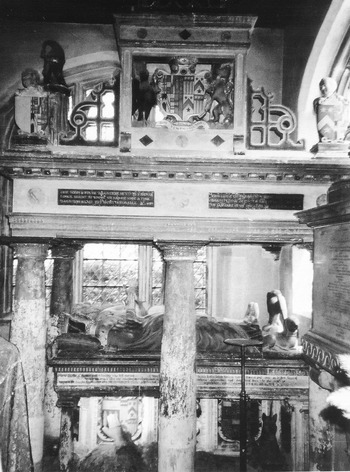
Despite their multiple marriages, only two of the 142 female tomb builders were memorialized in more than one church. The decisions that produced this result are numerous. Many first wives who built their first husband's tomb commemorated themselves on their monuments and were subsequently buried with that husband, as Anne Lady Scrope was over thirty years after her first husband died.Footnote 116 If their first spouse had been married before, some second wives still chose to be buried with him and his first wife. In several of these cases, the second wives commissioned the monument that commemorated all three of them, as Elizabeth Tame, widow of Edmund (d. 1534), did at Fairford, Gloucestershire. In still another arrangement, second wives who were also in second marriages chose burial with more than one of their spouses and built the monuments memorializing them. Margaret, countess of Bath (d. 1562), and Alice Lady Burgh (d. 1558) are examples (see fig. 3).Footnote 117
The two cases in which women had more than one monument reflected unique circumstances. Jane (née Hornby) Fitzlewis Norton (d. 1535) originally planned to be buried with her second husband, Sir John Norton, at Faversham, Kent, and she began building a monument there. However, when Norton died, he directed his executors to bury him at Milton, Kent, with his first wife. His widow therefore changed her mind and directed her executors to bury her with her first husband Sir Richard Fitzlewis at West Horndon, Essex, where she commissioned a brass with Sir Richard and his four wives, of whom she was the last. But she also directed them to complete the monument at Faversham.Footnote 118 In the other case, Mary (née
Monument of John, earl of Bath (d. 1561), and Margaret, countess of Bath (d. 1561), under the canopy. The effigy of the countess's first husband, Sir Thomas Kitson (d. 1540), slightly below ground level, is beneath them and barely visible in this photo. Hengrave Hall Church, Hengrave, Suffolk. Photograph by author.

Scrope) Jerningham Kingston (d. 1548) asked to be buried at Painswick, Gloucestershire, where her second husband was already buried with his first wife. In 1557 Sir Henry Jerningham, her eldest son by her first marriage, constructed a brass to her in his parish church at Low Leyton, Essex.Footnote 119
The most intriguing widows, fifty-four, or 24 percent of the original group of 226, chose to be buried apart from all their husbands. Fourteen of them selected other churches associated with their deceased husbands or marital families, often in the parishes where they were living on dower property. In these cases, their choice was a matter of convenience, not a sign of alienation from their deceased husbands or their marital families. Thus, Dame Jane Fitzwilliam asked to buried in the London parish where she was living on property her third husband had bequeathed her. He was buried a goodly distance away in Northamptonshire.Footnote 120
Thirteen women were heiresses who identified most strongly with the lineages they represented and chose burial in their natal parishes or with the kin from whom they inherited. After devoting her long life and considerable energies to advancing the Pastons’ fortunes, for example, Margaret Paston, according to her will, wanted to be buried with her ancestors at Mautby.Footnote 121 Dame Isabella Spencer, widow of Sir John and coheir of the Graunts of Snitterfield, asked to be buried there “near unto the sepulchre of my mother.”Footnote 122 Elizabeth, Lady Fitzwarren, and Maud, Lady Willoughby, were both buried with relatives—a brother and an uncle, respectively—from whom they inherited their property, although each of them had married three times.Footnote 123 The significance of inheritance as the factor motivating women to opt for burial in churches associated with their natal family is highlighted by the fact that only five noninheriting women made this choice.
Of the remaining women buried at sites unconnected to their husbands or their marital families, sixteen chose religious houses for their final resting places. The small number in this category stems from a number of convergent factors. The first is the overwhelming importance members of the aristocracy attached to parish churches as symbols of their and their family's political, economic, and social status.Footnote 124 It also reflects the declining importance of monasticism in Yorkist and early Tudor piety.Footnote 125 Finally, in some cases women were not buried in the religious houses of their choice because of the shortage of space. Thus, Elizabeth Barnardiston, with whom this article began, was not buried at Walsingham, as she desired, even though she was living there when she wrote her will and appointed the prior as her sole executor. Instead she was laid to rest in her parish church at Kedington.Footnote 126 No evidence exists about the remaining six women who chose burial apart from their deceased mates.
While the vast majority of aristocratic women actively chose the family identities they preferred in choosing their burial sites, only three of the 142 tomb builders studied here redefined their religious identity in response to the break with Rome and halting steps toward reform. In 1549, Dame Jane Calthorpe's tomb described her earthly virtues with a decidedly Protestant cast, expressing confidence that God had called her to heaven while eschewing any prayers for her soul. Her monument contained the earliest explicit Protestant epitaph on the tombs studied for this project—a statement of faith taken from the “Order for the Burial of the Dead” in the Book of Common Prayer.Footnote 127 In her will, she also left bequests to two local reformers and peripatetic preachers.Footnote 128 Elizabeth Goring (d. 1558) asked her executors to include “certain penitent scriptures written over the heads of the said pictures knowledging ourselves sinners and humbling ourselves wholly unto the mercy of god promised to all faithful and penitent persons by his son Jesus Christ our only redeemeer and Savior.”Footnote 129 Jane (née Bourchier) Knyvett, Lady Berners (d. 1562), commissioned an elaborate tomb that articulated her religious hopes in Reformed rather than Catholic terms.Footnote 130 The other 139 female tomb builders commissioned traditional epitaphs for their monuments. There is no way of knowing in particular instances whether these inscriptions represented an active commitment to Catholic doctrine or passivity in the context of unprecedented and confusing doctrinal change. In light of all the evidence cited in this article, the likelihood is that their apparent preference for conformity to Roman beliefs was sincere.
Two of the women leaning toward reform, Jane Calthorpe and Jane Knyvett, Lady Berners, also composed epitaphs describing their character, focusing on their success as household managers during their long widowhoods and traditional virtues. Lady Berners’ inscription stated:
Jane Knyvett resteth here the only heir by right
Of the Lord Berners, that Sir John Bourcher hight.
Twenty Years and three a widow's life she led,
Always keeping house where rich and poor were fed.
Gentle, just, quiet, void of debate and strife,
Ever doing good: Lo, thus she led her life,
Even to the grave, where earth on earth doeth lie;
On whose soul God grant of his abundant mercy.Footnote 131
Jane Calthorpe's epitaph was more explicit about her reformed religious practice:
Here lieth hid und this stone
The wife of Sir Philippe Calthorpe, Knight,
And clepyd Dame Jane, the daughter of one
John Blenerhasset, esquier he hight,
She loved God's word, and lived likewise,
She gave to the poor, and prayed for the rich,
She ruled her house in measure and size,
She spent as it came and gathered not much,
The day of April twenty and seven,
God did her call from hence on to heavan. Anno 1550.Footnote 132
Both descriptions were quite conventional in their praise of the two women. Nonetheless, they are early evidence of women fashioning their image for posterity.
Conclusion
What then does this survey of women who commissioned tombs, altars, and chapels suggest about aristocratic behavior and values in the late medieval, early Tudor period? At the most general level, it directs scholars’ attention to the rich possibilities of using religious buildings and art as primary historical texts for studying aristocratic strategies for asserting their political, social, and cultural hegemony, as well as for insights into their religious practices. Furthermore, it highlights another area in which widows deployed their and their husbands’ resources to record and perpetuate their families’ status and wealth, and it establishes their importance as patrons of sculpture and architecture in a period before aristocratic English families were involved in collecting and commissioning art on a scale comparable to their peers in Italy.
The monuments also embody and reflect the complexity of aristocratic families when we look at them from women's point of view. Widows’ conscientiousness in building their deceased husbands’ tombs and the desire of most of them to be buried with their spouses demonstrate their successful integration into their marital families and the centrality of marriage (or successive marriages) to their self-definition. Although wives belonged to different bloodlines from their husbands, their offspring represented its biological and social future. Women who were married more than once therefore usually chose burial with the father of their children, particularly the father of their first son.
At the same time, many aristocratic women preserved their ties to their families of origin. They often recorded their ancestry on their tombs even when they were buried with their husband in their marital family's parish church. This pattern was not limited to heiresses: Bridget, Lady Marney, and Dame Thomasine Clopton are just two examples of noninheriting women who did so.Footnote 133 Nonetheless, the relationship between women and their natal family was strongest in the case of heiresses, who enjoyed greater status, wealth, and power throughout their lives as representatives of their lineages. When they died, many of them chose burial in a church associated with the ancestors and land that defined their core identity.
From a methodological point of view, this article demonstrates that analyzing women's decisions when they built and endowed tombs and chantries provides an avenue into their subjectivity, a topic that has proved difficult for historians of women who lived in a period before they produced diaries, autobiographies, and self-revealing letters. This approach to the subject also shows that scholars dealing with the period before 1550 or 1600 need to rethink the way in which they define female identity and subjectivity.
Finally, as we have emphasized throughout, aristocratic funerary monuments, particularly epitaphs and the related endowment of chantries, provide still another body of evidence for the revisionist argument that reform in England, initiated and enforced by the government, spread slowly from the center to the population at large. At the same time, this evidence indicates the need for a more nuanced reading of the significance of the enormous flow of resources into the rebuilding, expansion, and embellishment of parish churches in the three-quarters of a century before Henry VIII's break with Rome. Revisionist scholars have cited this phenomenon as evidence of the vibrancy of traditional piety and the depth of support for the late medieval church.Footnote 134 While the religious sentiments that donors expressed in their benefactions were undoubtedly sincere, aristocratic commissions were equally concerned with memorializing their worldly status. In fact, as we have seen, many inscriptions recorded their subjects’ lineages and marriages without any reference to their spiritual concerns at all. Collectively, then, these monuments can be read as creations of a relatively insecure aristocracy anxious to establish and perpetuate its political and social status and also as records of its spiritual aspirations. Uninfluenced by our separation of faith and politics, Yorkist and early Tudor aristocratic women took care of the dead by looking both to this world and the next.