1 Introduction
As a powerful discourse-pragmatic mechanism of linguistic change, colloquialisation has been explored in many corpus-based diachronic studies of English (e.g. Biber & Finegan Reference Biber and Finegan1989; Mair & Hundt Reference Mair and Hundt1995; Hundt & Mair Reference Hundt and Mair1999; Biber Reference Biber, Aitchison and Lewis2003; Leech et al. Reference Leech, Hundt, Mair and Smith2009). The term is often used to refer to the shift of writing from a more formal, literary style to a more conversational, speech-like style (Leech et al. Reference Leech, Hundt, Mair and Smith2009: 239). Colloquialisation is seen as a driving force in the changing patterns of use of a number of grammatical features in English. In his study of long-term historical drift in English writing styles, Biber comments:
[I]n the course of the nineteenth and twentieth centuries, popular written registers like letters, fiction, and essays have … evolved to become more similar to spoken registers, often becoming even more oral in the modern period than in the seventeenth century. These shifts result in a dispreference for certain stereotypically literate features, such as passive verbs, relative clause constructions and elaborated noun phrases generally. (Biber Reference Biber, Aitchison and Lewis2003: 169)
Empirical support for colloquialisation in contemporary English is provided in Leech et al.’s (Reference Leech, Hundt, Mair and Smith2009) investigation of more recent grammatical change in English, namely, that which happened between the early 1960s and 1990s. Based on the four parallel members of the Brown family of corpora, their study shows that the frequency rise-and-falls of a range of grammatical features such as the modal auxiliaries, the progressive, genitive phrases and relative clauses are in line with the prediction of the colloquialisation hypothesis. Similar findings for an overlapping range of grammatical features were reported in the studies on recent, short-term change presented in Aarts et al. (Reference Aarts, Close, Leech and Wallis2013), in which a wider range of diachronic corpora, both spoken and written, were used to represent contemporary English.
To this day, the study of colloquialisation has been largely restricted to native English varieties, in particular British and American English (BrE and AmE). Until recently, possible manifestations of colloquialisation in non-native English varieties have not been investigated in detail. This is due in part to, and is reflective of, the shortage of historical data representing these varieties, which empirical investigations of stylistic change crucially rest upon. The research gap has been addressed in a recent issue of the Journal of English Linguistics compiled by Nöel, Van der Auwera and Van Rooy. Focusing on expressions of modality in English, the contributions to this issue examine convergences and divergences between Philippine English (PhilE) and its historical input variety (Collins et al. Reference Collins, Borlongan and Yao2014), and between Black South African English and its native counterpart in the same contact setting (Van Rooy & Wasserman Reference Van Rooy and Wasserman2014). Further extending our understanding of the evolution of non-native Englishes is the volume edited by Collins (Reference Collins2015a), which presents diachronic analyses of selected grammatical features in several other non-native varieties, such as Caribbean English, Hong Kong English and Indian English.
While the corpus-based studies mentioned above do not focus specifically on colloquialisation, the comparisons between speech and writing made in a number of them are suggestive of a distinction between the role of colloquialisation in non-native varieties and in their native counterparts: namely, that colloquialisation is a less powerful driver of grammatical change in the former than it is in the latter. This observation is essentially in line with the findings of several synchronic studies of non-native Englishes based on the International Corpus of English (Collins Reference Collins2009; Xiao Reference Xiao2009; Mair & Winkle Reference Mair, Winkle, Hundt and Gut2012; Collins & Yao Reference Collins and Yao2013). A pattern emerging from these synchronic comparisons is that grammatical features more typical of speech are more frequent in AmE and BrE than in non-native varieties, and within the latter group, more so in South East Asian varieties than in Indian and East African varieties.
Another notable finding of these studies is that the results are very mixed depending on the individual linguistic features that are analysed. For example, focusing on newspaper language in the Caribbean in the past half century, Hackert & Deuber (Reference Hackert and Deuber2015) examined the distribution of three linguistic features well known to be associated with colloquialisation: contractions, that- vs which-relatives, and the be-passive. While the first two features showed patterns consistent with the colloquialisation hypothesis, the be-passive evidenced little frequency change in the data. Conflicting tendencies have also been reported by Collins and his associates for Philippine English of around the same time period (Collins et al. Reference Collins, Borlongan and Yao2014, Reference Collins2015b). Their studies revealed, on the one hand, increases in the frequencies of semi-modal expressions (e.g. have to, need to) and relative that, which are driven arguably by colloquialisation, and on the other hand, stable and even falling frequencies of contracted and present-tense progressives, indicating that changes concerning the progressive cannot be accounted for by colloquialisation.
The mixed results obtained so far concerning individual linguistic features highlight the necessity for a more comprehensive, empirically grounded analysis of colloquialisation in non-native English. As such, the analysis should take into account not only a few opportunely selected features, but a much wider range of features possibly involved in the process. At the conceptual level, taking such an approach allows us to extend our understanding of colloquialisation and to see it not simply as an explanatory mechanism, but more importantly, as an empirically attestable phenomenon. At a more applied level, it enables us to determine whether and to what extent typical spoken features have permeated written language over time in non-native varieties across a range of registers, and how these varieties are similar to, or different from, native varieties in this respect.
In the present study, accordingly, we regard colloquialisation as a process affecting the overall shape of (at least) written English and involving a wide array of lexical, grammatical and discourse features.Footnote 2 We believe that colloquialisation can and is best measured using a data-driven approach and relying on a set of empirically defined colloquial features and anti-colloquial features (see section 3 below). In the following sections we present a case study of colloquialisation using this approach and focusing on its manifestations in grammar. The non-native variety examined is PhilE, with comparisons made with its input variety, AmE. Our analysis covers the period from the early 1960s to the early 1990s, as well as three written registers – press editorials, learned writing and fictional writing. In the next section we turn to a brief overview of PhilE. We then move on to introduce a general measure of colloquialisation derived from quantitative analysis of a large body of spoken and written data. The findings of an investigation of colloquialisation in PhilE and AmE are then presented.
2 Philippine English
English was introduced to the Philippines by American soldiers in 1898 after around three hundred years of Spanish occupation. It then began to spread throughout the country via the public school system established by the Americans, at a speed ‘unprecedented in colonial history’ (Gonzalez Reference Gonzalez and Bautista1997: 28). By 1948, census results indicated that around 37.2 per cent of the population claimed to be able to speak English, an increase of 10.6 per cent over the figures in 1939 (Bureau of Census and Statistics 1954: 304). The popularity of English continued to rise steadily during the post-war period. Under the 1974 Bilingual Education Policy, English became the medium of instruction for science, mathematics and economics at all levels of education. Nowadays English is recognised as an official language alongside Filipino (the basis of which is Tagalog), and is used in many controlling social domains in the Philippines, including government administration, mass media, commerce, science and technology, and international relations (Sibayan Reference Sibayan and Acuña1994). Despite a recent purported decline in English proficiency in the country, census figures show that as of 2006 about two-thirds of Filipino adults ‘understand spoken English’; another two-thirds ‘read English’; about half ‘write English’; about a third ‘speak English’; only 14 per cent of the respondents say that they ‘are not competent in any way when it comes to the English language’ (Social Weather Stations 2006).
As English became more deeply rooted in the new context, it began to exhibit distinctive features in terms of phonology, grammar, lexicon and discourse. Since the publication of Llamzon's (Reference Llamzon1969) pioneering monograph, considerable work has been conducted to document aspects of PhilE, in particular those that differ greatly from Standard AmE (Alberca Reference Alberca1978; Gonzalez Reference Gonzalez and McArthur1992; Bautista Reference Bautista2000, Reference Bautista2011; Bautista & Bolton Reference Bautista and Bolton2008; Dayag Reference Dayag, Low and Hashim2012). With regard to grammar, distinctive uses have been noted in word order, subject–verb agreement, plural marking, tense–aspect–modality expressions and so on. While some of the distinctive uses can be traced to analogy and substrate transfer, others appear to reflect an inclination for polite and formal style. Examples include the frequent use of -ly adverbs as disjuncts (e.g. essentially, frankly, unfortunately) in everyday speech (Dita Reference Dita2011) and the preference for modal would in non-past, non-conditional contexts where AmE would require will (Bautista Reference Bautista2004). Gonzalez (Reference Gonzalez2004: 12) comments that Filipinos have a tendency to speak as they write and to transform features characteristic of formal written English to speech and less formal registers, so that their English is ‘a monostylistic variety of English’. The monostylisticism hypothesis may serve as an explanation for the tendency discussed above, that PhilE makes less use of typical spoken features compared to native varieties of English. It remains to be seen whether the findings of the present large-scale study – albeit one whose focus is on writing – will provide any support for this hypothesis. In non-controlling, informal settings such as the home and the neighbourhood, communication often takes place in Filipino (Sibayan Reference Sibayan and Acuña1994), and it is common to find codeswitching among English, Filipino and Taglish, a mixed code of English and Tagaolog elements (Thompson Reference Thompson2003).
In recent years there has been growing awareness and acceptance of PhilE as a legitimate variety of English among local elites. Borlongan's (Reference Borlongan2009) survey of private university students showed that PhilE is functionally native for them and a representation of their Philippine identity. However, in other social groups English proficiency is lower and the attitude more ambivalent. Martin (Reference Martin and Kirkpatrick2010, Reference Martin2014a, Reference Martin, Buschfeld, Hoffmann, Huber and Kautzsch2014b) argues that PhilE seems to have found its place among the educated class; among less privileged members of the society, English may be largely inaccessible, and where it is, the preferred model of teaching and learning is still Standard AmE. The changing linguistic landscape in the Philippines, along with its complex sociohistorical context, provides a tempting subject for empirical diachronic investigation.
3 Defining colloquiality
As suggested in the introduction, the present study seeks to establish an analytical method that allows us to characterise the degree of colloquialisation across distinct varieties and registers of English. To this end, we rely on the term colloquiality, using it in a more general and technical sense to refer to a combination of the degree of preference for linguistic features more typical of speech, and the degree of dispreference for linguistic features more typical of writing. We call the two opposing groups of features colloquial and anti-colloquial features respectively. This of course does not mean that colloquial features can be found only in speech and anti-colloquial features only in writing. Rather, the two terms are reflective of distributional patterns which are shaped by relative frequencies of linguistic forms as opposed to their mere presence or absence in a given register.
It can be seen that our data-driven approach to colloquialisation resembles the multidimensional approach developed by Biber (Reference Biber1988). In both approaches, the operationalised measure of a construct is identified quantitatively and in a bottom-up fashion. However, the primary foci of the two approaches are quite different. The multidimensional approach focuses on the so-called ‘dimensions’ such as ‘informational vs involved production’ and ‘elaborate vs situation-dependent reference’. These stylistic oppositions highlight co-occurrence patterns of groups of linguistic features which are not equivalent to the more general speech/writing opposition that we are concerned with here.
3.1 The data
Our first goal is to determine the precise nature of colloquial and anti-colloquial features using a large collection of naturally occurring data. The texts collected for this purpose should cover a broad range of spoken and written texts, and ideally, represent the full range of situational variation across speech and writing. Moreover, as we aim to compare varieties of English at different time periods, it is necessary to take into account variation along the parameters of variety and time.
With these considerations in mind, we drew data from the following corpora:
(i) The Philippine component of the International Corpus of English (ICE-Phil). Sampled mainly for the 1990s, ICE-Phil is by far the most comprehensive multi-register corpus of contemporary PhilE. It contains around 1 million words divided into 32 text categories, 15 spoken and 17 written.
(ii) The American component of the International Corpus of English (ICE-US). In its current form, ICE-US contains around 400,000 words of written texts. These texts are parallel to the written section of ICE-Phil and represent AmE of roughly the same time period.
(iii) The Santa Barbara Corpus of Spoken American English (SBC; Du Bois et al. 2000–5). SBC was built with a view to being included in the spoken section of ICE-US. The corpus was also sampled for the 1990s and contains approximately 249,000 words. Although SBC does not provide a precise match of the spoken section of ICE-Phil, it also represents many spoken registers, for example, face-to-face conversations, telephone conversations, classroom lectures and sermons.
(iv) The Brown Corpus (Francis & Kučera Reference Francis and Kučera1964, 1971, 1979). As a 1 million-word corpus, Brown represents written AmE of the 1960s. Three of the text categories – B (press editorials), J (learned) and K (general fiction) – were selected as the basis for the diachronic analysis (see further section 3.4). The other written categories were omitted from our dataset, in order to avoid creating a major imbalance between spoken and written texts.
(v) The Phil-Brown Corpus (Borlongan in progress). Also sampled for the 1960s, Phil-Brown was designed to be the Philippine counterpart of Brown. Around two-thirds complete, Phil-Brown has been used to study individual grammatical features of PhilE (Collins et al. Reference Collins, Borlongan and Yao2014, Reference Collins2015b). For current analytical purposes, the same three categories, B, J and K, were selected to match the Brown texts.
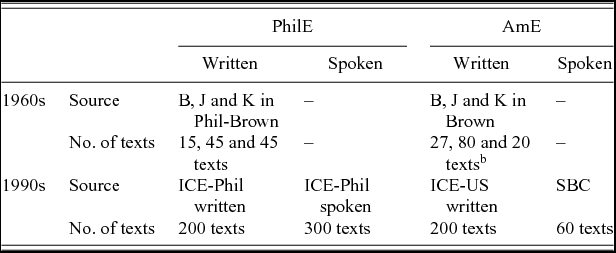
Table 1 presents a summary of the corpus data employed in this study. In total our dataset contains slightly over 2 million words, around two-thirds of which are written and one-third spoken. Although texts representing the 1960s are outnumbered by those representing the 1990s, as a whole the current dataset provides us with a useful point of departure for studying speech-and-writing differences in the two varieties. It should be borne in mind that, unlike the AmE corpora (which feature people from a wide variety of social backgrounds), both ICE-Phil and Phil-Brown feature the English used by educated Filipino speakers and writers. This means that the demographic makeup of the language users represented by the two PhilE corpora is arguably different from that for the AmE ones. Such difference is inevitable due to the disparate roles of English in monolingual and multilingual ecologies: as previously suggested, English is mainly used in controlling domains in the Philippines, making PhilE an acrolectal variety.
Corpus data used in this studyFootnote a

a Each text is approximately 2,000 words in length, except for those in SBC.
b The compilation of Phil-Brown is still incomplete. There are therefore some variations between Phil-Brown and Brown in the number of texts available for the individual categories.
To prepare for frequency counts, all texts were part-of-speech tagged with CLAWS (C7 tagset) after having their original markups removed (see http://ucrel.lancs.ac.uk/claws/ for an introduction to CLAWS).
3.2 The linguistic features
The next step is to decide on the linguistic features to be used as a basis for determining colloquiality. Our primary focus is on grammar, an area which has triggered much recent scholarly interest in relation to colloquialisation. A valuable resource of grammatical features potentially involved in colloquialisation is presented in Biber's (Reference Biber1988) multidimensional study of English registers. In his model, 67 features were used to uncover textual relations among spoken and written text types. We had to exclude five of these features because they do not yield very reliable results with CLAWS-tagged texts.Footnote 3 The remaining ones are then modified and further supplemented by other features derived from a survey of the literature on register variation in English worldwide with a focus on grammar (e.g. Biber et al. Reference Biber, Johansson, Leech, Conrad and Finegan1999; Leech et al. Reference Leech, Hundt, Mair and Smith2009; Kortmann & Lunkenheimer Reference Kortmann and Lunkenheimer2013).Footnote 4 In selecting the features we seek to cover as many possibly implicated features as we can. Our main consideration was feasibility, i.e. whether the frequencies of a given feature in the data can be determined with an automatic or semi-automatic procedure, since the size of our dataset does not lend itself to manual coding or close reading of the linguistic contexts of each hit. Our second consideration was that the features should be known to be shared by, or at least relevant to, the two varieties of English, particularly in the written mode, because the corpus texts used for the diachronic comparison in this study only contain written material (see further below). As is commonly known, corpus linguistic methodologies are not well suited for investigating very rare phenomena, and when an item can hardly be found in the data, the analysis based on its frequencies cannot be statistically robust (Szmrecsanyi Reference Szmrecsanyi2013: 36–7). We therefore set a frequency of 100 tokens (i.e. around 0.04 tokens per thousand words) in the entire dataset as the minimum threshold frequency for a feature to be added into the feature list. Features unique to PhilE were also excluded because applying them to published AmE writing as represented in the Brown family corpora where their absence is fairly categorical runs the risk of over-reporting colloquiality in PhilE. As a result, we had to rule out many interesting grammatical features known to be sensitive to register variation, such as the following:
(i) Interrogative/exclamative sentence types, cleft sentences (e.g. It is he who left us first.), zero relative clauses (e.g. the way he walks) and yes–no questions, which are features of standard English but can only be manually identified;
(ii) Loss of singular inflections of verbs (e.g. He go away.), use of definite article where standard English has indefinite article (e.g. I had the toothache.) and vice versa (e.g. A sun is shining.), which have often been suggested to be distinctive of non-native varieties but also need to be manually identified;
(iii) Borrowings from Tagalog, including the conjunction kasi (‘because’) and enclitic particles with pragmatic functions such as no, ba and pa (Lim & Borlongan Reference Lim and Borlongan2011), which are common in our spoken PhilE data but non-existent in AmE. Although ICE-Phil was built with a view to involve ‘minimum Tagalog insertions’ (Bautista Reference Bautista2011: 7), it is not hard to find unnaturalised indigenous linguistic elements with grammatical functions in the corpus, especially in spoken private conversations, as one reviewer of this article has correctly pointed out. In total the corpus yields 6,552 instances of indigenous single words and word strings (annotated as <indig></indig> by the corpus compilers), reflecting the close intertwining of English and Tagalog. Notably, 81.1 per cent of the indigenous elements appear in the spoken texts. Users of these elements account for 51.7 per cent of the 710 sampled speakers, and each user produces an average of 14.5 instances, corresponding to a textual frequency of around 8.9 instances per thousand words. By contrast, only 34.5 per cent of the 400 sampled writers produce such elements, with an average of 9.0 instances per writer and a textual frequency of 3.1 instances per thousand words. This clear contrast between the spoken and written texts suggests that some indigenous elements may qualify as colloquial features by our definition. However, they are not examined in this study given the present comparative purposes.
(iv) Me instead of I in coordinate subjects (e.g. My brother and me were late), plural forms of non-count nouns (e.g. staffs, advices) and no number distinction in demonstratives (e.g. this children). These features have been reported to be existent in PhilE (Kortmann & Lunkenheimer Reference Kortmann and Lunkenheimer2013) but their frequencies in the data do not reach the minimum threshold.
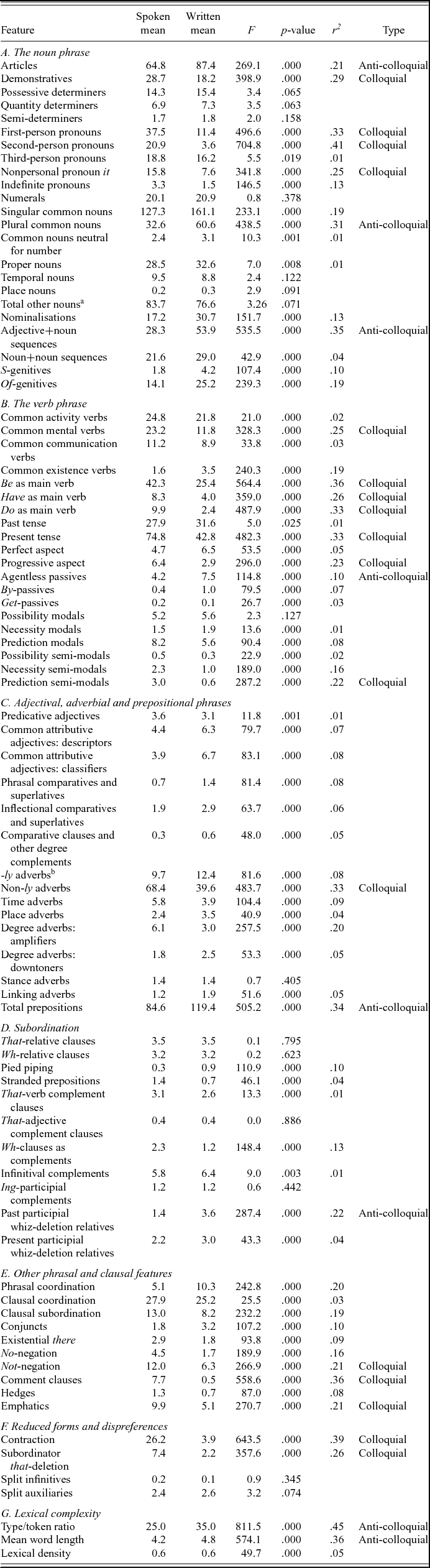
The resultant feature list contains a total of 86 features divided into seven major categories: (A) the noun phrase; (B) the verb phrase; (C) adjectival, adverbial and prepositional phrases; (D) subordination; (E) other phrasal and clausal elements; (F) reduced forms and dispreferences; (G) lexical complexity (see table 2 below).Footnote 5
Results of ANOVAs for the linguistic features
a This includes all nouns other than those counted as the six types of nouns listed above. It provides a further characterisation of the ‘nouniness’ of a text. In Biber (Reference Biber1988) this is defined differently, and includes all nouns other than nominalisations and gerunds.
b This feature replaces Biber's ‘total adverbs’, which includes any adverb that is longer than five letters and ends in -ly.
3.3 Determining colloquial and anti-colloquial features
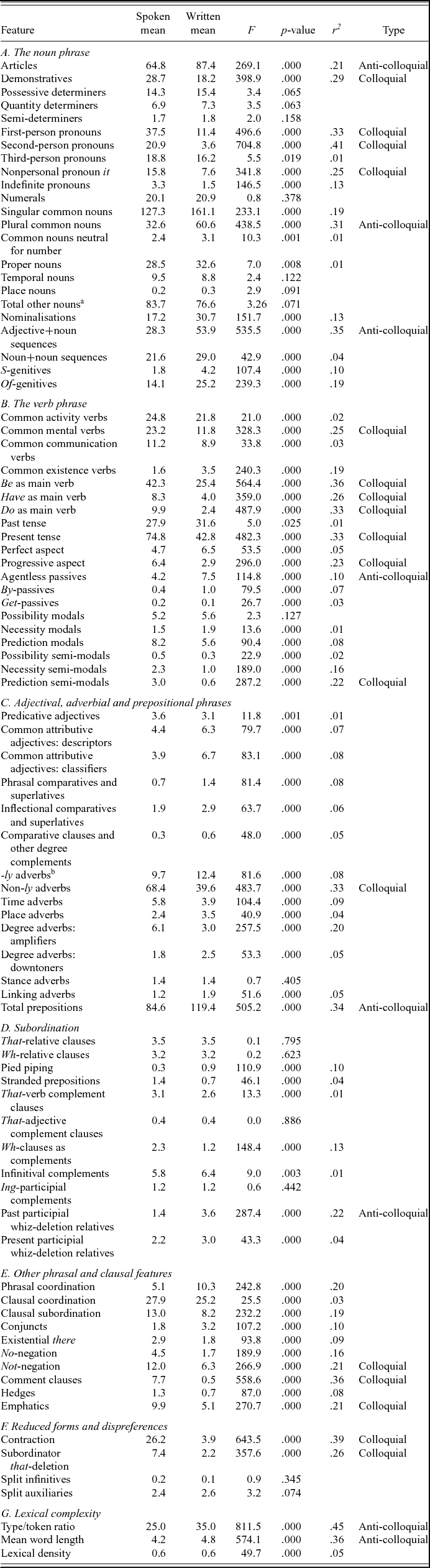
Frequencies of the 86 features were retrieved with PowerGREP, a grep software that enables complex searches using regular expressions. The results were then normalised to frequencies per thousand words for each text.Footnote 6 Means and standard deviations were computed based on normalised frequencies. Eighty-seven ANOVAs were then conducted to determine which of these features are preferred in speech or writing. Each ANOVA provides two useful statistics: p-value, which indicates whether the distributional difference between speech and writing is significant (set at the level of 0.05 in this study); and r2, which indicates the importance or strength of the difference.Footnote 7 An r2 higher than 0.20 is often interpreted as showing an important relationship between the independent and dependent variables (see Biber & Finegan Reference Biber and Finegan1989: 498). These two statistics enable us to arrive at our operational definitions of colloquial and anti-colloquial features. We take the former to be features whose frequencies are significantly higher in speech than in writing, and the latter to be those with a reversed distributional pattern. In order to highlight the most important statistical relationships in the data, we restricted ourselves to features with r2 values higher than 0.20. Table 2 shows the results of the ANOVAs, including mean normalised frequencies for speech and writing.Footnote 8
The majority of the selected linguistic features (66 out of 86) exhibit highly significant differences (p < 0.001) in their distributions across speech and writing. However, only 25 features, 17 colloquial and 8 anti-colloquial, are strong indicators of the speech-and-writing divide, with r2 values of higher than 0.20.
Some of the most remarkable register differences can be seen for features indicating a general concern with the ‘here’ and ‘now’ of the communicator. The present tense, for example, can be used to describe events and states that are ongoing or existing at the time of utterance. Demonstratives and first- and second-person pronouns establish reference to the communicators and in relation to aspects of the immediate situational context. Moreover, speech contains more expressions with emotional and attitudinal meanings: common mental verbs (e.g. think, know, want), which denote psychological states experienced by animate subjects; prediction semi-modals (be going to, be about to, want to), which express the communicator's prediction and volition; comment clauses (e.g. I mean, you know, you see), which indicate various kinds of attitude to the proposition expressed; emphatics, which signal a strong degree of certainty (e.g. for sure, such a). Speech also differs significantly from writing in having a higher frequency of structurally simpler forms such as non-ly adverbs (as opposed to -ly adverbs typically derived from adjectives), words with shorter lengths and reduced forms such as contractions (e.g. ’ll, ’m), and subordinator that-deletion (e.g. I think (that) this is the best solution). As for not-negation and the progressive, their popularity in speech can be ascribed to the functional prominence of the verb. Biber et al. (Reference Biber, Johansson, Leech, Conrad and Finegan1999: 65–6) have shown that verbs are more common in conversations than in academic writing. Since both negation and aspectual marking are tied to verbs, it is not surprising that these features appear more often in speech.
The anti-colloquial features identified in this study are generally indicative of an informative, compact style. Among such features are plural common nouns, adjective+noun sequences and past participial whiz-deletion relatives (e.g. the chemical (which is) produced by this process), reliance on which indicates more compact encoding of information. Many studies have revealed that written English has become increasingly oriented towards nominal discourse (e.g. Biber & Finegan Reference Biber, Finegan, Nevalainen and Kahlas-Tarkka1997; Biber & Gray Reference Biber and Gray2011). This orientation may explain our finding that articles and prepositions, which co-occur with nouns, also emerge as anti-colloquial features. The hallmark of informativeness is perhaps type/token ratio, which represents the number of different lexical words in texts. A higher mean score for writing on this measure suggests that writing is more varied in lexical choice, hence informationally richer. Correspondingly, speech is marked by features which express a lower level of semantic specificity, and which are therefore less informative: be, have and do as main verbs, and the nonpersonal pronoun it (e.g. It's warm today; It's getting dark). Finally, the fact that the agentless passive is also selected as anti-colloquial reflects that, in addition to packing a large amount of information, writing tends to be more detached and abstract (Biber & Finegan Reference Biber and Finegan1989; Wanner Reference Wanner2009).
3.4 Measuring colloquiality
We are now in a position to calculate colloquiality scores for texts to be used for the diachronic analysis of PhilE and AmE. The colloquiality score of a text summarises its preference for colloquial features and its dispreference for anti-colloquial features. Since some of the features have remarkably higher normalised frequencies (e.g. the present tense) than others (e.g. prediction semi-modals), we calculated the standardised scores (z-scores) of the normalised frequencies, so that the contributions of high- and low-frequency features are transformed to a common scale and can be compared. The colloquiality score of a text is defined as the sum of the standardised frequencies of all colloquial features minus the standardised frequencies of all anti-colloquial features in this text.Footnote 9
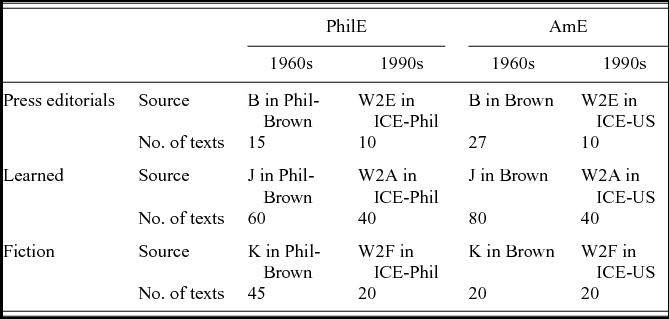
Parallel texts were then chosen from our dataset to build a diachronic corpus of PhilE and AmE. Specifically, this involved matching text categories in Phil-Brown and Brown to those in ICE-Phil and ICE-US. Unfortunately, the lack of representations of earlier PhilE speech prevents us from studying diachronic trends in the spoken language. Nevertheless, it is still possible to make comparisons with regard to three written registers, press editorials, academic writing and fiction, which represent distinct social functions and levels of formality. Table 3 shows the text selection scheme for our diachronic corpus. Colloquiality scores were calculated for all texts contained therein.
Corpus texts used in the diachronic comparisons

4 Variation in colloquiality scores
In this section we report quantitative findings gained from analysing the colloquiality scores of texts in the diachronic corpus. We begin by outlining general patterns of register variation in the data and proceed to determine whether and how far colloquialisation has progressed in the two varieties during the thirty-year period.
4.1 Register variation
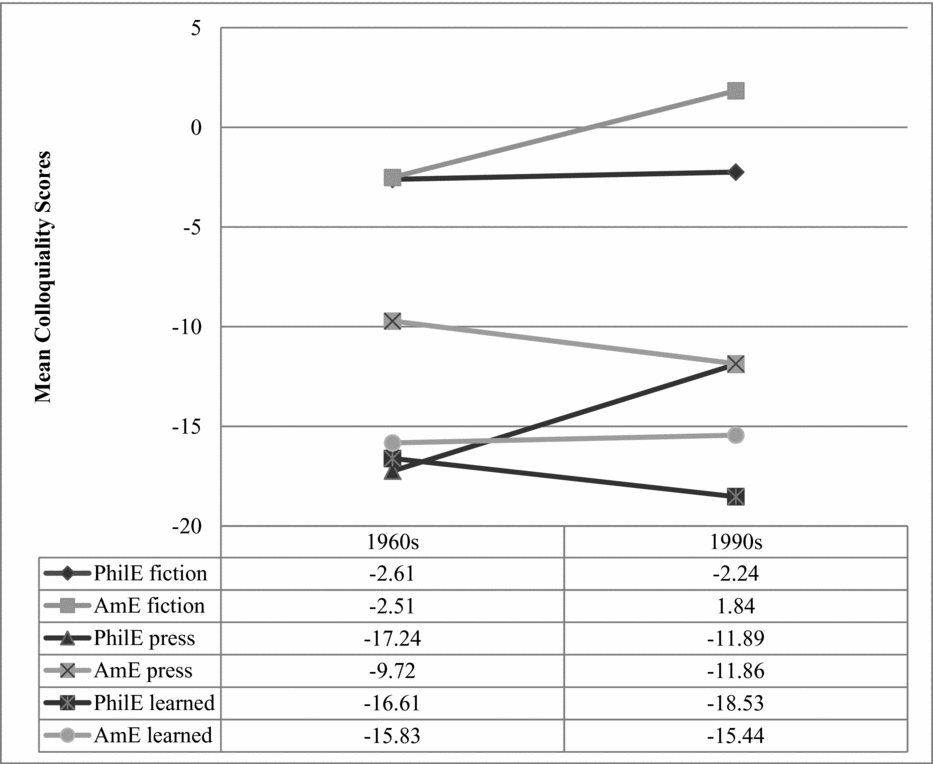
Figure 1 presents the mean colloquiality scores for the diachronic corpus. At first glance, regional and diachronic variation in colloquiality scores is less noteworthy than overarching patterns of register variation. The results largely confirm our expectations about the colloquiality levels of the three registers. Despite variation over time, the most colloquial register is fiction, with PhilE and AmE having respective mean scores of -2.43 and 0.34.Footnote 10 This is not surprising as writers create fictional worlds often by producing linguistic features that are imitative of those of face-to-face conversation. Sometimes narration is developed mainly through the conversation of characters. In comparison, the two informative registers are clearly anti-colloquial, with press editorials having mean scores of -14.57 (PhilE) and -10.79 (AmE), and learned writing -17.57 (PhilE) and -15.64 (AmE), all of which are far below zero.
Mean colloquiality scores of texts in the diachronic corpus

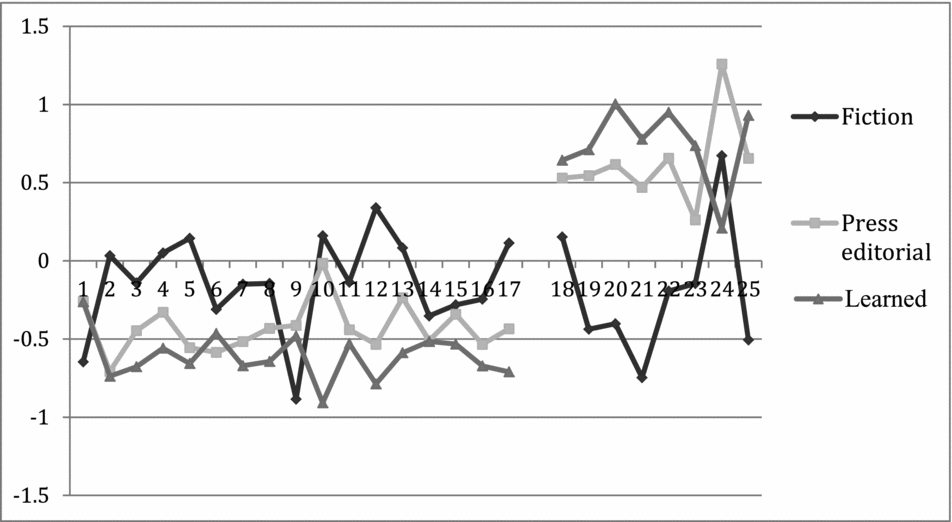
Figure 2 presents a more elaborate picture of general patterns of register variation by showing the mean standardised frequencies of the 25 features regardless of variety and time period. As in figure 1, we find in figure 2 a notable divide between fiction on the one hand, and press editorials and learned writing on the other. Fiction has higher frequencies of all colloquial features except demonstratives and present tense verbs. The frequency gap with demonstratives reflects a combination of two factors: first, a greater reliance in fiction on explicit reference to construct imagined situational contexts, and second, a stronger need in press and learned writing to establish anaphoric links to events and concepts introduced in the immediate text. The relative shortage of present tense verbs in fiction is apparently due to its concern with narration, for which the past tense tends to be a preferred choice. As a mirror image of the findings for colloquial features, most anti-colloquial features are less common in fiction than in the other two registers. The only exception to this pattern is type/token ratio. Its lowest score in learned writing reflects a smaller range of vocabulary as determined by this register's specialised content and narrow focus. What is especially interesting about the findings in figure 2 is that the gap between fiction and the two informative registers is much greater for colloquial than for anti-colloquial features. This means that the higher colloquiality level of fiction is defined not so much by its preference for colloquial features as by its dispreference for anti-colloquial features.
Mean standardised frequencies of colloquial and anti-colloquial features in the three registers

4.2 Diachronic variation
Having outlined general patterns of register variation, we move on to examine diachronic variation in colloquiality scores. A comparison of the 1960s and 1990s data reveals a striking change in PhilE press editorials (mean score -17.24→-11.89), suggesting that this register has become substantially more colloquial over the thirty-year period. The outcome of this change, together with a mild decline in colloquiality in the corresponding American data (-9.72→-11.86), is that PhilE and AmE press editorials of the 1990s are far more similar in their colloquiality level than they were in the 1960s. The second notable change concerns AmE fiction, whose mean score rises from -2.51 to 1.84. By contrast, PhilE fiction, which starts at roughly the same point in the 1960s, remains stable over time (-2.61→-2.24). As for learned writing, its colloquiality level has not changed much in AmE (-15.83→-15.44) and has even decreased slightly in PhilE (-16.61→-18.53). In general, what these patterns illustrate is that the three registers differ in their degree of susceptibility to colloquialisation during the second half of the twentieth century. It is useful here to consider the distinction drawn by Hundt & Mair (Reference Hundt and Mair1999) between ‘agile’ and ‘uptight’ styles. On the whole, fiction and press editorials are typical ‘agile’ registers in their receptiveness to linguistic innovations, whereas learned writing – a notably ‘uptight’ register – is more resistant to change. The distinction in question can be traced to different readership types. Fiction and press writing are typically produced subject to the economic pressure to attract bigger audiences and hence to conform to emerging and ‘fashionable’ styles. By contrast, learned writing targets a relatively stable group of readers and its stylistic conventions are thus more entrenched.
Before we turn our attention to diachronic changes in PhilE, a comment should be made concerning the findings for AmE. While the AmE fiction data clearly support the colloquialisation hypothesis, the mild decline in the colloquiality score for AmE press editorials appears somewhat perplexing at first sight. Upon closer examination, two factors emerge as responsible. First, compared with the 1960s press editorials, the 1990s texts employ far fewer first-person pronouns (mean standardised frequencies: -0.85 < -0.52) as well as fewer mental verbs (-0.69 < -0.36). Similar patterns were identified by Westin (Reference Westin2002) in her diachronic analysis of editorials in British ‘upmarket’ newspapers published over the past century. The implication is that in these texts there has been a move away from the explicit marking of author stance. Another remarkable difference between the 1960s and 1990s AmE editorials is that the latter greatly outstrip the former not only in the use of plural common nouns (0.57>0.02) and adjective+noun sequences (0.78>0.45), but also in mean standardised word length (0.80>0.38). Increases in the scores of these three anti-colloquial features are indicative of densification, a well-documented discourse process via which information is compacted into a smaller number of words (e.g. Leech et al. Reference Leech, Hundt, Mair and Smith2009; Biber & Gray Reference Biber and Gray2011). As economy of expression is highly valued in newspaper language, it is not surprising that American press editorials have moved towards informational density and become less colloquial over time.
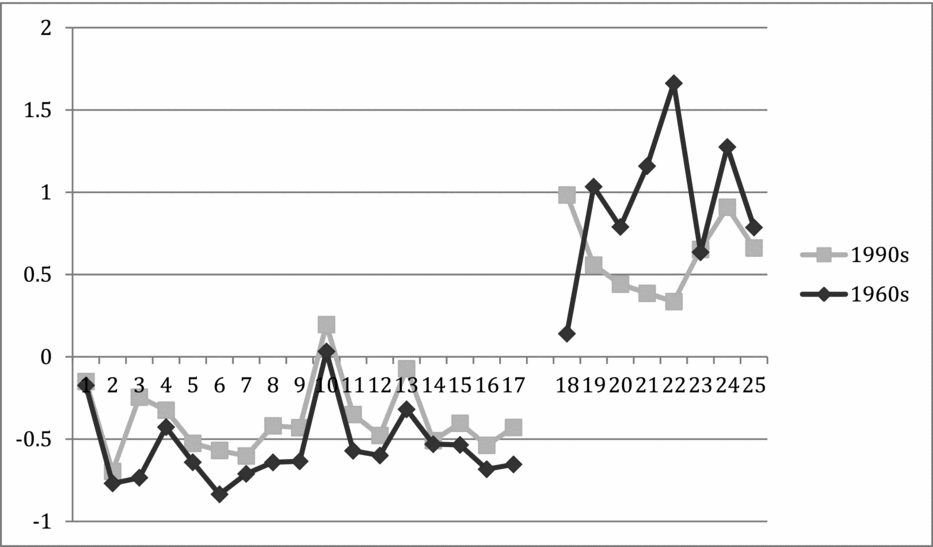
The evolution of PhilE press editorials follows an entirely different path, showing a strong colloquialising tendency which calls for further investigation into their linguistic and situational properties. As we have seen above, Philippine press editorials of the 1960s are highly formal and closely resemble learned writing. Figure 3 indicates that compared with their 1990s PhilE counterparts they are considerably less reliant on second-person pronouns (-0.73 < -0.24), be as main verb (-0.84 < -0.57), not-negation (-0.32 < -0.07) and subordinator that-deletion (-0.65 < -0.43). In line with these patterns is a higher type/token ratio (1.28>0.91) and a much stronger preference for the majority of the anti-colloquial features, including plural common nouns (1.03>0.56), adjective+noun sequences (0.79>0.44), agentless passives (1.16>0.39) and prepositional phrases (1.66>0.34). Taken together, these findings reflect a tendency for 1960s PhilE press language to be more compact in content and more complex in lexical choice and syntactic structure.
Mean standardised frequencies of colloquial and anti-colloquial features in PhilE press editorials

The following excerpts, taken from Phil-Brown and ICE-Phil, illustrate the stylistic preferences of 1960s and 1990s PhilE press editorials respectively:
(1) There is one project of the present administration the significance of which appears to have been lost in the welter of more sensational albeit transient scandals, both petty and monstrous in the government. This is the extension of the railroad into the Bicol region's southernmost areas and into the Cagayan valley. Studies have been made on this project and although millions of pesos are involved in its realization, the administration has repeatedly signified determination to push it through as a part of ambitious program to link Luzon to Mindanao through the Visayas. The major phase of the project, of course, is the railroad line's extension into the Cagayan valley up to Aparri, including not only the laying of rail lines north of the Carballo mountain range but also the construction of a tunnel through the mountain. A huge engineering job, from the erection of durable railbeds that can withstand the periodic overflow from the Cagayan River to tunneling through a vast mountain complex, will involve considerable work and expenditure which could discourage the weak of heart. (Phil-Brown B03)
(2) While lending rates have skyrocketed, interest rates on deposits continue at 2 to 3 percent. For the banks, it seems it is all take, take, take and never any give. In the present crisis, bankers continue to laugh all the way to the bank. It is as if the banks had a God-given right always to make money and never to lose any, no matter what the situation for the rest of the country. A time-honored principle of human relations is that those who shaft you should be shafted back. The banks are not afraid, for they believe in the Imeldific ‘rule’ that those who have the gold make the rules. That's true, but those who hold the rod can change the rules. The banks have money but the people have power. They can tell an administration seeking vindication at the polls to bring the banks to heel or under state control before they ruin the country and hurt the people some more. (ICE-Phil W2E010)
Excerpt (1) differs from (2) in the level of concentration of nouns (0.30 vs 0.22 token per word). More importantly, noun phrases in excerpt (1) often contain one or more modifiers or complements which serve to form complex structures containing detailed and precise information. These elements include attributive adjectives (e.g. sensational albeit transient scandals, ambitious program), nouns (e.g. railroad line, engineering job), s-genitives (e.g. Bicol region's southernmost areas, railroad line's extension) and prepositional phrases (e.g. the major phase of the project, the erection of durable railbeds). By comparison, in excerpt (2) the nominal constructions are less complex, have shorter lengths and feature fixed lexical combinations (e.g. interest rates, human relations). As for the verb phrase, excerpt (1) features agentless passives (which appears to have been lost, studies have been made). These constructions enable inanimate entities to become grammatical subjects, thereby allowing information to be structured in a coherent way. Excerpt (2), on the other hand, is characterised by a heavy reliance on verbal constructions in the active voice, as well as the use of be and have as main verbs (it is all take, take, take and never any give; The banks have money but the people have power) and high-frequency verbs (e.g. continue to laugh all the way; bring the banks to heel). The overall effect of these linguistic differences is that excerpt (1) is more informationally compact and requires a considerable amount of processing effort on the part of the reader, while excerpt (2) is more speech-like and less structurally complex.
The question that arises from the above discussion is what accounts for, first, the strong colloquialising tendency in PhilE editorials, and second, the absence of such a tendency in PhilE fiction and learned writing of the same period. This question can be addressed by further examining the sociohistorical backdrop against which PhilE has progressed. Unlike in Inner Circle countries/regions, English was ‘transplanted’ to the Philippines as a result of US occupation and colonisation, via the establishment of a regular system of English teaching at the beginning of the twentieth century. In the following decades, which saw the formation of PhilE, English teaching in the classroom was conducted mainly via grammatical analysis and imitation exercises. Teachers presented Anglo-American literary canons including those of Matthew Arnold, Washington Irving, Henry Longfellow and Ralph Waldo Emerson, as well as those of Shakespeare, as examples of ‘good English’ (Gonzalez 2008; Martin Reference Martin2008). Exposure to such texts and sustained writing practice had direct effects on students’ writing. Gonzalez (Reference Gonzalez and Cheshire1991) noted that Filipino students of the colonial period tended to write compositions in an antiquated, lofty Victorian style featuring archaic expressions and florid sentences, what he called the ‘Philippine classroom composition style’. In 1925, the Board of Educational Survey conducted a comprehensive study of the Philippine public system and reported that ‘children in upper grades seem to have a “reciting” knowledge of more technical English grammar than most children in corresponding grades in American schools’ (cited in Martin Reference Martin2008: 251). The continuing influence of the colonial pedagogic tradition is reflected in the penchant for complex and formal grammatical features in the earlier PhilE press. It is not surprising to see this penchant gradually weaken as teaching practices in the Philippines evolved over the years to incorporate functional approaches, such as communicative language teaching, content-based instruction and English for specific purposes (Gonzalez 2008). With such approaches, the focus on formal ‘correctness’ is often replaced by an emphasis on the appropriateness of language use in meaningful, communicative contexts.
There are several other social and demographic forces that are likely contributors to the colloquialisation of Philippine press language. First, increased international communication may have prompted Philippine journalists to adhere to the conventions of international journalism as promoted by the more colloquial American newspapers. Importantly, census figures show that the proportion of English speakers in the Philippines rose from around 39 per cent in 1960 to 56 per cent in 1990 (Gonzalez Reference Gonzalez2004). This substantial rise in English literacy resulted in the expansion of the general reading public, whose needs were better catered for by less complex and abstract styles. Furthermore, while television and radio stations have witnessed a rapid growth in Filipino programmes in recent years, the print media in the Philippines have long been dominated by English (Gonzalez & Bautista Reference Gonzalez and Bautista1986; Dayag Reference Dayag2004). All of the important newspapers that enjoy national circulation are in English, including the Philippine Daily Inquirer, Manila Bulletin and Philippine Star. Philippine newspapers also tend to have a wide readership and a strong social impact. Citing figures from the 2000 Philippine Media Factbook, Dayag (Reference Dayag2004) reported that 29 per cent of the entire Philippine population read newspapers and as high a proportion as 48 per cent of Metro Manila residents did so. It was in response to the wide influence of Philippine print media on the Philippine community that press freedom was severely curtailed during the 1972–81 martial law period. At that time, a number of newspapers critical of Marcos's military rule were terminated and replaced by those in favour. As a result, ‘the intellectual lights went out, along with the other “inalienable” rights of the Filipino people’, and the Philippines ‘went into a deathly journalistic silence’ (Mijares Reference Mijares1976: 325). In summary, improved English literacy and a popular audience are among the factors responsible for the marked shift of PhilE press editorials towards colloquial styles.
By contrast, the diachronic stability of PhilE fiction and learned writing can be traced to the lack of a general readership and the limited social impact of these two registers. As discussed earlier, the readers of learned writing tend to be members of a highly educated group comprised of academics, professionals, students and the like. This register can therefore afford to remain ‘uptight’, i.e. unaffected by the interests and demands of the general public. On the other hand, the social context that has fostered English fiction writing and reading in the Philippines is drastically different from that in the United States. The Philippines has not had a large community of English fiction readers. An important reason why fiction continues to be written and published in English in the Philippines is the provision of institutional support from the government, which regularly sponsors literary contests such as the Commonwealth Literary Awards and the National Artists Awards, in an effort to promote culture and the arts in the country. Despite these efforts, PhilE fiction remains largely unread by the majority of the local people. Lamenting the unpopularity of literature in the Philippines, Gonzalez (Reference Gonzalez1988: 36) notes the general impression that Filipinos are not book readers. According to writer Charles Ong, ‘a novel in English that sells a thousand copies in three or four years, itself a rarity, is deemed as a best-seller by Philippine standards’ (cited in Hau Reference Hau2008: 320). As for the demographic makeup of the intended audience of PhilE fiction, Hau (Reference Hau2008: 321) writes:
[I]ts production and reception are restricted to a minority of cultural workers in the publishing, journalism, and educational sectors and to a small percentage of the student and professional population in the Philippines, a fact that accounts for the seemingly ‘incestuous’ nature of literary production and consumption, and the preeminence of a ‘personal’ politics of authorship in the country.
The inability of PhilE fiction to reach a bigger audience places it in sharp contrast with Philippine newspapers, with their wide circulation. It is perhaps not surprising that the martial law period saw the leading personalities of the print media arrested and detained for their comments in newspapers, but not in fiction, poetry and drama. On this point Casper (Reference Casper1995: 5) asks:
Was it because established novelists, poets and playwrights were assumed to be beneficiaries of ‘capitalist imperialism’…whose ambitions coincided therefore with Marcos's own? Or had the authors turned to trivia as a safeguard, abandoning a long tradition of polemicism in literature? Or could it be that Marcos considered such works irrelevant inventions, temporary entertainments…?
Wherever the explanation may lie, it can be argued that limited readership and social impact lie behind the observed ‘uptightness’ of PhilE fiction and, in the same vein, that of PhilE learned writing.
5 Conclusion
In this article we have reported the findings of a corpus-based study of stylistic change in a non-native variety of English, PhilE, alongside its ‘parent variety’, AmE. Our investigation has focused on possible signs of colloquialisation, a well-noted diachronic trend for previously formal, literary writing to shift to informal, speech-like styles. Adopting a bottom-up approach, we have derived a comprehensive measure of colloquiality based on a total of 86 grammatical features. This measure, itself a summary of 25 strong indicators of the speech–writing divide, allows us to determine and compare the extent to which different texts favour linguistic features that are typical of speech, or colloquial features, and disfavour those typical of writing, or anti-colloquial features. According to our approach, colloquialisation is interpreted as a dual process involving not only the shift of writing towards a speech-like style, but also the shift away from a writing-like style. We believe a combination of the two opposing trends better encapsulates the process of ‘writing becoming more like speech’ than any single trend.
We have employed the measure of colloquiality to analyse texts in a diachronic, parallel corpus of PhilE and AmE. Drawn in part from the Brown corpora and the International Corpus of English family, the diachronic corpus consists of three written registers with distinct situational characteristics and spans around thirty years from the 1960s to 1990s. Our analysis of colloquiality scores has revealed several noteworthy patterns. Regarding register variation, we have seen that when transformed to a common scale it is anti-colloquial features, not colloquial features, that most clearly signal the difference between creative and informative writing in contemporary English. Texts representing these two registers are not drastically different in their use of colloquial features. Rather, the most remarkable differences on a global level lie in the frequencies of anti-colloquial features, which indicate overall lexical diversity and informational richness.
Regarding diachronic variation, evidence for colloquialisation varies across registers. There are considerable increases in the colloquiality scores of Philippine press editorials and American fiction over the time span under investigation. On the other hand, learned writing has not shown remarkable changes irrespective of variety. We have argued that the distinction drawn by Hundt & Mair (Reference Hundt and Mair1999) between ‘agile’ and ‘uptight’ registers is particularly useful for interpreting the diachronic findings. Popular registers which are driven by the need to cater to a large readership tend to be open towards stylistic innovations, whereas specialised registers are less receptive to change with their small and stable audiences. Differences in the nature of the intended audience account not only for the different findings for the two popular registers and learned writing, but also for the contrast between the rapid colloquialisation of PhilE press editorials and the stability of PhilE fiction during the same time period.
Importantly, we have seen that the evolution of PhilE registers cannot be explained by a simple process involving emulation of AmE. This is inevitable given the unique sociohistorical circumstances in which PhilE has evolved. PhilE's colonial history imparts to it an elitist character, placing it in a hierarchical relationship with the local languages. The patterns described in this study lend support to the general observation made in previous research that PhilE is less colloquial than AmE. However, there is no convincing evidence for monostylisticism since stylistic differentiation is on the whole fairly marked in PhilE (despite an affinity between press and learned writing of the 1960s). The conclusion is that PhilE speakers are no less sensitive to the stylistic conventions of the three registers than native English speakers. However, future research is required to see whether the same can be said about spoken and other informal registers.