




No CrossRef data available.
Article contents
Shamanism and efficacious exceptionalism
Published online by Cambridge University Press: 06 April 2018
Abstract
Shamans can have efficacy at healing through botanical remedies and in observational and advisory functions through cognitive strengths, while shamanic acts of strangeness are likely honest signals of these qualities. Given this potential for shamanic practices to have true efficacy and the capacity for honest signaling, we expect efficacy will influence the spread, persistence, and loss of shamanic practices.
Information
- Type
- Open Peer Commentary
- Information
- Copyright
- Copyright © Cambridge University Press 2018
References
Andritzky, W. (1989) Sociopsychotherapeutic functions of ayahuasca healing in Amazonia. Journal of Psychoactive Drugs 21(1):77–89. doi:10.1080/02791072.1989.10472145.CrossRefGoogle ScholarPubMed
Blackwell, A. D. (2009) Life history trade-offs in growth and immune function: The behavioral and immunological ecology of the Shuar of Amazonian Ecuador, an indigenous population in the midst of rapid economic and ecological change. Doctoral dissertation, University of Oregon.Google Scholar
Crow Dog, L. & Erdoes, R. (1995) Crow Dog: Four generations of Sioux medicine men. Harper Collins.Google Scholar
Feraca, S. E. (1998) Wakinyan: Lakota religion in the twentieth century. University of Nebraska Press.Google Scholar
Grim, J. A. (1983) The shaman: Patterns of religious healing among the Ojibway Indians. University of Oklahoma Press.Google Scholar
Hagen, E. H., Roulette, C. J. & Sullivan, R. J. (2013) Explaining human recreational use of “pesticides”: The neurotoxin regulation model of substance use vs. the hijack model and implications for age and sex differences in drug consumption. Frontiers in Psychiatry 4:142. doi:10.3389/fpsyt.2013.00142.Google Scholar
Hagen, E. H., Sullivan, R. J., Schmidt, R., Morris, G., Kempter, R. & Hammerstein, P. (2009) Ecology and neurobiology of toxin avoidance and the paradox of drug reward. Neuroscience 160(1):69–84.CrossRefGoogle ScholarPubMed
Heinrich, M. & Gibbons, S. (2001) Ethnopharmacology in drug discovery: An analysis of its role and potential contribution. The Journal of Pharmacy and Pharmacology 53(4):425–32. doi:10.1211/0022357011775712.Google Scholar
Ingelman-Sundberg, M., Sim, S. C., Gomez, A. & Rodriguez-Antona, C. (2007) Influence of cytochrome P450 polymorphisms on drug therapies: Pharmacogenetic, pharmacoepigenetic and clinical aspects. Pharmacology and Therapeutics 116(3):496–526. doi:10.1016/j.pharmthera.2007.09.004.CrossRefGoogle ScholarPubMed
Luna, L. E. (1984) The concept of plants as teachers among four Mestizo shamans of Iquitos, northeastern Peru. Journal of Ethnopharmacology 11(2):135–56. doi:10.1016/0378-8741(84)90036-9.Google Scholar
Purzycki, B. G. (2012) Finding minds in the natural world: Dynamics of the religious system in the Tyva Republic. University of Connecticut.Google Scholar
Roulette, C. J., Kazanji, M., Breurec, S. & Hagen, E. H. (2016) High prevalence of cannabis use among Aka foragers of the Congo Basin and its possible relationship to helminthiasis. American Journal of Human Biology 28(1):5–15. doi:10.1002/ajhb.22740.Google Scholar
Roulette, C. J., Mann, H., Kemp, B. M., Remiker, M., Roulette, J. W., Hewlett, B. S., Kazanji, M., Breurec, S., Monchy, D., Sullivan, R. J. & Hagen, E. H. (2014) Tobacco use vs. helminths in Congo basin hunter-gatherers: Self-medication in humans? Evolution and Human Behavior 35(5):397–407. doi:10.1016/j.evolhumbehav.2014.05.005.Google Scholar
Sugiyama, L. S. & Scalise Sugiyama, M. (2003) Social roles, prestige, and health risk: Social niche specialization as a risk-buffering strategy. Human Nature 14(2):165–90.CrossRefGoogle ScholarPubMed
Sullivan, R. J., Hagen, E. H. & Hammerstein, P. (2008) Revealing the paradox of drug reward in human evolution. Proceedings of the Royal Society B: Biological Sciences 275(1640):1231.Google Scholar
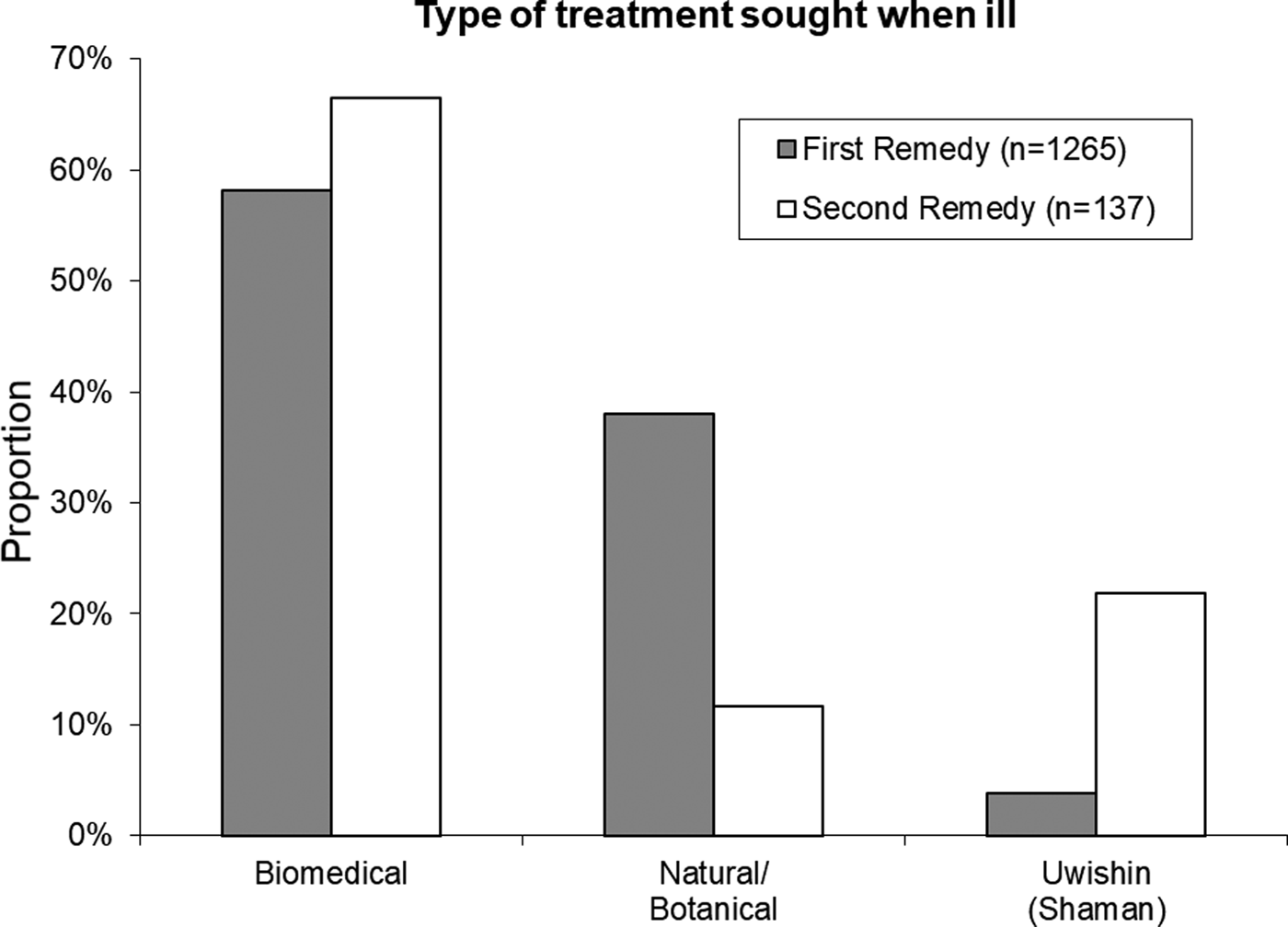
Figure 1. Type of treatment sought by Shuar who identified themselves as having been ill during the 2 weeks preceding a census survey of villages. Treatments were grouped as biomedical (doctor, health promoter, auxiliary health promoter, aerial ambulance), natural or botanical, or shaman (uwishin). Individuals who did not recover after seeking treatment were asked whether they sought additional treatment (second remedy). Uwishin were much more likely to be sought out as a secondary rather than primary remedy (OR = 7.08, 95% CI = 4.30–11.50, p < 0.001). From Blackwell (2009).
Singh argues that shamans need not be effective to be successful; shamanism will spread because convincing others that they can interact with invisible forces is sufficient. Although this may be true in a narrow sense, we argue that, because these practices are often linked to actual efficacy, effectiveness likely plays a larger role in observed features of shamanism than Singh presents. We suggest that, ceteris paribus, effective practices will outcompete ineffective ones and that many superhuman shamanic acts are not just illusions of strangeness, but are direct, honest signals of qualities related to effectiveness and power of influence. Therefore, effectiveness is important for understanding the cultural evolution of shamanism and the features of shamanic practices found across cultures.
To illustrate the potential for effective practices, we first consider healing. Shamans might successfully treat disease by either treating the underlying causative agents through medicine or providing support during healing. The first of these often is proffered through botanical remedies, many of which have been found to have some efficacy; some have even contributed to the development of Western drugs (Heinrich & Gibbons Reference Heinrich and Gibbons2001). Psychotropic drugs commonly employed by shamans (e.g., tobacco, marijuana, and ayahuasca) also have antiparasitic or purgative effects (Andritzky Reference Andritzky1989; Hagen et al. Reference Hagen, Sullivan, Schmidt, Morris, Kempter and Hammerstein2009; Roulette et al. Reference Roulette, Mann, Kemp, Remiker, Roulette, Hewlett, Kazanji, Breurec, Monchy, Sullivan and Hagen2014; Reference Roulette, Kazanji, Breurec and Hagen2016; Sullivan et al. Reference Sullivan, Hagen and Hammerstein2008). Psychotropic properties, bitterness, and obvious effects such as vomiting are clear signals of plants' toxicity; thus, they may serve as clear signals of antibiotic activity – cues that humans and other animals likely have evolved to seek out for their antiparasitic properties (Hagen et al. Reference Hagen, Roulette and Sullivan2013). In other words, shamans use substances with medical efficacy, even if they do so without understanding the mechanisms of action.
Second, shamans might be particularly adept at recognizing hidden patterns and thus might be able to intuit many things effectively. Despite their unpredictability, human and animal behaviors do exhibit predicable patterns. A good shaman is able to recognize patterns of all kinds, in a process that might be facilitated by some trance or hallucinogen usage: “Ayahuasqueros use this imaginative power of the drug to teach unsuccessful hunters to recognize animals and their behavior. The hunter in the trance state has to imagine an animal and project it onto a natural setting; then he describes it to the shaman who corrects his vision” (Andritzky Reference Andritzky1989). The same theory of mind skills useful for predicting animal behavior are useful for thinking about human minds, as well; this is further evinced by the often central role of shamans as psychiatrists, consultants, and organizers in the judicial, economic, and sociopolitical spheres (see Fig. 3 in the target article).
Third, shamans systematically serve as repositories of knowledge. Shamans have remarkably rich cosmological views and wisdom traditions that are otherwise unknown to the laity; they also recognize that other practitioners have different powers and understandings (Purzycki Reference Purzycki2012). Shamans are often individuals who are particularly good at remembering and organizing botanical and other knowledge, preparing recipes (e.g., ayahuasca, which is fairly complicated to prepare), knowing their clients, and discovering new patterns in the world. Singh argues that it is unlikely that shamans possess technical knowledge, such as specialized botanical knowledge, because limited personal privacy and frequent interaction would make it hard to conceal such information. This might be true for the most common remedies; most individuals can and do learn about these remedies because they will need them frequently. This is not true of specialized knowledge used less frequently, however. In this case, a specialist who carves out a niche as a centralized repository could be quite successful (Sugiyama & Scalise Sugiyama Reference Sugiyama and Scalise Sugiyama2003). Such a specialist would not have to actively conceal knowledge, because it is simply too costly for other individuals to acquire it. Indeed, the ethnographic record is replete with examples of societies in which medicine people cultivate niches with specialized knowledge and power. Some even have specific titles indicating their expertise (Feraca Reference Feraca1998; Grim Reference Grim1983).
If we posit that shamans possess specialized, effective skills and abilities, then it is no stretch to see performances of strangeness as honest signals of many of these abilities. Initiation rituals, demonstrations of pain resistance, and other dramatic performances are honest signals of willpower, commitment, and physical constitution. Further, considering how often hereditary shamans (Crow Dog & Erdoes Reference Crow Dog and Erdoes1995) and/or kin-specific ritual orders (Whiteley Reference Whiteley1998) appear in the ethnographic world, it should be no surprise if many of these behaviors indicate genuine, even partly heritable qualities. For example, shamans may possess traits such as cytochrome P450 polymorphisms that facilitate detoxification (Ingelman-Sundberg et al. Reference Ingelman-Sundberg, Sim, Gomez and Rodriguez-Antona2007); by repeatedly consuming psychotropic substances, shamans exhibit that they have the knowledge to prepare recipes and the constitution to detoxify toxic substances. Such traits may be important for shamans who expose themselves to many plant toxins, both through preparation of treatments and because shamanic knowledge is sometimes gained through something like trial-and-error testing of different plants. Indeed, Singh quotes older shamans' lamentations that “young people are not interested or are not able to endure the diet and continence necessary for learning from the plants” (Luna Reference Luna1984).
Given the potential for shamans to have some efficacy in a variety of domains and the potential for shamanic performances to signal true qualities, it is unrealistic to think efficacy will have little effect on the persistence and diversification of shamanic traditions. Shamans do compete with one another, as do their ideas and practices. Any practice that is actually effective would likely be favored over those that are not. In fact, Singh overlooks one of the key reasons for the collapse and loss of shamanic practices in recent times – competition with Western medicine, which is often even more effective at healing. Amongst the Shuar of Ecuador, individuals are more likely to pursue Western medicine first, turning to shamans only as a secondary remedy when Western medicine fails (Fig. 1). Paradoxically, this preference for Western remedies might provide a piece of key evidence supporting our assertion that effectiveness does matter in the selection and persistence of shamanism.
Type of treatment sought by Shuar who identified themselves as having been ill during the 2 weeks preceding a census survey of villages. Treatments were grouped as biomedical (doctor, health promoter, auxiliary health promoter, aerial ambulance), natural or botanical, or shaman (uwishin). Individuals who did not recover after seeking treatment were asked whether they sought additional treatment (second remedy). Uwishin were much more likely to be sought out as a secondary rather than primary remedy (OR = 7.08, 95% CI = 4.30–11.50, p < 0.001). From Blackwell (Reference Blackwell2009).