

1. Introduction
Illegal logging is widely recognized as a major economic problem and a cause of environmental degradation. In fact, forests are amongst the richest biological systems on earth, containing almost 90 per cent of the total terrestrial biodiversity. Continued illegal logging activities seriously endanger this biological wealth, creating irreversible losses such as the extinction of potential plants for medicinal use. In addition, forests prevent soil erosion and regulate water services. As a result, high deforestation rates may have long-term negative effects on agricultural production and local water supplies.
Forests also play a major role in the world carbon cycle, regulating climate by stocking and releasing CO2 back into the atmosphere. Currently around 1 trillion metric tons of CO2 are stocked in wood biomass (UN FAO, 2006). On the other hand, however, deforestation is the second major cause of global anthropogenic greenhouse gas (GHG) emissions, accounting for around 17 per cent of total annual atmospheric carbon release (IPCC, Reference Pachauri and Reisinger2007).
Against this background, illegal logging is inevitably associated with deforestation. The role it plays in this process is, nevertheless, still not clear. Some studies appoint illegal logging as the main cause of deforestation (Palmer, Reference Palmer2001); others, however, have identified agricultural land conversion as the major force behind deforestation rates (Geist and Lambin, Reference Geist and Lambin2001). In addition, wood extraction can also be associated with agricultural expansion, making it harder to individually identify what drives deforestation rates. Finally, slash and burn deforestation aiming to increase agricultural land is associated with larger emissions than illegal logging (Contreras-Hermosilla et al., Reference Contreras-Hermosilla, Doornbosch and Lodge2007), as in the latter case timber may be used in long-term carbon storage products such as furniture or construction, implying that a part of the carbon remains stocked in wood biomass.
Illegal logging activities create important social and economic problems. Forests are a critical natural resource for millions of the rural poor, providing essential gathering, hunting and fuelwood products. Continued forest depletion and degradation by illegal logging activities therefore negatively affect rural livelihoods and promote corruption. In addition, tax evasion and royalties on legally sanctioned timber reduce government revenues from some of the poorest countries in the world. According to a World Bank, (2006) study, this amounts to around US$5 billion per year. Also, sustainable forest practices are undermined by continued illegal logging, as it has been shown that the latter decreases global timber prices (Seneca Creek Associates, 2004). Finally, forests are also an important cultural and spiritual asset in many areas of the world.
Increasing awareness of these negative effects has fostered a wide range of proposals in order to combat illegal logging by major international conservation groups and international political organizations. The 2003 European Union's (EU) Action Plan on Forest Law Enforcement, Governance and Trade (FLEGT) has been at the centre of international attempts to control the world timber products trade. Under this system, producer countries negotiate Voluntary Partnership Agreements (VPA) expressing the details of a licensing scheme and setting out the capacity-building assistance to be offered by the EU. While the FLEGT-VPA system has the main advantage of creating a mechanism which makes it possible to distinguish between legal and illegal timber, the vast majority of the world timber trade remains uncovered. Conscious of this major drawback, the EU has considered more comprehensive policy instruments to ban illegal timber products from their internal markets. In this context, following the 2008 US legislation which prohibits the import of illegally harvested wood and wood products, the EU is now discussing a legislation proposal on banning illegal timber from the EU market. While the momentum for international action on illegal logging is increasing, it has been argued that policies targeting international trade are not appropriate instruments to tackle the illegal logging issue. The main criticism of this type of measure is based on the fact that most illegal logging activities tend to be poverty driven or low-level subsistence oriented. In fact, up to 80 per cent of total felled roundwood in tropical areas is consumed as fuelwood, while only 2 per cent of total fuelwood production is traded on international markets. Although this seems a reasonable criticism, it is necessary also to consider the broader picture with all possible interrelations of the illegal logging phenomenon in connection with legal actors within the economy. For instance, Brack et al., (Reference Brack, Gray and Hayman2002) point out that many commercial enterprises benefit from illegal activities, enjoying higher profits and evading taxation. In addition, commercial enterprises are known to have organized rural populations to practice illegal logging in compensation for low value payments (Contreras-Hermosilla et al., Reference Contreras-Hermosilla, Doornbosch and Lodge2007). Implementing actions at an international level will therefore close international markets to these types of timber, reducing incentives for enterprises to engage in such activities (Brack et al., Reference Brack, Gray and Hayman2002).
In this study we use the ICES (Intertemporal Computable Equilibrium System) computable general equilibrium model to estimate the reallocation of global demand and imports of timber following EU legislation to combat illegal logging. This is done by implementing an EU policy ban on illegal log imports. The implications of extending this policy to processed wood products are also analyzed. Our final objective is to assess the economic impacts and measure the potential emission reduction resulting from the introduction of this type of policy.
The paper is organized as follows. Section 2 presents the relevant economic literature on the topic. Section 3 presents the model, the methodology used to impose a ban on illegal logging by the EU, and describes the illegal logging data used. Sections 4 and 5 present and discuss simulation results. Section 6 concludes.
2. Literature review
A series of reports on illegal logging have identified the main impacts resulting from continued illegal logging activities, the scope of the problem and its role in international timber markets, and presented different options to combat illegal logging (Brack and Hayman, Reference Brack and Hayman2001; Brack et al., Reference Brack, Gray and Hayman2002; Contreras-Hermosilla et al., Reference Contreras-Hermosilla, Doornbosch and Lodge2007).
While the number of these reports is relatively large, economic data and literature dealing with illegal logging are still scarce. A study commissioned by the American Forest & Paper Association (Seneca Creek Associates, 2004) analyzed the effects of alleged illegal forest activity on US exporters in non-US markets. Among other findings, the study concludes that illegal wood reduces world prices, on average, by 7–16 per cent and US prices by 2–4 per cent.
Using two partial equilibrium models, the Global Forest Products Model (GFPM) and the Radiata Pine Market Model, a study focused on New Zealand (Turner et al., Reference Turner, Katz and Buongiorno2007) determined the production, trade and price effects of international trade distortions due to illegal logging, considering the effect of illegal logging on both the price and competitiveness of New Zealand wood products. This study concluded that the elimination of illegal logging leads to significant increases in the price and production of wood products in almost all countries without illegal logging activities. Moreover, illegal logging potentially lowered investments in forest development, resulting in higher carbon liabilities for countries such as New Zealand.
More recently, a paper using the same GFPM (Li et al., Reference Li, Buongiorno, Tuner, Zhu and Prestemon2008) aimed to assess the economic impacts on forest industries by predicting how markets would react to a worldwide elimination of illegal logging over five years. While it concluded that effects across countries would differ, the final impact on wood product prices, production and trade were estimated to be modest. World prices increased between 2 and 4 per cent, depending on the product. In its turn, industrial world roundwood production decreased by 0.5–1 per cent depending on the assumed scenario.
Closely related to the present study, a recent report has been produced with the main objective of helping the European Commission formulate its policy options to ban illegal timber and timber products from the EU market (Indufor, 2008). It concluded that, in general, a decline in production is compensated for by higher product prices. Some qualitative considerations on environmental impacts are also presented, although no quantitative analysis on carbon emission reductions from deforestation is performed.
Only a small number of studies addressed the issue of illegal logging within a computable general equilibrium (CGE) framework. Building upon the International Food Policy Research Institution's (IFPRI) CGE model, Banerjee and Alavalapati, (Reference Banerjee and Alavalapati2009) include an illegal sector characterized by differences in inputs costs and efficiency in timber production compared to the legal one. The authors analyze the medium-term land use and socioeconomic impacts of establishing forest concessions in Brazil's Amazon, showing that legal forestry activities rapidly increase and household welfare improves as a result of the policy. Using the Global Trade Analysis Project (GTAP) model, CIE, (2010) analyze the effects of a unilateral Australian policy to restrict imports of illegal logging through the implementation of a legality verification scheme. This is introduced in GTAP as an increase in production costs. For countries exporting timber products to Australia, compliance costs are modelled as an export tax, while for Australian producers it assumes the form of a production tax. The authors conclude that the introduction of this import restriction results in a net cost for Australia, at the same time as it ineffectively reduces illegal logging due to the trade diversion of illegally sourced timber products. Additional simulations showed that the latter effect could be reduced under a joint implementation of the Australian, American and European policies targeting illegal logging, but that would still not be enough to deliver a positive net benefit for that country. Finally, Mi et al., (Reference Mi, McInnis and Heyhoe2010) found similar results using the Global Trade and Environmental Model (GTEM), also analyzing two additional policy options for Australia not taken into account in CIE, (2010).
3. Data and methodology
3.1. Illegal logging and the industrial roundwood market
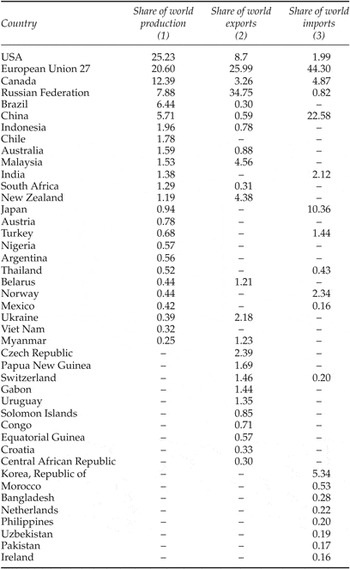
Industrial roundwood production is concentrated in three main regions/ countries (see table 1, column 1): the USA, Canada and the EU 27 which together are responsible for 58 per cent of total production. Countries where illegal logging activities are a major problem individually account for a much smaller fraction. The top five illegal logging producers – Russia, Brazil, China, Indonesia and Malaysia – jointly produce 24 per cent of global industrial roundwood (FAOSTAT, 2010).
Major industrial roundwood producers, exporters and importers in 2004 (% = country m3/world m3)

Notes: The dash denotes a negligible share.
Some of the main industrial roundwood producers play a less substantial role in world exports. In 2004, large roundwood producers such as the USA, Canada, China, Brazil and Indonesia exported 2.49 per cent, 1.90 per cent, 0.75 per cent, 0.34 per cent and 2.88 per cent of their total production, respectively. Russia was the world's largest exporter in 2004, representing almost 35 per cent of total world exports (see table 1, column 2). The EU 27 ranks second, accounting for 26 per cent of roundwood exports. With the exception of Russia, all other major illegal logging countries play a minor role in international markets. Malaysia, for example, represents 4.6 per cent of total world exports, while Myanmar, Indonesia and Brazil account for just 1.23 per cent, 0.78 per cent and 0.3 per cent, respectively. From these, Myanmar and Malaysia alone export a significant part of their national industrial roundwood production, 35.18 per cent and 21.53 per cent, respectively (FAOSTAT, 2010).
The EU is the world's largest roundwood importer (44.3 per cent) followed by China (22.58 per cent) and Japan (10.36 per cent) (see table 1, column 3). Given the aim of the present study, it is particularly relevant to identify the major EU suppliers. As detailed data on international bilateral trade are hard to obtain, we rely on our initial model database (Narayanan and Walmsley, Reference Narayanan and Walmsley2008). Accordingly, we find that Africa and Russia are the main sources of European roundwood imports. European imports from Russia are mainly destined for Finland. A recent study (Indufor, 2008) confirms these figures.
We may therefore conclude that, while for some countries illegal logging represents a major share of national production, it plays a minor role in international trade. Note, however, that illegal timber may also enter international markets through secondary wood products. The scope of this analysis focuses first on a ban on illegal logging, and then extends the restriction to other timber-producing sectors before discussing final conclusions.
3.2. Illegal logging shares
Illegal logging estimates are very hard to calculate and are therefore a contentious issue. In fact, reports on illegal logging rates by NGOs and national governments tend to provide rather disparate conclusions. The broadest and most widely used information on illegal logging rates today remains the Seneca Creek study commissioned by the American Forest & Paper Association (Seneca Creek Associates, 2004),Footnote 1 more recently integrated by Li et al., (Reference Li, Buongiorno, Tuner, Zhu and Prestemon2008).
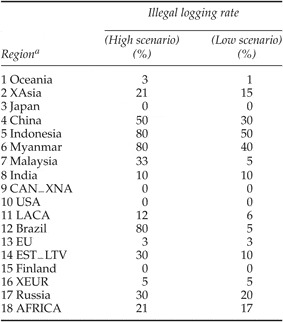
Our study makes direct use of these figures. Note, however, that data on illegal logging imports shares are lacking. Therefore, to compute the import restriction to be imposed, we directly apply estimates on illegal timber production. The assumption is that the share of illegal products in production translates directly on exports. Making use of data coming from various sources, Indufor, (2008) provide a sample of illegal logging percentage rates on roundwood exports. For all reported countries, illegal logging shares on exports are equal to or higher than the ones observed in production. To account for this we consider the upper level estimates provided in Li et al., (Reference Li, Buongiorno, Tuner, Zhu and Prestemon2008). A sensitivity analysis of this assumption is provided in section 4.
To adjust the original data to the regional aggregation used in this study, we recalculate illegal logging shares, weighting it by industrial roundwood production from the various countries included in the corresponding macro regions (see table 2).
Illegal logging data

Notes: aFor details on the regional aggregation please refer to table 3.
3.3. Modelling framework
3.3.1. The model
The analysis undertaken here endeavours to capture two crucial elements resulting from an EU ban on illegal logging: first, worldwide supply and demand re-composition induced by changing prices in the timber market; and second, sectoral adjustments occurring throughout the production chain. To this end, this study uses a CGE model. The main strength of this approach is the explicit representation of international and intersectoral trade flows. Goods, services and factors of production are indeed mobile between sectors and countries, responding to scarcity signals provided by changes in relative prices. Therefore, when the final implications on the GDP from each of the economies under investigation induced by some ‘perturbation’ are provided, they consider ‘market-driven adaptation’, i.e., all the adjustments at work in the economic system which are able to smooth or amplify the initial impact.
Another interesting feature of general equilibrium modelling is the possibility of highlighting consequences not only for the economy as a whole (a typical indicator in this sense is GDP), but also for each sector represented.
This study uses ICES (for details, see the online appendix available at http://journals.cambridge.org/EDE), a CGE model developed at the Fondazione Eni Enrico Mattei (FEEM). It is a recursive-dynamic and extended version of the GTAP-E model (Burniaux and Truong, Reference Burniaux and Truong2002), which includes CO2 emissions related to fossil fuel use. Although the model is recursive-dynamic, we use it in its static fashion. The aim of this exercise is indeed to highlight transmission mechanisms and possible feedback effects, rather than to study long-term dynamics. In order to do this, it is preferable to base the assessment on the verified historical data and parameterization of the calibration year (2004) and to avoid uncertain projections.
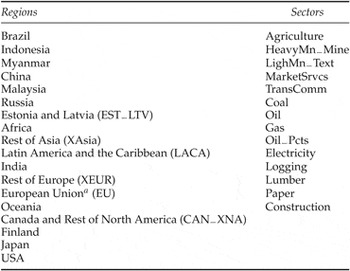
Table 3 presents the selected regional and sectoral aggregation used for this study. The regional detail singles out those areas where illegal logging is a major economic and environmental concern and explicitly identifies the major actors in the world timber trade. The sectoral detail emphasizes the logging industry and those where timber, raw or processed, is a major production factor (i.e., lumber, paper and construction). Other industries are aggregated into 10 macro sectors for the sake of simplicity.
ICES aggregation

Notes: aDoes not include Finland, Estonia and Latvia.
3.3.2. Carbon emissions
The emission module of the model has been enriched by emissions from forestry, relying on data published in UN FAO (2006). In using this data it is possible to estimate national carbon averages of stored aboveground biomass per cubic metre of wood and, therefore, to calculate the reduction in forest carbon stock as a direct result of logging activities (see table A1 in the online appendix). In addition, to account for the fact that clearances in commercial forest plantations are usually compensated through re-plantation, we adjust emissions to account for logging associated with primary forests alone, using collected data from Brown, (Reference Brown2000).
Finally, it should be noted that a significant fraction of the carbon previously retained in woody biomass may remain stocked in wood products, implying that emissions do not take place immediately. To correctly account for the time path of these carbon emissions, it would be necessary to have a complete description of the wood product cycle. Unfortunately, this type of information is still not available on a global scale. Taking this into consideration, we perform a sensitivity analysis on the amount of timber that is used in long-term storage structures (e.g., construction). In this case, if for example 75 per cent of harvested timber is used in long-term storage structures, this means that only the remaining 25 per cent will eventually be destroyed in the short run. Accordingly, we may estimate the amount of carbon emissions resulting from illegal logging activities by assuming that 25 per cent of carbon stocked in woody biomass is released when harvesting occurs.
3.3.3. Modelling the ban on illegal logging
A ban on illegal logging consists of a restriction on the imports from illegal logging regions, allowing only legal logs to enter European markets. As a result, logs coming from illegal sources towards the EU are reduced, which in its turn results in a higher EU import price for logs coming from illegal and legal logging producer countries. The modelling of a ban on illegal logging imports is replicated through the imposition of a tariff restricting log imports by the desired amount. In a CGE framework, where demanded quantities are endogenous and tariffs are exogenous, this is a typical procedure which exploits the well-known equivalence between quotas and tariffs (Bhagwati, Reference Bhagwati and Baldwin1965). In terms of quantity and prices, simulating the ban through tariffs is perfectly equivalent to doing it through quotas. What differentiates a tariff from a quota, however, is that the first generates revenues that need to be redistributed. Note that, in the case of a quota, a difference between the domestic and foreign price is produced anyway. This ‘quota rent’ may go to domestic importers or foreign suppliers, depending on the quota allocation (Laird, Reference Laird, Francois and Reinert1997). In our exercise the tariff paid by EU importers is rebated to them.
It is important to stress that the model does not represent differentiated legal and illegal timber markets. It is, therefore, impossible to describe the re-composition between legal and illegal activity induced by the EU ban. What can be derived is the impact on total domestic timber production due to the ban and through this it is possible to make some inference on illegal activity. However, our main interest here is to verify how a successful ban can impact demand, supply and ultimately prices in the remaining legal timber market. The decisive aspect is, therefore, the immediate reduction of EU demand for imports from regions where illegal logging activities have been identified as a sizeable part of the logging industry, and then the tracking of welfare effects, which we can indeed capture.
Due to the lack of data it is also assumed that the timber export composition of legal and illegal logs from an illegal logging country is the same irrespective of the importer, in domestic consumption, and that it is equal to the share of illegal logging over total logging production.
In section 5 this procedure is extended to timber processed products. In our model this translates into a ban on EU imports covering also the paper and lumber sectors of illegal logging regions. Given the non-existence of globally detailed data on the content of illegal timber used in forest products exports, the underlying assumption is that this share is equal to the share of illegal log exports. Finally, it is assumed that the ban is 100 per cent effective in tackling illegal exports (perfect traceability of illegal logs).
4. Results
In this section we study the case of a policy banning only illegal log imports into the EU. We focus our analysis on trade flows, production and prices in ‘wood dependent’ sectors and effects on GDP. We also assess the impact on GHG emissions for the main illegal logging countries.
4.1. Trade flows
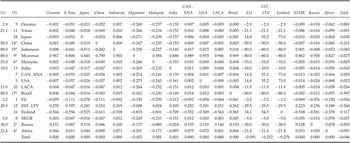
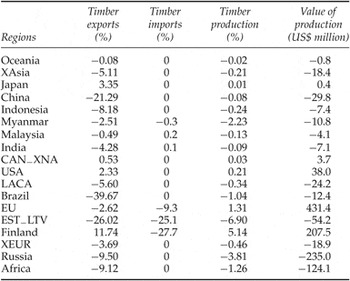
Table 4 extensively reports the effect of the EU ban on timber from illegal logging activities on world import/export volumes in the timber markets. The EU ban reduces timber exports from illegal loggers to the EU by −21 per cent from Africa to −80 per cent from Myanmar, Indonesia and Brazil. In absolute money terms, the highest export contractions to the EU are experienced by Russia (−US$239 million) and Africa (−US$122 million), which are the main EU timber trading partners. All illegal logging regions partially compensate the ban by increasing their timber exports to non-EU countries and often by timber use in the domestic market (see table 4). At the same time, the ban increases (on average by roughly 14 per cent) EU timber demand addressed towards the legal producers. This is met by a uniform and proportional increase in exports, primarily from the USA, Canada and North America, Japan and Finland. The ban also fosters EU domestic logging production, which increases by 1.3 per cent (table 5).
Changes in timber import (columns to row)/export (rows to columns) flows following the EU ban on timber from illegal logging activities

Notes: aIllegal logging >21.4 % of total logging activity.
(1) % of illegal over total logging activities.
(2) Country/region rank in wood exports (note this rank is slightly different from that of table 3 due to the different regional aggregation).
Changes in the timber sector following the EU ban on timber from illegal logging activities (change with regard to baseline)

The net reshuffling effect on timber import/export flows is relevant: in illegal logging-prone regions, the contraction in total timber exports ranges from −40 per cent in Brazil to −8 per cent in Indonesia (table 5). In ‘legal logger regions’, the increase in total timber exports ranges from 2.3 per cent in the USA to 11 per cent in Finland. Total EU timber demand on international markets contracts by roughly −9 per cent (in Estonia and Latvia by −25 per cent, and in Finland by −27.7 per cent). Imports in all the other regions are, however, scarcely affected. This confirms that a unilaterally imposed ban by the EU has mainly EU relevance.
4.2. Impacts on wood product sectors
Exporters hit by the ban decrease their timber production, but by much less than the drop in EU imports. This depends on the possibility of selling timber domestically and on the fact that exports are usually a minor share of total production. The opposite happens in regions where logging activities are mainly legal (see table 5).
Higher percentage contractions in production are thus experienced by Estonia and Latvia (−7 per cent), Russia (−3.8 per cent) and Africa (−1.26 per cent). These are the areas which have more intense timber trade flows with Europe. They are followed by Myanmar (−2.2 per cent) and Brazil (−1 per cent). On the contrary, Finland, the EU and the USA expand logging by 5 per cent, 1.3 per cent and 0.2 per cent, respectively.
Globally, contractions and expansions in logging activities almost perfectly compensate each other. This leaves world raw timber production and prices basically unaffected (see figures A1 and A2 in the online appendix). The effect on other industrial sectors is close to zero globally.
In terms of production (table 5), the EU ban clearly favours logging activities from legal producers, primarily within the EU (where the gain can be quantified as US$584.6 million), followed by the USA, the rest of North America and, marginally, Japan. It penalizes the logging activities in regions where illegal logging is widespread, especially those where the EU is the main export destination, i.e., Russia (−US$235 million) and Africa (−US$124 million).
Summarizing, the results so far obtained allows us to derive:
Conclusion 1
The (unilateral) EU ban has the main effect of removing illegally logged timber from the international market (as witnessed by the contraction in exports from illegal loggers), but it is not really effective in reducing illegal logging activities (much smaller contraction in logging activities).
Conclusion 2
The (unilateral) EU ban has a (moderately) positive effect on logging industries in legal logging regions (especially the EU) as their production increases together with prices. Conversely, the ban damages logging industries in illegal logging regions.
Note that conclusion 1 holds assuming that the composition of nation-specific exports of the illegal and the legal component does not change excessively after the reshuffling of illegal logs previously directed towards EU – in other words, assuming that the illegal component addressed to non-EU countries does not increase ‘too much’. For total illegal logging exports to increase after the ban, it would be necessary that its share directed to non-EU countries almost doubles from the pre-ban of around 17 per cent to 33 per cent. For Brazil, in particular, whose total exports sharply declined after the ban, even if all logging exports were illegal they would still be less than in the baseline scenario. Therefore we deem conclusion 1 credible.
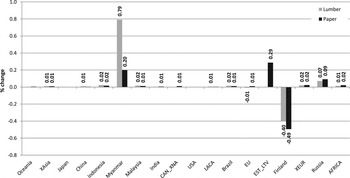
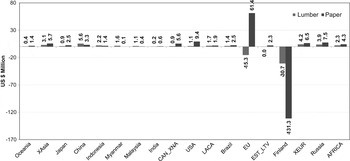
The size of quantity and price effects on production in the logging industry is rather modest. Even smaller impacts can be expected in those sectors using raw timber as a direct intermediate input such as lumber (which is a timber processing industry), and those higher up in the production chain, such as paper and construction, both of which are only indirectly hit by the EU policy. The negligible global and regional effects on lumber and paper production are indeed highlighted in figure 1.Footnote 2 Effects on the sectoral value of production are reported in figure 2.
Lumber and paper regional production (% change with regard to baseline)
Notes: EU excludes Estonia, Latvia and Finland.

Lumber and paper value of production (abs. change with regard to baseline)
Notes: EU excludes Estonia, Latvia and Finland.

These latter results allow us to draw the following conclusion:
Conclusion 3
The (unilateral) EU ban has an effect which is mainly circumscribed to the logging sectors and the logging market; in general it affects the activity and income of other wood dependent sectors only marginally.
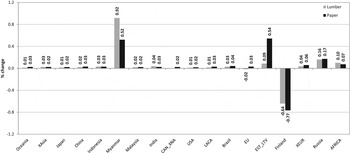
However, figures 1 and 2 also convey other important information. Illegal loggers, primarily Myanmar and Russia – and within the EU, Estonia and Latvia – are increasing lumber and paper production. A similar pattern can be observed in their exports (see figure 3). Essentially, in illegal logging countries there is an excess supply of raw timber (logs) which cannot be sold abroad. Therefore, this becomes a cheaper intermediate input for domestic lumber and paper industries which can increase production and exports. This leads to:
Conclusion 4
The (unilateral) EU ban also has the effect of stimulating secondary wood products in illegal logging countries and, through this mechanism, part of the banned illegal timber will remain in the international trade flows, but will be ‘hidden’ as processed wood.
Lumber and paper exports (% change with regard to baseline)

This is a kind of perverse effect as all illegal logging countries increase their exports of secondary wood products. This increase is, however, rather small. Therefore, while illegal timber may still enter international markets through this channel, it would seem that they do not compensate a reduction in log flows, and conclusion 1 is, therefore, still valid.Footnote 3
The final effect of the EU ban on secondary wood products in legal logging countries depends on trade relationships. Surely all their paper and lumber industries will face stronger competition from illegal loggers homologues. This will be felt more heavily in those countries sourcing their exports of paper and lumber to the EU. The case of Finland is emblematic. It experiences the major contraction in value of production (−US$162 million), production (−0.45 per cent on average) and exports (−0.7 per cent on average), as these are mainly addressed to the EU market where they have to compete with Russia, Estonia and Latvia which use illegal timber as intermediates.Footnote 4 The US also exports paper and lumber to the EU, but its market is wider and the effect on the domestic paper and lumber sectors is negligible. Therefore, it can be added that:
Conclusion 5
The (unilateral) EU ban also has the effect of exposing secondary wood producers in legal logging countries to higher competition from secondary wood producers in illegal logging countries. This can be harmful for those legal logging countries sourcing a higher share of their secondary wood product exports to the EU.
4.3. Impacts on GDP
Impacts on GDP are minimal. As a matter of fact, secondary and re-composition effects can prevail over direct effects, shadowing the role of typical market mechanisms. Given that the weight of logging activity is small if compared to the regional value of production, the feedback of shocks in the logging market onto the overall economic system are also small. Losses (gains) for the illegal (legal) logging sectors are thus dwarfed by demand, and supply adjustments occurring inside the remaining economic sectors.
Finally, this allows us to conclude the following:
Conclusion 6
The effects of the (unilateral) EU ban are particularly relevant at the sectoral level, primarily in the logging industry. Outside this sector, effects are mainly distributional with scarce scale implications for the overall economic activity.
4.4. Impacts on CO2 emissions
Given the characteristics of the ICES model, it is possible to identify not only the direct effects on forest carbon release associated with changes in logging activities, but also the overall change in carbon fluxes occurring on the rest of the economy due to the introduction of the ban.
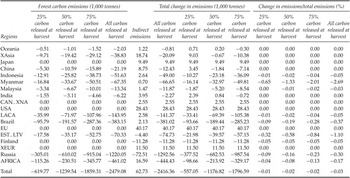
Table 6 presents the direct forest carbon release effects occurring on the logging sector, indirect carbon emissions and the resulting total effect. Globally, total reduction varies from 2,500 to 600 thousand tons of carbon, depending on the assumption made regarding the amount of timber entering long-term storage wood products. The reduction effect is highest for Russia, followed by Africa and Brazil. Considering that 75 per cent of harvested timber is used in long-term storage structures, illegal logging-related emissions in Russia decrease by 300 thousand tons, while for Africa and Brazil emissions decrease by 115 and 95 thousand tons of carbon, respectively. Finally, it is worthwhile noting that while logging decreases in these countries, harvesting increases in other areas. These increases, however, take place in countries where managed forests are responsible for almost all logging activities (USA, Canada and Finland), signifying that all eventually released carbon will be compensated by re-plantation of previously cleared areas.
CO2 emission effects

Given the limited size of the logging sector on the overall world economy production, global effects are relatively small on indirect carbon emissions. World emissions increase by 62 thousand tons of carbon, offsetting the total reduction on forest-related carbon emissions by 10 per cent when we assume that 75 per cent of illegally logged timber is used in long-term storage structures. Interestingly enough, the EU is the world region that increases its fuel-related emissions the most. In particular, it is the logging sector within this region registering the highest increase. A similar effect is observed in Finland, even if its total level of emissions decreases after policy introduction. We may, therefore, conclude that while banning illegal logging may have a negative overall effect as global fuel emissions increase, it is not enough to reap the benefits from illegal logging forest carbon release reductions.
Summarizing, we can derive:
Conclusion 7
The effects of the (unilateral) EU ban on CO2 emissions is moderate if emissions from forestry are considered (−0.9 per cent); it is negligible if total world CO2 emissions are the reference (−0.01 per cent). However, in absolute terms, carbon saving can be from 2.4 to 0.57 million tons per year.
4.5. Sensitivity analysis
Given the high uncertainty concerning illegal logging rate estimates, this section considers a policy exercise based on the low logging rate estimates in Li et al., (Reference Li, Buongiorno, Tuner, Zhu and Prestemon2008) (see table 2).
The main conclusion deriving from this sensitivity analysis is that all the qualitative findings of the previous subsections remain valid, while only the magnitudes of the effects identified there are reduced. The largest quantitative differences are experienced by those countries observing higher differences in illegal logging share estimates or high levels of trade relationship with the EU. Among these, the most relevant cases are the ones of Brazil and EST_LTV (Estonia and Latvia). The former is the country with the sharpest reduction in its illegal logging rate estimate (80 per cent in the high scenario vs. 5 per cent in the low scenario). The latter is among the regions with higher differences on share estimates, the one having stronger timber trade relations with the EU.
Brazil's contraction in log exports is now equal only to 2.5 per cent, vs. a 40 per cent reduction under a high illegal logging rate scenario; while for EST_LTV the reduction changes from 26 per cent to 9 per cent (see figure A3 in the online appendix). Finally, reduction in EST_LTV log production is also lessened under low illegal logging rates, decreasing now only by 0.7 per cent vs. a previous reduction of 7 per cent (see figure A4 in the online appendix).
5. Extending the ban
In this section we consider an extended ban also covering EU imports of paper and lumber from illegal logging regions, consistent with the provisions of the EU Due Diligence Regulation. We apply hereby the high illegal log shares estimates in Li et al., (Reference Li, Buongiorno, Tuner, Zhu and Prestemon2008) to both logging and timber processing sectors.
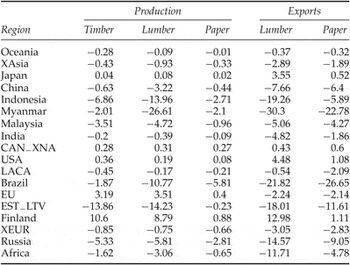
The extended ban has a significant impact on production. Particularly relevant are the cases of Indonesia and EST_LTV, whose contraction in logging activities are equal to 6.9 per cent and 13.9 per cent, respectively (see table 7). Note that under a ban targeting only log exports, Indonesian production remained nearly unchanged, while the reduction in EST_LTV was approximately 7 per cent (table 5). In Myanmar, Malaysia and Russia, production decreases by 2 per cent, 4 per cent and 5 per cent, respectively. In contrast, Finnish log production increases by 10.6 per cent. These results allow us to conclude the following:
Conclusion 8
The effects on logging production are reinforced by a ban extension to timber processed products; nonetheless, these reductions are still lower than current illegal log production estimates in high risk countries.
Changes in production and exports of logging-related sectors after extending the ban (% change with regard to baseline)

As one might expect, and in sharp contrast to the analyses in section 4.2, secondary wood sectors (lumber in particular) also experience large production and export contractions in the main illegal logging countries. Myanmar's lumber production decreases now by 27 per cent, while for EST_LTV, Indonesia, Brazil and Malaysia this reduction amounts to 14.2 per cent, 14 per cent, 11 per cent and 5 per cent respectively (see table 7). Reduction in exports in the lumber and papers sectors in these same countries varies from 4 per cent to 30 per cent (see table 7). It is therefore possible to state:
Conclusion 9
Extending the ban to processed timber products eliminates the perverse effect of stimulating secondary wood production and exports from illegal logging countries which partly re-introduced illegal logs into international markets.
Symmetrically, in legal loggers, we observe an increase in the production of secondary wood products (EU and Finland) and an increase in exports (CAN_XNA, USA and Finland). Therefore, it is possible to conclude:
Conclusion 10
Extending the ban eliminates the negative competitiveness effect on legal secondary wood producers imposed by a ban targeting only log exports. This effect will be stronger the higher is the share of their exports to the EU.
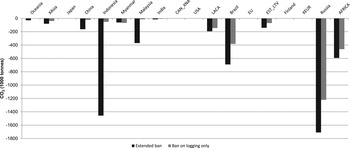
Finally, the reduction in logging activities resulting from a ban extension (see conclusion 8) also reduces forest carbon emissions from illegal logging activities. The final effect in absolute value terms will depend both on the change in illegal logging activities and regional forest carbon content. Taking these into consideration, the regions observing a higher reduction resulting from the ban extensions are Indonesia, Russia, Malaysia and Brazil (see figure 4). Note that under a policy scenario targeting only logs, both Indonesia and Malaysia had registered only a negligible reduction in forest emissions. Considering that all carbon is released at harvest, global forest carbon emissions reduce by 5.5 million tons of CO2, vs. a 2.4 million ton reduction in the previous policy scenario. Having said this, it is possible to state:
Conclusion 11
Extending the ban to timber processed products reinforces carbon emission reduction resulting from illegal logging activities. This effect is particularly important in regions holding important tropical forests.
Change in forest carbon emissions with regard to baseline (all carbon released at harvest)

6. Conclusions
This research analyzed the potential economic implications of an EU unilateral ban on imports of illegal logging within a general equilibrium perspective. We first provided an examination of the consequences of a ban targeting only illegal log imports. The main messages that have emerged from this exercise are the following:
• The unilateral EU ban has the main effect of removing illegally logged timber from the international market. This is witnessed by the sharp export contractions from main illegal loggers (ranging from −8 per cent to −40 per cent). At the same time, it does not seem particularly effective in reducing illegal logging activities as, in general, countries with illegal logging activities decline only moderately (−7 per cent at most in Estonia and Latvia). Illegal logs are indeed partly re-addressed to importers other than the EU, and used more in the domestic market.
• The unilateral EU ban has a (moderately) positive effect on logging industries in legal logging regions, as their production increases. The stronger positive effects are in the EU where log industry value of output increases by US$584.6 million. Conversely, the ban damages logging industries in illegal logging regions, primarily those located in major log exporters to the EU, i.e., Russia and Africa. These countries find it more difficult to internationally recompose their portfolio of customers.
• The unilateral EU ban primarily affects the logging sectors and the logging market. In general, the overall economic activity is not affected; impacts on GDP performances are negligible. Nonetheless, some interesting second-order effects can be seen in secondary wood products sectors.
• The unilateral EU ban indeed offers a more abundant and cheaper input (illegal timber which cannot be sold abroad) to secondary wood products industries (lumber and paper) in illegal logging countries. Accordingly, their production increases and their exports become relatively more competitive and, thus, also increase (0.9 per cent at the maximum in Myanmar). Through this mechanism, part of the banned, illegal timber will re-enter the international trade flows, but will be ‘hidden’ as processed wood. This effect is, however, limited.
• As a consequence, the unilateral EU ban also has the effect of exposing secondary wood producers in legal logging countries to higher competition from secondary wood producers in illegal logging countries. This can be somewhat harmful for those legal logging countries (e.g., Finland) sourcing a higher share of their secondary wood product exports to the EU.
• Given the limited effect on overall economic activity, effects on GHG emissions are also limited. Direct carbon emissions from logging activity can decrease from 2.5 to 0.6 million tons per year; however, this is a tiny advantage (a reduction of −0.01 per cent) if compared to world CO2 emissions.
Finally, the main consequences of extending the ban to timber processed products are that it:
• Eliminates the perverse effect in which illegal logs were re-introduced into international secondary wood product markets.
• Eliminates as well the negative competitiveness effect on legal secondary wood producers imposed by a ban targeting only log exports.
• Reinforces timber production contraction in illegal logging countries. Consequently, carbon emission reductions resulting from illegal logging activities are higher under an extended ban policy scenario. This effect is particularly important in regions holding important tropical forests.