INTRODUCTION
Increasing demand over the past three decades, among both ‘consumer’ and ‘supplier’, for more cost-effective and accessible treatments for common mental health disorders has reinforced a corresponding growth of brief, self-administered cognitive-behavioural interventions. This is nowhere more apparent than in the management of anxiety disorders, and panic disorder (PD) in particular, for which there is increasing evidence for the efficacy of reduced therapist-contact cognitive behavioural therapy (CBT) in a range of formats, including bibliotherapy (Gould et al. Reference Gould, Clum and Shapiro1993; Febbraro et al. Reference Febbraro, Clum, Roodman and Wright1999), computer-delivered programmes (Newman et al. Reference Newman, Kenardy, Herman and Taylor1997; White et al. Reference White, Jones and McGarry2000; Carlbring et al. Reference Carlbring, Westling, Ljungstand, Ekselius and Andersson2001; Kenardy et al. Reference Kenardy, Dow, Johnston, Newman, Thomson and Taylor2003; Lange et al. Reference Lange, Rietdijk, Hudcovicova, van de Ven, Schrieken and Emmelkamp2003; Kenwright & Marks, Reference Kenwright and Marks2004) and brief, condensed versions of standard CBT delivery (Côté et al. Reference Côte, Gauthier, Laberge, Cormier and Plamondon1994; Clark et al. Reference Clark, Salkovskis, Hackmann, Wells, Ludgate and Gelder1999). Marks (Reference Marks2002) had identified these developments and the determination of their effectiveness as partial evidence of CBT's ‘coming of age’ as a therapeutic science. However, he also notes that we have made much less progress in our ability to predict outcome and identify those individuals for whom particular treatments may or may not be indicated.
Following convention, the term ‘predictors’ is used here to refer to baseline variables that show similar relationships with outcome irrespective of treatment assignment (Kraemer et al. Reference Kraemer, Wilson, Fairburn and Agras2002). However, moderators, sometimes referred to as ‘prescriptive indicators’ (Whisman, Reference Whisman1993), are baseline variables not influenced by treatment, but which influence outcome differentially and so relate to whom or under what circumstances a given treatment may be effective. Thus, variables such as age, gender, severity and duration of disorder may function as moderators if they identify patient subgroups who respond differentially to different treatments. While the identification of predictors of CBT outcome is of obvious clinical value, as Hollon & Najavits (Reference Hollon, Najavits, Frances and Hales1988) observed, ‘only [moderators] are actually useful in the selection of treatment for a given patient’ (p. 651).
An analysis of moderating effects on outcome may be particularly relevant to brief, reduced therapist-contact CBT, as distinct from standard and other potentially more costly forms of CBT delivery, for several reasons. First, the identification of prescriptive indicators and contraindicators for brief vis-à-vis standard CBT would facilitate optimal treatment selection, further enhancing its effectiveness and efficiency. Second, several researchers in this area have reported fairly high variability of response to minimal contact regimes across a range of disorders including sexual dysfunction (Mathews et al. Reference Mathews, Bancroft, Whitehead, Hackmann, Julier, Greenwood, Goth and Shaw1976; Dow, Reference Dow1983), eating disorders (Wilson et al. Reference Wilson, Vitousek and Loeb2000) and generalized anxiety (Durham et al. Reference Durham, Fisher, Dow, Sharp, Power, Swan and Morton2004). Similarly, Kenardy et al. (Reference Kenardy, Dow, Johnston, Newman, Thomson and Taylor2003), in their comparison of three forms of CBT delivery for PD involving a ‘standard’ 12-session therapist-delivered CBT programme (CBT12) and two ‘brief’ six-session versions (one computer-assisted, CBT6CA, and the other therapist-directed only, CBT6), found all treatments to be effective, but CBT12 to be significantly superior to CBT6 on several key post-treatment measures. CBT6CA occupied an intermediate position, being non-significantly different from the other two treatments. These differences were no longer apparent at the 6-month follow-up. Again, however, a higher degree of variability of response to CBT6 at post-treatment compared to the standard approach was apparent on most measures.
In discussing such general findings, it has been proposed that this more variable response to brief forms of intervention may be due, in part at least, to the difference between standard and brief therapies in terms of the opportunity and time afforded to therapists in identifying and resolving common obstacles to behavioural progress, including significant co-morbidity; strongly held core dysfunctional beliefs; and primary or secondary social, marital or other related problems (Mathews et al. Reference Mathews, Bancroft, Whitehead, Hackmann, Julier, Greenwood, Goth and Shaw1976; Dow, Reference Dow1983). On this basis such factors may thus be hypothesized to contribute to a differential responsiveness to the two forms of treatment delivery: that is these variables may have a moderating effect on outcome (Dow, Reference Dow and Main1982).
In the examination of effect moderators from the trial of Kenardy et al. (Reference Kenardy, Dow, Johnston, Newman, Thomson and Taylor2003), a comparison between CBT12 and CBT6 is probably of greatest theoretical interest, the two programmes being essentially identical in content and method of delivery, differing only with respect to frequency of therapist contact. Moreover, this particular comparison is considered of broader relevance to general clinical practice, where there is more widespread uptake of brief CBT approaches but still very limited use of computers in treatment (Whitfield & Williams, Reference Whitfield and Williams2004).
Hypothesis
Because of statistical and other limitations, moderator (and mediator) analyses are often predominantly ‘exploratory and hypothesis-generating rather than conclusive or hypothesis-testing’ (RUPP Anxiety Study Group, 2003, p. 14). In the present study, however, it may be hypothesized that patients with greater baseline levels of panic severity and associated disability (including degree of co-morbidity, agoraphobic avoidance and impairment of social and occupational functioning, as well as strength and frequency of dysfunctional agoraphobic cognitions) would respond less well to brief (six-session) therapist-directed CBT compared to ‘standard’ (12-session) therapist-directed CBT, in view of the greater opportunity in the latter condition to identify, assess and resolve such difficulties.
METHOD
All data for this and for the first part of the present study were derived from the randomized controlled trial of CBT for PD reported in full elsewhere (Kenardy et al. Reference Kenardy, Dow, Johnston, Newman, Thomson and Taylor2003). Details of the sample, method of recruitment, the treatments and outcome measures have thus been documented previously in detail both in the original report and in the first part of this study and are therefore not repeated here.
Analysis
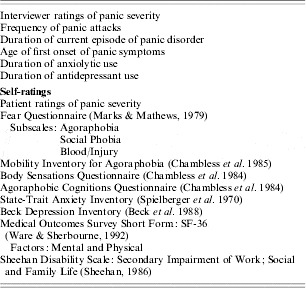
In the present study the moderators analysis involves examining whether a baseline or pre-randomization characteristic has an interactive effect with treatment on outcome; that is, do the effects of treatment for individual subjects depend on the value of the variable in question? The full list of potential moderators is shown in Table 1. Data on these variables were initially centred before forming the interaction term using the procedure recommended by Kraemer et al. (Reference Kraemer, Wilson, Fairburn and Agras2002). For the main continuous dependent measure (i.e. the post-treatment composite panic/anxiety score), a series of simultaneous multiple regression analyses was conducted, each involving the three variables of interest (treatment, predictor and treatment×predictor interaction), while controlling for pretreatment composite panic/anxiety score, which was forced to enter the equation before the predictors of interest.
Potential effect moderators of brief (6-week) and standard (12-week) CBT for panic disorder with/without agoraphobia: variables on which analysis conducted

Additional logistic regression analyses were conducted using clinically significant post-treatment end-state as the dependent variable, essentially to determine whether any significant interaction effects from the above analysis would be replicated for this more stringent measure of outcome.
Significant interaction effects from multiple regression were plotted using the procedure recommended by Cohen & Cohen (Reference Cohen and Cohen1983), and as described by Aiken & West (Reference Aiken and West1991).
RESULTS
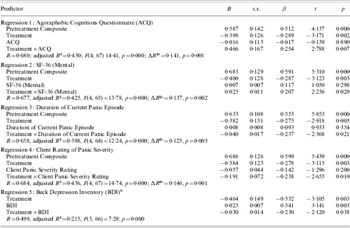
The analysis of treatment×predictor interaction effects focused exclusively on the comparison between standard (CBT12) and brief (CBT6) treatments for several reasons noted above. The results, shown in Tables 2 and 3, provide partial support for the hypothesis that patients presenting with more severe levels of PD, those with additional co-morbidity, and those with stronger dysfunctional cognitions relating to health and well-being would be more responsive to CBT12.
Simultaneous multiple regression analyses: significant moderating effects of specific pretreatment variables on treatment outcome (Post-treatment Composite Panic/Anxiety Measure)

s.e., Standard error.
a When compared with the model involving Pretreatment Composite Score only.
b In case of BDI, interaction effect with treatment significant only in absence of control for Pretreatment Composite Score.
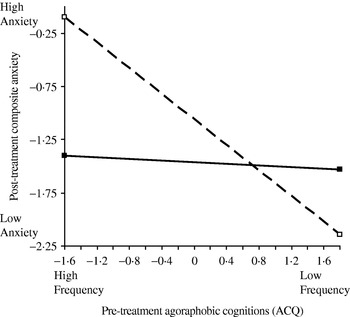
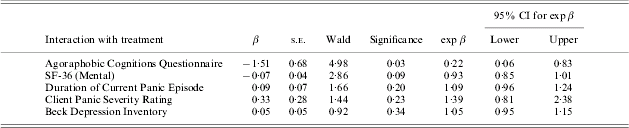
Thus, significant interaction effects with treatment (CBT12 and CBT6) were found on four pretreatment measures relating to panic disorder severity. These significant interaction effects included frequency of dysfunctional agoraphobic cognitions, patients' ratings of panic severity, duration of current panic episode and pre-treatment score on SF-36 (Mental). These moderator effects were all in the predicted direction, each favouring CBT12 at higher pretreatment levels of severity. Fig. 1 illustrates the nature of this differential treatment response in relation to baseline strength of dysfunctional agoraphobic cognitions. Essentially the same relationship was replicated for each of the other significant interaction effects. While a significant moderator effect was found for pretreatment level of depression, as measured by the BDI, this was apparent only when control for the pretreatment composite score was excluded. No significant interaction effects, however, were found for other measures of co-morbidity, baseline frequency of panic attacks or degree of agoraphobic avoidance. With high and low end-state functioning as the dependent variable, only the treatment×agoraphobic cognitions interaction was found to be significant (Table 3).
Results of linear regression analysis showing interaction effect between CBT format: CBT6 (□- - -□) and CBT12 (■—■) and baseline frequency of dysfunctional agoraphobic cognitions (Centred Equation) in relation to post-treatment composite anxiety score.

Results of separate logistic regression analyses of treatment×predictor interaction effects in relation to high/low end-state functioning

DISCUSSION
Despite the growth of brief self-help CBT interventions, there has been, in general, very little research interest in the prescriptive indicators for their use, relative to more standard forms of CBT delivery. This may be in part because moderator analyses have a number of limitations and significant interaction effects are often difficult to detect statistically (Shadish & Sweeney, Reference Shadish and Sweeney1991; McClelland & Judd, Reference McClelland and Judd1993).
In the present study, based on outcome data from a prior comparison of a ‘standard’ 12-week CBT programme and a comparable but condensed 6-week programme (Kenardy et al. Reference Kenardy, Dow, Johnston, Newman, Thomson and Taylor2003), several significant treatment×predictor interaction effects on post-treatment outcome, as measured by the composite panic/anxiety score, were found. These involved agoraphobic cognitions; quality of life (SF-36 – Mental factor); patients' ratings of panic severity; and duration of current panic disorder episode, all in the predicted direction. Thus, while there was no difference between brief and standard treatments for those patients with less severe baseline scores on each of these measures, brief therapy in each case had a less positive effect than standard 12-session CBT for those more severely disabled on the above specific measures. This is not to imply that brief therapy is contraindicated for those patients. An examination of pre–post therapy change for those patients in each of the two treatment groups, whose pretreatment scores were within the ‘most severe’ quartile on each of the above measures, showed significant pre–post therapy improvements of at least p<0·05 (two-tailed). The degree of change, however, was significantly greater in each case among those receiving CBT12.
That those with more severe panic symptoms and dysfunctional automatic interpretations about bodily sensations, of the type considered central to a cognitive theory of panic, should be more responsive to a treatment format that affords greater opportunity to help challenge those beliefs, seems entirely reasonable. A similar argument applies also, of course, to the almost significant relationship between pretreatment depression and the differential responsiveness to the two treatments in the reduction of panic and anxiety symptoms. A key function of therapist contact in CBT is identifying and resolving cognitive, emotional, motivational, social and other impediments to behavioural progress during largely self-administered homework tasks, before establishing new goals and assignments for the next interval between contacts (Mathews et al. Reference Mathews, Bancroft, Whitehead, Hackmann, Julier, Greenwood, Goth and Shaw1976). It follows that those with more severe difficulties in areas central to the maintenance of the primary disorder, such as mood/motivation, and a consistent and well-established pattern of misattribution of bodily sensations, should require more therapist contact than those with fewer or less severe problems of this type and ideally more than that which brief therapy allows. That these factors appear to be related to a more general profile of greater clinical severity, which would favour more frequent direct therapist contact, is reflected in the striking consistency of the moderator effects, encompassing patients' self-ratings of overall severity of panic, duration of the current episode and poorer perceived quality of mental well-being. These results have implications for future outcome studies in this area as strong moderators should be considered as stratification variables.
The identification of predictors and moderators of outcome will of course be limited by the nature and range of variables on which data are collected in outcome trials. In addition to intra-personal factors, there are numerous other inter-personal and environmental variables of potential moderating influence in relation to brief and standard length CBT for PD. For example, the relationship between degree of adaptive partner support and compliance with exposure homework sessions for agoraphobia has been well documented (Mathews et al. Reference Mathews, Gelder and Johnston1981). That interpersonal factors of this kind may differentially influence the effects of brief and standard length treatments, for reasons akin to the hypothesized moderating effects above, seems reasonable but it was not possible to examine them here. Therefore, as Kraemer et al. (Reference Kraemer, Wilson, Fairburn and Agras2002) point out, while moderator analysis is post hoc, ‘the decision to perform such an analysis must be a priori’ (p. 882). Nevertheless, the burden of data collection is necessarily limited by both ethical and practical concerns and perhaps the most we may reasonably plan is the gradual accumulation of reliable prognostic and prescriptive indicators over time to guide the use of specific therapies.
Research of this type also highlights the importance in clinical trials of detailed specification of sample characteristics. Treatment effectiveness in clinical practice will depend on factors that extend beyond type of intervention and the nature of the disorder. Sufficient detail on motivational factors, co-morbidity, social adjustment, marital status and stability, for example, are rarely provided and this study is not beyond similar criticism. There is also a need for a standard set of measures being used across related efficacy and effectiveness trials to permit comparison and potential corroboration of results.
We are still a long way from being able to answer the question posed by Paul forty years ago: ‘what treatment, by whom, is most effective for this individual with that specific problem, and under which set of circumstances?’ (Paul, Reference Paul1967). Nevertheless, continued examination of the moderators and mediators of CBT outcome will no doubt begin to produce some answers.
DECLARATION OF INTEREST
None.