Introduction
Delirium is a common neuropsychiatric syndrome, occurring in approximately one in five general medical inpatients (Siddiqi et al., Reference Siddiqi, House and Holmes2006), which is associated with elevated healthcare costs, morbidity, and mortality (Fick et al., Reference Fick, Kolanowski, Waller and Inouye2005). Despite this impact, delirium has been understudied due to the difficulties in researching a complex condition that occurs across a wide range of healthcare settings and specialties. In particular, there is a lack of consensus regarding the optimal approach to pharmacological management of delirium, with some recommending that “drug sedation” be used as a last resort to control behavior (British Geriatrics Society and Royal College of Physicians, 2006), while others advocate more widespread targeted use of pharmacotherapy based on prospective studies of efficacy and tolerability (American Psychiatric Association, 1999; Meagher and Leonard, Reference Meagher and Leonard2008). In part, this disparity reflects the heterogeneous nature of delirium whereby it occurs in a variety of populations with varying comorbidities and susceptibility to adverse effects, but also may relate to awareness and perception of existing knowledge. Although pharmacological treatment of delirium is supported by moderate-level evidence within proposed NICE guidelines (National Institute for Health and Clinical Excellence, 2009), there is continuing uncertainty regarding key issues such as the optimal agent, dosing and duration of treatment, mechanism of action, effectiveness in different clinical scenarios (e.g. motor subtypes, comorbid dementia), and relevance of tolerability issues in dementia to short-term use in delirium.
In recent times there has been a substantial increase in research activity, including pharmacological studies (Meagher, Reference Meagher2009). This has been complemented by the establishment of the European Delirium Association (EDA) to foster better awareness of delirium and a forum for collaborative research activity (MacLullich et al., Reference MacLullich, Meagher, Laurila and Kalisvaart2007). This report describes an educational workshop delivered under the auspices of the EDA aimed at provoking an informed debate as to the best application of existing knowledge regarding delirium pharmacotherapy. The specific aims of this study were to explore baseline attitudes towards delirium pharmacotherapy and to assess the impact of this educational intervention (i.e. a workshop involving a gameshow quiz format) on these attitudes.
Methods
A workshop focusing on the pharmacological management of delirium was held at the Andrew Sims Centre in Leeds, U.K. on three occasions: at the Liaison Psychiatry for Older People Conference (May 2009), and on two consecutive days at the Fourth Annual Scientific Conference of the European Delirium Association during October 2009. Attendees included a heterogenous mix of healthcare workers from a range of specialties and settings all with a common interest in improving delirium care.
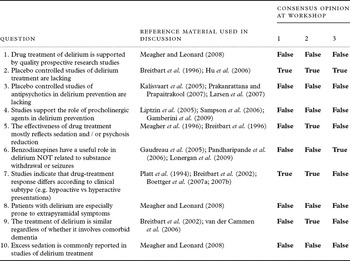
The workshop involved a two-hour interactive format with a University Challenge style quiz between two teams of three people (the “sceptics” vs the “neuroleptics”) and an audience consisting of the remaining attendees (n = 12–18) (see Figure 1). The “quiz” consisted of ten true/false statements for which the teams could volunteer an answer (see Table 1). The “correct” answer was judged after a group discussion augmented by a short (3–4 slide) presentation by the workshop facilitator (D.M.) consisting of relevant evidence to support or refute the statement under question. Statements were deliberately provocative and were not unequivocally true or false, ensuring that the workshop was highly active. The final decision on correct answers was according to the consensus vote of the audience and differed for some questions over the three workshops as shown in Table 1. A light-hearted atmosphere was encouraged by incorporating elements of less serious gameshows (e.g. Shooting Stars) to amuse the audience while keeping discussions focused.
Format of the educational workshop.

Workshop true/false questions

Attendees were asked to complete an anonymously coded questionnaire at the beginning and conclusion of the workshop exploring practice and attitudes towards pharmacotherapy of delirium.
Statistical analysis
Statistical analyses were conducted using SPSS 14.0. Suggested first- and second-line agents are described in absolute numbers while rating of adverse effects and proposed future use of pharmacological interventions are described in percentages. The Mann-Whitney U test was used to compare the frequency of psychotropic drug use and the suggested duration of continuation therapy for those who perceived the evidence as somewhat or very convincing versus those who were unaware of evidence or found it unconvincing. The Kruskal-Wallis test was used to compare the frequency of psychotropic drug use according to the perceived principal mechanism of action (antipsychotic vs sedative vs specific anti-delirium). Mann-Whitney U tests were used to compare the frequency of psychotropic drug use and the suggested duration of continuation therapy for those who rated at least one category of adverse effects as a major deterrent vs those who did not and also for individual categories of adverse effect (major deterrent vs minor deterrent or not a concern). The frequency with which respondents rated any category of adverse effect as a major deterrent to psychotropic drug use before and after the workshop was compared with Wilcoxon signed ranks test.
Results
Response and reported psychotropic use
Sixty-six attendees responded to the questionnaire which represented all participants at the three workshops (21 at the old age conference, and 21 and 24 at the two days of the EDA respectively). Of these, 65/66 indicated that they use psychotropic agents in the management of delirium (99%). The frequency of use varied considerably such that when asked to estimate the percentage use in delirious patients encountered in day-to-day practice, 20% reported use in 0–25% of such patients, 30% in 25–50%, 16% in 50–75%, and 34% in 75% or more. Median frequency of use was 60%.
Perception of evidence to support antipsychotic use
Respondents were asked to rate their perception of the published evidence to support treatment of delirium with antipsychotic medications: 12% were not aware of any evidence, 24% reported the evidence as unconvincing, 61% somewhat convincing, and 3% as very convincing. There was a disparity between perception of evidence to support use of antipsychotic agents for delirium and actual use, such that respondents who were unaware of evidence or did not find it convincing reported greater use of antipsychotics in their practice (72%) compared with respondents who rated available evidence as somewhat or very convincing who reported using antipsychotics in 54% of patents they encountered (p = 0.02).
Perceived mechanism of action of antipsychotic agents
Respondents were asked to indicate their perception of the mechanism of action for pharmacological agents and to rank the relative importance of sedative effects, antipsychotic effects, specific anti-delirium effects and other mechanisms: 78% rated sedative effects as a mechanism of action, 72% rated anti-psychotic actions, with only 45% indicating a specific anti-delirium effect. The principal mechanism of action was rated as sedation (38%) followed closely by psychosis alleviation (33%), with only 21% attributing benefits due to a specific anti-delirium or associated neurochemical change (e.g. correction of dopamine-acetylcholine imbalance). Seven percent indicated “other” mechanisms that included impact upon treating staff and relatives, as well as anxiolysis.
The frequency of psychotropic use varied with perceived main mechanism of action with 70% for those who identified a specific anti-delirium effect, 61% for those who related mechanism as via sedation, 52% for those who rated main effect as anti-psychotic, and 33% in those who identified “other” mechanisms, although this did not reach statistical significance (p = 0.1).
Choice of pharmacological interventions
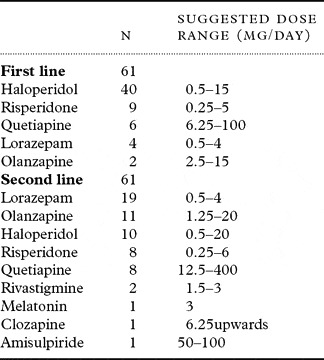
Agents of first and second choice, with typical dose range used, are shown in Table 2. Haloperidol was the preferred first-line agent for almost two-thirds of respondents with a variety of atypical antipsychotics, benzodiazepines, procholinergics and melatonin identified as first- and second-line alternatives. Many respondents provided additional information indicating particular preferences for specific patient groups, such as use of quetiapine in Parkinson's disease or Lewy Body dementia, rivastigmine in patients with comorbid Alzheimer's dementia, risperidone where less sedation was desirable, and amisulpiride in patients with hepatic failure. Of those respondents who identified sedation as the principal mechanism of action, 86% (19/22) selected haloperidol as their agent of first choice.
Suggested first- and second-line agents with dose ranges

Duration of treatment after symptoms resolve
Respondents were asked to indicate their practice with regard to treatment continuation after delirium symptoms resolve. There was considerable variation from immediate discontinuation once delirium symptoms resolved (23%), 1–2 days (23%), 3–5 days (30%), one week (20%), and two weeks (4%). The median duration of treatment continuation was 3 days.
Use of pharmacological interventions prophylactically
The majority of respondents reported that they were either unaware of studies to support pharmacological prophylaxis for delirium (31%) or found the evidence unconvincing (33%), while 35% reported the evidence as somewhat convincing and a single respondent as very convincing. Eleven respondents reported having used psychotropic interventions for the prophylaxis of delirium. The agents used were haloperidol (n = 4), benzodiazepines (n = 3), rivastigine (n = 2), melatonin (n = 1) and risperidone (n = 1).
Influence of potential adverse effects upon willingness to use antipsychotics in the treatment of delirium
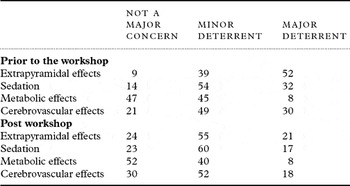
The impact of four potential adverse effects upon psychotropic agent use is shown in Table 3. Extrapyramidal effects were identified as the most common major deterrent with the risk of metabolic effects considered least problematic.
Rating of adverse effects impact upon prescribing practice before and after the workshop (percentage of respondents)

The relationship was explored between concerns regarding adverse effect profile and frequency of antipsychotic use and duration of use after symptom resolution. The frequency of antipsychotic use was significantly higher in those (30%) who did not rate any of the four categories of adverse effects as a major deterrent compared to those (70%) who rated at least one area as a major deterrent to antipsychotic use (p = 0.03). In contrast, there was no significant difference in relation to duration of continuation treatment after symptom resolution. Two individual adverse effects were related to the frequency of antipsychotic use with concerns regarding sedative potential (p = 0.01) and extrapyramidal effects (p = 0.02) associated with reduced frequency of use. Over two-thirds (67%) of respondents who rated extrapyramidal side effect potential as a major deterrent to using drug treatment selected haloperidol as their agent of first choice.
Impact of workshop upon reported future likelihood of using drug strategies in the management of delirium in various scenarios
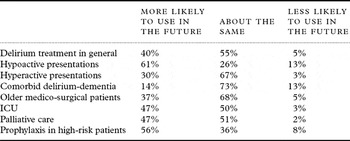
The impact of the workshop upon proposed future use of psychotropics in various scenarios is shown in Table 4. The two aspects of treatment that were most influenced by the workshop were use in hypoactive presentations and prophylaxis in high risk patients. In general, attitudes towards psychotropic agent use became more positive with the exception of use in patients with concomitant dementia, with many respondents reporting less willingness to use in the future.
Impact of the workshop upon proposed use of pharmacological strategies in future delirium management

In relation to potential adverse effects (see Table 3), 70% of respondents indicated that one of the four categories was a major deterrent to psychotropic drug use prior to the workshop while this reduced to 45% at the conclusion of the workshop. The specific adverse effect of greatest change was in relation to concerns regarding potential for extrapyramidal effects, which was reported as a major deterrent in 52% of respondents before the workshop and 21% after the workshop (p < 0.001).
Discussion
This study of the attitudes and practices regarding the pharmacological management of delirium among participants at an educational workshop highlights considerable variation in agents used, perceived mechanisms of action and concerns regarding adverse effect potential. This partly reflects the varied backgrounds of respondents which included delirium specialists from around the globe working in a variety of specialties and healthcare settings but also related to varying appreciation of the growing body of research that addresses the risks and benefits of pharmacotherapy in delirium. Concerns regarding the potential for adverse effects were identified as particularly important determinants of practice and these attitudes were amenable to provision of information such that participation in this educational event was associated with reduced concern regarding some adverse effects and a more positive attitude towards pharmacotherapy in many clinical scenarios.
The reported frequency of use of pharmacological interventions was surprisingly high given the degree of skepticism regarding strength of supporting evidence, with only two respondents rating the existing evidence as “very convincing”. Equally, the majority of respondents did not believe that antipsychotics have a specific anti-delirium effect, but rather act via sedative or antipsychotic effects. The latter view has been challenged by a recent review highlighting the lack of an association between sedative potential and effectiveness of psychotropics in delirium, as well as the time frame for response which is more rapid than the antipsychotic effect observed in other conditions characterized by psychotic symptoms (Meagher and Leonard, Reference Meagher and Leonard2008). Other work (van der Cammen et al., Reference van der Cammen, Tiemeier, Engelhart and Fekkes2006) has emphasized the disproportionate disturbance of dopaminergic metabolism associated with delirium and supports the prevailing notion of a relative dopaminergic excess and cholinergic deficiency as the principal neurochemical aberration underlying delirium (Trzepacz, Reference Trzepacz2000). This study highlights the importance of clarifying the mechanisms of action for psychotropic agents in order to achieve greater consistency in use.
Haloperidol was the agent of first choice in delirium treatment for the majority of respondents. This is in keeping with American Psychiatric Association (1999) and British Geriatrics Society guidelines (2006). In contrast, Alexopoulos et al. (Reference Alexopoulos2004) surveyed 48 American experts on treatment of older adults and could not reach consensus regarding a preferred first-line pharmacological agent for delirium. Tropea and colleagues (Reference Tropea, Slee, Holmes, Gorelik and Brand2008) retrospectively studied the pharmacological management of delirium in elderly general hospital patients and found that haloperidol was the most commonly used agent but with almost equivalent frequency of olanzapine use. Briskman et al. (Reference Briskman, Dubinski and Barak2009) reviewed antipsychotic use for delirium treatment in acute medical inpatients and found that haloperidol was the preferred typical antipsychotic agent but that risperidone was the most commonly used antipsychotic in general. Similarly, Hally and Cooney (Reference Hally and Cooney2005) found that haloperidol was the most commonly prescribed psychotropic agent for delirium treatment in general, with risperidone the most commonly used atypical antipsychotic agent. It was interesting that 19/22 of those who ranked sedation as the main mechanism of action indicated haloperidol as first choice agent even though it is relatively less sedating than other antipsychotic agents. Similarly, 19/28 of those who indicated that extrapyramidal side effect potential was a major deterrent to drug treatment selected the high potency antipsychotic haloperidol as their agent of first choice. Haloperidol remains the best-studied agent (Meagher and Leonard, Reference Meagher and Leonard2008) but emerging evidence supports the use of atypical antipsychotics in some clinical scenarios and patient populations, including where diminished extrapyramidal side effect potential is desirable (Meagher and Leonard, Reference Meagher and Leonard2008). The role of atypical agents was highlighted by many respondents with additional comments in response to this question.
The relatively high frequency of benzodiazepine use was somewhat surprising given that it was emphasized at the commencement of the workshop that the focus would be on delirium due to causes other than substance withdrawal. Tropea and coworkers (Reference Tropea, Slee, Holmes, Gorelik and Brand2008) found that almost one-third of elderly delirious patients received benzodiazepines during their delirium episode. Benzodiazepines are first-line treatment for delirium related to substance use or seizures and they can allow lower antipsychotic doses where extra sedation is desired. However, lorazepam can worsen mental state and is linked to elevated risk of delirium in ICU patients (Pandharipande et al., Reference Pandharipande2006). Over 2 mg/day in lorazepam dose equivalents has been linked to a significantly elevated risk of delirium in patients with cancer (Gaudreau et al., Reference Gaudreau2005). A recent Cochrane Review (Lonergan et al., 2008) concluded that there were no adequately controlled trials to support the use of benzodiazepines in the treatment of non-alcohol withdrawal related delirium among hospitalized patients, and they were therefore not recommended in the treatment of delirium.
There was considerable variation in relation to the suggested duration of continuation treatment for patients with symptom resolution. This ranged from immediate discontinuation to as long as two weeks’ continuation. There is very little systematic evidence to indicate the optimal approach but a previous survey (Alexopoulos et al., Reference Alexopoulos2004) identified one week as the preferred duration among an expert cohort. The importance of gradual dose tapering remains unclear.
There is a growing body of studies exploring pharmacological prophylaxis in patients at high risk of developing delirium. This work involves a range of antipsychotic and procholinergic agents with conflicting results that do not justify the routine use of pharmacological agents in delirium prophylaxis at present. While the majority of respondents indicated that they had not used pharmacological agents prophylactically in their practice, the evidence explored in the workshop included studies of antipsychotics and procholinergic agents (see Meagher and Leonard, Reference Meagher and Leonard2008 for review) and was associated with a more positive attitude towards possible use in the future in more than half of respondents (56%).
Although gathering evidence points towards a dopamine-acetylcholine imbalance as the principal neurochemical disturbance underpinning delirium, drug treatment has evolved as a response to specific symptoms and/or behavioral disturbances of delirium. It is interesting that the perceived risk of adverse effects was more closely linked to frequency of use than to the perceived mechanism of action or credibility of efficacy data. In particular, extrapyramidal symptoms were key determinants of antipsychotic use despite evidence that actual frequency is low, perhaps because delirium often involves an inherently anticholinergic state. This perspective changed over the course of the workshop where a meta-analysis of extrapyramidal symptoms from 20 prospective studies was described (Meagher and Leonard, Reference Meagher and Leonard2008).
The impact of the workshop on proposed future practice highlights the value of educational interventions in promoting awareness regarding delirium management. The workshop format was designed to challenge many of the presumptions that are often based on anecdotal personal experiences. It was interesting that the aspect of practice which was most substantially changed by the workshop was in relation to use of antipsychotic agents in the management of hypoactive presentations of delirium. This aspect of the workshop was informed by a number of uncontrolled case series that challenge the notion that drug therapy should be reserved for agitated/hyperactive presentations as many patients with hypoactive presentations experience considerable distress and psychosis during their episodes and improve with pharmacological treatment (Breitbart et al., Reference Breitbart, Tremblay and Gibson2002). This information is less accessible for practitioners as it is frequently overlooked in practice reviews due to the design of these studies. The issue of effectiveness of various agents (including partial agonists) for hypoactive presentations, and the importance of using lower doses and/or less sedative agents requires clarification but has the potential to impact radically upon our approach to delirium pharmacotherapy.
Educational interventions can influence practice with regard to delirium detection (Rockwood et al., Reference Rockwood1994; Ryan et al., Reference Ryan, Leonard, Guerin, Donnelly, Conroy and Meagher2009). Professional practice and patient outcomes are most likely to be improved by continuing medical education when it involves interactive workshops rather than traditional lecture formats (Thomson-O'Brien et al., 2001). The potential of games to promote active learning has been highlighted in recent education and healthcare reports (Howell, Reference Howell2005; Horizon Report, 2006) and in a Cochrane Review (Akl et al., 2009). A range of different formats have been reported in healthcare education, including board games (Ogershok and Cottrell, Reference Ogershok and Cottrell2004), “Trivial Pursuit” (Bhoopathi and Sheoran, Reference Bhoopathi and Sheoran2006), TV gameshows such as Jeopardy (D'Allessandro et al., Reference D'Alessandro, Ellsbury, Kreiter and Starner2002) and Family Feud (Burke, Reference Burke2001).
The adaptation of the television gameshow format promotes cooperative learning and is designed to engage the adult learner as it is provocative, entertaining, competitive and can generate useful points of departure for discussion. Active learning can be more stressful and anxiety-provoking than traditional passive approaches and this can impact upon retention of information, but the design of this activity, involving volunteer teams who can confer, limits the potential for participants to feel isolated or exposed. Moreover, the subject matter lacks absolute true or false answers and thus has limited potential for negative experiences due to perceived “poor” performance. The role of the audience in adjudicating “correct” answers actively engages a substantial number of participants (i.e. 20–24) and fosters a safe educational environment where ideas can be freely expressed and explored. Educational games stimulate higher-order thinking and promote critical thinking in a safe environment. This format can enhance ongoing capacity to appraise evidence which is particularly important in a rapidly changing field such as psychopharmacology where “today's truths can be tomorrow's myths” (Zisook et al., Reference Zisook2005). The active format is particularly suited to afternoon workshops that follow from a morning of rapid fire scientific presentations. Moreover, the content is readily adaptable to the emergence of new data.
Shortcomings and conclusion
This gameshow format may not be suited to all audiences or topics given that this target audience had substantial prior knowledge of the subject and a significant number of participants possessed well-developed critical appraisal skills. The provision of a light-hearted atmosphere is crucial to establishing a safe environment and encouraging more active participation but it is important that the pursuit of fun does not trivialize the subject matter. Also, it is important to keep the format relatively simple and consistent with familiar television shows to limit any additional learner burden regarding the rules of the exercise (Patel, Reference Patel2008).Inevitably, the true/false nature of the quiz questions raised queries regarding the wording of statements, which at times served as a (minor) distraction from the principal focus on delirium pharmacotherapy.
The before and after design of this study allowed an assessment of the impact of the workshop on attitudes but this does not extend to demonstrating superiority over any comparison intervention or an actual impact upon actual clinical practice. In addition, the inverse relationship between perception of strength of evidence and frequency of pharmacological intervention use may have been confounded by the background of the respondents, since it is usual for antipsychotic use to vary amongst specialists with more cautious use typical of those engaged in the care of frail elderly patients compared with intensive and palliative care settings (Meagher and Leonard, Reference Meagher and Leonard2008). The anonymous data collection did not include respondent specialty which prevented this issue being explored. Despite these limitations, it was clear that the format was successful in engaging participants and associated with a positive change in attitudes towards pharmacotherapy of delirium.
Conflict of interest declaration
David Meagher is Vice President of the European Delirium Association (www.europeandeliriumassociation.com).