INTRODUCTION
Ecotourism has become a popular concept to integrate conservation with economic development, mainly in the developing world. The permeable boundary makes ecotourism a difficult-to-define multifaceted concept (Björk Reference Björk2000; Fennell Reference Fennell2001). Thus, ecotourism is often described with attributes such as a nature-based environmentally benign way to garner funds for conservation and local development, a source of education for visitors and local communities, and a means for promoting increased respect for different cultures (Boo Reference Boo1991; Goodwin Reference Goodwin1996; Lindberg & McKercher Reference Lindberg and McKercher1997; Honey Reference Honey1999; Weaver Reference Weaver2005). A critical issue is whether ecotourism's guiding principles, such as minimizing negative impacts, raising environmental and cultural awareness, contributing to local development, empowering local people and providing financial benefits for conservation, are translated into practice for its sustainable management (Honey Reference Honey1999; Fennell Reference Fennell2008; TIES [The International Ecotourism Society] 2012).
Evaluation frameworks have been developed to assess the sustainability of ecotourism. Diamantis and Westlake's (Reference Diamantis, Westlake, Font and Buckley2001) evaluation criteria are based on whether a site is a protected area (tourism area), the extent of interpretation and training programmes (education), and the levels of integration of social, economic and ecological disciplines (sustainability), and classify ecotourism projects into very strong, strong, weak and very weak types. Ross and Wall (Reference Ross and Wall1999) evaluated ecotourism in three Indonesian protected areas using a four-component framework, consisting of ecotourism's impacts on local communities, biological diversity, the tourism industry and management organizations involved. Baral et al. (Reference Baral, Stern and Hammett2012) developed an evaluation framework consisting of seven attributes for soliciting visitors’ perceptions regarding the practice of ecotourism. An evaluation framework needs to include resources, communities and tourists that are interconnected through positive and negative impacts caused by tourism in economic, social and environmental domains (Ross & Wall Reference Ross and Wall1999; Tsaur et al. Reference Tsaur, Lin and Lin2006; Nyaupane & Poudel Reference Nyaupane and Poudel2011).
Ecotourism projects require two fundamental conditions for their sustainability: (1) undamaged natural resources, and (2) a supportive infrastructure (Higham Reference Higham and Higham2007). It is critical to analyse programmes and activities implemented by agencies or organizations to assess these conditions in their projects. Content analysis of the documents available for assessing temporal trends in programmes and activities that meet the fundamental conditions can obviate the need to rely solely on respondents to collect data, reduce the problem of respondents’ cognitive biases, and yield reliable measures for comparison.
Conventional evaluation frameworks implicitly assume that there is a linear cause and effect relation between interventions and outcomes (Miller & Twining-Ward Reference Miller and Twining-Ward2005; Ramalingam et al. Reference Ramalingam, Jones, Reba and Young2008). These frameworks often ignore the possibility that slowly changing socioecological variables can bring about unexpected outcomes. Oversimplistic assumptions of linear causality and stability lead to erroneous predictions regarding the outcomes. The reductionist approach may fail to examine the linkages and interactions among various components of ecotourism that ultimately shape the outcomes (Farrell & Twining-Ward Reference Farrell and Twining-Ward2004; Miller & Twining-Ward Reference Miller and Twining-Ward2005; Tyrell & Johnston Reference Tyrrell and Johnston2008; Lambert et al. Reference Lambert, Hunter, Pierce and MacLeod2010; Strickland-Munro et al. Reference Strickland-Munro, Allison and Moore2010; Hamzah & Hampton Reference Hamzah and Hampton2013).
Ecotourism enterprises behave like a complex adaptive system because they consist of interacting agents including visitors, tourism entrepreneurs and local communities, they constantly learn and adapt to respond to external changes to find the best fit with the environment, and they connect social, ecological and economic subsystems through strong feedback mechanisms (Leiper Reference Leiper1981; Holling Reference Holling2001; Gunderson & Holling Reference Gunderson and Holling2002; Cornelissen Reference Cornelissen2005; Ostrom Reference Ostrom2009). Because a linear model cannot capture such interactions and dynamics, the resilience approach can be an alternative conceptual framework for investigating how ecotourism adapts to changing environments.
Resilience is defined as the ‘capacity of a [social-ecological] system to absorb disturbance and reorganize while undergoing change so as to still retain essentially the same function, structure, identity, and feedbacks’ (Walker et al. Reference Walker, Holling, Carpenter and Kinzig2004, p. 4). Resilience is a property of social-ecological systems that determines to what extent they are capable of dealing with change and uncertainty. It is a broad and loosely defined concept when applied to social-ecological systems, but making the concept more precise can reduce its usefulness. Nonetheless, a theoretical distinction is made between ‘general’ and ‘specified’ resilience for conceptual clarity (Folke et al. Reference Folke, Carpenter, Walker, Scheffer, Chapin and Rockström2010). When any component or a whole system happens to be resilient to all kinds of disturbance, it is termed general resilience. Specified resilience is the resilience of a particular system component, related to a particular control variable, to one or more kinds of identified disturbance.
Resilience in social-ecological systems is often linked with diversity, innovation and self-organization. Diversity of components within a system is critical for its function (Levine Reference Levine1998), which can enhance the resilience of the system behaviour (Walker et al. Reference Walker, Kinzig and Langridge1999). Diversity serves as an insurance mechanism spreading risks and benefits widely to retain overall performance of a system in a volatile environment. Diversity is particularly critical during the turbulent times because it provides options for the future for exploring novel solutions to deal with the uncertainty (Luthe et al. Reference Luthe, Wyss and Schuckert2012). Since resilience is about the capacity to handle the disturbance, self-organization (establishing an order from within) is critical to respond to changing environment, leading to resilience in social-ecological systems (Olsson et al. Reference Olsson, Folke and Berkes2004). Social-ecological systems can reorganize in the absence of any command and control mechanism, and centralized planning through the process of self-organization, which can be facilitated by participatory management and capacity building (Walker et al. Reference Walker, Carpenter, Anderies, Abel, Cumming, Janssen, Lebel, Norberg, Peterson and Pritchard2002; Gonzalez et al. Reference González, Montes, Rodríguez and Tapia2008; Larsen et al. Reference Larsen, Calgaro and Thomalla2011).
Ecotourism has been promoted to protect the nature and culture for maintaining tourist attractions, while mobilizing tourism revenues to finance the park and support local livelihoods in the Annapurna Conservation Area (ACA), Nepal. Both the tourists and local people influence the environment and natural resources in complex and uncertain ways, requiring management responses. Therefore, the Annapurna Conservation Area Project (ACAP) and community-based organizations, such as tourism management committees and conservation area management committees, have been striving to develop tourism that aims to induce minimum negative environmental impacts, educate both visitors and villagers, and generate enough revenues to manage the park, thus reflecting the essence of ecotourism. Recognizing its emphasis on local empowerment for conservation, ACA is generally considered a successful model for meeting conservation goals by addressing local needs (Bajracharya et al. Reference Bajracharya, Furley and Newton2005; Baral et al. Reference Baral, Stern and Heinen2007; Spiteri & Nepal Reference Spiteri and Nepal2008). Ecotourism has been a cornerstone programme among various integrated conservation and development projects (Hough & Sherpa Reference Hough and Sherpa1989; Bunting et al. Reference Bunting, Sherpa, Wright, West and Brechin1991; Gurung Reference Gurung and McNeely1995; Mehta & Heinen Reference Mehta and Heinen2001; Baral et al. Reference Baral, Stern and Heinen2007), and had proved successful within the ACA prior to the Maoist insurgency.
The decade-long Maoist insurgency (1996–2006) undermined the integrity of ACA, when the rebels assumed control over it, killed local conservation leaders, forcibly evicted park officials, damaged physical infrastructure, and exploited natural resources within the ACA (Baral & Heinen Reference Baral and Heinen2006). Consequently, the number of visitors to the area plummeted, posing a threat to the ACA's ecotourism enterprise. Nonetheless, ecotourism survived and continues to develop and evolve. This provides a rare opportunity to study the specified resilience of the ecotourism system to the Maoist insurgency.
My aim in this paper is to document the impacts of ecotourism, summarize the consequences of the Maoist insurgency and explore why ecotourism was resilient to the insurgency in Annapurna. I document all the programmes and activities that have been implemented since the ACA's inception to sustain ecotourism. Linking these activities and programmes with the resilience concept, I aim to explain emergent patterns and processes that apparently helped to sustain the system. Rather than testing formal hypotheses and making predictions, I intend to describe, explain, synthesize and narrate ‘what happened and why’ in a complex ecotourism system besieged by political violence. As such, this paper comprises an exploration of ecotourism through a complexity science lens and an attempt at an interdisciplinary synthesis.
METHODS
Field research and data collection
For this research, I drew upon a series of cross-sectional studies and the long-term association with the study area. With slightly different, yet related research goals, I undertook field research for two months in 2006, four months in 2007 and four months in 2008 (a total of 10 months). I also participated in policy and management designs while working for the ACAP in 2001 and 2002. Thus, my association with the study area roughly spanned three important time periods: pre-Maoist insurgency, during the insurgency and post-insurgency. While the insurgency was ongoing, I surveyed a random sample of 315 foreign visitors in 2006 to gather information mainly on visitors’ perceptions of safety, evaluations of ecotourism and attitudes towards the park. In 2007, I conducted semi-structured interviews with a random sample of 190 local leaders who were involved in the management of ACA at the local level to collect data on how the system had performed during the insurgency. In 2008, I interviewed heads of 661 randomly selected households to solicit their perceptions about the resilience and effectiveness of local institutions during the insurgency. In addition, I interviewed 18 park officials to learn more about the development of the system. Detailed information regarding the sampling design, data collection and data analysis can be found elsewhere (Baral Reference Baral2009; Baral et al. Reference Baral, Stern and Heinen2010, Reference Baral, Stern and Hammett2012; Baral & Stern Reference Baral and Stern2011). Further to this, I gained more than 26 months of participant observation in different contexts and roles, and with different primary research goals. While living with the local communities, I recorded first-hand observations in field diaries and interpreted these later based on my acquired knowledge and expertise. Participant observation and experience in the area enabled me to put results in perspective and interpret them contextually.
Content analysis
I undertook content analysis of available annual reports from 1986 to 2007 to gather data on what programmes and activities the ACAP had implemented to sustain ecotourism. Because the ACAP has implemented several integrated conservation and development projects within the protected area, I excluded nature conservation and other local development activities from this article for brevity and practicality. The annual reports served as a sample frame, and sampling (census) was done at the level of subject topics. The unit of analysis was programmes/activities. While coding, the original names of or phrases used to describe programmes and activities were retained as far as possible, yet the information contained in them was condensed systematically to make codes comparable across the years. Close attention was paid to situations where it was difficult to understand the type of activity based on the description, or where the records were inconsistently kept. For example, the number of participants in clean-up campaigns was not always reported. In such situations, I recorded how frequently the activities were conducted without attempting to quantify details. The frequency with which a given activity/programme (code) appeared in the annual reports suggested the level of observation. After developing and applying an objective coding system to the data, I synthesized the relevant information contained within all the activities and programmes. I organized codes into four higher-order categories or themes (namely, building capacity of local communities, educating visitors and villagers, managing waste and developing tourism infrastructure) that theoretically represented key attributes of ecotourism. I anticipated that these four themes would have influenced how the ecotourism system responded to disturbance. In this case, a major advantage of content analysis is that it made easy to document the processes that occurred in different time periods, which could then be related to the system's resilience.
Data analysis
Based on the intensity of the Maoist insurgency at the local level, I separated the data analyses into three major time periods. The years between 1986 and 2001 were categorized as the pre-insurgency period (Table 1). The insurgency period occurred between 2002 and 2006. The insurgency officially ended in November 2006, thus I categorized 2007 onwards as the post-insurgency period. Considering annual visitor numbers as a quantitative indicator reflecting tourism demand, I calculated annual growth rates in visitor number, and estimated averages for the three time periods. I used a Kruskal-Wallis test (a nonparametric analysis of variance) to test whether average growth rates differed among the three periods. I applied a χ2 test to measure the association between categorical variables. Qualitative responses were analysed to further explore and support quantitative findings.
Annual growth rate in visitor numbers to the ACA during the three major time periods of the study.

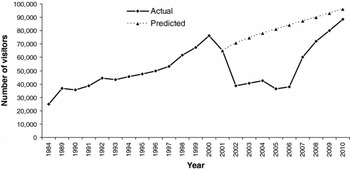
To construct an alternative scenario of what would have happened to visitor numbers had there been no insurgency, I constructed a regression model to predict annual visitor numbers using predictors such as a one-year lag in visitor numbers, a trend component (year) and two dummies representing the three time periods (more detailed information about the regression analysis is available in Appendix 1, see supplementary material at Journals.cambridge.org/ENC). Once the fitted model was found to be statistically adequate, the estimated coefficients were used to forecast visitor numbers, based on the assumptions of linearity and stability (Fig. 1).
Annual number of foreign visitors in the Annapurna Conservation Area.

RESULTS
What were the impacts of ecotourism?
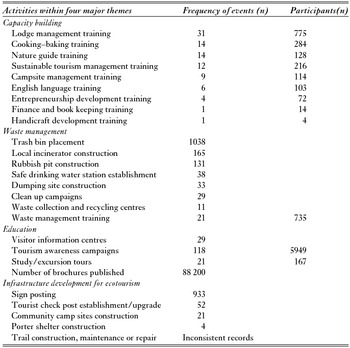
Capacity building appeared to be most prominent among the four thematic domains (Table 2) as 1710 local villagers benefited from 92 training programmes. All nine types of training seemed highly relevant for sustainable tourism management in the area, because these programmes were aimed at honing skills of local villagers to cater better services to visitors. Because most participants were hotel owners, they were more likely to use skills acquired during the training.
Activities related to ecotourism, their frequency of occurrence and the number of participants in those activities organized under the four thematic rubrics for the period between 1986 and 2007 in the ACA

Throughout the ACA, 29 visitor centres were established to provide visitors with information about nature conservation and sustainable development programmes in the area. There are now only 18 functioning centres because several of them were deserted during different time periods for various reasons. In some centres, documentary films were shown frequently to raise awareness among visitors. Upon visitors’ requests, the park staff scheduled interpretation events. The ACAP had established and managed a natural history museum in Pokhara (a major city serving as a base camp for visitors embarking on treks) centring on the rich natural heritage of the ACA. Local villagers were provided with resources and encouragement to establish eight ethnic cultural museums within the ACA. Both locals and ACAP published and distributed various brochures to promote local attractions and culture.
Within the ACA, several programmes were implemented either to reduce the amount of waste in the first place or to encourage proper waste disposal. For example, obviating the need to carry bottled water for visitors would help reduce the amount of plastic bottle waste. Guided by this reasoning, the ACAP established several safe drinking water stations at strategic locations where visitors can buy potable water at a reasonable price, operated mostly by local women's groups, the income from the sale of the water being used for local development by the groups. Another management intervention was appropriate waste disposal. At the recommendation of hotel owners, the ACAP placed trash bins along the major trekking routes to collect the waste. Also, rubbish pits and dumping sites were constructed. Locally constructed incinerators reduced the volume of combustible solid waste without recovering energy and materials. To mobilize local communities, waste management training programmes were conducted and clean-up campaigns were organized.
In terms of tourism infrastructure, the establishment of tourist checkpoints, maintenance of trails, and construction of camp sites and porter shelters were necessary for visitor services and facilities. In the 11 extant tourist checkpoints distributed throughout the ACA, records of foreign visitors were maintained in order to track them in case of emergency. Major trekking trails were constructed, repaired and maintained. Along the trails, signs were posted to guide visitors who travel on their own. The ACAP supported local communities in cash and kind to construct, operate and manage camp sites providing services to a small fraction of camping tourists. At remote treacherous places, porters accompanying visitors could not afford a decent place to sleep at night, so shelters were built to meet their lodging needs.
According to the ACAP staff, there has been no significant change in the programmes and activities since their inception. They reported that the programmes and activities needed to be adapted for the changing context. Staff had expressed some concerns regarding the inefficiency in programme implementation because of frequent changes in leadership at the centre due to political instability in the country. To consolidate past accomplishments, the Nepalese government's intention is to hand over the ACA to local communities for management by 2017.
How did the insurgency impact ecotourism?
The field research (2007–2008) indicated that the Maoist rebels destroyed ACAP's four regional headquarters and nine tourist checkpoints between May 2002 and December 2003, forcing the staff to withdraw from the area. The rebels killed three local conservation leaders (including two hotel owners) who opposed their ideology.
There was a gradual increase in visitor numbers prior to the insurgency. The number of visitors plummeted during the insurgency, but the number of visitors rebounded in the aftermath (Fig. 1). The average growth rate in annual visitor numbers during the insurgency period was negative and significantly different from the other two periods (Table 1; Kruskal-Wallis χ2 2 = 9.19, p = 0.010). With the decrease in visitor numbers, revenues generated from entry fees also declined and budgets were in deficit, which negatively impacted all nature conservation and local development activities.
In 2006 visitor surveys, 26% of respondents reported incidents of harassment or mistreatment by the Maoist rebels (n = 315). The rebels demanded money from visitors using several names including a ‘revolution fee’, ‘donation for liberation’ and ‘entry fee to the Maoists’ land’. Some visitors reported that they were terrified by the sight of rebels carrying guns, especially when they approached and asked for money, even though they reported that the rebels were polite. Some respondents mentioned that they negotiated with the rebels and did not pay any money, but the experience was unpleasant to them.
Why did ecotourism keep functioning?
Despite the ongoing insurgency, foreign visitors kept coming to the area, albeit in decreased numbers, and ecotourism remained functional. Explanations for this may lie in the perception of safety, unique attributes of the site, institutional strengthening of grassroots organizations and economic diversifications of tourism entrepreneurs.
In 2006 visitor surveys, about 71% of respondents (n = 315) reported that they were aware of the insurgency and knew about a travel advisory issued by their country, but they made the trip anyway. When asked to rate their opinions regarding the level of safety on a five-point scale, 25.0% of visitors considered ACA as ‘very safe’, 53.2% as ‘safe’, 18.8% as ‘precautious’, 2.6% as ‘unsafe’ and 0.3% as ‘very unsafe’ during the time of ongoing insurgency.
In the same survey, respondents were asked whether they would recommend their family, relatives and friends visit the area even if the insurgency continues. Of 305 respondents who answered the question, 83% reported that they would recommend a visit. Surprisingly, even 82.4% of those who reported mistreatments by the Maoist rebels replied that they would also recommend their friends and family to visit ACA (χ2 1 = 0.012, p = 0.914, n = 293).
Of 315 respondents in 2006, 38% learned about ACA by word of mouth from friends and family, and 43% reported that there was no alternative to ACA among world destinations supplying a similar ecotourism experience (n = 268). The proportion of respondents who reported a desire to revisit the area in the future was high (87.1%, n = 285).
When ACAP offices and staff were displaced, grassroots organizations, such as Tourism Management Committees (TMCs) made up of local tourism entrepreneurs, worked independently to sustain the ecotourism enterprise during the insurgency. They hold regular committee meetings, which provide a key forum for local political voice and clout, and an opportunity for policy input. The prior existence of these organizational structures was crucial for self-organization during and after the insurgency. The TMCs also formed an apex body to represent them called the Sanctuary Tourism Entrepreneurs Committee; this acted to coordinate programmes and activities, and solve pressing problems brought forth by the insurgency, thus demonstrating the emergence of an internal process of self-organization. For example, these organizations accomplished a menu standardization workshop to fix the price for food and board, taking into account the transportation costs of commodities and the standard of hotels. The ACAP had previously coordinated this programme. Such a local initiative was possible largely because the ACAP implemented all tourism-related programmes through the direct involvement of the TMCs in times of peace, which helped to build their confidence and capacities.
Of about 540 hotels and tea shops catering services to visitors, only few closed as a result of threats from the Maoist rebels. The TMCs decided that the hotels should remain operative during the insurgency even though it was challenging to cater services to visitors. Hotel owners supported the decision, despite the dwindling visitation rates, because their operating costs were minimal. Except for a few outside staff, these establishments were operated by family groups. The economic activities of most hotel owners diversified during the insurgency: they either engaged in agriculture or fell back upon their pensions for livelihoods when the tourism business became slow. When locals were asked whether there were hotel owners who solely relied on tourism for livelihoods, the response was almost always negative.
DISCUSSION
The content analysis reveals that the activities and programmes the ACAP had been carrying out largely reflected the essence of ecotourism, because they were targeted towards building local capacity, educating visitors and communities, managing waste and developing tourism infrastructure within the protected area. Local capacity building appears to be most prominent among the four thematic domains. These results support the findings of other studies that have highlighted the success of integrating environmental conservation with local development activities in the ACA (Nyaupane & Thapa Reference Nyaupane and Thapa2004; Bajracharya et al. Reference Bajracharya, Furley and Newton2005; Baral et al. Reference Baral, Stern and Heinen2007; Khadka & Nepal Reference Khadka and Nepal2010). Many ecotourism projects often fall short in making notable contributions to environmental education, environmental conservation and the empowerment of local people (Wallace & Pierce Reference Wallace and Pierce1996; Kiss Reference Kiss2004). The ACA apparently does not belong to this group, but its achievements do not imply that there is no room for improvement. While doing evaluation, the problem of counterfactual often emerges because the desired outcomes can also be caused by factors unrelated to the programme (Rossi et al. Reference Rossi, Lipsey and Freeman2004). As there is no organized tourism adjacent to the ACA, whatever tourism programmes and activities are launched within the ACA can largely be credited to the ACAP.
This study has some limitations. It was not feasible to include evaluations of nature conservation and other development activities/programmes in one paper, however their inclusion would have further corroborated the conclusions. Lack of consistent financial records and the challenges of estimating benefits precluded any measure of programme efficiency (such as benefit-cost or cost-effectiveness analyses) in this study. Future research may exploit these research avenues. While using complexity science, optimal ignorance and appropriate imprecision often invade the process of scientific inquiry (Ramalingam et al. Reference Ramalingam, Jones, Reba and Young2008). In this paper, I selected only the information needed to narrate a story (optimal ignorance) and accepted a certain level of inaccuracy in qualitative research (appropriate imprecision).
Was ecotourism resilient to the insurgency?
Ecotourism is susceptible to disturbances such as political violence, terrorism, natural disasters, climate change, economic recession and instability in visitor numbers (Bramwell & Lane Reference Bramwell and Lane2009; Novelli & Scarth Reference Novelli and Scarth2007; UNWTO [United Nations World Tourism Organization] 2009). Two major unexpected events in 2001, the Royal Palace massacre in Nepal and the 9/11 terrorist attack in the USA, also highlight the interconnectedness of the Annapurna's ecotourism enterprise with the wider world. The number of visitors declined in 2001for the first time since 1993, mainly due to these two events (Thapa Reference Thapa2003). A decline in visitor numbers after 2002 was primarily due to escalating Maoist insurgency in the area and the deteriorating security situation in the country. The number of visitors can be one quantitative indicator of the system's threshold. Although the number of visitors declined, the system did not cross the threshold to collapse or transform into another system (Folke et al. Reference Folke, Carpenter, Walker, Scheffer, Chapin and Rockström2010). The ecotourism system managed to survive and keep its identity even during the insurgency, suggesting that it was resilient to this disturbance. The later convergence of predicted and actual visitor numbers lends further support to this.
Ecotourism in Annapurna was resilient to the insurgency, mainly because visitors kept coming to the area even during the turbulent times. There could be several explanations for this. During the decade-long insurgency, no foreign visitor was kidnapped, murdered or robbed by the rebels in the ACA or within the country as a whole. This may have given a positive message about the safety of foreign visitors in the area, although visitors were aware of the ongoing insurgency and travel advice. Many visitors received information about the ACA directly from friends and family or a trusted information source, which may have helped to dispel their concerns about the security situation. This argument is also supported by a higher proportion of visitors mentioning that they would recommend that their family and friends visited the ACA. Furthermore, good infrastructure, a clean environment and tourism awareness may have helped to sustain the attractiveness of the area.
Self-organization by tourism entrepreneurs was another factor that contributed to resilience in Annapurna. When the ACAP officials withdrew from the field, there were no command and control mechanisms to dictate to the TMCs their course of action to handle the unexpected situation. In such a situation, self-organization was the only means of survival for the TMCs. Their self-organization might not be motivated by a long-term planning or management of tourism, but by a need for immediate survival against the destabilizing force of insurgency. Both diversity and innovation played a crucial role in self-organization in this case, facilitated by other factors such as strengthened capacity, diversified livelihoods, raised awareness and tourism infrastructure. Furthermore, a mechanism of earmarking the entry fee revenues to community institutions provided the finances to keep the TMCs functional and allow them to reorganize themselves, even in ACAP's absence. The programmes and activities that the ACAP had implemented to sustain ecotourism may have paid dividends in turbulent times in building the resilience. A number of empirical studies argue that the capacity for self-organization and diversified livelihoods are critical factors for building resilience in other social-ecological systems (Abel et al. Reference Abel, Cumming and Anderies2006; Holladay Reference Holladay2011; Ruiz-Ballesteros Reference Ruiz-Ballesteros2011; Biggs et al. Reference Biggs, Hall and Stoeckl2012).
What could be destabilizing forces in the near future?
All the people with whom I interacted formally or informally indicated that road access would likely soon become a major destabilizing force. The scenic landscape was once accessible only on foot, but now a network of roads connected many villages within the ACA to big cities outside. Many interviewees mentioned that problems such as deforestation, poaching and crime were likely to increase as people can now easily move in and out of the area. One conservation leader in Lete reported that local villagers had exerted an enormous amount of pressure on the local natural resources management committee to issue permits to export timber; he stated it was profitable now to export timber due to decreased transportation costs. Another conservation leader in Manang mentioned that their committee apprehended several poachers from the outside in recent times.
Another major concern was that roads had also shortened the length of the visitors’ stay in the area. All park staff and hotel owners that I interviewed agreed that foreign visitors were spending fewer days in the area, mainly due to road development. One park staff member put it this way: ‘The trekking route that took 21 days to complete in the past might take about 10 days now because a significant part of it can be covered by a vehicle’. Some local respondents even feared that a system might change from tea house trek to resort tourism in the future. Any sharp increase or decrease in visitor numbers in the future could have substantial ecological, social and economic impacts on the area.
All stakeholders emphasized the need for alternative trekking routes to provide visitors with a genuine ecotourism experience and increase their length of stay in the area. Local communities and the TMCs were taking initiatives to explore alternative trekking routes with the help of the ACAP and other concerned agencies. To this end, several feasibility studies were being conducted.
What about general resilience of ecotourism?
The ecotourism system has evolved and changed slowly since the inception of the ACA, but rapid change can be expected in the near future largely as a consequence of improved road access. Some foreboding signs include villagers’ intentions to export timber and increased incidents of illegal activities (primarily poaching). Another potential threat is that the system could transform into mass tourism as better road access promotes an increased influx of domestic and foreign tourists. Local communities are aware that roads could be a destabilizing force for the ecotourism system, and taking action to sustain the enterprise by, for example, establishing new alternative trekking routes (de Ruiter & Rai Reference de Ruiter and Rai2011). The tourism entrepreneurs crafted new institutions and took initiatives to sustain ecotourism during the turbulence of the insurgency, which indicates their willingness to steer the system in a desired direction. The slow nature of the disturbance (road access) and its far-reaching consequences mean it is too early to hypothesize how the system will respond, but there appear to be positive prospects for ecotourism because local tourism entrepreneurs possess both willingness and manipulative capacity. Information regarding the system's capacity to address broad problems will provide better insights into the system's general resilience.
CONCLUSIONS
A key issue in programme evaluation is to determine whether the outcomes enhance the capacity of the ecotourism system to adapt to the changing environment. Local capacity building, waste management, education of visitors and hosts, and tourism infrastructure development appear to have positively impacted the ecotourism system in Annapurna, and it was resilient to the Maoist insurgency. The resilience was primarily related to self-organization, diversity and innovation. Although easy access and popularity pose a threat of mass tourism, enabling the system to explore its own solutions will be crucial to address such challenges and maintain the resilience. The management goal should focus on building this resilience to endure disturbances, rather than achieving stability as such. A lesson that can be drawn from this study is that building local capacity, facilitating self-organization and diversifying livelihoods can enhance the resilience of ecotourism, sustaining stability and helping to deal with periods of sudden change or uncertainty.
ACKNOWLEDGEMENTS
I thank Ajay Pandey for providing some annual reports in digital format, and Surya Poudel for his comments. Niraj Poudyal helped in time series analysis. My special thanks to Heidi Lawrence for proofreading. The Rufford Small Grants Foundation, UK, and Sigma Xi, USA, provided grants for field research in 2007 and 2008. I am grateful to three anonymous reviewers and the Editor-in-Chief for their constructive comments.