Implications
Objective selection for calm sheep may improve animal welfare and economic performance of sheep flocks. We assessed the temperament of Uruguayan lambs (reactivity to social isolation) with a simple test – the isolation box test (IBT). This trait had a heritability of 0.18 in Corriedale lambs and 0.31 in Merino lambs; therefore, temperament (assessed by IBT) can be considered as a potential selection tool for sheep.
Introduction
Since domestication, natural and artificial selection have led to the adaptation of animals to different types of production environments. However, farmers still have to deal with low lambing rate and high lamb mortality (Simm et al., Reference Simm, Conington, Bishop, Dwyer and Pattinson1996). Artificial selection for behavioural traits in species of economic value can improve adaptation of the animals to production environments. The expression of undesirable behavioural traits in livestock has the potential to significantly compromise farm viability, animal welfare, human safety and labour efficiency (Turner et al., Reference Turner, Gibbons and Haskell2011). Fear and emotional reactivity (temperament) are behavioural elements in cattle and sheep, which are heritable and can have genetic and phenotypic associations with reproductive performance and lamb survival (Murphy, Reference Murphy1999; Reverter et al., Reference Reverter, Johnston, Ferguson, Perry, Goddard, Burrow, Oddy, Thompson and Bindon2003; Kadel et al., Reference Kadel, Johnston, Burrow, Graser and Ferguson2006; Turner et al., Reference Turner, Gibbons and Haskell2011). In sheep, multiple studies on temperament and its relationship with productive and physiological parameters have reported differences between calm and nervous sheep. Calm ewes have a higher ovulation rate in response to oestrus synchronization (Hart et al., Reference Hart, Van Lier, Viñoles, Paganoni and Blache2008), a higher twinning rate (Blache et al., Reference Blache, Hart, Chadwick, Sèbe, de St Torre, Poindrón, Nowak and Fergusson2006; Bickell et al., Reference Bickell, Durmic, Blache, Vercoe and Martin2010), more viscous colostrum with a higher concentration of immunoglobulin G and a greater proportion of lactose during the first 6 h postpartum and lower concentration of milk fat (Hart et al., Reference Hart, Chadwick, Sèbe, Poindrón, Nowak and Blache2006 and Reference Hart, Contou and Blackberry2009). Calmer Merino ewes are suggested to have better innate immune defences against infections (Ivanov et al., Reference Ivanov, Djorbineva, Sotirov and Tanchev2005). The challenge for farmers and researchers is to measure temperament with a method that can be used as a selection tool for production animals (Turner et al., Reference Turner, Gibbons and Haskell2011). Temperament should be easy to measure, should have minimum impact on animal handling and should be easy to include in routine farm practices (Turner et al., Reference Turner, Gibbons and Haskell2011). With this in mind, the University of Western Australia developed an easy test to measure temperament – the isolation box test (IBT; Blache and Ferguson, Reference Blache and Ferguson2005a and Reference Blache and Ferguson2005b).
Animal production systems differ among regions, and different sheep management and handling may have an impact on temperament (Grandin, Reference Grandin1998; Strutt, Reference Strutt2002; Goddard, Reference Goddard2008). Sheep husbandry in Uruguay in general terms occurs in small flocks (500 to 5000 ewes) in comparison with Australia, and sheep are brought to the yards more frequently as well. To explore the possibility of including temperament as a selection trait, the temperament of Uruguayan lambs was measured using the IBT. The aim of this study was to assess the temperament of Corriedale and Merino lamb populations in Uruguay and to estimate the heritability of this trait. Furthermore, we tested the effects of dam age, type of birth, lamb’s age and the contemporary group (CG; lambs belonging to the same year, flock, sex and rearing group) on temperament.
Material and methods
Animals and location
We tested the temperament of Corriedale and Merino lambs from 13 stud farms (seven Corriedale and six Merino) in Northern Uruguay. The flocks of each breed were connected by reference rams. Reference rams had progeny (with productive records) in more than one flock and/or in more than 1 year, and of which genetic evaluations among flocks were available (Genética Ovina, 2013). We used the progeny of 64 Corriedale rams (including 14 reference rams) and the progeny of 85 Merino rams (including 13 reference rams). The experimental protocol was approved by the Honorary Committee for Animal Experimentation (Comisión Honoraria de Experimentación Animal, CHEA, protocol N° 021130-006307-11), Universidad de la República.
A total of 8872 lambs were tested for temperament between one and three months post-weaning. Temperament was measured in from February to March 2011 and 2012 (progeny of 2010 and 2011, respectively). The flock details including breed and number of progeny per flock are presented as supplementary material (Supplementary Material S1 and S2). Genealogical information and information on dam age, birth type (single or twin) and lamb age were provided by the Secretariado Uruguayo de la Lana (SUL), through the SULAR-farmer module program (Uniform System of Survey and Records Storage). The lambs were kept in rearing groups formed either at the moment of birth, at weaning, at post-weaning weighing (90 and 120 days after weaning) or at shearing of the lamb. The information on rearing groups contained in the SULAR database was used to define the CG for each breed. The CGs were used to reduce variability due to management and environmental conditions. After eliminating animals with incomplete records from the database, we worked with the genealogical information of 7914 lambs (4962 Corriedale and 2952 Merino).
Temperament was measured using the IBT (Blache and Ferguson, Reference Blache and Ferguson2005a and Reference Blache and Ferguson2005b). The lamb was gently pushed inside a 1.5 m (L)×1.5 m (H)×0.75 m (W) box, and the degree of agitation was objectively measured by an ‘agitation meter’. The ‘agitation meter’ registered the vibrations of the box induced by the lamb’s movements and high-pitched vocalizations (Blache and Ferguson, Reference Blache and Ferguson2005a). The lower the agitation score, the calmer the sheep. The isolation box was calibrated with an electronic unit with the following three standard agitation settings: low, medium and high. By adjusting the sensitivity of the ‘agitation meter’ to these settings, the registration of the vibration’s intensity was comparable between tests. The intra-test coefficients of variation of the IBT were 6.47%, 7.10% and 6.34% for the low, medium and high settings, respectively. The inter-test coefficients of the IBT were 8.59%, 10.13% and 9.85% for the low, medium and high settings, respectively.
Statistical analysis
Selection of fixed effect models
Models included the fixed effects of CG, dam age (<2 years, 2 to 3 years or >3 years), type of birth (single or twin) and the lamb’s age at the time of temperament measurement. CG included the effects of year (2010 or 2011), flock, sex of the lamb and rearing group. Sex was included in the CG, as lambs were segregated according to sex, confounding sex with environment and management.
For the Corriedale analysis, we used two models that differed in the events defining the rearing group. The first Corriedale model used rearing group defined at weaning weight. The second model used rearing group defined post-weaning. For the Merino, we used a model with rearing group defined at shearing. The agitation score data were normalized using three types of transformation as follows: logarithm base 10, natural logarithm and cubic-root transformation. Each set was analysed using the SAS Systems programs (SAS 9.0V, SAS Institute Inc., Cary, NC, USA). Graphs of the residuals were drawn and tested for Normality along with the Kolmogrov–Smirnov, the Cramér-von Mises and the Anderson–Darling tests. We chose the cubic-root transformation model as the best transformation for both the Corriedale and the Merino.
Therafter, based on the AIC criterion (Burnham and Anderson, Reference Burnham and Anderson2002) for the Corriedale, we chose the group defined by post-weaning weight.
The assumed sire model was
 $$y_{{ijklm}} {\rm =}\mu {\rm {\plus}CG}_{i} {\rm {\plus}tb}_{j} {\rm {\plus}am}_{k} {\rm {\plus}}\beta {\rm la}_{{ijklm}} {\rm {\plus}}s_{{\rm 1}} {\rm {\plus}}e_{{ijklm}} ,$$
where y
ijklm
is the agitation score or its transformation (see text) of lamb m, μ the population mean, CG
i
the contemporary group (year, flock, sex and rearing group) (i: CG 1 to 42 for Corriedale and GC 1 to 30 for Merino), tb
j
the type of birth of lamb m (j: single, twin), am
k
the age of dam of lamb m (k: <2 years ewe, 2 to 3 years ewe and >3 years ewe), β the regression coefficient of the age of the lamb on temperament, la
ijklm
the lamb’s age at the time of measurement (as a covariate), s
l a random additive effect of the l
th sire with a distribution
 $s_{1} \,\sim\,N\,\left( {{\rm 0,}\,{1 \over 4}\sigma _{A}^{2} I} \right)$
, where σ
2
A
is the additive variance of temperament and I is an identity matrix of order number of sires, and e
ijklm
is the random effect of the error with independent normal distribution between the observations with variance σ
2
e
.
For a better interpretation of the data, we assessed the possibility to use the untransformed data instead of the transformed data. We calculated the correlation between sire solution (expected progeny difference) and the data with and without transformation. The correlation was 0.98, which allowed us to work with the untransformed data.
Animal model
For each breed, the heritability (h 2) of temperament and the non-genetic effects were estimated using the following animal model:
 $$y_{{ijkm}} {\rm =}\mu {\rm {\plus}GC}_{i} {\rm {\plus}tb}_{j} {\rm {\plus}am}_{k} {\rm {\plus}}\beta {\rm la}_{{ijkm}} {\rm {\plus}}a_{m} {\rm {\plus}}e_{{ijkm}} $$
The non-genetic effects used were as in the previous models, and a m is the random additive effect of the m th animal with a distribution a m ~N (0, σ 2 A A), where σ 2 A is the additive variance of temperament and A is an additive relationship matrix. Estimates were obtained with a Bayesian analysis using Gibb’s sampling (Blasco, Reference Blasco2001; Sorensen and Gianola, Reference Sorensen and Gianola2002; Blasco, Reference Blasco2005). We assigned five degrees of belief of the a priori distributions of the variance components. Data were assumed to be normally distributed. Marginal posterior distributions of all unknowns were estimated using Gibb’s sampling with the Gibbs2f90 program (Misztal et al., Reference Misztal, Tsuruta, Strabel, Auvray, Druet and Lee2002). After some exploratory analyses, we used one chain of 300 000 samples, with a burn-in period of 30 000, and samples of the parameter of interest were saved every 30 iterations. The marginal posterior distributions were estimated with 9000 samples each. The model was not full rank; therefore, different estimable linear functions of the chains of the non-genetic effects were defined (Sorensen and Gianola, Reference Sorensen and Gianola2002). We defined two estimable linear functions of parameters as follows: contrasts and least square means of the non-genetic effects (Goodnight and Harvey, Reference Goodnight and Harvey1997). Convergence was tested for each chain using the BOA program (Smith, Reference Smith2005), using the Z criterion of Geweke (Geweke, Reference Geweke1992) and graphs.
For all of the contrasts between the chains of marginal posterior distribution of each effect, the posterior mean (PM), posterior standard deviation (PSD), highest posterior density interval at 95% (HPD95%, shortest interval with 95% probability of containing the true value) and the probability of a positive difference between contrasts (P) were estimated. The non-genetic effects were considered to be different when the probability of a positive difference between contrasts was higher than 0.95 or lower than 0.05. The differences were considered to be relevant (Pr) when one group was at least 10 agitation scores higher than the other with a probability of 0.95 or higher.
Results
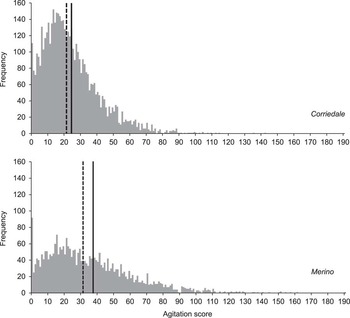
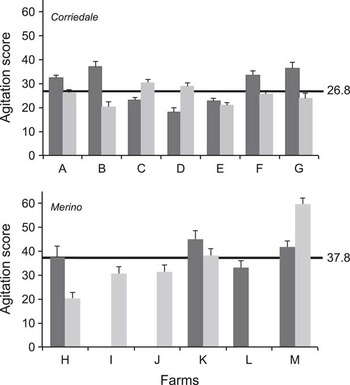
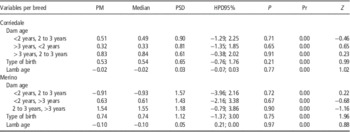
At testing time, the average age for the Corriedale lambs was 179±18 days (range: 118 to 217 days). For the Merino lambs, the average age was 171±26 days (range: 100 to 317 days). The mean agitation score (±s.e.m.) for the total population was 29.3 (±0.23), 24.7 (±0.23) for the Corriedale lambs (range: 0 to 143) and 36.8 (±0.45) for the Merino lambs (range: 0 to 190) (Figure 1). The LSM of agitation score of the different flocks and years (including only lambs with genealogical information) are presented in Figure 2. No differences in agitation scores were found between single and twin lambs, or among lambs of dams of different age (Table 1). With respect to the age of the Merino lambs, the agitation score decreased with increasing age, which was not considered relevant in the age range evaluated (Table 1).
Frequency of agitation scores for Corriedale and Merino lambs (continuous line=mean agitation score; discontinuous line=median agitation score).

Overall least square means (—) and least squares means (±posterior standard deviation) by year (2010 dark gray bar, 2011 light gray bar) of the agitation scores for the different flocks of Corriedale lambs (top panel: A to G) and Merino lambs (bottom panel: H to M).

Statistical description of the contrasts of non-genetic effects on temperament of Corriedale and Merino lambs, measured with the isolation box test

PM=posterior mean; PSD=posterior standard deviation; HPD95%=highest interval of posterior density at 95%; P=probability of a positive difference between contrasts (0.05>P>0.95); Pr=probability of relevant values (Pr>0.95 indicate relevant results); Z=Z-value of Geweke test.
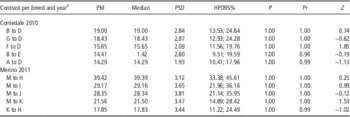
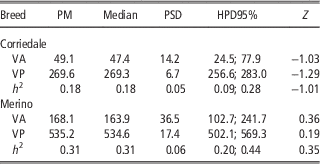
When we contrasted the CG of lambs (within the same breed) born in 2010 and in 2011, the agitation scores were different, but this was not relevant. Contrasts between CG of lambs (within farm) born in 2010 and in 2011 were only relevant in Corriedale lambs of farm B (PM: 16.63; median: 16.61; PSD: 2.81; HPD95%: 11.21 : 22.16; P: 1.00; Pr: 0.99; and Z: 0.48). In Merino sheep, differences in temperament of lambs born in 2010 and in 2011 were relevant for farm M (PM: −18.10; median: −18.10; PSD: 2.64; HPD95%: −23.30 : −12.98; P: 1.00; Pr: 1.00; and Z: −0.34) and nearly relevant for farm H (P: 1.00, Pr: 0.94). Only five out of 21 contrasts among the Corriedale farms with CG of lambs within the same year were relevant (2010), and five out of 10 contrasts among the Merino farms were relevant (2011) (Table 2), whereas no contrasts among the Corriedale farms in 2011 and the Merino farms in 2010 were relevant. The estimated heritability of temperament was moderate for both the breeds, with low values of PSD (Table 3), and the probability that temperament was a heritable trait was 100% (h 2 probability>0=1). The probability that heritability can be classified as moderate (according to the Cardellino and Rovira, Reference Cardellino and Rovira1989 criterion: low=h 2<0.15, moderate=0.15<h 2⩽0.40, high=h 2>0.40) was very high for the Merino (0.91) and somewhat lower for the Corriedale lambs (0.72).
Statistical description of relevant farm contrasts between contemporary groups of the same year for Corriedale and Merino lambs

PM=posterior mean; PSD=posterior standard deviation; HPD95%=highest interval of posterior density at 95%; P=probability of a positive difference between contrasts (0.05>P>0.95); Pr=probability of relevant values (Pr>0.95 indicate relevant results); Z=Z-value of Geweke test.
1 Only relevant farm contrast between contemporary groups of lambs of same year are shown.
Estimates of the marginal posterior distributions of the additive genetic variance (VA), phenotypic variance (VP) and heritability (h 2) of temperament of Corriedale and Merino lambs, evaluated with the isolation box test

PM=posterior mean; PSD=posterior standard deviation; HPD95%=highest interval of posterior density at 95%; Z=Z-value of Geweke test.
Discussion
The average agitation scores of the Corriedale and Merino lambs in Uruguay were below those recorded in Australian flocks using the same IBT and the same calibration (55: Poll Dorset, 63: Border Leicester, 65: Merino, 62: Poll Merino and 88: White Suffolk; Blache and Ferguson, Reference Blache and Ferguson2005a; 51 to 54: Merino and cross-bred lambs; Dodd et al., Reference Dodd, Hocking Edwards, Hazel and Pitchford2014). Although the heritability of temperament was higher for the Merino compared with the Corriedale, temperament can be classified as a behavioural trait with a moderate level of heritability for both breeds.
As observed by Blache and Ferguson (Reference Blache and Ferguson2005a and Reference Blache and Ferguson2005b), the type of birth and dam’s age at birth did not influence the temperament of the offspring. Although the value given by the IBT test for temperament changed with the age of the Merino lambs, it was not considered relevant by the Gibb’s analysis. Some studies suggest that young animals are more fearful in social isolation (Blache and Ferguson, Reference Blache and Ferguson2005a); however, in the present study, the decrease in agitation score per day of increasing age found was not statistically relevant nor biologically relevant. The interpretation of these results was difficult because it is not known whether the temperament score changes over time. For example, when the lambs get older, other factors such as puberty and handling may affect their temperament. In order to establish whether temperament stabilizes over time, repeated measurements should be taken throughout the life of the animals.
The differences in temperament on most farms within a year were not relevant. The differences that were relevant (mainly for Corriedale farms D and B in 2010 and Merino farms M and K in 2011) might indicate differences in environment and management among farms (feeding strategies, way of handling and habituation to human presence) that might have affected the lamb’s temperament, as has been suggested for calves (Hoppe et al., Reference Hoppe, Brandt, König, Erhardt and Gauly2010). Flock size, paddock size, stocking density, feed type (native or improved pasture, with or without supplementation; Del Campo, Reference Del Campo2011), frequency of handling, type of herding (use of dogs, horses, motorcycles; Grandin, Reference Grandin1998), frequency of rotation of stockpersons and number of animals handled by one person can affect temperament. Similarly, there were differences in temperament between years on farms B (Corriedale) and M (Merino), which might also be because of a change in management of the lambs, as the temperament of an animal can be influenced by handling and prior experience (Strutt, Reference Strutt2002; Del Campo, Reference Del Campo2011). Alternatively, the differences within farm might be a result of extreme weather conditions (heat) that could have reduced the reactivity of the animals at the time of measurement (Dwyer, Reference Dwyer2008). However, no information about on-farm handling or weather conditions was recorded at the time of testing. Further studies on handling and management that might influence the reactivity of sheep are required.
The moderate heritabilities of temperament estimates in the present study are consistent with heritability estimates in adult sheep (0.20, Plush et al., Reference Plush, Hebart, Brien and Hynd2011; Dodd et al., Reference Dodd, Hocking Edwards, Hazel and Pitchford2014) and of other production species, evaluated by various temperament tests (cattle: 0.26, Burrow et al., Reference Burrow, Seifert and Corbet1988; 0.22, Le Neindre et al., Reference Le Neindre, Trillat, Sapa, Ménissier, Bonnet and Chupin1995; sheep: 0.28, Boissy et al., Reference Boissy, Fisher, Bouix, Hinch and Le Neindre2005; horses: 0.23, Oki et al., Reference Oki, Kusunose, Nakaoka, Nishiura, Miyake and Sasaki2007; pigs: 0.23, Holl et al., Reference Holl, Rohrer and Brown-Brandl2010). Temperament heritabilities for different sheep breeds in Australia, using the same temperament test (IBT), were 0.14 for the Border Leicester, 0.29 for the White Suffolk and 0.38 (Blache and Ferguson, Reference Blache and Ferguson2005a) and 0.20 (Plush et al., Reference Plush, Hebart, Brien and Hynd2011; Dodd et al., Reference Dodd, Hocking Edwards, Hazel and Pitchford2014) for the Merino. Therefore, heritability values observed for Corriedale lambs (0.18) and Merino lambs (0.31) in Uruguay are within the range of heritability values reported for other sheep breeds.
Selection for less-reactive animals could be of interest to sheep breeders, as it can improve the animal welfare, the number of offspring per ewe, the immune defences of ewes, lamb survival and improve the quality of the final product (wool, milk and meat; Burrow, Reference Burrow2001; Del Campo et al., Reference Del Campo, Brito, Soares de Lima, Hernández and Montossi2010). The temperament of the Merino and Corriedale sheep in Uruguay, tested with the IBT, is a behavioural characteristic that varies among populations, and is moderately heritable. Temperament is not related to dam’s age, type of birth (single or twins) or age of the lambs. However, temperament can be affected by factors contained in the CG (year, flock, sex and rearing group). Nevertheless, for temperament to be included as a trait in selection programmes, more research on sheep temperament is necessary, in order to quantify its economic impact and to analyse its relationship with other production traits.
Acknowledgements
The authors thank the Corriedale Breeders Society and the Australian Merino Breeders Society of Uruguay, as well as the participating farms and their staff. The authors also acknowledge Dr Carolina Viñoles for helping establish the IBT in Uruguay; Drs Raúl Ponzoni, Jorge Urioste, Marcia del Campo and Gabriel Ciappesoni for their comments on the manuscript, and Alvaro Ocampo, Felipe Robaina and Omar Sena for their help with data collection. Noelia Zambra received a National Postgraduate Scholarship of the National Agency for Research and Innovation (ANII) (POS_NAC2011_1_3501).
Supplementary material
To view supplementary material for this article, please visit http://dx.doi.org/10.1017/S1751731114002833