Introduction
Various recent theoretical currents in International RelationsFootnote 1 have argued that global politics are constituted through actors beyond the human and that the current disciplinary parochialism impedes fully engaging the multiplicity now evident in the field.Footnote 2 Despite the push for a more global/globalised IR,Footnote 3 it has become clear that IR cannot include these voices without also diversifying the existential premises that inform its tools for translating across dynamically co-constituted worlds.Footnote 4 The issue here is that the discipline's common uses of ontology emerge from, reflect and replicate an ontological register that treats separation as the fundamental condition of existence, while rendering interconnection secondary or largely derivative.Footnote 5
While generally separation and interconnection both represent potential ways of understanding and describing the world, here they are specifically used to address a moment prior to the formal conceptualisation of ontology in which assumptions are made about the conditions of existence that subsequently inform our explicit ontological premises.Footnote 6 Though interconnection is very much present in our systems of thought, the reigning embrace of separation as the primordial condition of existence indelibly marks any approach that locates relations posterior to that initial existential engagement by necessarily curtailing the possible degree of relational understanding and action. Relational approaches that emerge through a register defined by separation are thus unequipped to grasp fully the implications of lifeways that start with interconnection as the primordial condition of existence.
Today we find ourselves facing challenging and accelerating planetary crises and pandemics in a pluriversal time-spacescape simultaneously shared by those who engage life with an interconnection-based ontological register. Confronting complexity requires a more diverse existential toolbox replete with nuanced, nimble tools. This may be achieved through synergistic exchanges with lifeways built off of a deep existential commitment to interconnection.Footnote 7 Nevertheless robustly relational lifeways of ‘being-feeling-knowing-doing’Footnote 8 – when perceived through a singularly separation-based ontological register – are continually interpreted and treated as objects of study because they do not figure coherently with this register.Footnote 9 Yet pluriversal encounters between lifeways built off of distinct existential commitments, where all are seen as necessary and key interlocutors, are ‘absolutely critical to our survival, where “our” includes more-than-human realms’.Footnote 10
To recognise and deal effectively with ontological pluralism, our use and understanding of ontology must be recrafted.Footnote 11 More than the study of being, recrafting ontology to permit plural registers with distinct existential points of departure would allow us to examine the intimate link between the assumptions that we make about the conditions of existence and how we engage and therefore participate in co-creating existence. Discerning this connection would improve our chances at interacting effectively and correspondingly in said pluriversal encounters and therefore grasp more fully the implications of the presented contrasts. This experience would in turn prod us to develop ontological agility, or a knowing of how and when to use distinct registers during ontological translation. Very different from an inclusion-based project that seeks to add voices to the pot, the goal of this proposal is to engage across and through pluriversal worlds in meaningful ways.Footnote 12
To lay the groundwork then, we first need to see how our current understanding of ontology actively disallows a fuller comprehension of existential possibilities. When we begin to perceive that which is being actively truncated from our current ontological purview characterised by a singular register, we can realise the value that these previously unacknowledged contrasts hold for understanding today's planetary crises. The value, though, is not in one or the other approach, where one option would be ‘better’ or ‘more right’ than the other, but in their interaction with interlocutors capable of ontologically translating ideas without ‘inadvertently’ demanding their reduction.Footnote 13
Towards this end, the first section of this article indicates the pervasive use of a register of separation in the discipline before pointing to the fissures that this prior commitment to separation spawns in IR's predominant relational currents including poststructuralism, constructivism, and new materialism. The second section pluralises ontology to include registers based on both separation and interconnection as potential primordial conditions of existence. With multiple registers, the robustly relational aspects systematically rendered invisible through a singular, truncated register now (re)appear. The key conceptual tools developed here provide the opportunity in the third section to revisit the fissures identified in the first and to examine how a commitment to separation enforces ontological reductionism, exclusion and domination, thereby hindering any attempt to engage a ‘world multiple’.Footnote 14
Before proceeding, a few clarifications beckon. First, the argument has been inspired through my daily interactions in the Andes for over 15 years. The concepts applied here were developed to make sense of the stark differences between my own ontological-cultural programming and other ways of knowing exemplified in Andean cosmovivencias shared with me through these interactions – sometimes with people and beings very dedicated to them, at other times with those who openly expressed disdain for them.Footnote 15 The great lesson from these interactions was that we need the Other to recognise both other ways of being/knowing in the world and the ontological architecture that edifies our own. I thank all of the beings that have brought me to the understandings introduced here.
Second, I recognise that taking us further into the realm of ‘leaps of faith’ is uncomfortable in a discipline whose craft masters seek to demonstrate that International Relations is a legitimate social science. It seems, however, that we cannot expand our existential options for facing today's complexity without opening ourselves up to these questions. Even though no particular first-moment ontological commitment is the ‘correct’ one since ‘matters of philosophical ontology … can really never be settled definitively’, these fundamental existential assumptions shape in a very direct way how we exist and therefore the kinds of worlds that we co-create.Footnote 16
Third, by insisting on adopting and recrafting the term ‘ontology’ I realise that I am running the risk of having lifeways that emerge through a commitment to robust relationality (indigenous and otherwise) be ‘shoehorn[ed] into a European register/s’ as Morgan Brigg, Mary Graham, and Martin Weber suggest in this Special Issue.Footnote 17 While I yearn to find a term that is not ontology, the forms of exclusion created by prejudices reproduced at the ontological level within academia itself are my immediate concern here.Footnote 18 Moreover, since ‘nothing is more political than the claim of existence’ as Querejazu also observes in this Special Issue, I am politically calling out how discussions about ontology have been invested in such a way that other fundamental existential commitments do not even appear on the register as legitimate possibilities and that those approaches most likely to be empathetic with these other voices are ontologically ‘strapped’.Footnote 19 Until we see how a reductionist account of ontology is keeping our theoretical innovative capacity ‘shored up’, we're not going to get very far in terms of a pluriversal, conscientious tinkuy, or encounter between complementary-opposite tendencies, a process of sitting in and learning from the tensions generated through a contrast between distinct fundamental existential assumptions.Footnote 20
Separation's dominance in the discipline: Cracks, cracks everywhere
The discipline, including its central relational currents, collectively privileges separation as the primordial condition of existence. That is, we have been taught an understanding of ontology that takes the ‘distinguishability’ among stuff to indicate a basic condition of existential autonomy that requires treating perceived boundaries based on difference as real.Footnote 21 While generally unremarked, this collectively held existential commitment provides a shared consistency that is fundamental to defining IR as a particular craft.Footnote 22 As Ludwig Wittgenstein notes, as a premise of our IR language-games: ‘People don't come to blows over it; … That is part of the framework on which the working of our language is based.’Footnote 23 This lesson similarly applies to the fundamental existential assumptions that precede both language and culture in that they generate a consistent resonance between our learned existential commitments and the way the world seems to be.Footnote 24
We can see this in how ontology is commonly treated in the discipline as dealing with matters of what is in the world.Footnote 25 To be in a position to ask ‘what’ questions, one already has to assume that the world is made up of identifiable objects or categories. Patrick T. Jackson, in his monumental effort to open the scientific endeavour of IR to a plurality of approaches including more relational currents, shows how this approach to ontology takes separation for granted prior to explicit ontological commitments.Footnote 26 Employing Heikki Patomäki and Colin Wight's distinction between philosophical and scientific ontology, Jackson links the ‘What is in the world?’ question to the realm of scientific ontology, where we would expect to see
a catalog of objects, processes, and factors that a given line of scientific research expects to exist or has evidence for the existence of: ontology as bestiary, so to speak, concerned with what exists, or with the general principles on which such existence might be determined.Footnote 27
He adds a prior question, ‘What is the nature of my hook-up to the world?’, to correspond to philosophical ontology referring to the realm of the ‘most abstract constitutive potentials of social life’.Footnote 28
Asking this question allows Jackson to propose two ontological wagers that are selected in this logically prior ontological realm and that generate very different types of knowledge. The first, mind-world monism, directly challenges the knowledge produced within a scientific ontological approach based on mind-world dualism. Fomenting greater explicit discussion of philosophical ontology and a more pluralist understanding of philosophical ontologies allowed IR scholars who did not practice neopositivism to move beyond academic debates over which things may really exist and according to what parameters and to launch discussions about relations as process.Footnote 29 By showing how a given philosophical ontological orientation corresponds to a particular range of methodological prescriptions and kinds of knowledges (and not others), he could argue that scientific inquiry should be redefined in terms of its goals and not limited to one particular method.Footnote 30 With this manoeuvre, Jackson bravely forged a place for methodological pluralism in the scientific endeavour of IR, giving even more radical relational scholars a chance to be deemed legitimate in the discipline.
While many scholars, myself included, enjoyed the extra breathing room, it is curious to note how this gesture, in the domain of the question of ontology itself, still harbours a commitment to separation as the primordial condition of existence. The wagers themselves, ‘mind-world dualism’ and ‘mind-world monism’, are articulated in terms of mind in relation to the world, revealing a prior assumption of separability: that between the mind and all else related to the mind, such as the physical body, emotions, and sensing channels. It also reinforces a divide between humans possessed of ‘mind’ and the rest of ‘mindless’ existence. While it may allow us to arrive at intersubjective understandings of how humans interact as seen in linguistic-turn-based relational currents, the emphasis on mind still undergirds separating this species from other beings found in the cosmos. Here is the first of many examples in this article that illustrate just how pervasive and unnoticed the monopolised ontological register is and its curtailing impact on our ability to appreciate the fruits of lifeways whose primordial ontological commitments are not subsumed to separation.
To engage ontological complexity, we might be better served with the concept, ‘ontological moments’, or distinct time-place points at which deeper questions of an ontological nature are asked-answered (with or without the awareness of the person applying the lens). Instead of leading us necessarily to linear or binary logics, the concept allows for a more configurational understanding of how existential commitments are made at distinct moments, whereby the whole configuration, not just a singular moment, delimits the corresponding field of imaginable possibilities. Through ontological configurations we can begin to address the relative degrees and kinds of relationality and separation found across intellectual currents, as in the weaker relational expressions of constructivism that still hold onto various prior commitments to separation, or in the more complex architecture of the new materialisms reviewed below.
In contrast to a more poststructuralist reading of relationality that undergirds Jackson's argument cited above, constructivists developed a distinctive ontological configuration. While faithful to the implications of the linguistic turn's more relational claims, mainstream ‘weak’ constructivists have opted for a more ‘modernist’ epistemology to demonstrate that they are ‘scientific enough’.Footnote 31 Placing their epistemological bets on a stronger, prior supposition of separation – that of an objective reality sitting outside the intersubjective domain – allowed constructivism to become a ‘third paradigm’ of IR, enabling, despite its limits, an increased sensitivity to relational notions like co-constitution, identity, and norms in the discipline.Footnote 32 Most poststructuralists suggest, however, that this constructivist move privileges certain types of relations that constitute agents/structures in a way that leaves an assumed categorical division of existence intact.Footnote 33
One unforeseen consequence of the linguistic turn's drive to humble truth claims in the social sciences by erasing the subject-object divide was the simultaneous bolstering of another fissure: that between humans and all else through human language. The gaping wound and repercussions of anthropocentrism soon became the point of contention for a new generation of materialists.Footnote 34 While embracing the very relational metaphor of the network and acknowledging the generative impact of human discourse, the new materialists refused the idea that all things material are subject to human will. They do so in order to recognise the agency of material things. To suture the wound, they ‘displace human privilege’ by abolishing the hierarchy between humans and all else.Footnote 35 Quickly they set to ‘troubling dichotomies’, unsettling boundaries, and revolutionising objectivities to theorise the agency of (vibrant) matter.Footnote 36 As a result, a unique ontological anatomy has emerged: both material and ideational worlds have become inescapably entangled and detached with human and nonhuman actants enmeshed in lively intra-actions. Though now much harder to detect, certain key fissures still linger here.
One particular partition that is still constitutive in very important ways – despite Bruno Latour's acknowledgment of its constructed nature – is that between science and religion.Footnote 37 Jane Bennett's engagement with the debate on life and mattering is particularly illustrative. To avoid any association with fundamentalist Christian understandings of vitalism, she is extraordinarily careful to reproduce Hans Driesch's distinction between naïve and critical/modern versions.Footnote 38 In theorising vitality, Bennett sees her (and Driesch's) struggle as one of making ‘the life-matter relationship as close as it can possibly be without going all the way over to a (mechanistic) materialism and without implying a metaphysics of “soul”’.Footnote 39 She admires Driesch's strategy to ‘yoke’ the ‘vital principle to experiential activities in the lab’, because it ‘ward[s] off the temptation within vitalism to spiritualize the vital agent’.Footnote 40 While this position moves us well beyond an anthropocentric focus to encompass vibrant matter, it obliges us – if we want to discuss that vibrancy – to stick to a science lab and to a ‘materialism [that] eschews the life-matter binary and does not believe in God or spiritual forces’.Footnote 41 This prohibition is not unique to the new materialisms. It is also central to the ontological architecture of strategies stemming from the linguistic turn, as witnessed in early Wittgenstein's famous admonition: ‘Whereof one may not speak, thereof one must be silent.’Footnote 42
The purpose of this section has been to show that the common use of ontology in the discipline is based on a fundamental existential commitment to separation, that relational approaches in IR retain certain fissures, and that distinct cuts at different moments generate and reflect different ontological configurations. To understand how these persistent fissures affect both relational approaches in IR and our ability to ‘encounter’ other robustly relational forms of knowing/being, the next section develops pertinent conceptual tools.
Pluralising the ontological register
In The Microbial State, Stefanie Fishel crucially addresses the transformative power of metaphors through what she calls ‘metaphorogenesis’.Footnote 43 Her attentiveness to the generative dimension of our use of language and metaphor in particular is common to the relational approaches reviewed here. Beyond their generative character, however, the deployment of a metaphor both reflects and reproduces an ontological architecture that directly shapes a particular way of participating in co-creation. That is, metaphors come with an ontological imprint, or a particular range of existential commitments, that allow them to even be recognised and function as metaphors (despite polysemy).Footnote 44 Earlier this idea was alluded to with the term ‘cosmovivencia’, or ‘cosmic living’, where our forms of being, doing, and sensing are an integral part of cosmic co-creative process. Elsewhere in this Special Issue, Querejazu talks of ‘cosmopraxis’ to describe this emergent process of ‘worlding’.
The main point is that making fundamental assumptions about existence, be it separation, interconnection, or otherwise, gives form to how we channel our vital life force; it shapes how we ‘world’ and what we co-generate. The fruits borne through ‘practicing existence’, such as forms of engaging, concepts, languages, ways of life, objects, and phenomena, then bear the mark of collectively applied sets of assumptions.Footnote 45 Because these by-products reflect the corresponding embraced image, cosmopraxis, like the rules of a language game, gets ‘naturalised’ through the shared fruits. Moreover, because the co-generated fruits are consonant with the ontological configuration with which we begin, they reinforce applying the same image. In short, each ontological configuration affords a particular range of ways of perceiving, filtering, engaging, and strategising (and not others), and as such generates a limited field of imaginable possibilities.
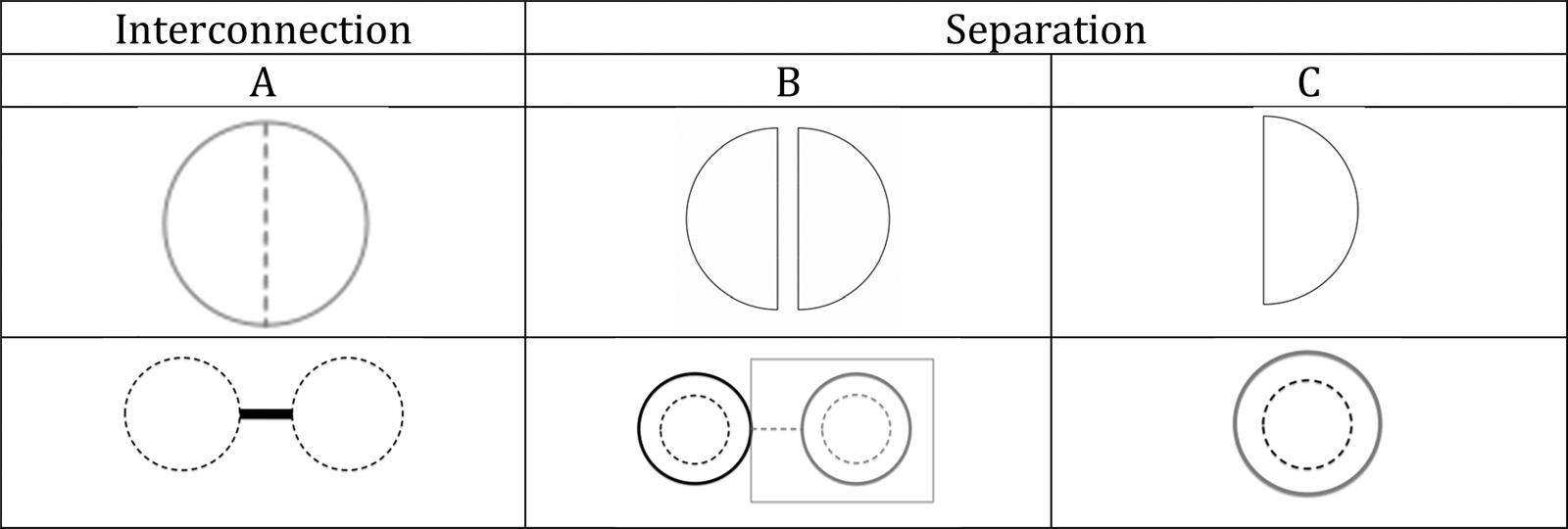
Below is a graphic portrayal of an ideal-typical and very rudimentary model of ontological images to show how existential assumptions mold the co-creative process. The purpose of the model is to contrast first-moment existential claims so that we can start to conceptualise how each shapes what can be afforded in that and subsequent ontological moments in very different ways. The contrast is critical for identifying below how the separation-based elements of each relational approach's ontological architecture allow certain aspects of relational thinking and being and disallow others. Each image remains faithful to and fractally shapes the range of possibilities afforded by the privileged fundamental existential assumption.Footnote 46 We both perceive and ‘world’ through this geometric co-creative architecture. The filters are not just visual, but very much sensual, cognitive and multidimensional.
Figure 1 presents possible images for each first-moment assumption in question. The images below illustrate the indelible impact that embracing separation in the first moment can have on a primarily relational ontological configuration that emerges posterior to this first assumption.
Primordial assumptions and corresponding images.

The lower picture in the third column represents the most typically applied ontological image for separation. When privileging separation in the first moment, every ‘thing’ is treated as an existentially autonomous unit. In this case, the unit or category, such as treaty, conflict, or citizen, has the status of being ontologically independent from all other imaginable substantives, which encourages the user to conceive of categories in an ‘embodied’ (or ‘in-corp-orated’) sense in contrast to the ‘energetic’ or ‘principled’ nature of the relational components above.
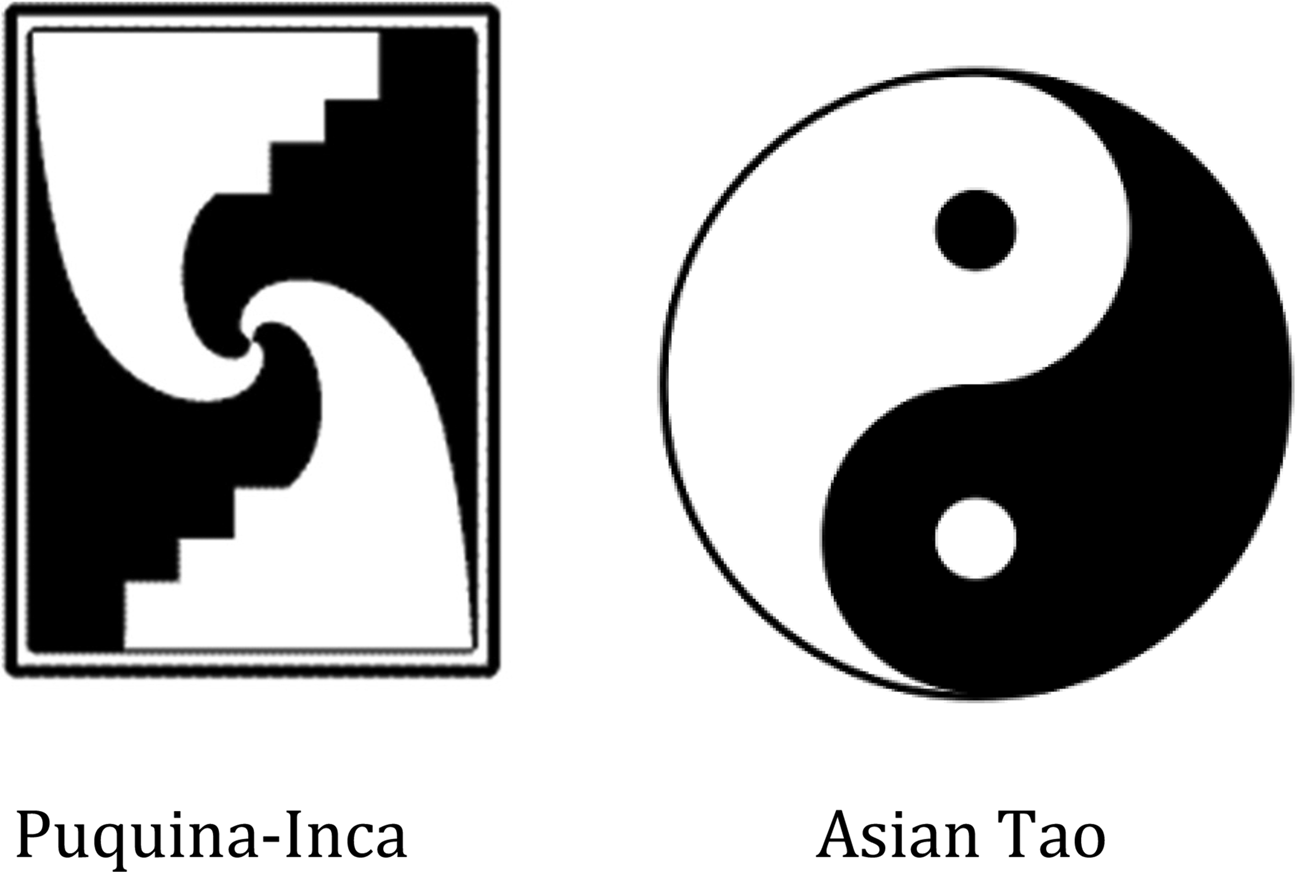
The ontological images corresponding to the assumption of interconnection as the primordial condition of existence in (A) in contrast show one ‘whole’ consisting of the relation that tethers two complementary-opposite components, such as up/down, left/right, feminine/masculine.Footnote 47 The lower picture of (A) highlights the primacy of the relation through the solid black line that interconnects two perforated circles or components. The perforated aspect highlights their interpenetrating, emergent character, wholly contingent upon the constantly dynamic nature of the relation they share. Furthermore, the dotted line in the top image shows the permeated and permeable nature of these components, whereby part of one impulse can be found within the other and vice versa. This particular image leads us to pay attention to that which is permeable or ‘disincorporated’. While the two-in-one basic building block serves to highlight what privileging interconnection as the primordial assumption implies, the reductionist nature of the model fails to capture how each component is deeply and fractally embedded in all relations on a cosmic scale.Footnote 48 The symbols in Figure 2 begin to convey the complexity:
Fruits of robust relationality: Iconographic representations of the four elements in a parity-based relation.
Source: Javier Lajo, Qhapaq Ñan: La ruta Inka de la sabiduría (Quito, Ecuador: Abya-Yala, 2003), p. 98.

Each image in Figure 2 depicts four elements, which represent two relations of proportionalities between two pairs such that any encounter between beings is also an encounter between their relative distribution of not necessarily ‘in-corp-orated’ elements.Footnote 49
Both elements, separation and interconnection, are present in each primordial ontological commitment. It is the order in which the elements appear ontologically that affects how we register existence. Privileging interconnection puts primary attention on the relation (even the one between interconnection and separation) as signalled by the solid black line in the bottom image of (A). The distinguished components it tethers are ontologically secondary such that their current presentation is actually the emergent, fleeting result of relation. For separation the order of ontological appearance is best illustrated under (B). When separation is privileged, the relation between existentially autonomous objects is secondary to the categories themselves. This makes all relationships contingent, and this contingency becomes the focus of social science.
The relative ordering of the elements, according to the first-moment assumption, also fundamentally shapes the corresponding logic on which distinct forms of cosmopraxis are based. To embrace interconnection as the primordial condition of existence illustrated in (A) ontologically removes the option of not taking the wholly interconnected other into consideration and privileges a both-and logic.Footnote 50 In contrast, images (B) and (C) above suggest that considering the other is at maximum optional. Because the object's assumed ontological autonomy renders it devoid of any primordial justification for its existence, arbitrary yet socially shared and enforced teleological measuring sticks have been devised to guide separation-based cosmopraxis. They are conceptual arrows that extend from an imagined inferior state, such as barbarism, falsehood, or underdevelopment, to an opposite superior one like civilisation, truth, and development.Footnote 51 This better-worse scheme, in conjunction with the either-or logic that corresponds to image (C), beckon us to aspire to the superior element and eliminate the less desired one. In the postcolonial context Yves Guillemot has referred to this manoeuvre as the ‘vampire's mirror’: When the reflection in the mirror does not correspond to the colonising onlooker's image, he seeks to destroy the difference.Footnote 52 Because the complementary opposites are not interconnected at the primordial moment, the option to eradicate or submit is not only made available but is mandatory in a ‘yes-saying world’.Footnote 53 As such, any relational approach that emerges from such a first-moment commitment is strongly circumscribed by this initial impulse.
The contrasting effects of the order of ontological appearance based on first-moment commitments can be examined through the notions of peace and conflict each affords. When each state is treated as ontologically autonomous, it is possible to imagine a world ‘free’ of conflict. It is a matter of choosing either peace or conflict, which are separable conditions. However, image (A) makes it existentially impossible to do away with what might be a less desired complementary-opposite state. Since both peace and conflict are always ontologically existent, this both-and logic would emphasise a strategy that ‘proportionalises’ or moderates the tensions between complementary opposites.Footnote 54
The distinct orders of ontological appearance beg other clarifications. First, the fruits of each first-moment assumption are not commensurate, because the geometric basis of their ontological anatomy do not coincide. Thus, I am careful to distinguish between an existentially autonomous category or unit and the ontologically interdependent components of relation as the contrasting fruits begotten through other primordial suppositions. This approach stands in contrast to the indiscriminate use of relata to address that which is connected through relation for both first-moment commitments.Footnote 55 The latter approach leads us to believe that when we switch primordial ontological assumptions, we simply swap relata (objects) for relations as if they were categorically fungible.Footnote 56
Let's further contrast binaries to illustrate my point: black/white, inside/outside, separation/interconnection, conflict/peace. Their ontological status, and therefore their very nature, change depending on the applied filter. When read through a separation-based lens, each element of these pairs is ontologically autonomous, meaning the relationship is secondary to their existential independence, and they are thus treated hierarchically. Through a robustly relational lens based on an Andean philosophical perspective, however, these are parity-based relations, whereby the friction generated between the complementary opposites is the very source of the vibration that animates life.Footnote 57
When critical scholars decry the use of these binaries, they actually demonstrate that they – just like those who attempt to dominate or eliminate the undesired element of the pair – are using a separation-based lens to understand them. Categorical critiques of binary thinking cannot see how, through a robustly relational approach, these complementary-opposite pairs can represent a logic that fosters neither domination nor extermination of the different other but instead an appreciation for the contrast provided through the complementary opposites. This is very telling of the degree to which separation is still taken for granted as the fundamental existential condition even in critical theory.
While written on paper the same way (up-down), it is simply not possible to swap the fruit of one field of imaginable possibilities built on an embrace of interconnection as the primordial condition of existence with a fruit from a separation-based field of imaginable possibilities. Depending on the first-moment assumption, these complementary opposites involve very different mechanisms, foci and purposes such that no commensurate correspondence exists. Viveiros de Castro calls the conflicting translations that necessarily present in an encounter between ontologically contrasting lifeways, ‘equivocations’, or ‘the limiting condition of every social relation, a condition that itself becomes superobjectified in the extreme case of so-called interethnic or intercultural relations, where the language games diverge maximally’.Footnote 58 It is important to note that like the case of the generic use of relata above, the conceptual possibility of swapping only becomes available from a reductionist vantage point – the fruit of addressing ontology in a way that already takes for granted the monopolised position of separation in the first ontological moment. To preclude assuming an imposing ‘univocality – the essential similarity – between what the Other and We are saying’, Viveiros de Castro suggests that when we translate, we should ‘presume that an equivocation always exists’ and ‘communicate by differences, instead of silencing the Other’.Footnote 59
Inspired by arthropods who perceive through ‘multiple overlapping, though not exactly identical, images at once’, Suzana Sawyer proffers the tool of ‘fractal optics’ to engage this difference.Footnote 60 One effective illustration is found in this Special Issue, where Jarrad Reddekop first establishes how the Amazonian Quichua ‘runa’ and its translation ‘equivalent’ of ‘human’ are hardly commensurate and then addresses the implications of a more robust conceptualisation like runa for political theory. In another instance, Mario Blaser reviews the cosmopolitics between the colonial settler community, government officials, biologists and conservationists, and the Innu people in the Canadian province of Newfoundland and Labrador regarding the declining population of a distinct species called ‘caribou’ by the first group and the ‘atiku’, a being to which people are intimately interconnected by the second.Footnote 61 Both studies urge a multidimensional contemplation of cosmopolitical landscapes.
Translating with and through difference requires understanding that distinct commitments regarding the primordial condition of existence generate geometrically incommensurate counterparts. Logics, lifeways, sensing apparatuses, purpose of life are mobilised in very different ways and these always have an impact on resulting co-creations. If we were to allow ourselves to acknowledge pluralism in the first ontological moment, then we could recognise how the fruit-bearing apparatus of cocreation changes with the irreconcilably distinct logic of robust relationality. We could then develop translation tools in a more concerted manner that already take into consideration the impact of the supposed primordial condition of existence on the afforded field of imaginable possibilities. This is why recrafting our truncated understanding of ontology is so crucial.
A second clarification on the distinct orders of ontological appearance regards language as the fruit of anchored intra-actions in a given time-space among those sharing certain fundamental existential commitments. The term ‘ontology’ is one of those fruits. It can be used as a count or non-count noun. While nouns themselves tend to be more substantialist in nature than verbs, count nouns in particular reflect and reinforce assuming ontological independence, as reflected in Image (C) above.Footnote 62 Employing ‘ontology’ as a count noun limits the range of afforded connotations to separation-based ideas, such that ‘ontologies’ signals an ordinal set of what would singularly be ‘an’ ontology. The ease with which we move from ‘ontology’ to ‘ontologies’ signals a reification: ‘ontologies’ are conjured as distinct possible catalogues of contested and contestable sets of objects.Footnote 63 It is an understanding of ontology that arises at a moment posterior to assuming separation as the primordial condition of existence. When the term ontology itself disallows acknowledging other possible, equally legitimate existential options at an earlier juncture, we deny ourselves the fuller range of conceptual fruits that accompany the possibility of more than one first-moment commitment. Using ‘ontology’ as a non-count noun in the singular without an article gives us the breadth necessary for talking about how distinct fundamental existential assumptions are generative of different fields of imaginable possibilities. To recognise the rich contrasts provided through a plural ontological register so important for engaging the field of IR in more complex, nuanced ways, I suggest avoiding ‘ontologies’ and instead using terms like ontological commitments, ontological orientations, and existential assumptions to discuss distinct strategies for engaging existence. I also use relational expressions, degrees of relational commitments and relational approaches instead of ‘relationalities’.
Reductionism, exclusion, and domination: The fruits of ontological homogeneity in the first moment
Insisting on separation as the only possible primordial condition of existence foments reductionism, exclusion, and domination due to the indelible imprint this commitment leaves on the geometric co-creative architecture described above. These forms of violence have critical implications for relational theorising in IR and especially for developing more complex tools required for engaging today's complexity. This section returns to the fissures highlighted in the first to contemplate the consequences of continuing to utilise a monopolised ontological register.
Image (A) in Figure 1 depicts images that become available when the most prior ontological commitment is to interconnection. When the general understanding of ontology starts only posterior to a primordial commitment to separation, then any reading or translation of (A) will come through the reductionist filters of (B) or (C). For relational theoretical approaches in the discipline then, a truncated ontological register means that any proposed relational concept must sufficiently comply with separation in the first moment so as to be recognised by others in the craft. However, adhering to separation in the first moment paradoxically means that their fruits will bear the stamp of separation and its concomitant forms of reductionism, exclusion, and domination.
We can see this in Jackson's effort to make science inclusive of other methodological currents in IR. First, because the distinction between philosophical and scientific ontology is made to discuss appropriate forms of scientific knowledge production, philosophical ontology still remains subservient to the purposes of scientific ontology even though it is treated as if ‘logically prior’.Footnote 64 Second, the framing of his argument affirms that choosing separation in the first moment is the only way to legitimately produce knowledge for the scientific enterprise. In addition to having to make an initial nod to separation as the primordial condition of existence, this posture requires that relational theoretical discussions explain themselves in reference to separation-based understandings of ontology.Footnote 65 This is not only an incommensurate venture, but one that will always result in limited understandings in scope and depth of the implications of relational theory. Furthermore, because relational expressions are always secondary to separation in this scheme, these theories will be pressured to conform.
McCourt's entreaty that relationalism and practice theory be subsumed to the ‘new constructivism’ attests to this pressure.Footnote 66 While McCourt himself acknowledges the complications associated with fostering a catalogue of relational categories through the ‘fractal distinction’ of constructivism, he still argues for putting them all under one ‘new constructivist’ umbrella to strengthen relational theory's position in the discipline. He does so recognising that this means disallowing the central wager embraced by more radical poststructuralists to overcome the violence of power-laden truth claims, a product of the Cartesian subject-object distinction.Footnote 67 The radical poststructuralists’ reluctance to accept this appellation foreshadows how more robust forms of relationality might feel about the terms of engagement of a pluriversal encounter based on ontological reductionism – even when their influence on world politics is readily acknowledged. (Self-)enforcing a reductionist approach unnecessarily hamstrings relational approaches in IR: when the bottom images of (B) and (C) in Figure 1 are the only ones legitimately available in the first moment, it is difficult for them to recognise how they themselves reinforce separation's first-moment dominance.
Also effecting various forms of reductionism, exclusion, and domination is the ‘silenced’ fissure between the secular and the divine common to both linguistic-turn and new materialist approaches mentioned above. Specifically, it inhibits being in a place to hear, listen to, and learn from lifeways that do not start from the same fundamental existential assumption, because using the term ‘secular’ to avoid dealing with the metaphysical, for example, actually reinforces the presence of the Judeo-Christian tradition. Georgio Shani pertinently notes that ‘the categories of the religious and the secular emerge from within the Judeo-Christian tradition and cannot be understood without reference to it.’Footnote 68 Furthermore, the reductionism inherent in the lens that leads us to hierarchically distinguish between secular and nonsecular leaves intact and reaffirms the ontological architecture common to both Christian and post-Christian traditions. As such, it simultaneously rejects contemplating religions with other ontological configurations, whose import and impact on worlding practices are critical to understand in a discipline like IR.Footnote 69
The teleological measuring stick extending from ‘non-secular’ up to ‘secular’, furthermore, encourages subduing the less desired category. Efforts to do so can be very subtle but still have lasting effects. For example, in the new materialist literature that addresses religion directly, the gaze still moves from ‘scientist’ to ‘professor of the faith’ and not the other way around. Here too methods from this approach focus on defining the ‘immaterial’ dimension in ‘material’ terms. One study in Catherine Keller and Mary-Jane Rubenstein's extremely thought-provoking compilation examines the Light of the World Church in terms of its formation, spread, and impact on material reality.Footnote 70 Treated as a global multi-agentic process of entanglement, Manuel Vásquez conducts an actor-network analysis of the church and its constituents, effectively transforming (material) religious practices into ‘objects’ of study all the while effectively avoiding dealing directly with the religion's immaterial dimensions.
This domination scheme persists in postcolonial contexts like the Andes, where othering is transmuted into the acceptance and affirmation of the dominance of the very framework that enacts it. In this context, millennial cosmic principles are reread, understood, and translated through separation-based reductionist filters. Once stripped of their robustly relational character, the assumption of correspondence can ensue. Since this correspondence apparently lends validity to the concept itself (in a predominantly separation-based context), it is normalised, and the reductionist interpretation is reproduced and reassimilated into the original language whence the concept comes.Footnote 71 We can see how the first half of this process occurs in a Bolivian volume on ‘development and the sacred’, where Denise Arnold draws a parallel, through a new materialist frame, between vitality in the sense that Bennett uses it and camay, the principle of vital life force in Andean philosophy.Footnote 72 This connection is particularly curious in that camay, the vibration generated through the parity-based relations between complementary opposites discussed above, would provide an acceptable (Judeo-Christian-God-less) alternative for critical/modern vitalism, yet it emerges through an ‘animist tradition’, a category that Bennett herself expels as naïve vitalism.Footnote 73
Even though Arnold is careful to reference the new light through which animism is being considered in anthropology, her contemplation of camay as a corresponding variation of the vitalism to which Bennett and Driesch make reference nourishes the chuchaki colonial, or colonial hangover, in several ways.Footnote 74 She hooks the fruit of a robustly relational ‘animist’ tradition up to a position that enforces severing naïve vitalism from the ‘critical/modernist’ one, which simply reinvokes the ‘ghosts’ of colonising discourses. Furthermore, when this principle – or any other robustly relational concept – is highlighted for the purpose of being worked through a theoretical frame whose ontological register disavows a primordial commitment to interconnection, the nuance with which we can address its relational dimensions is direly diminished. The terms of engagement are no longer ontologically nimble enough to convey either the very complex and robust character of this notion or the profound implications it represents. In addition, the forms of separation to which the discussion adheres prevents us from seeing how drawing the parallel in this way simultaneously affirms and further reinforces the legitimacy of ways of knowing/being that derive from a primordial commitment to separation and rejects the possible candidacy of those that start with interconnection as learning objectives, relegating them instead to the status of objects of study.Footnote 75 Why is it so important to establish correspondence to already established ‘valid’ (separation-based) forms of knowing/being in order to justify the relevance of Andean philosophy? Why is it that we do not first foster the agility necessary for engaging a plural ontological register so that we can grasp its implications through the primordial existential commitments through which it was borne?
A sketch of a more robust understanding of camay illustrates the rich contrasts and lessons that could become available when we employ a plural ontological register and knowingly apply the corresponding primordial ontological commitment. Camay as vital life force, as vibration that animates all life, relies on the friction generated through the dynamic encounter between complementary opposites.Footnote 76 When the proportions between complementary opposites are out of balance, life flow gets blocked. As such paying very close attention to the ever emergent, always contingent circumstances of the process of co-creation is critical for identifying imbalances. Attention turns to reproportionalising the elements of parity-based relations through a wider, non-anthropocentric conversation.Footnote 77 In this process of dynamic harmonising, so-called ‘non-human others’ are beings with whom we must be in conversation, and this requires being sensorially receptive and knowing how to listen and follow accordingly. Harmonising also hinges on a both-and logic, whereby both the material and the immaterial must be simultaneously considered, studied, and proportionalised. As components of a parity-based relation, neither can be contemplated in isolation from the other.
In sum, a robust version of camay hardly corresponds to a vitalism that attempts to elude the immaterial. The fact that new materialists seek to avoid discussion of the immaterial in these terms clearly demonstrates the continued application of the either-or logic of separation, which precludes understanding the depth and breadth of the both-and logic when starting from interconnection as primordial condition of existence. Moreover, since a focus on harmonising the elements is inconceivable through this lens, it makes sense that we do not find a discussion of a wider conversation or of its corresponding purpose of proportionalisation in this literature.
A robust understanding of camay also speaks to new materialism's predominant focus on technology. Despite a parallel that Arnold draws between the technology used in Andean weaving practices and a new materialist reading of technology as an enmeshed object with agency, or actant, a robust understanding of camay does not encourage such disproportionate attention to technology.Footnote 78 When camay is conscientiously activated in the doing, technology is anything that permits proportionalising parity-based relations.Footnote 79 So when, for instance, Ccory Ribeiro laments over the fact that in his hometown ponchos are no longer woven by hand and the dyes no longer display the chromatic schemes of local sources, the change in technology is not so much his concern as is how the new machinery emerging through another existential logic redirects attention away from weaving as a proportionalising process.Footnote 80 It is a loss of the opportunity to conscientiously generate life by sitting in the tension created through complementary opposites and proportionalising them.
This very short elaboration on the robustly relational dimensions of camay proffers some preliminary insights. First, camay as the fruit of an ontological register that starts from interconnection cannot be coherently swapped with the conceptual fruits of new materialism's ontological architecture. Once people who have historically understood the world through a monopolised ontological register become aware of the possibility of starting from another fundamental existential assumption, having a plural ontological register available makes it possible for them to begin to glimpse the robust nature of the fruits of interconnection-based lifeways. We can begin to understand how distinct ontological configurations cascade into different fields of possibilities and then see how other logics and their corresponding forms of knowing-sensing-feeling-being-doing are valid in their own way. Moreover, through the both-and logic borne through robustly relational commitments, we can appreciate the contrast generated between these incommensurate approaches (not the one over the other) that provides the rich basis for learning and exchange. That is, we can see why a pluriversal encounter with these essential interlocutors is necessary for diversifying our existential toolbox. Lastly, the mirror of contrast provided by a robustly relational understanding of camay also helps us better discern new materialisms’ ontological anatomy. I remain riveted here, because much hope is being invested in the sea change generated through this extremely viscous, interdisciplinary approach in terms of how we engage the effects of climate change and a global pandemic that fortifies inequalities. It is important to understand the affordances that are allotted and denied through the embraced ontological configuration.
To illustrate the last point, I first draw on the poem that inspired the title of Barad's new materialist oeuvre Meeting the Universe Halfway:
Because truths we don't suspect have a hard time
making themselves felt, as when thirteen species
of whiptail lizards composed entirely of females
stay undiscovered due to bias
against such things existing,
we have to meet the universe halfway.Footnote 81
This magnificent excerpt draws our attention to the ways in which our conceptualisation of existence keeps us blind to other existential possibilities. Yet the text also reveals a positionality and gaze not quite ready to surrender a privileged place of ‘penetrating’ human-exploration-turn-colonial-‘discovery’.Footnote 82 Remaining here are the goal of discerning yet-to-be-revealed truths and the idea that it is simply a matter of getting a clearer vision by recognising and overcoming bias. No consideration is allotted for the possibility that it could be the ontological lens itself that brings us to the corresponding modus operandi that actually generates the bias. As such, the call to ‘meet the universe halfway’ does not seem to seek robustly sensitive interlocutors that can listen, accommodate, and respond to the circumstances they present. I am not saying that the one is better than the other but that we cannot use the ontological anatomy of the one to fully understand the fruits of the other and that we can learn more about being part of the cosmos through the kind of contrast that emerges between the approaches themselves.
Despite new materialists’ very eager acknowledgment of both human and non-human agency, the approach still holds on to certain key fissures. To start, even though matter now has agency and assemblages constitute actants in an entangled, enmeshed world, the terms ‘subjects’, ‘objects’, ‘material’, ‘immaterial’, ‘human’, and ‘non-human’ still heavily populate the literature, signalling a drive to maintain distinctions between objects and persons. This very point enables us to start talking about the effects of touch on our dogs but at the same time precludes us from learning how to listen to and follow them.Footnote 83 On another front, just because we demonstrate what is wrong with science today does not mean that we have stopped wanting to improve it and reaffirm its privileged position in society.Footnote 84 In addition, the act of cutting is the focus, even when intra-actions ‘enact agential cuts, which do not produce absolute separations, but rather cut together-apart (one move)’.Footnote 85 The fascination still lies with technology and matter (to the exclusion of that deemed otherwise).Footnote 86
Now that the crevices are microscopic and dynamic in comparison to the staunch and stable crevasses seen in classical versions of materialism, we might believe that we have overcome the problem, but sidling tightly, intimately up to them does not actually indicate an opening to ontological pluralism in the first moment. Instead it demonstrates a honed skill at shaving off ever-finer splices, even when that which surrounds the splices is portrayed in very relational terms. In eerily similar ways to the spirits described by Elías Ortega-Aponte in his new materialist-Africana account of complexity, these cracks are the ghosts that haunt us, because their impacts on co-creation continue to flourish.Footnote 87 As has been shown, the ontological parochialism that accompanies insisting on a singular ontological register precludes us from seeing and dealing effectively with lifeways, logics, and fruits that are already there but that derive from other fundamental existential commitments. It also leads us to assume that incommensurate fruits somehow correspond. Furthermore, by adhering to this truncated ontological register, relational approaches actually reinstate and enforce exclusionary practices that they work so hard to decry in other areas.
Other impacts now become apparent. For example, in the continual reapplication of a monopolised filter, it never even occurs to us that learning to use distinct ontological registers according to the context may be both possible and necessary. Ontological capture can also be dangerous. L. H. M. Ling, for instance, recounts how Oppenheimer used a reductionist filter to understand dharma. By considering his dharma in the fragmented sense only as scientist and not in relation to all of the facets of his life, he was able to justify developing the atomic bomb. Had he fully grasped the implications of this relationally robust concept, Ling asserts, this justification would not have been possible.Footnote 88 Finally and most importantly, denying ontological pluralism in the first moment in general makes us blind to how our generative lifeforce, when channelled through a monopolised ontological register, continually lends itself to feeding the imbalance that drives the global predicaments of concern.Footnote 89
In short, we find ourselves in a complicated (but unnecessary) reductionist predicament: we do not see how we are contributing to the imbalance and replicating violence on our life-timespacescape. At the same time we are ‘fighting’ the consequences with a limited toolset derived from a singular ontological register. If the planet is demanding new strategies, why are we, in a discipline that seeks to respond to global issues, choosing to insist on one primordial ontological commitment that keeps us existentially strapped?
I am not denying the importance of the more scientific standpoints. Nor am I arguing that everyone should embrace interconnection as the fundamental condition of existence. Effective answers will not come from either primordial commitment alone. We need to diversify our homogenised existential toolbox to take on multiplicity more effectively. This we can do through a synergistic exchange among lifeways deriving from disparate fundamental existential assumptions. To even contemplate such an encounter though, we must first pluralise ontology itself so that we stop forcing other ways of being, knowing and doing in the world through a reductionist filter.
If we were to recraft ontology to include the counter-reflection of interconnection, we could start to foster ontological literacy. Just an awareness of more than one possible initial existential starting point would render us more capable of discerning the intimate connection between the ontological commitment, our participation in co-creation, and the impact it has on the kinds of worlds we foster through these commitments. This can prod us to become aware that we are constantly making a choice as to what assumptions to embrace. With this realisation, we can begin to switch back and forth between primordial assumptions to learn through practice how these ontological architectures generate differently. We will start to understand the critically qualitative difference between simply aggregating other voices to the pot of IR and honouring, listening to, and learning from other ways of knowing/being. As we build ontological agility, we will be able to synergistically encounter the tension created through a pluriversal encounter so as to generate more nuanced tools better equipped to engage complexity.
While this article places primary attention on relational theoretical approaches to IR – since they seemingly would be the most apt to engage more effectively with lifeways that embrace interconnection as the fundamental existential starting point – the implications of my argument are relevant to the entire discipline. If we are interested in being part of a craft that does not become obsolete in this extremely complex, shared timespacescape, it is absolutely critical for us all to become aware of the centrality of ontology to what we do as scholars in IR and the impacts of our own fundamental existential assumptions on how we direct our life force and therefore participate in co-creation. Insisting on a homogenised toolset for confronting multiplicitous complex phenomena of global politics is only one concern; a more looming one regards how we contribute to this accelerating situation through the ways in which we direct our life force in our teaching, writing, doing, and breathing.
In conclusion, ontological parochialism is embedded in the very way we understand ontology itself, since the discipline's shared ontological register only recognises a single option as the primordial condition of existence. When other fundamental existential assumptions are not acknowledged as fundamental to the ontological register itself, they are excluded, and when their respective fruits are engaged, the translations thereof are necessarily reduced and relegated as inferior. The existential assumption of separation that makes the register possible not only justifies domination of the fruits of interconnection but demands an assertion thereof. Keeping ourselves chained to a reductionist ontological register though hamstrings relational theorising in IR and gravely diminishes our innovative capacity to respond to junctures like the present moment by unnecessarily homogenising our existential toolbox.
A pluriversal encounter with other lifeways that start with a prior commitment to interconnection, it is suggested, can provide important contrasts that help diversify that toolbox and generate new approaches for facing today's global challenges. A fruitful encounter, however, requires overcoming the systematic denial of the legitimacy of forms of knowing/being that derive from assuming interconnection as the primordial condition of existence by recrafting ontology to include a plurality of primordial conditions of existence. Then the generation of existentially complex tools would call for knowing how to translate effectively at the ontological level, and this relies on honed ontological agility. Avoiding such explorations certainly constitutes the easier strategy, although it no longer seems prudent for us to continue to engage in such a stalling game. A major overhaul that starts with pluralising our ontological register can wait no more.
Acknowledgements
I have experienced many forms of loss while writing this article, so it is dedicated to my new ancestors and reconfigured ties. I especially thank the reviewers and editors for, without their uplifting tone, this text would not have seen publication. I send very special thanks to my patient colleagues David Blaney, Jarrad Reddekop, Arlene B. Tickner, Navnita Behera, Giorgio Shani, and Adhemar Mercado for being so helpful on this particular set of ideas that have been in development for many years. I honour and thank the elements and beings that have supported me while elaborating this text.