In terms of business volume, cross-border growth, and transformative impact on payment practices, the success of the bank credit card is self-evident. However, the credit card was at first a relatively specialized project for deposit-accepting financial institutions, involving substantial investment in both working capital and industry-specific assets. Naturally prudent and conservative bankers in the United States and elsewhere were initially cautious about investing in credit card infrastructure given the low business volume and high delinquency of early bank credit card schemes in the United States. In its origins, the bank credit card's success—even its predominant role as a medium of payment—was uncertain.
The financial history of Mexico, Spain, the United Kingdom, and the United States, however, suggests that to implement credit card schemes effectively, banks needed three important preconditions that, together, supply sufficient “critical mass” and infrastructure. First, the financial institutions in our sample were already significant players in their domestic markets. Preestablished distribution networks facilitated massification; at the same time, credit relationships with large retailers favored the uptake of other merchants. Second, investments in computer technology were key to enabling efficiency in operations and capturing economies of scale. A third element for the long-term success of bank-issued credit cards was international cooperation: staff from our sample banks regularly and actively shared resources, information, and knowledge with other banks, helping newcomers to understand and handle credit card operations. Such support and advice was indispensable in securing the success of the credit card project. By documenting these three preconditions, this article offers evidence of the transformation of a retail payment technology from a proprietary payment system into a global payments network.
We explore the drivers of a relatively homogeneous innovation, the credit card, in four very different economic climates with different legal and corporate cultures: Mexico, Spain, the United Kingdom, and the United States. Anglo-American experiences have been thoroughly documented, but those elsewhere in Europe and the Americas lack research attention. We compare the widely different regulatory and competitive situations in two early innovators in the financial system (United Kingdom and United States) and two early adopters (Mexico and Spain).
Evidence comes from banks’ institutional archives, contemporary articles in newspapers (ABC, Financial Times, The Times, American Banker, Christian Science Monitor), staff magazines (Spread Eagle, Barclaycard Magazine, Barclaycard Merchant News, Noticia Propia, Información al Personal), magazines (The Banker, The Economist, Time), corporate histories, and annual reports, together with interviews of key actors. This evidence let us explore the extent to which differences in the competitive milieu affected the adoption of a new financial service. In this regard, it might be argued that different stages of financial development influence the timing of the adoption of a financial innovation, but our evidence suggests otherwise.
We move in this article from discussing the conceptual and empirical issues that commonly frame research into the credit card industry to detailed evidence of the cross-border growth of credit cards in the late 1960s and early 1970s. Our final section evaluates this evidence for future studies of the globalization of retail financial markets.
Embedding Two-Sided Markets in Their Historical Context
Studies on payment platforms, including credit cards, often rely on a conceptual framework known as two-sided markets.Footnote 1 The genesis of this research agenda was validated by exploring the credit card industry in the United States.Footnote 2 Its logic runs in the following way: payment card transactions occur in a market involving several players, namely, retail consumers (i.e., cardholders) and their banks (issuers), merchants and their banks (acquirers). A network operator or platform coordinates and sets rules for the participants so that two sets of end users (customers and merchants) interact simultaneously.
Anyone can issue plastic money, but its success depends on acceptance.Footnote 3 In other words, the payment card scheme that signs up the greatest number of cardholders and merchants will dominate. The irreconcilable aims of the demand and supply sides of the market characterize so-called two-sided markets and, hence, their novel formalization of codetermined prices and network externalities between at least two distinct groups of users, typically cardholders and merchants.
Contributors to the two-sided market research agenda point to the serious error that antitrust analysis incurs if it fails to account for the consequences of the two groups’ interlinking demands.Footnote 4 According to Jonathan Williams, however, empirical evidence for two-sided markets is rare and inconclusive.Footnote 5 Yet this has not deterred others from using the two-sided market framework to explore the competitive dynamics of retail payments.Footnote 6 These studies, however, have been instigated mostly by regulatory and antitrust concerns. They ignore the sunk costs of building the retail payment infrastructure. They also forget that when paying with plastic, fees and other costs inhibit parity of value in the exchange of goods and services for money.Footnote 7
In our view, therefore, the double-sided market narrative considers the exchange of value only once the market has formed and stabilized. This suggests scanty understanding of the physical, technological, and organizational infrastructure that today's retail payments ecosystem demands.Footnote 8 The preconditions for the functioning of these markets, which are often assumed, remain unexplored. Our research, however, suggests that a historical exploration of these preconditions can complement other studies and help us to better understand the long-term functioning of the retail payment market. This article thus joins others in questioning the tendency toward direct explanation from economic theory, seeking to clarify the possible long-term impact from the initial conditions for the adoption of specific technologies and industry configuration.Footnote 9
The Dawn of the Bank Credit Card Business Model
Pioneers in the United States
The history of credit cards in the United States, in its several stages, is intimately linked to changes in consumption habits.Footnote 10 There is some agreement in locating its roots in the installment credit programs to finance large purchases that became popular between the wars, while in the late 1940s charge cards and roll-over credit widened in popularity.Footnote 11 Retailers would typically sell at one price for cash and a higher price for credit. Proprietary or cooperative card agreements were offered by retailers to increase sales and loyalty, but not to make profit per se.Footnote 12
The new travel and entertainment (T&E) cards, which allowed non-cash on-the-spot payments to many retailers, differed from previous charge cards by being exclusively profitmaking. T&E cards for the Diners Club (from 1950) spread to Mexico in 1953 and Spain in 1957; American Express (from 1958) followed in 1959 and 1963, respectively.Footnote 13
In response, some banks competed with the large retailers by issuing their own charge account cards.Footnote 14 Like T&E cards, these had no revolving credit and were payable in full. Several U.S. banks tried to introduce charge account programs in the 1940s and 1950s but failed because of high start-up and operational costs; only twenty-seven of the hundred or so U.S. schemes launched after 1947 were still viable in 1958.Footnote 15 New England bankers’ adoption of charge cards was noted as “intentionally . . . cautious.”Footnote 16 But the actual reason for their failure was that legal limits on banks’ geographical growth ensured the collapse of charge card projects before they could reach critical mass. Indeed, the few bank charge account schemes that were successful in the late 1950s all limited their credit to small and medium-sized local retailers. In this regard, new research has challenged perceived wisdom in reevaluating the importance of charge accounts for U.S. banks’ adoption of credit card programs.Footnote 17
At the end of 1963, one estimate placed the U.S. consumer credit market at $69.89 billion of which $22.20 billion (32 percent) was reserved for automobiles and only $5.87 billion (8 percent) for charge cards—the latter figure comprised $4.46 billion to diverse retail stores, $895 million to department stores, and $520 million to bank charge cards.Footnote 18 This was to change by 1970, when large U.S. banks ventured into credit cards. Some—notably Bank of America, based in San Francisco, and the network built around Interbank—had been successful, but not all—chiefly Chase Manhattan and the First National City Bank (today Citibank), both based in New York City.Footnote 19 Although Citibank's project lasted many years, like Chase, it eventually forwent going at it alone and joined MasterCard.
Two “national interchange credit card plan[s]” were born in the 1960s and built around two different business models: BankAmericard (Visa International from 1977) and Interbank (named MasterCharge in 1969 and MasterCard from 1979).Footnote 20 National interchange meant the advent of a bank credit card plan covering the United States after almost twenty years of fragmented experiments around regional, local, or single-bank charge card plans.Footnote 21 Fragmentation helped with franchising in that member banks would not, at least initially, compete with one another. It also meant that bank credit cards remained a local solution until the 1980s.
The pioneering credit card scheme of Bank of America had to overcome the operational shortcomings and negative attitudes of other banks toward charge accounts. It allowed, among other things, economies of scale and widespread consumer adoption by creditworthy consumers, while rivaling revolving credit offerings by large department stores and overcoming consumer perception that credit was a working-class expedient. It also revealed the benefits of franchising to uninitiated and skeptical bankers, linked unfamiliar consumer credit to established banking practices, dealt with state restrictions on the interest rates on consumer loans chargeable by local banks, and advised merchants on sales promotion and the purchasing of equipment.
The long-term success of the bank credit card is manifest.Footnote 22 Aggregate data also corroborate the increased use of bank credit cards following the establishment of BankAmericard (Visa) and Interbank (MasterCard). In 1967, bank-backed credit cards in the United States granted $820 million in credit; this amount grew to $4.4 billion in 1971 and to $9.1 billion in 1975.
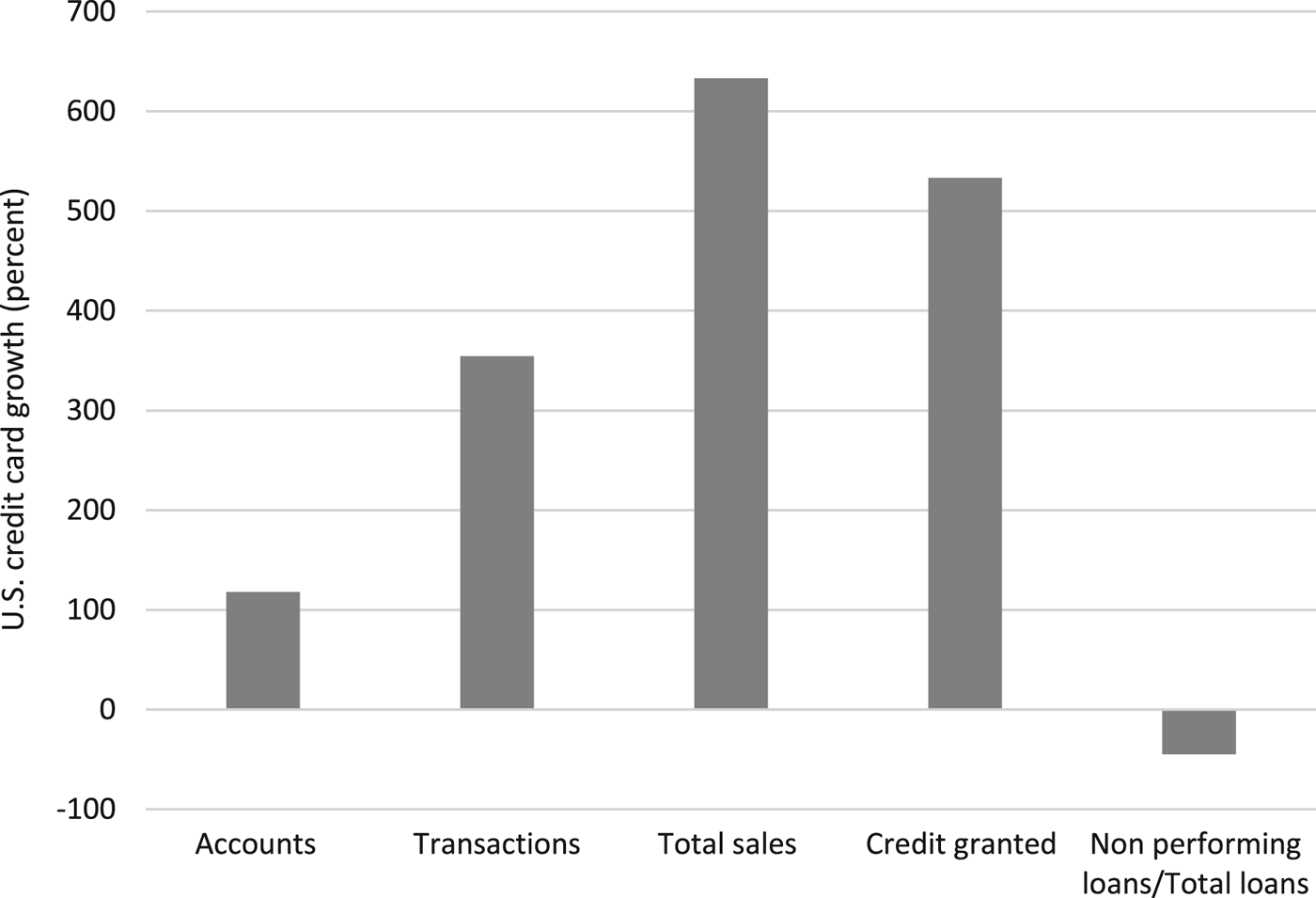
Figure 1 illustrates the growth of credit card activity in the United States between 1970 and 1978. Interestingly, in this period, accounts grew 355 percent, sales using bank-backed credit cards increased 633 percent, and credit granted using them grew 533 percent. These magnitudes suggest that greater growth occurred in the intensification of activity (i.e., the use of the card) than in the number of accounts. These data also show delinquency declining during this period, implying some form of organizational learning and more resilient systems in awarding credit (despite the mass mailing of “live” cards).Footnote 23
Activity of credit cards issued by banks in the United States. Growth in percent, 1970–1978. (Source: Steven W. Straw, “An Analysis of Consumer Usage of Computer Consoles for Credit Cards: An Empirical Exploration of Retail Customer Behavior” [PhD diss., Ohio State University, 1976]).

Developments in the United Kingdom
Financial intermediaries working in British retail banking markets have experienced sustained and continuous change.Footnote 24 By 1911, a process of amalgamation left some 80 percent of deposits in the hands of five banks: Midland, Barclays, Lloyds, Westminster, and National Provincial. These, plus some six others, controlled access to the check clearing system, hence the name “clearing banks.”Footnote 25 Amalgamations also had the effect of providing clearing banks with a national web of offices and retail bank branches.Footnote 26 By the 1960s, Barclays was the largest clearing bank in terms of total assets, spearheading international diversification and the adoption of computer technology.Footnote 27 As the case of the credit cards shows, Barclays was also a trailblazer, bringing new products and services to the mass retail finance market in Britain.
British consumers had access to charge cards before the advent of the bank credit card, but as late as 1971 there was “no statistic available on [charge cards] or information on the trades and their issuers. They [were] it appears more in the catering trades than in the retailing of goods.”Footnote 28 In other words, charge cards in the United Kingdom were largely T&E cards.Footnote 29
The first T&E card in Britain was launched in 1951 when Finders’ Services, a company offering support to professionals, diversified into this market.Footnote 30 A second, similar company, called Credit Card Facilities, began in 1953. Finders’ Services signed a reciprocal agreement with Diners Club in 1959. At a stroke, Finders’ expanded the number of establishments accepting its card, and available to its 19,000 cardholders, from 850 to 35,000—although the expansion was mostly overseas.Footnote 31 Finders’ charge card operations, plus those of Credit Card Facilities, merged to become Diners Club UK Ltd. in 1962.Footnote 32 The following year, American Express began operating in the United Kingdom, and by 1967, its card was being promoted by Lloyds Bank and Martins Bank.Footnote 33 Other T&E and store cards available in Britain had smaller business volume.
Although a number of events had kept British banks outside the mortgage market, they were (directly) involved in consumer credit through a small amount of personal loans and (indirectly) through open market operations that secured wholesale funding to hire purchase companies. In this context, a pivotal event was Barclays’ launch of its credit card with the support of Bank of America in 1966. It is not clear whether the British approached the Californians or vice versa.Footnote 34 The fact remains that Barclays was the first U.K. bank to embrace the full potential of credit cards, while Bank of America saw the agreement with Barclays as a chance to license its credit card system and expand abroad.46 Barclays’ balance sheet was smaller than the American bank in assets but not in numbers of branches. Barclays employed 54,905 people domestically, and it had 3,215 branches in the United Kingdom (mostly in England and Wales), representing 65 percent of Barclays’ total and 23 percent of all British bank branches.Footnote 35
When Barclays negotiated an exclusive franchise from Bank of America at the end of 1965, a small team was set up to plan a U.K. launch under the Barclaycard brand.Footnote 36 Except for minor amendments to allow for different postal codes and imperial measures, Barclays adopted the business and organizational model of the California bank. In six months, thirty thousand establishments had signed up, mainly small and medium-sized stores. Larger retailers had their own credit schemes (and did not want to pay Barclays’ service charge of 3 percent or more). By the end of 1966, Barclays had passed the milestone of one million cardholders, thanks to its acceptance by the British adult population.Footnote 37 Note that Barclaycard grew despite being effectively the same as other British charge cards, because the Bank of England allowed roll-over credit until 1967.Footnote 38
Other large British banks “were not convinced that credit card operations in [the U.K.] would prove commercially successful ([given the] losses . . . incurred by many USA banks).”Footnote 39 Instead, they reacted by launching a check guarantee card in 1966. This was part of the six-country consortium, called Eurocheque, that was meant to integrate national check card systems.Footnote 40 But soon after, they changed their minds. In 1970 these same banks appointed a working group to produce an alternative to Barclaycard, branded Access, which materialized in 1972 under the aegis of the newly named MasterCharge.Footnote 41 British credit cards were thus firmly based on U.S. predecessors.
Adoption in Mexico
Mexico and Spain also provide exemplary stories of the process of adopting bank credit cards. At the time, both countries had enjoyed a period of sustained economic growth, when their banking systems had expanded. A rapid increase in the urban population of both countries also contributed to the retail banking environment.Footnote 42
In Mexico, the sum of commercial banks’ assets totaled 16.5 percent of GDP in 1959, rising to 32 percent of GDP in 1970. It was a relatively stable and profitable industry. The four largest banks accounted for 50 percent of the country's bank loans and only the two largest banks had a meaningful national presence. About ninety other, mostly regional, banks accounted for the other half of the country's bank loans. Banking laws in Mexico prohibited the operation of foreign banks (except for Citibank). However, some banks had international financial intermediaries or individual foreign residents as shareholders. The larger banks also had financial relationships with international banks, as well as representation in financial centers in several countries.Footnote 43
Between 1950 and 1970, Mexican retail banks implemented a policy to deliver their services to a mass market, largely in response to the growth of cities and the urban middle class. In 1965, when the biggest banks in terms of assets brought in their first computers, digitized operation started.Footnote 44 This move paved the way for credit cards.
The bank credit card was introduced earlier in Mexico than in other Latin American countries; the first in the region came in January 1968 from Banco Nacional de México (Banamex), then the largest Mexican bank in terms of assets.Footnote 45 The card was branded Bancomatico and affiliated with the Interbank system.Footnote 46 In June 1969, its main rival, Banco de Comercio (Bancomer), then the second-largest Mexican bank, launched its own credit card scheme based on the BankAmericard.Footnote 47 Two months later, a syndicate of midsize banks introduced Carnet, a third card, to Mexico.Footnote 48 These three cards have since defined the country's credit card market, led, until recently, by Banamex's Bancomatico.
The Spanish market for payment cards
During the 1960s, the Spanish banking industry increased its penetration in the economy, from 53 percent in 1960 to 75 percent in 1970, measured as the ratio of deposits of banks and savings banks to GDP.Footnote 49 Seven major banks dominated the market and had branches in most regions. Their headquarters were in Spain's financial centers, Madrid, and such northern cities as Bilbao in the Basque country and Santander in Cantabria. Madrid-based banks dominated the retail financial market, while the Banco de Bilbao (established in 1857) had a market share of 10 percent in 1975, when the Banco de Vizcaya (established in 1901) had a 6 percent stake.Footnote 50 The Spanish financial system was operated chiefly by domestic institutions, many having business links with international banks.
Launched in December 1970, Eurocard, Banco de Vizcaya's MasterCharge-backed scheme, was Spain's first credit card. In June 1971, the other bank of importance in the region, Banco de Bilbao, launched its credit card, based on BankAmericard.Footnote 51 Banco de Bilbao then had 422 branches, or 10 percent of all the branches of Spanish commercial banks.Footnote 52 This network extended across every province and provincial capital, giving the bank access to a potential market comprising 84 percent of the country's whole population and 88 percent of total income.
The early performance of Vizcaya's Eurocard was mediocre. For instance, at the end of 1972, the card was accepted by 17,000 merchants and carried by 18,000 cardholders, while its rival had 18,000 merchants and 360,000 cardholders.Footnote 53 Eurocard did no better over the next ten years; in spite of Vizcaya's pioneering advantage, the Bilbao's card dominated the market.
By 1980, the Bilbao and other small Spanish banks had 2.3 million Visa cards in circulation, with annual turnover of 28 billion pesetas.Footnote 54 Meanwhile, MasterCharge took hold in Spain when Banca Catalana and fifteen small regional banks formed the Agrupación Española de Tarjetas de Crédito in 1975.Footnote 55 In 1980, MasterCard had 250,000 cardholders and 3 billion pesetas in turnover, while Vizcaya's Eurocard had 100,000 cardholders and 4 billion pesetas in turnover.Footnote 56
Assembling the Parts: A Two-Sided Market Yet to Come
The emergence of today's dominant players in the global retail payments market was rather gradual and markedly staged. We can trace a straight line between BankAmericard in 1958 (today's Visa) or Interbank in 1966 (today's MasterCard) and the reproduction of their business model in the United Kingdom in 1966 and 1972, Mexico in 1969 and 1968, and Spain in 1971 and 1970, respectively. The decision to adopt the credit card—an unproven product, of marginal importance to profitability, beyond the United States—was not easy, especially in countries such as Mexico or Spain where income levels and middle-class populations were clearly below those of the United States and Britain.Footnote 57 However, it offered the possibility of displacing cash by inserting banks between merchants and card users during exchanges of value. This opened an opportunity for fee income generation. Admittedly, in the 1960s fee income was a minor item of most retail banks’ profit and loss, but the introduction of the credit card should be seen as part of a broader move beginning in the late 1950s to diversify banks’ product offerings in western Europe and North America.
Although the credit card project worked well for many banks, the process of adoption was not uneventful. For instance, the boards of Barclays in the United Kingdom and of Banamex in Mexico fully supported the idea. In Spain, however, the then managing director (later CEO) of the Bilbao, José Ángel Sánchez Asiaín, had to threaten resignation before the board would approve the project.Footnote 58 In Mexico, Manuel Espinosa Yglesias, Bancomer's CEO and president, was not convinced even in 1969 of its soundness; however, competitive pressure from Banamex's innovation forced Bancomer to respond.Footnote 59
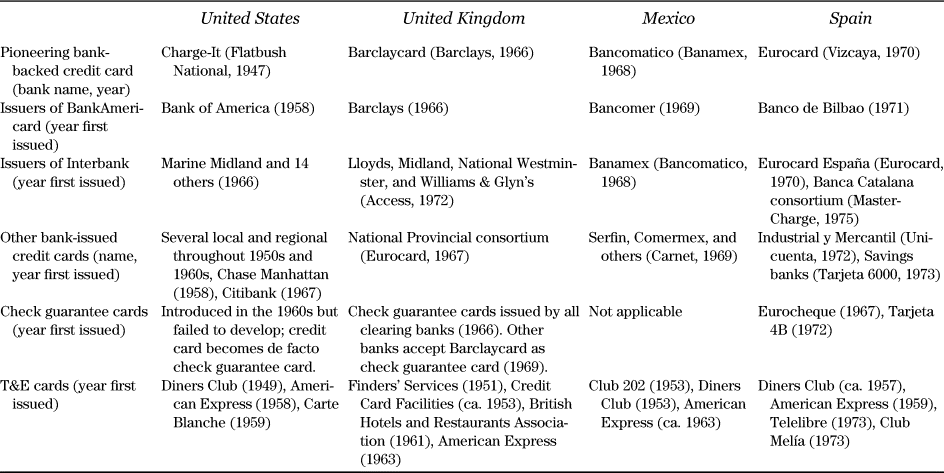
Table 1 summarizes the state of play in four competitive environments when financial institutions first launched their cards. Evidence suggests that customers, regulators, and banks knew something of payment cards through their experience of indigenous T&E cards and through efforts by American Express and Diners Club to build cross-border payment platforms.
Main Competitors in the Payment Cards Market in Selected Countries, 1950–1975
Sources: Authors’ compilation based on archival sources in addition to Hemeroteca ABC; Financial Times; The Times; Patrick Frazer, Plastic and Electronic Money (Cambridge, U.K., 1985); Robert W. Pullen and Frederick D. O'Connell, “Supplement to Bank Credit Card and Related Plans,” New England Business Review, Federal Reserve Bank of Boston (Dec. 1966); David L. Stearns, Electronic Value Exchange: Origins of the Visa Electronic Payment System (London, 2011); and John C. Weistart, “Consumer Protection in the Credit Card Industry: Federal Legislative Controls,” Michigan Law Review (Aug. 1972): 1475–543; Banco de Bilbao and Banco de Vizcaya collections, Archivo Histórico BBVA, Bilbao; Barclays Bank (U.K.), Barclays Group Archives, Manchester; Committee of London Clearing Banks collection, London Metropolitan Archives, London; annual report collection, Biblioteca Universidad del Pais Vasco, Bilbao.
As mentioned, foreign licensees replicated the business and organizational models of the U.S. banks. For example, unlike the international norm hitherto, Bank of America and each foreign adopter of BankAmericard and Interbank set up a card organization that was always a subsidiary, that is, an organization focused on credit card operations, semidetached from the main bank but consolidating its financial results. This move not only limited the possible credit exposure of the parent company to the capital of the subsidiary, but further suggested that the credit card project had to be profitable in its own right.Footnote 60 Banks sent staff to the United States, especially California, to observe firsthand the workings of U.S. banks.Footnote 61 We also found frequent, multilateral, and intense exchange of ideas among executives of the growing international licensees of BankAmericard. These took shape in many forms, including letters and annual and semiannual meetings, as well as sharing of newsworthy articles sourced in English-language newspapers and magazines such as the Wall Street Journal, Financial Times, and The Economist. The latter were often translated into Spanish (or English) in order to have a wide internal readership at the recipients’ bank.
In Britain, Barclays immediately invested in a dedicated computer system to support credit card operations, while in Spain Banco de Bilbao's first computer served the same purpose—these at a time when most western European banks were adopting computer technology to support check clearing and accounting functions such as payroll.Footnote 62
Meanwhile in Mexico, in a show of modernity, Banamex leveraged the introduction of its credit card by giving it the same name as its computer center, established in 1966: Bancomatico. Before signing up with Interbank, Banamex had tried to introduce an established U.S. credit card scheme. Hence, Banamex staff had negotiated with major banks in New York City, specifically Chase Manhattan and First National City Bank (today Citibank) as well as Bank of America in California. However, Banamex considered the payment demanded for a brand name, know-how, and opportunities for international clearing too high; instead, it formed a loose alliance with Interbank while developing computer systems in-house with the cooperation of external IT consultants.Footnote 63
Typically, foreign banks adopted the BankAmericard in exclusivity for their country. This exclusivity turned out to be significant in making Banco de Bilbao and Barclays the single biggest acquirers in their growing domestic credit card market for the next two decades.Footnote 64 Exclusivity also brought competitive responses from other domestic banks joining Interbank—which encouraged the formation of locally shared licenses, creating very different incentives for interbank cooperation, together with different organizational hierarchies linking member banks.Footnote 65
The bank-issued credit card unquestionably marks a turning point in retail payments. Most countries observed an explosion in the number of new domestic entrants into “paying with plastic” following widespread signing up to either BankAmericard or Interbank.
The introduction in Mexico of a third bank credit card, amid competition between Banamex and Bancomer, is another example of multiple entrants jockeying for position. Ten Mexican banks jointly established Promoción y Operación S.A. (Prosa) in August 1969 to coordinate the launch and operation of a third credit card scheme, Carnet, supplementing those of Banamex and Bancomer. Although a couple of the banks behind Prosa operated nationwide retail branch networks, their directors could not guarantee sufficient business volume to move independently into credit cards and thus joined forces in order to meet the sunk costs of the system. Interestingly, records show that Banamex helped to set up Prosa and develop its computer system. This action suggests that after Bancomer brought the BankAmericard to Mexico, Banamex followed a “divide and conquer” policy. Although the banks behind Carnet generated enough business volume for their card scheme to remain viable for decades afterward, Carnet was accepted only in Mexico, Cuba, and a couple of Central American countries. Consequently, it remained a proprietary network, never challenging the global ambitions of BankAmericard or Interbank.
Table 1 also shows that the Bilbao's competitors in Spain in the early 1970s included Banco de Vizcaya's Eurocard/MasterCharge; the savings banks’ consortium Tarjeta 6000; Banca Catalana's consortium MasterCharge card; and Banco Industrial y Mercantil's Unicuenta. These coexisted with check guarantee cards (Eurocheque and Tarjeta 4B) and such T&E cards as American Express, Diners Club, Telelibre (issued by the state telephone monopoly Telefónica), and Melia Club (issued by travel group Melia with financial support from Banco Coca). State-owned gas stations and highway tolls refused the Bilbao card, unwilling to pay the high fees. Some department stores, for example, Sears and El Corte Inglés, had their own cards. But given the early acceptance of the Bilbao card by the El Corte Inglés and its large network of stores across Spain, other large retailers (such as Galerias Preciado) and smaller merchants began to accept the Bilbao's card.Footnote 66
The early move of the Bilbao into credit cards was remarkable, considering the highly conservative environment that otherwise characterized Spain in the late stages of Franco's regime. In fact, Bank of America had Banco de Santander as its main partner and correspondent there. However, this and other large Spanish banks showed no interest in inaugurating a credit card.Footnote 67 Soon after, Santander and the biggest Spanish bank at that time, Banco Español de Crédito (Banesto), for reasons that are unclear, attempted, albeit in vain, to persuade the Bilbao to share the franchise of BankAmericard in Spain, apparently with support from Bank of America. Instead, Santander joined Banesto and the two other biggest Spanish banks (Central and Hispanoamericano) to launch a check guarantee card in 1974 (branded Tarjeta 4B), hoping that personal checks rather than credit cards were the future.Footnote 68 Unfortunately, personal checks failed to generate significant business volume in Spain. Consequently, the banks behind the 4B brand turned their card into a proper credit card in 1979 and joined the newly created Visa Spain (while at the same time using their card to activate their new ATM network).Footnote 69
Spanish and Mexican regulators appeared indifferent to the credit card project, whereas the United States had passed regulations following problems relating to fraud and mounting losses at Illinois banks stemming from the mass mailing of unsolicited “live” cards. The hearings around the Truth in Lending Act (1968) exposed such practices and generated momentum for their prohibition in 1970. These hearings also introduced cardholders’ limited liability for lost and stolen credit cards.Footnote 70
Similar debates developed in the United Kingdom. The initial concern in Britain was to limit the growth of credit card schemes allowing foreign cash withdrawals to circumvent currency controls. Credit cards later figured in the internal British debate about the effects of personal credit on inflation and informed the passing of the Consumer Credit Act 1974 (which, to bankers’ displeasure, introduced the annual percentage rate, or APR, and supervision of personal credit transactions by the Office of Fair Trading).
Customer Selection as the Foundation of a Global Network
Domestic roots of global retail payments
Credit cards issued by retail banks emerged alongside such innovations as check guarantee cards, personal loans, hire purchase (installment credit), overdrafts, travelers’ checks, early forms of electronic transfer, and cash dispensers. The successful implementation of many of these innovations marked the transformation from extolling savings and frugality to encouraging debt and consumerism.Footnote 71 Explicit in research by David L. Stearns, and implicit in a contemporary view by Kenneth V. Larkin, an executive at Bank of America, is that marketers realized the value of access to a large middle-class customer base, brand awareness, and banking relationships with merchants (preceding credit cards) as factors that help to explain the long-term success of bank-issued credit cards.Footnote 72
To give an idea of difference between target markets, consider that in 1966 American Express issued cards to people earning at least £2,000 per year in the United Kingdom and $7,500 in the United States. At the time, the average income per capita was $4,146.30 in the United States and £2,032.11 (or $1,959.60) in the United Kingdom.Footnote 73 Credit limits of Barclaycard in 1972 oscillated between £50 and £200 according to individual circumstances (businessmen would typically get higher limits). Individuals using a Barclaycard could withdraw up to £100 at a branch of Barclays (approximately £1,500, or $2,000, in 2017).Footnote 74 At the same time, a check guarantee card from any other English bank would allow up to £30 cash withdrawal per check, while banks limited cash machines to £10 per withdrawal (and some banks restricted customers to two withdrawals per month).
As in the United States, both individuals and merchants in Britain were targets of mass mailing. But to avoid the same fraud or heavy losses as the Illinois banks had suffered, managers of retail bank branches in Britain, Spain, and other foreign licensees were asked to suggest names of creditworthy customers and merchants in their vicinity (regardless of relationship with the bank).Footnote 75 Caution paid off, and despite the mass mailing of “live” cards, fraud and delinquency were significantly lower in Britain and Spain than in the United States.
Meanwhile, Mexican banks faced an uphill battle to introduce the credit card. It was complex to incorporate a massive clientele in a developing economy with a weak legal system. Banamex initially offered its credit card to customers who were also members of the Rotary Club, thus preselecting clients with a stable income who had a credit and savings history with the bank.Footnote 76 Banamex then established a protocol to accept new (mostly male) cardholders. It covered a large segment of the population: customers who for three or more years had had the same address, worked for the same company, and earned at least 5,000 pesos ($400) per month—then a significant income level. Setting the bar high promised to capture the better off, given the skewed income distribution typical of emerging markets.Footnote 77 As in Spain, the relationship of Banamex with the midsize and large retail businesses that had been its customers before the bank card era facilitated its adoption.
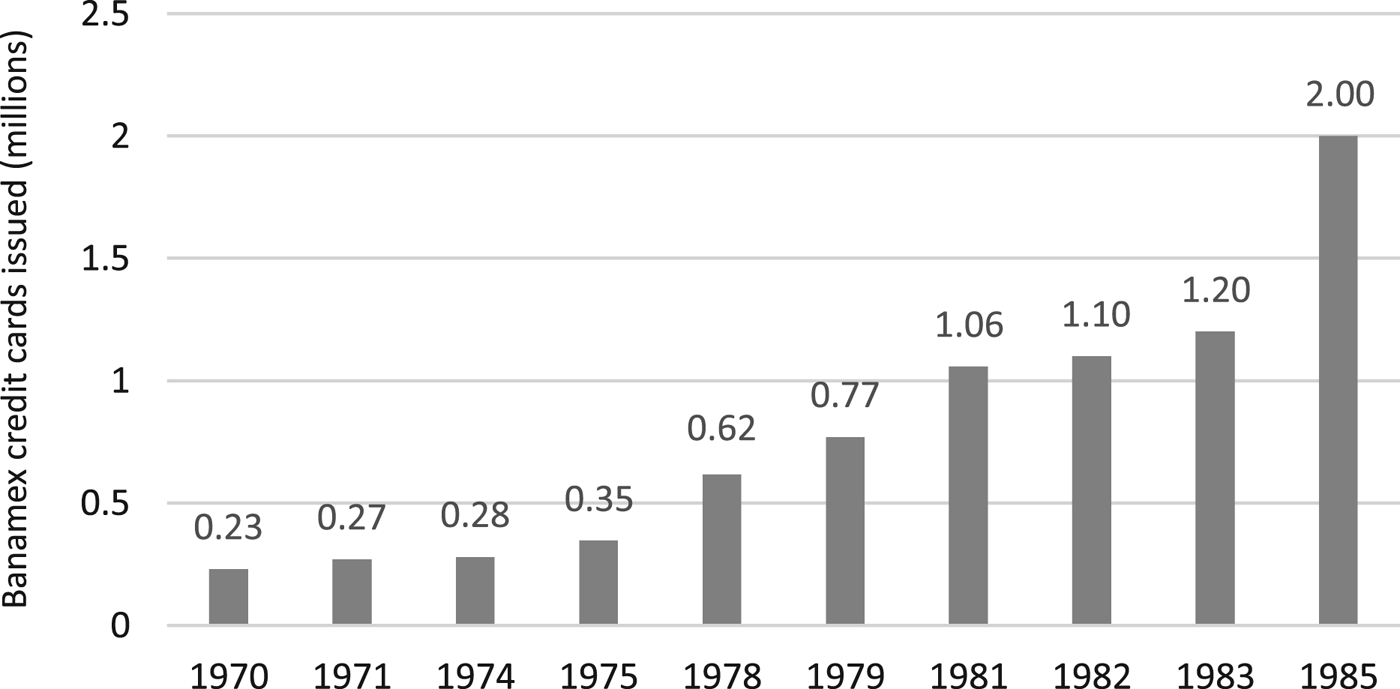
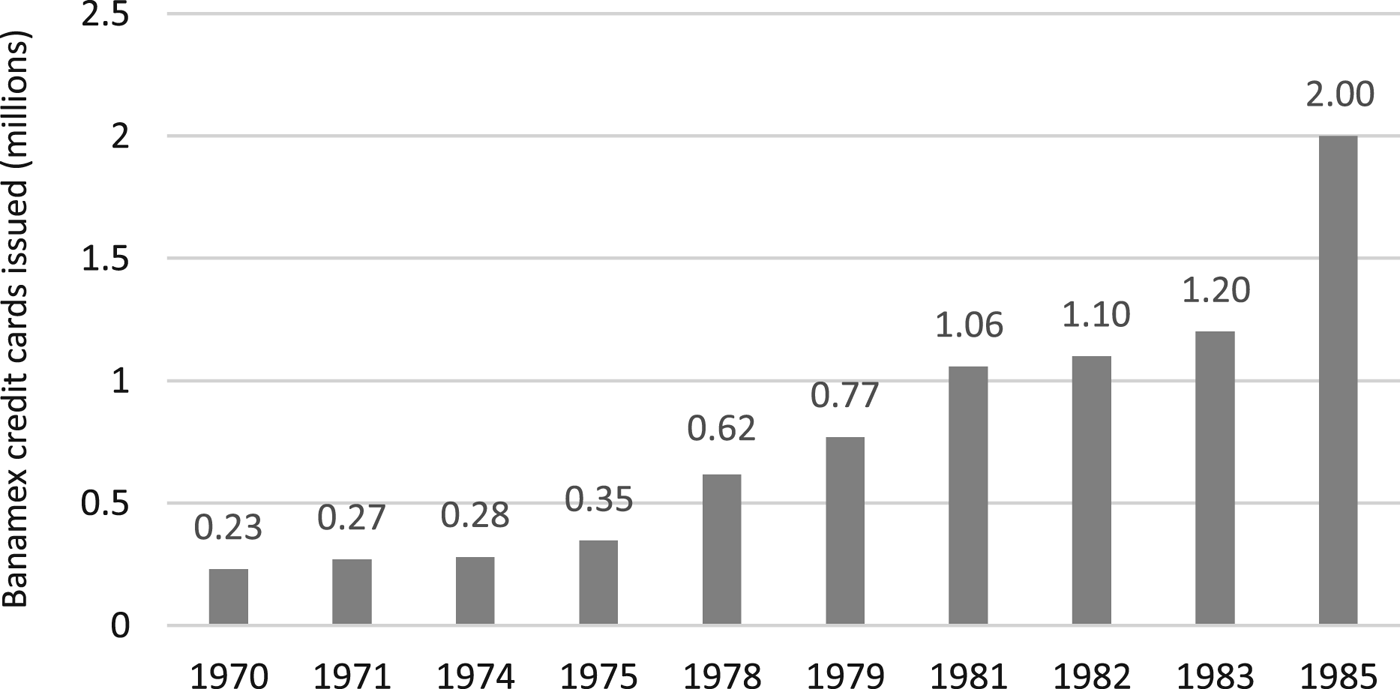
By the end of 1968, Banamex had 46,365 cards in the market and 6,378 affiliated establishments. Only 2,803 of those establishments were in Mexico City, with the other 3,575 dispersed among ninety-three cities around the country.Footnote 78 The uptake of Bancomatico was unyielding. In 1969 the Banamex network had 165,000 affiliated cards and 17,500 establishments. Banamex cards continued to grow from 1970 to 1985; as Figure 2 shows, by 1982 it had more than 1,000,000 cards. It also had 54,665 establishments. These numbers positioned Banamex as the leader, with a 45 percent share of the Mexican card market.Footnote 79
Credit cards issued by Banamex in Mexico (millions), 1970–1985. (Source: Banamex, Informes Anuales, 1970 to 1985, Archivo Banamex, Mexico City).
Like Banamex, Bancomer had built a large network of retail bank branches in Mexican cities.Footnote 80 As mentioned, presence in urban centers was essential for selecting and recruiting cardholders and retailers and the consequent success of the card.
Although the top echelons of Bancomer were initially skeptical about the credit card project, once committed, the bank pursued an aggressive marketing strategy to create awareness among individuals and business. There is little archival information on Bancomer's methods of selecting cardholders. But between 1969 and 1970 its marketing campaign included an alliance with the Mexican subsidiary of Reader's Digest, offering a free subscription to the magazine to each new cardholder.Footnote 81 Bancomer initially had fewer than 17,000 establishments affiliated in 1969. By the end of 1970, it had 24,000, which by 1973 had risen to 34,774. The number of cardholders increased from 217,000 in 1970 to 274,000 in 1974.Footnote 82
The formation of IBANCO
The next step in building a global network was to form two international hubs. Surviving business records allowed us to explore IBANCO, later Visa International. This part of the story took place around 1974.
At this time, the international network of BankAmericard had eighteen principal members, all of which were independent, domestic, proprietary credit card schemes. It had 35 million cardholders, almost 500,000 merchants, and 5,700 banks worldwide.Footnote 83 Outside the United States, it had 9.3 million cardholders (5.83 percent of whom were in Spain), while transactions had reached 19 million in volume and $516 million in value.Footnote 84 Bank of America had thus been successful in turning its proprietary credit card scheme into a payment network by persuading a number of domestic and overseas banks to adopt its business model. But a major difference was that the international licensees had no common language, legal framework, or broad business and banking environments (as had been the case with the U.S. licensees). The international organization thus had to extract those system elements that were truly global.
When domestic licensees established National BankAmericard Inc. (NBI) in 1970, an initial attempt was made to break away from Bank of America and form an international organization, apparently influenced by the creation of NBI. This collapsed, however, because the international licencees failed to organize. The organizational architecture was also under pressure from such problems as dealing with shop floor issues and cash withdrawals using cards issued abroad.
During the first quarter of 1974, 1.1 million domestic cash withdrawals were made beyond the United States, at an estimated value of $76 million.Footnote 85 Some banks, like the Bilbao, were not promoting cash withdrawals (although the Bilbao allowed cross-border cash withdrawals by its customers, but only after January 1973).Footnote 86 Nevertheless, marketing had led individual cardholders in many countries to believe that foreign banks would honor withdrawals on foreign cards. But since each licensee bank had signed an agreement only with Bank of America Service Corporation, in practice international withdrawals depended on an interchange agreement between the two banks concerned and telephoned authorization from the issuing bank—that is, bilateral agreements between individual members of the payment network. Each had to negotiate legal minutiae, fees for cash withdrawals charged to customers, the system for fixing the exchange rate, and the interchange fee paid by the issuing bank for allowing its customers access to foreign cash.
Clearly the future of cross-border growth was bleak, while the cost of setting and managing bilateral agreements threatened to spiral out of control. International member banks thus pressed Ernest J. Young, president of the Bank of America Service Corporation, to form a “universal credit card company.”Footnote 87 But Young was reluctant to form a coordinating organization for Europe analogous to NBI for domestic affiliated banks. However, international banks had the support of Dee Hock, president of NBI, and other directors at Bank of America (including Bruce Marcus). Finally Bank of America gave in to licensee pressure, but only after heavyweight participants such as Barclays threatened to leave the system.Footnote 88
IBANCO, the umbrella organization that would set rules for international licensees of the BankAmericard system, incorporated in September 1974. This organization was to be modeled on NBI, including the method of formulating the interchange fee.Footnote 89 International licensees agreed to allow other banks to act as merchants and issue BankAmericards in their countries (but many, such as the Bilbao and Barclays, remained the sole acquirer). The bylaws of the new organization also allowed for “duality,” that is, for merchant banks to participate in competing credit card systems.Footnote 90
Conclusion
The formation of the global bank credit card industry relied on strong domestic players, all of which had large distribution networks and longstanding relationships with individual customers and retailers. The combination of a critical mass of users with the capacity to adopt and implement technological change and international collaboration explains the ascent of “paying with plastic.”
Context-specific strategies played a role in the evolving formation of its network. For instance, few writers doubt that mass mailings of unsolicited cards played an important role in establishing the bank credit card market. However, its unbridled use, resulting in significant losses, rising delinquency, and adverse regulation, led contemporary bankers to be cautious.
The so-called “non-discrimination clause” through which credit card companies forced retailers to offer the same price for goods and services regardless of payment medium was another contributory factor. Most countries retained this practice until relatively recently. The “non-discrimination clause” calls into question the assumption that paying with cash has no transaction cost. Moreover, it hides the fact that the business model behind the credit card is aimed not only at generating interest income from roll-over credit, but also at making a bank the intermediary between individuals and retailers, thus introducing a “toll” in the transfer of value.
The check guarantee card is another noteworthy example of a “toll” in the “payments railway” that serves to highlight the competitive aspects of retail payments. This alternative form of plastic payment offered bankers (and potentially customers and retailers) a viable alternative technology to the credit card. During the 1960s, some attempts were made to introduce check guarantee cards in the United States. But merchants were reluctant to accept payment from banks they did not know; soon afterwards the credit card became the de facto check guarantee card, as it remains.112 However, check guarantee cards were deployed under the Eurocheque initiative in several western European countries, notably Germany and the United Kingdom.
In the 1960s and early 1970s all major British banks deployed both check guarantee and credit cards. During this process Barclays cannily succeeded in having Barclaycards accepted as single plastic token that could be used both as a credit card and to guarantee checks. Of equal interest is the Tarjeta 4B check guarantee card in Spain, where personal checks were insignificant before 1970. At the heart of this business model was a deliberate attempt to introduce a “toll” in the transfer of value by making a bank the intermediary between individuals and merchants. Meanwhile, there was, to the best of our knowledge, no attempt to introduce a check guarantee card in Mexico between 1950 and 1975.
In summary, our research explains the formation of what is considered a two-sided market. For this, historical research was indispensable. This article posits the view that the dominant approach to envisioning payment industries—that is, a framework based on the literature of two-sided markets—fails to consider the formation of the market and, therefore, may require refinement for the study of emerging technologies within the retail payments space.Footnote 91 Nevertheless, we find that the emergence of the credit card serves as an allegory for understanding the effect of fixed costs and critical mass and the way in which these may constitute initial conditions for analyzing market networks.