International adoption carries with it a number of potential difficulties that add to those seen in biological families.Reference Lesens, Schmidt and De Rancourt 1 In particular, adopted children may experience more psychopathological difficulties than the general population.Reference Askeland, Hysing, Aarø, Tell and Sivertsen 2 , Reference Keyes, Sharma, Elkins, Iacono and McGue 3 On January 12th, 2010, a major earthquake measuring 7.0 on the Richter scale struck Haiti, causing over 300,000 deaths, and leaving over 300,000 injured and over 1.2 million homeless. Between 2007 and 2009, 1787 Haitian children were internationally adopted in France. 4 - 6 About 1000 were transferred in 2010 after the earthquake, many were routed through Guadeloupe where they remained for several days in a dedicated center before joining their French adoptive parents. 7 The purpose of the stopover in Guadeloupe was to ensure that the children received the necessary medical, psychological, pedagogical, and legal follow-up investigation before entering France. These children had undergone several severe traumatic experiences: an earthquake, uprooting, separation from their biological families, and arrival in new French families. Many adopting families suffered stress owing to a lack of information or because the assigned child was known to have been injured or killed in the earthquake.Reference Balsari, Lemery, Williams and Nelson 8 Later, some had problems obtaining recognition of adoption by the French authorities—in particular, plenary adoption—which, unlike simple adoption, severs the relationship between the birth parent and the child. Little is known about the resilience and the frequency of behavioral symptoms in children who have experienced a disaster followed by international adoption. We conducted a quantitative and qualitative study to compare the characteristics of Haitian children internationally adopted before and after the earthquake.
Methods
A total of 40 Haitian children attended the clinic for international adoption at Clermont-Ferrand, France, from January 2009 to December 2011. Standardized medical records for international adoption were retrospectively reviewed for demographic data, clinical diagnosis, and biological and radiological results. An information letter was sent by e-mail to the eligible families, and contact was made by phone 1 month later. After obtaining written consent, an individual face-to-face interview was conducted and sound-recorded 18-24 months after the earthquake. The themes of the topic guide included the adoption project, the experience of waiting between the earthquake and the child’s arrival, and problems arising since the child’s arrival. Parents and children were asked to fill out State-Trait Anxiety Inventories (STAI) and STAI for Children (STAI-C) questionnaires, composed of self-report scales measuring state anxiety (20 statements) and trait anxiety (20 statements). Parents were also asked to answer additional questions including some on eating, sleeping, behavior, and concentration problems, and aggressiveness. The study was approved by the ethics committee of the clinical investigation center (CECIC) and the National Commission for Information Technology and Civil Liberties (CNIL).
Statistical analyses were performed using Stata software, version 13 (StataCorp., College Station, TX, USA). The tests were two-sided, with α=0.05. Patient characteristics were described for each group as mean±standard deviation (SD) or median and interquartile range [IQR] for continuous variables, according to statistical distribution (normality assessed using the Shapiro–Wilk test), and as the number of patients (%) for categorical variables. Comparisons between groups (pre-earthquake and post-earthquake) for patient characteristics were performed using χ2 or Fisher exact tests for categorical variables and Student’s t-test, or Mann–Whitney test if the assumptions of normality and homoscedasticity examined using the Fisher–Snedecor test for quantitative parameters 7 were not met.
Results
Retrospective Chart Reviews
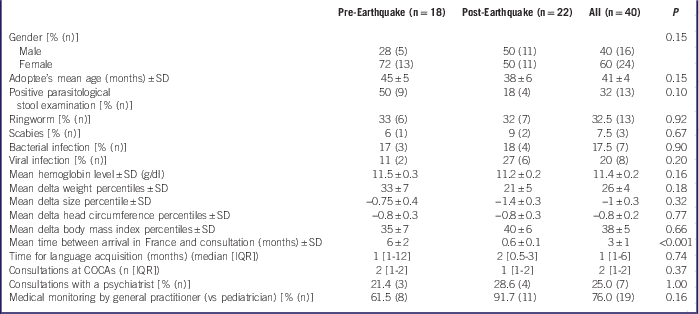
In all, 40 Haitian adoptees from 38 adoptive families attended the clinic for international adoption during the study period. Of these, 22 children had experienced the earthquake, and 18 had been adopted before January 2010. Clinical diagnosis did not differ between the groups (Table 1) except for a shorter time between arrival in France and attendance at the international adoption clinic for the children who arrived after the earthquake.
Comparison of Clinical Data for 40 Haitian Adoptees Attending the International Adoption Clinic Before and After the Earthquake (Retrospective Chart Review)

Abbreviations: SD, standard deviation; IQR, interquartile range; COCA, Center for Orientation and Counsel in Adoption.
Interviews with Families
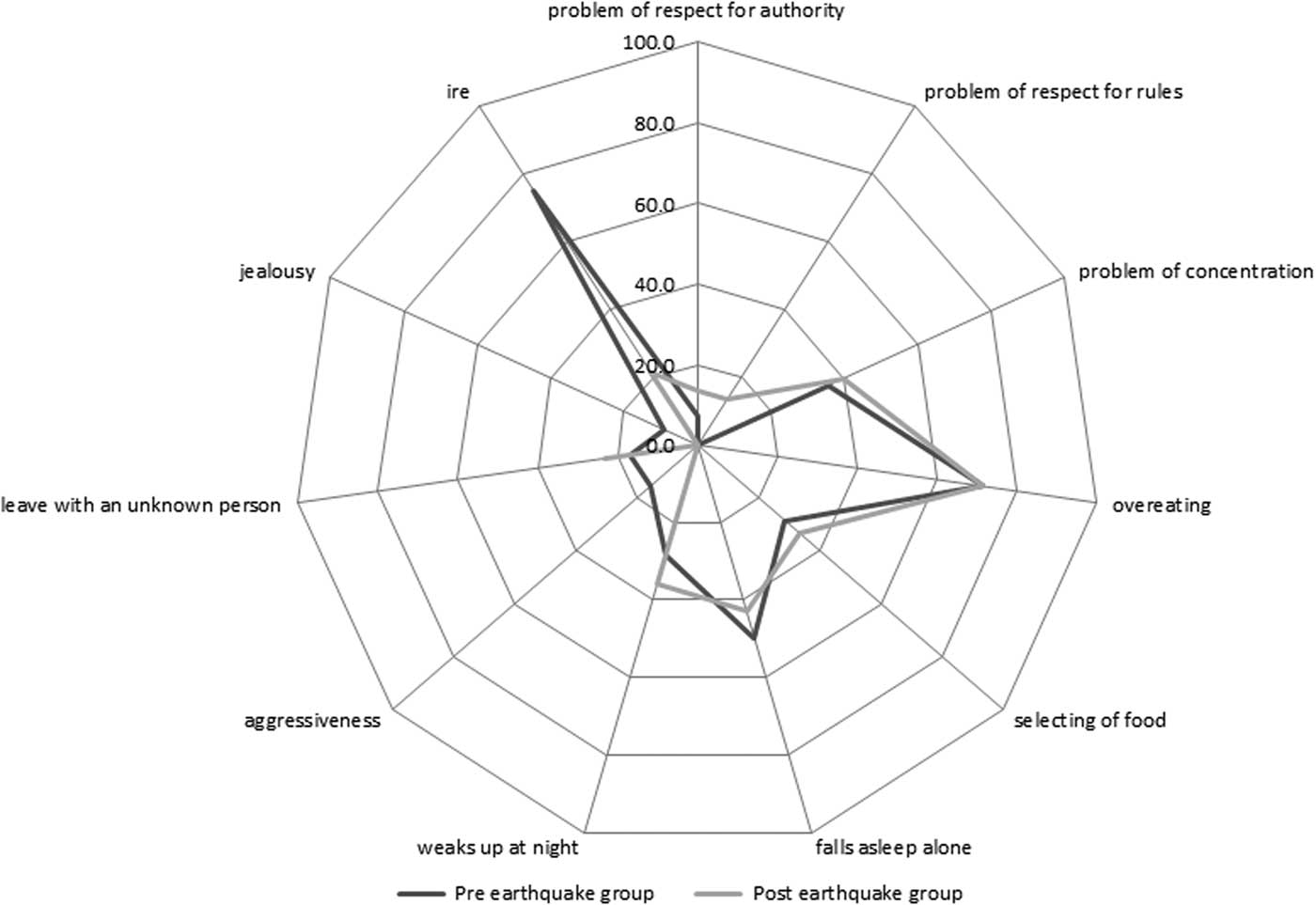
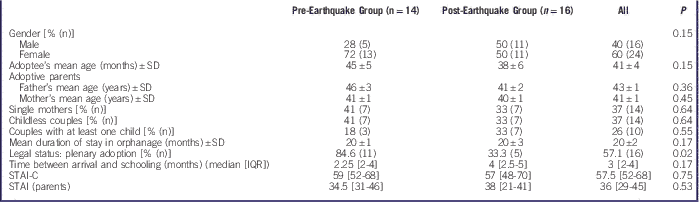
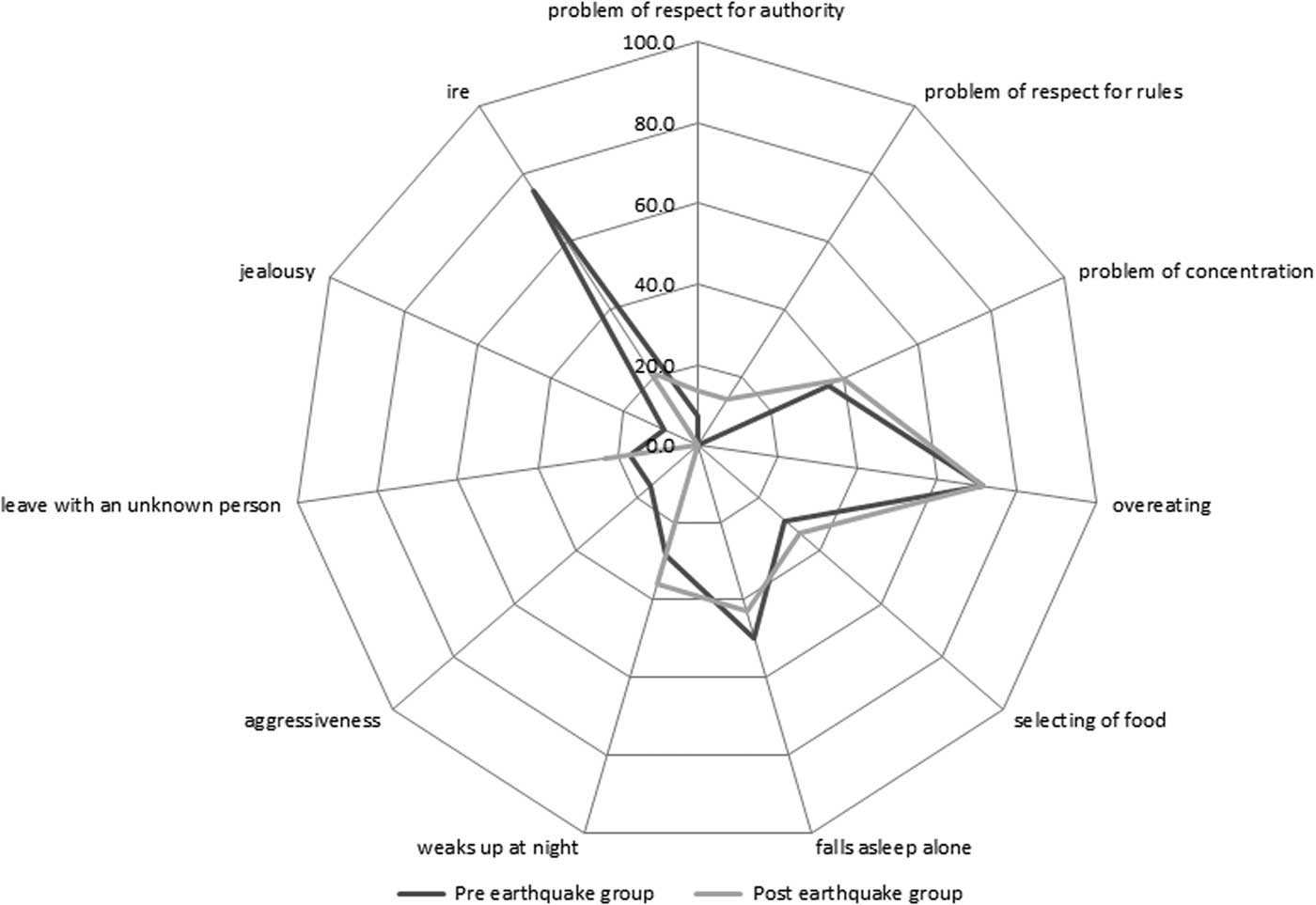
A total of 3 families refused the interview, and 6 could not be reached. The adoptive families of 30 children (14 pre-earthquake and 16 post-earthquake) participated in the qualitative study and filled out the questionnaire. Demographic characteristics did not differ between the two groups (Table 2). There was no statistical difference between the two groups for the STAI (P=0.53) and STAI-C (P=0.75) (Table 2). There was no statistical difference for the characteristics of adoption (duration of orphanage stay and of adoption process, age of adoptive parents, and number of children in the adoptive family), the number of psychiatric consultations (3% vs 4%, P=1), and anxiety for the child’s future (5% vs 3%, P=0.68). The time between arrival and schooling was longer in the post-earthquake group (4 [2.5-5] months vs 2.25 [2-4] months, P=0.17). The frequency of behavioral problems did not differ between the 2 groups (Figure 1) except for the frequency of fits of anger in response to frustration, which was higher in the pre-earthquake group (21.4% vs 75%, P=0.02). The main difference lay in the legal status of the adoptees: plenary adoption was pronounced for 84.6% of the children adopted before the earthquake vs 33.3% for those adopted afterwards (P=0.02).
Behavioral Symptoms in Haitian Adoptees Attending the Center for Orientation and Counsel in Adoption (COCA) Before and After the Earthquake.
Comparison of Demographic Data for 30 Haitian Adoptees (from the Families Who Participated in the Qualitative Study and Filled Out the Questionnaire) Attending the Center for Orientation and Counsel in Adoption Before and After the Earthquake.
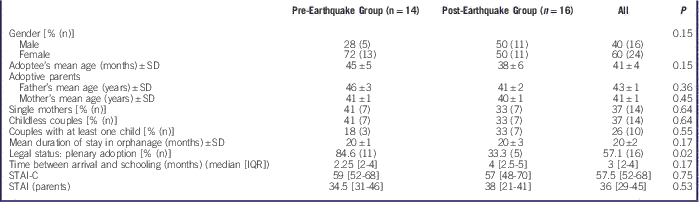
Abbreviations: SD, standard deviation; IQR, interquartile range; STAI, State-Trait Anxiety Inventory; STAI-C, State-Trait Anxiety Inventory for Children.
Qualitative Results
Adoptive families were sent information with a photo of their future adoptee (most often by e-mail) very early in the adoption process, which could take several years (median 18 months [12-24] for the 30 children in the study). This can make the wait distressing, because the process can be interrupted for many reasons (administrative, disease, death, disaster, or biological family refusal), whereas the attachment process is already strong for the parents: “I felt a mum as soon as I received the e-mail with the message and the picture of my daughter.” Children rarely talked about the experience of the earthquake, even with their adoptive families. When they did, they briefly described the “earth shaking,” “cries,” or water and food restrictions. Conversely, adoptive families had a sharp memory of the events they had followed hour by hour on TV, and of the efforts they had made to obtain information about their child. The experience was always described as a dramatic and stressful event that was particularly upsetting for some of them: “We learnt by e-mail that one of the children at the orphanage had died. We found out 5 days later it was our daughter.” One child survived, whereas his sister, who was sleeping in the same bed, died. “For me, my son is a survivor,” said a father, “He survived malnutrition and diseases due to the earthquake. I hope I’ll never have to go through what he did.” One adoptive child lost his biological father and brother, but most of the interviewed parents had good news from the biological family.
Parents were very critical of the transferal process with a route through Guadeloupe: “I didn’t want to leave my daughter with strangers, even trained and professional.” “All we got out of the emergency transferal was a delay of several months for our daughters’ arrival.” “It made us feel like kidnapping the children.” In the quantitative study, the interviews did not reveal any difference in behavior or parental attachment for the 2 groups. On the other hand, difficulties in obtaining plenary adoption for children adopted after the earthquake were expressed by adoptive families as a cause of suffering and humiliation. They felt they were regarded with suspicion about the regularity of the adoption in the context of the disaster. “There is really a feeling of injustice,” said a mother.
Discussion
This is the first qualitative and quantitative study evaluating the outcome of children internationally adopted after a disaster. We did not find any difference between the children adopted before and after the earthquake. They had the same medical characteristics on arrival, the same frequency of mental disorders and the same level of anxiety 18-24 months after the earthquake. Only a few children in the 2 groups were seen by a psychiatrist, mostly for sleeping disorders or reassurance. Similar results were found in a retrospective report published as an abstract from a congress in 2014 by De Monléon et al.Reference De Monléon, Simonet-Font and Vinay 9 The same result was found in adoptive families.Reference Keyes, Sharma, Elkins, Iacono and McGue 10 , Reference Mitchell and Jenista 11 It is striking that most of the adoptees did not express any need to talk about the earthquake. This may be explained, in part, by the trauma due to the disaster, or by an unconscious rejection of their native country. Another explanation is the state of hyper-resilience that characterizes adoptees, in whom all energy and concentration seem to be concentrated on adapting to the new family and habits of the new country. Many young children in this situation do not want to talk about their origins, but this issue usually reemerges when they reach the age of 10-12 years, a critical period for adoptees.Reference Askeland, Hysing, Aarø, Tell and Sivertsen 2 , Reference Keyes, Sharma, Elkins, Iacono and McGue 3 It is thus likely that reviviscences of trauma will emerge at this age. Health care providers and adoptive parents should, therefore, be watchful of the mental health of adoptees who have experienced the earthquake, even when resilience appears high 2 years after the event.
Studies have evaluated the presence or absence of post-traumatic stress disorder (PTSD) in children and adolescents who have experienced a natural disaster such as an earthquake or a tsunami.Reference Math, Tandon and Girimaji 12 - Reference Feo, Di Gioia, Carloni, Vitiello, Tozzi and Vicari 15 Early psychological assistance is needed to prevent the development of PTSD, especially, for children who have lost their home or a family member.Reference Tian, Wong, Li and Jiang 13 Usami et al showed that trauma symptoms in children who had survived a major tsunami gradually faded with time.Reference Usami, Iwadare and Watanabe 14 In the study of Feo et al, children aged 3-5 years did not show any signs of PTSD or anxiety symptoms 12-17 months after the earthquake.Reference Feo, Di Gioia, Carloni, Vitiello, Tozzi and Vicari 15 Despite its low power, our study is, therefore, consistent with this literature.
Our study also provides some feedback on how the difficulties met in bringing together adoptees and adoptive families were managed after the earthquake. In the aftermath of the earthquake, many children, some of whom were not orphans, were “rescued” and evacuated by plane for international adoption without permission. One lesson already learnt is that, in the event of a disaster, international adoption should be restricted to those adoptions already underway. In 2007 staffers of the non-governmental organization Arche de Zoé, who claimed to have rescued Darfur orphans, were sentenced to imprisonment in Chad for carrying out illegal adoptions and trying to smuggle 103 children to France. Warned by this experience, the French authorities exercised great caution when managing the transferal of Haitian future adoptees. 16 , 17 Though difficult in a disaster, it makes sense to ensure that children to be adopted had already been assigned to a family before the disaster, and that the administrative process was ongoing at that time. However, an accelerated procedure needs to be implemented to avoid severe disease or death in the interval. Routing children through the island of Guadeloupe may not have been very useful, and was criticized by adoptive families. Finally, the judiciary procedure of plenary adoption should be facilitated with clear recommendations valid throughout the French territory. The Canadian government sent the Government of Haiti a list of children who were already in the adoption process at the time of the earthquake. When all the conditions were met, 203 Haitian children were transferred. The operation ended on March 4, 2010, 6 weeks after the earthquake. 18 In Belgium, 13 Haitian children being adopted arrived on January 25, 2010, only 13 days after the earthquake. For all these children, the procedure had begun before the earthquake, and was expedited by the joint efforts of the Belgian and Haitian authorities. 19
The study has some limitations. Only 40 children were eligible, in a single region, and inclusion was restricted to families who attended the clinic for international adoption. Our population may, thus, not be representative of the entire population of Haitian adoptees, and the study may lack statistical power to detect difference between groups. However, the results were supported by a qualitative study with face-to-face interviews with the families of 30 adoptees. For small-size studies, the focus should not only be on statistical significance, but also on the quality of the study and the amplitude (size effect) of the findings.Reference Feise 20 Because not all 20 individual symptoms representing PTSD in DSM-5 (Diagnostic and Statistical Manual of Mental Disorders) were investigated, we cannot assert that PTSD was totally absent in these children.Reference Armour 21
In conclusion, adoptees from Haiti after the earthquake did not present any sign of behavioral symptoms compared with those adopted before the earthquake. However, the children were disinclined to talk about this period, and resurgence of mental disorders after age 10 is still possible. Management of future transferal of adoptees should take these findings into account.
Acknowledgments
OL and JP collected, analyzed the data, and wrote the article; MD-M and AL analyzed the data and wrote the article; PB performed statistical analysis; VP collected the data; and AL analyzed the data.
Conflicts of Interest
All authors declare that they have no conflicts of interest.
Ethical Approval
All procedures performed in the study were in accordance with the ethical standards of the institutional and/or national research committee and with the 1964 Helsinki declaration and its later amendments or comparable ethical standards.
Informed Consent
Informed consent was obtained from all individual participants included in the study.