Introduction
The potential for drugs of abuse to induce psychosis is well known, with extensive evidence that acute psychotic symptoms can be induced by alcohol, amphetamines, lysergic acid diethylamide (LSD), phencyclidine and ketamine, as well as by synthetic novel psychoactive substances (NPS) (Glass, Reference Glass1989; Paparelli et al. Reference Paparelli, Di Forti, Morrison and Murray2011; Zawilska & Wojcieszak, Reference Zawilska and Wojcieszak2013). There is also evidence that regular use of psychoactive substances is associated with the development of schizophrenia in vulnerable individuals, with the strongest evidence for an association with cannabis use (Semple et al. Reference Semple, McIntosh and Lawrie2005; Callaghan et al. Reference Callaghan, Cunningham, Allebeck, Arenovich, Sajeev, Remington, Boileau and Kish2012).
For many users, substance-induced psychotic symptoms resolve completely with abstinence, and this is defined in the International Classification of Diseases, Tenth Revision (ICD-10) as a psychotic disorder due to a specified psychoactive substance or substance-induced psychotic disorder (SIPD) (World Health Organization, 1992). However, recent studies suggest that some patients who experience SIPD subsequently develop schizophrenia at a higher rate than would be expected. The strongest evidence is for transition to chronic psychosis following cannabis-, amphetamine-, or alcohol-induced psychosis (Thirthalli & Benegal, Reference Thirthalli and Benegal2006), with estimates of between 25% and 50% converting (Arendt et al. Reference Arendt, Rosenberg, Foldager, Perto and Munk-Jorgensen2005; Caton et al. Reference Caton, Hasin, Shrout, Drake, Dominguez, First, Samet and Schanzer2007; Crebbin et al. Reference Crebbin, Mitford, Paxton and Turkington2009; Kittirattanapaiboon et al. Reference Kittirattanapaiboon, Mahatnirunkul, Booncharoen, Thummawomg, Dumrongchai and Chutha2010). It has also been reported that a previous history of stimulant or cannabis-related disorders is associated with increased likelihood of later diagnosis of schizophrenia following first admission with a brief psychotic episode (Sara et al. Reference Sara, Burgess, Malhi, Whiteford and Hall2014a , Reference Sara, Burgess, Malhi, Whiteford and Hall b ). Despite this, there have been few studies to date examining long-term clinical outcomes at a population level following acute SIPD and comparing a range of drugs of abuse. One large register-based study from Finland (Niemi-Pynttari et al. Reference Niemi-Pynttari, Sund, Putkonen, Vorma, Wahlbeck and Pirkola2013) found the cumulative risk of conversion from SIPD to schizophrenia spectrum disorders to be 46, 30 and 5% for cannabis-, amphetamine and alcohol-induced psychoses, respectively, with the majority converting within 3 years.
An important question is whether patients who experience SIPD may constitute a clinically high-risk group for schizophrenia (Fusar-Poli et al. Reference Fusar-Poli, Bonoldi, Yung, Borgwardt, Kempton, Valmaggia, Barale, Caverzasi and McGuire2012). Evidence of a link would enable clinicians and patients to understand the risk of developing schizophrenia following an episode of SIPD, and to have an understanding of the length of follow-up required to pick up as many as possible of those who go on to develop schizophrenia.
The current study sought to address these questions by analysing readmission patterns of all patients who had a first admission to a Scottish psychiatric hospital with a diagnosis of SIPD from 1 January 1997 to 31 July 2012. We aimed to establish the transition rate and mean time to transition to a diagnosis of schizophrenia from hospital admission with a new diagnosis of SIPD. We also aimed to establish whether any demographic (age at first presentation; gender) or clinical (substance attributed to psychotic episode; length of first admission) variables were significantly associated with a subsequent diagnosis of schizophrenia.
Methods
Sample characteristics and inclusion criteria
The Information Services Division (ISD), a division of National Services Scotland, collects mental health activity data nationally from information routinely drawn from hospital administrative systems across NHS Scotland. The principal data source is the Scottish Morbidity Record Four (SMR04) return (http://isdscotland.org/Health-Topics/Mental-Health/Psychiatric-Hospital-Activity/), which contains information on all admissions to and discharges from NHS mental health hospitals and psychiatric in-patient units within general hospitals in Scotland. Diagnosis is coded by ICD-10 codes (World Health Organization, 1992), which were first introduced in the SMR04 dataset in 1997. Anonymisation of the national databases and adherence to a Statistical Disclosure Control Protocol (http://isdscotland.org/About-ISD/Confidentiality/Disclosure-Protocol-Version-2-3_webversion.pdf) based on the guidance released by the UK Office of National Statistics ensure protection of any personally identifiable information.
In order to obtain an incidence cohort, we initially selected all ‘first admission’ cases, that is, patients who had not previously received psychiatric inpatient care, hospitalised between 1 January 1997 and 31 July 2012. We selected all cases with a main diagnosis of SIPD on discharge recorded by ICD-10 codes F10.5, F11.5, F12.5, F13.5, F14.5, F15.5, F16.5, F17.5, F18.5 and F19.5. Age was defined as age at admission. We then retrieved all of each patient's subsequent admissions to hospitals in Scotland over the follow-up period, which was until a patient's first episode of schizophrenia, or July 2012, whichever came first.
Statistical analysis of sample characteristics
Independent t tests, equal variances not assumed, were performed to compare age at first admission and length of first admission in males and females. Pearson Chi-square was used to compare gender distribution between those who went on to a diagnosis of schizophrenia (F20) with those who did not.
Transition rate and mean time to change to schizophrenia
The proportion of patients with a change in diagnosis to schizophrenia was calculated. Kaplan–Meier survival analysis with censoring was performed to examine the survival time of the entire dataset from first recorded diagnosis of SIP to specific diagnosis of schizophrenia (F20). Separate groups of subjects defined by specific substance, gender, length of first admission (>14 days) and age at first admission (⩾30 years) were compared using plots of cumulative survival by period of observation. Tests of homogeneity of survival across these strata were conducted using the log-rank test and, where significant, were entered into a Cox proportional hazards analysis. Plots of cumulative survival, one minus cumulative survival, log survival, log minus log survival and cumulative hazard were obtained for illustration and to check model assumptions. Interactions were also explored to examine any interdependence between the significant variables identified. For those patients who did convert to schizophrenia diagnosis, mean time to change was calculated.
We repeated these analyses for the broader outcome categories of schizophrenia spectrum disorders (see online Supplementary material). All data analysis was performed using the Statistical Package for Social Sciences (SPSS Statistics release 17.0.0).
Results
There were 3486 cases of first episode SIPD identified in the Scottish hospital admission data between 1 January 1997 to 31 July 2012.
Whole sample characteristics
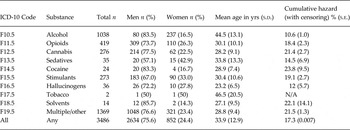
Table 1 shows the gender distribution of new diagnoses of SIPD by substance subcategory, mean and standard deviation (s.d.) of age at first admission and cumulative hazard (%) of diagnosis schizophrenia (F20). The overall male/female ratio was 3.1:1, with an average age of 33.7 years (s.d. = 12.9), and an average length of stay in hospital of 31.1 days (s.d. = 444.0). A total of 517 patients (14.8%) were subsequently admitted to hospital with a diagnosis of schizophrenia (F20). This group had a significantly higher male/female ratio of 5.5:1, compared with those who were not later admitted with such a diagnosis (N = 2969; male/female ratio 2.8:1); χ2(1, N = 3486) = 26.43, p < 0.0001. They also had a statistically significant younger age of first presentation: 28.3 years (s.d. = 10.1) v. 34.6 years (s.d. = 13.1); t(852) = 12.63, p < 0.0001. Mean admission was also longer for those later diagnosed with schizophrenia: 40.5 days (s.d. = 188.4) v. 27.5 days (s.d. = 142.2), but this was not statistically significant; t(1886) = −0.91, p = 0.361.
Summary of patient demographics and risk of conversion (cumulative hazard) to diagnosis of schizophrenia (F20) across specific substance sub-groups

Whole-sample transition rate and mean time to change to schizophrenia
Kaplan–Meier survival analysis with censoring over the 15.5-year period revealed the mean survival time from first recorded diagnosis of SIPD to specific diagnosis of schizophrenia to be 13.4 years (95% CI 13.2–13.5). The cumulative hazard rate was 17.3% (s.e. = 0.007). Examination of covariates found that male gender, length of first admission (>14 days) and age at first admission (<30 years) were significant risk factors, with hazard ratios of 1.6 (95% CI 1.3–2.0), p < 0.0001, for male sex, 2.0 (95% CI 1.7–2.4), p < 0.0001, for longer first admission, and 4.8 (95% CI 3.9–5.8), p < 0.0001, for younger age at first admission. None of the specific substances were significant risk factors to the development of schizophrenia in this regression analysis.
Looking at those who later went on to a diagnosis of schizophrenia as a group, the mean time to change in diagnosis was 2.5 years (s.d. 2.6) and the median time to change in diagnosis was 1.7 years (range 0–13.5 years). 38.5% had converted within 1 year of first presentation SIP and the conversion rates at 2, 3, 4 and 5 years were 55.3, 69.1, 77.4 and 82.8%, respectively.
Demographic and clinical variables associated with specific substances and subsequent diagnostic change to schizophrenia
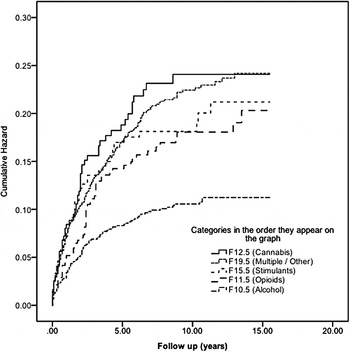
As summarised in Table 1, and illustrated by Fig. 1, which shows time to change from SIPD to a diagnosis of schizophrenia, the 15.5-year cumulative hazard rate to diagnosis was 21.4% (s.e. 2.7) for persons with previous cannabis-induced psychosis. For stimulant-induced psychosis the rate was 19.1% (s.e. 2.7) and for those with opioid-induced psychosis the rate was 18.4% (s.e. 2.3). The hazard rate was 10.6% (s.e. 1.0) for persons originally diagnosed as having alcohol-induced psychosis (n = 1038) and 21.5% (s.e. 1.3) for those with multiple/other substance-induced psychosis (n = 1369). Sedative-, cocaine-, hallucinogen-, tobacco- and solvent-induced psychosis groups were too small to allow meaningful interpretation and are therefore not shown in Fig. 1. However, it is worth noting a high conversion rate in the cocaine group (23.8%, s.e. 9.5) and a low conversion rate in the hallucinogen group (12%, s.e. 5.7).
Hazard function with censoring illustrating time to change from SIP to schizophrenia in a cohort of patients first-ever admitted to any Scottish psychiatric hospital between January 1997 and July 2012 subdivided by substance attributed to psychotic episode.

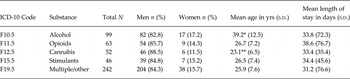
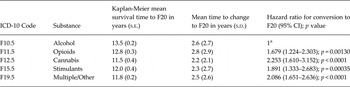
Between-group comparisons of the five largest groups (alcohol-, opioid-, cannabis-, stimulant- and multiple/other drug-induced-SIPD) who subsequently received a diagnosis of schizophrenia are shown by Tables 2 and 3. Table 2, illustrating between-group demographics, shows broad similarities across the groups in terms of gender distribution and mean length of stay. Those who developed schizophrenia following an alcohol-induced psychosis were significantly older at first SIPD episode when compared with the other groups, with a mean time to diagnosis of between 11.5 and 13.5 years (Kaplan–Meier survival analysis, with censoring). Those diagnosed with schizophrenia after a cannabis-induced psychosis were significantly younger, with a mean time to diagnosis of between 2.2 and 2.8 years. Table 3 shows between-group comparisons of outcomes. The risk of developing schizophrenia was significantly greater for all of the other groups when compared with the alcohol-induced psychosis group, where the risk was lowest. Between group comparisons for the risk of opioid, cannabis, stimulant and multiple/other drug-induced episodes of psychosis leading to schizophrenia showed no significant differences.
Between group demographics and length of inpatient stay for selected cohorts who received a subsequent diagnosis of schizophrenia (F20)

*Significantly older than all other groups: p < 0.0001.
**Significantly younger than all other groups: p < 0.0001 for alcohol, p = 0.005 for opioids, p = 0.018 for stimulants, p = 0.007 for multiple/other.
Between group comparisons of outcome measures for selected cohorts who received a subsequent diagnosis of schizophrenia (F20)

a A hazard ratio of one indicates the comparator group.
Discussion
In the present study, conversion to schizophrenia was estimated at 17.3% of those presenting with SIPD. Systematic reviews of studies in which clinical ultra-high-risk groups are examined found the risk of conversion to be higher, at between 30% and 40% over 2- to 3-year follow-up (Gee & Cannon, Reference Gee and Cannon2011; Fusar-Poli et al. Reference Fusar-Poli, Bonoldi, Yung, Borgwardt, Kempton, Valmaggia, Barale, Caverzasi and McGuire2012). These studies generally focus on young people, those with sub-syndromal symptoms or high genetic risk, and with broader definitions of schizophrenia spectrum disorder outcomes, whereas our population included older patients experiencing psychotic symptoms in the context of both alcohol and drug misuse.
A number of possible mechanisms may underlie this association. Certain psychoactive substances may alter brain function, perhaps by altering dopamine receptor sensitivity (Paparelli et al. Reference Paparelli, Di Forti, Morrison and Murray2011), leading to psychotic illness. It may be that those who experience an acute episode of psychosis when using certain substances are already inherently vulnerable to the development of chronic psychotic illnesses (Caton et al. Reference Caton, Hasin, Shrout, Drake, Dominguez, First, Samet and Schanzer2007; Paparelli et al. Reference Paparelli, Di Forti, Morrison and Murray2011; Bramness et al. Reference Bramness, Gundersen, Guterstam, Rognli, Konstenius, Loberg, Medhus, Tanum and Franck2012). Indeed, there is evidence for common genetic mutations in those who experience psychotic symptoms in response to amphetamines and those with schizophrenia (Ikeda et al. Reference Ikeda, Okahisa, Aleksic, Won, Kondo, Naruse, Aoyama-Uehara, Sora, Iyo, Hashimoto, Kawamura, Nishida, Miyagawa, Takeda, Sasaki, Tokunaga, Ozaki, Ujike and Iwata2013), and there is evidence that individuals with a diagnosis of schizophrenia are more likely to become acutely psychotic with amphetamines than those without (Lieberman et al. Reference Lieberman, Kane, Gadaleta, Brenner, Lesser and Kinon1984). Alternatively, the ability of substances to induce acute psychotic symptoms in patients who subsequently develop a chronic psychosis may reflect a prodromal syndrome (Bramness et al. Reference Bramness, Gundersen, Guterstam, Rognli, Konstenius, Loberg, Medhus, Tanum and Franck2012), or that psychoactive substances are being used to self-medicate symptoms of an emerging chronic psychosis (Chambers et al. Reference Chambers, Krystal and Self2001).
Considering the risk of transition associated with specific substances, the cumulative hazard for conversion from diagnosis of cannabis-induced psychosis to schizophrenia in this study was 21.4%. Other studies have found higher rates – 46% in the Finnish study (Niemi-Pynttari et al. Reference Niemi-Pynttari, Sund, Putkonen, Vorma, Wahlbeck and Pirkola2013) and 44.5% in the Danish study (Arendt et al. Reference Arendt, Rosenberg, Foldager, Perto and Munk-Jorgensen2005) – possibly, in part, because they used the broader outcome of schizophrenia spectrum disorder (see other online Supplementary Material). It has been proposed that these higher rates suggest that cannabis-induced psychosis tends to occur more frequently in patients with a predisposition to developing schizophrenia (Kittirattanapaiboon et al. Reference Kittirattanapaiboon, Mahatnirunkul, Booncharoen, Thummawomg, Dumrongchai and Chutha2010). Cannabis may be an independent risk factor both for the development of psychotic symptoms and psychotic disorder in vulnerable groups, including individuals who use cannabis during adolescence, those who have previously experienced psychotic symptoms, and those at high genetic risk of developing schizophrenia (Semple et al. Reference Semple, McIntosh and Lawrie2005). We found that cannabis-induced psychotic disorder was not a specific risk factor to the development of schizophrenia; rather those who experienced an episode that converted to schizophrenia were significantly younger than any of the other groups. Earlier age of exposure to cannabis is also known to increase the chances of later development of schizophrenia (Rubino et al. Reference Rubino, Zamberletti and Parolaro2012). Higher rates of conversion in those who present with cannabis-induced psychotic disorder may relate to exposure to cannabis during a vulnerable period in adolescence and early adulthood, when there may be disruption of maturational events within the endocannabinoid system. The possibility that the endocannabinoid system may have an aetiological role in the development of schizophrenia merits further investigation (Murray et al. Reference Murray, Paparelli, Morrison, Marconi and Di Forti2013).
The cumulative hazard rates for development of schizophrenia in opiate-induced (18.4%) and stimulant-induced (19.1%) psychotic disorder groups were also lower than in the Finnish cohort (Niemi-Pynttari et al. Reference Niemi-Pynttari, Sund, Putkonen, Vorma, Wahlbeck and Pirkola2013), which again may be partly related to the broader definition of schizophrenia spectrum disorder used in that study. We likewise found the lowest chance of conversion to schizophrenia to be in the alcohol-induced psychotic disorder group, with a cumulative hazard of 10.6%. The Finnish study found a lower probability of around 5%, despite the broader schizophrenia spectrum disorder diagnosis (Niemi-Pynttari et al. Reference Niemi-Pynttari, Sund, Putkonen, Vorma, Wahlbeck and Pirkola2013), but their sample was of 15 787 individuals compared to 1038 in our population, and the patterns of alcohol misuse or the diagnostic practice of labelling an episode as alcohol-induced psychotic disorder may differ between Finland and Scotland. Nevertheless, both studies found this group of patients to be relatively older, and previous studies (Schuckit, Reference Schuckit1983) have not found psychotic symptoms in the context of alcohol misuse to be associated with a family history of schizophrenia, suggesting that alcohol-induced psychotic disorder may be aetiologically distinct from schizophrenia.
The largest group in our study was the ‘multiple/other substance’ group (n = 1369). This group was very similar to the cannabis-induced psychotic disorder group in terms of age, gender, length of stay, and cumulative hazard to development of schizophrenia (21.5% v. 21.4%). It is likely that ‘multiple/other substances’ will include cannabis (Arias et al. Reference Arias, Szerman, Vega, Mesias, Basurte, Morant, Ochoa, Poyo and Babin2013) and this may explain the apparent similarities. It is equally possible that exposure to multiple psychoactive substances elevates the risk of developing a psychotic disorder to a similar extent as cannabis. Additionally, NPSs are neither routinely screened for, nor is NPS-induced psychotic disorder coded separately, and therefore psychotic episodes caused by NPS (Zawilska & Wojcieszak, Reference Zawilska and Wojcieszak2013; Helander et al. Reference Helander, Backberg, Hulten, Al-Saffar and Beck2014) may fall within the F19.5 category.
The main gender differences were the higher proportion of men in the alcohol-induced psychotic disorder group and the higher proportion of women in the stimulant-induced psychotic disorder group, compared with other substances. This reflects known patterns of drug and alcohol misuse in the general population (European Monitoring Centre for Drugs and Drug Addiction, 2005). Interestingly these differences did not carry over into the groups who went on to develop schizophrenia after alcohol- or stimulant-induced psychosis. Gender ratios for all of these groups were not significantly different. Male gender was a risk factor to development of schizophrenia and schizophrenia spectrum disorders in the survival analyses and this is a finding that is replicated across all studies looking at risk factors to development of schizophrenia (Fusar-Poli et al. Reference Fusar-Poli, Bonoldi, Yung, Borgwardt, Kempton, Valmaggia, Barale, Caverzasi and McGuire2012).
Those who developed schizophrenia were younger (28.3 v. 34.6 years) at the time of first episode SIPD than those who did not, and being under 30 years old was a significant risk factor in the survival analysis, increasing the chances of developing schizophrenia by almost a factor of five. This may reflect a detrimental effect of exposure to psychoactive substances during critical periods of neuronal maturation.
The alcohol-induced psychotic disorder group was significantly older than the other groups. Studies have suggested early age of onset of alcohol dependence and chronic alcohol use are a necessary prerequisite to the development of alcohol-induced psychotic disorder (Perala et al. Reference Perala, Kuoppasalmi, Pirkola, Harkanen, Saarni, Tuulio-Henriksson, Viertio, Latvala, Koskinen, Lonnqvist and Suvisaari2010). There is also evidence that the specific functional changes associated with alcohol-induced psychosis are different from those associated with schizophrenia (Jordaan et al. Reference Jordaan, Warwick, Nel, Hewlett and Emsley2012). It would be interesting, therefore, to examine the nature of alcohol-related psychosis as it seems likely that it is aetiologically distinct from schizophrenia. As well as tending to present in later life, it is less likely to be associated with schizophrenia and interventions aimed at tackling symptoms such as alcoholic hallucinosis may involve additional strategies to the use of antipsychotics (Jordaan et al. Reference Jordaan, Warwick, Nel, Hewlett and Emsley2012).
The ICD-10 (World Health Organization, 1992) and DSM-5 (American Psychiatric Association, 2013) diagnostic guidelines, along with other studies (Lambert et al. Reference Lambert, Conus, Lubman, Wade, Yuen, Moritz, Naber, McGorry and Schimmelmann2005; Tucker, Reference Tucker2009), suggest that the longer the index admission – a proxy for severity – the greater the likelihood of conversion to schizophrenia or related psychoses. No such association was found in the Finnish study (Niemi-Pynttari et al. Reference Niemi-Pynttari, Sund, Putkonen, Vorma, Wahlbeck and Pirkola2013) and although we did not find a statistical difference between the length of stay in hospital when comparing those who converted to schizophrenia with those who did not, we did demonstrate that length of stay greater than 14 days doubled the chances of developing schizophrenia in the survival analysis.
The present study had a number of limitations. The ISD database covered only data regarding hospital admissions in Scotland. We could not exclude the possibility of any previous presentation with SIPD to mental health services outside Scotland, any previous presentation with SIPD or any subsequent psychotic relapse, which may not have required hospital admission or which may have led to hospital admission outside Scotland, and we had no information regarding deaths occurring during the follow-up period. While it is not possible to categorically state that only first admission cases were included, as the ICD-10 codes used were only introduced in 1997, admission status was recorded in the same way prior to this, minimising the possibility that patients with admissions prior to 1997 were included. Diagnostic accuracy is a common problem with administrative data since clinical diagnoses cannot be verified or validated. It is unlikely that this constitutes a major problem in the current study since the uniformity of psychiatric training across Scotland and our large national cohort will have minimised the impact on the results of any diagnostic discrepancies. It would have been useful to have had additional clinical details relating to the nature of the psychotic symptoms experienced but this was beyond the scope of the available data. Such additional clinical data would have allowed more detailed examination of any specific relationship between particular clinical characteristics of SIP and progression to schizophrenia. Additionally, these data did not include information on demographic factors such as employment status, socio-economic class or level of education which may have had some impact on long-term prognosis. The nature of the available data meant that any confirmation of the associated substances by drug screening was not recorded. It is unlikely that a diagnosis of a specific substance related psychotic episode would have been made without such confirmation. This may explain the fact that the largest category was ‘multiple/other substances’ psychotic disorder, which may have been used as the default diagnosis for any unconfirmed cases where drugs were clearly implicated. It is also possible that this was the largest category simply because patients were taking several substances and it was not possible to determine which of these substances caused the episode of SIPD.
The nature of the study design also precluded analysis of any confounding effect that potential therapeutic interventions may have exerted on the observed outcomes. This would include pharmacological, psychological and social interventions. Of note, there has been a decline in psychiatric inpatient beds across Scotland over the study period and the potential shortening of duration of hospitalisation following the introduction of home treatment services in some areas may have biased the average length of hospital stays. However, given that SIPD episodes tend to be short-lived and typically florid, it is questionable whether such changes in healthcare provision would have significantly impacted on the clinical management, particularly of first-episode cases. Other than this general reduction in numbers of admissions, it is not possible to say if there were trends in the types of patients admitted to Scottish hospitals during the study period.
Current evidence shows that substance misuse disorders are common in those with first episode psychosis (Tucker, Reference Tucker2009), have a detrimental impact on outcome (Lambert et al. Reference Lambert, Conus, Lubman, Wade, Yuen, Moritz, Naber, McGorry and Schimmelmann2005), and a significant effect on drop-out rates from follow-up (Crebbin et al. Reference Crebbin, Mitford, Paxton and Turkington2009). Early interventions for psychosis that include addressing the issue of substance misuse may have a positive impact on longer-term outcomes (Lambert et al. Reference Lambert, Conus, Lubman, Wade, Yuen, Moritz, Naber, McGorry and Schimmelmann2005). Our data suggest that these interventions ought to span at least two or perhaps 5 years after first presentation of SIPD to aid identification of half or three-quarters of those who will develop schizophrenia.
These data suggest that about 17% of those presenting with an acute SIPD transition to schizophrenia within 5 years. With this in mind, future research should address those clinical variables that could predict those at elevated risk of subsequently developing schizophrenia following an episode of SIP, and what ought to comprise the essential elements of a effective treatment plan to reduce that risk.
In summary, these data suggest that psychotic disorder episodes associated with use of cannabis, amphetamine, opioids or multiple/other substances requiring hospital admission are more likely to be associated with later diagnosis of schizophrenia than psychoses caused by alcohol. Lengthy follow-up periods of about 5 years are needed to detect the one in six individuals who will ultimately develop schizophrenia or a related psychotic disorder. Risk factors include male gender, early age of first presentation with SIPD and admission for SIPD lasting over 2 weeks.
Supplementary material
The supplementary material for this article can be found at https://doi.org/10.1017/S0033291717001118.
Acknowledgements
This research received no specific grant from any funding agency, commercial or not-for-profit sectors.
Declaration of Interest
SML has received personal fees from Forum and Janssen and Sunovion, grants and personal fees from Roche, and a grant from Abbvie, outside the submitted work. None of the other authors declared any conflicts of interest.