Introduction
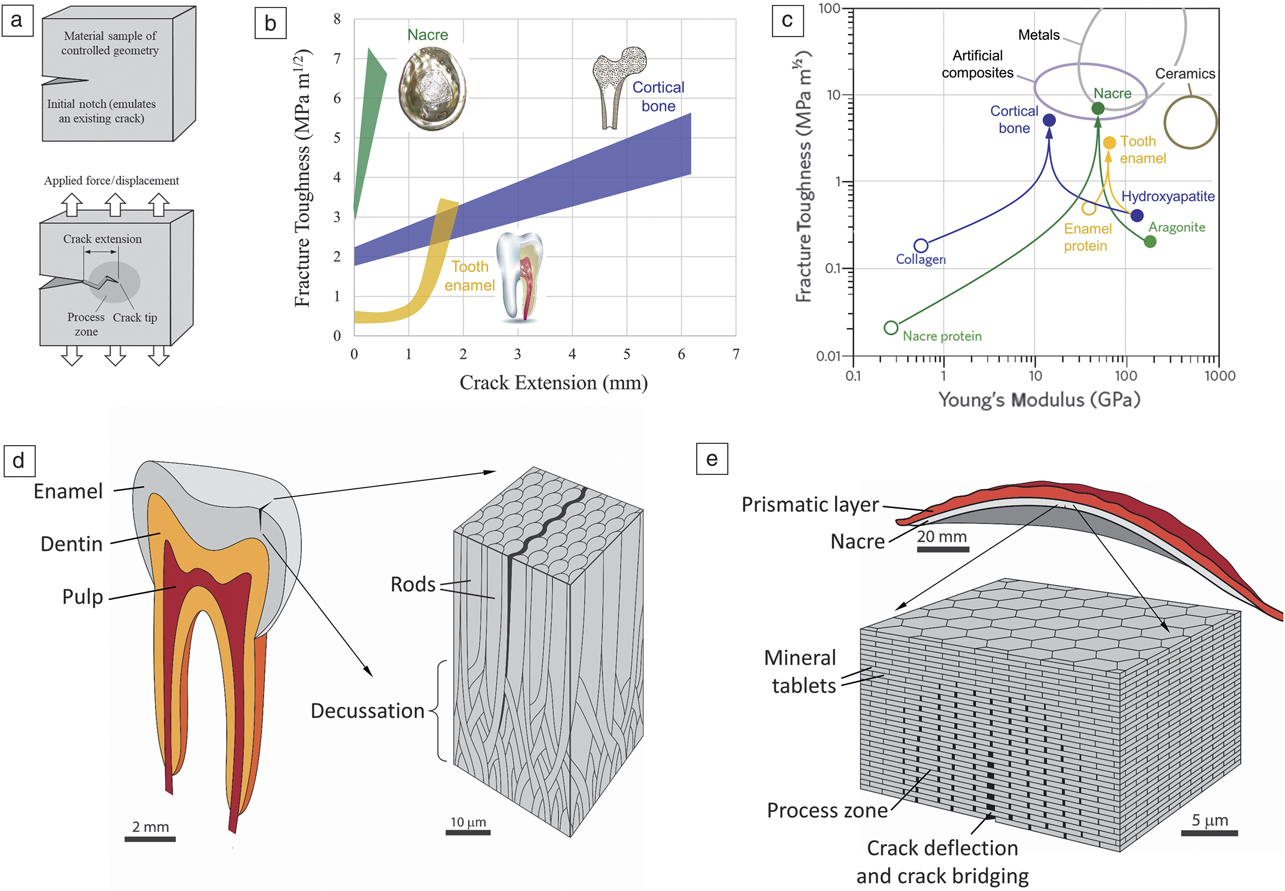
Nature is well ahead of engineers in terms of sophistication and efficiency in making tough materials.Reference Fratzl and Weinkamer1 While stiff materials are generally hard,Reference Ashby2 high toughness usually comes at the expense of hardness.Reference Ritchie3 Fracture toughness, the ability of a material to resist crack propagation, is critical to achieve high tensile strength, reliability, robustness, damage tolerance, and notch performance (i.e., the suppression of stress concentrations at the notch to delay failure). Fracture toughness is measured by mechanically loading a sample to propagate a crack from an initial notch (Figure 1a). Depending on the loading condition, sample geometry, and material, crack propagation may be stable or unstable (catastrophic), and it may follow a straight or convoluted path.
(a) Measuring fracture toughness by propagating a crack in a well-controlled material sample and conditions. (b) Crack-resistance curves for nacre,Reference Mayer6 bone,Reference Ballarini, Kayacan, Ulm, Belytschko and Heuer7 and tooth enamel.Reference Barthelat8 (c) Fracture toughness-modulus chart showing data for bone, nacre, and tooth enamel, highlighting the toughness amplification over their constituents.Reference Ashby2,Reference White, Luo, Paine, Fong, Sarikaya and Snead11–Reference Ge, Cui, Wang and Feng13 Data for various synthetic materials are also included for reference. (d) The architecture of human tooth enamel channels surface cracks deeper into the material and into trapping configurations. In the deeper regions of enamel, the microarchitecture is arranged in complex 3D “criss-crossing” patterns (decussation) of enamel rods that promote crack arrest. (e) The “brick-and-mortar” architecture of nacre from mollusk shell impedes crack propagation through crack deflection, crack bridging, and nonlinear deformations (process zone toughening).

Figure 1b shows typical crack-resistance curves for nacre from mollusk shells, for human cortical bone, and for human tooth enamel. In these materials, the toughness increases as the crack advances, and the maximum toughness is 2–6 times higher than the crack initiation toughness. This rise in crack resistance (or “R-curve behavior”) is due to powerful toughening mechanisms such as process zone toughening and crack bridging that are activated upon crack propagation. Rising crack resistance is key to damage tolerance, because any crack that may propagate from defects or microdamage in the material will be immediately stabilized. The toughness of these biological materials is similar to high performance engineering ceramics (for comparison the toughness of aluminum oxide is about 3.5 MPa m1/2),Reference Lawn4 which is striking considering that hard biological materials are built from relatively weak components: soft biopolymers (proteins, polysaccharides) and biominerals (calcium carbonate, hydroxyapatite). While many engineering materials (metals, composites) are stiffer and tougher than natural materials, the “amplification” of toughness found in natural materials compared to their based constituents is currently not matched by any engineering materialsReference Sarikaya and Aksay5–Reference Wegst, Bai, Saiz, Tomsia and Ritchie10 (Figure 1c).Reference Ashby2,Reference White, Luo, Paine, Fong, Sarikaya and Snead11–Reference Ge, Cui, Wang and Feng13
Toughening mechanisms in biological materials
A multitude of compositions, architectures, and fracture mechanisms have been reported in biological materials over the past 30 years. More recent efforts have identified construction rules and micromechanisms, which are universal in the biological worldReference Naleway, Porter, McKittrick and Meyers14 and transcend the boundaries of the animal species.
Building blocks and architecture
In mineralized tissues, minerals are in the form of building blocks that are joined by softer interfaces and matrices, forming complex three-dimensional (3D) architectures. A notable example is nacre, the material of pearls, which is commonly found on the inner shell layer of many mollusks and snails. In nacre, the mineral building blocks are microscopic aragonite tablets joined by nanometer-thick biopolymer mortar to form a 3D brick wall (Figure 1e). In tooth enamel, the building blocks are long hydroxyapatite rods approximately 5 μm in diameter and generally perpendicular to the tooth surfaces, joined by a small fraction of softer proteins (Figure 1d). These architectures are produced through natural growth processes that are tightly controlled and inherently repeatable. A primary contributor to the stiffness and hardness of mineralized materials is the volume concentration of the mineral building blocks—intermediate in bone (about 60 vol% mineral content), high in mollusk shells (95%), and extremely high in tooth enamel (96–99%), which is the hardest tissue in the human body.Reference Nanci and Ten Cate15 These high concentrations make fracture of the mineral blocks more likely, yet it must be avoided or delayed as fracture within the brittle mineral building blocks decreases the overall macroscopic toughness. A critical role of the interfaces is to deflect and channel propagating cracks to prevent them from penetrating into the mineral blocks.
Weak interfaces and nanoscale ductility
In general, a propagating crack that crosses an interface may deflect into that interface, provided it is sufficiently “weak.” The exact criterion for relative weakness may be defined as low toughness relative to the bulk,Reference He and Hutchinson16 low strength ratio,Reference Barthelat, Dastjerdi and Rabiei17 or a combination of the two.Reference Parmigiani and Thouless18 Weak interfaces are indeed ubiquitous in hard biological materials.Reference Barthelat, Yin and Buehler19 For example, the interfaces in nacre have a measured mode I fracture toughness of only about 10 J m–2,Reference Mayer6,Reference Dastjerdi, Rabiei and Barthelat20,Reference Currey21 which is about 100 times lower than the toughness of nacre across the direction of the aragonite tablets.Reference Rabiei, Bekah and Barthelat22 Shearing of the interfaces, however, leads to high-energy dissipation,Reference Jackson, Vincent and Turner23– Reference Barthelat, Tang, Zavattieri, Li and Espinosa25 which is critical to toughness. This nanoscale ductility in nacre is made possible by strong adhesion to the mineral phase and by molecular mechanisms such as the breakage of sacrificial bonds enabling large deformations in the interfaces at the nanoscale.Reference Smith, Schäffer, Viani, Thompson, Frederick, Kindt, Belcher, Stucky, Morse and Hansma26 Such weak interfaces also pack the microstructures of enamel, bone,Reference Poundarik and Vashishth27,Reference Fantner, Hassenkam, Kindt, Weaver, Birkedal, Pechenik, Cutroni, Cidade, Stucky and Morse28 tendons,Reference Ker29 fish scales,Reference Currey30 and arthropod shells.Reference Zimmermann, Gludovatz, Schaible, Dave, Yang, Meyers and Ritchie31
Collective mechanisms for toughness
Crack deflection by itself does not always produce high toughness.Reference Clegg, Kendall, Alford, Button and Birchall32 Tough biological materials rely on crack deflection, but only to initiate richer and more powerful arrays of toughening mechanisms. One of these mechanisms is crack bridging, where intact building blocks interact across the crack faces and exert a closure force, effectively increasing toughness.Reference Ritchie, Buehler and Hansma33– Reference Bajaj and Arola35 For example, in tooth enamel, cracks initiated from the surface by high contact stresses are channeled along the mineral rods in a relatively straight and unimpeded path. In deeper regions, the rods crisscross in complex 3D decussation patterns,Reference Macho, Jiang and Spears36 which impede further crack growth by a series of crack deflection and crack bridgingReference Bajaj and Arola35 and prevent tooth chipping (Figure 1d). This “crack trapping” mechanism is responsible for the sudden rise in the crack-resistance curve shown in Figure 1b. Similar mechanisms are found in conch shells, another example of a highly mineralized biological material (>99 vol%).Reference Kamat, Su, Ballarini and Heuer37
Nacre also partially relies on crack bridging and pullout of mineral tablets (Figure 1e), but in addition, high stresses force the tablets to slide on one another over large volumes (in the order of mm3) around cracks, which is promoted by the progressive jamming of the tablets.Reference Barthelat, Tang, Zavattieri, Li and Espinosa25 As the crack propagates, this volume undergoes an inelastic loading/unloading cycle, which dissipates a tremendous amount of energy via deformation of the biopolymer and frictional interactions between mineral asperities covering the tablets.Reference Wang, Suo, Evans, Yao and Aksay24 Process zone toughening has been demonstrated to be the main toughening mechanisms for nacre,Reference Barthelat and Rabiei34 making it several orders of magnitude tougher than aragonite.Reference Rabiei, Bekah and Barthelat22,Reference Wang, Suo, Evans, Yao and Aksay24 In these mechanisms, the high deformability of the interfaces is likely its most important property.Reference Barthelat and Rabiei34
Bone is an even more complex material, where multiple toughening mechanisms occur at different length scales concurrently,Reference Ritchie, Buehler and Hansma33 including nanoscale ductility,Reference Poundarik, Diab, Sroga, Ural, Boskey, Gundberg and Vashishth38,Reference Gupta, Wagermaier, Zickler, Raz-Ben Aroush, Funari, Roschger, Wagner and Fratzl39 bridging and pullout of individual fibers,Reference Fantner, Hassenkam, Kindt, Weaver, Birkedal, Pechenik, Cutroni, Cidade, Stucky and Morse28 crack deflection and bridging at the lamellar level,Reference Peterlik, Roschger, Klaushofer and Fratzl40 and crack deflection along the cement lines.Reference Koester, Ager and Ritchie41 Bone can be understood as a hierarchical integration of structural building blocks connected by weak interfaces that can channel deformation and cracks over multiple length scales.Reference Barthelat, Yin and Buehler19,Reference Launey, Buehler and Ritchie42
Bioinspired tough and hard materials
The architectures and mechanisms that nature has evolved to control crack propagation suggest powerful strategies for bioinspired materials that could overcome the inherent brittleness of glasses and ceramics and expand their range of applications.Reference Mayer6,Reference Barthelat8–Reference Wegst, Bai, Saiz, Tomsia and Ritchie10,Reference Sarikaya43,Reference Vincent44 However, despite several decades of research efforts, duplicating the sophisticated features of structural natural materials still presents formidable challenges. Many of these fabrication methods have been aimed at mimicking nacre, which is now the main model for hard bioinspired materials.
Nano- and microcomposites
A simple and intuitive fabrication method consists of dispersing micro- or nano-size platelet-like hard inclusions in a matrix of a softer material. While simple conceptually, early work that used centrifugation, shearing cylinder, spinning plate, or sedimentationReference Almqvist, Thomson, Smith, Stucky, Morse and Hansma45 showed that in practice, aligning elongated tablets in high concentrations is extremely challenging. A variety of newer creative fabrication approaches have since been proposed, including self-assembly,Reference Aksay, Trau, Manne, Honma, Yao, Zhou, Fenter, Eisenberger and Gruner46,Reference Bonderer, Studart and Gauckler47 layer-by-layer deposition,Reference Podsiadlo, Kaushik, Arruda, Waas, Shim, Xu, Nandivada, Pumplin, Lahann and Ramamoorthy48,Reference Podsiadlo, Kaushik, Shim, Agarwal, Tang, Waas, Arruda and Kotov49 freeze casting,Reference Deville, Saiz, Nalla and Tomsia50,Reference Bouville, Maire, Meille, Van de Moortèle, Stevenson and Deville51 magnetic fields,Reference Erb, Libanori, Rothfuchs and Studart52 and templated mineralization.Reference Mao, Gao, Yao, Liu, Cölfen, Liu, Chen, Li, Yan and Liu53
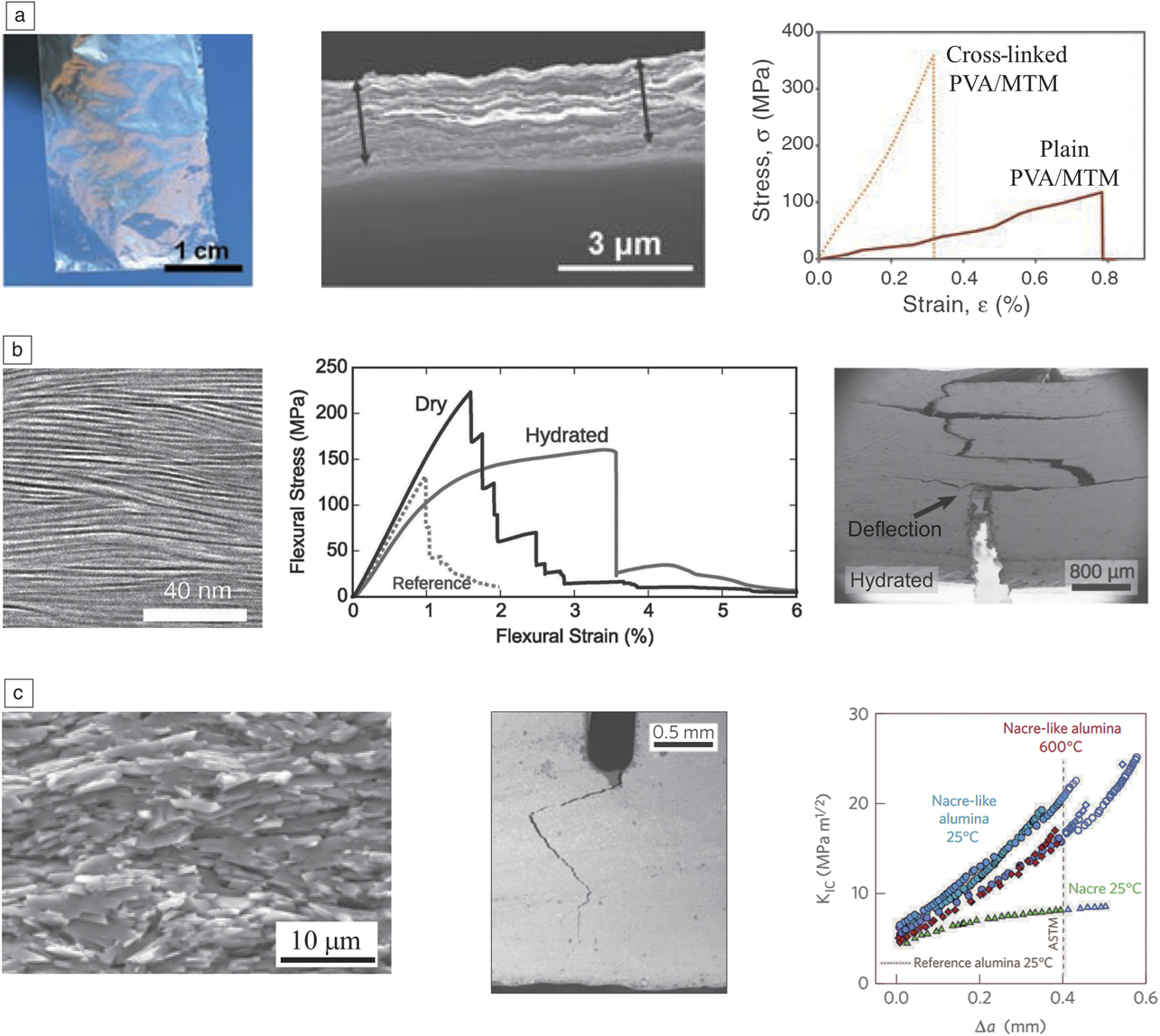
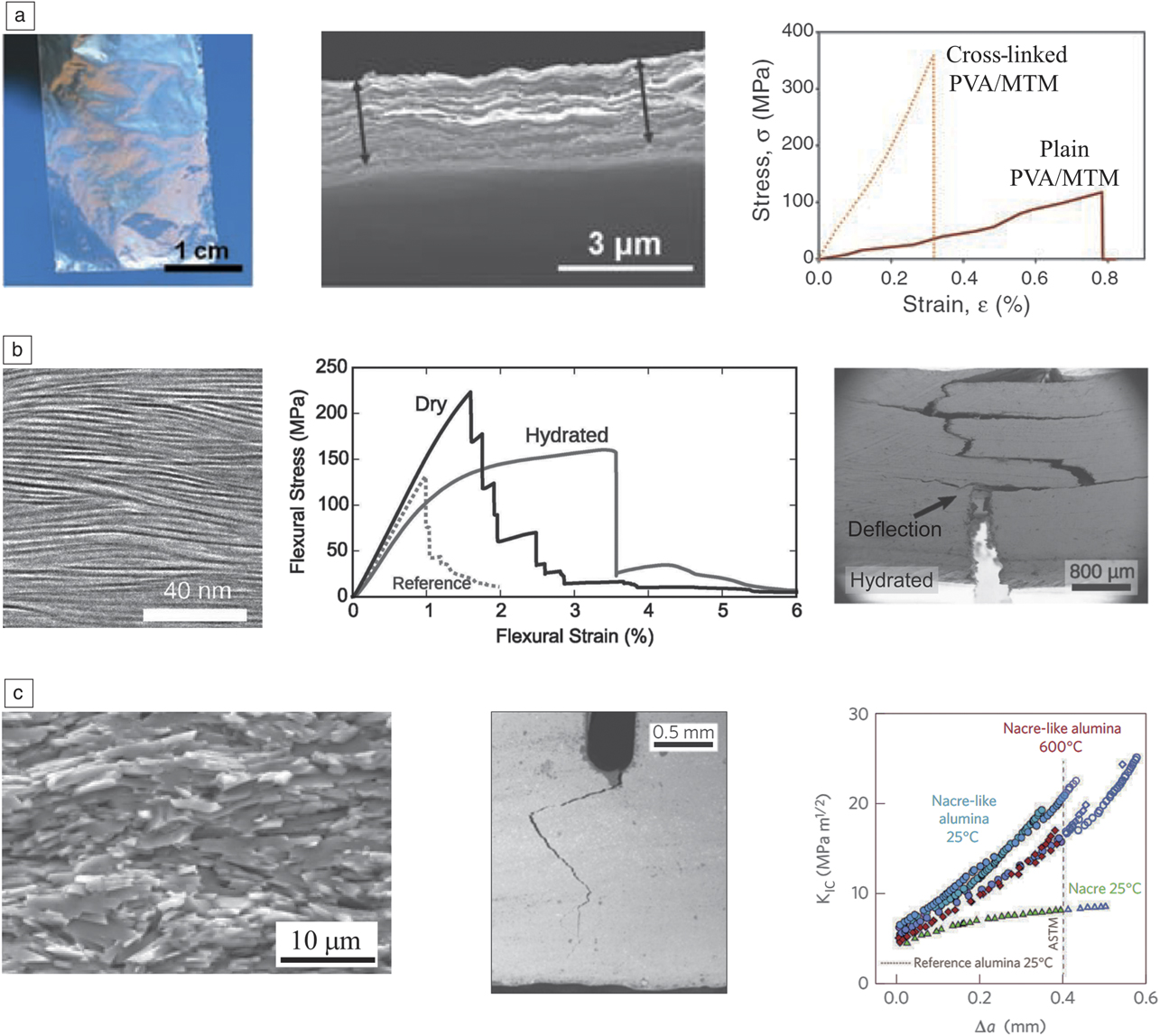
A class of nacre-like materials of their own, such nanocomposites rely on the extremely high strength of nanoscale reinforcements such as montmorillonite clayReference Podsiadlo, Kaushik, Arruda, Waas, Shim, Xu, Nandivada, Pumplin, Lahann and Ramamoorthy48,Reference Podsiadlo, Kaushik, Shim, Agarwal, Tang, Waas, Arruda and Kotov49 for performance. The nanoclays are embedded in more deformable polymers that can be cross-linkedReference Podsiadlo, Kaushik, Arruda, Waas, Shim, Xu, Nandivada, Pumplin, Lahann and Ramamoorthy48 to produce thin films with high strength, but small deformability (Figure 2a). Interestingly, thin films of nanostructured montmorillonite nanoclay/poly(vinyl alcohol) can also be obtained with evaporation-induced self-assembly,Reference Walther, Bjurhager, Malho, Pere, Ruokolainen, Berglund and Ikkala54 and then laminated to form millimeter-thick materials (Figure 2b),Reference Morits, Verho, Sorvari, Liljeström, Kostiainen, Gröschel and Ikkala55 thick enough for flexural tests and through-thickness fracture measurements (KIC = 3.4 MPa m1/2, lower than natural nacre, Figure 1b).
Three examples of nano-/microscale bioinspired composites. (a) A poly(vinyl alcohol) (PVA) and montmorillonite nanoclay (MTM) nanocomposite film obtained by layer-by-layer assembly showing strong but brittle tensile response.Reference Podsiadlo, Kaushik, Arruda, Waas, Shim, Xu, Nandivada, Pumplin, Lahann and Ramamoorthy48 (b) A laminated MTM/PVA nanocomposite showing progressive failure in flexion and multiple crack deflections. Hydrated samples were kept at 75% relative humidity and are shown alongside dry sample for reference. (c) An alumina-glass microcomposite (indicated as “nacre-like” alumina) fabricated using freeze casting that produces extensive crack deflection and high toughness.Reference Bouville, Maire, Meille, Van de Moortèle, Stevenson and Deville51
In addition to nacre-like “brick-and-mortar” nanomaterials, advances in nanotechnologyReference Rogach, Talapin, Shevchenko, Kornowski, Haase and Weller56–Reference Murray, Sun, Gaschler, Doyle, Betley and Kagan58 have also allowed for synthesis of enamel-like structures.Reference Chen, Tang, Liu, Sun, Chang, Peters, Mansfield, Czajka-Jakubowska and Clarkson59– Reference Li, Mao, Wang, Xu, Pan, Deng, Gu and Tang61 These structures rely on self-assembly and growth of artificial apatite into micron-sized rods and have been shown to duplicate the basic morphological features found in the outer enamelReference Chen, Tang, Liu, Sun, Chang, Peters, Mansfield, Czajka-Jakubowska and Clarkson59, Reference Chen, Clarkson, Sun and Mansfield60 where the rods are aligned. Yeom et al. created abiotic enamel using sequential growth of zinc oxide nanowire carpets to form the rods and layer-by-layer deposition of polymeric matrix to form the interfaces.Reference Yeom, Sain, Lacevic, Bukharina, Cha, Waas, Arruda and Kotov62 Their abiotic enamel produced modulus and hardness values similar to those reported in natural enamel, and they qualitatively reproduced the decussating cross-ply structure found in mouse incisors;Reference Cox63 however, toughness measurements were not reported.
“Freeze casting” has also now become a popular choice for the fabrication of ceramic-based bioinspired microcomposites. This approach uses slowly growing crystals of ice as microscopic templates to produce nacre-like microstructures (Figure 2c).Reference Deville, Saiz, Nalla and Tomsia50,Reference Bouville, Maire, Meille, Van de Moortèle, Stevenson and Deville51 The interfaces may be infiltrated with a more ductile phase such as a polymer, a metal,Reference Deville, Saiz, Nalla and Tomsia50,Reference Munch, Launey, Alsem, Saiz, Tomsia and Ritchie64 or even another inorganic phase for high-temperature applications.Reference Bouville, Maire, Meille, Van de Moortèle, Stevenson and Deville51 These methods also allow for the fabrication of nacre-like nanobridges and nanoasperities on the surface of the tablets.Reference Deville, Saiz, Nalla and Tomsia50,Reference Bouville, Maire, Meille, Van de Moortèle, Stevenson and Deville51 These materials display rising crack-resistance curves (Figure 2c) and exceed the stiffness, strength, and toughness of natural nacre.Reference Deville, Saiz, Nalla and Tomsia50,Reference Bouville, Maire, Meille, Van de Moortèle, Stevenson and Deville51
While these newer methods produce highly ordered microstructures, their morphology and architectures are still inferior to that of natural nacre. The toughening mechanisms in nacre-like materials are limited mainly to crack deflection (Figure 2) and some crack bridging. In natural nacre, more powerful mechanisms such as process zone toughening occur over larger length scales (∼.5 mm)—large enough to be visible to the human eye—and amplify the crack resistance well above predictions due to bridging and deflection. So far, there has been no evidence in artificial nacre-like materials that suggest the process zone toughening is active, except for a few prototypes of synthetic nacres with tablets on the order of millimeters.Reference Seyed Mohammad Mirkhalaf and Francois65 Recent numerical studies have shown that given a set of constituents for brick-and-mortar nacre-like structure, perfect periodicity and regularity is indeed required to achieve the highest deformability and toughness.Reference Pro, Lim, Petzold, Utz and Begley66,Reference Abid, Mirkhalaf and Barthelat67 Any statistical variations and imperfections in the architecture of these materials weakens the material and precipitates strain localization and brittle fracture. Therefore, there is a strong incentive for better control of the microarchitecture.
Macrocomposites
A possible approach to circumvent the limitations of small-scale fabrication in terms of microstructural control is to produce structures at a larger scale, which allows for higher-precision control over composition, architectures, and toughening mechanisms. Larger building blocks also represent larger obstacles for cracks, which in general lead to higher fracture toughness.Reference Launey and Ritchie68,Reference Evans69 Millimeter-thick plates of high-performance ceramics can be assembled with polymers to create layeredReference Livanov, Jelitto, Bar-On, Schulte, Schneider and Wagner70 or nacre-likeReference Mayer71 materials with unusually high toughness.
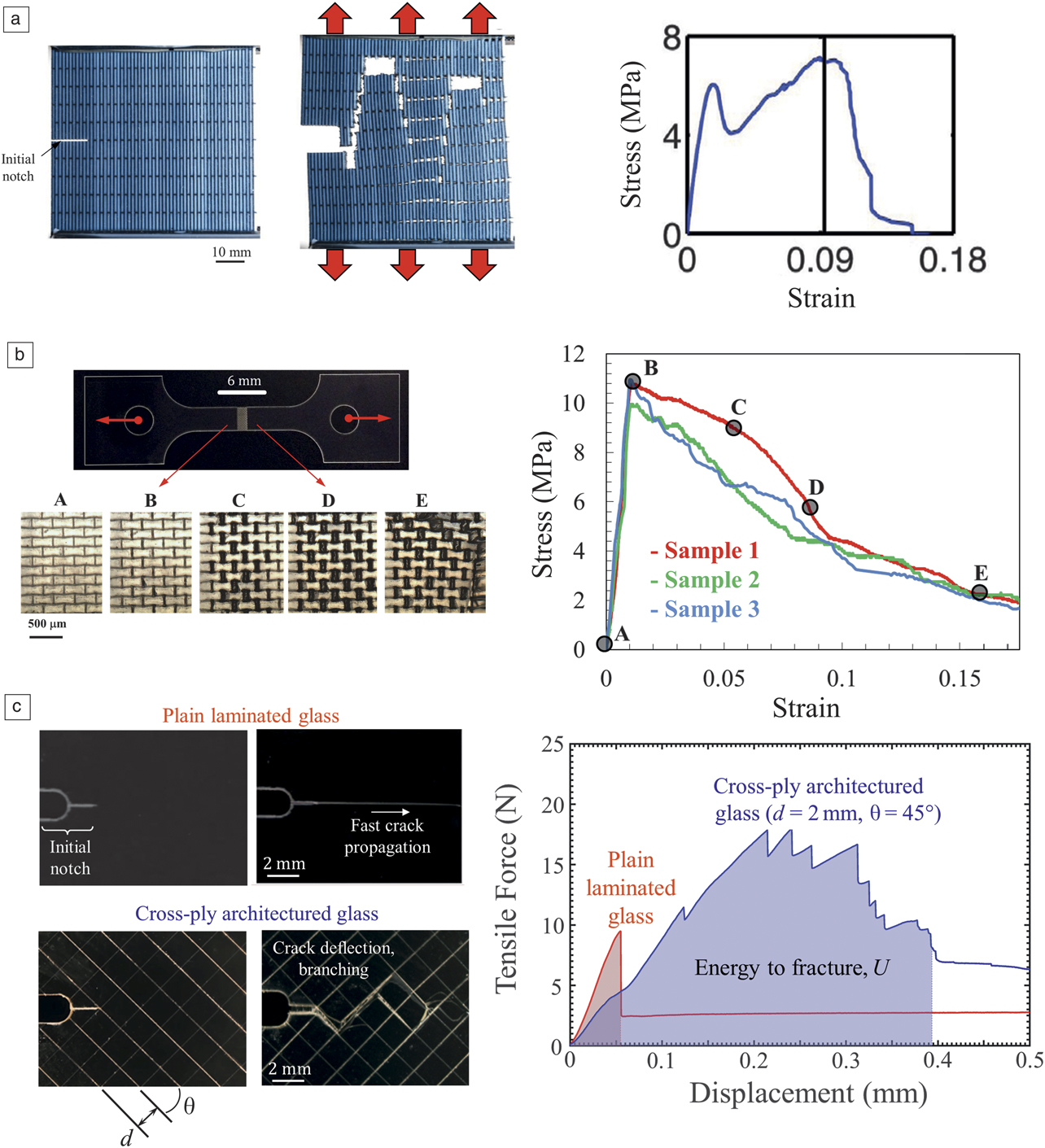
Three-dimensional printing is also a natural choice for the fabrication of large-scale bioinspired materialsReference Stampfl, Seyr, Luxner, Pettermann, Woesz, Fratzl, Aizenberg, Landis, Orme and Wang72 because it enables high spatial fidelity, flexibility, and high throughput, and it has proven to be a powerful tool to explore the mechanics of bioinspired architectured materials.Reference Dimas, Bratzel, Eylon and Buehler73,Reference Espinosa, Juster, Latourte, Loh, Gregoire and Zavattieri74 For example, Dimas et al.Reference Dimas, Bratzel, Eylon and Buehler73 3D printed nacre-like materials with a stiff acrylic polymer for the tablets and used a softer, more deformable urethane for the interfaces (Figure 3a).Reference Dimas, Bratzel, Eylon and Buehler73 In notched tension, the material duplicated all of the key mechanisms in nacre—crack deflection, bridging, and large inelastic deformations over large volumes (Figure 3a). The stress–strain curve in Figure 3a shows the global response for the composite and is nonlinear and nonmonotonic. The accumulation of nonlocalized failure promotes the gradual development of a second peak in the stress–strain curve prior to global failure.
Three examples of macroscale bioinspired composites. (a) Three-dimensional printed nacre-like panels. (b) Laser engraved nacre-like glass, with stress–strain curves shown for three samples fabricated in the same manner. Various stages of deformation are shown in A–E and are indicated in the adjacent stress–strain curves. (c) A laminated glass enriched with a cross-ply architecture is tougher, stronger, and more reliable than traditional laminated glass.Reference Yin, Dastjerdi and Barthelat79 (a) Reprinted with permission from Reference Reference Dimas, Bratzel, Eylon and Buehler73. © 2013 Wiley. (b) Reprinted with permission from Reference Reference Seyed Mohammad Mirkhalaf and Francois65. © 2015 IOP Publishing.
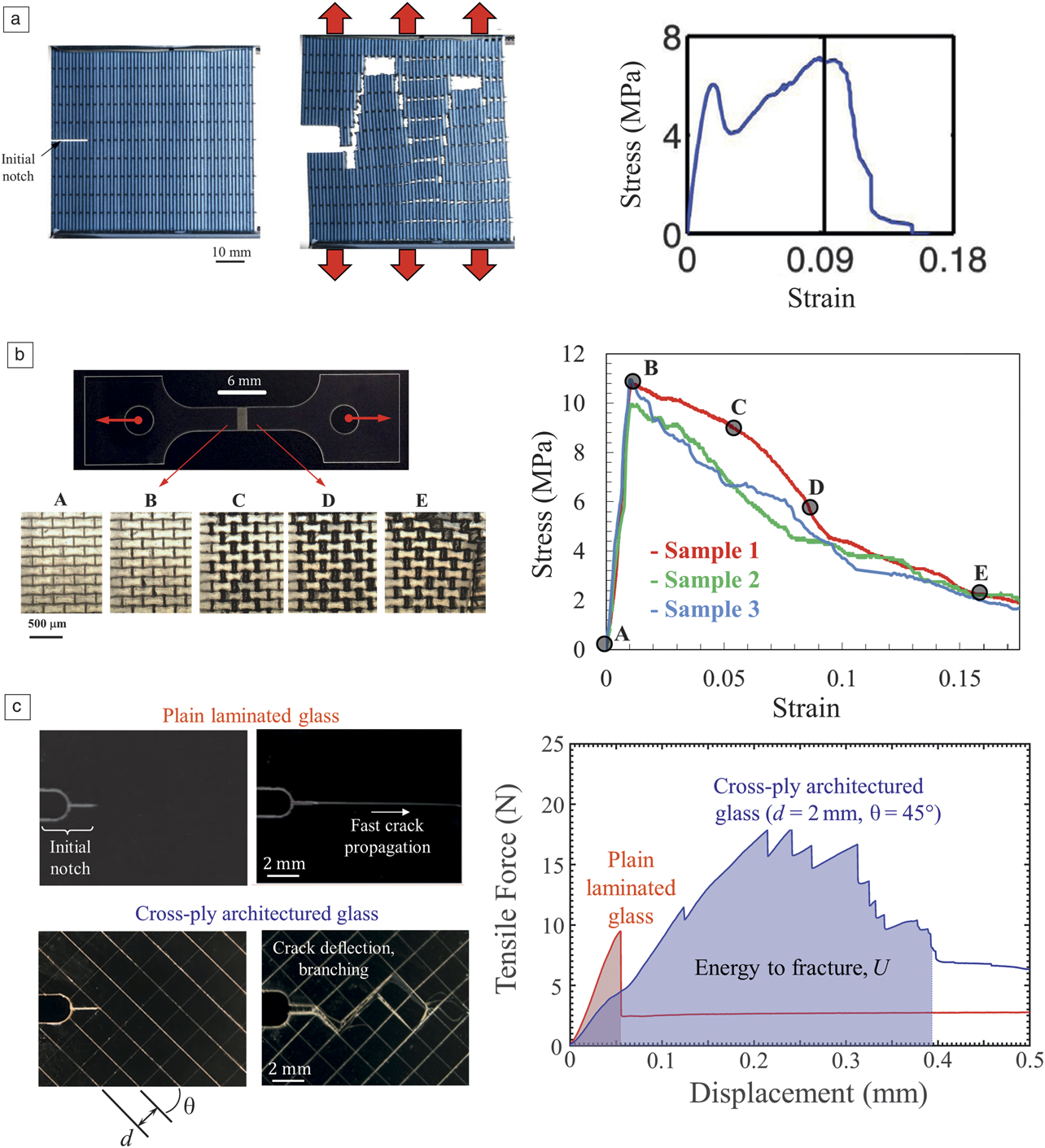
Another method consists of carving interfaces and architectures in glass or ceramics.Reference Mirkhalaf, Dastjerdi and Barthelat75 Sufficiently weak interfaces can deflect and channel cracks, which can be used to control crack propagation. Submillimeter nacre-like glass was fabricated with this method, producing materials with >99 vol% glass content and showing inelastic deformations through tablet sliding, and toughening through tablet bridging and the process zone (Figure 3b).Reference Seyed Mohammad Mirkhalaf and Francois65 Larger-scale fabrication methods also allow materials with long range order, such as cross-plies, where fabrication is extremely challenging at small scales. Photolithographic microfabrication methods have been used to carve cross-ply patterns into multilayer silicon/polymer.Reference Chen, Ballarini, Kahn and Heuer76 The material was 36 times tougher than silicon and showed progressive and “graceful” failure, as indicated by the sharp peaks and valleys in the post-peak softening response (similar to Figure 3c) that decrease on average. The material duplicated delamination and crack bridging, two powerful toughening mechanisms in tooth enamelReference Bajaj and Arola35 and conch shell.Reference Kamat, Su, Ballarini and Heuer37 Other methods to make macroscale cross-ply architectures include co-extrusionReference Karambelas, Santhanam and Wing77 and carbon fiber composite layup.Reference Grunenfelder, Suksangpanya, Salinas, Milliron, Yaraghi, Herrera, Evans-Lutterodt, Nutt, Zavattieri and Kisailus78
Yin et al. enriched laminated glass with cross-ply-like weaker lines that could deflect cracks, initiate crack bridging, and promote inelastic deformation using a similar laser engraving technique to the nacre-like glass. The resulting material is 50 times tougher than regular laminated glass (Figure 3c). Its large deformations (>80% strain) completely suppress stress concentrations, making this bioinspired glass notch insensitive.Reference Yin, Dastjerdi and Barthelat79
In general, the tensile strength of macroscale composites is not as high as their nano- and microscale counterparts, but their toughness is several times greater. The nonlinear process zone in these materials can be so large that traditional fracture testing methods are not possible, with the process zone often breaking through the edge of the sample before the crack starts propagating (work of fracture is then used instead of fracture toughness as a measure of crack resistance). These large-scale energy-dissipation mechanisms, however, make macroscale composites excellent candidates for protective and impact-resistant materials.
Summary and outlook
Natural materials can control deformation and prevent crack propagation and catastrophic failure through specific mechanisms and architectures, which have thus far not been achieved in synthetic materials. Weak interfaces are required so that cracks can interact with the architecture of these materials, a somewhat counterintuitive rule which is a universal theme in natural hard biological materials.Reference Barthelat, Yin and Buehler19 Crack deflection in biological materials initiates powerful mechanisms associated with crack bridging and nonlinear deformations. The precision and effectiveness of toughening mechanisms in natural materials has inspired new composite materials, but their fabrication still presents formidable challenges.
While nacre-like nanocomposites rely on the inherent strength of two-dimensional nanomaterials and on tailored matrix strength, other methods such as freeze casting or sedimentation yield ceramic composites that approach nacre in terms of microstructure and surpass nacre in term of properties. However, the toughness of these materials relies only on crack deflection, and more powerful toughening mechanisms associated with nonlinear mechanisms could not be duplicated, which is likely due to the lack of regularity in the structure of these materials. Large-scale fabrication methods are a promising strategy leading to macrocomposites with high morphological fidelity and high toughness. There is an opportunity to exploit the interplay between architecture and the properties of the materials used at the interfaces.Reference Livanov, Jelitto, Bar-On, Schulte, Schneider and Wagner70,Reference Dimas, Bratzel, Eylon and Buehler73,Reference Espinosa, Juster, Latourte, Loh, Gregoire and Zavattieri74
The development of bioinspired and architectured materials is likely to provide exciting and stimulating challenges in mechanics and manufacturing for many years to come.

William Pro is a postdoctoral researcher in the Department of Mechanical Engineering at McGill University, Canada. He received his PhD degree in mechanical engineering in 2016 from the University of California, Santa Barbara, and his BS degree in mechanical engineering in 2010 from the University of Kansas. His research focuses on computational mechanics and algorithm development for modeling crack growth in complex bioinspired materials and engineered multilayers. Pro can be reached by email at will.pro87@gmail.com.

Francois Barthelat is professor of mechanical engineering and a Chwang-Seto Faculty Scholar at McGill University, Canada. He leads the Laboratory for Advanced Materials and Bioinspiration. He received his PhD degree in mechanical engineering in 2005 from Northwestern University, his MSc degree in mechanical engineering in 1998 from the University of Rochester, and his BSc degree in 1997 in mechanical engineering from the École Nationale Supérieure d’Électricité et de Mécanique, France. His research focuses on the mechanical performance of hard biological materials (e.g., seashells, teeth) and on the development of novel bioinspired composites. Barthelat can be reached by email at francois.barthelat@mcgill.ca.