INTRODUCTION
The co-evolution between flowering plants and pollinating insects is widely recognized. However, in spite of many intriguing examples of specialized plant-pollinator adaptations and relationships, most plants and pollinators are generalists and thus most plant-pollinator networks include numerous links (Johnson & Steiner Reference JOHNSON and STEINER2000, Ollerton Reference OLLERTON1996). Certain plant species flower en masse, during a very short time span, which may reduce the chances of getting all flowers pollinated. However, pollinators like social bees which can recruit workers from their colonies are often found to be abundant at these mass flowering plants (Jha & Vandermeer Reference JHA and VANDERMEER2009, Krishnan et al. Reference KRISHNAN, KUSHALAPPA, SHAANKER and GHAZOUL2012, Veddeler et al. Reference VEDDELER, KLEIN and TSCHARNTKE2006). The advanced communication system (waggle dance) of the social honeybee is for example suggested to have evolved because of its benefits in landscapes with patchy, high-quality resources (Donaldson-Matasci & Dornhaus Reference DONALDSON-MATASCI and DORNHAUS2012, Dornhaus & Chittka Reference DORNHAUS and CHITTKA2004).
Human land use not only modifies the extent and distribution of natural environments, but also alters the relative amount of resources for pollinators across time and space. This is particularly evident in agricultural systems with mass-flowering crops (Kovacs-Hostyanszki et al. Reference KOVACS-HOSTYANSZKI, HAENKE, BATARY, JAUKER, BALDI, TSCHARNTKE and HOLZSCHUH2013, Persson & Smith Reference PERSSON and SMITH2013). Human intervention also includes direct modifications of the pollinator community by actively managing and moving bees, especially the honey bee, Apis mellifera L. (Potts et al. Reference POTTS, BIESMEIJER, KREMEN, NEUMANN, SCHWEIGER and KUNIN2010). These kinds of activity will affect the composition of pollinators across landscapes. It is thus important to study pollinators in human-modified landscapes from both an ecological and conservation point of view and because pollinators provide an important ecosystem service to farmers.
In this study we surveyed the pollinator community visiting the mass-flowering perennial crop coffee, Coffea arabica L., in its native range in Ethiopia. The main pollinators of coffee have before only been studied in its introduced range and not in its native range, where the co-evolution between the plant and the pollinators should have occurred (Ngo et al. Reference NGO, MOJICA and PACKER2011). In plantations with coffee most plants flower simultaneously and the entire coffee bloom may be completed within a couple of days (Klein et al. Reference KLEIN, STEFFAN-DEWENTER and TSCHARNTKE2003a, Krishnan et al. Reference KRISHNAN, KUSHALAPPA, SHAANKER and GHAZOUL2012). The short bloom imposes high demands on the pollinator community. Coffea arabica attracts a range of insect pollinators (Ngo et al. Reference NGO, MOJICA and PACKER2011). However, in regions where coffee has been introduced, honeybees (Apis spp.) are often the dominant visitors, even if other eusocial bees are also frequent (Badano & Vergara Reference BADANO and VERGARA2011, Boreux et al. Reference BOREUX, KUSHALAPPA, VAAST and GHAZOUL2013, Klein et al. Reference KLEIN, STEFFAN-DEWENTER and TSCHARNTKE2003a, Ricketts Reference RICKETTS2004, Roubik Reference ROUBIK2002, Vergara & Badano Reference VERGARA and BADANO2009). Higher bee diversity on coffee flowers is associated with low-impact management systems (Vergara & Badano Reference VERGARA and BADANO2009), proximity to natural forests (social bees) and local factors such as higher light intensity (solitary bees) (Klein et al. Reference KLEIN, STEFFAN-DEWENTER, BUCHORI and TSCHARNTKE2002, Reference KLEIN, STEFFAN-DEWENTER and TSCHARNTKE2003a, Reference KLEIN, STEFFAN-DEWENTER and TSCHARNTKEb; Ricketts Reference RICKETTS2004). Thus, our selected study area is of particular interest since we have a gradient in shade tree structure, and both C. arabica and honeybee, A. mellifera, are native and found wild (Anthony et al. Reference ANTHONY, BERTRAND, QUIROS, WILCHES, LASHERMES, BERTHAUD and CHARRIER2001, Meixner et al. Reference MEIXNER, LETA, KOENIGER and FUCHS2011).
Our aim with this study was in addition to identifying the main day-time pollinators of coffee in its native range, to also evaluate the effect of variation in local shade-tree structure on the pollinator communities visiting coffee flowers. We had three hypotheses. First, social bees, including honeybees, are the main pollinators of coffee, since they can recruit workers from their colonies and may collect the mass of resources available during a short time. Second, species richness of pollinators is higher in sites with more complex shade-tree structures, since some species may be absent in more altered, simplified habitats. Third, honeybees are less affected by shade-tree structure compared with other pollinators, since they are very mobile and are provided with nests (traditional beehives that could be colonized by wild swarming bees) in most parts of the landscape.
METHODS
Study landscape
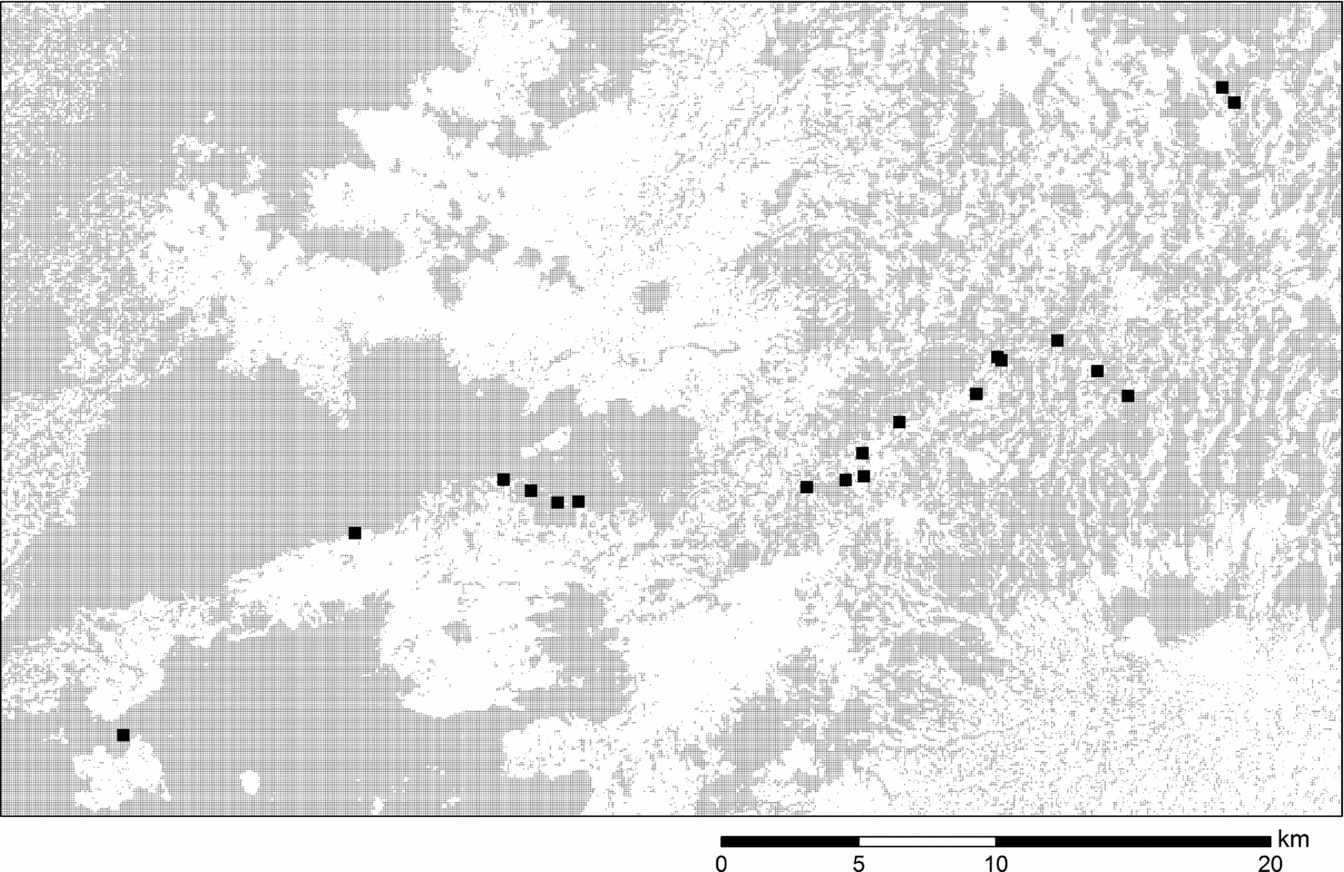
Gera and Goma districts (7.8°N; 36.4°E) are located in one of the main coffee-growing areas in Ethiopia. The landscape is dominated by small-scale agriculture and moist afromontane forests. The western part of the landscape has larger remnants of continuous forest, whereas the forests in the eastern part of the landscape are highly fragmented (Figure 1). Honey production is widespread in Ethiopia and in our study landscape, with both modern and traditional beehives. Traditional beehives are most common and are made of split logs, carved and tied together and thereafter tied to a branch in a tree without further management. The honeybee, Apis mellifera, is native to Ethiopia (Meixner et al. Reference MEIXNER, LETA, KOENIGER and FUCHS2011) and the honey production with traditional beehives depends on colonization by wild swarms of honeybees (Dietemann et al. Reference DIETEMANN, PIRK and CREWE2009). No other bee species are used for honey production. However, honey hunting from wild stingless bees does occur (Kajobe & Roubik Reference KAJOBE and ROUBIK2006). The coffee normally starts to flower in January or February, after the first heavy rains, and flowers one to four times before the main rainy season starts in June or July. The landscape is dry during this time of the year, and there are few other herb and shrub species flowering because of the dryness and high grazing pressure by livestock. However, most tree and fruit-tree species have their main flowering period in the dry season.
The study landscape in south-western Ethiopia. The western part of the landscape contains larger remnants of moist afromontane forest (forested areas are in grey), whereas all forests in the eastern part have been converted into fragmented semi-plantation coffee stands. The black squares are the 19 sites we visited for sampling of coffee pollinators.

Coffee production system
Coffea arabica is the only coffee species cultivated in the landscape and it is grown mainly in the forest or in forest patches in the agriculture-semiforest mosaic. The coffee production systems are recognized as semi-forest or semi-plantation coffee depending on the forest management intensity and plant diversity (Hundera et al. Reference HUNDERA, AERTS, FONTAINE, VAN MECHELEN, GIJBELS, HONNAY and MUYS2013). In most coffee stands, understorey vegetation is repeatedly removed to reduce nutrient competition for the coffee plants and to facilitate picking of coffee berries from the ground (Schmitt et al. Reference SCHMITT, SENBETA, DENICH, PREISINGER and BOEHMER2010). Pruning of shade trees and coffee plants is not a common management practice; instead old coffee plants are removed and replaced with coffee seedlings occasionally. The coffee was organically managed, i.e. no pesticides or chemical fertilizers have been used, with the exception of two coffee state farms that had access to fertilizers and herbicides.
Study design
Before the onset of the coffee flowering in 2011, we identified coffee sites that differed in diversity of shade-tree species, interspersed over the landscape. When the coffee flowering started, we selected coffee sites for sampling of coffee pollinators depending on the availability of flowering coffee. Each site had more or less synchronized blooms with fresh flowers for only 1–2 d, but the flowering pattern over the landscape was not fully synchronized, letting us sample for approximately 5 d during each coffee flowering period. We aimed to cover a long gradient in shade-tree diversity and to visit as many sites as possible. Altogether we sampled 19 coffee sites during the two flowering events, in mid-February (10 sites) and at the end of March 2011 (nine sites). Sites were separated by at least 650 m when sampled in the same flowering period. The shortest distance between two sites sampled in different periods was 150 m. The distance between the two furthest sites was 46 km (Figure 1).
In each coffee site, we established a 40 × 40-m plot where we collected the following environmental variables: canopy cover, by visual estimation in percentage; number of coffee plants; number of shade trees (>10 cm dbh) and number of tree species. We estimated the freshness and number of open coffee flowers on a scale between 1 and 5, where 1 represented few and 5 many fresh flowers. An estimate of the total amount of coffee flower resources in the site was achieved by multiplying the coffee flower variable with our visual estimate of the coffee ground cover (%). We noted presence of honeybee hives in the vicinity of the sites and surveyed other flowering plants. Each flowering plant was noted as very common (3) (>1000 flowers or flower heads), frequent (2) (100–1000), or rare (1) (10–100). The numbers for each flowering plant species were summed per site to get an estimate of the amount of alternative flower resources.
Three persons simultaneously collected insects landing on coffee flowers. All insects were collected with aerial nets and stored in alcohol. The sampling was conducted during four trials; each trial lasted 15 min. The collectors were standing on the same location for the whole 15-min trial and moved to a new position for the next trial. In total we spent 3 h per site sampling coffee visitors. The sampling at each coffee site ended with 15 min of sampling of pollinators that were not foraging on coffee flowers, hereafter referred to as the surrounding sampling. The surrounding sampling was skipped in four sites since the understorey vegetation very recently had been cleared. On most days, two sites were sampled, one site before and one after noon. Sampling normally started around 9 h 30 and was finished around 15 h 30. Sampling was not conducted on rainy days. Each site was sampled once due to the trade-off between number of sites and replication, where we aimed for maximizing the number of sites. Pollinators were sorted into genera and identified to species or morphospecies.
Data analysis
The abundance, which is the number of collected individuals, of honeybees and other pollinators were analysed separately. In other pollinators we included all bee species (except honeybees) and hoverflies, since these groups are well-known pollinators. The number of species and abundance of the other pollinators were closely correlated (r = 0.96), therefore we only used total abundance as a response variable for the other pollinators. The overall low abundances did not permit us to investigate rarefied species richness and the different groups (hoverflies, solitary bees and other social bees) could not be analysed separately for the same reason. Thus, we had three response variables: abundance of honeybees on coffee, abundance of other pollinators on coffee and abundance of other pollinators in the surroundings of the coffee (not on the coffee).
We identified four variables that reflected the shade-tree structure of the site: canopy cover, number of trees, number of tree species and if the site was part of a contiguous forest or of the agriculture-agroforestry mosaic (categorical variable). These variables, except canopy cover, covaried (P < 0.05). The variable number of trees had the longest gradient; therefore we chose it to be included in the models to represent the shade-tree structure of the sites, and disregarded the other variables. However, to verify that the estimated variable captured the shade-tree structural complexity we also developed a forest index based on all four variables using ordination techniques. We did a principal components analysis (PCA), using the standardized values of the four variables, in the vegan-package in R. The PCA site scores from the first PCA axis, which explained 63% of the total variance, were used as a forest index. Higher scores represented more forest-like conditions.
All analyses were done in the statistical software R 3.0.1 (R Development Core Team). Five explanatory variables that we hypothesized to influence the pollinator community were included in the full models for all response variables: (1) number of trees or forest index, (2) coffee flower resources, (3) other flower resources, (4) time of the day (rounded to nearest hour of sampling start) and (5) presence of beehives (yes or no). All analyses were run twice, including either number of trees or forest index, i.e. these variables were not used simultaneously since they should reflect the same thing: shade-tree structures. The model for each response variable was simplified using the drop1-function to drop non-significant variables until a final model was found. Variables were dropped only if the models’ residuals did not get distorted. The final models were verified by applying forward selection by adding each dropped variable singly. The full models were inspected for violations of the assumption of normal distribution by plotting the residuals against each explanatory variable and the model's fitted values. The models with the abundance of honeybees and other pollinators on coffee did not meet the assumptions. Therefore the abundances of honeybees were loge-transformed. The abundances of other pollinators on coffee were analysed with a Poisson generalized model (GLM). Since overdispersion was detected in this model, the standard errors were corrected by using a quasi-GLM model where the variance is given by the dispersion parameter times the mean (Zuur et al. Reference ZUUR, IENO and WALKER2009). In the result section, β-values and standard errors are presented from standardized variables (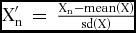 ${\rm X}_{\rm n}^\prime \, = \,\frac{{{\rm X}_{\rm n} {\rm - mean(X)}}}{{{\rm sd(X)}}}$).
RESULTS
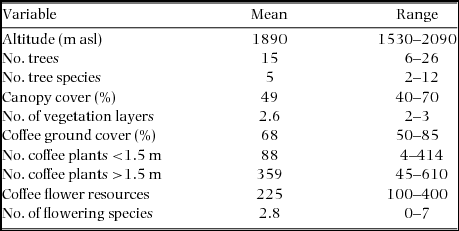
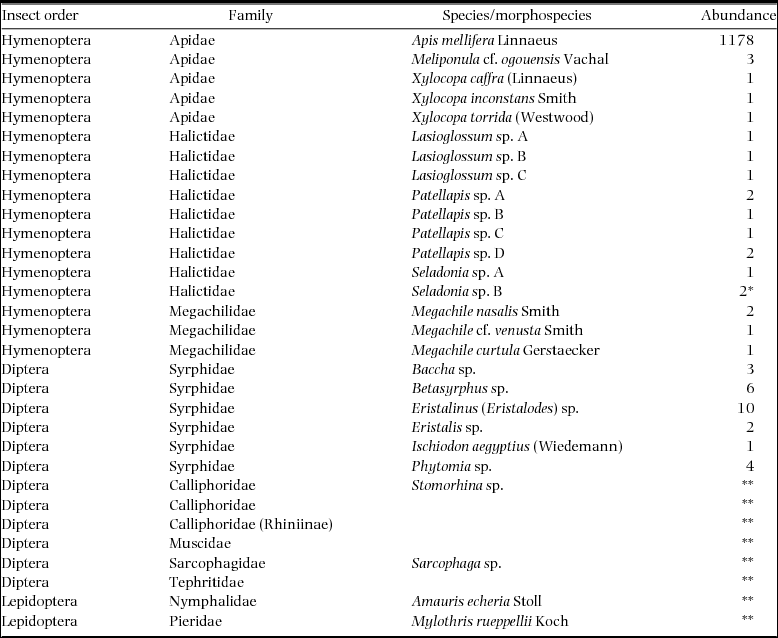
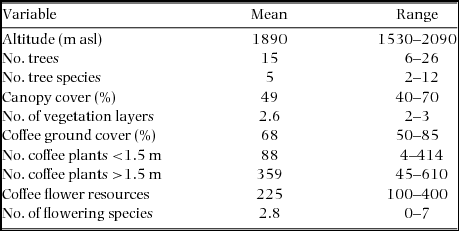
All sites had a high cover of coffee (50–85%) but varied widely in number of trees and number of tree species per site (Table 1). Altogether, 1226 pollinators were collected on coffee flowers in the 19 sites. The honeybee, A. mellifera, probably subsp. simensis Meixner, Leta, Koeniger & Fuchs, was the dominant pollinator and accounted for 96% of the collected pollinators. We found six hoverfly species and 16 bee species visiting coffee (Table 2). The only captured eusocial bee species were the honeybee and Meliponula cf. ogouensis. In the sampling from the surrounding of coffee plants, honeybees were rare and other bees generally more common than on coffee (per 15 min-period, mean: 0.8 other pollinators on coffee, vs. 5.6 other pollinators surrounding coffee, P = 0.003, Appendix 1).
Environmental variables in the coffee sites (n = 19) in south-western Ethiopia measured in a 40 × 40-m plot. The variable coffee flower resources is the estimated amount of open fresh coffee flowers multiplied with the coffee ground cover (%).
The taxa observed on coffee flowers. A variety of literature was used for the identification including the key to bee genera and subgenera of sub-Saharan Africa (Eardley et al. Reference EARDLEY, KUHLMANN and PAULY2010). * = observed on coffee off the time of standardized sampling. ** = observed on coffee but not included as pollinators in the analyses.
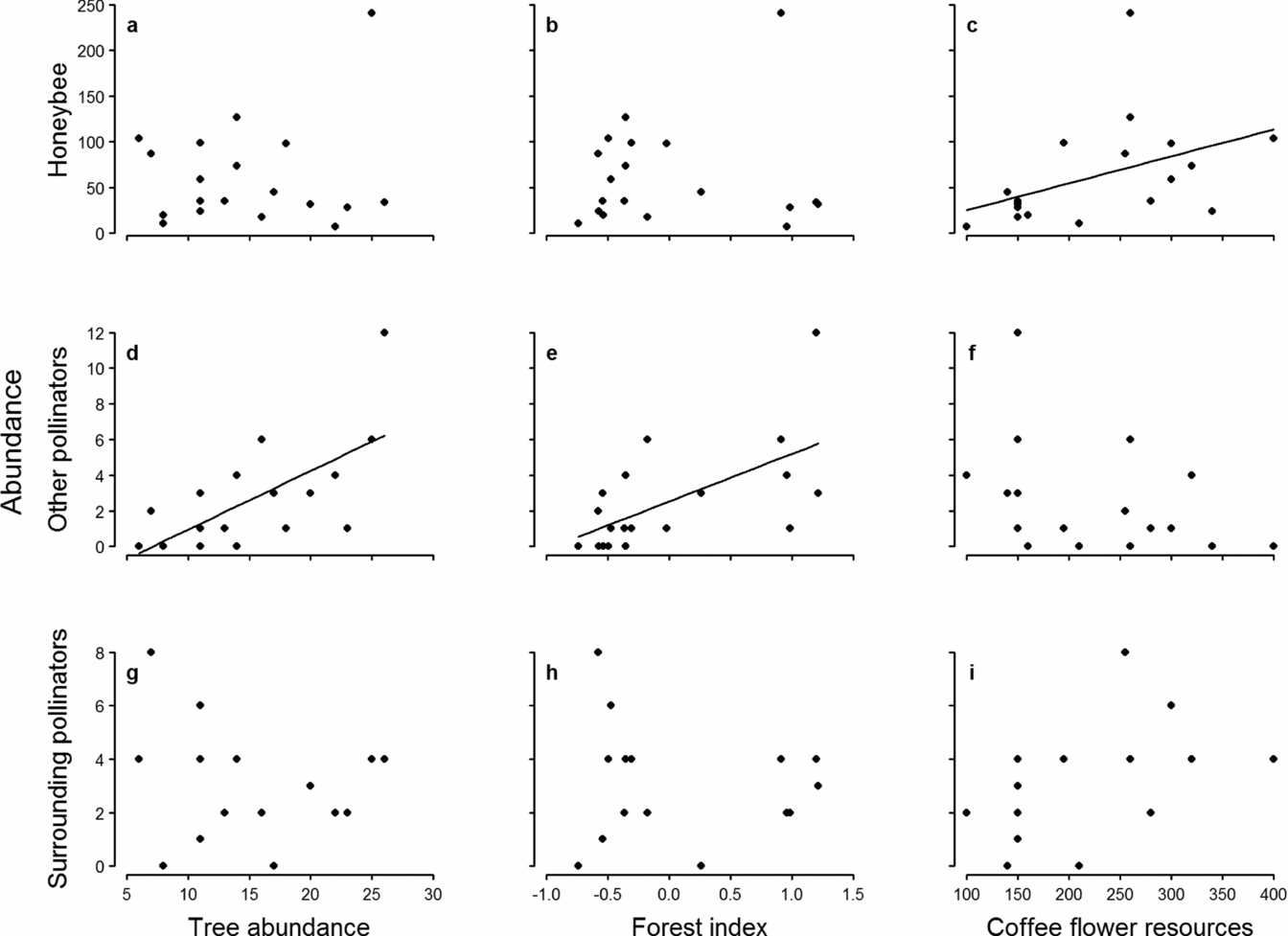
The honeybee abundance was positively affected by the amount of coffee flower resources (LM: β = 0.50, SE = 0.18, t = 2.8, df = 17, P = 0.013, Figure 2c), but not by the shade-tree structure (Figure 2a, b). In contrast, other coffee pollinators were positively affected by more complex shade-tree structure in the coffee sites (quasi-GLM with number of trees: df = 17, P < 0.001 (Figure 2d); quasi-GLM with forest index: df = 17, P = 0.001 (Figure 2e)). The other pollinators were not affected by the amount of coffee flower resources in the sites (Figure 2f). Traditional beehives were present in the close surroundings of six sites, but the number of honeybees or other pollinators on coffee were equally abundant in sites with and without traditional beehives. We found no correlation between the number of honeybees and other pollinators on the coffee (t = 0.19, df = 17, P = 0.85). The final model for pollinators from the surrounding sampling included no significant variables (Figure 2g–i).
The relationships between pollinator abundances and three habitat and landscape variables in a coffee landscape in south-west Ethiopia for the honeybee (a–c), other pollinators on coffee (d–f), and pollinators in the surroundings of the coffee (g–i). The relationship is shown for number of trees (a, d, g), forest index (b, e, h) and coffee flower resources (c, f, i). Significant relationships (P < 0.05) are indicated with a solid line. Other pollinators include hoverflies and bees except the honeybee (n = 19). Surrounding pollinators are other pollinators sampled around the coffee plants (n = 15).
DISCUSSION
In all surveyed sites, the honeybee was present and was the dominant visitor of coffee flowers with a dominance sometimes even higher than in other studies on coffee in its introduced range (Klein et al. Reference KLEIN, STEFFAN-DEWENTER and TSCHARNTKE2003a, Ricketts Reference RICKETTS2004). Its abundance was as expected related more to flower resources than shade-tree structure reflecting its high mobility (Beekman & Ratnieks Reference BEEKMAN and RATNIEKS2000, Ricketts Reference RICKETTS2004). However, other pollinators on coffee were favoured by forest complexity. This finding highlights that biodiversity and total pollinator abundance need not always correlate positively.
Honeybee abundance in our study landscape is promoted through the provision of traditional nests during parts of the year, even though colonies have to find alternative nest sites to survive during times when hives are not erected. Since honeybees are very mobile and can travel several kilometres from their hive (Beekman & Ratnieks Reference BEEKMAN and RATNIEKS2000), our survey of beehives in the vicinity of the sites may not necessarily reflect the number of beehives that actually had access to the coffee sites. Normally, the traditional beehives are set out in the coffee areas just before the onset of flowering, to utilize the abundant nectar resources coffee provides, and are colonized by swarms of wild honeybees. The rapid colonization of traditional beehives may reflect a shortage of natural, high-quality nesting places for honeybees in the landscape, and the provision of beehives could possibly explain the high abundance of honeybees on coffee. This idea is strengthened by our observation of a very low abundance of honeybees on coffee in the same landscape in January 2013 coinciding with an unusually early coffee flowering period and a delayed erection of beehives. The temporal variability in bee densities suggests that we need additional studies on the population dynamics of the honeybee in our study area to understand how the temporal variation in coffee flowering and management regimes impacts honeybee abundance on coffee.
The ability to recruit workers to mass-flowering crops is known from other social bee species, and the eusocial stingless bees are, in many regions, found to be important and common pollinators of coffee (Klein et al. Reference KLEIN, STEFFAN-DEWENTER and TSCHARNTKE2003a, Ricketts Reference RICKETTS2004). However, in our study, only one other eusocial bee species was found on coffee flowers, a Meliponula sp. with three individuals in one site. It thus seems that other social bee species in this landscape do not utilize the pulse of resources offered by the coffee flowering. Other pollinators on coffee, such as other bee species and hoverflies, were rare compared with honeybees. However, in contrast to the case for honeybees, these other pollinators were positively affected by more complex shade-tree structures. This finding is in accordance with studies from other regions (reviewed in Klein et al. Reference KLEIN, CUNNINGHAM, BOS and STEFFAN-DEWENTER2008) and highlight the importance of maintaining natural environments from a biodiversity conservation approach. The low number of other pollinators however suggests that they probably have little importance in this system (at least this year) for providing pollination services. On the other hand, in parts of the introduced range of coffee, coffee fruit set is positively affected by a high bee diversity, and a visit by a solitary bee has been found to be more effective than a visit by a honeybee (Klein et al. Reference KLEIN, STEFFAN-DEWENTER and TSCHARNTKE2003a, Vergara & Badano Reference VERGARA and BADANO2009). The effectiveness of honeybees as coffee pollinators is ambiguous, as high abundances of honeybees have been reported with both increased and decreased coffee yields (Badano & Vergara Reference BADANO and VERGARA2011, Roubik Reference ROUBIK2002). Different pollinator species probably complement each other (Albrecht et al. Reference ALBRECHT, SCHMID, HAUTIER and MÜLLER2012) or increase pollination effectiveness (Brittain et al. Reference BRITTAIN, WILLIAMS, KREMEN and KLEIN2013). However, since we did not measure the pollination efficiency of the coffee visitors we cannot evaluate the contribution by the honeybee and the other bees’ impact on coffee harvest.
The low abundance of alternative floral resources during the dry season can lead to the impression that there was a general lack of resources and pollinators in our study landscape during our survey, which would explain the low diversity of other pollinators on coffee. However, some tree species, including several fruit trees, mainly flower during the dry season and both this and other studies suggest that other pollinators are present in the surrounding vegetation. The sampling of pollinators surrounding the coffee showed the presence of pollinators other than honeybees and a separate study in the same landscape similarly found other pollinators on a perennial herb (Fabaceae: Senna didymobotrya (Fresen.) Irwin & Barneby) that flowered simultaneously to coffee plants (U. Samnegård, unpubl. data). Sampling on this plant, using a similar sampling effort as in this study, revealed higher abundances of many bee species also found in low numbers on coffee. Moreover it showed that an overall higher diversity was present in the landscape (>530 bees other than honeybees of ≥27 species were sampled). Thus, it appears that even though other bees were present in the landscape, they select for other floral resources or were unable to utilize the resources from the coffee. We found no negative correlations between the number of honeybees and other pollinators on coffee, suggesting that the honeybee in this system does not affect other pollinators negatively (Stout & Morales Reference STOUT and MORALES2009).
The Ethiopian system seems vulnerable since it is so heavily dependent on one major pollinator. Nevertheless, it is worth noting that African honeybees have a higher genetic variation than introduced and domesticated honeybees, which makes them more resistant to diseases and mites (Dietemann et al. Reference DIETEMANN, PIRK and CREWE2009). Since many wild honeybee populations are still present, a collapse seems unlikely in the near future and thus this system with only one main pollinator may not be as fragile as it first appears. However, the observation from January 2013, with no bees on the coffee when almost no traditional beehives were erected, is calling for more studies on interactions of coffee and bees across space and time in these landscapes. The landscape in south-western Ethiopia is rapidly changing, with deforestation in many areas (most pronounced at altitudes above the coffee-growing areas, Hylander et al. Reference HYLANDER, NEMOMISSA, DELRUE and ENKOSA2013) and simplification of the forest structure in most coffee-growing areas (Hundera et al. Reference HUNDERA, AERTS, FONTAINE, VAN MECHELEN, GIJBELS, HONNAY and MUYS2013). These are worrying trends since other pollinators seemed to depend on complex environments and because the wild honeybee depends on a variety of trees during other seasons (Dornhaus & Chittka Reference DORNHAUS and CHITTKA2004). This study is the first to investigate pollinators visiting coffee in Ethiopia. We suggest that future work here should focus on wild honeybee population dynamics across landscapes, inter-annual pollinator patterns and comparisons across larger geographic settings with longer gradients in coffee shade-tree structures and management systems in Ethiopia.
ACKNOWLEDGEMENTS
We thank Connal Eardley for assistance with bee identification and Gerard Pennards for Diptera identification. We also thank Konjit Dereje, all assistants in the field, the coffee owners for their permission to let us work with their coffee, and the IBC in Addis Ababa for their help and cooperation. The study was financed by grants from SIDA and Formas (to K.H.).
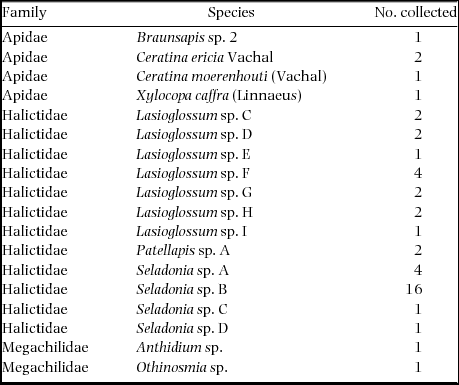
The bee taxa collected in the surroundings of coffee plants in 15 sites in south-western Ethiopia. A variety of literature was used for the identification including the key to bee genera and subgenera of Sub-Saharan Africa (Eardley et al. Reference EARDLEY, KUHLMANN and PAULY2010).