We had all that love, and we just cracked up under it. It's a big airplane engine, that takes you through the sky, right up to the top of the mountain. But when you put it in a Ford, it just shakes it to pieces. That's what we are, Frank, a couple of Fords.Footnote 1
James M. Cain, The Postman Always Rings Twice (1934)Edgar G. Ulmer's celebrated “Poverty-Row quickie” Detour (1945) certainly wastes no time in introducing the problems of its down-on-his-luck protagonist. After a credit sequence shot from the back of a vehicle speeding through the desert, we see a lonely hitchhiker thumbing at night, and then the same sad sack riding through a rear-projected forest of Reno's neon signs.Footnote 2 By the time the traveler has come to rest in a diner, trying to shut out a truck driver grousing about his long haul at the other end of the counter, the film has established many of the elements that comprise film noir's distinctive conventions – the cheap sets, the restless camera, the harsh contrast of glaring lights and darkness, the exhaustion of a character driven to relentless movement.Footnote 3 But so too have the scenes communicated that sense of fate both most characteristic of noir and most inviting of interpretation. The lead actor, Tom Neal, has expressed all the emotional range of a death-row inmate waiting for what another character will later call a “sniff of that perfume they give to murderers in Arizona.” Is he a war vet? A Communist? An early refugee from a nascent era of hyper-consumerism?Footnote 4 The time had other genres with which to tell such stories, as the many social-problem films of the day attest. What I want to explore period filmmakers striving to articulate through film noir is a world-changing event everywhere in evidence in these first shots of Detour, one for which filmmakers did not have a ready vocabulary, but one we still struggle to conceptualize: the transformation of twentieth-century America by the power of oil.
Why a development so foundational to the modern nation should be one so hard to examine has been one of the main questions raised by critics such as Stephanie LeMenager, Bob Johnson, Timothy Mitchell, and Frederick Buell, among others, who have advanced critical approaches referred to collectively as the energy humanities. If LeMenager argues, for example, on the “aesthetics of petroleum,” that we might take literary and cinematic texts of the period as “archiving sensory and emotional values associated with North American oil cultures of the twentieth century,” then it is an aesthetics Johnson diagnoses as rather “schizophrenic” at its core, as with the development of a modern sense of self with the fossil-fuels era, or “regime,” the persistent narrative of progress has always been accompanied by an “antiaesthetic underside” of environmental and social devastation and exploitation, a “dirty secret” that must be kept away from national consciousness.Footnote 5 Indeed, Patricia Yaeger has gone so far as to suggest an “energy unconscious” working against such awareness.Footnote 6 And yet, as Mitchell explores, that “dirty secret” of fossil-fuel dependence shaped American democracy, playing a role in determining cultural forms Buell would not limit merely to the political but would find “significantly entwined with [all] cultural history. Energy history,” Buell goes on to say, “is in fact entwined with changing cultural conceptualizations and representations of psyche, body, society, and environment; it is correlated not just with changing material cultures, but with symbolic cultures as well.”Footnote 7 Only, energy-humanities studies of period symbolic texts have mostly focused on reflections of the industry itself – in novels like Upton Sinclair's darkly satirical Oil! (1926) or films like George Stevens's petro-western Giant (1956) – rather than on the ways the new fuel affected “cultural conceptualizations and representations” farther afield than, well, the oil field.
Indeed, one of the main problems faced by critics in this arena is not just the question of, as Imre Szeman puts it, “How to Know about Oil,” but also how to account for the resource's real costs of extraction, dependence, and reorganization. As Graeme MacDonald asks the question, “How … to dramatize the disastrous nature of oil's benevolent banality?”Footnote 8 What I want to argue is not merely that Detour and other films noirs provide one answer to MacDonald's question, but also that such films still have a lot to teach us about the fuel's vast, systemic impact. Indeed, the films trace in remarkable ways the subtle and myriad emotional and psychological consequences of oil's more mundane points of end use, which we might term oil's “felt truth” or its “psychic reality,” effects dependent on networks much harder to recognize and analyze than simple cause–effect relationships or individual technologies considered in isolation.Footnote 9 Film noir's slippery problem of definition is thus one I want to connect to its affective tracking of a subject difficult to grasp rationally: the predominance in America of an energy resource whose new powers are changing almost everything about daily life. And while it might be a rather noir thesis itself to propose that such films register the significance of something larger and harder to define than a single object or event, in its use of the techniques that have come to define noir, Detour offers an insightful exploration of the changes brought about by oil, an experience that it, like others, imagines to be a dark and fated, if unintentional, criminal act.Footnote 10
In the continuation of Detour's first full scene in the diner, that feeling of criminality is expressed in a manner both familiar and surprising. After rebuffing the proposal from the persistent truck driver that the hitchhiker accompany him north, the hitchhiker, pianist Al Roberts, hears to his chagrin that the driver has selected a song on the jukebox that Roberts knows only too well. Roberts, until now a closed book, begins to confess – by way of that reliable genre standby of voice-over narration: “That tune. That tune! Why was it always that rotten tune? Following me around, beating in my head, never letting up.” The song, viewers will soon find out, was played by Roberts and sung by his fiancée in their New York City nightclub routine, before the singer headed to Hollywood – and before Roberts attempted to follow her. As Roberts will relate in flashbacks, he accepted a ride from a conman who mysteriously fell dead, then assumed the conman's identity to avoid being charged for the man's murder, before also picking up a hitchhiker – a woman, Vera – who blackmailed him with knowledge of his false identity until he accidentally murdered her and made his bid to escape justice by once again taking to the road.
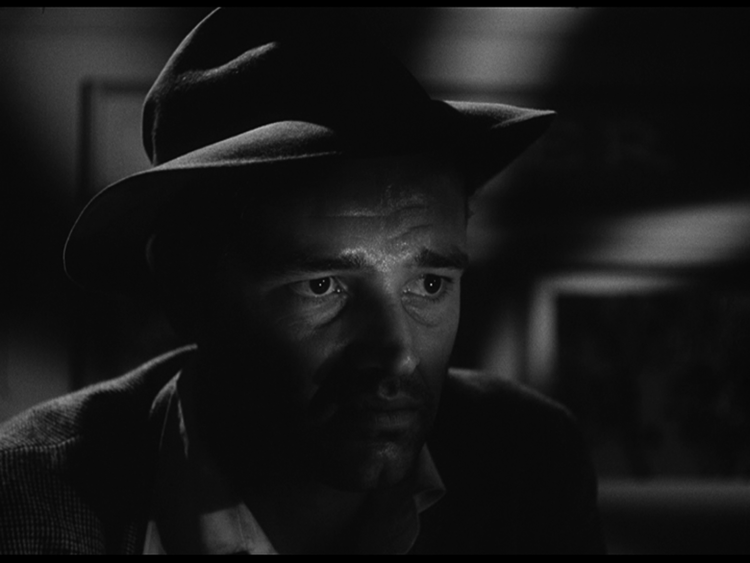
The other familiar elements that follow this start of Roberts's confession are largely visual in nature. They consist of the now-iconic noir techniques of an active camera, dollying forward to a close-up of Roberts's anguished face, and a dimming of the lights that allows the camera to track behind the character through the resulting darkness to rest on the record spinning in the jukebox's illuminated confines. But before the camera leaves him, the film's audience is confronted with a surprising vision: Roberts boxed in by that darkness, with searchlights seeming to shoot out from behind him as he stares into a small rectangular light (Figure 1). The actor's body too visibly shrinks at this moment, with the actor hunching his shoulders, as if accommodating himself to a constricting space. And the graphic match of Roberts's coffee mug, the spinning record, and the bass drum that will anchor the other side of the flashback all serve to foreshadow another round shape that will be in front of Roberts for much of the film's pivotal scenes, which is a steering wheel.Footnote 11 Combined with the vividly dramatic lighting scheme, these details effectively place the character in an imaginary automobile.Footnote 12 He stares into that space where that car's rearview mirror would be, his face lit up by a light that would come from a vehicle behind him, as if the past were another car, chasing him down.
Detour (Criterion Collection). Roberts is trapped in an “automobile.”

The continuation of Roberts's voice-over, delivered as he sits transfixed by that strange light in his eyes, adds to the jarring effect of the scene:
Did you ever want to forget anything? Did you ever want to cut away a piece of your memory or blot it out? You can't, you know, no matter how hard you try. You can change the scenery, but sooner or later you'll get a whiff of perfume, or somebody will say a certain phrase or hum something, then you're licked again!
In nine emphatic instances of the second person in these few short lines, Roberts insists that the dilemma he faces is also the spectators’. This direct address is a feature the film shares with its 1939 source novel of the same name, written by Martin M. Goldsmith, who also penned the screenplay. And it was a characteristic of the film that attracted comments from its first reviewers, such as in the Los Angeles Times's observation, “You're not just looking at a picture; you're right in it and suffering along with the man whose troubles are being told.”Footnote 13 Several critics have explored how Roberts's journey might have reflected the director's own suffering. Ulmer, a music-loving Austrian émigré who achieved early fame with his pre-Code Black Cat (1934), made the mistake of romancing (and eventually marrying) the wife of the nephew of Universal head Carl Laemmle. This led to Ulmer's being relegated to directing a series of “ethnic films” on the East Coast, before returning west a little more down-and-out, at the decidedly B film studio of Detour's PRC, or Producer's Releasing Corporation – whose product was often jokingly referred to as “Pretty Rotten Crap.”Footnote 14 Of course, the place viewers are being put into by the film's identification of them with Roberts is raced and gendered, features I will examine. And yet what possible criminality could male, majority viewers – or the director, for that matter – intuit to be operant in their own lives, in 1945?
What I will argue is that Detour's attempt to answer this question through the use of identifiable noir techniques tells us much about why those techniques should be so persistent and powerful.Footnote 15 Through these recognizably representative strategies of lighting and narration that identify its spectators with its mobile and criminal main character, the film effectively asks its spectators on a journey of self-exploration and even self-condemnation, inviting them to take up again that unattributed point-of-view shot with which the film started, looking out of the back of a moving automobile. I will show this journey to be concerned at first with the dangerous implications of Americans’ adoption of the automobile our protagonist imagines entrapping him. But the film will go on from there, to trace the consequences of the new American oil regime as well in its spectators’ entanglements in oil's disruptive information and media systems. Finally, I will focus on the film's own shaping by oil's social, financial, and environmental networks, which the film explores as entrapping its spectators in exertions of power. What I will find the film uncovering is thus a complex web of technologies, beliefs, and behaviors, a web the film presents to its spectators from its very first frames as already involving them in a “dirty secret” the film struggles to bring to light.
HOW OIL'S SIREN CALL BECAME AUTOMOBILITY'S DEADLY WOMAN
Looking backwards at the ways in which the nation adopted petroleum as its primary resource, we might identify other features of American life than the automobile that partook in what Frederick Buell characterizes as oil's “marriage of catastrophe and exuberance.” Some of these, such as mass media, gas heating and cooking, electrical lighting, and telephone communication, I will have cause to comment on a little later. But all became more widespread features of a society overhauling itself on a resource whose liquidity and ease of transport empowered a heightened mobility – and risk. These new elements had long-term impacts traced in subtle ways in film noir, such as in the increased debt that grew to pay for the nation's makeover in the aftermath of the Great Depression, referenced in 1944 Double Indemnity's insurance salesman's one-liner about a customer's house that it must have cost “about thirty thousand bucks – that is, if he ever finished paying for it.”Footnote 16 But the automobile was always the most obvious feature of this new way of life for which it served as main vehicle of expression. In The Postman Always Rings Twice (1946), for example, the greed that blinds a diner owner to the threat posed by the employee who has become his wife's lover comes through business success enabled by the nearby city's expansion; his wife and employee first try to kill him in a bathroom “accident” but end up murdering him in a car crash.Footnote 17 In Double Indemnity, too, the oil executive whose house put him so deep into hock is first imagined as dying in an oil field accident but is murdered by his own wife and lover in a car. In these and other films, what appear in each as a seductive if dangerous new set of practices of the oil regime – urban growth and business expansion, a networked consumerist economy that includes the lure of large payouts, an increasingly mechanized industry, or, in Detour's first main scene, popular music – are all funneled through film noir's imaginary to become a deadly trip by automobile.
That trip by automobile, which was to become a defining American experience of the postwar period, had established itself early in southern California, a development that Detour director Ulmer would have witnessed firsthand. That onset depended not just upon the availability of oil, however, but also upon the creation of roads, gas stations, tourist courts, maps – as well as new laws, regulations, financial inducements. And these latter were even more instrumental in the industry's success than any new product. It wasn't just oil's repurposing as fuel for motion, or even the until-then unheard-of amounts of advertising by the industry, tapping into Americans’ ideals of individuality and freedom, that made oil's rise a reality; the price of the resource was also kept low by private–public partnerships with the expressed aim of “stimulating consumption.”Footnote 18 Those new products, in turn, like cars with ever greater horsepower, were designed to waste as much of this cheap resource as possible. So while coal use dropped with the Great Depression and World War II, oil consumption rose dramatically in the 1930s, just as film noir was taking shape, to surpass coal's rate of consumption after the war, at the genre's height.Footnote 19 What escapes energy histories’ focus on technology or governmental policy is the dependence of such a transition on its adoption by the “little man” at the center of so many films noirs, through desires that were manipulated, if not outright manufactured.Footnote 20 As early as 1904, Standard Oil might be depicted as an octopus secretly controlling with its many arms railroads and factories,Footnote 21 but the same pervasiveness might well have been felt by consumers. The resource did much more than offer increased choice; its technologies reshaped Americans into “form[s] of social being” locked into a set of activities the automobile was only the most visible in enabling and, in part, enforcing, from its seemingly benign “driving” and “transporting” to its more problematic “polluting” and “killing.”Footnote 22 And although automobiles were marketed mainly to white men, every American community confronted the paradox of the machine. As Arthur Raper notes was true in the Georgia “Black Belt” of the 1930s, in the car the “negro … [was] not so constantly reminded of the meaning of his color,” but the still-expensive purchases also dangerously allowed more power for “what the individual wants to do rather than what the community does not want him to do”; as a result, this empowerment caused many a purchaser of a new car to court disasters beyond the financial.Footnote 23
And yet, just as with the environmental devastation eventually wrought by such resource use, the extent of oil's impact was what Timothy Morton terms a “hyperobject,” a phenomenon too vast for its participants to comprehend fully.Footnote 24 Their points of contact with that system, considered rationally and separately, might not seem to amount to much. Starting one's car, for example, still hardly seems destructive, until one considers how many other cars are being started, and what their pollution, added together, causes.Footnote 25 But early feelings about that new infrastructure were a different matter, especially as the appeal to the first drivers of the automobile was, like every new development of oil's, made less on the basis of utility than of pleasure.Footnote 26 Both Goldsmith's Detour and Sinclair's Oil! begin with scenes of driving as an overwhelming rush, for example: a powerful pleasure that, as it would turn out, would have more than one edge. As life became reorganized around these new technologies, as Christopher Jones observes happens with every energy-resource transition, its participants were forced to abandon older methods of moving and acting, leaving them no power to return to, or even to imagine, any other way of life.Footnote 27 The car opened up land for development in Detour's Los Angeles, for example, but neighborhoods distant from rail stops were then stuck with the car … and its costs of maintenance, its accidents, and its traffic. A basic truth about energy explored in Detour in its plot about a character with a car-shaped problem – lack of means to follow his fiancée west – who then finds the automobile impossible to get rid of, is that engagement with just one aspect of a regime entangles one in a larger system.
Those networks of new highways that Roberts takes west in Detour, for example, like so much of the emerging petromodernity, were argued into existence with promises of increased personal empowerment, but financialization of this new “mistress” and her “irrational drives” came with corruption and the defunding of other areas of public life, and road building in Los Angeles only led to “apparently random travel.”Footnote 28 And at the center of this risky consumerist enticement in period advertising was the image of a beautiful woman. Just as Wolfgang Sachs notes was the case in Germany, in the US, too, “The association between ladies and the automobile first cleared the way for the establishment of driving as a model of consumption.”Footnote 29 Automobility was sexualized, with the car cast in the role of “wife” or “lover,” a central element in a new “libidinal economy.”Footnote 30 Yet if, in early 1920s Germany, the Austrian Ulmer would have also seen the automobile winning, as in America, “a permanent place in desire,” the director's visits back to Europe in the early 1930s would have also shown him how German road construction had become wedded to a larger and darker project, combining the car's “feeling of rising and flying” with the Reich's growingly militarized, and racialized, demands for living space.Footnote 31 Film noir's obsession with dichotomous women characters – pure or evil – reflects the standing of the car in America. On one hand, it encouraged a somatic, even sexual, exhilaration. As LeMenager notes, “Cars made the human body more valuable, pleasurable, and fun.”Footnote 32 But, on the other hand, driving, as it was bound up with a sexualized pleasure of “rising and flying ‘beyond limitations,’” also evoked “the anxious tension of having risked too much.”Footnote 33
Detour's connection of automobile ownership to murder had some basis in fact, after all. Traffic deaths per million people peaked in the United States in the 1930s, prompting newspaper headlines like “Death by Automobile” and “Death on the Road.”Footnote 34 As the nation's streets became the perilous playground of motorized vehicles, an important civic arena was forced to incorporate within itself new “masters of time and space,” who, in pursuing the fulfillment of their wants also not infrequently killed.Footnote 35 Into the social sphere of urban community thus burst a terrible technology apparently built around “conflict,” one that provided “the feeling of power without the consent of others.”Footnote 36 From the very earliest period of the automobile's development, then, the relationship of the nation to this new technology of consumption was repetitively expressed as a “romance” or “love affair” – but one that might have felt abusive.Footnote 37 What “noir's cars” symbolize, then, as Mark Osteen observes, is a “rootless amorality” often depicted on-screen in irrational extremes of emotion and action.Footnote 38 What Ulmer's film identifies with the common practices of petromodernity is not just an amorality, however, but a loss of agency.
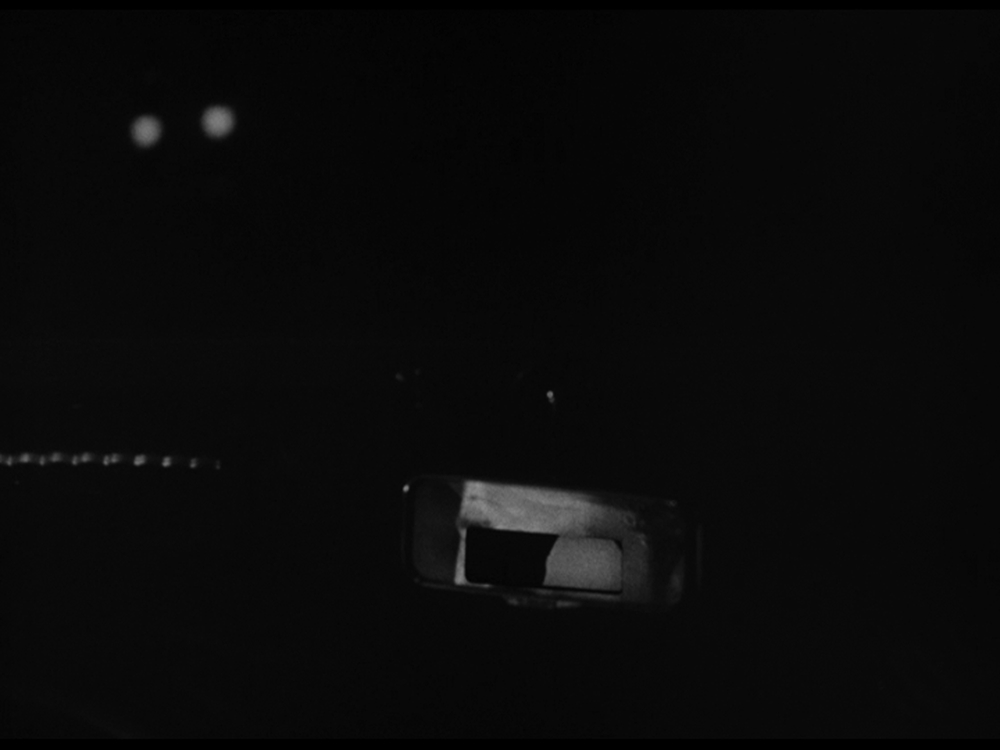
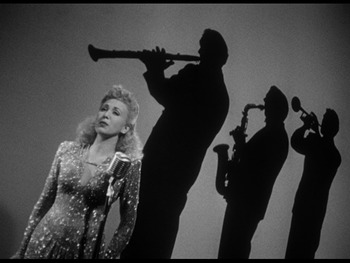
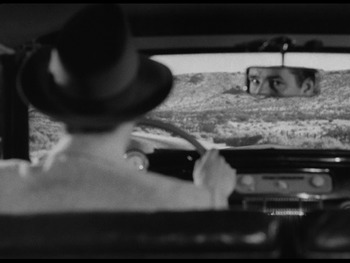
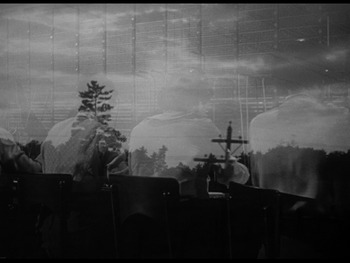
Detour makes this charge with the very structure of its plot, in which two men's decided plans for their future are literally, and fatally, detoured by their picking up hitchhikers. And both decisions are informed by the car's “needs”: for another driver, in the case of Haskell, and for a routine stop at a gas station, which is where Roberts meets Vera. In a scene after Roberts is picked up by Haskell, in which Roberts is taking his turn at the wheel, Detour answers the question it prompted its audience to ask in that first diner scene. Only audience members who expected Robert's haunting vision in the rearview mirror to be of a tragic accident will be surprised. Haskell is apparently asleep in the passenger seat, but it is ostensibly Roberts who is dreaming, as the camera shooting over his shoulder tracks forward suddenly, coming to focus on the rearview mirror. There, a smaller frame appears over Roberts's eyes and rapidly expands (Figure 2). Once it has expanded to fill the screen, the viewer will recognize it as a low-angle, canted shot of Roberts's fiancée, Sue, singing their signature song, with the shadows of three musicians behind her (Figure 3).Footnote 39 As the scene comes immediately before Roberts decides to ditch Haskell's body, this vision provides the motivation for Roberts's decision: a dream of being a part of Sue's success in Hollywood. And yet the way Ulmer shoots the scene emerging from the mirror suggests that the origin point for that dream of success is the car. This, then, is what Roberts is haunted by in the diner: not a past tragedy, but a past hope, one seemingly thought up by an oil-powered machine. I will explore in a moment how we might understand the film's identification of the car as the origin point for a destructive vision. But the shot might already be recognized as fraught with tension. Its Dutch tilt gives it a futurist flavor, drawing the eye along a rising line from left to right, but it is a rise countered by the musicians’ diminishing heights. So too is the image complicated by a bright foreground set off from a darker field, suggesting a myopia in this vision of success for a singular self that throws others into shade. Moreover, as the musicians have been reduced to shadows, one wonders what place pianist Roberts could have in Sue's success. Perhaps Roberts also doubts his place, as the dream provokes his anxiety, a mood that immediately comes into play, as rain prompts him to pull over to put up the convertible's top and leads him to discover Haskell is not sleeping, but dead.
Detour (Criterion Collection). A blinding dream emerges from the rearview mirror.

Detour (Criterion Collection). The machine entices its viewer with a dream.

The proximity with which the film connects Roberts's automobilic fantasy to his offhand abandonment of Haskell's body expresses some of the fears the era might have had about a dangerous product advertised in such a sexualized manner. Like other drivers, perhaps, dreaming of a woman, Roberts has killed a stranger. But the scene also hints at Roberts's own use by those systemic elements he should command. Roberts takes Haskell's car to fulfill what he believes are his own desires, but he soon finds this possession dictating his own actions. In the novel, the main character, Roth instead of Roberts, signals this loss of power by putting on the dead man Haskell's ring, figuring the technological and social “marriage” of oil's catastrophic empowerment of which Buell speaks, but also marking the character as feminized, as he also takes the other man's name (38). And that loss of agency might be tied to developments everywhere in evidence in the time of Detour's filming. Even before World War II, automobiles had become so prevalent that the situation on the streets was compared to war; after war started, casualties on the home front were sometimes calculated as outnumbering those suffered overseas.Footnote 40 And yet, while Roberts's entrapment by a female hitchhiker who unnervingly detects the truth about him (“Call me Vera”) would seem to confirm the Office of War Information's public cautions during the period about the danger of “‘thumbing’ a ride,” the same office's open discouragement of public transit, even as the equation was often made in rationing campaigns between blood and oil, would leave Roberts, and the audience, with no other course of action.Footnote 41 The only patriotic choice, in other words, was paradoxically to become a car owner, a consumer of this vital “blood.” Accordingly, Detour presents the assumption of car ownership as a crime, but an unwitting, “othering” experience, with the novel bluntly commenting that, in killing his tormenter Vera, Roberts becomes “Charles Haskell to a T,” perhaps even to a Model T (129).
It is thus no accident that so many critics of film noir should be fascinated by the role the car plays in the genre, or that Paul Cantor should assert that Detour “revolves around the automobile” – we might even view the film as a whole to be a meditation on that consumerist fantasy of individual empowerment of “automobility,” “one of the principal socio-technical institutions through which modernity is organized.”Footnote 42 During World War II, even though manufacture of new automobiles was severely curtailed – only seven hundred passenger cars were produced for private consumption in 1945Footnote 43 – advertising for automobiles continued, with the result that, as Sarah Frohardt-Lane observes, the “potential outcome” of a return to patterns of prewar consumption became “conflated with the war's purpose,” so that “unlimited driving” became stuck in the public mind as the “reward” for winning the war.Footnote 44 But we have only identified one entry point into that extensive web that film noir senses in the emerging oil system.
THE DANGEROUS ROUTES OF DESIRE
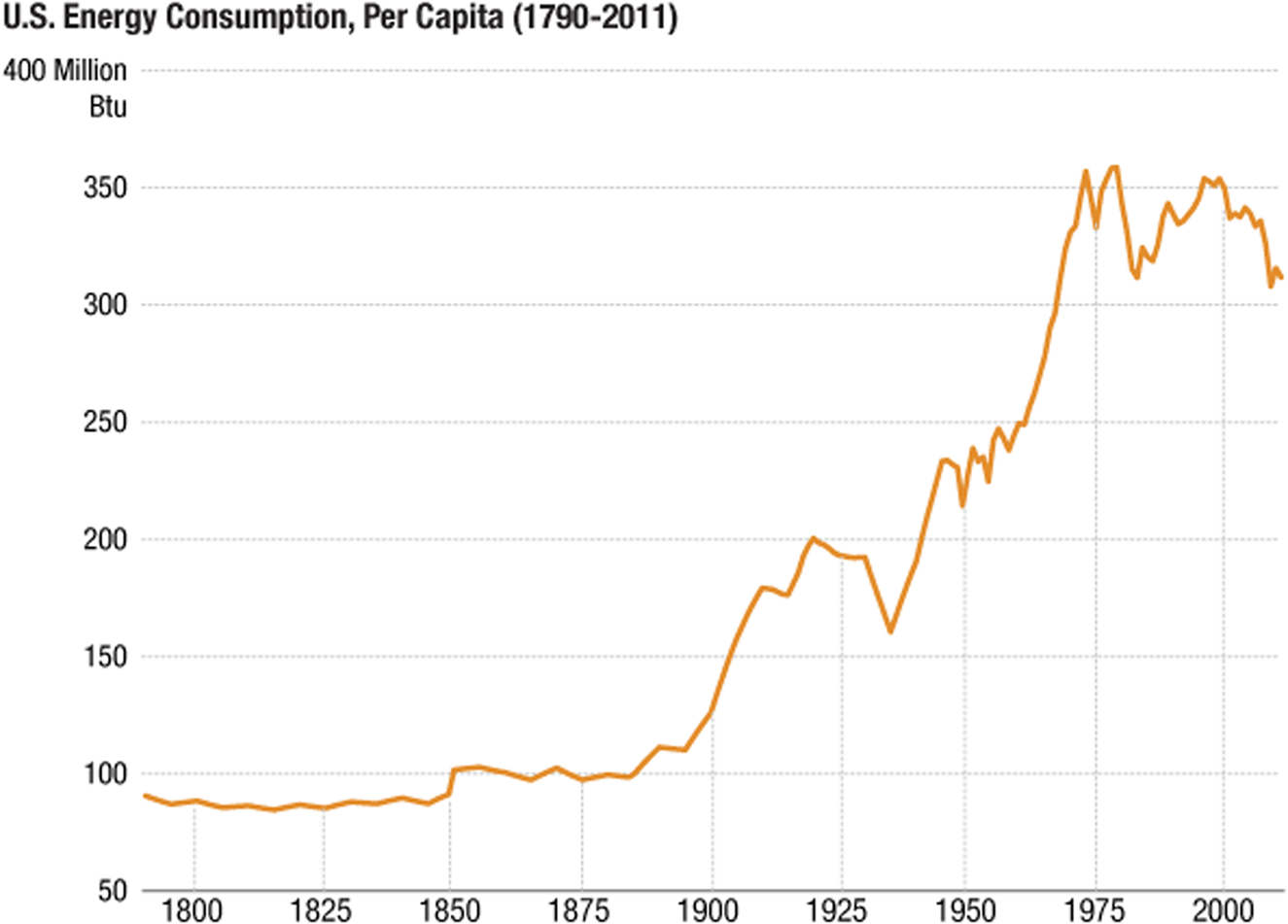
As “fantasy symbols for gratification,” after all, automobiles were not merely shorthand for prewar patterns of self-reward;Footnote 45 they were one of a myriad of promises of a greater return on investment than had been experienced in any human era, ever. They were, in short, promises of a better life, one that would also continue to improve. But if the complex vastness of that system challenged every attempt at rational explanation, so too did its effects. After more than a decade of decreasing per-capita energy consumption, as clear a marker of individual impoverishment as can be found, and unlike any other time in American history, Americans experienced, during the lead-in to the Second World War, that decline's mirror image: a ramp-up in that rate of consumption whose steepness also had no historical equal (Figure 4). Of course, that enrichment was unevenly distributed. And it occurred during a grudging decline in income inequality from the greatest wealth divide the country had ever seen.Footnote 46 As oil began to empower the nation at the end of the Great Depression, its beneficiaries were only too aware that there were others the new wealth had not yet touched – and might never touch. As such, automobiles were like other products, even that baby food about which a grocery shopper in Double Indemnity complains, “I don't know why they always put what I want on the top shelf.” For far too many, including those who attended the 85 percent of theaters, mostly in small cities and rural areas, unaffiliated with a major studio, which depended upon B films like Detour to fill out a double bill and give their customers a sense of “satiety,” those products would remain out of reach for a while longer.Footnote 47 But even for the rest, the act of stretching out one's hand for one's own enrichment should have given reason for pause – even if they had not just abandoned a body in a ditch.
Report titled “Two Centuries of Energy in America, in Four Graphs” by Jacob Goldstein and Lam Thuy Vo, as originally published on npr.org on 10 April 2013, used with the permission of NPR. Any unauthorized duplication is strictly prohibited. ©2017 National Public Radio, Inc.

Andrew Nikiforuk's neat summarization of the issue, that “every form of energy consumption … involves, somewhere, a sacrifice,” indicates why energy regime shifts should also occur with changes in moral systems – societal agreement on which sacrifices are acceptable, and which are not.Footnote 48 But Nikiforuk's summary also points out a fact that often escapes us, that consumption inevitably has costs – no energy source, not even today, is “clean” or “free.” When Ulmer arrived in Hollywood to film disposable westerns, California might have been supplying one-quarter of the world's demand for oil, but it was also the catastrophic site of some of the nation's very first anti-pollution efforts, led by the industry's own unionized laborers, who performed dirty and dangerous jobs.Footnote 49 This, together with the diminishing available energy over the decade of the 1930s, confronted US citizens with a zero-sum game, just as a second third of the country was being extended electrical service. In other words, Americans witnessed an expansion of energy products at the same time as they experienced a reduced budget with which to chase after those products placed just out of reach, at a time when those extractive industries had yet to perfect their magic trick of hiding their “dirty secrets.” For most Americans, the Great Depression did not encourage risk; it gave them a keener, closer sense of risk-takers’ victims.
So although the car might be the most obvious point around which so much of Roberts's own individual plot turns, the story at Detour's heart does not begin with Roberts's need for an automobile to follow Sue out west. To use the old formalist binary of fabula and syuzhet, the film's chronological story, or fabula, begins, rather, with Sue's imagination of that better life promised by products like the automobile, a seemingly innocent desire, and yet the precise thing Roberts is both trying to “blot” from his memory and accusing his audience of sharing. Although critics have pointed to the hazy early scene of the couple's walk home through the streets of New York City as simply another example of cost-cutting by a director who often had to make do with fog instead of a set, the resulting dreamlike atmosphere of their discussion of Sue's decision to move to Hollywood as “the only sane thing to do” accomplishes two seemingly contradictory objectives: the scene's vagueness makes it seem as if it could be happening anywhere, as such conversations about moving elsewhere might be understood to be happening throughout the growingly mobile nation, with 21.5 percent of American civilians moving to a different county or state during the period 1940–47;Footnote 50 but the scene also frames that conversation about “need” in concrete terms. Researchers identify many reasons for mobility, most economic – people move in order to “maximize utility given the prevailing wage and price level in each location” – but in Detour Sue's decision is presented as a surrender to brute material circumstances: the actors don't even have a proper set!Footnote 51 So while the film's presentation of the scene with Sue after the framing device of Roberts's telling his tale in flashbacks from the diner emphasizes the film's sense of fate (Roberts is doomed before his story begins), it also serves to displace Sue's “commonsensical” dream from its proper place as first cause of the sequence of events, making it the “dirty secret” Roberts is trying to forget.
Detour is thus not just critical about the American Dream, as films noirs have so widely been characterized; it identifies such “sane” and “commonsensical” plots as harboring an oddly paradoxical destructiveness.Footnote 52 Sue's hopes might appear innocuously common, even clichéd – but that's exactly the problem.Footnote 53 Her beliefs and actions reflect the normalization of an entire system of beliefs and actions, that almost unimaginable “hyperobject” of oil's systemic compulsion, in which, in the much later context of climate change, one's individual involvement Timothy Morton imagines might appear part of a familiar plot: “Just like in noir fiction: I'm the detective and the criminal!”Footnote 54 In Morton's example, in other words, starting a car entangles one in almost countless costs to the climate, ranging from the individual car's pollution to the various mining processes that produce the vehicle, and everything in between. Detour is, of course, not concerned with climate, but it is suspicious of the consequences of Sue's own simple action of buying into the belief that to thrive she must move. In Detour, like in so many other films noirs, the kernel of fate lies not in the commitment of the actual crime but in the dangerous desire that sparks the action: Sue's sudden conviction that for her it is “Hollywood or bust,” and Roberts's conclusion soon after that he must follow her. Moreover, film noir commonly presents this initializing desire as one that seems to characters to have been conjured in them by the object itself: a small statuette of a black bird, a suitcase hot to the touch. As Cora also remarks in The Postman Always Rings Twice, about a desire being “put” into her (by whom? or what?), the result is a strangely mismatched, machine-like self: a car with an “engine” too powerful for her frame.
In Detour, the mismatch of power and self that Cora describes begins early in the chronological beginning of the film's plot, through a seemingly innocent, even clichéd and jokey, pattern of misrepresentation. When joining Roberts at his piano after their show, Sue salutes Roberts with the name of a famous touring pianist – “Mr. Paderewski, I presume?” – misidentifying him, as Roberts will later misrepresent himself, taking the name of a dead man after he has taken the man's car. She encourages him with the typical pianist's dream, “You're going to make Carnegie Hall yet, Al,” in a manner that foreshadows his own misplaced vision of her “shooting to the top.” But it is clear from this start that these mass-produced dreams and standards are taking the place of the characters’ more sincere and personal wishes. What Roberts says he wants, in the voice-over he can only share with those who understand him – not Sue herself, of course, but the audience – is only an “ordinary, healthy romance.” Sue too spends much of their walk home trying to encourage him and lift his mood. But then Sue suddenly changes attitudes, with no explanation, when she concludes, “We've been struck out.” How to understand such a change? It appears consistent with the irrational nature of oil that Brian Black identifies with the resource's “Dutch disease,” its bipolar booms and busts.Footnote 55 But what is so fascinating about the film's exploration of the absurdist circuit of compulsion that results from Sue's sudden mood change is not the irrationality of the characters’ movement – also apparent in Frank's “itchy feet” in The Postman Rings Twice, for example – it is rather the film's clever visual implication that the spectator is already one of the afflicted.
After taking ownership of Haskell's car, Roberts is driving along when he remarks, “I kept imagining I was being followed,” glancing up just then into the rearview mirror, to look directly into the camera, in obvious violation of Hollywood realist conventions (see Figure 5). Until this moment, viewers have been free to imagine they are in a much different situation than Roberts, in his entanglement with a force unseen – regardless of his use of the second person in his voice-over. But in Roberts's direct stare, the film reminds its spectators that they too sit in a darkness gazing into their own rectangle of light, and it suggests that they too might best search their memories for how they have impersonated Haskell. Have the audience members been drawn to the theater, like Al and Sue have been drawn out west, through a similarly problematic desire for light and action – even a glimpse of a better life – or maybe just an irrational mood? The growth of the movie industry closely paralleled that of oil during the time. Film and oil shared an “explosive” material: literally, as celluloid was a combustible product of the petroleum that Los Angeles residents occasionally saw erupting from the ground under high gas pressure, not uncommonly resulting in explosions; but also figuratively, in that each industry identified itself with a risky, futuristic societal advancement.Footnote 56 But so too were the developing conventions of Hollywood cinema bound up with the emerging belief system of petromodernity, including its commitment to “boom-or-bust” high-budget productions, its cultivation of a breathless overstimulation, and its promulgation of a happy ending for societal advancement, all of which encouraged participation in the new systems of consumption that Roberts warns Sue might just as well lead to her “polishing cuspidors” as becoming a star.
Detour (Criterion Collection). “I kept imagining I was being followed.”

In this, Detour, like film noir in general, concerns itself with the mysterious problems of its own material production:Footnote 57 the cheapness of its sets in an increasingly empowered nation, and its iconic use of new lighting to illuminate only that same nation's dark and desiring spaces. These features reveal the unevenness of the nation's development under oil, its leaving swaths of poverty, but they also spotlight the new industries’ creation of new forms of dependency, even new victims. These include not merely the victims of accidents involving cars, gas heating, or other new technologies, or of the perceived threats of a “faster” lifestyle exploited in Ulmer's earlier film about venereal disease, Damaged Lives (1933).Footnote 58 They also include the workers in the expanded service industries required by the new oil system, ranging from the diners of Detour, The Postman Always Rings Twice, and Mildred Pierce (1945) to the service station of Out of the Past (1947) and the “tourist camp” of For You I Die (1947). Geographically, in other words, the American landscape was being redefined by the automobile's needs and limitations: its use required an infrastructure, spaced at certain distances, for example, in accordance with its fuel efficiency and tank capacity. But the social landscape of the nation also required an infrastructure of labor: workers at these various stations, whose wages were no higher than a certain level, who would be dependent upon the casual quickness of interactions with strangers. In Detour's opening scene in the diner, when the waitress objects to the truck driver's jukebox selections so far – “Let's have something quieter this time. My head's splitting” – her fellow industry tool, the truck driver, responds, “Is that what's wrong with it?” Haskell too mistreats the waitress when he and Roberts stop, telling her, after a big tip, “I'll be waiting for you when you finish work.” These are hardly murders, of course, but film noir was never about tracking a real crime spree.Footnote 59 What these workers confront is that “new servitude” prompted by the new oil regime – the way the resource required, in turn, “manpower” for maintaining its infrastructures and flows, people who served the machines and were treated like machines, too.Footnote 60
The film thus prompts its spectators to think about the ways they are using their film-going experience and its mechanical production for their own self-gratification. But it also connects this experience to a greater network: the oil-powered communications and transportation networks Detour pictures in Roberts's telephoning of Sue from East Coast to West, which certainly helped generate sensations of crisis among the American public about the ways people were interacting with one another (Figure 6). The Hollywood scandals that led to the Hays Code, for example, may have been generated via a star system of oil-fueled wage disparity that set some of the industry's employees above the reach of the law, and new and expanded trade publication to ratchet up the drama, but those stories also fought for their audience's distracted attention with real crises, such as the car crashes of film personalities from Jackie Coogan to Howard Hughes.Footnote 61 But regular people too were reported involved in plots of violence – by automobile, commonly, but also by other modern conveniences, such as natural gas, mode of attempted murder in Angel Face (1953) and attempted suicide in Damaged Lives.Footnote 62 Such stories played on many fears, among them a suspicion of the newly transient connections in American society, which appeared to cultivate a cold and mechanical selfishness.Footnote 63 Accordingly, while the film's source novel is circumspect in regard to the origin point of this circuit – “Whether people's hopes are the result of pictures or pictures are based on hopes, I can't say” (116) – it agrees with the film that the most significant consequence of participation is that the “I” might now recognize itself “to be a weapon” (87).
Detour (Criterion Collection). The oil system is a web of roads, wires, and circuits.

In Detour's source novel, Sue recognizes that her dream of fame in Hollywood is only “a frame-up plotted by the publicity-greedy studios and the Chamber of Commerce to lure people [to Hollywood], away from their regular jobs, their families and friends” (46–47). But, of course, she still sacrifices everything for her dream – including fellow main character Roth's happiness – making her pronouncement at the novel's end, “This is a very nasty world we live in,” ring with more than a little irony (139). The film delivers that ring visually, with special attention in this case not to the automobile, but to that “ultimate noir machine” the telephone.Footnote 64 And while the phone might not seem to deserve such a moniker, having none of the hulking, murderous aura of the era's cars, film noir does a good job of exploring its own threats, the way the machine could reach out from a safe, domestic space into the more dangerous wider world – or invite the dangerous world inside.
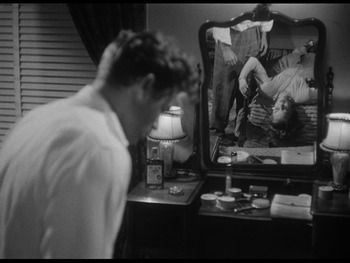
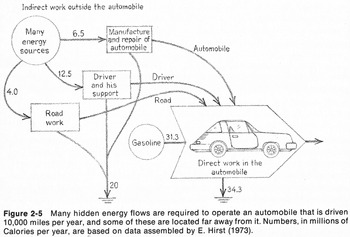
In Detour, Roberts experiences the same physical constriction from the phone booth in which he proposes marriage to Sue as he does when sitting behind the car's steering wheel, and the film goes to great pains to connect these twinned technologies of the oil regime – showing, for example, stock footage of phone-board circuits and roadside wires overlaid when Roberts makes that long-distance call. During the call, Roberts ridiculously blows kisses to Sue through the receiver, but when Roberts is threatened late in the film by Vera taking the phone into the other room of their suite to call the police, he pulls at the cord Vera has trailed under the door only to find he has accidentally strangled her with it. Ulmer's subjective camera goes in and out of focus as it pans across Vera's body, her hairbrushes, her clothes – before finding the phone cord again in the carpet and tilting up to Roberts's usual grim mug (Figure 7). The camera has described a loop, encouraging the audience to think of how Roberts has put his own head in a noose with his killing of Vera. But that circle also graphically represents the way complex systems function (Figure 8). Like one of Los Angeles's new drivers let loose on the city's streets, Roberts has appeared guided by nothing more than moving towards that next object just out of reach, but those objects are part of a network of other objects, beliefs – and people. Systems work through feedback loops, in which one small, seemingly harmless act – such as Morton's starting a car – can become damagingly amplified back upon the actor. And when those systems are powered by a fuel the likes of which have never been seen before by humankind, the consequences might indeed strain our credulity.
Detour (Criterion Collection). Vera is strangled by that “ultimate noir machine,” the telephone.

Is this a graphic illustration of an energy system, or the tangled diagram of a film noir plot? Howard T. Odum and Elisabeth C. Odum, Energy Basis for Man and Nature (New York: McGraw-Hill, 1976), 34.

THE ROAD TO PROGRESS AND ITS DETOURS
Film noir's repetitive presentation of a story in which an actor becomes trapped by desire within a vast and mysterious system is thus perhaps the archetypal plot of petromodernity. Yet film noir expresses very little yearning for the traditional moral system of the previous energy regime – and for many reasons. The rise of oil in the early twentieth century caused not just the creation of a consumerist ideology revolving around technologies such as the automobile; Detour shows it, quite accurately, as also having remade the American continent. That is, if in the novel Roth might express his relief at a ride in the middle of New Mexico by remarking that he “took back all the names he had been calling the Southwest,” his comment demonstrates an obvious benefit of oil to that region (6). Energy humanities has been adept at recognizing the environmental “sacrifice zones” of resource extraction, and southern California had by the release of Detour seen its share.Footnote 65 After it was first discovered in Los Angeles in 1892, oil became one of the most important Californian exports with the drilling of the famous Signal Hill in 1921, where, as Daniel Yergin describes, “parcels were so small and the forest of tall wooden derricks so thick that the legs of many of them actually interlaced.”Footnote 66 And yet Ulmer, who liked to refer to Los Angeles as a city stuck “between the desert and the Pacific Ocean,” would have been well aware that these same workers, and the dirty processes in which they thickly engaged, were what made life in the desert possible.Footnote 67 The national wealth gleaned from the new resource was being put to use in the West in the most expensive utopian scheme ever devised, that of making that desert “bloom,” and the result of the spiderweb of dams and aqueducts and roads was not just that Los Angeles became the nation's fastest-growing city, but also that the modernity to whose immense wealth and power it significantly contributed rested upon a new precarity, social and environmental.Footnote 68
For one thing, this desert miracle sparked power struggles, between corporate elites on one side and “the ‘little man’ who,” authorities such as the House Un-American Activities Committee, formed in 1938, feared, “might one day rise up and demand his dues.”Footnote 69 As Timothy Mitchell describes the matter, American democracy owed a great debt to the coal industry, employing as that industry did large numbers of workers at centralized mining sites that could be shut down by collective action, as a result fostering popular power; oil extraction, by contrast, depended upon fewer workers, was accomplished at more dispersed sites, and took place above ground, where workers might be easily surveilled.Footnote 70 The resulting oil-extraction and -distribution systems, then, produced at least four paradoxical features in American life: an increased material enrichment at the expense of popular political power; technological, business, and governmental strategies aiming not just to extract oil but to waste it and limit its availability and thus its power; an increased use of machines often replacing, devaluing, or reshaping human labor; and new systems and rhetoric of security for holding onto a precious substance that seemed everywhere.Footnote 71 Those who recognized oil's corruptive power, like Oil! author Upton Sinclair, who ran for governor of California in 1934, also recognized the ways in which Hollywood's products were being made to serve that power. Before his defeat, Sinclair had planned to nationalize the film industry, and it was because of such perceived threats to Hollywood's own hegemony that the film industry in the same year, under the guise of moral policing, began to censor its productions. The resulting Hays Code Office expressed the first and fourth of Mitchell's paradoxes. It was a factor in the burgeoning industry's crowding out competitors and thus limiting the voices able to be heard through the medium, even as it launched itself into sound, and it produced its own rhetoric of security supporting the industry's tight-fisted control of its product.
These contradictions shape the very structure of Detour. Goldsmith draws heavily from his own novel, so that readers will identify in the film not merely the novel's plot but also idiosyncratic turns of phrases: the horse “Paradisaical,” a character “taking it on the Arthur Duffy” (140, 34). What they will not find carried over to the film are the book's use of different perspectives, shifting as the novel does its first-person point of view back and forth from Alexander Roth to Sue Harvey as their plans slowly crumble in parallel. Joseph Breen objected to this element in the treatment he read in October 1944, on the basis that Sue's experience of sexual exploitation in Hollywood cast the film industry in an unfavorable light.Footnote 72 What the loss also meant, of course, was the dismissal of any other point of view in the story besides Roberts's, and the hiding of some of the heinous reality of Hollywood that has persisted up until the recent Me Too movement. And while there is no reason to believe Hays Office chief Joseph Breen personally responsible for changing the main character's name from the novel's recognizably Jewish Alexander Roth to the film's Al Roberts, this change, too, limits the film's perspective, heightening from the “outside,” as it were, that sense of paranoia so often in evidence on-screen, a reflection of oil's generation not just of a “rhetoric” of security but also of agencies of enforcement.
Ulmer was Jewish, as were so many in Hollywood, from crew hands to actors and writers to studio moguls. But even though Ulmer would make quite clear in his body of work his natural affinity for “the little man,” in an era of labor struggles, in which labor sympathizers were automatically assumed to be “Reds” dangerous to the government, Roth's transformation into Roberts was itself a representative act of many Jews who, facing anti-Semitism in the same Red-baiting propaganda, decided it would be best to be seen as “white” rather than “be the object of opprobrium.”Footnote 73 The new empowerment of the oil regime was thus one that could be used to reinforce existing authority just as much as it could be used to overturn it. Arthur Raper notes, for example, that the car threatened established racist power structures in the South, creating a public arena in which the descendants of slaves might exert their own power of mobility and even seem in danger, in the perception of descendants of slave-owners, of running the latter off the road; but at the same time, film noir reflects as much as any Hollywood product of the day the reactionary enforcement of what Eric Lott identifies as the “racial dominance … built in to Hollywood industrial and generic norms.”Footnote 74 The song Sue sings, for example, had been recorded by some of the greatest African American artists of the era, including Louis Armstrong, Billie Holliday, and Ella Fitzgerald, but if there is tension in the film's canted dream image, part of it has to come from the one white woman being loomed over by three black shadows.Footnote 75 Detour's characters do not appear in a work merely censored; these elisions and implications cause them to inhabit an almost solipsistic universe, endangered by any suggestion of otherness – especially if such a suggestion should bring into finer focus a picture of the new system's many victims.
It would thus be a mistake to consider the absence of any awareness of energy issues in the film as solely the mysterious workings of an “energy unconscious,” as so many of those details are more properly judged the manifestations of power. Indeed, if one thing the film traces is competition for a dangerous resource – with Roberts ditching Haskell and killing Vera for access to its power – Jacqueline Najuma Stewart's observation that, “By speaking to a ‘white’ audience, mainstream … cinema seems to negate Blackness” is especially relevant to Detour, as the film could not possibly restrict any more severely the competitors it imagines for that enrichment.Footnote 76 If the film shows a struggle for the “means of projection,” as Davarian Baldwin traces in African American theaters and cinema of a slightly earlier period, it is one that has in many ways already been decided.Footnote 77 Indeed, the shift undergone by the story in its movement from a print to a visual medium is an illustrative example of the paradoxes Mitchell identifies. The film, seemingly more visceral than a book, engaging as it does not just the sense of sight but also sound and touch, in the plush comfort of the movie palace, perhaps even the warm smells and sharp tastes of the concession stand, nevertheless provides an impoverished experience for its audience members – one Goldsmith's novel has great fun in lampooning:
If this were a movie, I would fall in love with Vera, marry her and make a decent woman of her. Or else she'd make some supreme Class A sacrifice for me and die, leaving me free to marry Sue. She would experience a complete and totally unwarranted change of heart, wipe out her sins by a dramatic death, pleasing me, the Hays office and the morons in the mezzanine. Sue and I would bawl a little over her grave, make some crack about there is good in all of us and fade out. But this isn't a movie, and Vera, unfortunately, was just as lousy in the morning as she'd been the night before. (115)
In the end, Goldsmith's narrator is not too far wrong, as the film's final scene provides a vision of Roberts's arrest demanded by Breen. But what as a result becomes heightened in the film is the novel's probing of its narrators’ identity panic. Both of the characters in the novel navigate a self-strangeness through constant criticism of the “phony” media that dominate their lives, but in the film, which cannot broach the same criticism, the world of the characters expresses an especially straitened version of that “disastrous” nature Graeme MacDonald pairs with the oil regime's “benevolent banality”: not just its hypocrisy but its oppressive homogeneity.
The issue of energy's “invisibility” is thus also clearly bound up in what power allows to be represented. Detour's terse exchanges between Haskell and Roberts, one man with money and the other without it, reflect period tensions between workers and management, prevalent in the era's many strikes among workers in the oil, auto, and film industries, in several of which both black and Jewish workers took prominent part.Footnote 78 But the film offers no other character capable of exerting power than these white males, unless one counts the femme fatale. Los Angeles, the goal of the lovers in Detour, was a favored destination during the whole of the twentieth century, of a migration that hit unparalleled heights with oil's rise to dominance.Footnote 79 As Fred MacMurray's insurance agent in 1944's Double Indemnity comments, “They say all native Californians come from Iowa.” As Eric Lott points out, Iowans are not usually the main threat in period films’ fears of invasion; instead, what causes panic in the genre is rather a specifically black Great Migration.Footnote 80 But while there certainly is an element of Lott's “nightmarish world of otherness and racial aliens” in Detour, the most threatening subject in Ulmer's film is that unnamed power that can, through the desires of the empowered self, remake a Roberts into something even worse than a Haskell.Footnote 81 Ulmer had, as I have mentioned, returned to California after directing a number of “ethnic films,” including an all-African American cast in Moon over Harlem (1939), and if Detour is so insistently “white,” it only reflects the very real reclamation of power by the major studios, through many factors, including new sound systems and the expansion of national theater chains.Footnote 82 Not coincidentally, Ulmer's return west took place as “minority” filmmaking was approaching collapse in 1940.Footnote 83 Just as in the novel's and film's plot of a character glimpsing the possibility of self-betterment, only to have that possibility taken away, so too did many of oil's “beneficiaries” see their glimpses of a better future come to resemble a past they were trying to escape. But if film noir tracks a puzzling fate concerning energy systems, one of its most basic features is that a system does not care about the purposes to which its resources are put. A good cause, like love, does not obtain its energy from a special nonpolluting, nondestructive, nonexploitative source, nor is it exempt from causing damage. Haskell the conman and Roberts the love-struck sucker meet the same doom. Al and Sue had the sense that they were trapped as soon as they started dreaming – and the film suggests they were right.
Detour thus advances no social agenda, and while it has no explicit vocabulary for the way energy contributes to such issues, the film does make some of its observations about power coalesce around another “invisible” subject, one prohibited by law from being pictured on film, which is money. In the novel, Alex Roth stumbles upon real insight when, while sorting through Haskell's wallet, he remarks on the dead man's “high finance,” “It looked like the war debt to me” (66).Footnote 84 Fiat currency is founded on national debt, tied to war and colonial expansionism – just as energy requires somewhere a “sacrifice,” so too does moneyFootnote 85 – so Roth is not wrong in thinking of such figures as “seven hundred and sixty-eight bucks” as not being innocent.Footnote 86 Only he cannot afford scruples: “They say that money is nothing, that a buck is only a piece of paper crawling with germs, and that you can't buy happiness with cash. I say sour grapes” (66, 23).
The film goes farther in its thinking, and in a manner that makes use of visual techniques. The first part of this thinking occurs when Roberts is given a ten-dollar bill as a tip by a patron after Sue has left him for California. His voice-over comments, “What was it? A piece of paper crawling with germs. It couldn't buy anything I wanted. It couldn't …” The voice-over narration breaks off here, and the scene cuts to a new shot. Whereas before the camera had centered on a low-angle close-up of Roberts at the piano, foregrounding the tip he has taken from a waiter, the new shot is from a distance, and from a high angle, with Roberts to the left. And as if to finish his thought for him – a ten-dollar tip is about the best he could hope for from this place, but it could also buy him a ticket somewhere else – the camera begins to track right, anticipating his getting up to phone Sue. Both novel and film struggle to name that force operant in the character's life, one other than “God or Fate,” but here the camera reveals its own complicity with that “higher power.” Like the character's automobilic dream of success, or the cash in his hand, the camera is just another element of the system that determines the movement of the citizens under its surveil, by the choices it offers – and the options it closes down.
Because of its tight focus, and its general compliance with the Hays Code, the film has little to say about the social injustices suffered by others in a society so organized, and perhaps that kind of omission is one reason Ulmer later comments about his career, “I really am looking for absolution for all the things I had to do for money.”Footnote 87 The closest the film gets is to cast into grave doubt a “white” myth of equality and plenty, that ideal of a fossil-fueled “Industria” whose supposedly interchangeable citizenship Ian Morris pictures so revealingly as a blank, or white, field.Footnote 88 That is, Roberts might remark to Haskell, the con man, after being bought a meal, “That's white of you,” but this pairing of whiteness and oil's “benevolent banality” is the first thing to die in the film, in the form of Charles J. Haskell with his head against a rock – just another phony story in a society full of them. What Detour is much more sensitive to is the disturbing sensation of that empowerment as a destructive compulsion.Footnote 89 In the second part of the film's thinking on money, Roberts muses, as he starts his journey westward,
Money. You know what that is. It's the stuff you never have enough of, little green things with George Washington's picture that men slave for, commit crimes for, die for. It's the stuff that has caused more trouble in the world than anything else we ever invented, simply because there's too little of it. At least I had too little of it.
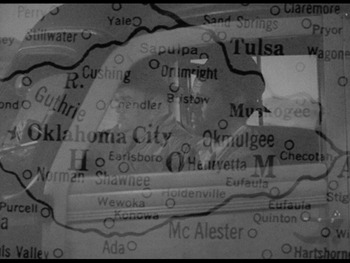
The disorienting nature of this dilemma of desiring more, and being given more – of an energy both empowering and damaging – is then underscored with a wry visuality, as the image of Roberts in a left-sided front passenger seat dissolves into a close-up of a map of the heart of the United States, centered on the letters “HOM” in “Oklahoma” (see Figure 9).Footnote 90
Detour (Criterion Collection). Roberts is looking for “HOM” in “Oklahoma.”

CONCLUSION: FALLING OUT OF “BAD LOVE”
Film noir thus focuses itself squarely on a period-specific conundrum that Roberts's wandering illustrates clearly: how was it possible to make a “home” within such an energy regime? But in pessimistically pursuing its answer, Detour charges viewers with something much more active than an unconsciousness with regard to its subject; rather, in the film's play of glances between the main character and spectators, it asserts that its viewers are also bound up with the story the film's narrator tells, that their means of viewing the world and others have already come to revolve around a specifically networked experience. Cinema, of course, is part of that network, and, regardless of the “contempt” Detour's director might have felt about the crassness of the medium, the film would have been rather meaningless if the audience did not bring to it its own desires of wanting to participate in all of that Catastrophe and Exuberance so energetically advertised in every movie trailer, with that genre's trademark fondness for the exclamation point.Footnote 91 It is thus appropriate that Detour should offer a humorous, if subtle, “internal” critique of this circuit within its first minute. If the film invites its viewer to consider as shared experience its main character's glimpse in a rearview mirror, that is, it is one the film has also already presented in its opening credits. In those first few seconds, careful viewers will recognize, the car upon which the camera is riding passes another vehicle pulled off to the shoulder on the other side of the road. Is the man standing next to the other car in distress? Does he wave for help? Who knows? The camera keeps rolling, and the “little man” is left behind. In much the same way, the film offers us the experience of a “little man” subject to the powerful forces of the new oil-fueled American mid-twentieth century; we listen to his story, and then we leave him behind. The throwaway shot thus captures quite succinctly a newly empowered throwaway culture: entrusted with too much power, as Cora charges in James M. Cain's novel, we see, we use, we might even feel, but, not wanting to know (wanting to “blot it out”), we then speed right by (see Figure 10).
Detour (Criterion Collection). Noir's “little man” is stranded in the opening credits.

“What the film noir does so effectively,” J. P. Telotte comments, “is to recognize what we ‘couldn't see’ normally, and then shift focus to that which is, disconcertingly, too close to be seen, too much a part of our personal and cultural lives for us to view and assess clearly.”Footnote 92 Nobody, not even James M. Cain's Cora, could have predicted that the “top of the mountain” of empowerment petroleum was to provide the “American Century.” Or the predicament of climate change in which oil's burning has left us. But film noir seemed to sense well enough the new compulsions oil created, and in trying at least to adumbrate those difficult topics, it acts on that imperative of all film to, as Imre Szeman puts it, “record what is otherwise inaccessible to vision.”Footnote 93 And what the title of the novel and film sees dimly in the darkness is the way in which such empowerment takes its recipients to a destination quite different from the one the comforting narratives of progress of both the oil and the film industry suggest:
And in a movie, if the hero decides to become a doctor, he becomes a doctor, not a grocer or dentist. If he decides to go to Frisco, he goes to Frisco. He doesn't wind up in Miami or New Orleans or in jail. Things are plotted in straight lines. There are never any unexpected happenings which change everything about the hero but his underwear. (115)
In The Postman Always Rings Twice, the subjective shot showing Frank's glance at the “Man Wanted” sign in front of the diner where he will meet his fate reveals another sign, “OIL,” lurking in the background. Not all films noirs are as efficient in their registering of that substance that “underwrites” their heroes’ own decision making, but the force that drives on both Roth and Roberts in, respectively, the book and film versions of Detour is never in doubt.
One question Detour poses for its viewers, in other words, is whether one can participate in such a system without being transformed into what the systems “wants.” Film noir presents this experience of having been changed in everything “but [one's] underwear” in hindsight, as having already happened, which the statistics of oil consumption during the period would support: the nation had irreversibly entered a new age. But although this backwards view often also generates a nostalgic mood, of something lost, noir offers few clues as to what that lost life is.Footnote 94 Detour begins with its characters already desiring something better. Whatever it is that then proceeds to move them about is thus a force that has already taken the form not only of the “dark” world they live in, but also of their own blindness to what they have. Detour and other films noirs thus show us visually not merely the effects of the rise of a new energy regime on already established persons and places; they explore what it means to be re-created through a new power into particular “technologies of self,” to borrow a phrase from Michel Foucault, technologies whose ways of being might be understood not just as straitened but also as fated.
Stephanie LeMenager remarks about her own study of twentieth-century oil culture, “This is a short cultural history of, essentially, destructive attachment, bad love.”Footnote 95 And in this identification, provided for us also throughout the film noir canon, we find a greater opportunity for insight than in other conceptions of our energy regime: as an addiction, a devil's bargain, or a “curse.” For love is what it feels like to inherit and inhabit oil's power: it is the feeling of flying, of daring to risk all. And becoming aware of its illusions is similarly to experience heartbreak: as Al and Sue's song has it, “I Can't Believe That You're in Love with Me.” And such suspicion is only reasonable, with all the upheaval and destruction the resource has caused. Oil has hardly returned our headlong affection. Is that the source of so much of the anger and desperation of the genre – that intimation of betrayal?
In James M. Cain's The Postman Always Rings Twice, heroine Cora's condemning definition of herself and her lover as two “Fords” not only characterizes their own identities as having become “mass-produced” through a manufactured desire;Footnote 96 it condemns them as misassembled creations, invested with a too-powerful desire, one tied to a destructiveness they can only begin to sense through the strangeness of her metaphor. In a time in which we too have come to question our own love affair with oil, which has empowered us beyond all imagining but also perhaps ruined us beyond all moral reckoning, the gift such films offer is the reminder that our lives are just as much felt as reasoned, just as much lived in bodies as in minds. Imre Szeman remarks on the importance of the contributions to be made by the energy humanities, “Only by knowing oil can we start to understand fully what and who we might become without it – a task that needs to be at the heart of our political thinking today.”Footnote 97 And that need to know is indeed, as any film noir shows, compelling. But if we are falling out of love with the resource that has transformed us, that much more irrational-seeming experience will also inform our politics, and so it would behoove us to think about how that experience also feels.