Introduction
Angiostrongylus cantonensis, the rat lungworm (Chen, Reference Chen1935), is a parasitic nematode known throughout the world (Wang et al., Reference Wang, Wu, Wei, Owen and Lun2012). It was introduced to the continental USA prior to 1986 when the species was first reported in rats from Louisiana (Campbell and Little, Reference Campbell and Little1988). The life cycle of A. cantonensis has been well described (Bhaibulaya, Reference Bhaibulaya1975; Cowie, Reference Cowie2013) and uses rats as definitive hosts and mollusks as intermediate hosts. Human infections occur through ingestion of the infective third stage larvae (L3) through either the mollusk or paratenic hosts (Cowie, Reference Cowie2013). Clinical signs vary in humans, some may have neurological sequelae (Wang et al., Reference Wang, Wu, Wei, Owen and Lun2012). In the USA, this parasite is considered established in Hawaii, and has also been reported in a variety of hosts in many other states, particularly in the southeastern USA (Gardiner et al., Reference Gardiner, Wells, Gutter, Fitzgerald, Anderson, Harris and Nichols1990; Costa et al., Reference Costa, McClure, Snider and Stewart2000; Kim et al., Reference Kim, Stewart, Bauer and Mitchell2002; Teem et al., Reference Teem, Qvarnstrom, Bishop, da Silva, Carter, White-Mclean and Smith2013; Burns et al., Reference Burns, Bicknese, Qvarnstrom, DeLeon-Carnes, Drew, Gardiner and Rideout2014; Kottwitz et al., Reference Kottwitz, Perry, Rose and Hendrix2014; York et al., Reference York, Butler and Lord2014; Dalton et al., Reference Dalton, Fenton, Cleveland, Elsmo and Yabsley2017; Rael et al., Reference Rael, Peterson, Ghersi-Chavez, Riegel, Lesen and Blum2018).
Incidental hosts in Florida
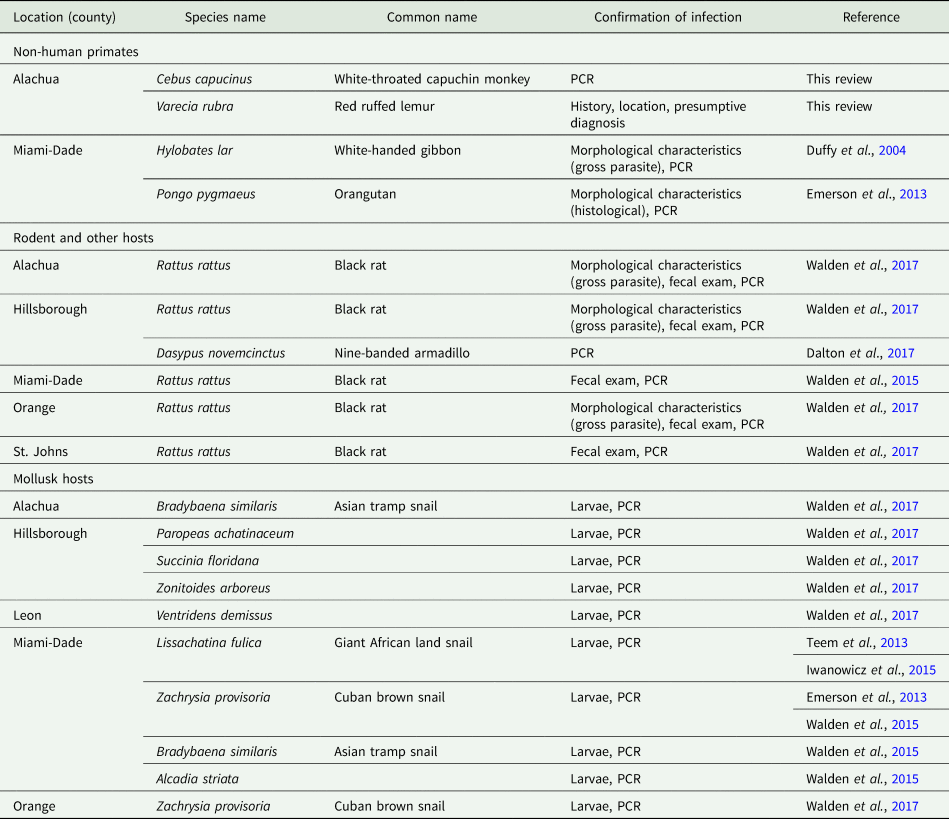
The earliest report of A. cantonensis in Florida was in a white-handed gibbon (Hylobates lar) housed at the Miami Metro Zoo in Miami, Florida (Duffy et al., Reference Duffy, Miller, Kinsella and de Lahunta2004). The route of infection was unknown and the gibbon presented with extreme limb weakness. Nematodes were recovered from the brain and spinal cord and identified morphologically as Parastrongylus (Angiostrongylus) cantonensis. In 2012, a privately owned, 6-year-old female orangutan (Pongo pygmaeus) from Miami area was presented to the University of Florida College of Veterinary Medicine teaching hospital (Emerson et al., Reference Emerson, Stockdale Walden, Peters, Farina, Qvarnstrom, Xayavong, Bishop, Slapcinsky, McIntosh and Wellehan2013). The orangutan had a 2-week history of thoracic and pelvic limb weakness and fever. She had minimal function of the limbs, muscle atrophy and pelvic limb reflexes were absent. Laboratory results indicated leukocytosis and eosinophilia, and lumbar spinal fluid showed eosinophilic pleocytosis (71 WBC/μL in CSF, 86% eosinophils). She continued to decline and was euthanized. Necropsy results showed pinpoint lesions in the brainstem and several larval nematodes were found on histologic examination. Real-time polymerase chain reaction (PCR) analysis confirmed the nematodes were A. cantonensis. The owners of the orangutan indicated she liked to eat snails, and upon further investigation of snails collected from the property, three different species were found infected with the parasite (Emerson et al., Reference Emerson, Stockdale Walden, Peters, Farina, Qvarnstrom, Xayavong, Bishop, Slapcinsky, McIntosh and Wellehan2013; Walden et al., Reference Walden, Slapcinsky, Qvarnstrom, McIntosh, Bishop and Rosseland2015).
In 2015, a 17-year-old white-throated capuchin monkey (Cebus capucinus) in Gainesville, Florida (Alachua County) was presented to the University of Florida College of Veterinary Medicine Zoological Medicine ward with acute onset of lethargy and hind end paresis. Caretakers reported this monkey was sleeping more often during the day, which was unusual, and was also not appropriately responding to them. Cytology results indicated a moderate eosinophilic pleocytosis (307 WBC/μL in CSF, 55% eosinophils). Angiostrongylus cantonensis had been previously detected on the property (Walden et al., Reference Walden, Slapcinsky, Roff, Mendieta Calle, Diaz Goodwin, Stern, Corlett, Conway and McIntosh2017), and given the history and current clinical signs, a cerebrospinal fluid (CSF) sample was taken from the monkey and was positive for A. cantonensis by real-time PCR. Soon after, a red ruffed lemur (Varecia rubra) located on the same property presented with clinical signs similar to the capuchin monkey. A CSF sample showed eosinophilia (135 WBC/μL in CSF, 45% eosinophils), but the remaining sample was accidentally disposed of before submission for PCR. The presumptive diagnosis, considering the history of infection from this location and response to treatment, it is most likely that this animal was infected with A. cantonensis. Both the capuchin monkey and lemur were treated with fenbendazole (7 mg/kg PO q24 h × 14d) and recovered. These animals are long-term residents at a local zoo, and the exact infection source is unknown, but A. cantonensis has been identified in Bradybaena similaris snails and Rattus rattus at the site (Walden et al., Reference Walden, Slapcinsky, Roff, Mendieta Calle, Diaz Goodwin, Stern, Corlett, Conway and McIntosh2017).
Mollusk hosts in Florida
The time and source of introduction of this parasite into Florida is unknown, but rapidly increasing rates of international travel and commerce are escalating the introduction of non-native species including snails (Robinson, Reference Robinson1999; Cowie et al., Reference Cowie, Hayes, Tran and Meyer2008) that are potential hosts for A. cantonensis. Many distantly related snail species have been reported as hosts for A. cantonensis (Kim et al., Reference Kim, Hayes, Yeung and Cowie2014) and snail introductions are common in Florida (Robinson and Slapcinsky, Reference Robinson and Slapcinsky2005). Lissachatina fulica are common intermediate hosts for A. cantonensis (Lv et al., Reference Lv, Zhang, Steinmann and Zhou2008) and this species has been introduced twice into Florida; once in 1966 after which the species was eradicated (Poucher, Reference Poucher1975) and again in 2011 (Roda et al., Reference Roda, Nachman, Weihman, Yong Cong and Zimmerman2016). The source of the 1966 introduction was from Hawaii where A. cantonensis has been established since at least 1960 and where the species shows high infection rates and parasite loads (Kim et al., Reference Kim, Hayes, Yeung and Cowie2014). In Florida, multiple studies have examined L. fulica for the potential infection with the rat lungworm. Teem et al. (Reference Teem, Qvarnstrom, Bishop, da Silva, Carter, White-Mclean and Smith2013) tested L. fulica from the Miami area and identified four infected snails within 8 km of the Miami Metro Zoo. In a separate study, A. cantonensis was found in 18 L. fulica throughout Miami-Dade County, encompassing most of the city of Miami (Iwanowicz et al., Reference Iwanowicz, Sanders, Schill, Xayavong, da Silva, Qvarnstrom and Smith2015).
In addition to the A. cantonensis-infected L. fulica, other non-native snails, Zachrysia provisoria, Bradybaena similaris and Alcadia striata in the Miami area were found positive for A. cantonensis by PCR (Emerson et al., Reference Emerson, Stockdale Walden, Peters, Farina, Qvarnstrom, Xayavong, Bishop, Slapcinsky, McIntosh and Wellehan2013; Walden et al., Reference Walden, Slapcinsky, Qvarnstrom, McIntosh, Bishop and Rosseland2015). A survey investigating the distribution of the parasite found four additional snail species including three native species infected in various counties throughout the state (Walden et al., Reference Walden, Slapcinsky, Roff, Mendieta Calle, Diaz Goodwin, Stern, Corlett, Conway and McIntosh2017). These results included Ventridens demissus in the northern Panhandle (Leon County), B. similaris in north-central Florida (Alachua County), Z. provisoria in central Florida (Orange County), and B. similaris, Succinia floridana, Paropeas achatinaceum and Zonitoides arboreus in south-central Florida along the Gulf Coast (Hillsborough County).
Other hosts in Florida
Definitive rat hosts (Rattus rattus) infected with A. cantonensis have been found throughout Florida (Walden et al., Reference Walden, Slapcinsky, Roff, Mendieta Calle, Diaz Goodwin, Stern, Corlett, Conway and McIntosh2017). Infections have been detected in adult and juvenile rats, as well as rat feces collected from the environment. Rats harbouring adult worms were found in Alachua, Hillsborough and Orange Counties. Rat feces collected from the environment containing first stage A. cantonensis larvae (L1), verified by morphological characteristics and PCR, were found in Alachua, Orange, St. Johns and Miami-Dade Counties (Walden et al., Reference Walden, Slapcinsky, Qvarnstrom, McIntosh, Bishop and Rosseland2015, Reference Walden, Slapcinsky, Roff, Mendieta Calle, Diaz Goodwin, Stern, Corlett, Conway and McIntosh2017). In 2017, the Southeastern Cooperative Wildlife Disease Study in Athens, Georgia reported an infected nine-banded armadillo (Dasypus novemcinctus) from the Tampa, Florida area, in addition to a nine-banded armadillo and a Virginia opossum (Didelphis virginianus) in Louisiana (Dalton et al., Reference Dalton, Fenton, Cleveland, Elsmo and Yabsley2017). The animal had a history of circling and other abnormal behaviour. Cytochrome-c oxidase gene sequences from DNA extracted from the brain tissue of these animals were 99.6–99.7% identical to A. cantonensis (Dalton et al., Reference Dalton, Fenton, Cleveland, Elsmo and Yabsley2017).
Known host species for Angiostrongylus cantonensis in Florida

Discussion
The reported hosts for A. cantonensis throughout Florida include definitive hosts (rats), intermediate hosts (mollusks) and incidental hosts (non-human primates and armadillos) and suggests the establishment of the parasite in the state. Many snail species are found to be infected with A. cantonensis include invasive species such as Z. provisoria, native to Cuba (Auffenberg et al., Reference Auffenberg, Stange, Capinera and White2011) and B. similaris, native to Asia. Movement around the world is suggested to coincide with the movement of plants and produce (Carvalho et al., Reference Carvalho, Bessa and D’Ávila2008). The Giant African land snail, L. fulica, is also an important intermediate host for A. cantonensis (Lv et al., Reference Lv, Zhang, Steinmann and Zhou2008) and is currently in south Florida (Iwanowicz et al., Reference Iwanowicz, Sanders, Schill, Xayavong, da Silva, Qvarnstrom and Smith2015). Snail species native to Florida are also found to be infected with the parasite, which is concerning considering the negative metabolic impact of the parasite on snail metabolism (Lima et al., Reference Lima, Augusto, Pinheiro and Thiengo2020) and the potential risk to threatened or endangered species.
To date, no human infections have been reported in Florida; however, in the continental USA, human infections have been documented in Louisiana (New et al., Reference New, Little and Cross1995) and Texas (Foster et al., Reference Foster, Nicholson, Chun, Gharfeh, Anvari, Seeborg, Lopez, Campbell, Marquez, Starke and Palazzi2016; Hammoud et al., Reference Hammoud, Nayes, Murphy, Heresi, Butler and Pérez2017). In the USA, the greatest number of human infections has come from Hawaii, with 82 known reports from 2007 to 2017 (Johnston et al., Reference Johnston, Dixon, Elm, Calimlim, Sciulli and Park2019). With the introduction of L. fulica in Florida in the 1960s, eradication in the 1970s and later reintroduction in 2011 (Poucher, Reference Poucher1975; Iwanowicz et al., Reference Iwanowicz, Sanders, Schill, Xayavong, da Silva, Qvarnstrom and Smith2015; Roda et al., Reference Roda, Nachman, Weihman, Yong Cong and Zimmerman2016), this parasite has likely been established in the state for some time, as observed in Hawaii, persisting undetected due to a lack of awareness and non-specific disease symptoms that mimic other diseases and are misdiagnosed. It is likely that there have been many more cases than those officially reported. Limiting or preventing infections in humans can be accomplished through not ingesting raw or undercooked mollusks. Infection through accidental ingestion of raw mollusks can be minimized by properly washing produce that could harbour small mollusks.
Future directions
Around the world, the future of A. cantonensis research is targeting better diagnostics, not only in human medicine, but veterinary medicine, as well. With a potentially devastating impact on human and animal health, effective treatments and supportive care are also top priorities. As this parasite spreads to other areas of the world, we are beginning to see this historically tropical parasite in more temperate climates as temperatures rise, permitting the movement of snails into these areas. It is important to investigate the impact on host populations, not only the mollusk intermediate hosts, but also paratenic hosts that can serve as a source of transmission. These new host–parasite interactions may have serious consequences for biodiversity and food safety.
Acknowledgements
This paper represents a contribution to the 6th International Workshop on Angiostrongylus and Angiostrongyliais held in Hilo, Hawaii in January 2020. We would like to thank the staff of the University of Florida Zoological Medicine Service and the Santa Fe Teaching Zoo for their assistance with animal care.
Financial support
Financial support for the attendance of this meeting was provided by the organizing committee of the 6th International Workshop on Angiostrongylus and Angiostrongyliasis and meeting sponsors, as well as the University of Florida Faculty Enhancement Opportunity.
Ethical standards
Care of the red ruffed lemur and white throated capuchin monkey was provided by veterinarians and zoo keepers in accordance with current standards of care.
Conflict of interest
None.